
Make your own mountain bars
March 10, 2010 § 2 Comments
March heralds the arrival of spring, and most importantly the ski-touring season. I have a trip planned to the Vanoise in France mid month and Tim to Glarus in Switzerland a week later, so time to make a batch of mountain bars to provide energy on the hill.
I found this recipe a few years ago on the University of Oregon Library Staff Association website. They call it “Johnny Crunch” and recommend it as the ideal food for skiing, hiking, in fact any kind of strenuous outdoor activity.
Here’s a bar shot on location at the Kinder Downfall in the Peak District last autumn.

The bars taste good, are high in calories, are compact for slipping into your pocket, they don’t freeze to a tooth-shattering lump at low temperatures, nor do they melt at warmer ones. Oh, and there’s the added bonus that you can rub the almond oil they contain into your skin for an inpromptu handcream!
Once you’ve assembled the ingredients, it’s merely a case of mixing them up:

…then pressing into a suitably sized tin:

Recipe for Mountain Bars
Thanks to the University of Oregon Library Staff Association for this recipe. The quantities are all in American cups (US cup is 8 fl oz). Helpfully a standard 370g jar of honey, peanut butter etc equates approximately to a US cup so the measurements can be done by eye which makes life easier with dense sticky ingredients.
Most of the ingredients can be picked up easily at your local supermarket. Try a health food shop for the almond butter and barley malt/date syrup.
Note for those on gluten free diets. As far as I’m aware, the only gluten-containing ingredient in this recipe is the barley malt syrup. If you use date syrup instead, you have the perfect high energy gluten free snack. I skied with aspirant (now fully qualified) mountain guide Mark Thomas last year. Mark doesn’t tolerate gluten which makes life very difficult in the mountains where much of the staple food on offer (bread, pasta, cake etc) contains gluten. This one’s for you Mark!
Ingredients
2 cups puffed rice (I used rice crispies made by you-know who)
1 and 1/2 cups chopped walnuts or other favourite nuts
1 and 1/2 cups sesame seeds
3/4 cup runny honey
3/4 cup crunchy peanut butter (I like Whole Earth)
1/2 cup raisins
1/2 cup dried cranberries
1/2 cup barley malt syrup (or date syrup for a gluten-free option)
1/2 cup almond butter
1/2 cup chocolate chips
Mix all the ingredients together in a large bowl with a wooden spoon. The mixture should be very firm and sticky. If it seems not firm enough, add more rice crispies and sesame seeds to give the correct consistency. Press into a 9 by 9 inch tin (or rectangular tin of similar area). DO NOT BAKE. Refrigerate overnight then cut into small squares and wrap individually in cling film. Makes 25-30 squares. Store in fridge or better still freezer if not using straightaway.
Variations: you can substitute linseeds for some of the sesame seeds and dried goji berries for some of the dried cranberries.
Antigua & Barbuda breakfast
February 16, 2010 § Leave a comment
I have never been to Antigua so this was a virtual voyage of discovery for me. Fancifully, I see the whole Caribbean archipelago as the curved vertebrae of some fantastic fossil creature. At the top there is Cuba, next the island of Hispaniola comprising Haiti and the Dominican Republic, then Puerto Rico. The remaining islands dwindle in size curving gracefully towards the South American mainland coast. Antigua is one of the tiny vertebrae at the base of the spine slotting in not far below Puerto Rico.
The island’s name was given to it by Christopher Columbus in 1493 in honour of the Santa Maria La Antigua (St Mary the Ancient) church in Seville. The British occupied the island from 1632 and soon established a lucrative sugar trade based on slavery. Nelson established a naval dockyard there in 1725. Antigua remained under British control until 1981 and it remains part of the Commonwealth.
Based on a quick web search for information and pictures, Antigua is clearly now reliant on tourism and is chock full of expensive hotels catering mainly for a US clientele. I settled on the Carlisle Hotel “situated on the unspoilt south coast of Antigua overlooking one of the most beautiful bays in the Caribbean”. It is one of just four hotels collectively forming the of the Campbell Gray group of four hotels. Other group members are One Aldwych and Dukes in London and rather oddly, a gaff in Beirut.
Back to the Carlisle. From the hotel’s “Indigo on the Beach” breakfast menu I picked out the following dishes with a bit of local colour:
Fresh-cut tropical fruit
Crispy bacon, avocado, fried plantains, two eggs any-way
Banana bread
Coffee and mango juice to drink
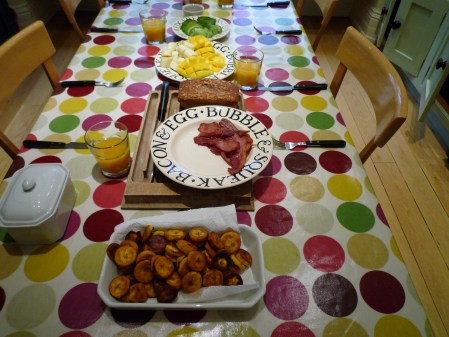
A visit to the lively “Strawberry Garden” fruit and vegetable stall in Manchester’s Arndale market provided plantains, bananas, mangos and avocadoes.
Whilst I’m on the subject, what a disaster area the Arndale Market is! It’s indoors, partly underground, and nail bars rub shoulders with food stalls resulting in a strange aroma which is an unholy combination of salt cod and acetone.
I recall that various council officials visited Barcelona’s Boqueria market to gain inspiration for the Arndale market revamp a few years back. Clearly they either suffered from a lack of imagination or else failed to put into practice what they saw. However there are a handful of stalls which buck the mainly dismal trend, Strawberry Garden being one and the fantastic looking but unimaginatively named “Direct Fish” fishmongers popular with Chinese and Caribbean cooks being the other.
Plantains can easily be mistaken for bananas but this comparison shot show the differences. Plantains are super-sized, a bit more fibrous and even when ripe rather more green than a banana.

Fried for a couple of minutes each side in hot oil they morph from soft, sallow slices into a crispy, golden-brown starchy mouthfuls of heaven. A great addition to breakfast.

Just the banana bread to bake and we’re ready to go.
There are hundreds of banana bread recipes out there. One which I use regularly is Gary Rhodes’ recipe which is really more of a sticky cake than a bread. Bill Granger has a gorgeous breakfast recipe for chocolate and banana loaf which is heavenly if made with grated unsweetened dark chocolate. I found one recipe on the web which purported to be authentically Caribbean and had a delicious flavour from the inclusion of Muscovado sugar and grated nutmeg but the texture was not good – too crumbly.
The banana bread recipe which I can recommend comes from the ever-reliable Four Seasons cookbook by Margaret Costa. I’ve swapped her caster sugar for Muscovado and added a handful of chopped walnuts and a flavouring of grated nutmeg to pick up on the best points of the Caribbean recipe.
Recipe for banana bread
Adapted from Margaret Costa
Ingredients
2 oz (55g) butter
4 oz (115g) Muscovado sugar
1 egg
2 large or 3 small ripe bananas mashed with a fork to as smooth a pulp as you can manage
8 oz self raising flour
handful chopped walnuts (about 2 oz I would guess)
1/2 teaspoon freshly grated nutmeg
1/2 teaspoon salt
3 tablespoons natural yoghurt
Cream the butter and sugar together until light and fluffy. Beat in the egg and banana pulp. Add, alternately, the flour sifted with the salt and nutmeg and the yoghurt. Fold in the chopped walnuts. Pour the mixture into a greased loaf tin and bake for an hour at 180 degrees C (350 degrees F; gas mark 4).
Slice thickly and spread with butter if you like.
In the depths of a UK winter, after a breakfast like this, you can imagine being wafted away to the warm Caribbean overlooking that beautiful bay from the Carlisle hotel terrace….
Dalemain marmalade competition 2010
February 14, 2010 § 1 Comment
We wait with bated breath this morning for the results of this year’s “Grand Prix of Marmalade” held at Dalemain, a country house and estate near Penrith in Cumbria.
http://www.marmaladefestival.com/competition.html
Marmalade is a man-thing in our household. Much as I enjoy marmalade, it’s my husband Tim and our two sons who insist on its presence at the breakfast table. It’s become part of our annual ritual that Tim tracks down Seville oranges every January, painstakingly shreds the tough peel and produces 6 or so gleaming jars of marmalade that generally last us through until August. Then it’s back to the Tiptree or Frank Cooper’s to get us through the rest of th year.
We discovered the Dalemain marmalade festival during a tour of the house and gardens during the summer. It seemed entirely natural that the right category to enter would be the “man-made” one (name self-explanatory).
Here is Tim carefully scraping pulp and pips from the juiced Seville oranges into a piece of muslin. These are a rich source of pectin and will give the marmalade the right set.
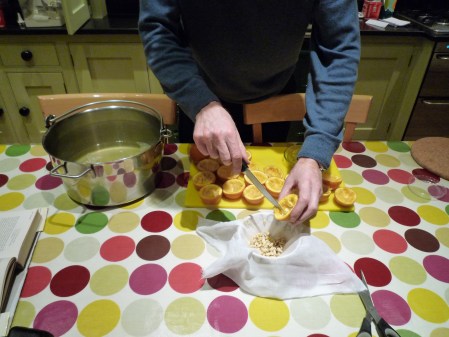
Here are the prepared oranges ready for the first boiling stage. This fills the house with delicious orange aromas brightening up the depths of winter. You can see the little muslin bag containing pips and pith tied to the preserving pan handle.

Here is the selected jar ready for despatch to Dalemain:
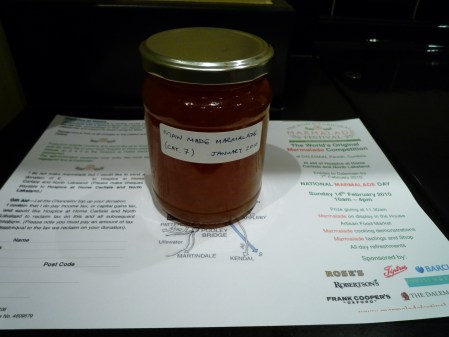
I must say the marmalade was very good this year, the aromatic and with just about the perfect set – not too runny, not rubber-solid. Tim’s fate is in the hands of those tough Women’s Institute judges now who’ll make their decision later this morning. Let’s see what happens…
Recipe for Seville orange marmalade
This is the recipe that Tim uses for consistently reliable results. It’s from Delia Smith’s Complete Cookery Course.
Ingredients
2 lb (900g) Seville oranges
1 lemon
4 lb (1.8kg) preserving sugar (ie the large crystal kind, NOT the one with added pectin) or granulated sugar
4 pints (2.25 litres) water
Measure the water into the preserving pan. Cut the oranges and lemon in half and squeeze out the juice. Add the juice to the water and place the pips and bits of pith clinging to the squeezer onto a square of muslin.
Cut the orange peel (not the lemon peel) into quarters with a sharp knife, then cut each quarter into thinnish shreds. As you cut, add the shreds to the water and any further pips of pith to the muslin. The pips and pith contain the all-important pectin to set the marmalade so be diligent at this stage and don’t just chuck it away.
Tie up the piece of muslin to form a little bag and tie this to the handle of the pan so that the bag is suspended in the water. Bring the liquid up to simmering point and simmer gently, uncovered, for 2 hours or so until the peel is completely soft. Test by pressing and/or biting it.
Remove the bag of pips and set aside to cool. Add the warmed sugar to the pan and stir it occasionally over a low heat until it dissolves. Increase the heat, and squeeze the bag of pips over the pan to extract as much jelly-like pectin as you can, scraping it off. Stir to mix thoroughly.
Once the mixture reaches a fast boil, start timing. After 15 minutes test for a set by spooning a teaspoon of marmalade onto a saucer cooled in your freezer. You have the right set if, once the mixture has cooled for a minute it has a crinkly skin. If it’s not reached setting point, boil for another 5 minutes and test again. Keep doing this until setting-point is reached. This can take some time depending on your particular batch of oranges.
Once setting-point is reached, remove the pan from the heat. Skim off any excess scum at this stage. Leave the marmalade to settle for 20 minutes. This resting will ensure the peel is evenly distributed in the jar when you come to pot.
While you wait, warm your cleaned, rinsed and dried jars (6 1lb jars or their equivalent) in a moderate oven for 10 minutes.
Pour the marmalade with the aid of a metal jam funnel or ladle into the jars. Top each with a waxed disc and seal with a lid immediately. Label when cool.
Valentine’s day dinner at home
February 8, 2010 § Leave a comment
The thought of going out to a restaurant next weekend to spend the evening eating overpriced indifferent food sitting amidst heart-shaped helium balloons, wilting red roses and pink napery fills me with dread. Far better to put together a special meal for two at home instead.
Food for a Valentine’s day dinner should go easy on the garlic and other strong flavours. It needs to be light and delicious and look pretty on the plate. It shouldn’t require too much last minute preparation as who wants to sit down next to a cook spattered with fat from flash-frying a steak?
What I plan to prepare for a main course is a koulibiac of salmon, the version given in Margaret Costa’s Four Seasons cookery book. This has a delicious light crispy crust of yeast-raised dough rather than the more usual puff pastry. This is not a quick dish as the dough needs to be started the day before you plan to eat the koulibiac. It is not difficult to prepare and the various elements can all be done well ahead of time. Slip it into the oven as you sit down for your first course and it will be ready 20 minutes later. With it, I would serve a bowl of sour cream to act as a simple sauce, some steamed spinach simply dressed with olive oil and lemon juice and perhaps one or two baby potatoes.

To start, I will prepare a carpaccio of beef, following the simple instructions (one can hardly call them a recipe) in Alastair Little’s book “Keep it Simple”. My local butcher sells beautiful beef from locally reared grass fed animals which is just right for this dish. The truffle oil in the dressing is appropriate for Valentine’s Day as truffles are known for their aphrodisiac qualities. A simple first course with lots of delicious savoury flavours to tempt the appetite.
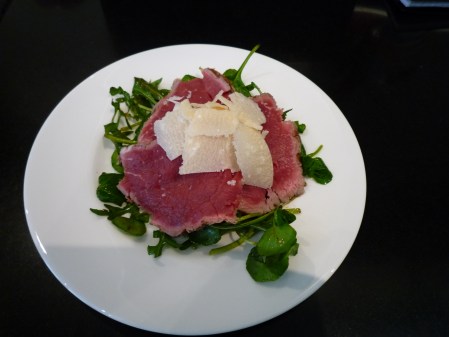
For pudding, there are various options. My favourite cheese of the moment is a buttery Ossau Iraty from the Basque country. A wedge of this with a tiny perfect bunch of grapes and a glass of dessert wine would be one way to finish the meal. Or perhaps slices of perfectly ripe mango mixed with passionfruit pulp, the whole brought to life by a spritz of lime juice. Or maybe only a little something sweet will do. I have a weakness for white chocolate, white Toblerone if I can get my hands on it, otherwise plain old Milky Bar buttons. I think I might whip up a white chocolate mousse using the recipe from Frances Bissell’s book Entertaining. Served in dainty white ramekins together with a spoonful of sharp fruit compôte and a crisp biscuit, it should bring the meal to a stylish and satisfying conclusion.

Recipe for carpaccio of beef
From Alastair Little’s lovely book “Keep It Simple” published in 1993 but still fresh and relevant today. A piece of beef the size specified in the recipe will serve 4-6 people so use what you need for dinner for two and eat the rest for lunch the next day.

Ingredients
1lb (450g) piece of beef fillet from the tail end
about 1/4 pint (150 ml) olive oil
salt and freshly ground black pepper
To finish the dish
Handful of rocket leaves
2 oz (50g) best quality parmesan cheese
2 teaspoons truffled olive oil
1/2 teaspoon balsamic vinegar
salt and freshly ground black pepper
Trim the beef into a neat shape if necessary. Brush all over with olive oil. Preheat a ridged grill pan to very hot. Lay the fillet on the grilling pan and give it 60 seconds on each side, including the two cut ends (6 sides in all), turning it with tongs. Immediately refresh by dipping the seared beef into iced water for a few seconds, then pat dry with paper towels. Season all over with salt and pepper, wrap tightly in cling film, place on a plate and refrigerate for several hours. In fact the beef can be kept for several days like this in the refrigerator.
When ready to eat, remove the meat from the fridge. Wash the rocket and spin it dry. Put it into a bowl, pour over the oil, vinegar and seasoning and toss to coat each leaf. Mound a pile of gleaming leaves onto each plate.
Carve the beef into thickish slices at an angle of 30 degrees. Distribute on top of the rocket. Using a vegetable peeler, shave generous curls of Parmesan cheese over the top.
Recipe for koulibiac of salmon
From the Four Seasons Cookery Book by Margaret Costa. First published in 1970, another book that’s stood the test of time. A great source of inspiration for the occasional instances when you can’t think what to cook. Somewhat surprisingly, you can buy fresh yeast at your nearest in-store Sainsbury’s bakery, maybe other supermarkets too, but I haven’t yet needed to go further afield. The recipe makes 6-8 portions, but it’s a good-tempered dish so take what you need and eat the rest cold or warmed through the next day.

For the pastry
2 oz (55g) butter
8 oz (225g) plain flour
pinch of salt
3/4 oz (20g) fresh yeast
1/2 teaspoon sugar
2 small eggs
4 tablespoons (60 ml) lukewarm milk
For the filling
3 oz (85g) long grain rice
fish, vegetable or chicken stock
2oz (55g) butter
1 medium onion or two small shallots, thinly sliced
3oz (85 g) button mushrooms, thinly sliced
1lb (450g) salmon fillet
3 hard-boiled eggs, sliced
3 dessertspoons (30ml) freshly chopped parsley (or mixture of chopped soft fresh herbs such as basil, chervil and tarragon)
Melted butter; fine dry breadcrumbs
First make the pastry. Cream the butter. Sift the flour and salt into a warmed basin. Cream the yeast with the sugar and when it looks frothy, add the well beaten eggs and the lukewarm milk. Mix into the flour, adding more lukewarm milk as necessary to make a soft paste. Beat thoroughly with your hand and finally work the creamed butter into the mixture. Cover and leave in a warm place to rise for 30 minutes. Then leave the dough in a polythene bag in the refrigerator overnight.
Next day, start by making the filling. Cover the rice with exactly twice its volume of cold stock. Let it come to the boil, cover and turn off the heat or remove to a cooler part of the stove. In 15-20 minutes, all the liquid should be absorbed and the rice cooked through, with the grains firm and separate.
Skin the salmon, wrap in foil and bake in a 180 degree C oven for 15 minutes or until just cooked through. Melt the butter and cook the onion or shallot in it until soft and transparent. Add the mushrooms and cook for a few minuted longer. Mix in the rice and stir in the coarsely flaked cooked salmon. Mix together thoroughly, then stir in the sliced hard-boiled eggs and the herbs. Season well.
Now divide the pastry in half and roll each piece into a rectangle 12 by 8 inches (30 by 20 cm). Put one onto a greased baking sheet and cover it with the cooled filling to within an inch (2.5cm) of the sides. Dampen the edges. Take the second rectangle and place on top of the first. Press the edges together then make crosswise slashes at 3/4 inch (2cm) intervals to make a lattice-work effect. Knock up the edges with the back of a knife and leave the koulibiac in a warm place for 1/2 hour to prove.
Brush with melted butter and sprinkle with fine dry breadcrumbs. Bake in a hot oven 230 degrees C, 450 degrees F, gas mark 8 for about 20 minutes. Pour a little melted butter into the koulibiac through the slits and let it cool just a little before serving.
Recipe for white chocolate mousse
From Entertaining by Frances Bissell. A book filled with lovely ideas if only one had the time, and the lifestyle. After all, how often is one called upon to prepare a picnic to be eaten on an island reached from a small boat departing from Hong Kong harbour? Don’t attempt this recipe unless you have an electric whisk to deal with the heavy duty work of beating egg whites and hot sugar syrup together. This quantity is enough to fill 8 small ramekins so plenty left for a treat another day.

Ingredients
7oz (200g) white chocolate, either buttons or bar broken into pieces
1 oz (25g) golden caster sugar
2 fl oz (50ml) water
2 egg whites, beaten until the soft peak stage
7 fl oz whipping or double cream, softly whipped
optional: 1 teaspoon chocolate or vanilla extract or a little grated orange zest
Break the white chocolate into pieces (not necessary if you are using buttons), place in a heatproof bowl and set over a pan of hot water to melt very gently.
Place the sugar and water in a small saucepan and boil until the firm ball stage (124 degrees C if you have a sugar thermometer). Pour the hot syrup in a thin stream over the beaten egg whites whilst simultaneously whisking furiously to incorporate the syrup before it sets. Carry on whisking until the mixture is cold.
Incorporate a little of the whipped cream into the melted chocolate. Blend the chocolate into the egg whites, then add the rest of the cream and your chosen flavouring if using. Use a light touch and a large metal spoon being careful not to knock all the air out of the mixture. Spoon into ramekins immediately and chill until set.
Proper Puddings
February 6, 2010 § Leave a comment
Last week’s Radio 4 Food Programme was devoted to one of my favourite things, British puddings. The programme was a joy to listen to, almost as good as eating the puddings themselves.
http://www.bbc.co.uk/programmes/b00q9k53
I was pleased to hear Jane Grigson’s English Food quoted, and also to have my previous assertion about the origins of Sticky Toffee Pudding corroborated. You can read about it in my post https://rhubarbfool.co.uk/2009/08/08/return-to-the-home-of-sticky-toffee-pudding-8-august-2009/
Mary Norwak, author of “English Puddings Sweet and Savoury” was featured on the programme. I’d heard of her books but never before heard her interviewed. I’m afraid she was rather a disappointment. She came across as rather distant and snooty and her comments on trifle made me quite angry. We all have our differing views as to what should go into a trifle, but surely this is a matter of personal preference. As far as I’m concerned, if you like it, put it in. Mrs Norwak has no right to look down on anyone else simply because of what they like to put in their trifle. I didn’t feel inclined to buy her book after listening to her.
Nevertheless, still inspired by the programme as a whole, I thought I would give the recipes for two of our favourite traditional puddings at home, Guards’ Pudding from Margaret Costa’s classic Four Seasons Cookbook, and Lemon Layer Pudding (which is sometimes also referred to as Lemon surprise Pudding or Delicious Pudding). This particular version is from the Good Housekeeping cookery book – a comprehensive and reliable cook book let down by a terrible index – try finding apple crumble and you’ll see what I mean. It’s listed idiosyncratically under F for fruit (but not under A for apple, C for crumble or even P for pudding).
The list of ingredients for Guards’ Pudding is unprepossessing – brown breadcrumbs, bicarb, jam, sugar, butter and egg (no flour). As the pudding steams, a marvellous alchemy takes place and the end result is moist, light and delicious. I think it’s best served with proper custard. You can buy really good ready prepared egg custard now from Marks & Spencer, Sainsbury’s and Waitrose to name but three supermarkets. This is a great help for the busy cook preparing Sunday dinner which is the preferred meal of the week for a pudding.

Culinary alchemy of a different kind results in the lemon layer pudding mixture separating into a light sponge and lemon sauce after being gently baked in a water bath.
Here’s the pudding fresh out of the oven luxuriating in its hot water bath:

And here is a picture showing the pool of lemon sauce that magically appears during baking. All it needs now is a spoonful of extra thick single cream to set off all that lovely lemony sharpness.

Recipe for Guards’ Pudding
From The Four Seasons Cookery Book by Margaret Costa. Serves 4.
Ingredients
4 oz (115g) butter
4 oz (115g) soft brown sugar
3 tablespoons (45 ml) raspberry or strawberry jam
4 oz (115g) fresh brown breadcrumbs (some crust left on is OK)
2 eggs
1/2 teaspoon bicarbonate of soda
butter for pudding basin
Cream together the butter and sugar until fluffy, and blend in the jam. At this point, the mixture will be a disgusting pink colour but don’t worry. Add the breadcrumbs, the beaten eggs and the bicarbonate of soda dissolved in a very little warm water. Mix well, turn into a buttered pudding basin and steam for 2 to 2 and 1/2 hours. Set the basin in the lowest possible oven for a few minutes before turning out and then, if you can wait, let it stand a minute or two longer to firm it.
Recipe for Lemon Layer Pudding
This recipe comes from The Good Housekeeping Cookery Book. Serves 4.
Ingredients
grated rind and juice of 2 lemons
2 oz (50g) softened butter
4 oz (100g) golden caster sugar
2 eggs, separated
2 oz (5og) self raising flour
1/2 pint (300ml) milk
Grease a 2 pint (1.1 litre) capacity ovenproof dish. A white porcelain soufflé dish looks clean and elegant if you have one. Cream together the lemon rind, butter and caster sugar until pale and fluffy. Beat in the egg yolks one by one, then the flour, continuing to beat well to combine. Whisk the egg whites until stiff. Fold a tablespoon or so of the whisked egg whites together with the lemon juice and a little of the milk into the mixture. Continue in this way with the milk and egg white until it is all incorporated into the mix. It will look like a cake mix which has gone badly wrong at this stage – runny and curdled. Don’t worry, this is how it’s meant to look. Pour the mixture into the greased baking dish, then stand the dish in a shallow tin of cold water (a roasting tin is ideal) and bake in the oven at 180 degrees C (350 degrees F or gas mark 4) for about 45 minutes or until the top is golden brown, set and spongy.
If you have any traditional British pudding recipes you’d like to share, I’d love to hear from you – please send me a reply.
Angolan breakfast of champions
January 30, 2010 § 4 Comments
The African Cup of Nations tournament reaches a climax this weekend with the final being contested on Sunday 31 January 2010. Briefly, the spotlight will shine on Luanda, Angola’s capital when Ghana and Egypt compete for the trophy. What might the teams eat for breakfast beforehand? We can offer the following menu based on an Angolan breakfast we prepared at home a couple of weeks ago.
Our chosen menu was funje, a traditional cassava porridge; tropical fruit; pão burro literally “donkey bread” a Portuguese influenced recipe reflecting Angola’s colonial past; quince and plum preserves again reflecting the Portuguese history; and finally, coffee to drink.
I talk about Angola’s colonial past but it was as recently as 1975 that Angola achieved independence from Portugal. Civil war lasting until 2002 broke out almost immediately, a civil war that didn’t really impinge very much on our consciousness over here. I remember with some embarrassment being questioned by a sharp civil service interviewer about my views on the conflict in Angola when I attempted to join the foreign office some years ago now. As a callow twenty year old I didn’t have much to say and stared back at him blankly. No, I didn’t get the job…
In terms of geography, Angola sits just above Namibia on the west coast of southern Africa. Huge numbers of square miles or kilometres become meaningless to me after a certain size: at 481,000 square miles, Angola is very roughly twice the size of France (or twice the size of Texas for those with a more transatlantic viewpoint). I took a dreamy trip along Angola’s 1,000 mile long Atlantic coastline, courtesy of Google Earth – seemingly endless sandy beaches with Atlantic breakers hitting the shore. There must be potential for Angola to become a cult surfing destination. Sure enough, go to YouTube and you will find mesmeric scenes like this one. Those in the know would call it a left point break:
http://www.youtube.com/watch?v=khKUN5Vo-p8
How did I come up with the breakfast menu? Cassava flour is a staple food across West Africa. The name for this in Angola is funje or fufu. This is most frequently turned into a porridge. I found the instructions for making funje porridge here:
http://www.celtnet.org.uk/recipes/miscellaneous/fetch-recipe.php?rid=misc-funje
They read as follows:
Recipe for funje from Angola
“What you need for the traditional method (of preparing funje) is a deep pan and a funje stick. This is a long-handled stout wooden spoonwith a flattened oar-like blade (typically it’s 35cm or longer). Almost every West African household has one of these (we have my wife’s family version). For perfect funje you need twice the volume of water to the amount of cassava flour.
Bring the water to a boil and as soon as it’s boiling remove from the flame, sit on the floor, wrap in a cloth and hold steady with your feet. Add all the cassava flour in one go and beat energetically with the funje stick. You must beat very hard and fast as the mixture thickens rapidly and if you do not beat thoroughly you will end-up with lumps and hard ‘kernels’ rather than a smooth dough-like porridge.”
My first problem was how to get hold of the funje flour itself. Fortunately, Manchester is a thriving cosmopolitan metropolis and I quickly located a specialist African grocery, Global Africa, based in Hulme market hall (just next to Asda). I give contact details below. The two African guys running the shop viewed me with some suspicion as I walked in. Any hopes I might have had about engaging them in conversation about the tropics and picking up some recipe tips were quickly dashed. Our exchange was monosyllabic but I did end up with what I was looking for – a 3kg bag of fufu, the cheerfully packaged Tropical Sun brand.

This is how I interpreted the recipe instructions, swapping funje stick for a conventional wooden spoon:
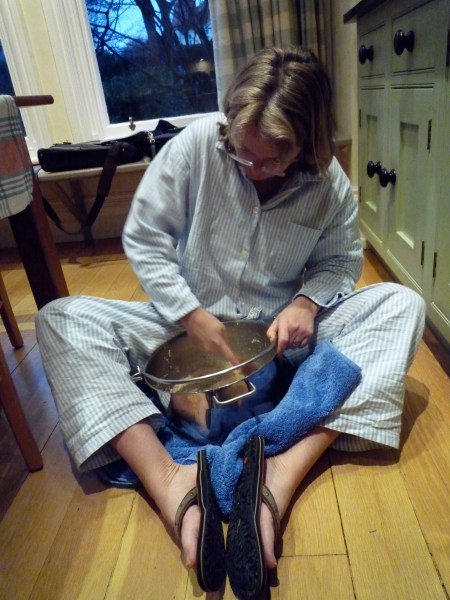
I am sorry to report that my first attempt at funje was lumpy and full of the hard pellets that the above instructions tell you to avoid. It would be an understatement to say that this was not one of my favourite breakfast foods. It had a distinctly challenging slippery, gelatinous consistency and the taste was bland but with a not altogether appealing chemical astringency. I managed a teaspoonful but then I must sheepishly report that I put the rest on our compost heap.
I read about pão burro (literally donkey bread) being a traditional Angolan food but internet searches revealed no recipes, just references to a funky sounding Angolan rapper who has adopted this as his stage name. I came up with a rustic bread recipe, half wholemeal, half white flour which is my interpretation of what something called donkey bread might taste like. To go with it, I thought quince and plum conserves (from pukka English jam makers Tiptree) had the Portuguese influence I was looking to incorporate.
Angola does produce tropical fruit and some coffee, but there’s little or no chance of finding Angolan exports over here so we made do with a Ghanaian pineapple, some bananas of indeterminate origin and a guava (which being South American isn’t in fact at all authentic!) plus our usual house coffee blend. Here’s the finished breakfast ready to be served.
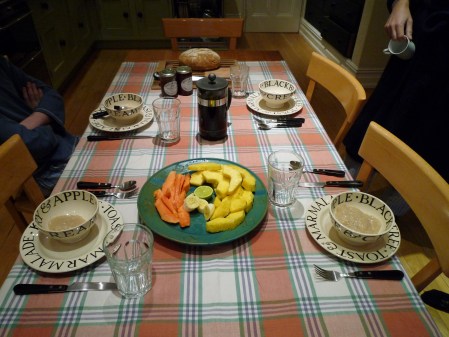
I could just about imagine myself at a beachside café in Luanda eating this kind of thing…
May the best team win on Sunday!
Contact details
Global Africa
78 Hulme High Street,
Manchester
M15 5JP
Tel 0161 232 9797
Open season for Haggis – ideas for a Burns supper
January 25, 2010 § Leave a comment
Today is 25 January, Robert Burns’ birthday which means that the traditional Burns supper of haggis, neeps, tatties (mashed swede and mashed potatoes)and of course plenty of Scotch whisky will be served up to Scots both at home and abroad tonight. We Sassenachs got in on the act early this year, on Saturday night in fact, when we were invited to a Burns supper at nearby Manchester Grammar School.
You might well ask why would anyone voluntarily go and spend an evening eating school dinners? In fact the school did us proud and produced food of a high standard. Pride of place went to a splendidly proportioned haggis (Macsweens of course – I did check with the catering manager!) which was preceded by a bagpiper and ceremonially stabbed with the Skean dhu/Sgian Dubh (the dagger a Scotsman tucks into his sock). You can clearly see the victim’s entry and exit wounds…

I realise this picture may not look appealing to those of a nervous disposition but, honestly, it was delicious.
Eating my meal on Saturday night, it occurred to me that hosting a Burns supper at home would be a fun evening and the food would be pretty straightforward. To start, the obvious choice would be Scottish smoked salmon. You could serve this as a canapé beforehand on tiny oatcakes and dispense with a starter if that suited. Smoked venison too with redcurrant or, better still, rowanberry jelly would be good if you could source some. A smoked loch trout or kipper pâté with oatcakes would be another option. Don’t turn your nose up at kipper pâté – it may not sound glamorous but I can still remember some that I ate in Tiddy Dol’s (sadly now closed) restaurant in Mayfair some 20 years ago – velvety smooth and absolutely delicious with just a hint of a peaty malt whisky in the background.
The main course would obviously be a haggis (there are vegetarian versions too to cater for all tastes) and the aforementioned neeps and tatties – these can be prepped in advance and heated through when you are ready to serve. A little whisky poured over the haggis is all the sauce you need but you could serve a little gravy (or jus as restaurants insist on calling it) if you liked. I like Francis Bissell’s idea from her book “Entertaining” of serving haggis Parmentier, a Scottish take on the bistro classic hachis Parmentier (a French version of shepherd’s pie). Cooked haggis, carefully spooned out of its casing forms the based of the dish with a smooth mixture of mashed potato and swede forming the top. Some finely shredded curly Scots kale, steamed for just a minute or two to retain its vibrant greenness, would make a good accompaniment.
Pudding is a little bit of a challenge given the quantity of food you will already have consumed. Cranachan (a combination of whipped cream, toasted oatmeal, whisky, heather honey and raspberries) would be traditionally Scottish and you could use very acceptable frozen Scottish raspberries. If you wanted something very light and refreshing then a raspberry water ice or sorbet would fit the bill. An individual baked or steamed pudding made with whisky and Dundee marmalade would be good for traditional pudding lovers. My final pudding thoughts would be a Caledonian ice cream as served at Glasgow’s Ubiquitous Chip. This is a witty take on a French style praline ice cream with frugal toasted oatmeal taking the place of the usual almonds. You could serve this with a sauce of melted Mars bars – a nod to that other most traditional of Scots puddings, the deep-fried Mars bar….
I also give a recipe for an oatmeal shortbread biscuit as featured in the BBC Great British Menu programme. Chef Jeremy Lee turned them into a neat stack with cream and raspberries but they are a good crisp biscuit either to eat on their own or to provide a contrasting texture to a creamy pudding.
Recipe for Caledonian ice cream
This is a recipe from Glasgow’s Ubiquitous Chip restaurant brought to the masses by Delia Smith in her Summer Collection book. Serves 8. I’ve tried this recipe at home and it works well with our without an ice cream maker.
Ingredients
For the caramelised oatmeal
3 oz (75g) caster sugar
4 tablespoons water
2 oz (50g) pinhead oatmeal
For the syrup
4 oz (110g) caster sugar
4 tablespoons water
For the ice cream
1 pint whipping cream
1/2 teaspoon vanilla extract
Start by making the caramelised oatmeal. Put the caster sugar and water into a small saucepan over a low heat and leave it for 5 minutes. Then take a medium sized frying pan, place it on a medium heat and when the pan is hot, add the oatmeal and swirl it round the pan constantly so that it browns evenly – which it will do in about 5 minutes. Remove the oatmeal to a plate to prevent it becoming over-brown. By now the sugar in the saucepan will have dissolved so you can turn the heat up and let it boil. Watch it very closely until it becomes a rich brown caramel colour. Stir in the toasted oatmeal, remove from the heat and quickly pour the mixture onto a baking sheet lined with baking parchment. Put to one side to get cold and firm (about 15 minutes). Then take off small pieces at a time and pound them in a pestle and mortar until they are the size of large salt crystals (you could do this carefully in a food processor too but don’t overdo it and reduce it to too fine a powder). Put to one side in an airtight container until you are ready to make the ice cream.
To make the sugar syrup, measure the sugar and water into a small saucepan, place it over a gentle heat and stir until the sugar has dissolved – about 5 minutes. Then remove from the heat and allow to become completely cold.
To make the ice cream, pour the cold syrup into a mixing bowl along with the whipping cream and vanilla extract. Whisk with an electric whisk or mixer until the mixture just begins to thicken and hold its shape. Then pour into an ice cream maker and freeze according to manufacturer’s instructions until firm but still pliable. If you don’t have an ice cream maker, freeze the mixture until firm but pliable in a large plastic container, beating vigorously every half hour or so with a wooden spoon. Transfer to a bowl, stir in the oatmeal mixture, fold it in then spoon the ice cream into a loaf tin 7 1/2 by 4 1/2 by 3 1/2 inches. Cover with a double thickness of foil and freeze until needed.
To serve, remove from the freezer to the refrigerator about 30 minutes before you need it. Dip the base and sides of the loaf tin into hot water for 10 seconds or so, loosen round the edges with a palette knife, then turn onto a plate. Using a sharp knife dipped in hot water, cut into neat slices.
Recipe for almond shortbread thins
The original recipe title is for raspberry shortcake but I think this is confusing as shortcake to me means the American scone type soft cake. It comes from The Great British Menu Cookbook accompanying the BBC TV series of the same name. This recipe was cooked by chef Jeremy Lee. Jeremy is a native Scot who is the longstanding head chef at London’s Blueprint café. I have tried this recipe at home and it does work – the biscuits are delicious. It makes about 20 biscuits from memory (recipe says serves 4).
Ingredients
125g soft unsalted butter
40g caster sugar
1 tsp finely grated orange zest
40g best quality blanched almonds such as Marcona ground in a food processor quite fine but still with some texture
40 g toasted white breadcrumbs (from 70g bread chopped up, crusts on, baked at 150 degrees C/fan 130 degrees C/gas mark 2 for 30 minutes or until lightly toasted then processed to crumbs in a food processor)
To serve
250 ml double cream, softly whipped; a great bowl of raspberries, a small bowl of caster sugar, a little icing sugar for sifting
Beat the butter and sugar together well until pale. Pop in the orange zest and beat very well. Add the flour, ground almonds and breadcrumbs, and mix thoroughly into a soft dough.
Cut a large piece of baking parchment. Place the dough at one end of the paper, then roll it in the paper to make a sausage shape roughly 5cm in diameter. Seal the sausage in the paper and chill for a few hours or ideally overnight.
Preheat the oven to 170 degrees C/fan 150 degrees C/gas mark 3. Line a large baking sheet with baking parchment. Cut the roll of dough into 3mm thick slices (about the thickness of a UK £1 coin) and lay them on a baking sheet. Bake for 12-15 minutes or until golden brown. Let cool and become crisp.
You can eat them as they are or sandwich 3 of them together with raspberries and whipped cream to form a neat stack for pudding.
Producer/other details
Macsween’s haggis
Stockan and Garden oatcakes from Orkney
http://www.stockan-and-gardens.co.uk/
Glasgow’s Ubiquitous Chip restaurant
http://www.ubiquitouschip.co.uk/index.html
Please do leave a comment if you have Burns supper experiences or Scottish recipe ideas to share
Comforting casseroles part 2: beef
January 24, 2010 § 2 Comments
The snow has melted here in but the weather outside remains wintry in a dank Mancunian kind of way so casseroles are still the order of the day. I started off thinking about pork earlier in the month:
https://rhubarbfool.co.uk/2010/01/09/comforting-casseroles-part-1-pork/
I’ve now moved on to beef. I made a carbonnade last week and for the first time ever finished it off properly with toasted bread on top -it worked a treat and wasn’t fiddly at all as I had supposed it might be. The end result was I suppose a Belgian take on the familiar stew and dumplings, deeply savoury with the beer adding an extra dimension to the taste.
Here’s the finished dish:

This is what it looked like before the addition of the bread:

And here is the mise en place:

The origins of the word carbonnade are somewhat confusing. A couple of web sources I checked out suggested the word meant (i) something to do with grilling the meat or (ii) had a Spanish derivation. Neither of these seem immediately plausible to me. Though on reflection, given that Spain controlled the Netherlands (in the wider sense encompassing modern day Belgium) for 150 years or so beginning in the mid sixteenth century, maybe there is something in the Spanish connection. My own conjecture is that, like spaghetti carbonara being a hearty meal for Roman charcoal burners, this could possibly be a favourite dish of Belgian coal miners.
This particular version comes from Leith’s cookery bible.When I made this a couple of weeks ago there was still snow on the ground so I had to do my shopping on foot at our local Marks & Spencers. I bought a couple of pieces of topside which worked a treat. Topside is often sold as a roasting joint but invariably disappoints when served as roast beef. The beer was a dark ale from Adnams of Suffolk, Marks and Spencers own label but uncannily like an Adnams Broadside.
I give a second beef recipe too, a daube from Julia Child’s book. I did think about quoting her Boeuf Bourgignon recipe instead which is really good but a little involved requiring separate sautéing of the the component parts. Let’s face it, sometimes all we have time for is to throw a few things on the pot and leave the oven to work its magic over the next 3 hours. If you don’t have much time for preparation then this daube recipe is for you.
Recipe for carbonnade of beef
This recipe which serves 4 comes from Leith’s cookery bible. As ever, I can’t leave a recipe alone and so have tweaked one or two of the ingredients to suit what I tend to keep in the cupboard. I’d recommend making a double quantity and stashing the other half (minus the French bread topping) in the freezer.
Ingredients
675g/1 1/2lb chuck steak (or topside which I used successfully) trimmed weight
1 tablespoon beef dripping (in fact I used some goose fat leftover from Christmas)
2-3 onions thinly sliced
1 clove garlic finely chopped
2 teaspoons muscovado sugar
2 teaspoons plain flour
435 ml/3/4 pint brown ale
145 ml/1/4 pint brown stock or vegetable stock or water
1 teaspoon balsamic vinegar
1 bay leaf
pinch chopped fresh or dried thyme
pinch freshly grated nutmeg
salt and freshly ground black pepper
To serve
8 slices French bread or Ciabatta type loaf spread thickly with Dijon mustard
Cut the beef into small steaks, cutting across the grain of the meat. Heat half of the dripping or oil in a large frying pan and fry the steaks a few at a time until browned. Put them into an ovenproof lidded casserole (Le Creuset type ideal) as they are done. If the bottom of the pan becomes very dark or too dry, put in a little water, deglaze and pour over the meat. Heat up a little more dripping or oil and continue to brown the meat. Once the meat is done, deglaze the pan, add the remaining dripping or oil and fry the onions slowly (you may need a little extra dripping at this stage depending on how much you used to brown the meat). When the onions begin to brown, add the garlic and sugar and continue to cook for a further minute or two until nicely brown.
Stir in the flour and cook for a further minute stirring as you do so. Remove the heat and pour in the brown ale and stock.
Return to the heat and bring slowly to the boil, then simmer for 2 minutes, stirring continuously. Pour into the casserole and add the vinegar, bay leaf, thyme, nutmeg, salt and pepper.
Cover and bring to simmering point then cook in a preheated oven (150 degrees C/300 degrees F/gas mark 2) for 1 1/2 – 2 hours or until the meat is tender. Remove the casserole from the oven and increase the heat to 200 degrees C/400 degrees F/gas mark 6. Place the slices of bread, mustard-side up, on tope of the stew. They will absorb the flavoursome fat on the top. Return the casserole, lid off, to the oven until the bread is toasted and golden-brown (5-10 minutes).
Recipe for daube de boeuf à la Provençale
From “Mastering the Art of French Cooking” by Julia Child, Simone Beck and Louisette Bertholle. This recipe serves 6 but I find the quantities tend to be on the generous side – this would imply 8oz meat per person whereas the carbonnade recipe above allows 6oz per person which is about right for me. Another good recipe for doubling up and freezing.
Recommended cuts of beef for the daube are rump, chuck, thick flank, topside or silverside.
Ingredients
3lb lean stewing steak cut into 2 1/2 inch squares, 1 inch thick
1/2 pint red wine
1/8 pint brandy
2 tablespoons olive oil
2 teaspoons salt
1/4 teaspoon pepper
1/2 teaspoon thyme
1 crumbled bay leaf
2 cloves mashed garlic
1/2 lb thinly sliced onions
1/2 lb thinly sliced carrots
1/2 lb bacon lardons
6 oz sliced fresh mushrooms
1 1/2 lb ripe tomatoes peeled seeded juiced and chopped or 2 400g/14oz tins tomatoes, chopped or 1 pint passata
approximately 4oz sifted plain flour on a plate for coating the beef
1/2 to 3/4 pint beef stock (or water or additional red wine)
For the Provençal seasoning
10 flat anchovy fillets packed in olive oil
2 tablespoons capers
3 tablespoons wine vinegar
3 tablespoons olive oil either from the anchovy tin and/or plain
2 cloves mashed garlic
2 tablespoons chopped parsley
Place the beef in a bowl and mix with the wine, brandy, olive oil, seasonings. herbs and vegetables. Cover and marinate for at least 3 hours, stirring every so often. Remove the beef from marinade and drain through a sieve. Reserve both the vegetables and the marinade liquid.
Line the bottom of a large ovenproof lidded casserole (again, Le Creuset type is perfect) with one third f lardons. Strew one third of the marinade vegetables and mushrooms over them then add a third of the tomatoes. Piece by piece, roll the beef in the flour and shake off the excess. Place closely together in a layer over the vegetables. Continue with another layer of bacon and vegetables, then a second layer of beef. Conclude with a final layer of bacon and vegetables.
Pour in the marinade liquid and enough stock (or water or wine) to almost cover the contents of the casserole. Bring to simmering point on top of the stove, cover tightly and place in the lower part of an oven preheated to 150 degrees C/325 degrees F/gas mark 2. Regulate the heat so that the liquid simmers slowly for 3 to 4 hours. The meat is done when a fork pierces it easily.
While the daube is cooking, prepare the Provençal seasoning. Using a fork, mash the anchovies and capers to a paste in a bowl. Beat in the other ingredients. After the daube has cooked for 2 1/2 to 3 hours, remove it from the oven and skim off the fat. Pour on the Provençal seasoning mixture and baste the beef with the cooking juices from the casserole. Cover and return to the oven for a final half hour of cooking.
Serve with noodles or plain boiled potatoes , a green salad or vegetable and of course a glass of your favourite wine.
Do you have a great beef casserole recipe or a fresh insight into why a carbonnade is so named? If so, please leave a comment.
An Antipodean New Year in London
January 13, 2010 § Leave a comment
For the past 10 years we have spent New Year’s Eve with a group of friends, taking turns to host and organise a special meal. All of us enjoy good food and wine and we make a bit of an effort each year to come up with a different theme. In the past we’ve covered French, Italian, Middle Eastern, Spanish and American cuisines to name but a few. This year we were in Highgate, North London and our hosts decided to choose an Australian theme.
This was a real eye-opener for me as I’ve never visited Australia. I know there’s a lively food scene down under particularly in Sydney but my knowledge of Australian chefs and cookery writers was, until last week, restricted to Bill Granger’s books (of which I have seven at last count!), Jill Dupleix’s magazine articles and of course those handy little Australian Womens’ Weekly cookbooks.
Here is our fabulous menu:
Wasabi almonds and macadamia nuts
Fillet of wild kangaroo with anchovy butter; olive and bush tomato focaccia
Barbecued giant prawns; tarator; pepperberry bark
Spiced orange granita; orange, date and mint salad
Neil Perry’s slow-roast rib of beef; potato and celeriac gratin; green beans
Kiwi, blueberry and strawberry Pavlova; macadamia tuiles
It tasted as brilliant as it sounds and I discovered some brand new ingredients (bush tomatoes and pepperberry as well as the more obvious kangaroo), two new chefs/cookery writers (Neil Perry and Juleigh Robins) and a better tarator recipe than the previous one I’ve posted.
This is the amazing looking pepperberry bark, a paper thin crispbread which has dried Australian pepperberries both in the dough and sprinkled on top. I give the recipe later on in this post.

According to cookery writer Juleigh Robins (whose book “Wild Food” was the source of some of the evening’s recipes) the pepperberry bush Tasmannia Lanceolata grows in the subalpine rainforests and gullies of Tasmania. It can be used like black pepper – it has a distinctive spicy taste, a bit like a Szechuan peppercorn. Juleigh Robins’ book lists other exotic and enticing ingredients too – anisata, bush tomato, Davidson’s plum, and best of all the miraculously chocolate flavoured wattleseed. Only two of her ingredients were familiar to me, the macadamia nut and wild rosella. I have come across wild rosella flowers referred to as hibiscus. They are preserved in syrup and make a superior edible garnish for champagne or soft drinks.
The pepperberry bark accompanied giant prawns which were cooked in true Australian style on the barbie, despite freezing temperatures outside. You’ll see from the work-in-progress photo below that we dressed appropriately for the occasion:

The orange granita which followed made a refreshing palate cleanser before we moved on to the rare beef and then pudding. Here’s a picture of the granita and I’m afraid this is the last photo as the evening was too much fun to stop and take pictures.

Recipe for pepperberry bark
This recipe for a paper thin crispbread akin to Sardinian carta da musica comes from Juleigh Robins’ book “Wild Food.” The dried pepperberries impart a subtle purple colour to the dough and warm aromatic flavour to the finished bread.
Ingredients
375g plain flour
2 teaspoons salt
2 teaspoons caster sugar
2 teaspoons dried crushed pepperberries
40g butter at room temperature
2 tablespoons milk
100 ml water
1 egg yolk
2 teaspoons sesame seeds
extra crushed pepperberry for sprinkling
Using the paddle attachment on an electric mixer, mix the flour, salt, sugar, crushed pepperberry and butter together. Once the butter is well incorporated into the flour, add the milk, water and egg yolk and work until the mixture forms a firm dough. Cover and rest in the refrigerator for one hour or so.
Preheat the oven to 170 degrees C and line a large baking tray with baking paper.
Divide the dough into four. Roll each piece as thinly as possible preferably using a pasta machine. It should be as thick as a tortilla/corn chip. Work quickly not overworking the dough. Let it rest for 20 minutes. Tear each sheet of dough into 5 or 6 lengths making 20-30 pieces in all. Carefully place the dough strips on the lined baking tray. With a pastry brush dipped in water lightly brush the surface of the bread. Sprinkle with sesame seeds and crushed pepperberries. Bake for 15 minutes until a light golden brown.
Recipe for barbecued marinated giant or king prawns
This recipe and the two that follow are from star Australian chef Neil Perry’s book “The Food I Love”. Neil Perry is the chef behind Sydney’s legendary Rockpool restaurant but his book is full of recipes designed to cook at home without too much restaurant-style frippery. Just checked and it’s readily available on Amazon if you’re interested. This recipe serves 4.
Ingredients
for the marinade
2 cloves garlic
2 tablespoons chopped fresh ginger
1 lemongrass stalk peeled and chopped
2 tablespoons chopped coriander
2 tablespoons chopped mint
1 teaspoon ground cumin
1 teaspoon ground coriander seeds
1 teaspoon smoked paprika
2 red chillies
zest of half a lemon plus juice of one lemon
1 teaspoon sea salt
125 ml extra virgin olive oil
to grill and serve the prawns
20 large king prawns cut in half lengthways and deveined (for our multi-course meal we made do with just 3 monster prawns, half per person, each the size of a small lobster!)
Extra virgin olive oil
Freshly ground black pepper
125 ml tarator (see next recipe)
lemon wedges
To make the marinade, put all the marinade ingredients in a food processor and blend until smooth. Put the prawns into a large bowl, pour over the marinade, cover and leave for 30-45 minutes.
Preheat the barbecue to hot. Make sure the grill bars are clean. Put the prawns on the grill cut side down. Cook for one minute (a little longer for a giant prawn). Turn and cook for one minute more (again a little longer for a giant prawn).
Remove the prawns from the grill and pile onto four plates. Drizzle with olive oil, season with a few twists of pepper and serve with a dollop of tarator and a lemon wedge or two.
Recipe for tarator
Another Neil Perry recipe. This is a better tasting tarator than the one I posted back in September. It calls for pounding by hand in a pestle and mortar. I’m not sure if our hostess did this on new year’s eve – I would be tempted to use a food processor.
Ingredients
50g walnuts, lightly roasted
sea salt
2 garlic cloves
40g fresh breadcrumbs
freshly ground black pepper
juice of a lemon
125 ml extra virgin olive oil
Put the walnuts, salt and garlic in a mortar. Pound to a paste. Add breadcrumbs and a dash of water and pound to mix through. Add pepper and lemon juice then slowly add the olive oil a little at a time, pounding to a creamy consistency.
Recipe for date, orange and mint salad with orange granita
A final Neil Perry recipe. This makes a zingy and refreshing intermediate course or pudding. On new year’s eve we had a simplified version with just the granita and a few dates scattered on the side. This recipe serves 8.
Ingredients
for the granita
550 ml orange juice, freshly squeezed
115g caster sugar
1/2 teaspoon ground cinnamon
pinch ground cardamom
5 drops orange flower water
125 ml water
for the salad
16 fresh dates soaked in hot water for 10 minutes then skins removed and pitted
4 segmented oranges
8 finely sliced mint leaves
Strain the juice through a fine sieve and put in a bowl with the sugar, spices,orange flower water and 125ml water. Stir until the sugar dissolves. Strain into a container such that the mixture is approximately 2 inches deep. Freeze. Fork through every 30 minutes or so. The mixture will take 4-5 hours to freeze into granular crystals.
To make the salad, quarter the dates and mix together with the segmented oranges and sliced mint leaves. Divide between 8 glasses and add a spoonful of granita.
If you had a special meal on New Year’s Eve I would love to hear about it.
Rustic food in Klosters and traditional dishes from Graubünden
January 10, 2010 § 2 Comments
I’m going to start this post on our recent trip to Klosters with a mention of Charly’s Chestnuts. No, this isn’t an irreverent dig at the British royal family who like to holiday here but a reference to a Klosters landmark. The eponymous Charly sets up his wagon daily just outside the station and his roast chestnuts are very good indeed.

I’ve already written about some of Klosters’ hotel restaurants and the elegant food they serve up. What I haven’t mentioned so far are some of the mountain restaurants catering for skiers. Yes, there are the busy cafeteria style establishments by the main lifts at Gotschna, Davos and Madrisa, but if you want something a bit special, you have to travel a little further afield.
Bruhin’s restaurant is virtually on the summit of the Weissfluhgipfel which at 2883m is the highest point on the Parsenn massif. The views across to the Silvretta and Rätikon are stunning and window tables here are in great demand. The menu offers either restaurant style dishes or local specialities. I haven’t eaten here recently, but they do a good cup of coffee – you can warm up on the sheepskin upholstered seats before taking the long run down to Schifer.
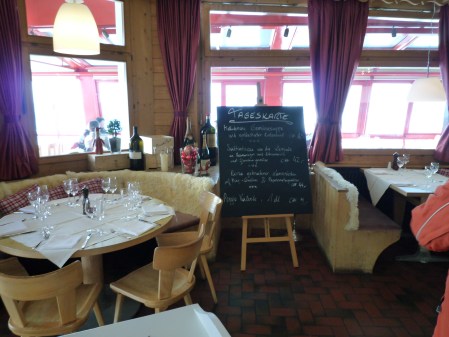
If you are skiing in the Madrisa ski area, then Berghaus Erika in the hamlet of Schlappin makes a worthwhile destination. Its plus point or drawback, depending on your point of view, is that is situated at the foot of a long tree-lined black run.
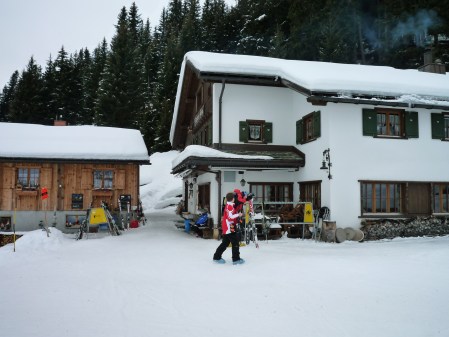
We tried the local Prättigau speciality Chäsgetschäder here, a cheesy bread bake, perfect after a hard morning’s skiing. I’ve searched out a recipe for this dish which I give below. The version in the recipe sounds more soupy and creamy than the dish we ate at Berghaus Erika – their version appears to have been baked in the oven or cooked on the stove top to produce a golden crust:

At the foot of another black run is the Hotel Kulm in Wolfgang, the hamlet on the main road between Klosters and Davos. This is another atmospheric place to eat, with lots of local specialities on the menu. The hotel sits between the main road and station at Wolfgang – there’s no ski lift back to the slopes, so time your meal to coincide with a Rhätischebahn train back to either Davos or Klosters . Here’s a view of the hotel from the station platform.

We tried Maluns, a dish of fried potatoes served with cheese and apple sauce, a typically Swiss combination. This dish looks rather basic when it arrives – essentially a plate of crispy golden crumbs, a piece of cheese and dollop of apple sauce on the side, but the combination tastes good. I’ve managed to find a recipe too which I give below.
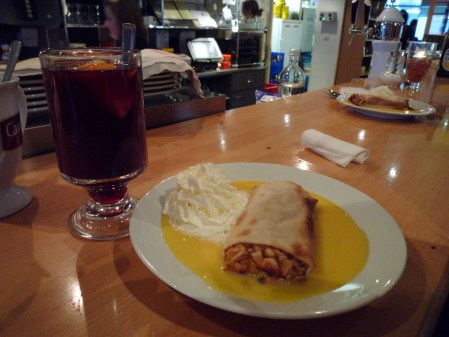
A day skiing in Klosters wouldn’t be complete without an après-ski drink and snack in Bistro Logo in the main street – this seems to be the town’s only café and is permanently busy as a result. Since Graubünden went smoke-free a couple of years ago, this is now a very pleasant place to sit and chat. My son George’s favourite order here is the apple strudel with both vanilla sauce and whipped cream:
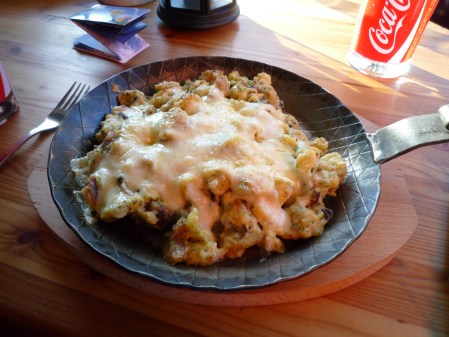
Finally, a mention of two other regional dishes which appear frequently on menus in and around Klosters. The first is Pizokel, a gratin of potato dumplings which makes a hearty ski lunch. Here’s how it’s served locally andI give a recipe below.
The second is Capuns, another Graubünden speciality – little parcels of savoury stuffing wrapped in Swiss chard leaves. Sadly, I didn’t have an opportunity to try these during our trip. Of all the local dishes, these seem to fit in with current cooking trends – not too much cheese, butter and starch and the use of a vegetable rather than pasta or pastry to encase a savoury filling has a contemporary feel even though this is a traditional regional dish. My trusty little Betty Bossi cookbook which I bought in Switzerland ages ago has come up trumps again – I give the recipe below and plan to give it a try as soon as I can get hold of some Swiss chard.
Recipe for Maluns – a fried potato dish, a speciality of Graubünden
This recipe comes from “Bündner Landfrauen Kochen” (the Graubünden Farmers’ Wives Cookbook), a little spiral-bound paperback book I bought in the Klosters bookshop a couple of years ago. The contributor is a Mrs Renata Canetg from Domat/Ems, a little town in the Rhine Valley near Chur.
She doesn’t say how many people this will serve – I estimate this would make 4 generous portions.
This was originally a breakfast dish eaten with and in fact mixed with milky coffee. You will find it more commonly served now as a hearty lunch or supper dish with a good-sized wedge of cheese and a dollop of apple sauce. The combination of cheese, potato and apple is typically Swiss.
Ingredients
1 kg waxy potatoes boiled in their skins and left for two days
350 g plain flour
1 teaspoon salt – more to taste
125g-150g butter (depending on how your potatoes behave)
To serve
Apple sauce
Wedges of Graubünden mountain cheese
Peel the potatoes and grate them using a coarse grater. Mix the grated potatoes with the flour and a little salt. Divide the mixture into two and fry one portion at a time in a non-stick frying pan in hot butter. When the mixture colours, turn the heat down a little and cook until golden, stirring frequently with a wooden spoon. The mixture will form into small balls. Serve immediately while hot and crispy.
Recipe for Kartoffelpizokel – potato dumplings, a speciality of Prättigau
This recipe serves 4 people and comes from a little recipe book by fictional Swiss author Betty Bossi entitled “Specialités Suisses”. The Prättigau is the region within the canton of Graubünden comprising the Landquart and Landwasser valleys in which respectively Klosters and neighbouring Davos are located.
Ingredients
700g peeled raw potatoes, floury such as Désirée
100 to 150g plain flour
1 teaspoon salt
freshly ground black pepper
For the gratin
200g grated Prättigau mountain cheese (substitute Gruyère if you like)
1 tablespoon butter
100g lardons (diced bacon)
2 medium onions halved and thinly sliced
Cranberry sauce to serve (the Swiss recipe suggests a compôte d’airelles which is similar to our cranberry sauce – the airelle is a sharp red mountain berry)
Grate the potatoes into a bowl using a fine grater. Squeeze out some of the raw potato juice with your hands. Mix in 100g of the flour, salt and pepper. Bring a large pan of salted water to the boil. With two spoons, take a small piece of the mixture, form it into a dumpling and drop it into the boiling water. If it doesn’t hold its shape, stir in the extra 50g of flour specified in the list of ingredients.
Form the mixture into dumplings and drop them into the water. Stir around. Allow to simmer for 10 minutes. They will at first drop to the bottom of the pan then rise to the surface once they are cooked, like gnocchi. Remove with a slotted spoon and place them into a buttered gratin dish. Sprinkle over the grated cheese and bake in an oven preheated to 200 degrees C for 20 minutes.
While the pizokel are in the oven, melt the butter in a frying pan, add the lardons and cook until golden. Add the sliced onions to the pan and continue cooking until the onions are golden. Spread the mixture over the baked pizokel.
Recipe for Chäsgetschäder – a rustic cheese bake, a speciality of Prättigau
Another recipe from the Betty Bossi Swiss Specialities book – serves 4.
Ingredients
100g butter
2 onions, finely chopped
250g day old white bread, crust on, cut into cubes
750 ml milk
salt and freshly ground black pepper
a little grated nutmeg
600g aged Prättigau mountain cheese, grated (or a mixture of aged Appenzell,Gruyère and Fribourg Vacherin cheeses in the ratio 250:250: 100. The recipe needs mature cheese otherwise it will lack flavour and be too stringy and indigestible)
Melt the butter in a large saucepan or enamelled casserole. Add the chopped onions and cook until golden. Add the bread cubes and fry briefly. Add the milk, bring to the boil and allow to simmer gently for 10 minutes, stirring from time to time. Season to taste with salt, pepper and nutmeg. Gradually add the grated cheese, stirring constantly, until the mixture become creamy. Serve immediately.
Recipe for Capuns – stuffed swiss chard leaves, a speciality of Graubünden
Ingredients
For the stuffing
150g flour
pinch salt
3 tablespoons milk
2 eggs
1 dessertspoon butter
1/2 onion, finely chopped
1 tablespoon finely chopped parsley
1 dessertspoon snipped chives
50g chopped air dried beef from Graubünden
100g cooked salami type sausage cut into small dice
For the wrappers
16 young tender Swiss chard leaves
To finish the dish
100 ml double cream
200 ml meat stock
salt and freshly ground black pepper
a little butter for frying the ham strips
50 g raw cured ham cut into strips
Work the flour, salt, milk and eggs into a thick paste. Put it aside and leave it to rest for 30 minutes. Melt the butter in a saucepan, sauté the onions until translucent. Add the chopped herbs, give the mixture a quick stir, then turn off the heat. When the mixture is cool, mix it with the paste. Add the chopped dried beef and sausage.
Now prepare the leaves. Blanch them briefly in abundant boiling salted water then plunge them immediately into iced water. Dry them on absorbent kitchen paper.
Place a teaspoon or so of filling onto each leaf then roll up.
Now cook the formed capuns. Pour the cream and stock into a large saucepan, season and bring to simmering point. Add the capuns to the pan, cover and allow to simmer for 5 to 10 minutes. Heat a little butter in a small frying pan and quickly fry the ham strips until crispy. Divide the capuns between 4 plates, spoon over a little cooking liquid and garnish with the fried ham strips.
Restaurant contact details
Bruhin’s Weissfluhgipfel
7260 Davos Dorf
Tel. +41 (0)81 417 66 44
Fax +41 (0)81 417 66 40
www.gourmetdavos.ch
Berghaus Erika – Schlappin
Tel +41 (0)81 422 11 17
Hotel Restaurant Kulm
7265 Davos-Wolfgang
Tel. +41 (0) 81 417 07 07
Fax +41 (0) 81 417 07 99
Bistro Logo
Bahnhofstrasse
7250 Klosters
Tel. +41 (0)81 422 19 96
 The Rhubarb Fool