
Clonter opera picnic: what to eat with Rigoletto
October 5, 2009 § Leave a comment
Our friends Emma and Andrew organise a trip to Clonter Opera each October for an ever-increasing group of friends and neighbours. Clonter is the Cheshire equivalent of Glyndebourne and strikes a harmonious balance between serious music-making and jolly social occasion. Clonter specialises in giving young singers fresh out of conservatoire a leg-up in establishing their careers. For example, we heard New Zealand bass baritone Jonathan Lemalu at Clonter a few years ago and he’s now made quite a name for himself as an up-and-coming artist.
Enough of music and onto the serious business of the food. What the Clonter audience usually does is arrive at 6.30 and unpack hampers onto the tables provided in the barn seating area for drinks, canapés and first course. The performance then starts at 7.30 with a 70 minute long supper interval, just long enough for main course and pudding. We’re old hands now and know there is never time or appetite for cheese or coffee so we cut the stress and don’t bother with these now.
We were a group of 19 this year and Emma asked me if I might do some platefuls of nibbles to hand round which would serve both as canapé and as first course without the need to be formally seated. Nice idea but allowing 5 items per person and rounding up, this would necessitate making 100 canapés which is a tall order for a busy Saturday afternoon. I set myself the additional challenge of theming the canapés with the opera which was Rigoletto.
The opera is set in Mantua and was given its first performance in Venice. There is plenty of drama in Verdi’s dark tale of debauchery and deception but it is light on frivolous drinking and feasting scenes. The dreadful climax of the opera comes when court jester Rigoletto realises that the body in the sack he is about to hurl into the river is not that of the evil Duke of Mantua, but that of his beloved only daughter Gilda.
A few minutes mulling over the opera plotline and I came up with the idea for Northern Italian finger-food featuring miniature filo pastry sacks. Is this in poor taste and taking theming a little too far? Yes probably but I’m afraid that is how my mind works…..
Anyway without dwelling overmuch on my foibles, the chosen canapé menu was:
Stuffed olives. Waitrose do some gorgeous large Kalkidis (sic) olives stuffed with fruit compôte – not entirely authentically Italian but nevertheless very good. Surely these should be spelt Halkidikis or at the very least Kalkidikis? Looks like a syllable has gone missing. Maybe I’ll write to Waitrose to point this out.
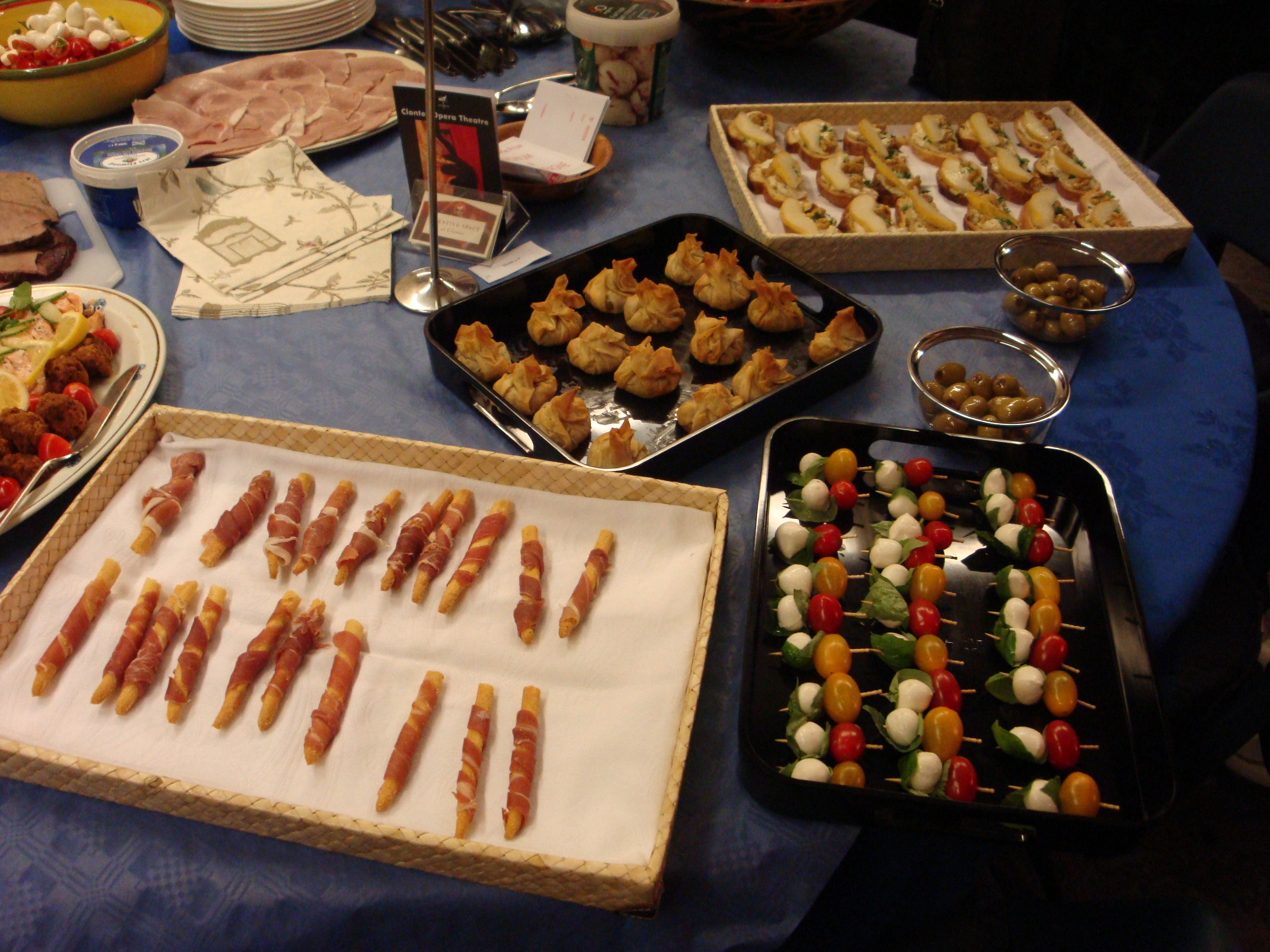
Twists of parma ham artfully spiralled around rustic breadsticks – both elements picked up at favourite local shop Goose Green Delicatessen
Bruschetta with Gorgonzola dolce, walnuts and slices of fresh pear (painstakingly dipped in lemon juice to stop them going brown)
Mozzarella, tomato and basil bites – individual buffalo mozzarella bocconcini balls threaded onto a cocktail stick with a mixture of red and yellow cherry tomatoes and a single perfect folded basil leaf
All the above were pretty straightforward to put together – essentially an assembly job with deli ingredients. The pièce de résistance was to be the Mantuan miniature filo pastry sacks – Mantuan because of the chosen filling of roast butternut squash, sage and parmesan. I visited Mantua on a tour of Northern Italy a few years ago now. Its most famous dish is Tortelli di Zucca – ravioli filled with pumpkin, served with a simple sauce of sage-flavoured butter. I took inspiration from this dish for my sacks. Butternut squash is a pretty good substitute for the local Mantuan pumpkin having the necessary sweetness and depth of flavour once it’s been given the roasting treatment. I cut the squash into chunks and tossed them in a tablespoon or so of olive oil into which I’d thrown a few snipped purple sage leaves from the garden and some sliced garlic cloves, then baked them in the oven for about an hour. My baked squash became intensely savoury before being incorporated into the filling for the filo pastry sacks.
Here is the beautiful orange squash ready to go into the oven:

And here are the finished canapés ready for serving on our Clonter picnic table. All disappeared in a fraction of the time they took to prepare.
Almost forgot to mention that the performance of Rigoletto was a triumph – fantastic singing and inspired casting. One of the best performances I’ve seen in ages.
The recipe of my own devising for the Mantuan filo pastry sacks follows. These would have been best served warm but were in fact still pretty good at room temperature having been transported from kitchen to Clonter.
Recipe for Mantuan filo pastry parcels
Makes 20 parcels
Ingredients
1 medium butternut squash, peeled, deseeded and cut into 1 inch chunks
8-10 sage leaves, roughly chopped
3 cloves garlic, chopped
2 tablespoons light olive oil
Sea salt and freshly ground black pepper
1 egg yolk
1/2 teaspoon freshly grated nutmeg
2 oz finely grated parmesan or grana padano
270g pack filo pastry sheets
2 oz melted butter, maybe more if required
Make the filling. Peel, deseed and chop the squash into chunks. In a large bowl, toss the chunks with the oil, sage and a little salt and pepper and tip the whole lot onto a shallow baking tray lined with baking paper to avoid the squash sticking. Bake at 200 degrees C until the squash is cooked through and is become deliciously slightly charred and toasty round the edges. Don’t take it too far – you are looking to intensify the squash flavour, not burn it.
Let the baked squash cool a little then tip it into a roomy bowl and go in with a crinkle-cut chip cutter to reduce the squash to a chunky not too smooth purée. Add the cheese, nutmeg, and egg yolk, mix, then taste and adjust seasoning if necessary. If you are concerned about eating raw egg yolk, do the tasting bit before mixing in the egg yolk.
Now form the parcels. Melt the butter in a small pan and allow to cool a little. From memory, the pastry packet contains 10 large sheets folded pastry. Begin by cutting these 10 sheets neatly in half to make 20. Put aside and cover 10 of these half sheets and work with the other 10. Filo pastry is very thin and dries out quickly so you need to keep covered what you are not using in the next few minutes. Cut your ten half sheets in half again to make 20 smallish squares.
For each parcel, take 2 squares and lay them out on a pastry board. Brush each square scantily with melted butter and lay one one on top of the other at a 90 degree angle to create a rough star shape. Place a generous teaspoon of the squash filling in the centre and pick up and roughly twist the pastry together to create a sack or money-bag effect. Dab the formed parcel with some additional melted butter. Place the completed parcel onto a metal baking sheet. Continue until you have 10 parcels then gauge whether you need some more melted butter and repeat the process with the other half of your pastry.
Bake the parcels at 180 degrees C for 15-20 minutes until the pastry is golden brown and becoming crisp in parts. Cool on a rack.
Making use of the bumper harvest of British plums
September 12, 2009 § Leave a comment
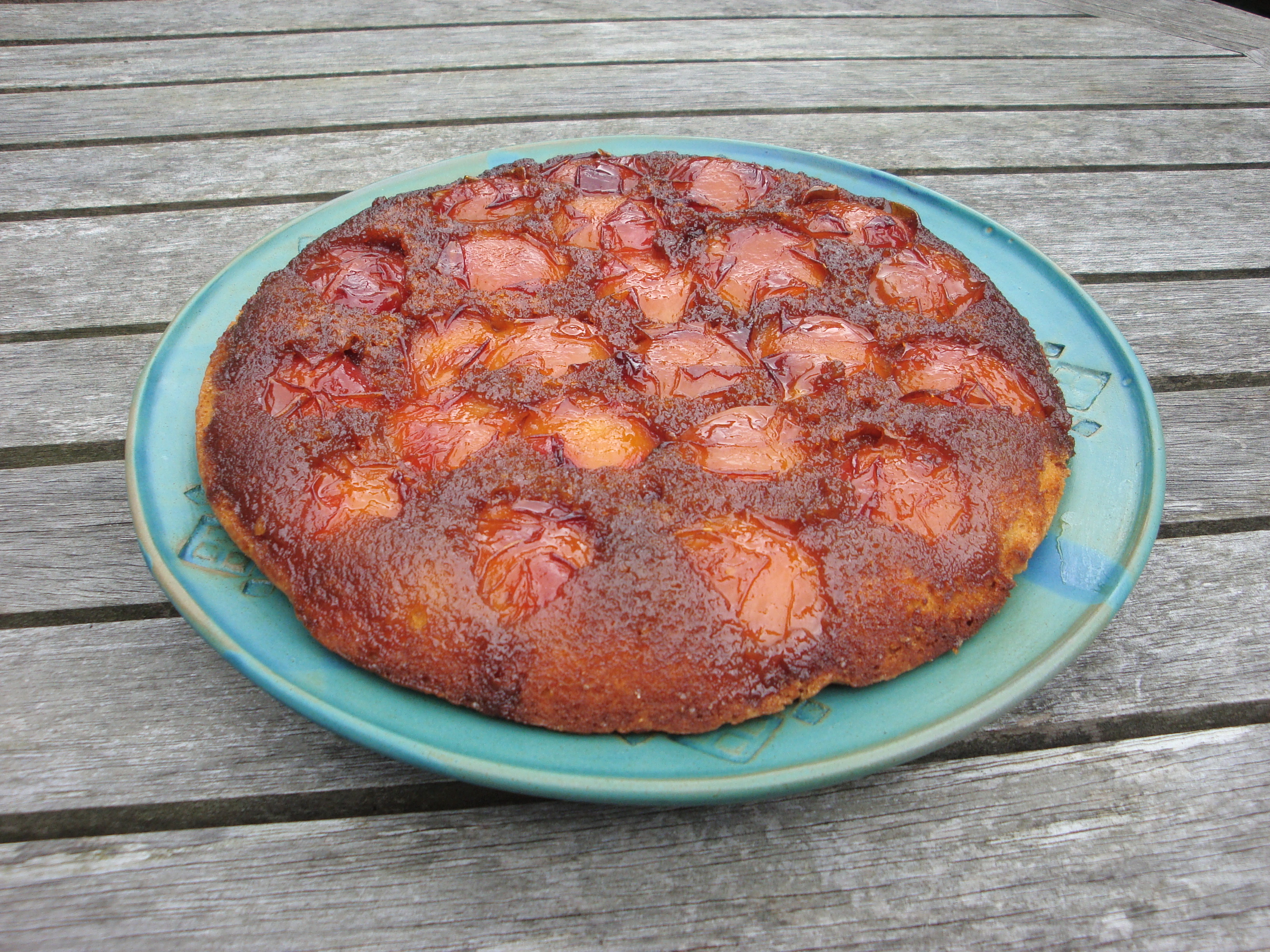
A story on BBC Radio 4’s Farming Today earlier in the week about this year’s bumper harvest of British plums prompted me to seek out some plums at the weekend and bake this fantastic upside-down plum cake from Aussie chef Bill Granger’s book “Bill’s Food”.
I really like Bill’s take on food, so much so that I have five of his books now and invariably the recipe I’m searching for is in the fifth book I look in. The recipes are fresh and uncomplicated and, unlike some glossy cookbook authors I might mention (yes I mean you Nigella and Nigel) all the recipes I have tried have worked first time.
Bill’s trick of using a frying pan in which to bake this cake is a neat one and I bet it would work just as well for a Tarte Tatin so I can cross off that Le Creuset Tarte Tatin tin from my wish list now and save valuable space in my kitchen.
Recipe for upside-down plum cake
Ingredients
Caramelised plums
1 lb 14 oz (850g) plums
1 3/4 oz (50g) butter, softened
4 oz (115g) caster sugar
1 tablespoon lemon juice
Cake
3 1/2 oz (100g) butter
8 oz (225g) caster sugar
4 eggs, separated
1 teaspoon vanilla extract
5 1/2 oz (155g) plain flour
2 teaspoons baking powder
1 teaspoon ground cinnamon
pinch salt (optional – especially as Bill specifies unsalted butter in this recipe whereas I invariably use slightly salted butter for most things)
Preheat the oven to 180 degrees C (350 degrees F/Gas 4). Use a sharp knife to slice the cheeks from the plums and discard the stones. To make the caramel, melt the butter in an ovenproof (ie not one with a plastic or wooden handle) 28cm (11 inch) frying pan over low heat. Add the sugar and lemon juice and stir until dissolved. Increase the heat and cook for 5-6 minutes, or until golden and caramelised. Transfer the plums to the pan and cook gently for 2 minutes.
To make the cake, cream together the butter and sugar until light and fluffy. Add the egg yolks, one at a time, beating well after each addition, then add the vanilla extract. Sift the flour, baking powder, cinnamon and salt over the mixture and beat until smooth. Beat the egg whites in a clean dry bowl until stiff (using an electric whisk for speed). Fold into the cake mixture with a metal spoon. Spoon over the plums in the pan, smoothing the surface with a spatula.
Bake for 40 minutes, or until a skewer inserted into the centre comes out clean. Leave to rest for a minute or so before carefully turning out and serving with cream or crème fraîche.
Serves 10-12
Obsessed by cauliflower
September 7, 2009 § Leave a comment

Obsessed by cauliflower? I can hear the incredulity in your question but, yes, it’s true.I listened to Radio 4’s Food Programme back in August whilst on holiday and heard Yotam Ottolenghi, founder of London’s Ottolenghi restaurant group, singing the praises of the humble cauliflower. This was one of a series of “Chef’s Choices” where 6 chefs picked their favourite ingredient. I was delighted that cauliflower had been chosen by a chef with a middle eastern background who could have chosen any one of a thousand exotic ingredients.
I believe that every vegetable can taste fantastic if it is cooked sympathetically. Cauliflower is a case in point. My abiding childhood memory of cauliflower is seeing a whole head of cauliflower boiled soggily in the pan, complete with enormous white grub…. yuck.
Cauliflower is really not at its best plain boiled when its brassica flavour can become overpowering. Easily overcooked, it can become mushy and unpleasant. Cauliflower does however, as Ottolenghi reminded us, take brilliantly well to spices. The spiced cauliflower fritters he prepared on the programme sounded absolutely mouthwatering. I’ve dug out the recipe and list it below along with some more from my own repertoire: another middle eastern fritter recipe from Claudia Roden’s much quoted “A New Book of Middle Eastern Food” together with a cauliflower salad from the same source, and a recipe for cauliflower with potatoes from Madhur Jaffery’s first BBC book “Indian Cookery”.
The programme interspersed clips of Ottolenghi in the kitchen with factual and cultivation details from a Lincolnshire based cauliflower grower. Cauliflower sales it seems are sadly in decline as cauliflower has been eclipsed by its sexier green cousin, broccoli. It’s definitely time to support our home grown caulis and free them from their blankets of gloopy cheese sauce!
Recipe for cauliflower and cumin fritters with lime yoghurt
Ingredients for lime sauce
330g Greek yoghurt
2 tbsp chopped coriander
Grated zest 1 lime
2 tbsp lime juice
2 tbsp olive oil
Salt and pepper
Ingredients for cauliflower fritters
1 cauliflower
120g plain flour
3 tbsp chopped flat leaf parsley
1 garlic clove crushed
2 shallots chopped
4 eggs
1.5 tsp ground cumin
1 tsp ground cinnamon
1.5 tsp ground turmeric
1.5 tsp salt
1. tsp black pepper
550 ml vegetable oil for frying
1. Put all the sauce ingredients in a bowl and whisk well. Taste – looking for a vibrant, tart, citrusy flavour – and adjust seasoning. Chill or leave out for up to half an hour.
2. Prepare the cauliflower, dividing it into florets. Add to a large pan of boiling salted water and simmer for 15 minutes or until very soft. Drain into a colander.
3. Put the flour, chopped parsley, garlic, shallots, eggs, spices, salt and pepper in a bowl and whisk into a batter. When the mixture is smooth, add the warm cauliflower. Mix to break down cauliflower into the batter.
4. Pour vegetable oil into a sauté pan – 1.5cm depth – and heat. When hot, spoon in generous portions of the cauliflower mixture, 3 tablespoons per fritter. Fry in small batches, controlling oil temperature so the fritters cook but don’t burn. They should take 3-4 minutes on each side.
5. Remove from pan and drain on a kitchen paper. Serve with sauce on the side.
Recipe for deep fried cauliflower with walnut tarator sauce
Ingredients for walnut tarator sauce
2 thin slices bread, crusts removed
120 g (4 oz) roughly chopped walnuts
150ml (1/4 pint) olive oil
1-2 tbsp wine vinegar (start with 1, taste and add more if required)
1 clove garlic, crushed
Salt and pepper
Ingredients for deep fried cauliflower
1 cauliflower
EITHER batter made with the following ingredients
OR egg and breadcrumbs
4 oz plain flour
1/4 pint water
1 whole egg, beaten
1 tsp ground turmeric
1 tsp ground coriander
1 tsp ground cumin
salt and pepper
Prepare the tarator sauce. Dip the bread in water and squeeze dry. Place in the bowl of a food processor with 1 tbsp of the vinegar, nuts, garlic and seasoning. Process, gradually adding the olive oil, until smooth. Taste, adding more vinegar and seasoning if required.
Wash the cauliflower and separate into florets. Boil in salted water until only just tender (5-10 minutes). Drain and allow to dry well. If using batter rather than egg and breadcrumbs, make the batter by tipping flour into a bowl, breaking an egg into a well in the middle and gradually whisking in the water to the egg and flour. Whisk in the spices, salt and pepper.
Dip the cooked florets in the above batter mixture (or egg and breadcrumbs) and deep-fry until golden, turning over once. Drain well. Serve with the tarator sauce.
You can also serve the tarator sauce with plain boiled or steamed vegetables such as green beans or courgettes. Hazelnuts can be substituted for walnuts but I think the walnuts work better with cauliflower.
Recipe for fennel, celery and cauliflower salad
1 small cauliflower
1 bulb fennel
3 sticks celery
Olive oil, lemon juice, salt and pepper
1-2 tbsp chopped fresh mint
Claudia Roden’s recipe suggests lightly cooking the vegetables to make an unusual salad but I prefer to use them raw.
Wash and prepare vegetables by cutting into bite-sized pieces. Either use the vegetables raw (my preference) or cook them in boiling salted water for a few minutes until only slightly softened.
Dress with plenty of olive oil, lemon juice , salt and pepper and the chopped fresh mint.
Recipe for cauliflower Waldorf salad
I dreamed up this salad to make use of the tarator sauce I had left over from the deep-fried cauliflower recipe. Take the salad vegetables from the preceding fennel, celery and cauliflower salad recipe, add 2 sliced eating apples, skin-on (red skin looks good). Dress with tarator sauce (from above deep fried cauliflower recipe) toss lightly and serve. The walnuts required for a Waldorf salad are of course present, ground, in the sauce.
Recipe for Cauliflower with Potatoes Phool gobi aur aloo ki bhaji
Serves 4-6
1/2 lb (225 g potatoes)
1 medium cauliflower (you need 1 lb (450g) florets)
5 tbsp vegetable oil
1 teaspoon whole cumin seeds
1 teaspoon ground cumin seeds
1/2 teaspoon ground coriander seeds
1/4 teaspoon ground turmeric
1/4 teaspoon cayenne pepper
1/2-1 fresh hot green chilli very finely chopped
1/2 teaspoon ground roasted cumin seeds
1 teaspoon salt
Freshly ground black pepper
Boil the potatoes in their skins and allow them to cool completely. (Day-old cooked potatoes that have been refrigerated work very well for this dish). Peel the potatoes and cut them into 3/4 inch (2 cm) dice.
Break up the cauliflower into chunky florets, about 1 1/2 inches (4 cm) across at the head and about 1 1/2 inches (4 cm) long. Soak the florets in a bowl of water for 30 minutes. Drain. ( I have frequently omitted this step and the recipe seems to work just the same without the faff of soaking and draining).
Heat the oil in a large, preferably non-stick frying pan over a medium flame. When hot, put in the whole cumin seeds. Let the seeds sizzle for 3-4 seconds. Now put in the cauliflower and stir it about for 2 minutes. Let the cauliflower brown in spots. Cover, turn heat to low and simmer for about 4-6 minutes or until cauliflower is almost done but still has a hint of crispness left. Put in the diced potatoes, ground cumin, coriander, turmeric, cayenne, green chilli, ground roasted cumin, salt, and some black pepper. Stir gently to mix. Continue to cook uncovered on low heat for another 3 minutes or until potatoes are heated through. Stir gently as you do so.
We eat this at home sometimes as an accompaniment to an Indian meal or more often as a midweek meal in itself along with brown rice and a cucumber raita.
Guernsey: Hedge Veg, Fenella Maddison’s Fort Grey cheese and a recipe for aubergines
August 31, 2009 § 2 Comments
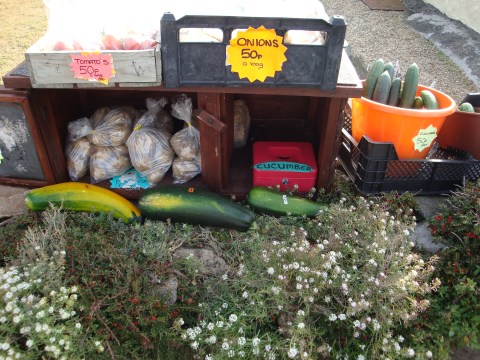
One charming aspect of visiting Guernsey, the island of a thousand greenhouses, is discovering the local custom of “hedge veg”. Keen amateur gardeners sell their surplus produce in their front gardens or at the roadside, leaving out an honesty box. You will find most often potatoes, tomatoes and French beans, also cucumbers, peppers and aubergines and occasionally melons and grapes too. Shops are thin on the ground outside St Peter Port but during the summer months, thanks to hedge veg, you will find an abundant supply of fresh picked fruit, vegetables and salad wherever you are on the island.
Here’s a rather splendid example from the west coast:
The last day of our holiday came round on Saturday so I decided to to pick up some fresh Guernsey produce for a nostalgic supper at home that evening. First stop was our local Vazon Bay roadside stall for some gorgeous glossy aubergines:

Next, a visit to the bustling Forest Stores en route to the airport to track down a locally made soft blue cheese called Fort Grey. I’d spotted an article on this cheese in the Guernsey Evening Press a few days earlier. It’s made by Fenella Maddison using local Guernsey cows’ milk from Torteval. She made the headlines after taking a Silver award at this year’s Nantwich Cheese Festival held at the end of July.
Here’s Fenella’s cheese which made a lovely end to our meal back home later that evening. It’s soft and creamy but with a distinct blue tang. If you enjoy Gorgonzola dolce then I think you would enjoy this cheese too and I urge you to give it a try if ever you have the chance.

Savouring the cheese at the end of our meal the name Maddison suddenly rang a bell – Derek Maddison was a former colleague of mine at GEC’s Stanhope Gate head office in London some years ago. I remembered he’d then moved to Guernsey to take up an insurance job. The mental wheels kept turning and I remembered too that his girlfriend at that time was called Fenella… what a coincidence! Clearly Derek and Fenella are married, living in Guernsey and Fenella is now an artisan cheesemaker. Good on you Fenella! I shall drop you a line shortly and let you know how much I enjoyed your cheese.
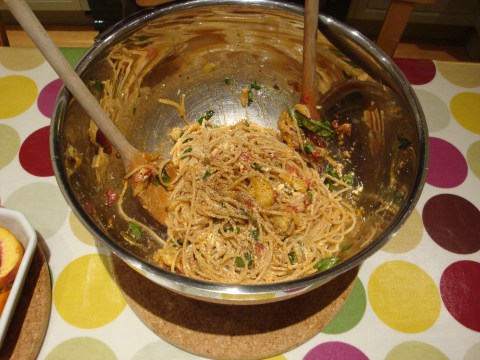
Before the cheese course, I turned the glossy Guernsey aubergines I brought home into one of my favourite pasta recipes – Spaghetti alla Siciliana – adapted from Marcella Hazan’s recipe. I don’t salt and drain aubergines now but roast and squeeze out the bitter juices instead.
Here’s the finished dish ready for serving:
And here is the recipe:
Spaghetti alla siciliana
For 6 as an Italian style pasta dish; 2 for a generous main course dish
1 large or 2 medium aubergines baked for 45 minutes, cooled, squeezed, peeled and chopped into rough chunks
1 tbsp olive oil
1 medium onion thinly sliced
2 cloves garlic peeled and chopped
14 oz 400g tinned plum tomatoes drained and cut into thin strips
freshly ground black pepper
salt
1lb spaghetti (wholewheat is good here)
3 tbsp grated mild pecorino cheese
1 oz fresh ricotta
8-10 fresh basil leaves roughly torn
freshly grated parmesan cheese for the table
Add the olive oil to the pan along with the sliced onion. Cook over medium/high heat until the onion becomes pale gold. Add the chopped garlic and cook for a few seconds more, stirring as you cook. Add the tomato strips, turn the heat up to high and cook for 8-10 minutes stirring frequently. Add the aubergine, turn the heat down to medium and cook for a minute or two, mixing it with the other ingredients. Season with pepper and salt, remembering that salty pecorino will be added subsequently.
Cook the spaghetti in plenty of boiling water. When still al dente, drain and mix with the sauce in the pan or in a warmed serving bowl. Stir in the cheeses and basil and season once more.
Serve immediately with more parmesan cheese at the table.
Details for Guernsey’s Forest Stores are:
Forest Stores
Le Bourg
Forest
GY8 0AW
01481 238 395
As far as I know, the only retail outlets for Fenella’s Fort Grey and Torteval cheeses are on Guernsey – either the Forest or Torteval stores. You can read about Fenella’s cheesemaking exploits here:
Battle of the bakers: exhibiting at Guernsey’s North Show
August 28, 2009 § Leave a comment
I’ve cherished the ambition for a number of years now of entering some home-made produce into an agricultural show. Being an urban dweller, opportunities to visit rural shows are thin on the ground, but if you happen to be in Guernsey in August (as we were on our family summer holiday) you can’t fail to miss the three events on the social calendar, the South Show, the West Show, and the biggest and best of the lot, the North Show which hosts the famous Battle of the Flowers (more on this later). Curiously, there is no East Show – presumably because the east of the island is dominated by St. Peter Port or Town as the locals call it.
All three shows were heavily trailed on the local radio stations: after all, Island FM’s strap line is “Breaking News Across the Bailiwick” so it wasn’t long before I realised this could be my big opportunity. I seized the moment and telephoned Mr Dorey, the show organiser and soon found out how to register. I had to attend Castel Parish’s Douzaine Room, a local community hall, between the hours of 3.00 and 5.00 on the Saturday afternoon before the show.
I turned up at the appointed time to find the hall bustling. The first thing I had to do was become a member of the North Show Agricultural and Horticultural Society, annual subscription £15.00. Oh no! I quickly learned that in order to qualify as a member not only do you have to be resident of Guernsey but of three specific parishes, Castel, Vale and St Sampson’s. Fortunately, this is Guernsey where a relaxed attitude is taken to addresses of convenience. In return for fifteen quid they were happy to accept the address of our holiday apartment which we would occupy for precisely one week. They didn’t even rumble me when I mispronounced the name of our parish Castel, which in the local accent is pronounced Cattle.
Phew. Next hurdle was choosing what to exhibit. I picked up a handsome looking Show Schedule, homed in on the baking section and practically with my eyes closed stuck my pen down on a random choice which turned out to be local speciality Gâche Melée. I had no idea what this was, but it seemed to be a popular choice and, what the heck, I had a few days to research it before the show opened on Wednesday.
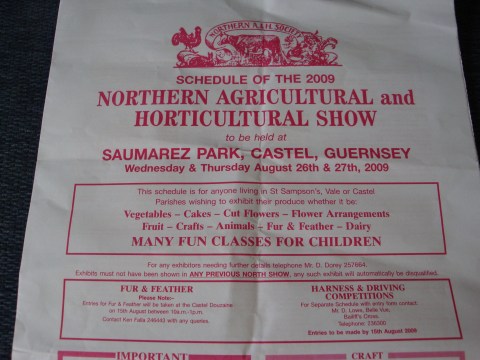
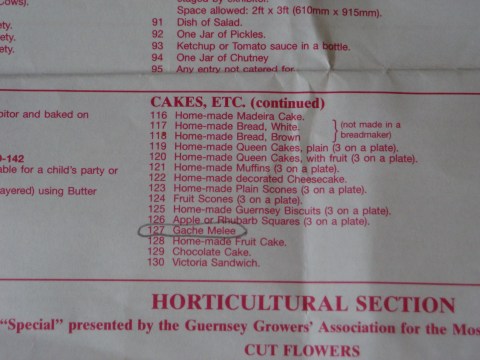
Back to our holiday apartment in Vazon Bay and within minutes, with the help of the miraculous iPod Touch, a WiFi Hotspot and of course the assistance of a 10 year old boy, I had discovered that Gâche Melée was a rustic apple cake. That sounded manageable. After copying down seven different recipes, I stopped – they were all similar but subtly different, the kind of dish that is handed down mother to daughter with each family taking pride in their own version. The ingredients were simple enough: apples, flour, sugar, fat in the form of suet or butter, liquid in the form of egg or milk, plus a little spice – nutmeg or cinnamon.
Game on! I reckoned I could show the natives a thing or two so decided to experiment that evening with the most cheffy of the recipes I’d found – a version which caramelised the apples and used loads of butter. The recipe was simple enough but, oh dear, I hadn’t reckoned on the self catering oven which was completely devoid of markings, temperature controls and instructions. My first attempt to achieve a moderate heat resulted in a super-hot grill, whereas my next attempt heated up just the oven base. After a little trial and error, I found a workable baking heat and put my gâche in to bake.
Here is the end result.

Hmm. It tasted OK but wasn’t going to win any prizes in the looks department. That self-catering pyrex dish didn’t really cut the mustard in the style stakes either. I was going to have to raise my game. I decided that for the Show itself, I should stick with what worked and use a prizewinning recipe.
Presentation is important too so next day in St Peter Port I called into well stocked kitchen shop Lelievre’s, just on the harbour frontage, and picked up a square metal tin (so important for a non-soggy crust) and, my secret weapon, a modish square plate to present my creation! The helpful staff also told me how to pronounce gâche melée the local way – you should say gosh molloy rather than putting on your best French accent.
The morning of the Show dawned and I was up at 5.00 am to make sure my Gâche Melée was as freshly baked as it could be. I’d prepared the apples the night before so it was pretty easy to throw together. I forgot to mention earlier that not only was I winging it on oven temperatures but I had no scales either, so it was completely put together by eye. I was pretty pleased with the end result:

I cut a neat but generous square for the judges, positioned it artfully onto my new square plate then packed up the whole lot and transported it on my bike to Saumarez Park, the show venue, a mile or so up the road. There was an air of purposeful activity in the showground. Guernsey cows and goats were being installed outside, and there was a steady stream of people coming and going through the main show tent. Exhibitors were giving there vegetables, baking, mini gardens and so on the final primping. I placed my gâche in its right place on the long trestle table assigned to baked goods, slipped the brown envelope with my exhibitor card next to it and had a quick look at the competing entries – mine didn’t look half bad in comparison – I could be in with a chance.
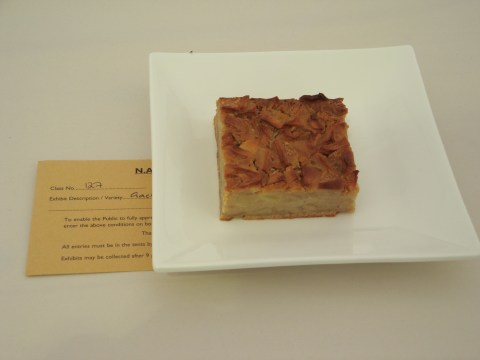
Back to the apartment for a well-deserved breakfast.
We made a family outing to the Show later on that morning, admiring the perfectly groomed animals and the too-perfect horticultural produce. The laden tables were a sight to behold.
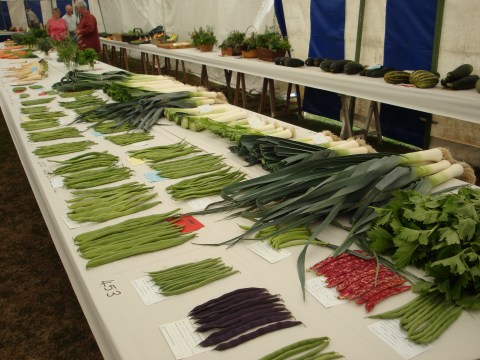
11.00 o’clock was the designated time for judging. As you can see, the entries were protected from flies, and perhaps greedy spectators, by netting.

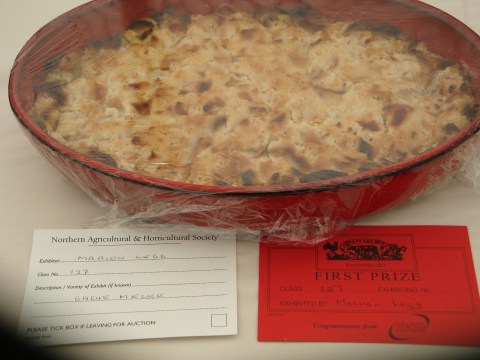
Once the judges had made their decisions and awarded the coveted red and blue cards it was the moment of truth. I wasn’t expecting a first place, after all as a non-Islander, it would be pretty embarrassing. I needn’t have worried. Marion Legg won first prize with this entry, generously proportioned, crusty and golden-brown and sensibly cling-filmed.
Would the blue card and second prize be mine? No, this went to Sarah Giles with her appealing, crumbly version.

There was still hope – there was no shame in a third prize. Could this be mine?
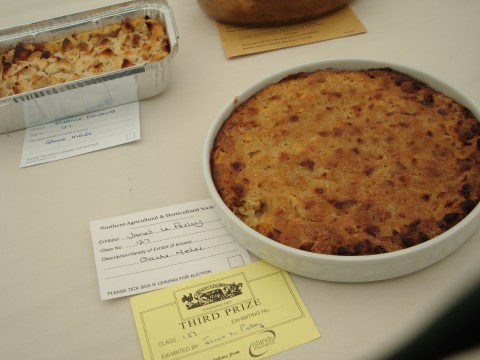
No! Sadly not, as this was awarded to Janet Le Pelley (a good Guernsey surname). I was disappointed and would have to try again. With the benefit of hindsight, I wonder if a more rustic traditional presentation might have suited the judges better. Also, I think you get a lighter textured gâche if you chop the apples, add them to the batter and bake straightaway without leaving the mixture to stand. I had prepared my apples in advance causing the juices to run and dilute the batter producing a dense clafoutis like result rather than the more cakey texture of the prizewinners.
Tension relieved, we were able to enjoy the rest of the show. The main event is the Battle of the Flowers, a competition for floats decorated with flowers, both artificial and real. Here are two of my favourites:


Both took first prize in their respective classes and the Viking Longship was the overall Battle of the Flowers Champion.
It’s time I gave you the gâche melée recipe. We all enjoyed testing it and it definitely has potential to become a family favourite – quick and easy to make, the children enjoy it and it makes good use of apples, (both cookers or eaters work).
Recipe for Gâche Melée
Ingredients
1 and 1/2 lb apples peeled, cored and chopped
3 oz granulated sugar
2 oz suet
4 oz self-raising flour
1 beaten egg
1/2 teaspoon powdered cinnamon
Combine chopped apples, sugar, suet, flour and cinnamon in a bowl. Mix thoroughly then mix in the beaten egg to form a softish batter. Add a tablespoon or so of milk if it seems to stiff. Spoon into a prepared baking tin – a rectangular 6″ by 7″ metal baking tin lined with baking parchment is recommended. Sprinkle the surface with a little additional sugar and cinnamon Bake for 30 to 40 minutes at 180 degrees C or until the top is a deep golden brown. Serve with cream, custard or ice cream or just enjoy it on its own as a cake. It transports well for picnics.
Guernsey: the Lobster Saga Part 2
August 24, 2009 § Leave a comment
The Big Day had dawned: I was going to prepare (euphemism of course for kill) my first lobster and then prepare the classic dish of Homard a l’Américaine for the very first time. I planned to follow the elaborate instructions given in classic cookbook Mastering the Art of French Cooking by Louisette Bertholle, Simone Beck and Julia Child. Volume I of this magnum opus gives the recipe and Volume II gives magnificent anatomical instructions and drawings.
First catch your lobster. Arthur and I checked the bus timetable and chose the 8.30 commuter service into St Peter Port, travelling with the pinstripe-suited bankers and back-office workers who make up a high percentage of Guernsey’s population.
We soon arrived in Town, as St Peter Port is universally known, and made our way to Seafresh Fishmongers where we were fast becoming regular customers. We picked up our lively lobster, a good size weighing in at just over 3 lb, female. We christened her Les (for the alliteration) and sadly she soon became known as Fat Les…
A request to have her packaged for our return journey resulted, in no-nonsense Guernsey style, in our being handed a second plastic bag.

We took the opportunity to enjoy a quick cappuccino on the harbourside and a read of the papers – full of coverage of England’s Ashes victory the day before – before hopping back on the bus with lobster quietly on the seat beside us.

On our return back to the apartment, we unwrapped Fat Les from her inelegant double plastic bag and stowed her gingerly in the base of the fridge loosely wrapped in paper. She seemed pretty calm.
After spending the afternoon on the beach, surf lesson and swimming, we returned to the apartment ready to do the deed and despatch Fat Les to the cooking pot. She still seemed pretty lively after half a day in the fridge as the following video clip demonstrates:
The recipe I’d chosen, Homard a l’Américaine, didn’t allow for the cheat’s option of merely dropping the lobster into boiling water but demanded the Full Monty, severing the spinal cord with a sturdy kitchen knife. I won’t dwell on the details but it wasn’t pleasant. Intent on being certain that the lobster had been properly despatched, I nearly removed the poor creature’s head in an executioner’s strike. Nevertheless the muscle spasms which followed (which Mastering the Art of French Cooking warns you to expect) were still alarming.
We’d done most of the advance preparation for the recipe, the mise en place as chefs call it, earlier in the day. You can see from the following picture that we’d improvised with a couple of ingredients we come to hand. Fish stock is hard to come by when you are cooking on holiday so we boiled up some winkles gathered the day before from Lihou island. Wild fennel grows nearby in abundance and as its herby aniseed flavour works well with fish, I decided to flavour the sauce with it.
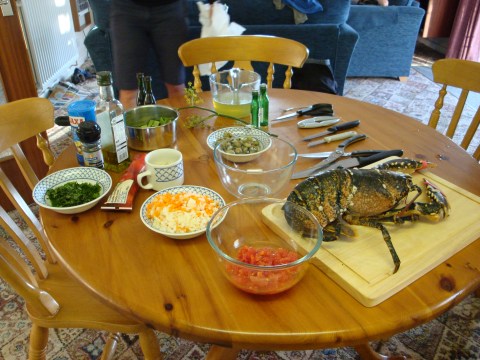
I can’t pretend this recipe is simple: it took an age to butcher the lobster and I learned that a bit of simple brute force is the best thing to crack those tough claws. The claw crackers in the kitchen drawer were feeble in the extreme and didn’t even make a dent. A rock from the beach was an inelegant but effective substitute.
Following the admirably clear and detailed instructions in Mastering the Art of French cooking, the frankly rather disgusting looking grey green mush inside the lobster (which is in fact the liver or tomalley) was turned into a delicious enrichment for the sauce. I was mystified at first by the abundance of a second type of gunge in the body cavity, this one a dark moss green. I worked out that this must be the roe and confirmed this by heating a little in a small frying pan whereupon it was miraculously transformed by the heat into a familiar firm red form. I was jubilant to have discovered a small mistake in the normally word perfect recipe – the recipe refers to the roe as being a bright orange red which of course is only true when it is in its cooked state.
An hour or so of chopping, frying, sieving and boiling later, the finished dish was ready, served with steamed long grain rice and lightly cooked French beans. It was absolutely delicious but had been hard and harrowing work. Here is the finished dish:
Here is the recipe taken straight from Volume I Mastering the Art of French cooking. For the detailed lobster preparation instructions and wonderfully instructive drawings by Sidonie Coryn, you’ll have to get hold of copy of Volume II for yourself.
Recipe for Homard a l’Américaine
For 6 people
Three 1 and 1/2 lb live lobsters
Split the lobsters in two lengthwise. Remove sand sacs in the heads and intestinal tubes. Reserve coral and green matter. Remove claws and joints and crack them. Separate tails from chests.
2tbl olive oil A heavy 12-in enamelled frying-pan or casserole
Heat the oil in the frying-pan until it is very hot but not smoking. Add the lobster pieces, meat-side down, and sauté for several minutes, turning them, until the shells are bright red. Remove lobster to a side dish.
1 medium carrot, finely diced 1 medium onion, finely diced
Stir in the diced carrot and onion, and cook slowly for 5 minutes or until almost tender.
Preheat oven to 350 degrees F., Mark 4.
Salt and pepper
3 tbl. chopped shallots or spring onions
1 clove mashed garlic
1/8 pt cognac
1 lb. fresh ripe tomatoes, peeled, seeded, juiced, and chopped
2 tbl. tomato paste
1/2 pt fish stock
3/4 pt dry white wine or 1/2 pt dry white vermouth
Optional: 1/2 tbl. meat glaze
2 tbl. chopped parsley
1 tbl. fresh tarragon
Season the lobster, return it to the frying-pan, and add the shallots or spring onions, and the garlic. With the frying pan over moderate heat, pour in the cognac. Avert your face and ignite the cognac with a lighted match and shake the frying-pan slowly until the flames have subsided. Stir in all the ingredients and bring to simmering point on top of the stove. Cover and place in the middle part of a pre-heated oven. Regulate heat so that lobster simmers quietly for 20 minutes.
3 oz softened butter A 5-pt mixing bowl
The lobster coral and green matter
While the lobster is simmering, force the lobster coral and green matter with the butter through a fine sieve into the mixing-bowl and set aside.
When the lobster is done, remove it to a side dish. Take the meat out of the shells if you wish. Place frying-pan with its cooking liquids over high heat and boil down rapidly until sauce has reduced and thickened slightly. It will acquire more body later when the butter and coral mixture is added. Taste very carefully for seasoning.
(*) Recipe may be completed to this point, and finished later.
Return the lobster to the sauce and bring to simmering point to reheat the lobster. Beat 1/2 pint of hot sauce by drops into the coral and butter mixture, then pour the mixture into the frying-pan with the lobster. Shake and swirl the frying-pan over low heat for 2 to 3 minutes to poach the coral and green matter, but do not bring the sauce near simmering point again.
A ring of risotto or of steamed rice
2 to 3tbp. chopped parsley, or parsley and fresh tarragon
Arrange the lobster and sauce in the rice ring, decorate with the herbs, and serve immediately.
Guernsey: the Lobster Saga part 1
August 22, 2009 § Leave a comment
When we visited Guernsey the previous year (summer 2008) I had imagined eating spanking-fresh seafood daily, acquired after haggling with gnarled fisherman clad in salt-encrusted Guernsey sweaters down by the harbourside. Fish and shellfish were certainly available in abundance – there were lobster pot buoys off every rocky headland and lobsters featured on every restaurant menu – but where on earth did you buy the raw materials? We discovered the answer on the last day of our holiday – Seafresh Fishmongers on St Peter Port’s harbourside – “Guernsey’s only traditional fishmonger”. This year, I was determined to cook one, maybe two lobster dishes, a simple one using cooked lobster to start and, if this went well, one of the classic lobster dishes such as Thermidor or Américaine. I’d pre-ordered a good sized cooked lobster whilst we were still in Sark to be ready for collection in St Peter Port as soon as we disembarked en route to our holiday apartment at Vazon Bay.
Here is Seafresh fishmongers, authentically situated right by the water on the approach to local landark Castle Cornet. Refurbishment is under way hence the scaffolding: 
Inside is a fantastic wet fish counter and a tank, replenished daily, for live crabs and lobsters. A magnet for small boys!
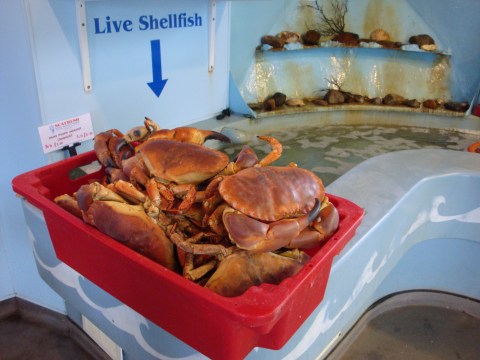
We collected our 3lb lobster, still warm from the enormous pot where the live shellfish are cooked on the premises each morning, and it shared a 20 minute taxi ride with us over to Vazon Bay on Guernsey’s west coast.
We collected the key to our apartment, unpacked our bags and then unpacked our handsome lobster, now christened Laura. She was definitely female – you can tell both from the presence of roe and from the anatomy of the swimmerets:
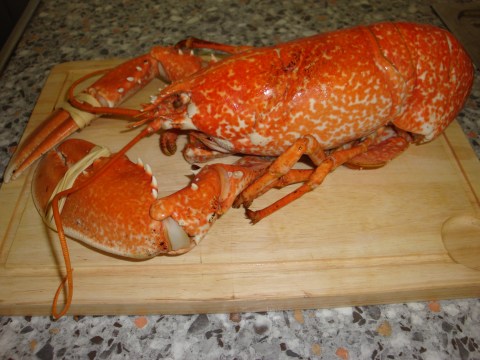
A lobster is a challenging creature to prepare, even when it is already cooked, as most of us don’t eat them very often.
With this in mind, I’d brought a photocopy of the illustrated instructions from my trusty copy of “Mastering the Art of French Cooking” by Julia Child, Louisette Bertholle and Simone Beck. Mine is the Penguin edition (though the original first appeared in the US in 1961). I’ve had this book for ages and it has become the reference work I turn to for any aspect of French cookery or technical skill. The text is clear, accurate but never dry. The illustrations, black and white line drawings by Sidonie Coryn (what a wonderful name!) are so much more than a technical diagrams – they are beautiful in a botanical illustration kind of way.
The book didn’t let me down – within 20 minutes or so, the lobster meat was extracted and cut into chunky pieces and the greenish blue liver was reserved for enriching the sauce. Sadly I had no use for the roe today.
I was now ready to prepare my recipe – spaghetti with lobster – a simple pasta sauce of my own devising, comprising lobster, garlic, chopped parsley and olive oil. It is a good way of making one lobster serve several people.
Here is the finished dish:
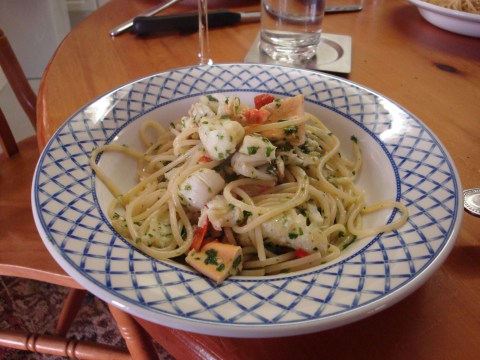
Recipe for Spaghetti with Lobster
For 4 generous main course portions
Ingredients
Meat from a 3lb cooked lobster cut into bite size chunks
If liked, 2 teaspoons lobster liver to add to sauce
3 cloves garlic, chopped
1 teaspoon dried chili flakes
6 tablespoons olive oil
3 tablespoons chopped parsley
Juice of 1/2 lemon
Enough dried spaghetti for 4 people – best quality you can find to do the lobster justice
Warm 4 bowls. Put the spaghetti into ample boiling salted water. In the time it takes to cook (8 minutes or so) you will have time to prepare the sauce. Fry the garlic in a sauté pan big enough to hold the cooked spaghetti with its sauce. When the garlic turns golden and aromatic, add the dried chili flakes and the lobster liver (if using this) and let it all sizzle in the pan for a few seconds, then add the lobster pieces, parsley and seasoning to taste. Turn off the heat and wait till the spaghetti is ready, maybe another minute or so. Drain the cooked pasta, add to the sauté pan, toss, adding more extra virgin olive oil if necessary and a squeeze of lemon juice, then serve in the warmed bowls. Please, no parmesan which is not right with fish.
Finally, here are contact details for Seafresh:
Seafresh Limited
Castle Emplacement
GY1 1AG
Tel 01481 722707
Return to the home of Sticky Toffee Pudding
August 8, 2009 § 5 Comments
Our good friends Simon and Penny were over from Hong Kong for a couple of weeks in August and threw a small party at their house in the Lake District, Ormathwaite Hall on a Saturday 8 August. I offered to bring Sticky Toffee Pudding as my contribution to the catering.
The meal began with plenty of champagne – Simon is a very generous host – accompanied by crudites and dips. Another friend and excellent cook Shelley had prepared a delicious lamb tagine served with couscous.
My sticky toffee pudding with served with extra sticky toffee sauce and ice cream finished things off pretty well and guest numbers being larger than anticipated, it was served in mercifully tiny portions – just right to finish off the meal.
The prepared pudding is shown below fresh out of the oven at home. It is very easy to transport, doesn’t need refrigeration and reheats beautifully so is a perfect choice for taking to a party in advance.

Sticky Toffee Pudding can be found on menus all over the Lake District, from where it originates, and indeed all over the UK and beyond all year round. Jane Grigson is one of my favourite food writers and is a consistently reliable source of information. In her book “English Food” she reminds us that Sticky Toffee Pudding is by no means an ancient traditional English pudding but was devised by Francis Coulson who opened the Sharrow Bay Hotel in Ullswater in 1948. The Sharrow Bay can lay claim to being the first country house hotel and Francis Coulson’s recipes are generous in their use of butter and cream: his sticky toffee pudding recipe is no exception.
The recipe I use comes from one of chef/Lake District hotel proprietor John Tovey’s books with one modification of my own – the use of soft fudgy Medjool dates rather than ordinary ones. The grated orange zest in the sauce really lifts the flavour in a subtle way and cuts through the sugar and syrup. I’m afraid I don’t know which of John Tovey’s books it comes from – my copy of the recipe was dictated to me over the phone by my mum some years ago so all I have is a list of ingredients and brief manuscript notes in my personal recipe book.
Recipe for Sticky Toffee Pudding
Ingredients
For the pudding
4 oz butter
6 oz soft brown sugar
4 eggs
8 oz sr flour
8 oz Medjool dates
1 tsp bicarbonate of soda
2 tbsp camp coffee essence
10 fl oz boiling water
For the topping
2 tbsp double cream
3 oz soft brown sugar
2 oz butter
For the sauce
8 oz golden syrup
few drops vanilla essence
2 oz butter
2 oz soft brown sugar
Grated rind of 2 oranges
2 tbsp double cream (optional)
9”-10” lined square tin; 180C 350F
Cream the butter and sugar together, then beat in the eggs. Fold in the flour sifted with the bicarbonate of soda. Add the dates. Dissolve the coffee essence in the boiling water and pour into the mixture. Beat until mixed. Pour into the tin and bake for 1 ½ hours.
To make the topping, combine the ingredients in a saucepan and bring to the boil. Pour over the cooked pudding and brown under a hot grill.
To make the sauce, melt all the ingredients together in a small saucepan. Serve with chilled pouring cream or vanilla ice cream as well as the toffee sauce.
Cordials for Summer
August 5, 2009 § Leave a comment
Making elderflower cordial has become an annual event in our household with the arrival of the heady scented elderflower blooms in June heralding the beginning of summer. I first tasted elderflower cordial at the smart London wedding of our friends Tim and Laura Davis some 17 years ago. At last, a refreshing non alcoholic drink to suit an adult palate! I’ve been drinking it every summer since and have now settled on my favourite recipe which I discovered in Thane Prince’s slim but inspiring volume “Summer Cook”.
This year, inspired by the taste of the perfumed scarlet syrup remaining after making a summer pudding I tried out a new addition to the range – raspberry and redcurrant cordial. Diluted with ice cold still or sparkling water they make lovely summer drinks and making your own is less expensive and more satisfying than buying a pricy branded bottle from the supermarket.
I am pleased to say I have been asked for the recipe for both cordials this year. The recipes follow, as does a picture below. You will see that I recycle old wine and spirit bottles when bottling the cordial. The Stolichnaya is not all it seems…
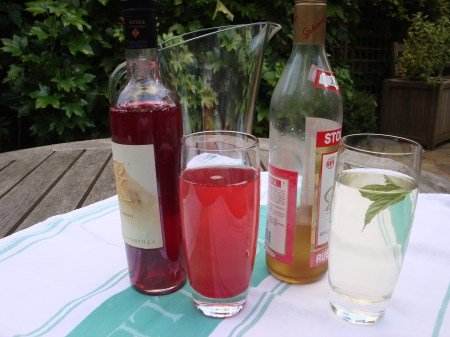
Recipe for elderflower cordial
Ingredients
1 kg (2.25 lb) sugar
1.8 litres (3 pints) water
2 well scrubbed lemons
2 well scrubbed oranges
about 20 large elderflower heads
60g (2 oz) citric acid
Note on citric acid: this is becoming increasingly difficult to find but the more old-fashioned kind of chemist will usually have some in stock or be prepared to order it for you. Citric acid is used both as an aid to injecting heroin and also in the manufacture of the explosive HMTD so be prepared to answer the pharmacist’s questions when you go in to buy it!
Make a sugar syrup by dissolving the sugar in the water in a preserving pan and boiling for 5 minutes.
Chop the whole fruit into 2.5 cm (1 inch) chunks and add to the hot syrup along with the flowerheads. Do not wash the flowerheads, just shake out any insects. Stir in the citric acid, cover the pan and leave in a cool dark place for 4 days to infuse. Strain off the syrup (I do this using a muslin lined sieve) pour into spotlessly clean bottles and cap.
I have found that the cordial has improved keeping qualities if pasteurised. This is simple to do. Place the uncapped bottles in a preserving pan filled with water. Bring to boil then simmer for 15 minutes. Cap bottles while still hot.
Recipe for raspberry and redcurrant cordial
This is my own invention which I put together after checking out a few recipes I found on the web for various fruit cordials.
Ingredients
5lb mixed redcurrants and raspberries
granulated sugar
water
2-3 lemons
Put whatever quantity of fruit is available to you into an appropriately sized pan. I used approximately 5 lb fruit in total, 2/3 redcurrants and 1/3 raspberries. Just cover with water and boil gently for 15 minutes. Don’t boil for too long or too fiercely otherwise you will end up with a jelly rather than a cordial. Allow to cool and strain off the liquid. Measure the liquid back into a clean pan. Add 1/2 lb sugar and the juice of 1 lemon for each pint of liquid. Bring the mixture to the boil, stirring to dissolve the sugar, then boil for 3 minutes. Pour into sterilised bottles. Store in a cool dark place. Pasteurise if you like by standing the filled uncapped bottles in a preserving pan filled with water then bringing the water to the boil, allowing it to simmer for 15 minutes and capping the bottles while still hot.
Breakfast in Afghanistan
July 28, 2009 § 1 Comment
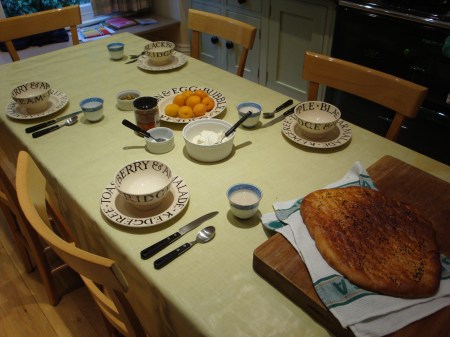
Breakfast is a big event in our household but lately the house breakfast of bacon, fried egg, Mediterranean fried bread and baked beans has seemed a little staid and over familiar. Earlier this summer we (me, husband Tim and sons George and Arthur) hit upon the idea of eating our way through breakfasts of the world beginning with A for Afghanistan and working our way through all 100 and odd countries on George’s flag poster right through to Z for Zambia.
What do Afghans eat for breakfast? First stop Amazon whence Helen Saberi’s helpful and concise book “Afghan Food & Cookery” published by Hippocrene was swiftly despatched.
The national drink is tea, chai, and Ms Saberi says “it is consumed in great quantities and I must say both the green and black tea are excellent”. I was tempted by the extraordinary sounding recipe for qymaq chai tea with clotted cream but in the end opted for a green tea flavoured with cardamon, with added sugar and milk.
NeverthelessI can’t resist quoting a paragraph on qymaq chai which is “a special tea prepared for formal occasions, such as engagements or weddings. It is made with green tea and by the process of aeration and the addition of baking soda the tea turns dark red. Milk is added (and sugar too) and it becomes a purply-pink colour. It has a strong rich taste. Qymaq, the luxury cream-like product is floated on the top. My husband, who is very poetic and very homesick, likens the color of the tea to the rosy-hued glow of the mountains in Afghanistan as the sun rises or sets. The qymaq represents the white snowcapped peaks.”
How’s that for a weird sounding brew and a great bit of purple prose!
With our standard Afghan tea we ate Roht, a round sweet flat bread which Ms Saberi says is often eaten for breakfast with tea or hot milk. The recipe is given below. Some apricots (Ms Saberi notes that the Panjshir valley is particularly noted for its apricot trees), pistachio nuts (for which the region of Herat is famous) and thick plain yoghurt completed the meal.
The end result was a fragrant and unusual breakfast and as a result I am tempted by many of the other recipes in Ms Saberi’s book, for example aush pasta with yogurt, chickpeas, kidney beans and minced meat on page 82 and the intriguing-sounding abrayshum or silk kebab on page 256.
Next stop for breakfast Albania – can’t wait!
Recipe for Roht – Afghan sweet flatbread
This recipe comes from Helen Saberi’s “Afghan Food & Cooking”. Ms Saberi attributes the recipe in turn to her friend Aziza Ashraf. I learned something new about the nigella seeds or sia dona which I quote: “These small black seeds, which can be bought under the name kalonji in an Asian grocery, are a confusing item because some people call them black onion seeds although they have nothing to do with onions. They are also confused with caraway seeds. Another mistake is to call them black cumin seeds, as true cumin seeds come from a different plant. Sia dona come from the plant Nigella sativa and are sometimes called nigella seeds.”
Ingredients
1 and 1/2 pounds (5 and 1/4 cups) all purpose flour
2 level teaspoons of baking powder
1 pack quick rise yeast
1/4 tsp ground cardamom
3/4 cup vegetable oil
1 and 1/2 cups sugar
3/4 cup warm water
1 egg, beaten
1 level tablespoon yoghurt
sia dona (nigella seeds)
sesame seeds
Mix together the flour, baking powder, yeast and cardamom. Warm the oil in a small pan, then add to the flour and rub together for a few minutes. Add the sugar to the warm water and gradually add to the flour, mixing well. Now add the egg (reserving a little for glazing) and the yogurt. Mix well and knead into a quite soft dough for about 5 minutes. Cover with a cloth and leave in a warm place for about an hour or so.
Meanwhile preheat the oven to 425 degrees F.
Divide the dough into two and roll out each on a floured surface into a round of about 1/2-inch thickness. Prick all over with a fork, glaze with the reserved egg and sprinkle the top with the sia dona and sesame seeds according to your fancy.
Place on a slightly oiled or greased baking tray and bake in the hot oven for about 15 minutes until risen, golden brown and cooked through. (If the top is browning too quickly, turn down the heat and cook on the lower heat for a little longer.)
Remove from the oven and place in a warm tea towel or plastic bag to stop the bread drying out too much.
 The Rhubarb Fool