
A pudding for Queen Elizabeth
September 17, 2022 § 1 Comment
This week, I’ve been watching televised queues of people lining the streets of villages, towns and cities throughout Britain waiting to catch a glimpse of the late Queen’s coffin. This is not for me. Instead, I’ve been working up a recipe I started thinking about during the Platinum Jubilee celebrations earlier in the year.
Out of curiosity, I did make that competition-winning Platinum Jubilee pudding featuring in a BBC TV programme, a confection of canned mandarins, lemon jelly, amaretti biscuits and rather showy white chocolate bark shards. It was OK, but suffered from a serious lack of booze. Oh, and I’m sorry but jelly in a trifle is a definite no-no in our household.

I’ve gone down the more warm and comforting route for my pudding. It’s a white chocolate, whisky and marmalade bread and butter pudding with a distinctly Scottish flavour.
I came up with the idea of creating a pudding out of marmalade sandwiches after watching my favourite part of the Platinum Jubilee celebrations – the moment where the Queen entertained Paddington Bear at Buckingham Palace, sharing tea and marmalade sandwiches. Charming or sentimental? You decide but it’s surely preferable to being serenaded by Paul McCartney and Rod Stewart…
The next part of the pudding jigsaw puzzle was being tempted by a white chocolate, whisky and marmalade bread and butter pudding on the menu at The Ceilidh Place, a brilliant gastropub in Ullapool in far north of Scotland. Sadly, they’d sold out when I came to order it on a visit earlier this year so I had to store the idea away until I was able to make it myself.
The pudding idea finally came together when I found the right whisky to cut through the potentially cloying sweetness of white chocolate and marmalade. Adding whisky to food is a tricky business as there are so many wildly contrasting whisky styles from the heavily peated Islay single malts that knock your head off, to smooth Speyside spirits matured in sherry casks that come close to a fine Cognac.
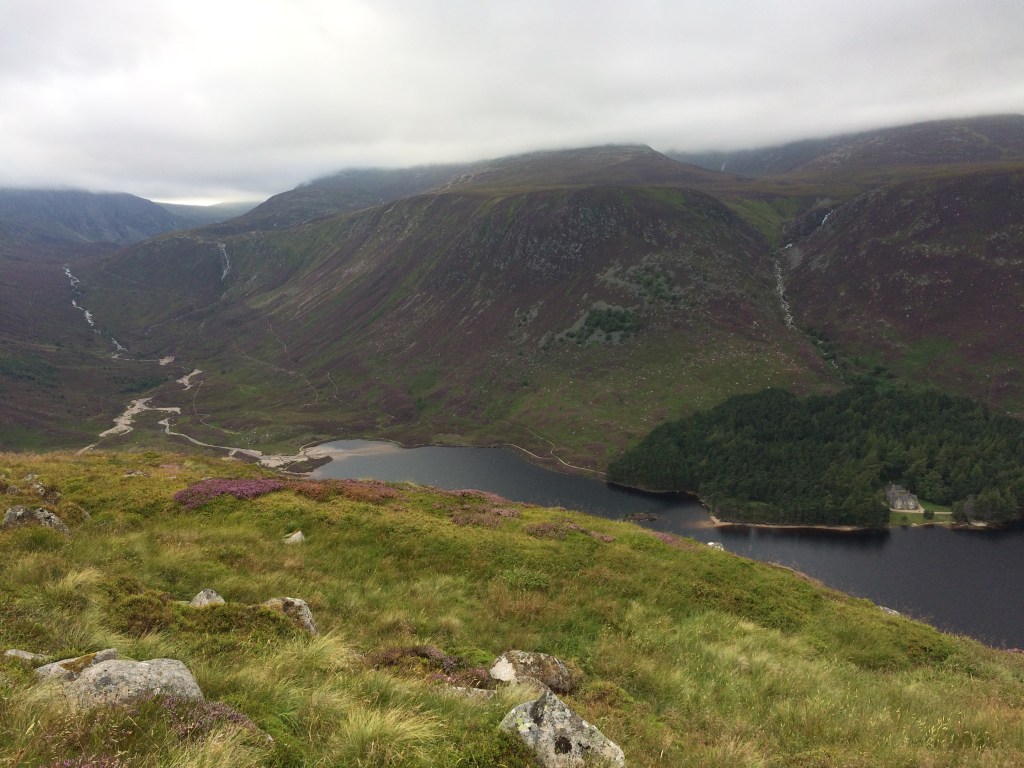
I chose Royal Lochnagar whisky for two reasons. Firstly, it is made in a charming small distillery at Crathie, bang next-door to the late Queen’s Balmoral Estate and has royal warrants dating back to Queen Victoria, Edward VII and George V. Second, it is the perfect complement for marmalade with its candied citrus peel, demerara sugar and spice flavour profile. I’ve been lucky enough to visit both the distillery and Balmoral Castle on separate visits to Royal Deeside. It’s a stunning part of the world and it’s no surprise that the queen chose to spend her final days there.



It took a couple of experiments to refine the recipe and make the flavours sing without any one element being too overpowering. This is my end result and it will be gracing my Sunday dinner table tomorrow as the nation prepares for Monday’s state funeral and we collectively have a quiet moment of self-reflection at the end of an era.
White chocolate, whisky and marmalade bread and butter pudding
Serves 6
Ingredients
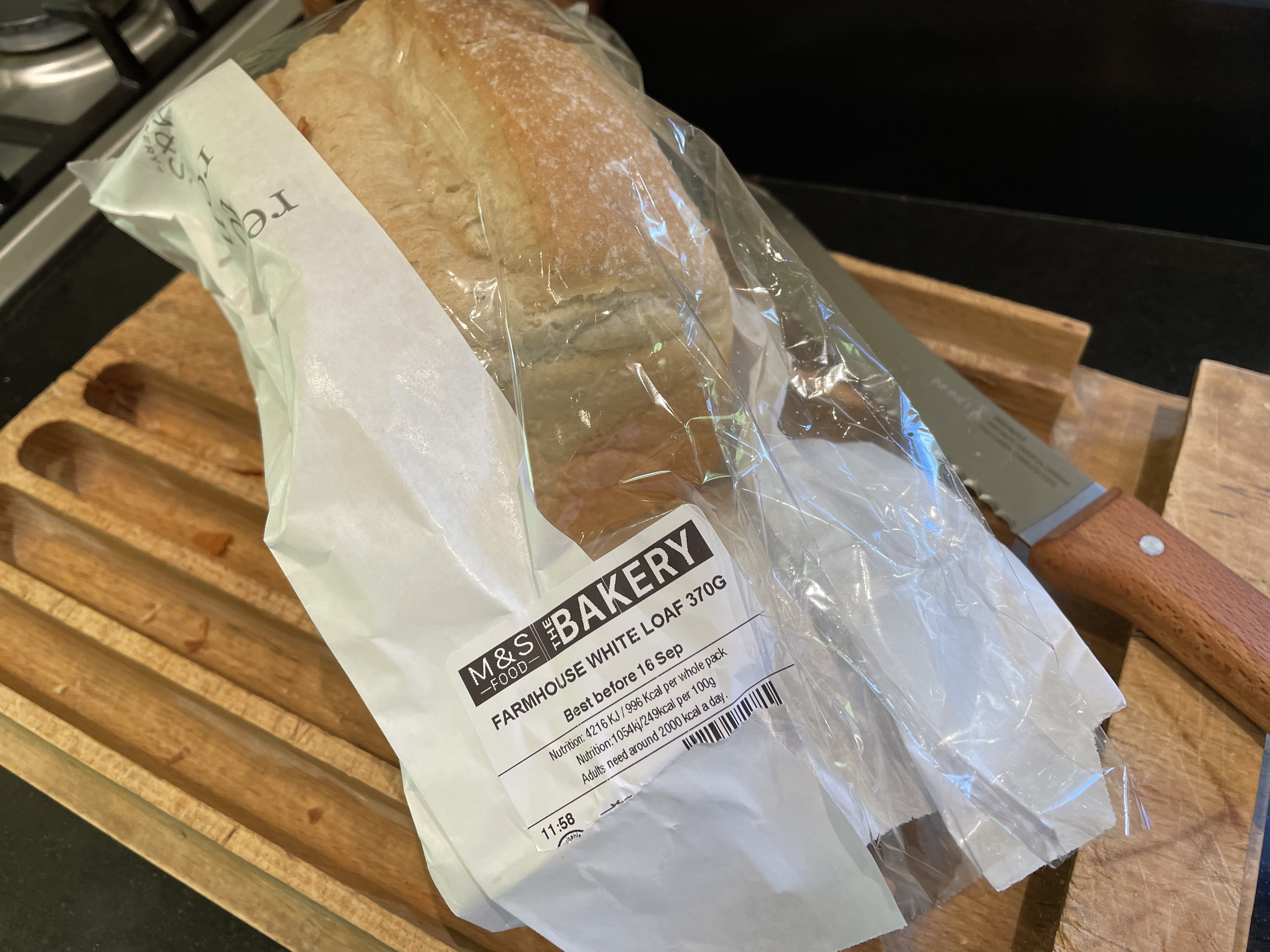
12 thin slices white bread
Softened butter for spreading on the bread and greasing the baking dish
6 generous tablespoons of your favourite marmalade
150g good quality white chocolate flavoured with vanilla, broken up into squares
425-450 ml whipping cream (or a 300ml pot single cream plus a 150ml pot double cream)
1 teaspoon vanilla extract
1 teaspoon grated orange zest
3 large eggs
4 tablespoons of your favourite whisky (I used Royal Lochnagar)
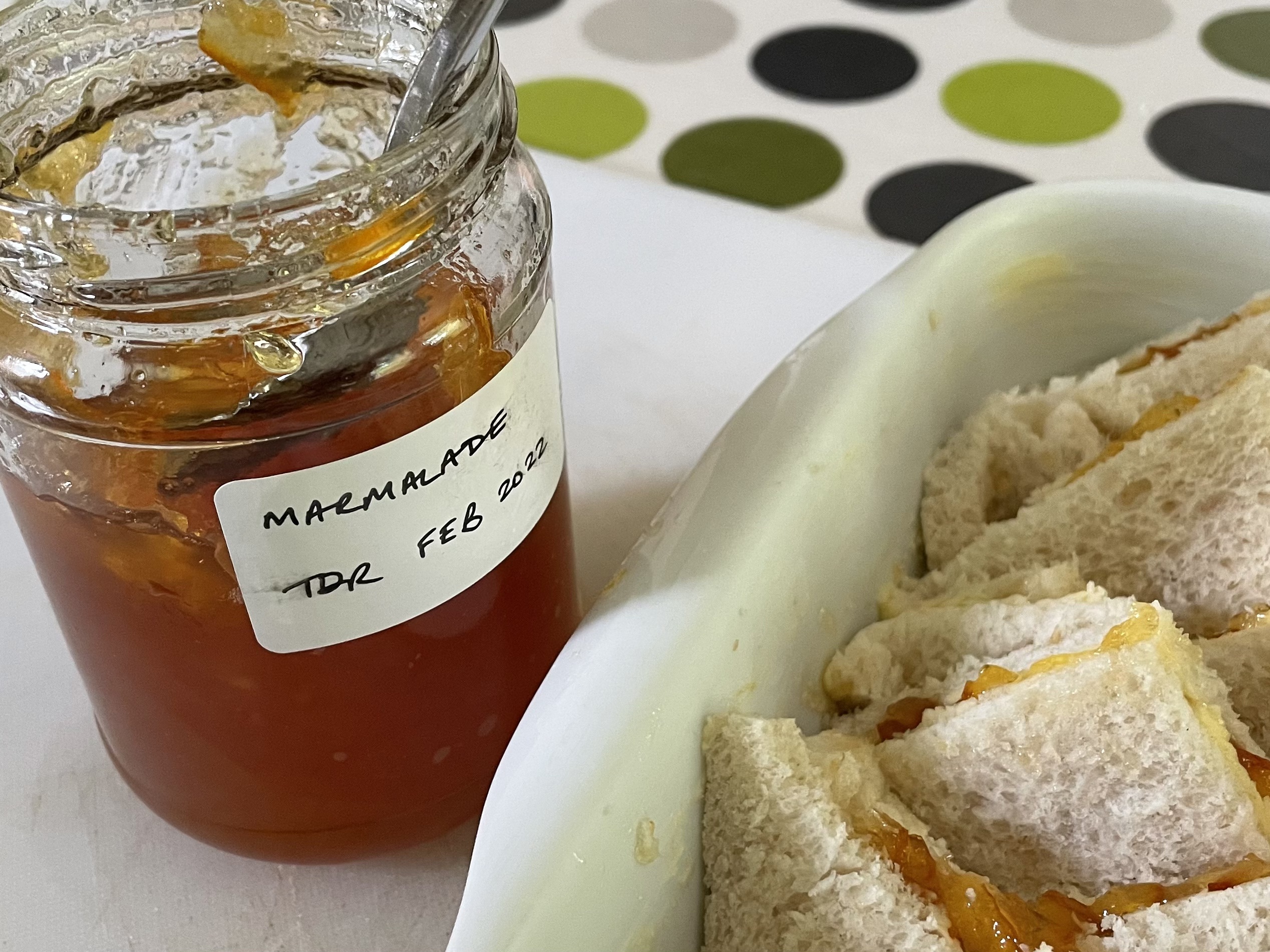
Begin by cutting off the crusts from the slices of bread, spreading them sparingly with butter then making 6 marmalade sandwiches using 1 tablespoon of marmalade for each sandwich. Cut each round into four tiny triangular sandwiches.
Butter your baking dish generously then arrange the tiny marmalade sandwiches in decorative overlapping rows in the dish. You need a shallow, ovenproof dish for this. I used a square white porcelain dish approx. 22cm by 22cm by 5cm which worked well.
Place the chocolate, cream, vanilla extract and orange zest in a heatproof bowl and set the bowl over a pan of not quite simmering water. Wait until the chocolate has melted then remove the bowl from the heat and stir well to combine. Allow to cool for a couple of minutes.
In a separate bowl or jug, whisk together the eggs and the whisky, then add the egg mixture to the slightly cooled cream and chocolate mixture and whisk well to combine.
Gently ladle the chocolate mixture over the marmalade sandwiches. Use a fork to press down the sandwiches gently so that they are covered evenly with the chocolate mixture. Depending on the size of your bread slices and, you may not need to use all of the chocolate mixture.
Cover the baking dish with clingfilm and transfer it to the fridge for a minimum of 24 and ideally 48 hours.
Preheat your oven to 170 degrees C fan. Remove the clingfilm and bake the pudding for 30 minutes until the top is crunchy but the interior is still soft and yielding. Leave to stand for 10 minutes before serving with cold cream and maybe a few berries.
Delicious sustainable fish
July 24, 2022 § Leave a comment
I am lucky enough to live within walking distance of Altrincham market which boasts a busy, friendly fish stall every Tuesday, Friday and Saturday. Whilst in the queue, I like to watch what other people are buying. Dispiritingly, most customers stick to the so called Big 5 best sellers – farmed salmon from Scotland, tuna from Indonesia, cod, haddock and various types of prawn, none of which are particularly sustainable.
Here are a couple of my favourite recipes, both of which use sustainable fish, as per the Marine Stewardship Council website.

The first uses mackerel fillets (OK if they are line caught from a Cornish coastal fishery) which are rendered sweet and fresh when baked on top of potatoes and basted liberally with a mixture of olive oil, garlic and parsley.
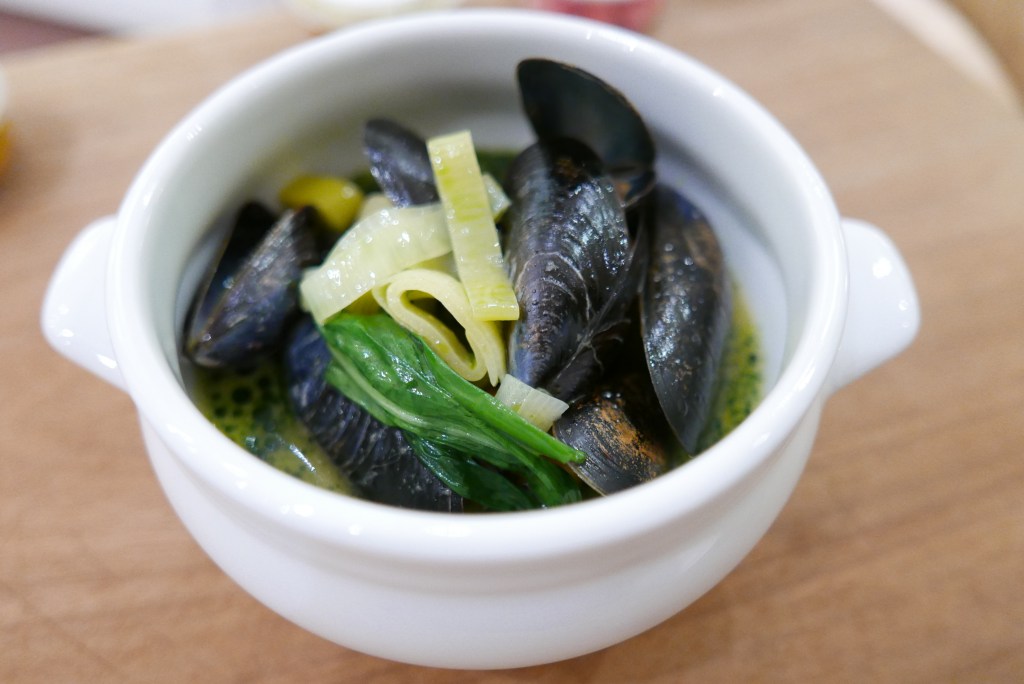
The second uses farmed, rope-grown mussels, a brilliant choice of farmed seafood as the mussels actually clean the seawater they are grown in. This recipe is a twist on the classic Moules Marinière, with fennel and tarragon adding a subtle anise flavour.

Baked mackerel with potatoes, Genoese style
Adapted from a recipe in Marcella Hazan’s Second Classic Italian Cookbook
Serves 4 people with modest appetites
Ingredients
500g waxy potatoes
4 tablespoons extra virgin olive oil
2 cloves garlic, peeled and chopped
25g roughly chopped flatleaf parsley
salt and freshly ground black pepper
4 medium mackerel fillets with the skin left on (ask your fishmonger to fillet the mackerel for you)
Method
Preheat oven to 230 degrees C fan.
Scrub the potatoes (no need to peel them) and cut into very thin slices with a mandolin.
Remove any remaining bones from the mackerel fillets if necessary.
Into a shallow oven proof baking dish large enough to hold the potatoes and fish fillets comfortably without overcrowding (enamelled cast iron is ideal) put all the potatoes, half the olive oil, half the garlic, half the parsley and a liberal amount of salt and freshly ground black pepper. Mix everything thoroughly, then spread the potato slices evenly over the bottom of the dish.
Place the dish in the preheated oven. Bake until the potatoes are half cooked, approximately 12-15 minutes, maybe a little longer.
Remove the dish from the oven and place the mackerel fillets skin side down over the potatoes. Mix the remaining oil, garlic and parsley in a small bowl and pour the mixture over the exposed surface of the fish basting it well. Sprinkle with a generous amount of salt and pepper. Return the dish to the oven.
After ten minutes, remove from the oven. With a spoon, scoop up some of the oil in the dish and baste the fish and potatoes with it. Loosen those potatoes that have become browned and stuck to the sides of the dish, moving them away. Push into their place some of the slices that are not so brown. Return the dish to the oven and bake for five more minutes.
Serve piping hot with all the juices from the dish, scraping loose any crispy potato slices clinging to the sides of the dish. Accompany with a salad or some simply steamed green vegetables.
Mussels with fennel and tarragon
Serves 2 as a main course, 4 as a starter. Adapted from a recipe in Olive magazine.
Ingredients
2 tablespoons extra virgin olive oil
2 shallots, peeled and thinly sliced
Half a bulb of fennel, trimmed and thinly sliced
3 cloves garlic, peeled and thinly sliced
100ml dry white vermouth eg Noilly Prat
1kg mussels, cleaned and debearded
75ml double cream
Small handful of tarragon leaves, roughly chopped
Small handful of flatleaf parsley, large stems removed, roughly chopped
Method
Heat the olive oil in a large casserole (enamelled cast iron with a lid is ideal) over a medium-high heat, add the shallot and fennel with a pinch of salt, and cook for 10 minutes until soft and beginning to caramelise. Add the garlic and cook for another minute before pouring in the vermouth and seasoning well. Bring to the boil, then tip in the mussels and toss really well. Put on the lid and cook for 3-4 minutes, shaking the pan every now and again, until the mussels have just opened. Discard any mussels that remain unopened.
Remove the lid, stir in the cream and scatter in the chopped tarragon and parsley. Spoon into bowls and serve. Accompany with crusty bread or chips and a salad.
Happy new year 2011 and review of 2010
January 4, 2011 § Leave a comment
The stats helper monkeys at WordPress.com mulled over how my blog did in 2010, and here’s a high level summary of its overall blog health:

The Blog-Health-o-Meter™ reads This blog is on fire!.
Crunchy numbers

A Boeing 747-400 passenger jet can hold 416 passengers. This blog was viewed about 12,000 times in 2010. That’s about 29 full 747s.
In 2010, there were 55 new posts, growing the total archive of this blog to 93 posts. There were 358 pictures uploaded, taking up a total of 1gb. That’s about 7 pictures per week.
The busiest day of the year was December 23rd with 77 views. The most popular post that day was Macaroons made in Manchester.
Where did they come from?
The top referring sites in 2010 were en.wordpress.com, google.co.uk, twitter.com, facebook.com, and google.com.
Some visitors came searching, mostly for rhubarb fool, macaroons manchester, kabuni, breakfast in afghanistan, and albanian recipes.
Attractions in 2010
These are the posts and pages that got the most views in 2010.
Macaroons made in Manchester April 2010
Breakfast in Afghanistan July 2009
Albanian Adventure October 2009
2 comments
Preparing for Christmas: recipes for cake, pudding and mincemeat November 2009
6 comments
The Rhubarb Recipe Page May 2010
 The Rhubarb Fool