
Pecan puffs for Christmas
December 18, 2016 § Leave a comment
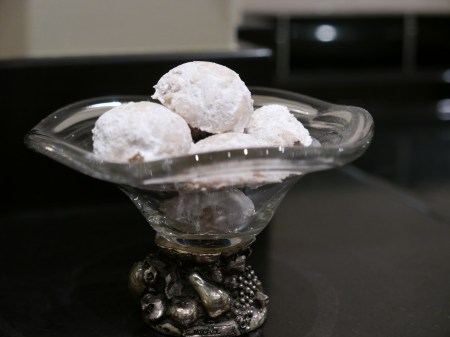
I first came across this recipe more than 20 years ago in Sophie Grigson’s recipe column for the Evening Standard. I was delighted to rediscover it recently when I was thumbing through an old copy of her book “Sophie’s Table”.
She recounts how an American friend would send the family a gift of these puffs for Christmas each year and how they would barely last beyond Christmas Eve. They are a crumbly and buttery mouthful, essentially a shortbread but with a delicious pecan and vanilla flavour.
They have a Christmassy feel with their snowball-like appearance and are quick and easy to make. The only slightly fiddly part of the recipe is the rolling in icing sugar and returning to the oven to set the sugar.
They’ll keep for a week or more and so would make a lovely last-minute edible gift.
As an alternative to icing sugar, I’ve recently discovered “snow sugar” on the Bakery Bits website. It’s powdered dextrose plus cornflour and doesn’t dissolve away so bakes retain that freshly dusted look for longer. Ordinary icing sugar is fine though.


Pecan puffs
Adapted from a recipe in Sophie Grigson’s book “Sophie’s Table”.
Makes about 35.
Ingredients
125g unsalted butter
3g salt
30g golden caster sugar
½ teaspoon vanilla extract
150g shelled pecan halves
150g plain flour
icing sugar or snow sugar for dusting
Freeze the pecans beforehand to prevent them turning oily too quickly when ground. Put them into a food processor with the golden caster sugar and grind to a coarse powder without overworking.
Cream the butter, beat in the vanilla extract and gradually work in the ground nut and sugar mix and the flour to make a paste.
Chill the mixture briefly in the fridge to allow it to firm up just a little.
Roll rounded teaspoons of the mixture into balls and set onto baking sheets lined with silicone paper. Space the balls well apart to allow them to bake evenly.
Bake at 150 degrees C fan for 30 minutes until golden.
Allow to cool very briefly then carefully roll each puff in icing sugar, place back on the baking sheet and return to the oven for a further 2 minutes to set the icing sugar.
Cool on cake racks and store in an airtight tin, dusting each layer with icing sugar and separating with sheets of baking paper.
Twelve days of Swiss Christmas
December 29, 2012 § Leave a comment
On The Twelfth Day of Christmas my true love sent to me:
12 Chocolate Snowmen
11 Christmas Guetzli
10 Grilled Kalbsbratwurst
9 Glasses of Glühwein
8 Rhåtischebahn Engines
7 Rustic Chalets
6 Christmas Trees
5 Singers singing
4 Advent Candles
3 Christmas Stockings
2 Davos Sledges
and an enormous Cinnamon Star!


That’s more or less a summary of our Swiss Christmas,though we didn’t spend any where near 12 days there, and I haven’t even mentioned the skiing.
We have our mince pies and Christmas cake but the Swiss go nuts for their Guetzli – Christmas biscuits which are on offer in every bakery, household and public place throughout Christmas. The good Hausfrau will of course make her own to offer to guests and family. Leafing through my Betty Bossi Christmas baking book I see cosy colour pictures of Orangenschnittli (filled almond orange shortbread), fantastically embossed Tirggel, Orangenschümli (orange mini meringues), Pfeffernüsse (little spiced gingernuts) to name but a few.
Best of all in my opinion are the Zimsternen – cinnamon star biscuits. At their best they’re nutty and spicy, a little bit crunchy, a little bit chewy with a crisp meringue icing. These biscuits aren’t exclusively Swiss but can be found throughout the German-speaking countries.
The biscuit base, a mixture of ground nuts, sugar and egg whites flavoured strongly with cinnamon and lemon zest is half way beween marzipan and a macaroon. I’ve come up with my own version of the classic recipe compiled from 3 sources: (i)the recipe on the back of the special split “profi” star cutter; (ii) Marianne Kaltenbach’s “Aus Schweizer Küchen”; (iii) Thorsten’s recipe on website Food.com. Dry matter per egg white varies from 225g to 275g and the percentage of ground nuts varies from 59% to 77% in the different recipes. This version uses 300g nutsand 200g sugar making 250g dry matter per egg white with 60% of the dry matter made up of nuts.
To make the biscuits using the method shown in my pictures you’ll need to get hold of a special split star cutter which releases the moist iced biscuits without sticking. I found mine in specialist kitchen shop Sibler in Zürich. If you have a standard star cutter then I’d recommend cutting the shapes out, placing them on the baking sheet then brushing with the icing.


Recipe for Cinnamon Stars
Makes about 34 biscuits in two rollings plus 15 small additional shapes with the soft trimmings.
Ingredients
For the biscuit dough
75g whole unblanched almonds
75g halved walnuts
100g golden caster sugar
60g egg white (about 2 medium egg whites)
pinch of salt
approximately 150g ground almonds (more may be needed to make a pliable, workable dough)
further 50g golden caster sugar
50g icing sugar
2 teaspoons ground cinnamon
1 teaspoon finely grated lemon zest
For the icing
30g egg white (1 medium egg white)
small pinch of salt
175g icing sugar, sifted
1 teaspoon lemon juice
Lightly toast the whole nuts. Allow to cool then blitz in a liquidiser with the 100g golden caster sugar until very finely chopped.
Whisk the egg whites with a pinch of salt until they reach the soft peak stage. Mix in the ground nut and sugar mixture, the ground almonds, caster sugar, icing sugar, cinnamon and lemon zest. Add additional ground almonds if necessary to make a workable dough. Wrap the dough in cling film and rest in the fridge for about an hour.
When the resting time is nearly up, make the icing. Whisk the egg white with a pinch of salt until stiff. Whisk in the sifted icing sugar a tablespoon at a time together with the teaspoon of lemon juice. You may not need to add all the icing sugar; stop when you reach a thick spreading consistency.
Preheat the oven to 160 degrees C (fan) and line two or three baking trays with parchment.
Dust a pastry board and rolling pin with plenty of sifted icing sugar then roll out the rested dough to about ½ cm thick. You can roll out the dough between 2 sheets of parchment if you prefer.
If you have a special split star cutter which can be squeezed to release the iced biscuit you can use this method to complete the stars: using a pastry brush, paint the surface of the dough thickly with the meringue icing and cut out the iced stars and carefully place them on a baking sheet a few centimetres apart. This gives a neat and professional finish but the drawback is that the icing is mixed into the dough when the trimmings are combined for rerolling making the dough wetter each time. To counteract this you may need to add more ground almonds each time you reroll. For my third rolling, I simply rolled the soft mixture into a log and cut thick disks. I didn’t ice this third batch but instead topped each with a whole blanched almond for a more macaroon-like biscuit.
If you have an ordinary star cutter, don’t try and pre-ice the biscuits as they will stick and not release from the cutter: simply cut out the star shapes, place them on the baking sheet then brush the biscuits with the meringue icing.
Bake the biscuits for about 15 minutes until baked through but still somewhat moist with crisp and uncoloured white icing. The biscuits will swell a little as they bake to end up 1cm thick. Leave on the baking sheet for a few minutes after removing from the oven before transferring to a rack to cool thoroughly.
You might like to bake any un-iced biscuits at a slightly higher temperature to give a more toasty flavour as there’s no icing to brown.
Good things from Borrowdale
November 10, 2011 § Leave a comment
Perhaps the only good thing about having the kitchen redecorated is that we’re forced to get out of the house. When a glistening fresh coat of extra-slow drying oil-based eggshell arrived on the cupboard doors on Friday afternoon, we were forced to spend a weekend away. Fortunately, it all fell into place as there was a weekend of glorious high-pressure weather forecast for the North of England (remarkable for the first week in November) and my favourite youth hostel, the remote but cosy one up on the Honister Pass in the Lake District, had a family room available. So we packed the car, upped sticks and were rewarded with the most fantastic autumn weekend in and around the Borrowdale valley.

Saturday was spent on a circular lower level walk which, in addition to uplifting views and vibrant autumn colours, took in 4 different tearooms at Grange-in-Borrowdale, Watendlath, Rosthwaite, then back to Grange for a visit to its other tea establishment. Definitely my kind of walk.

I took the opportunity to stock-up on local products including this fantastic comb honey available from the Grange tearooms. According to the label, it comes from S. Edmondson of Troutdale, just down the road. It’s a dark, clear honey – from heather perhaps? and spread on my breakfast toast this morning I can confirm that the taste is divine – deeply fragrant, not too strong, and, odd as it may sound, I love the chewy crunch of the little bits of honeycomb wax.

I’ve now done a little reading round about the etiquette of whether or not to eat the wax in honeycomb. The consensus amongst the beekeeping community seems to be to go for it and eat the lot, honey, wax and all, so I now feel vindicated. There are some more delicate folk out there who prefer to chew then discreetly spit out – each to his own I suppose.
The village of Rosthwaite is home to Yew Tree Farm and its Flock-In tearoom which with its practical slate floors and generously sized cakes and mugs of tea, offers a warm welcome to walkers.
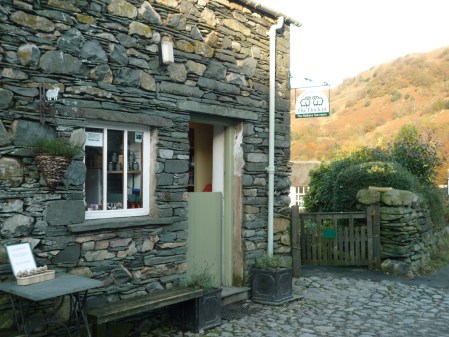
They make their own Borrowdale teabread here and sell whole loaves to take away as well as buttered slices to accompany your tea. I love teabreads of all kinds – quickly made, wholesome, and because there’s generally not much if indeed any fat in the cake mix itself, you can feel justified in enjoying a slice spread with lots of lovely butter.
Borrowdale teabread is a dark, moist slightly spicy loaf cake. Its colour comes both from the tea-soaked dried fruit it contains and the soft brown sugar used in the mix. I had a chat with Mrs Relph of Yew Tree Farm who was behind the counter that afternoon about the origins of Borrowdale teabread. Her view was that the dried fruits, spices and indeed tea in this teabread are a legacy of the overseas trade from the nearby port of Whitehaven. She mentioned that her recipe is made without the addition of fat so that it needs to be well-wrapped and stored in an airtight tin if it’s not to dry out if kept for any length of time. Not much chance of that in our family…

I’ve researched Borrowdale teabread recipes and have come up with my own version which I give below which combines the best bits of each recipe. I think the addition of a little melted butter which several recipe authors suggest will improve the keeping qualities of the cake.
I was then reminded of a treasured recipe for Borrowdale biscuits which I assume must originate in this same Lake District valley. Here’s the recipe given to me by my schoolfriend Helen Wright’s grandmother absolutely ages ago and kept in a file ever since:

These are the most moreish pale gold crunchy biscuits – like a superior Hob Nob for those familiar with the McVities product range. Going back to Helen’s house after school we’d be offered some of these with a cup of tea. I’m not proud to say I’d help myself to 6 or so more than the polite 2 offered when I thought nobody was looking…
I’ve tinkered with the original recipe just a little, substituting butter for margarine as I avoid margarine if I possibly can on grounds of flavour and odd as it may sound, health – all those lovely fat-soluble vitamins in butter from grazing cows can’t be all bad.
Most of the measurements in the original recipe are in “small teacups” so I’ve done my best to standardise the measures to give a consistent result.
I can’t wait to get back into my kitchen to start cooking once again rather than relying on baking memories, but in the meantime, it’s good to be outdoors burning off those cake and biscuit calories.

Recipe for Borrowdale teabread
Adapted from various sources including a Lakeland contributor to the Farmer’s Guardian, Carole Gregory’s little booklet “Favourite Lakeland Recipes”, Sizergh Barn’s online recipe (unusable as published as riddled with errors) and eating carefully the of Flock-In tearoom’s own teabread. I’ve maintained the key ratios and ingredients of the recipe but have incorporated what I think are the best elements of each recipe.
Good spread thickly with salted butter and maybe a wedge of crumbly Lancashire cheese.
Makes one large loaf cake.
Ingredients
½ pint (225 ml) strong hot black tea
14 oz (400g) dried mixed fruit (to include sultanas, raisins and glacé cherries)
6 oz (170g) dark soft brown sugar (use light soft brown sugar for a paler teabread with a less pronounced molasses flavour if you prefer)
1 large egg, beaten
grated rind of 1/2 orange and 1/2 lemon
1 oz (25g) melted butter
7 oz (200g) plain flour
2oz (50g) wholemeal flour
3/4 teaspoon bicarbonate of soda
¼ teaspoon freshly grated nutmeg
½ teaspoon mixed spice
Mix together the dried fruit and sugar in a large mixing bowl. Pour over the hot tea, cover and leave overnight to steep.
The next day, prepare a 2lb loaf tin by greasing and lining the base with baking paper. Preheat the oven to 160 C (fan).
Add the beaten egg, melted butter, grated citrus rind and grated nutmeg to the bowl containing the soaked fruit and mix well.
Sieve together the flours, bicarbonate of soda and spices. Tip any bran from the wholemeal flour or any larger pieces of grated nutmeg which don’t make it through the sieve back into the bowl too. Add to the bowl and fold into the mixture to blend thoroughly.
Pour the mixture into the prepared tin and bake for about 1 hour until firm when pressed lightly, well-risen and a deep golden brown.
Cool in the tin for 30 minutes then turn out and cool on a wire rack. Store in an airtight tin. Best left overnight before eating to allow the flavours to develop and the bread to soften and become sticky.
Recipe for Borrowdale biscuits
Adapted from a recipe given to me by my schoolfriend Helen Wright’s grandmother.
Makes 50-60 biscuits
Ingredients
8 oz butter
8 oz golden caster sugar
2 dessertspoons golden syrup
6 oz rolled porridge oats
8 oz self raising flour
1 teaspoon bicarbonate of soda
2 tablespoons boiling water
Cream together the butter, sugar and syrup. Dissolve the bicarbonate of soda in the boiling water. Add to the mixture then add the dry ingredients.
Pinch off and roll between your palms small balls of the dough about the size of a heaped teaspoon and set a little way apart on a prepared baking tray.
Bake at 160 degrees C/325 F/gas 3 for approximately 15 minutes.
Contact details
Flock-In tearoom
Yew Tree Farm
Rosthwaite
Borrowdale
Cumbria
CA12 5XB
Tel 01768 777 675
Website www.borrowdaleherdwick.co.uk
Borrowdale honey – jar and whole honeycomb in box available from tearoom in Grange-in-Borrowdale
Details on honey label are:
S. Edmondson
Troutdale
Keswick
Cumbria
 The Rhubarb Fool