
Mountain breakfast from Andorra
November 15, 2009 § Leave a comment
Hmm this one proved a challenge. Tiny Andorra, only 180 square miles in land area is just a little smaller than the Isle of Man (in turn 1/3 of the size of Hertfordshire) and has a population of 70,000, about the same of my home town of Altrincham. It is located in the Pyrenées, squeezed in between France and Spain and is mainly rugged and mountainous in character – no part of the country lies below 3,000 ft or 900m – like living permanently on the summit of Helvellyn.
Andorra, known for cheap skiing holidays, duty free booze and a dodgy football team that even England can beat, is essentially Catalan in culture. Its food, from what I can glean, is rustic and hearty reflecting the life its mountain people lead (or used to lead before the influx of Irish skiers looking for a bargain).
I found no specific breakfast recipes, but rustled up two typical Andorran dishes are Trinxat – a Catalan version of bubble and squeak, and Truites de Carreroles, a type of mushroom omelette. These were just the thing for a hearty breakfast on a chilly November morning. What type of mushroom omelette we shall never know as the sources are silent on this – I decided to do my own thing on the mushroom omelette front.
The recipe for Trinxat follows, from a handy little website www.europeancuisines.com. I’ve tweaked the recipe a little to simplify the bacon fat rendering and cabbage cookery suggestions – boiling the cabbage whole for 45 minutes before chopping it sounded neither sensible nor pleasant.

Recipe for Trinxat Andorran cabbage and potato cake with bacon
Enough for one generous potato and cabbage cake in an 8-10 inch diameter frying pan. I used my trusty non-stick Meyer Anolon pan (8 inch diameter at the base flaring to 10 inches diameter) which is good for pancakes and omelettes of all kinds
Half a 2lb Savoy cabbage, quartered, core removed and shredded
1 lb floury potatoes, peeled
2 oz lardons (diced fat bacon pieces – I used inauthentic pancetta)
2 tbsp olive oil
1 clove garlic, peeled and crushed
pepper
Crisply fried or grilled rashers of bacon to serve
Boil the potatoes and mash using a food-mill for a lump-free mash. Season but add no butter or anything else to it at this stage.
Steam the shredded cabbage for 5 minutes until just cooked.
Mix together the cabbage and potatoes. Taste and season again.
Fry the lardons gently in the olive oil for 5 minutes or so until the fat is rendered and the lardons begin to turn golden-brown at the edges. Throw in the garlic and cook for a couple of minutes more. Add the cabbage and potato mixture, stir to distribute lardons and garlic then flatten into a 1/2 inch thick cake. Cook over a moderate heat on the hob until a crust has formed (5-10 minutes). Invert a large plate over the frying pan and carefully flip the cake over and slide it back into the pan. I wear oven gloves to do this. Cook for a further 5-10 minutes until the second side is crusty and browned.
Serve with crisply fried or grilled bacon rashers. A poached egg or two would be a good addition if not entirely authentically Andorran.
Algerian breakfast…not what you might think
October 18, 2009 § Leave a comment
“A line of cheap speed and a shot of Pernod, usually taken as a pick-me-up after a rough night” is how Urbandictionary.com defines an Algerian breakfast. Hmmm I’m not even quite sure what speed is let alone how to procure it cheaply in Altrincham. I had in mind something rather more civilised.
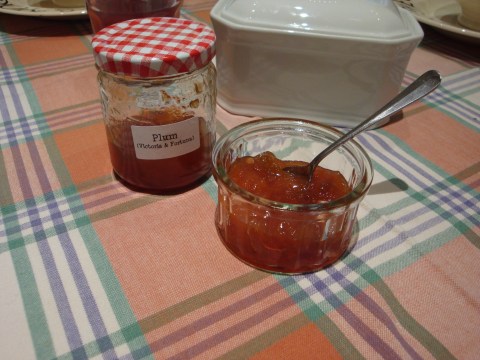
Algeria is a former French colony (think Zinadine Zidane, Albert Camus and the French Foreign Legion) becoming independent in 1962. The French left behind, amongst other things, the legacy of their bread so a crusty baguette was the first item to be chosen. I still baulk at tackling a loaf of French bread at home so this was purchased fresh from the boulangerie. With the baguette, unsalted butter and a jar of home-made jam – the one I chose was an amber coloured plum jam made by friend Nadia who is into preserving big-time at the moment. Nadia takes the trouble to crack open the plum stones and add the almondy kernels to the jam which is something you’ll never find in the shop-bought stuff.
To drink, café au lait in bowls, plus glasses of deep purple pomegranate juice (I’m not sure whether the juice is authentic but I wanted to bring some eastern exoticism onto the breakfast table on this chilly October morning).

The pièce de resistance was a plateful of Makrout el Assel freshly deep fried, a kind of Algerian almond doughnut, the whole plateful doused in warm honey.

All of us spent the next couple of hours bouncing off the walls on a sugar, white bread and caffeine-induced high. Who needs cheap speed and Pernod with a breakfast like this!
I found the Makrout recipe on http://www.la-cuisine-marocaine.com French language website – yes I realise this means Moroccan but the given derivation was most definitely Algerian. Here’s the recipe translated as best I could.
Recipe for Makrout el Assel
Ingredients
Dough
500g medium semolina
125g melted smen (clarified butter)
pinch salt
orange-flower water
10cl warm water
Filling
250g ground almonds
150g caster sugar
orange-flower water
Oil for deep-frying
Place the semolina and salt in a bowl. Mix. Add the melted clarified butter and rub with the palms of your hands to mix well and incorporate the fat into the semolina. The mixture should be sandy in texture.
Add the warm water plus a little orange flower water gradually to the mixture and bring it together to form a dough without over-working. Once you have a supple dough, leave it to rest in the fridge.
Mix together the ground almonds and sugar and add a little orange flower water to form a paste. The mixture should not be too moist.
To form the Makrout, take a good-sized piece of dough, roll it out and hollow out a groove in the middle without going right through. Form with your hands a fat rope shaped piece of the almond filling and place it into the groove. Bring up the edges to seal in the filling and roll the whole thing, flattening it a little until it is 3-4cm thick. Cut the flattened roll into lozenges and place them on a plate until you are ready to fry them. Expect to repeat this exercise 3-4 times to use up the dough and filling.
Take a paintbrush, dip it into lightly beaten egg white and brush over the cut surfaces of the individual lozenges to seal in the almond filling before frying.
Fry in hot oil, preferably in a deep-fat frier with a basket, until golden brown. Drain on absorbent paper and serve with warm honey.
Note on semolina. I have semolina in my cupboard (for baking middle-eastern type cakes not for making the milk pudding of school-dinner induced nightmares) but have never been entirely sure what it is. Trusty Harold McGee in “On Food & Cooking” explains that semolina is “milled durum endosperm with a characteristically coarse particle size (0.15-0.5mm across) thanks to the hard nature of durum endosperm (finer grinding causes excessive damage to starch granules). So now you know.
Albanian Adventure
October 12, 2009 § 3 Comments
I’ve always wanted to visit Albania. Aged 14, I wrote to the Foreign Office requesting information on how to travel to Albania and received back a helpful advice pack detailing how to travel to all the then Communist Eastern bloc countries (with difficulty). They probably put me on a watch list back then and maybe that’s the reason why I never made it into the Civil Service despite passing those horrible exams whilst at University… I digress. I finally made a small excursion to Albania on Sunday morning in the form of the next breakfast of the world, (according to my son George’s flag poster) which, in alphabetical order, is that of Albania.
Detailed information sources on Albanian food and specific recipes are scarce. A good starting point was www.tourism-in-albania.com which helpfully explained “You have the option of starting your day with a continental breakfast that most Albanian hotels serve. However, if you are adventurous, you may try the traditional Albanian breakfast of pilaf, which is flavoured rice or paça – a soup made using animals’ innards.” Whilst trawling through internet search responses I found various Albanian travel blogs and was amused to read Gareth Morgan’s account of breakfast in the Albanian city of Shkodra – 2 espressos and 14 cigarettes.
Next stop was Lesley Chamberlain’s excellent book “The Food and Cooking of Eastern Europe” published by Penguin in 1989. The book is both comprehensive in scope covering cuisines from East Germany and Poland in the north to Albania in the south and the then USSR in the east. The recipes are clearly written and easy to follow and are interspersed with just the right amount of scholarly information and journalistic travel writing.
I quote the following extract both by way of background and to illustrate Ms Chamberlain’s poetic and informative style. “Today, with a population of 3 million, Albania declares itself self-sufficient in food. Realistically, this means some belt-tightening towards the end of winter and into mid-spring, for the cuisine is wholly dependent on the seasons rather than imports, but it remains primarily an agricultural country. I happened to visit Albania in September, which was, at the opposite end of the scale, the high season of locally harvested food. Peppers, tomatoes and aubergines abounded, with goat’s milk brine cheese, eggs, pasta, rice, dried beans and unadulterated bread. There was yoghurt, a wonderful green olive oil, some passable red meat and chicken, good fish – we ate grey mullet from the sea and carp from Lake Shkodra – and to highlight the Turkish legacy wonderful sweet Oriental pastries and lokum (Turkish delight) followed at the table and in the streets with fat bunches of green grapes and slices of refreshing watermelon.”
I decided to begin our breakfast with an Albanian soup recipe from Ms Chamberlain’s book. She writes in her soup chapter “Before the arrival of coffee in Central Europe, the first cup of soup was drunk at breakfast and the habit continued well into the nineteenth century…Magyar peasants first thought of coffee as ‘black soup’.”
Ms Chamberlain wrote back in 1989 that “it is difficult to find Albanian recipes, for there is no book on Albanian food in English.” Times have changed and I managed to track down “The Best of Albanian Cooking” by Klementina and R. John Hysa published in the US by Hippocrene in 1998. Mr and Mrs Hysa, whose scary black and white photos adorn the inside cover of the book (he a dead ringer for Frankenstein’s monster and she for Cruella de Ville) are an emigré couple now living in Canada. R.John Hysa writes in the introduction to book “All visitors we happened to host have really enjoyed the delicious Albanian dishes my wife served them. They couldn’t resist asking her to write down some of te
Albanian breakfast soup recipe
“A less elaborate garlic soup is made in Albania by frying half a dozen cloves of garlic in a tablespoon of olive oil, sprinkling on a teaspoon of paprika and a few cups of water. When the soup boils, add a few handfuls of vermicelli, season with salt to taste and garnish with parsley.”
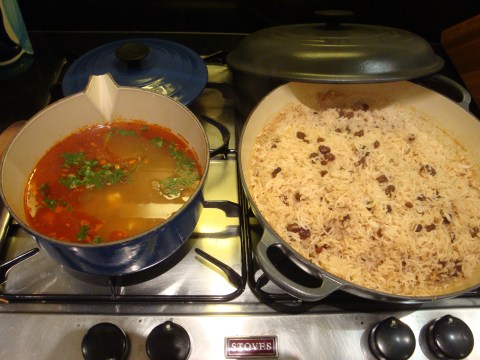
In fact I substituted some home made beef stock for the water – after all, paça or paçe (see above) appears to mean a meat broth – and also substituted a handful of spaghetti snapped into bite-size lengths for the vermicelli. The end result was basic in flavour but good.
Here is the finished soup along with kabuni, a sweet rice pilaf:
Ms Chamberlain writes “It is difficult to find Albanian recipes, for there is no book on Albanian food in English”. This has since been put right as I succeeded in tracking down a copy of “The Best of Albanian Cooking” by Klementina and R. John Hysa published in the US in 1998 by Hippocrene. The authors are an emigré couple now living in Canada and their rather scary black and white photographs adorn the inside back cover, he a dead-ringer for Frankenstein’s monster and she for Cruella de Ville. Mr Hysa writes in the introduction to the book “All visitors that we happened to host have really enjoyed the delicious Albanian dishes my wife served them. They couldn’t resist asking her to write down some of the recipes for them or urging her to open a restaurant that couldn’t but be a ‘smashing success’..”
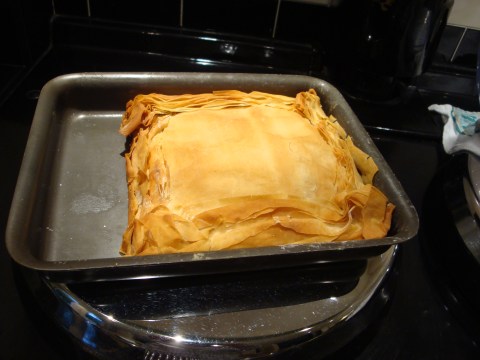
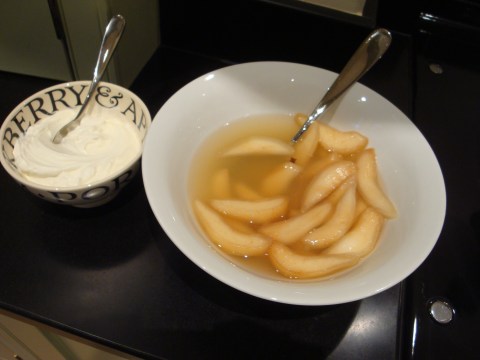
Flicking through the book I came across “Spitroasted Lamb Entrails”, “Stuffed Beef Spleen”, copious references to frying in margarine and a Trahana soup whose principal ingredients are water, breadcrumbs and toast. This is not a straightforward cuisine to sell to the uninitiated and I wanted to shout to R.John Hysa “Don’t do it! Don’t open that restaurant – your guests were just being polite!” Nevertheless, the book is clearly set out and gives a real flavour of authentic Albanian cooking, though the recipes are a little sketchy. After a little searching within, I found a sweet rice pilaf, kabuni (see above). The use of meat stock in a sweet rice dish is unusual and the clove and cinnamon flavouring typically Albanian. I decided to complete the breakfast with some fruit – a pear compote with an Italian influenced lemon zest flavouring,also a filo pastry pie (byrek or burek- a similar word to the Turkish pie börek) and some thick natural yoghurt for which Albania, like Bulgaria is well known. Of all the dishes, the filo pastry pie with a feta and parsley filling was the most accessible and is probably the one I would cook again. Here’s the pie, fresh out of the oven:
All in all, an unusual breakfast which provided a geographical and historical insight into this enigmatic Balkan country.

The 3 recipes from “The Best of Albanian Cooking” are reproduced below in all their sketchy glory.
Kabuni – Sweet Rice and Raisin Pilaf
Ingredients
1 cup rice
1/4 cup butter
1 cup sugar
1 and 1/2 cups mutton or lamb bouillon
1/4 cup raisins
Ground cinnamon and ground cloves
Sauteé rice slightly in butter mixed with a teaspoon sugar. Add boiling bouillon and raisins. Simmer 10 minutes, mix with sugar and bake in moderate oven (350 degrees F) for 20 minutes. Remove from oven, sprinkle with cinnamon and cloves. Serve hot. 4 servings.
Jennifer’s notes: I used basmati rice which I soaked in cold water for 20 minutes before draining in a sieve and frying according to the recipe. I increased the bouillon quantity to two cups which are the usual proportions for a pilau or pilaf. I used a mixture of home-made chicken and beef bouillon rather than lamb as that was I happened to have in the fridge. I added the spices to the buttery rice before adding the stock rather than at the end of cooking and I also reduced the sugar quantity by about 1/4. I covered my pan with a lid before baking in the oven.
Byrek me gjizë – cottage cheese pie
Ingredients
1 and 1/2 cups salted cottage cheese
3 eggs
4 tablespoons chopped parsley
Salt
6 tablespoons melted butter or margarine
1 and 1/2 packets pastry leaves (phyllo dough)
Mix well cottage cheese, eggs, parsley and a bit salt, and use this mixture as filling for the pie. Use melted butter/margarine to brush the baking pan and to sprinkle pastry leaves. Prepare and bake the pie as in the recipe spinach pie (Brush the baking pan with some of the melted butter/margarine, and start laying pastry leaves, allowing the edges to get out of the baking pan for about one inch: lay two leaves, sprinkle or brush with butter/margarine, then lay two other leaves, and so on, until half of the leaves are laid. Spread the filling mixture over the laid pastry leaves. Finish laying the other half of pastry leaves, turn the edges of the bottom leaves over the pie, sprinkle with melted butter/margarine and bake in a moderate oven at 350 degrees F for about 45 minutes or until a golden brown crust is obtained.) 4 servings.
Jennifer’s notes: I used a single pack of Cypressa filo pastry and a single pack of crumbled feta cheese combined with half the quantity of other ingredients for the filling. I baked the pie in a deepish rectangular metal tin which it didn’t fill: the halved pastry sheets formed a rustic square shape which looked quite attractive. This pie was also good cold and survived well for a picnic.
Komposto dardhe – pears compote
Ingredients
2 pounds pears
3 tablespoons lemon juice
1 cup sugar
1 tablespoon grated lemon rind
1/4 cup liqueur wine
Cloves (whole)
Put peeled sliced pears with the cores removed into 2 cups cold water and lemon juice for 20 minutes. Simmer pear peels for 10 minutes in 4 cups water in another utensil, filter the liquid, add sugar and return the syrup to the sliced pears. Chill and stir in wine. Season with cloves.
Jennifer’s notes: I added sugar to the water and boiled this to make a syrup rather than adding sugar afterwards. Best to cool the syrup a little before pouring over pears as it made their edges turn soggy. Does it mean a teaspoon rather than a tablespoon of lemon rind? The lemon flavouring really lifts the pears and Marcella Hazan uses it in her Italian fruit salad or macedoine recipe – that Balkan influence again!
Breakfast in Afghanistan
July 28, 2009 § 1 Comment
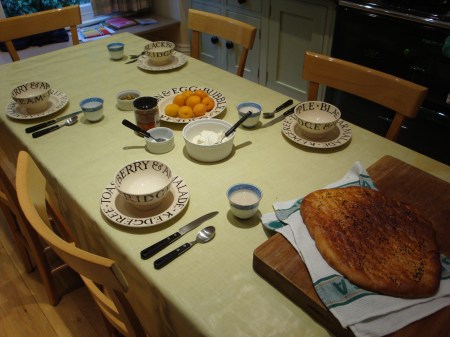
Breakfast is a big event in our household but lately the house breakfast of bacon, fried egg, Mediterranean fried bread and baked beans has seemed a little staid and over familiar. Earlier this summer we (me, husband Tim and sons George and Arthur) hit upon the idea of eating our way through breakfasts of the world beginning with A for Afghanistan and working our way through all 100 and odd countries on George’s flag poster right through to Z for Zambia.
What do Afghans eat for breakfast? First stop Amazon whence Helen Saberi’s helpful and concise book “Afghan Food & Cookery” published by Hippocrene was swiftly despatched.
The national drink is tea, chai, and Ms Saberi says “it is consumed in great quantities and I must say both the green and black tea are excellent”. I was tempted by the extraordinary sounding recipe for qymaq chai tea with clotted cream but in the end opted for a green tea flavoured with cardamon, with added sugar and milk.
NeverthelessI can’t resist quoting a paragraph on qymaq chai which is “a special tea prepared for formal occasions, such as engagements or weddings. It is made with green tea and by the process of aeration and the addition of baking soda the tea turns dark red. Milk is added (and sugar too) and it becomes a purply-pink colour. It has a strong rich taste. Qymaq, the luxury cream-like product is floated on the top. My husband, who is very poetic and very homesick, likens the color of the tea to the rosy-hued glow of the mountains in Afghanistan as the sun rises or sets. The qymaq represents the white snowcapped peaks.”
How’s that for a weird sounding brew and a great bit of purple prose!
With our standard Afghan tea we ate Roht, a round sweet flat bread which Ms Saberi says is often eaten for breakfast with tea or hot milk. The recipe is given below. Some apricots (Ms Saberi notes that the Panjshir valley is particularly noted for its apricot trees), pistachio nuts (for which the region of Herat is famous) and thick plain yoghurt completed the meal.
The end result was a fragrant and unusual breakfast and as a result I am tempted by many of the other recipes in Ms Saberi’s book, for example aush pasta with yogurt, chickpeas, kidney beans and minced meat on page 82 and the intriguing-sounding abrayshum or silk kebab on page 256.
Next stop for breakfast Albania – can’t wait!
Recipe for Roht – Afghan sweet flatbread
This recipe comes from Helen Saberi’s “Afghan Food & Cooking”. Ms Saberi attributes the recipe in turn to her friend Aziza Ashraf. I learned something new about the nigella seeds or sia dona which I quote: “These small black seeds, which can be bought under the name kalonji in an Asian grocery, are a confusing item because some people call them black onion seeds although they have nothing to do with onions. They are also confused with caraway seeds. Another mistake is to call them black cumin seeds, as true cumin seeds come from a different plant. Sia dona come from the plant Nigella sativa and are sometimes called nigella seeds.”
Ingredients
1 and 1/2 pounds (5 and 1/4 cups) all purpose flour
2 level teaspoons of baking powder
1 pack quick rise yeast
1/4 tsp ground cardamom
3/4 cup vegetable oil
1 and 1/2 cups sugar
3/4 cup warm water
1 egg, beaten
1 level tablespoon yoghurt
sia dona (nigella seeds)
sesame seeds
Mix together the flour, baking powder, yeast and cardamom. Warm the oil in a small pan, then add to the flour and rub together for a few minutes. Add the sugar to the warm water and gradually add to the flour, mixing well. Now add the egg (reserving a little for glazing) and the yogurt. Mix well and knead into a quite soft dough for about 5 minutes. Cover with a cloth and leave in a warm place for about an hour or so.
Meanwhile preheat the oven to 425 degrees F.
Divide the dough into two and roll out each on a floured surface into a round of about 1/2-inch thickness. Prick all over with a fork, glaze with the reserved egg and sprinkle the top with the sia dona and sesame seeds according to your fancy.
Place on a slightly oiled or greased baking tray and bake in the hot oven for about 15 minutes until risen, golden brown and cooked through. (If the top is browning too quickly, turn down the heat and cook on the lower heat for a little longer.)
Remove from the oven and place in a warm tea towel or plastic bag to stop the bread drying out too much.
 The Rhubarb Fool