
Review of Da Piero, Irby (Wirral)
May 4, 2010 § 3 Comments
The arrival of warm spring weather coincided with the Delicious magazine’s Italian issue appearing on the shelves earlier this month. Browsing through its glossy pages I noticed a feature on an Italian restaurant that wasn’t (as usual) in London but in the small village of Irby on the Wirral (south of Liverpool) less than an hour’s drive from Manchester.
Da Piero gained recognition beyond its local loyal customer base earlier this year when it was named “Best Newcomer” in the 2010 edition of the Good Food Guide. Hot on the heels of this accolade came recognition (in the form of two knives and forks) in the latest Michelin Guide. It’s owned and run by the Di Bella family, with father Piero in the kitchen, wife Dawn front of house and son Alan sous-chef in training. Piero grew up in Sicily and the restaurant specialises in authentic Sicilian dishes.
Sicilian food in a village on the Wirral? It sounds unlikely doesn’t it? Maybe a Mafia money-laundering operation with links to the Liverpool underworld? Undaunted we booked a table and, on a beautiful Wednesday evening we drove off into the sunset.
Here’s what we found:

Apparently just a small neighbourhood restaurant in a quiet street. Going inside, it was as if you had walked into your gran’s front room into which someone has unaccountably placed four tables. There are just 15 covers in the restaurant. A couple of black and white family photos hang on a magnolia painted wall and that’s it in terms of decoration. Thankfully no Chianti bottles in straw, red-checked tablecloths that kind of thing.
We were greeted and waved to what was evidently our table by a smiling Dawn. All the other tables were occupied and there was a hum of contented post-meal chat over Italian pop music playing in the background (you may not like piped music but Zucchero is at least authentic).
We browsed the handsomely large menus which are laid out in traditional Italian style (antipasti, primi piatti; secondi piatti and dolci) and the interesting wine list.
Piero is clearly a man who knows what his customers want – the menu is by no means exclusively Sicilian: there are Northern Italian specialities (osso bucco) plus Italian restaurant favourites (spaghetti carbonara) as well. We later discovered that Piero’s family has roots in mainland Italy so the menu is almost a blended family history.
I was determined to have the full authentic Sicilian experience so chose a classic caponata to start, then a pasta with garlic, parsley and hot pepper, followed by home-made salsiccia (sausage) Siciliana with lentils.
Following Dawn’s advice about portion sizes, Tim elected to share the pasta course with me and chose osso bucco as his main course.
The caponata, correctly served warm rather than piping hot, was simple and delicious, each vegetable cooked to perfection. If you don’t know the dish, think of it as a Sicilian version of ratatouille, enlivened with capers and olives. Unusually it contained nuggets of potato along with the aubergines and tomato. A bit odd but entirely successful.
The pasta was good quality factory-made tagliatelle simply dressed with best quality olive oil, browned garlic, flecks of parsely and chilli flakes. I asked Dawn later about whether they made their own pasta – she said they generally used factory pasta but made their own if there was a ravioli special on the menu. This sounds like an entirely sensible decision for such a small restaurant but don’t go there expecting mounds of beautiful home-made pasta.
Here’s Tim’s rich and meaty osso bucco:

And here is my glorious dish of home-made sausage and lentils:

The sausage was rustic and flavoursome with just the right amount of chilli heat and the lentils were the perfect accompaniment and cooked to just the right degree of tenderness. One of those dishes you could eat again and again…
I think it was Ed Balls who that very day (during the election campaign) said he wanted to give one-parent families more money so they wouldn’t have to feed their children lentils every day. Ed, get down here and eat your words!
We’d chosen from the short but interesting wine list a reasonably priced organic red wine (Nero d’Avola) from Sicily (Cerasuolo di Vittoria 2008) which was earthy and just right with the rustic food.
We were too full for puddings so just had a skilfully made espresso each. By now there were just two tables left occupied in the restaurant and as Piero had finished cooking he came out from the kitchen unprompted to meet the remaining guests. He’s a distinguished looking man who, dressed in a toga rather than immaculate chef’s whites, could pass for a Roman senator. He’s passionate about his food and utterly charming. Who can resist a man who’ll share a caponata recipe with you (the addition of potatoes was his own idea) and is such a perfectionist that he makes his own candied orange peel?
What a lovely evening. Don’t come here expecting refined food or a slick city restaurant experience. Simplicity and freshness are what it’s all about together with a genuinely warm welcome. My advice would be to get here while you still can.
Contact details
Da Piero
5 Mill Hill Road
Irby
Wirral CH61 4UB
0151 648 7373
www.dapiero.co.uk
L’Artisan du Chocolat arrives in Manchester
April 25, 2010 § Leave a comment
Just as the chocolate fest which Easter has become is finally over, L’Artisan du Chocolat go and open a concession in Selfridges Manchester store!
Despite the name, L’Artisan du Chocolate is a British company founded by Gerard Coleman and make chocolates to die for. Like most people, I enjoy chocolate but wouldn’t call myself a chocoholic. These chocolates though are something else. I was first introduced to them by my friend Shelley who gave me a box as a new year gift two years ago. Now I make a bee-line for their Sloane Street store when I visit London. The good and bad news is that 1) I don’t have to any more as theyr’e much closer to home 2) they are both incredibly moreish and on the pricey side – but those two factors do cancel each other out.
On display when I visited was this rather magnificent chocolate elephant. He’s not solid chocolate but apparently has a polystyrene core and is spray painted with real chocolate using car production line technology. Fancy that.

I was immediately drawn to L’Artisan’s gleaming chocolate pearls – pearlised shells in white or dark chocolate with a soft ganache filling. If you buy a sufficient quantity, they package them in gorgeous little jewelry-type coffrets. I was only the market for a small quantity so had to content myself with a cellophane bag.

Here are my precious purchases – the aforementioned pearls, a couple of bars in unusual flavours (white chocolate with saffron; dark chocolate with Darjeeling tea) plus a tasting box which I’ve been working my way through, one divine chocolate per night after dinner with a cup of espresso. Quality not quantity.
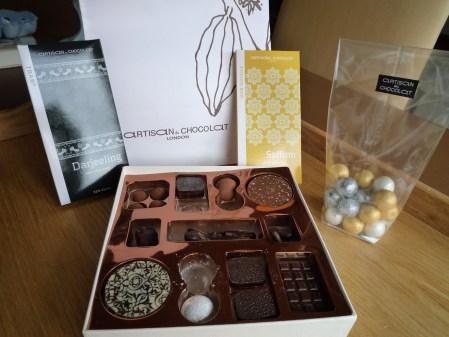
Sof far, my favourites are the signature liquid salted caramel balls also the wondrous thin discs filled with either passionfruit coulis or apricot and tonka bean coulis.
Selfridges food customers are rather fickle – the fresh fish and meat counters soon disappeared as did the cheese counter. Let’s hope Artisan du Chocolat can stay the course.
And they’ve brought out a range of election chocolate buttons too bearing tongue-in-cheek slogans so you can stay topical and enjoy your chocolate at the same time.
http://www.artisanduchocolat.com/ArtisanduChocolatSite/pages/home/default.asp
Contact details
http://www.artisanduchocolat.com
L’Artisan du Chocolat – flagship London store
89 Lower Sloane Street
London SW1 8DA
0845 270 6996
Manchester – Selfridges concession store
1 Exchange Square
M3 1BD
Dalemain marmalade competition 2010
February 14, 2010 § 1 Comment
We wait with bated breath this morning for the results of this year’s “Grand Prix of Marmalade” held at Dalemain, a country house and estate near Penrith in Cumbria.
http://www.marmaladefestival.com/competition.html
Marmalade is a man-thing in our household. Much as I enjoy marmalade, it’s my husband Tim and our two sons who insist on its presence at the breakfast table. It’s become part of our annual ritual that Tim tracks down Seville oranges every January, painstakingly shreds the tough peel and produces 6 or so gleaming jars of marmalade that generally last us through until August. Then it’s back to the Tiptree or Frank Cooper’s to get us through the rest of th year.
We discovered the Dalemain marmalade festival during a tour of the house and gardens during the summer. It seemed entirely natural that the right category to enter would be the “man-made” one (name self-explanatory).
Here is Tim carefully scraping pulp and pips from the juiced Seville oranges into a piece of muslin. These are a rich source of pectin and will give the marmalade the right set.
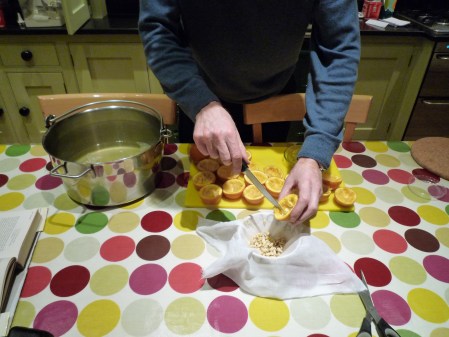
Here are the prepared oranges ready for the first boiling stage. This fills the house with delicious orange aromas brightening up the depths of winter. You can see the little muslin bag containing pips and pith tied to the preserving pan handle.

Here is the selected jar ready for despatch to Dalemain:
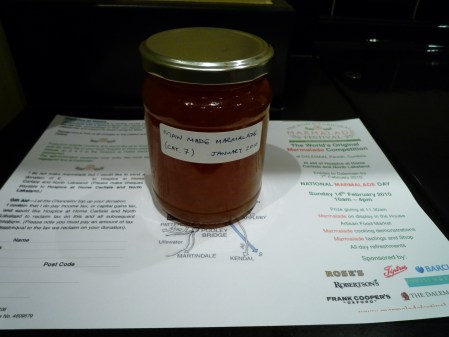
I must say the marmalade was very good this year, the aromatic and with just about the perfect set – not too runny, not rubber-solid. Tim’s fate is in the hands of those tough Women’s Institute judges now who’ll make their decision later this morning. Let’s see what happens…
Recipe for Seville orange marmalade
This is the recipe that Tim uses for consistently reliable results. It’s from Delia Smith’s Complete Cookery Course.
Ingredients
2 lb (900g) Seville oranges
1 lemon
4 lb (1.8kg) preserving sugar (ie the large crystal kind, NOT the one with added pectin) or granulated sugar
4 pints (2.25 litres) water
Measure the water into the preserving pan. Cut the oranges and lemon in half and squeeze out the juice. Add the juice to the water and place the pips and bits of pith clinging to the squeezer onto a square of muslin.
Cut the orange peel (not the lemon peel) into quarters with a sharp knife, then cut each quarter into thinnish shreds. As you cut, add the shreds to the water and any further pips of pith to the muslin. The pips and pith contain the all-important pectin to set the marmalade so be diligent at this stage and don’t just chuck it away.
Tie up the piece of muslin to form a little bag and tie this to the handle of the pan so that the bag is suspended in the water. Bring the liquid up to simmering point and simmer gently, uncovered, for 2 hours or so until the peel is completely soft. Test by pressing and/or biting it.
Remove the bag of pips and set aside to cool. Add the warmed sugar to the pan and stir it occasionally over a low heat until it dissolves. Increase the heat, and squeeze the bag of pips over the pan to extract as much jelly-like pectin as you can, scraping it off. Stir to mix thoroughly.
Once the mixture reaches a fast boil, start timing. After 15 minutes test for a set by spooning a teaspoon of marmalade onto a saucer cooled in your freezer. You have the right set if, once the mixture has cooled for a minute it has a crinkly skin. If it’s not reached setting point, boil for another 5 minutes and test again. Keep doing this until setting-point is reached. This can take some time depending on your particular batch of oranges.
Once setting-point is reached, remove the pan from the heat. Skim off any excess scum at this stage. Leave the marmalade to settle for 20 minutes. This resting will ensure the peel is evenly distributed in the jar when you come to pot.
While you wait, warm your cleaned, rinsed and dried jars (6 1lb jars or their equivalent) in a moderate oven for 10 minutes.
Pour the marmalade with the aid of a metal jam funnel or ladle into the jars. Top each with a waxed disc and seal with a lid immediately. Label when cool.
Dinner at Michael Caines Restaurant at ABode Manchester
November 5, 2009 § 2 Comments
Tim and I finally made it to Michael Caines Restaurant at ABode on a wet and windy Wednesday night in early November.
First, a little background on the Abode concept (sorry I can’t keep up the tricksy capitalisation any longer). Abode is a small chain of boutique city centre hotels each with a Michael Caines restaurant attached. Looking at the website, they aim to attract a hip and trendy crowd, but looking round at the lobby the real clientele is somewhat older, more portly but no doubt more monied. The man with the money behind the concept is one Andrew Brownsword, an entrepreneur with a taste for discreet self-publicity, hence the AB in ABode and the sponsoring of Brownsword Hall in Poundbury, Prince Charles’ model village. Yes, Brownsword is numbered amongst Prince Charles’ best mates.
Brownsword has featured regularly in the Sunday Times Rich List for a decade or so. He made his money in greetings cards and Forever Friends teddy bears, businesses which he sold to Hallmark Cards in the early 90s reputedly for some £190 million. He used the money to establish a hotel business and is also majority owner of Bath Rugby Club.
Brownsword and Caines met after a lunch at Exeter’s Royal Clarence Hotel in 2003 where Caines was executive chef. Brownsword enjoyed his meal so much that, in a Victor Kiam moment, he bought not just the restaurant but the hotel as well and the Abode concept was born. There are now Abode hotels in Glasgow, Canterbury, Chelsea and Chester as well as Manchester and Exeter.
Enough of background and onto the dinner experience. We descended from the hotel lobby into the basement where you will find the champagne bar and restaurant. Manchester is famous for being the centre of cotton industry in the nineteenth century and the building where Abode is now situated is very evidently a former cotton warehouse. It has been sympathetically converted, keeping the roomy expanse of space you associate with a warehouse and making a feature of the sturdy cast iron columns which support the roof. Clever use of translucent glass panels breaks up the room and gives its various spaces an intimate feel within the large basement area.
The comedy French maître d’ (is he for real?) whisked away my bags of early Christmas shopping and seated us in the champagne bar, a space adjoining the the main dining area with plenty of scope for people watching. The basement is softly lit, lots of dark wood, brown and orange and a Paul Smith striped carpet. There are black and white photos of rock stars on the walls and napery is limited to generously sized white napkins. The problem any basement encounters is that there is no natural light. On a cold and wet evening in late autumn this didn’t matter at all but I probably wouldn’t come here for lunch for that reason despite the remarkably good value £12 “grazing” menu lunch offer.
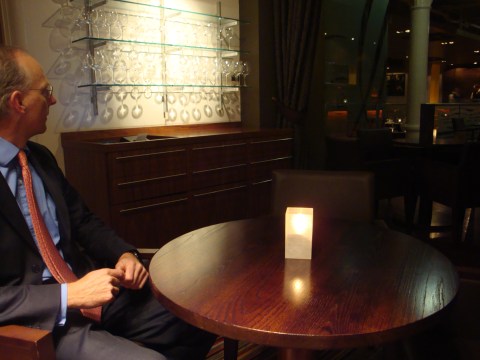
The cocktail list is impressive, naming the Head Mixologist as one Adrian Vipond. I liked the sound of the wittily named Lady Macbeth (blended Scotch plus various red fruit liqueurs shaken over ice) but Tim and I both plumped for a flute of the house champagne. This was acceptable but I wasn’t blown away by it. Being bone dry, it would have been good in one of the various Champagne cocktails on offer. I’d love to come back and try a cocktail sometime – the only downer was the rather damp smell lingering in this corner which resulted from a leaking skylight. Our fellow drinkers didn’t seem to notice that the sofa they were perched on was damp from dripping rainwater. I think they’d had a few…
After a little difficulty identifying the right member of staff – there were lots of staff in the dining room but working apparently to strict lines of demarcation- we succeeded in getting hold of menus. The first decision you have to make is whether to go with the grazing menu, multi-course tasting menu or standard à la carte selection. Prices didn’t look too unreasonable – for instance the tasting menu is a headline £65 per head (sorry I failed to make a note of whether this included VAT and service). Our hostess patiently explained how the grazing menu worked: these are small portions of stand-alone dishes which function either as starter or main. You order as many or as few as you like in whatever order takes your fancy. In effect it’s a design-your-own tasting menu.
Unsure of portion sizes and how the grazing concept would work in practice we decided to dip a toe in the water and choose 2 grazing dishes each as a starter followed by an à la carte main. My choices were (i) crab cannelloni with pink grapefruit jelly and lemon thyme foam, and (ii) tuna tartare with pickled beetroot and turnip, wasabi mayonnaise and sweet raisin vinaigrette. Both dishes were pretty as a picture as you can see below and modishly served on a square glass plate and slate tile respectively.

Head chef Ian Matfin clearly knows what he is doing. The flavour combinations were logical, classic even but presented in a new way and both dishes showcased high levels of skill in the kitchen. After tasting these two dishes, I wish I’d gone for the full grazing option rather than a single main.
My main course was roast mallard with jus (known in my kitchen as gravy) celeriac mash and winter berries (these were cranberries and blueberries I think). The mallard was cooked to an accurate medium rare as requested and was pink and juicy. It came unexpectedly with a tiny jug of bread sauce which, given the presence of celeriac mash, was not entirely necessary, nor is it a classic roast duck accompaniment. My only gripe (a perennial one) was that we had to order a selection of vegetables and potatoes to accompany the our main courses. These were dinkily served in a lidded white china sugar bowl but were nevertheless the same old boring boiled broccoli, cauliflower and carrot.
We chose a bottle of Gigondas to accompany our meal which appeared ostentatiously in the separate Fine Wine section of the menu. Why the wine list couldn’t simply be presented by region with wines listed in price order rather than by grape type I don’t know. This leads to weird anomalies such as Châteauneuf du Pape being grouped with Beaujolais under “Red wines – other”. Given the excellence and variety of the grazing dishes it would have been good to see more wines offered by the glass too – crab cannelloni and Gigondas is definitely not a match made in heaven.
We were offered the pudding menu with lots of interesting sounding choices. I chose the pumpkin crème brûlée with chocolate ice cream. It sounded weird and it was. Frankly it was a bit yucky. Like pumpkin pie filling but without the benefit of pumpkin spice. An obsession with inventiveness had clearly clouded the chef’s judgement here. Never mind, the espresso which came next was just right.
I’d love to come again and would try the full-blown grazing option skipping the pudding next time.
Review of The Church Green, Lymm, Cheshire
September 5, 2009 § Leave a comment
It was our wedding anniversary yesterday and Tim and I visited the Church Green in Lymm for dinner last night to celebrate. This is chef Aiden Byrne’s latest venture and though it opened back in March I think it’s still the new place to go round here. Aiden Byrne is familiar to our family as one of the chef’s on TV programme Great British Menu. This year he represented the North West but was trounced (rightly) by stalwart Nigel Haworth. I remember Aiden Byrne’s TV persona as that of an overawed Scouser fresh out of catering college. His food on the programme was meticulously prepared with flashes of inspiration. I made his chilled broad bean soup with goat curd recipe for a family celebration dinner in June. Cold soups are practical and can be distinctly underwhelming but this one really was a thing of beauty with its herb and flower garnish and the balance of tastes and textures was spot on. I recall his overall Great British Menu was unbalanced and that he was a self-confessed novice pastry chef so puddings were not his forte.
My only other preparation for this visit was reading Matthew Norman’s damning Guardian Online review from March 2009 a couple of weeks after the place opened. The article strapline goes “Michelin poncery in a village pub leaves Matthew Norman with a nasty taste in his mouth”. Oh dear – overall rating only 4 out of 10.
The Church Green is indeed a converted village pub right in the middle of desirable Cheshire commuter village Lymm. We arrived, parked up on the battered tarmac apron which sadly obscures most of the front façade of the building and took a look.

There’s no denying that this place looks like a pub, despite the flash conservatory tacked on the side. The impression was reinforced when we walked inside as part of the original bar is still intact complete with dodgy carpet and painted flock wallpaper on the ceiling. We’d dressed up a little for the occasion so it was slightly odd to find a group of hikers in red cagoules propping up the bar. They’d clearly popped in for a drink after the day’s exertions. No matter – I really hate dress codes in hotels and restaurants and have in fact been thrown out of the Ritz in London twice for being incorrectly attired and won’t go near the place now.
The two glasses of champagne we ordered as an aperitif took an age to arrive – service is a little nervous and less than slick but this gave us plenty of time to take in the ambience and décor. The impression is that not that much has been spent on doing the place up. They don’t bother with white linen – the small polished wood tables give a bistro feel (but without bistro prices). The other impression was that the restaurant was nowhere near full which really on a Friday night no longer in school holidays it should have been. Maybe it’s the price issue again.
We were shortly ushered to our table and our first courses arrived. I’d ordered borlotti bean soup with smoked duck foie gras. This was a shallow bowl of pale puréed creamy soup topped with a generous slice of duck liver, fresh out of the pan. This turned out to be, without exaggeration, one of the most delicious things I’ve ever eaten. The duck liver was perfectly cooked, a light crust on the outside, meltingly soft within and the hint of smoke flavour was just perceptible in the background. The soup was full flavoured and velvety smooth.
My main course was lamb three ways – the chef’s favourite cut of rack, plus a neat cube of pressed slow-cooked shoulder and a sticky braised lamb’s tongue. Main courses came with only minimal vegetables and no potatoes so at the waitress’s suggestion we ordered a portion of French beans and some thick cut chips to share. I resent having to order side dishes and would much prefer the chef to have considered and presented a complete dish with a balance of tastes and textures. I particularly dislike the habit of presenting a half moon side-dish of supposed “seasonal vegetables” which usually comprised boiled broccoli, carrot and a bit of overcooked cauliflower. They don’t fall into that trap here but it is nevertheless a bit gastro-pub to have to share a big portion of chips. They were really good chips – crispy on the outside and fluffy within – so I’m not complaining too much. My lamb was delicious and skilfully and inventively cooked -I applaud the use of different parts of the animal, the cheaper cuts as well as the best ones. The meat and accompanying reduction were all so intensely flavoured that I was overwhelmed by an impression of brown stickiness and, unusually for me, couldn’t finish my plate.
We chose New Zealand Pinot Noir to accompany our meal. The wine list is short and rather idiosyncratic and contains a number of glaring gaps. Wine knowledge is clearly not Aiden’s thing and there were I think no half bottles available and a very limited selection of wines by the glass which is disappointing.
I was unable to manage pudding but tried a little of Tim’s tiramisu. Pudding choice was underwhelming – nothing to really tempt the tastebuds and the tiramisu that arrived was not at all dainty – a great lumpen thing served inappropriately in a knickerbocker glory glass. Looking at the Church Green’s website this morning I see they are advertising for an experienced pastry chef – it shows!
My overall impression mirrors the Great British Menu experience – flashes of inspiration (Byrne is clearly a wizard when it comes to beans whether broad or borlotti! ) but his cooking lacks balance – when it comes to brown stickiness you can have too much of a good thing – and he needs to employ a decent pastry chef soon.
The Church Green,
Higher Lane ,
Lymm,
Cheshire
Telephone: 01925 752 068
Return to the home of Sticky Toffee Pudding
August 8, 2009 § 5 Comments
Our good friends Simon and Penny were over from Hong Kong for a couple of weeks in August and threw a small party at their house in the Lake District, Ormathwaite Hall on a Saturday 8 August. I offered to bring Sticky Toffee Pudding as my contribution to the catering.
The meal began with plenty of champagne – Simon is a very generous host – accompanied by crudites and dips. Another friend and excellent cook Shelley had prepared a delicious lamb tagine served with couscous.
My sticky toffee pudding with served with extra sticky toffee sauce and ice cream finished things off pretty well and guest numbers being larger than anticipated, it was served in mercifully tiny portions – just right to finish off the meal.
The prepared pudding is shown below fresh out of the oven at home. It is very easy to transport, doesn’t need refrigeration and reheats beautifully so is a perfect choice for taking to a party in advance.

Sticky Toffee Pudding can be found on menus all over the Lake District, from where it originates, and indeed all over the UK and beyond all year round. Jane Grigson is one of my favourite food writers and is a consistently reliable source of information. In her book “English Food” she reminds us that Sticky Toffee Pudding is by no means an ancient traditional English pudding but was devised by Francis Coulson who opened the Sharrow Bay Hotel in Ullswater in 1948. The Sharrow Bay can lay claim to being the first country house hotel and Francis Coulson’s recipes are generous in their use of butter and cream: his sticky toffee pudding recipe is no exception.
The recipe I use comes from one of chef/Lake District hotel proprietor John Tovey’s books with one modification of my own – the use of soft fudgy Medjool dates rather than ordinary ones. The grated orange zest in the sauce really lifts the flavour in a subtle way and cuts through the sugar and syrup. I’m afraid I don’t know which of John Tovey’s books it comes from – my copy of the recipe was dictated to me over the phone by my mum some years ago so all I have is a list of ingredients and brief manuscript notes in my personal recipe book.
Recipe for Sticky Toffee Pudding
Ingredients
For the pudding
4 oz butter
6 oz soft brown sugar
4 eggs
8 oz sr flour
8 oz Medjool dates
1 tsp bicarbonate of soda
2 tbsp camp coffee essence
10 fl oz boiling water
For the topping
2 tbsp double cream
3 oz soft brown sugar
2 oz butter
For the sauce
8 oz golden syrup
few drops vanilla essence
2 oz butter
2 oz soft brown sugar
Grated rind of 2 oranges
2 tbsp double cream (optional)
9”-10” lined square tin; 180C 350F
Cream the butter and sugar together, then beat in the eggs. Fold in the flour sifted with the bicarbonate of soda. Add the dates. Dissolve the coffee essence in the boiling water and pour into the mixture. Beat until mixed. Pour into the tin and bake for 1 ½ hours.
To make the topping, combine the ingredients in a saucepan and bring to the boil. Pour over the cooked pudding and brown under a hot grill.
To make the sauce, melt all the ingredients together in a small saucepan. Serve with chilled pouring cream or vanilla ice cream as well as the toffee sauce.
Danger lurks in the woods
August 3, 2009 § 3 Comments

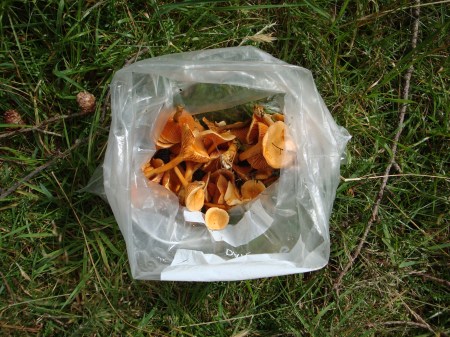
On the final leg of a Lake District walk along the far side of Buttermere I was delighted to spot the egg yolk yellow of what I assumed were chanterelles emerging from deep green moss. Eagerly I filled a small bag with the perfect little specimens below:
We ended the walk with a celebratory ice-cream at nearby Syke Farm in Buttermere village where they make delicious and unusual flavours from their own herd of Ayrshires. Blackcurrant cheesecake flavour was definitely a winner. They don’t have their own website but further details about the ice cream and Syke Farm tearoom can be found at http://www.explorelakedistrict.co.uk/detail_to_see.php?v_id=72
Back home that evening I thought I would double check my wild mushrooms against the photo and description in my trusty Collins gem Mushrooms book. After a few minutes I was dismayed to discover that I’d gathered a bagful of false chanterelles. These are marked “POISONOUS: A minority suffer from sickness and hallucinations”. Oh dear. They were quickly consigned to the dustbin and I was relieved to have escaped unharmed. I was mindful of the widely reported story of how Scottish “Horse Whisperer” author Nicholas Evans became seriously ill in September 2008 after mistaking a deadly cortinarius mushroom for the prized chanterelle. The little Collins book is really helpful as an identification guide as long as you pay attention to each section: the key piece of information in my case was habitat: I’d gathered my mushrooms beneath larches in acid-soiled woodland, a classic false chanterelle habitat whereas the true chanterelle grows mainly amongst broad-leaved trees, only occasionally amongst pine.
I was rewarded with a solitary real chanterelle a week or so later which I discovered on the wild fringes of a Lake District country house garden. I’m going to keep the exact location secret as chanterelles are thin on the ground! The perfect thing to with a single chanterelle is to cut it into neat small dice, fry it quickly in hot butter and serve it alongside creamy scrambled egg on toast. A perfect combination.
 The Rhubarb Fool