
Visit to the heart of Yorkshire’s Rhubarb Triangle
March 12, 2010 § 2 Comments
I finally made a visit in mid February to what I suppose must be the spiritual home of The Rhubarb Fool, Oldroyd’s rhubarb farm in the village of Carlton near Leeds, home to the world’s largest rhubarb forcing shed.

Dutch rhubarb has been inveigling its way into our shops for a couple of months now. Thanks to the “High Priestess of Rhubarb” Janet Oldroyd’s interesting talk I know know how and why that is and why it’s best to wait for the proper stuff from Yorkshire. Whereas Oldroyds and the other 10 remaining Yorkshire rhubarb producers wait patiently for frost to break the dormancy of the rhubarb crowns growing in the fields, the Dutch cheat by spraying their crowns with an active plant hormone, the nasty sounding gibberellic acid.
Rhubarb, or to give it its evocative and alliterative full name Rheum Rhabarbarum is an ancient plant originally from China and Russia. It’s literally the plant of the barbarians and there is some speculation that the Rha in the Latin name might refer to the River Volga in Russia.
On the morning of our visit Janet was dressed appropriately in a vibrant chartreuse outfit the exact acid yellow of forced rhubarb leaves. As she cradled some of the precious rhubarb stalks in her arms I saw the perfect photo opportunity but was just too polite to thrust my camera in her direction. I had to content myself with pictures of the Oldroyd establishment instead.
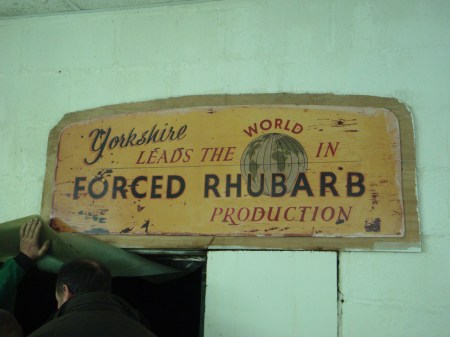
From 1877 onwards, Yorkshire did indeed lead the way in forced rhubarb production. It had the natural advantages of heavy water retaining soil, cold frosty conditions in winter, high rainfall and plentiful supplies of wool by-product “shoddy” to provide a nitrogen rich fertiliser. The Yorkshire coalfields provided fuel for heating the sheds and the newly built railway lines provided a ready route to market. The Victorian heyday of rhubarb is reflected in the names of the different varieties – Victoria and Albert are both popular but I must say my own palate is not yet sufficiently attuned to detect the difference.
Janet’s talk was interesting but after 30 minutes or so we were all itching to get into the sheds themselves. Finally our time came and we filed solemnly through the plastic curtain into the darkened shed itself lit only by flickering candlelight.
The warm, humid atmosphere and pungent vegetal smell hit us at once. There was a palpable sense of pent-up energy in the shed. As our eyes became accustomed to the soft light we saw row upon row of ruby red crowns largely devoid of soil packed tightly together. The stems were thrusting upwards striving vainly to find the light. The steamy atmosphere of fertility and growth was all too much for one lady in our party – she declared herself a little faint and made a hasty exit!

Our visit ended with an opportunity to buy some of the stuff. Some of the more contrived products (rhubarb wine and rhubarb salad dressing?) didn’t appeal but the gorgeous satin-ribbon pink stalks did. I was sorely tempted by a whole box of the premium grade rhubarb – 20 or so sticks as thick as a baby’s arm presented in a blue presentation box. What a fantastic Valentine’s Day or Mothering Sunday gift that would be! I remained sensible and chose a pound or so of spanking fresh class 1 stalks (or petioles as Janet Oldroyd botanically correctly calls them).

Back home, I cut them up into chunks and baked them in the oven for 20 minutes or so with a generous quantity of golden caster sugar, and the grated zest and juice of an orange. Absolutely gorgeous chilled with a dollop of Greek yoghurt. Since then, I’ve not been able to get enough of the stuff – more rhubarb recipes to follow soon.
If you are tempted to buy some rhubarb, have a look at the producer name on the packet – chances are it will say Oldroyd.
Swiss food in London
January 18, 2010 § 1 Comment
After the New Year’s Eve feast (see previous post) it was our turn to rustle up a meal for 14 (6 adults, 8 children) on New Year’s Day. We’d prepared in advance by doing all the shopping, except for the salad ingredients, in Switzerland. Even the bread came from a lovely bakery in Zürich airport terminal. Swiss wine, an essential component of the meal, would have been too heavy to carry so we’d arranged an advance delivery to our hosts’ address by UK wine merchant Nick Dobson Wines. Nick is a man after my own heart who specialises in wines from Austria, Switzerland and Beaujolais. I’ve bought a number of items from him over the years both for home consumption and as gifts and he’s been really efficient, helpful and knowledgeable every time, plus supplied some really enjoyable wines so I would definitely recommend him if you are looking for something unusual. I give his contact details below at the end of this post.
Our Swiss themed menu was:
Bündnerfleisch (dried cured meat from Graubünden) – a mixture of beef and venison
Mixed salad
Cheese fondue
Bündner Nusstorte (caramel walnut pie from Graubünden)
We indulged in a bit of judicious cheating (or careful purchasing depending on your point of view!) and brought back from Klosters a bag of ready grated weighed and blended cheese for the fondue and the Nusstorte too. I give recipes both for cheese fondue and Nusstorte below if you want to have a go at home. Both recipes have been tried and tested more than once back home in the UK.
Our Bündnerfleisch came from an artisanal manufacturer in Klosters, a little shop on the main Landstrasse road close to the Heid ski lift. Bündnerfleisch is salted and cured meat, usually beef but we bought the venison version as well – similar but darker red with a background gamey flavour. The raw meat is first salted and mixed with a secret recipe of herbs and spices before being hung up to dry for several weeks. The meat is then pressed into a distinctive rectangular shape before being very thinly sliced and served. Bündernerfleisch is similar to the better known Italian bresaola which itself comes from the nearby Valtellina.
The people who run the Klosters business very kindly showed me round their processing and drying rooms where I was able to sea the beef pieces maturing slowly in the rafters:

You can read more about Bündnerflesich by following this link: http://www.grischuna.ch/productsE.html. I just wish we could get hold of it more readily over here as it’s delicious.
This was a really easy meal to feed a crowd of people, fun for both grown-ups an children. Neither the truly authentic Bündnerfleisch nor a pre-prepared Nusstorte are readily available here but you could easily substitute a platter of other cured meats and procure a tart from your local bakery to recreate the idea. Here is the grown-ups’ table (the riotous childrens’ table is just next door).

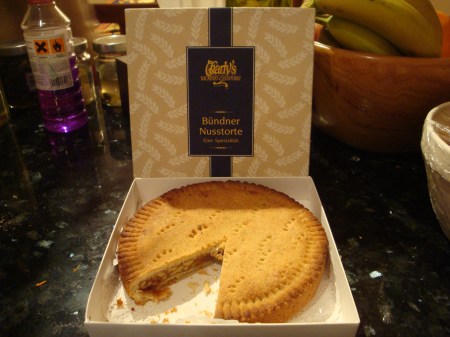
And here’s the beautiful Nusstorte fresh (well almost) from Charly’s in Klosters:
Recipe for cheese fondue “moitié-moitié” (half and half)
This recipe comes from my trusty little Betty Bossi Swiss Specialities cook book, a little ringbound volume with one recipe per page, clear simple and instructions and a photo of every dish. The half and half in the recipe title refers to the mixture of 2 cheeses used in this fondue. This recipe serves 4 people generously.
Ingredients
600g day-old bread from a cob or chunky baguette type of loaf (you need the right ratio of crust to crumb – a tin loaf would give too much crumb) cut into cubes
300g mature gruyère cheese
300g vacherin fribourgeois cheese (substitute emmental if vacherin fribourgeois is not available)
300 ml white wine, ideally a Swiss chasselas, otherwise whatever dry white wine you have to hand
1 peeled clove of garlic left whole
1 small glass (liqueur glass) of kirsch
1 tablespoon cornflour
a pinch each of freshly ground black pepper, paprika, freshly grated nutmeg
Grate the cheese using a coarse grater and place into the fondue pan. A traditional fondue pan is referred to as a caquelon. If, like me you bought a ready grated fondue mix of cheeses, simply tip the contents of the packet into the fondue pan. In a separate bowl, mix together the cornflour and white wine. Pour the mixture over the cheese in the fondue pan. Place the pan over a low heat and slowly bring the mixture up to boiling point, stirring constantly with a wooden spoon. Add the whole garlic clove, kirsch and seasoning to the mix. Once the mixture is smooth, creamy and bubbling, bring the fondue pan to the table and set your table burner on low. You are now ready to serve. Give the bottom of the pan a stir every so often with a bread cube on the end of your skewer to stop the cheese crust which forms on the base (known as la religieuse) from burning.
Recipe for Bündner Nusstorte
This recipe comes from a little ringbound paperback “Bündner Landfrauen Kochen” (Graubünden farmers’ wives cookbook) and was submitted both by Mrs Annina Mengiardi of Ardez (Swiss German version) and by Mrs Marta Padrun of Lavin (Romansch version) so it is certainly authentic. My Romansch is limited but as far as I can tell, the recipes are identical. The translation from Swiss German is mine as are one or two additions. I’ve made the recipe twice now so can confirm that it works. The sweet pastry dough is a little difficult to handle so be gentle with it. Caramelising the sugar for the filling has to be done carefully as well. The key thing is to seal in the filling thoroughly otherwise it bubbles out when baked. A small slice of the pie is enough so on that basis the recipe would serve 12 people. It’s usually served on its own without cream or ice-cream and is just as good with a cup of tea or coffee as it is for pudding. I wonder if this is the European precursor to the American pecan pie?
Ingredients
300g plain flour
150g caster sugar
150g butter
1 egg, lightly beaten
pinch of salt
Filling
300g caster sugar
50 ml water
250g roughly chopped walnuts
200 ml double cream
1 dessertspoon of honey
Rub the butter into the flour to which you have added the pinch of salt until it resembles fine breadcrumbs. Stir in the sugar then the beaten egg and work into a dough handling as lightly as you can. Wrap and chill the dough for half an hour. Roll out 2/3 of the dough and use it to line a loose bottomed flan tin 24-26cm in diameter. Do not trim the excess pastry as you should aim to leave an overlap of 3 cm. Wrap and return the remaining pastry dough to the refrigerator while you prepare the filling.
For the filling, melt together the sugar and water in a heavy based saucepan and allow to caramelise to a brown colour. Add the chopped walnuts, cream and honey, stir well and allow to cool to room temperature.
Fill the pie base, then roll out a lid and place it over the tart. Seal the edges well. I recommend leaving the pie edges untrimmed at this stage as you can neaten up the edges after baking. Prick the surface with a fork all over decoratively if you like (see picture above) but don’t overdo it as the filling will leak out.
Bake at 220 degrees C for the first 10 minutes then reduce the heat to 180 degrees C and bake until the tart is a light golden brown (approx another 30 minutes.
Contact details for Nick Dobson Wines
Telephone 0800 849 3078
 The Rhubarb Fool