
Twelve days of Swiss Christmas
December 29, 2012 § Leave a comment
On The Twelfth Day of Christmas my true love sent to me:
12 Chocolate Snowmen
11 Christmas Guetzli
10 Grilled Kalbsbratwurst
9 Glasses of Glühwein
8 Rhåtischebahn Engines
7 Rustic Chalets
6 Christmas Trees
5 Singers singing
4 Advent Candles
3 Christmas Stockings
2 Davos Sledges
and an enormous Cinnamon Star!


That’s more or less a summary of our Swiss Christmas,though we didn’t spend any where near 12 days there, and I haven’t even mentioned the skiing.
We have our mince pies and Christmas cake but the Swiss go nuts for their Guetzli – Christmas biscuits which are on offer in every bakery, household and public place throughout Christmas. The good Hausfrau will of course make her own to offer to guests and family. Leafing through my Betty Bossi Christmas baking book I see cosy colour pictures of Orangenschnittli (filled almond orange shortbread), fantastically embossed Tirggel, Orangenschümli (orange mini meringues), Pfeffernüsse (little spiced gingernuts) to name but a few.
Best of all in my opinion are the Zimsternen – cinnamon star biscuits. At their best they’re nutty and spicy, a little bit crunchy, a little bit chewy with a crisp meringue icing. These biscuits aren’t exclusively Swiss but can be found throughout the German-speaking countries.
The biscuit base, a mixture of ground nuts, sugar and egg whites flavoured strongly with cinnamon and lemon zest is half way beween marzipan and a macaroon. I’ve come up with my own version of the classic recipe compiled from 3 sources: (i)the recipe on the back of the special split “profi” star cutter; (ii) Marianne Kaltenbach’s “Aus Schweizer Küchen”; (iii) Thorsten’s recipe on website Food.com. Dry matter per egg white varies from 225g to 275g and the percentage of ground nuts varies from 59% to 77% in the different recipes. This version uses 300g nutsand 200g sugar making 250g dry matter per egg white with 60% of the dry matter made up of nuts.
To make the biscuits using the method shown in my pictures you’ll need to get hold of a special split star cutter which releases the moist iced biscuits without sticking. I found mine in specialist kitchen shop Sibler in Zürich. If you have a standard star cutter then I’d recommend cutting the shapes out, placing them on the baking sheet then brushing with the icing.


Recipe for Cinnamon Stars
Makes about 34 biscuits in two rollings plus 15 small additional shapes with the soft trimmings.
Ingredients
For the biscuit dough
75g whole unblanched almonds
75g halved walnuts
100g golden caster sugar
60g egg white (about 2 medium egg whites)
pinch of salt
approximately 150g ground almonds (more may be needed to make a pliable, workable dough)
further 50g golden caster sugar
50g icing sugar
2 teaspoons ground cinnamon
1 teaspoon finely grated lemon zest
For the icing
30g egg white (1 medium egg white)
small pinch of salt
175g icing sugar, sifted
1 teaspoon lemon juice
Lightly toast the whole nuts. Allow to cool then blitz in a liquidiser with the 100g golden caster sugar until very finely chopped.
Whisk the egg whites with a pinch of salt until they reach the soft peak stage. Mix in the ground nut and sugar mixture, the ground almonds, caster sugar, icing sugar, cinnamon and lemon zest. Add additional ground almonds if necessary to make a workable dough. Wrap the dough in cling film and rest in the fridge for about an hour.
When the resting time is nearly up, make the icing. Whisk the egg white with a pinch of salt until stiff. Whisk in the sifted icing sugar a tablespoon at a time together with the teaspoon of lemon juice. You may not need to add all the icing sugar; stop when you reach a thick spreading consistency.
Preheat the oven to 160 degrees C (fan) and line two or three baking trays with parchment.
Dust a pastry board and rolling pin with plenty of sifted icing sugar then roll out the rested dough to about ½ cm thick. You can roll out the dough between 2 sheets of parchment if you prefer.
If you have a special split star cutter which can be squeezed to release the iced biscuit you can use this method to complete the stars: using a pastry brush, paint the surface of the dough thickly with the meringue icing and cut out the iced stars and carefully place them on a baking sheet a few centimetres apart. This gives a neat and professional finish but the drawback is that the icing is mixed into the dough when the trimmings are combined for rerolling making the dough wetter each time. To counteract this you may need to add more ground almonds each time you reroll. For my third rolling, I simply rolled the soft mixture into a log and cut thick disks. I didn’t ice this third batch but instead topped each with a whole blanched almond for a more macaroon-like biscuit.
If you have an ordinary star cutter, don’t try and pre-ice the biscuits as they will stick and not release from the cutter: simply cut out the star shapes, place them on the baking sheet then brush the biscuits with the meringue icing.
Bake the biscuits for about 15 minutes until baked through but still somewhat moist with crisp and uncoloured white icing. The biscuits will swell a little as they bake to end up 1cm thick. Leave on the baking sheet for a few minutes after removing from the oven before transferring to a rack to cool thoroughly.
You might like to bake any un-iced biscuits at a slightly higher temperature to give a more toasty flavour as there’s no icing to brown.
An alternative Christmas dinner
December 20, 2012 § 1 Comment
I’ve been teaching some local young people simple cooking skills at our local Parish Centre/Church Hall over the past few months. To celebrate the “end of term” we congregated together for a special pre Christmas meal.
My initial idea for this meal was to showcase the 3 original Christmas gifts of gold, frankincense and myrrh. Having researched their culinary possibilities I decided that whilst it would be straightforward to decorate a dessert with real edible gold leaf, incorporating frankincense and myrrh into savoury dishes might be more challenging and maybe even downright toxic. I sourced high quality frankincense and myrrh resins the origins of which were Oman and the Yemen and decided to incorporate them into the meal by burning them over charcoal.The fragrant smoke is very atmospheric and transports you instantly to the Middle East.
Hence the inspiration for the meal – food inspired by the the Holy Land as reinterpreted by Yotam Ottolenghi and Sami Tamimi in their rather gorgeous new book “Jerusalem” featuring recipes from their respective Jewish and Arabic heritages. The book, hardback and handsomely cloth bound, was an early Christmas present to myself and I couldn’t wait to put it through its paces.
This was the menu for yesterday’s alternative Christmas dinner for 18, largely taken from the pages of “Jerusalem”:
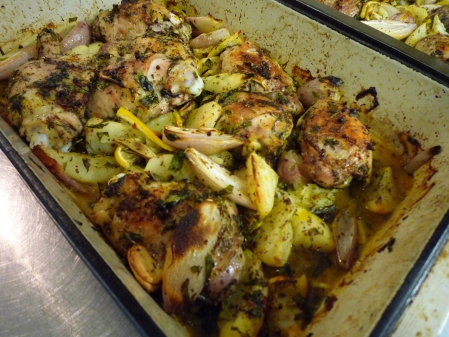
Roasted chicken with Jerusalem artichoke and lemon
Open kibbeh
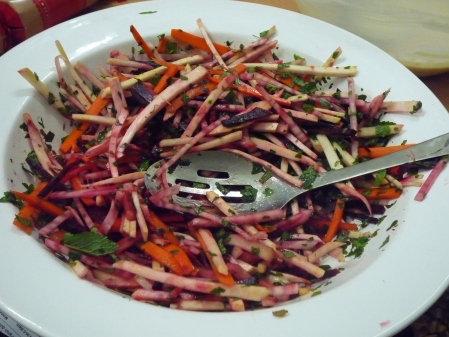
Root vegetable slaw
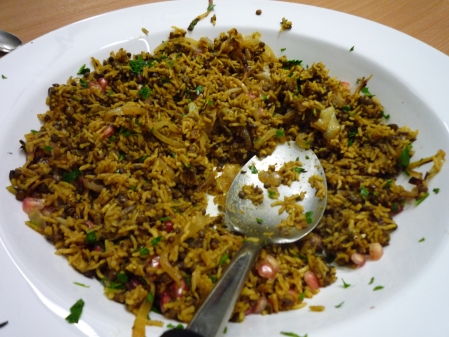
Mejadra
Roasted butternut squash and red onion with tahini and za’atar
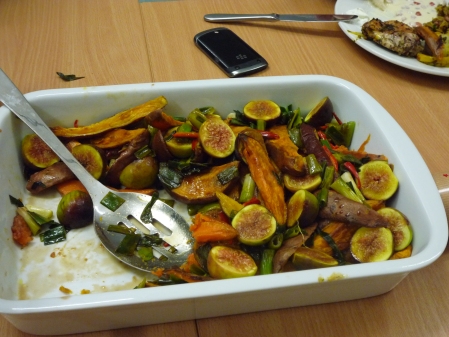
Roasted sweet potatoes and fresh figs
Basic hummus and hummus with lemon sauce and pinenuts
Pitta
Labneh
Golden clementine cake
Yoghurt, honey and pomegranates
Pomegranate and rose cordial
And here we are enjoying the rather magnificent feast:

I did quite a bit of prep beforehand at home helped by Laura who made the rather beautiful roasted sweet potato and fresh figs:
and stunning root vegetable slaw, vibrant in colour and taste, combining crisp raw roots sliced on the mandolin and cut into matchsticks combined with a sharp lemony dressing and Ottolenghi’s trademark abundance of fresh herbs:
At the Parish Centre kitchen, Laura and Emma prepared the chicken with Jerusalem artichoke and lemon which baked to a toasty gold and was aromatic and delicious with lots of slow-cooked shallot, sweet garlic cloves and of course the nuggets of Jerusalem artichoke. This would be a fantastic dish for an informal dinner party or a very welcome addition to a buffet for family and friends over the holiday period.
Perhaps the best fun was preparing our own hummus, just as good as the stuff you can buy at Sainsbury’s! I’ve never had much success with homemade hummus before but I’d always started with canned chickpeas. WRONG! You need to start with dried kind, and some bicarb to help remove the skins. In fact the method is not so different from our own homegrown mushy peas. Oh, and a whole jar of tahini paste per batch, and the magic ingredient – ice cold water which turns the mix, after a whole 5 minutes of processor blasting, magically into an elegantly pale and silky smooth emulsion. Jess and Oli did a fantastic job of mixing up the two different batches of hummus, one plain and one garnished.
My simplified version of Mejadra, a spicy, oniony rice and lentil mix, was a more dramatic and interesting alternative to plain boiled rice:
The finishing touch to our feast was the chocolate ganache iced and gold leaf decorated Golden Clementine cake, sweet and citrussy. This cake, minus the decadent chocolate icing, clearly derives from the many recipes for Sephardic Jewish cakes featuring citrus and ground almonds that the Jews brought with them from Spain hundreds of years ago. Many cookbook authors give recipes for similar cakes – Claudia Roden, Nigella Lawson and of course Delia to name but three. This version is simple to make, deliciously moist with the addition of syrup and very Christmassy with its sharp citrus notes shining through. It reminds you of clementines stuffed in your Christmas stocking and pays a nod to that old British confectionery favourite, the Terry’s chocolate orange. Clemmie and James were the pastry chefs who ably prepared the chocolate icing and painstakingly applied the gold leaf with tweezers.
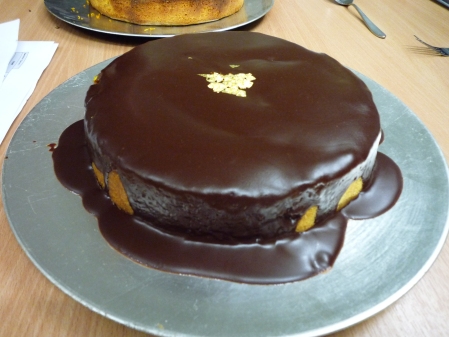
I give below the recipes we prepared together in the kitchen last night – maybe some of the young people will cook the dishes at home for their families over the holidays?
For the rest, you’ll need to buy the book – it would make a great late Christmas present for any keen cook.
Recipe for roasted chicken with Jerusalem artichoke and lemon
Adapted from a recipe in “Jerusalem” by Yotam Ottolenghi and Sami Tamimi.
Serves 8 as a main course or up to 16 if served as part of a buffet.
Ingredients
900g Jerusalem artichokes, peeled and cut into 6 lengthways wedges, about 1.5cm thick
3 tablespoons lemon juice
16 chicken thighs, bone in, skin on
24 shallots, peeled and halved lengthways
24 large garlic cloves, sliced
2 medium lemons, cut in half lengthways and then into very thin slices
2 teaspoons saffron threads
100ml olive oil
300ml cold water
3 tablespoons pink peppercorns, slightly crushed
8g dried thyme or herbes de Provence mix
40g chopped tarragon leaves
4 tsp salt
1 tsp black pepper
3 further tablespoons lemon juice
further 40g chopped tarragon
Put the Jerusalem artichokes in a large saucepan, cover with plenty of water and add the 3 tablespoons lemon juice. Bring to the boil, reduce the heat and simmer for 10-20 minutes until tender but not soft. Drain and leave to cool.s
Place the Jerusalem artichokes and all the remaining ingredients except the final 3 tablespoons lemon juice and 40g chopped tarragon into a large mixing bowl and use your hand to mix everything together well. Cover, refrigerate and leave to marinate for at least 2 hours.
Preheat the oven to 240 degrees C/220 degrees C fan/Gas mark 9. Arrange the chicken pieces skin side up in the centre of a roasting tin and spread the remaining ingredients around the chicken. Roast for 30 minutes. Cover the tin with foil and cook for a further 15 minutes by which point the chicken should be completely cooked.
Remove from the oven and add the reserved tarragon and lemon juice. Stir well, taste and add more salt if needed. Serve at once.
Recipe for Mejadra
Adapted from a recipe in “Jerusalem” by Yotam Ottolenghi and Sami Tamimi.
250g green or brown lentils (we used Puy lentils which were fine)
6-8 medium onions (1.4kg before prep)
6 tablespoons light olive oil
3 tsp cumin seeds
2 tablespoons coriander seeds
400g white basmati rice
4 tablespoons light olive oil
1 teaspoon ground turmeric
2 teaspoons ground allspice
3 teaspoons ground cinnamon
2 teaspoons sugar
700ml water
salt and black pepper
Chopped fresh parsley or coriander and pomegranate seeds to garnish (optional)
Place the lentils in a small saucepan, cover with plenty of water, bring to the boil and cook until the lentils have softened but still have a little bite, then drain.
Peel and slice the onions thinly. Fry in 2 large frying pans each with about 3 tablespoons light olive oil over a medium heat for about 20 minutes until the onions are soft and brown but not burnt. The original recipe requires the onions to be dipped in flour and deep-fried but I have simplified this step and the resulting slow-cooked soft brown onions still taste good mixed with the rice, spices and lentils.
Take a large heavy based lidded saucepan and place over a medium high heat. Once hot, add the cumin and coriander seeds and dry-fry to toast the seeds for a minute or two, stirring constantly with a wooden spoon. Add the rice, olive oil, turmeric, allspice, cinnamon, sugar, 1 teaspoon salt and plenty of black pepper. Stir to coat the rice with oil and then add the cooked lentils and the water. Bring to the boil, cover with a lid and simmer on a very low heat for 15 minutes.
Remove from the heat, lift off the lid and quickly cover the pan with a clean tea towel. Seal tightly with the lid and set aside for 10 minutes.
Finally, add half the fried onion to the rice and lentils and stir gently with a fork. Pile up in a shallow serving bowl and top with the rest of the onion. If like, garnish with chopped fresh parsley and or coriander leaves and a few pomegranate seeds.
Recipe for basic and garnished hummus
Recipes adapted from those in “Jerusalem” by Yotam Ottolenghi and Sami Tamimi.
Serves 12 or more if served as part of a buffer
Ingredients
For the basic hummus
500g dried chickpeas
2 teaspoons bicarbonate of soda
540g light tahini paste
8 tablespoons lemon juice
8 garlic cloves, crushed
200ml ice cold water
salt
To garnish half of the batch
4 tablespoons whole cooked chickpeas reserved from the second batch
2 tablespoons pine nuts lightly toasted in the oven or dry frying pan
2 tablespoons chopped flatleaf parsley
For the lemon sauce
10g flatleaf parsley finely chopped
1 green chilli finely chopped
4 tablespoons lemon juice
2 tablespoons white wine vinegar
2 garlic cloves, crushed
¼ teaspoon salt
Start a day before by washing the chickpeas well and placing them in a large bowl. Cover them with cold water, at least twice their volume, and leave to soak overnight.
The next day, drain the chickpeas. Place a large saucepan on a high heat and add the drained chickpeas and bicarbonate of soda. Coll for about 3 minutes, stirring constantly. Add 3 litres fresh water and bring to the boil. Cook, skimming off any foam and any skins that float to the surface. The chickpeas will take between 20 and 40 minutes to cook, maybe even longer. Once done, they should be very tender, breaking up easily when pressed between your finger and thumb, almost, but not quite, mushy.
Drain the chickpeas. You should have roughly 1.2kg now. Place half of the the chickpeas in a food processor bowl. Process until you get a stiff paste then, with the machine still running, add the half of the tahini paste, lemon juice, garlic and 1 ½ teaspoons salt. Finally, slowly drizzle in half of the iced water and allow it to mix until you get a very smooth creamy paste, about 5 minutes. Transfer to a bowl, cover with cling film and refrigerate for at least half an hour.
Repeat with the second batch of ingredients (you used only half), but remember to reserve 4 tablespoons cooked chickpeas to garnish.
Shortly before you serve the hummus, combine all the lemon sauce ingredients in a small bowl.
Top the second bowl of hummus with the cooked chickpeas, drizzle generously with the lemon sauce, and garnish with chopped parsley and toasted pine nuts.
Recipe for golden clementine cake
Adapted from a recipe in Jerusalem by Yotam Ottolenghi and Sami Tamimi.
Serves 8 generously or up to 16 if cut into delicate slices.
Ingredients
For the cake
200g unsalted butter
300g golden caster sugar
grated zest of 4 clementines and and 1 lemon
280g ground almonds
5 medium eggs
100g plain four sifted with a pinch of salt
For the syrup
80g golden caster sugar
120ml lemon and clementine juice
For the chocolate icing (optional)
90g unsalted butter, diced
150g good quality dark chocolate broken into pieces (or Valrhona or similar buttons)
¾ tablespoons honey
½ tablespoons cognac
To decorate
Long strips of zest taken from an orange using a zester
or flakes of real gold leaf (available from specialist cake decorating suppliers)
Preheat the oven to 180 degrees C/160 degrees C fan/Gas mark 4. Lightly grease a 24cm round cake tin, ideally loose bottomed and line the base and sides with a double layer of parchment.
The cake is best made in a stand mixer such as a Kenwood. Cream together the butter and caster sugar thoroughly. Add approximately half the ground almonds. Beat in the eggs gradually, scraping the bottom and sides of the bowl with a spatula from time to time.
Add the remaining ground almonds, flour and salt and work them into the mix until completely smooth.
Spread the cake batter into the prepared cake tin and level with a palette knife (a small crank-handled one does the job well).
Bake the cake for 50 to 60 minutes, checking to make sure it’s not browning too much. Test in the usual way by seeing if the sides have shrunk just a little and by inserting a skewer which should come out clean.
Towards the end of the cooking time, prepare the syrup by combining the sugar and citrus juices in a small saucepan. Bring to the boil then remove the syrup from the heat.
As soon as the cake comes out of the oven, brush it with the boiling syrup until it has all soaked in. Leave the cake in its tin to cool completely before removing it from its tin.
Either garnish with the orange strips and serve as is or coat with chocolate icing.
To make the chocolate icing, put the butter, chocolate and honey in a heatproof bowl and set OVER (not in) a pan of simmering water making sure the bowl does not touch the water.
Stir until everything is melted, remove from the heat straightaway and fold in the cognac.
Pour the icing over the cool cake allowing it to dribble naturally over the sides without covering the cake completely.
Let the icing set then decorate either with strips of orange zest of flakes of gold leaf in the centre of the cake.
Comforting casseroles part 3: veal
December 15, 2012 § Leave a comment
The weather pre-Christmas is cold and wintry and thoughts turn to warming casseroles once again. I’ve previously shared my favourite pork (part 1) and beef (part 2) casserole recipes and now it’s veal’s turn. Don’t worry this isn’t pale Dutch veal reared in less than humane conditions, but the more robust English pink veal reared to high welfare standards, a tasty by-product of the UK dairy industry that frankly would be a waste NOT to eat.
Today’s dish is classic Milanese dish of braised veal shin on the bone, Osso Buco, served up with its traditional partner, saffron scented risotto milanese, one of the few instances in Italian cooking when risotto is served as an accompaniment rather than as a separate primo piatto course.
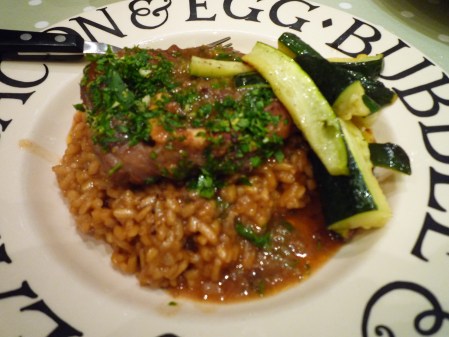
I’ve read about this dish many times over the years but have never been able to try it as a) I had no inkling where I’d get hold of decent veal which hasn’t until recently been widely available in the UK and b) even if I could track down veal I didn’t think I’d find a butcher able to prepare the necessary shin slices complete with intact marrow bone, one of the highlights of the finished dish.
I was delighted to find that Ocado recently began offering slices of veal shin for osso buco alongside its other veal offerings (which include fantastic veal chops, veal rib joints and proper escalopes). They come two or occasionally three to a pack and a pack weighs a tad over 500g so you need two packs for the recipe below which serves four.
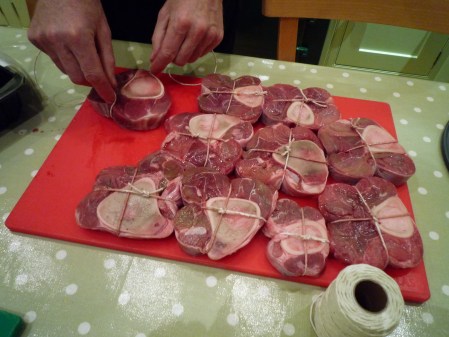
You begin by tying your veal into dinky packages with string. This serves to keep the star marrowbone intact during the long braising. You may need to tie around the piece of veal shin as well to keep it in a nice round piece. My pieces of veal looked perfectly well formed and butchered so I omitted this step and just did the package tied up with string thing:
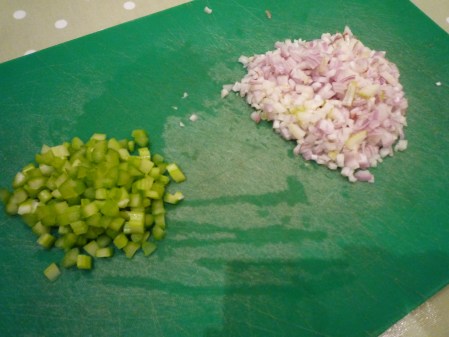
Once the trussed veal pieces have been coated in seasoned flour, the only other bit of prep required is to finely dice a small onion and stick of celery. Don’t worry if you’re iffy about celery – after 2 hours cooking the vegetables break down to produce a textured sauce and there’s no pronounced celery flavour, just a deep savouriness.
The next step is to brown the floured veal slices in hot oil. The veal is then removed and set aside whilst the vegetables are sweated in some butter which you add to the pan. Then the vermouth or white wine is added and reduced a little before adding the stock and returning the meat to the pan for a long slow 2 hour braise.
A word about choice of stock. In a quest for meaty perfection I bought some rather expensive chilled beef stock from the supermarket and used this topped up with some stock from a “quality” reduced salt beef stock cube. I did the same thing with my accompanying risotto milanese. The end result, odd as it may sound was just too beefy and intense. The veal marrowbones and collagen-rich shin meat make a most wonderful sauce as the meat braises so I think there is really no need to start with a rich meaty stock. Next time I make this dish I’ll use a light stock made from a good quality reduced salt cube, making it up at a weaker strength than recommended on the packet. The meat and bones will do the rest for me.
This is how the veal looks before the long slow braise:
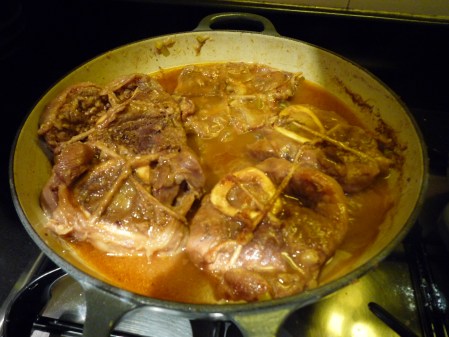
And here it is once the cooking is complete, freshened up with its sprinkling of gremolada, a lively mix of chopped flatleaf parsley, grated lemon zest and a smidge of finely chopped garlic:

Serve the meat with risotto alla milanese and a green vegetable. We chose roast courgette, as Anna del Conte does in the glorious photo accompanying the recipe in her book “Gastronomy of Italy”. I’ve largely drawn on this recipe in my version which I give below. The recipe is an authentic Milanese one and thus, unlike many published versions of the recipe, contains no tomato.
The risotto alla milanese recipe I give below is also adapted from Anna del Conte’s and is made in the usual way. If you’re familiar with making risotto you’ll have no trouble following it. If you haven’t made risotto before I’d suggest buying a good Italian cookbook and reading up in detail on risotto-making technique before attempting to follow my slightly sketchy instructions!
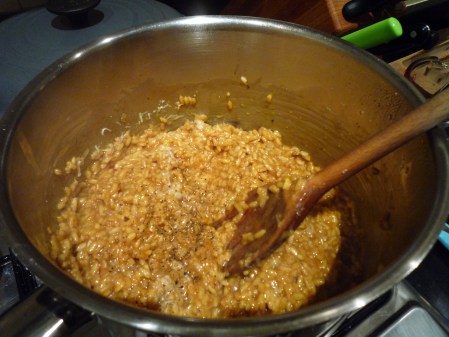
One last word – be sure to scoop out the unctuous marrow from the centre of the ossi buci and mash it into your risotto – delicious.
Recipe for ossibuci alla milanese
Adapted from Anna del Conte’s recipe in “Gastronomy of Italy”.
Serves 4
Ingredients
4 decent sized ossibuci (slices of veal shin on the bone) each weighing about 250g)
seasoned flour
3 tablespoons light olive oil
25g butter
1 small onion, finely diced
1 small stick of celery, finely diced
175 ml white vermouth (I like Noilly Prat) or white wine
300 ml light stock (beef, chicken, vegetable – a qood quality stock cube is OK) or even water
For the gremolada
1 teaspoon grated lemon zest
1 very finely chopped small garlic clove
2 tablespoons chopped flatleaf parsley
Tie each osso buco with string as if you were wrapping a package. This is to retain the marrowbone in place during the long cooking and turning process. If, after looking at your pieces of veal, you think it advisable to tie a piece of string around the circumference of each slice to keep it all together then do this as well.
Coat the veal slices lightly in seasoned flour. I put about 6 tablespoons of flour into a deep bowl, then mix in a teaspoon of fine salt before dipping the veal pieces in the flour. Discard the excess flour afterwards.
Heat the 2 tablespoons of light olive oil over a medium heat in a heavy lidded shallow casserole that is big enough to hold the veal snugly in a single layer. Once the oil is hot, put the veal pieces into the pan and leave untouched for 4 or 5 minutes to brown. Turn the veal over using a pair of tongs and brown the other side. Once the browning is complete, turn the heat to low, remove the veal and set aside in a shallow dish.
Once the pan has cooled a litle, add the butter and once melted, add the diced onions and celery and fry gently without browning until soft and translucent, about 8 to 10 minutes’s cooking. Now add the vermouth or wine to the pan and let bubble for a minute or two to reduce a little. Now add the stock and return the veal slices plus any juices which have accumulated in the dish back to the pan. Turn up the heat to bring the contents to the boil then reduce the heat to a bare simmer, cover with the lid and leave to simmer for one and half to two hours until the meat is tender.
Turn the meat over delicately with tongs about every twenty minutes during the 2 hour cooking period to ensure an even braise and tender meat.
While the meat is cooking, prepare the gremolada by combining the chopped parsley, finely chopped garlic and grated lemon zest in a small bowl. Mix well, cover and set aside.
Once you judge that the meat is cooked, check the consistency of the sauce. If it is a little too thin, remove the lid and raise the heat a little and gently boil away some of the liquid until you have a chunky coating sauce consistency. Check the seasoning too. Because the stock you have used is likely to contain salt (especially if you’re using a stock cube) I’ve not specified any additional salt in the recipe other than a little salt in the seasoned flour.
Snip of the string from the meat, scatter over the gremolada and serve with risotto milanese and a green vegetable – roast courgette (still available as I write in December) or steamed broccoli would both work well.
Recipe for Risotto alla Milanese
Adapted from Anna del Conte’s recipe in “Gastronomy of Italy”.
Serves 4
Ingredients
900ml light chicken or beef stock (homemade or good quality stock cube)
1 small onion or medium shallot finely diced
40g unsalted butter
350g risotto rice (Carnaroli or Arborio)
90ml white vermouth (I like Noilly Prat)
big pinch saffron strands
sea salt and freshly ground black pepper
additional 20g unsalted butter
25g freshly grated parmesan
You need two medium heavy-based saucepans for this recipe. Bring the stock to simmering point in the first saucepan and melt 40g butter in the second. Add the chopped onion or shallot to the pan containing the butter and sauté gently until soft and translucent.
Add the rice to the butter and onions and stir over a low heat until the rice is thoroughly coated with the butter. Turn up the heat to medium and add the vermouth and boil for a minute or so, stirring all the time. Now add the hot stock a ladleful at a time, stirring until the rice has absorbed the stock before adding the next ladleful. Once two or three ladles of stock have been added, crumble the saffron strands into the risotto. It should be kept simmering, not too slowly and not too fast either and should be cooked in 15-20 minutes. Test the rice after it has cooked for 15 minutes by biting on a grain. When ready it should be cooked through to the al dente stage and and should no longer have a hard chalky centre but should not be soft and mushy. If it’s not ready, add a little more stock (or boiling water if you’ve used it all) and cook for a minute or so longer before testing again. Conversely, you may not need to add all the stock from the pan.
When the risotto is ready, remove from the heat, stir in seasoning and add the additional 20g butter and 25g grated parmesan, cover the pan and leave for a minute or two for all the elements to merge in a savoury manner.
The perfect melting middle chocolate pudding
November 15, 2012 § Leave a comment
The melting middle chocolate pudding or moelleux au chocolat as it’s known in France is one of those dishes that pops up all over the place, from Masterchef to TV cookery programmes to the Marks and Spencer chilled section.
It’s now a recipe in my newly expanded repertoire of chocolate desserts following a trip earlier in the year to the Lenôtre Cooking School, the best place in Paris to learn about making fine pâtisserie at home. I’ve written before about attending classes at Lenôtre -see my post Le Vrai Macaron Parisien. For anyone interested in baking it has to be the place to come and learn tricks of the trade (though all the teaching is conducted in French so at least schoolgirl French is a must). Our group comprised 3 chic Parisiennes, a jolly baker from Lille up for the weekend to hone his skills, and of course me. We were instructed by the charming and surprisingly thin Gilles Maisonneuve:

Gilles is a hands-on kind of instructor, particularly if you are young and glamorous. Here he is instructing one of my fellow students.
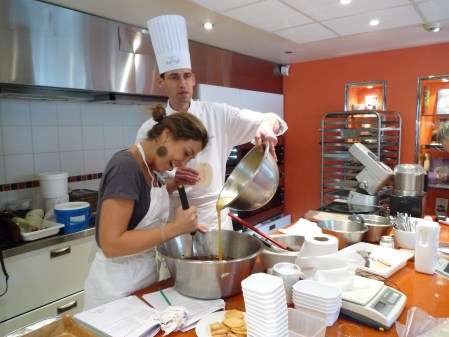
Unlike baking at home that has to be done in a kitchen where family meals are cooked, homework done, laundry dried or whatever, the Lenôtre kitchen is gleamingly clean and empty and set up for baking action.
I love the way the finest ingredients are used here in industrial quantities – neatly labelled bins of best quality couverture chocolate, Madagascan vanilla powder, paste and whole pods in similar neat hoppers, different kinds of sugars, nuts, fruits, spices, flours. Then there’s the equipment – rack upon rack of prepared uniform size baking trays, tartlet tins, piping nozzles of all kinds. It just makes you want to get started on an ambitious baking project, and there’s even your own personal kitchen porter to whisk away your dirty pots. What bliss!
The name of this half day course was “Desserts Tout Chocolat” and we made chocolate tartlets, chocolate sorbet and the universally loved chocolate brownie (pronounced “Brooney” or “Bruni” in French – depending on whether your reference points are Manchester United players or politicians’ wives) as well as the moelleux au chocolat, but it is this last dessert that I’ll be concentrating on today.
I am so thrilled with this recipe – it works perfectly every time and is very straightforward – even my 14 year old son can knock out a batch of perfect puddings. It sits in the fridge quite happily for a few days ready to be baked and served withing 9 minutes – perfect for dinner parties. The puddings freeze well too though I think it’s worth defrosting them for, say, 2 hours at room temperature rather than baking straight from frozen. The recipe, though simple, does call for precision (and I mean to the nearest gram) in the weighing of ingredients, the portioning out of the mixture between the moulds and cooking temperature and time.
I’ve cooked these numerous times at home now and have tried rival recipes, specifically those in TV chef Rachel Khoo and Lorraine Pascale’s books. Sorry ladies, your versions just don’t cut it – too big, too sweet, wrong texture.
At Lenôtre we cooked our moelleux in individual disposal foil pudding basins which we buttered and floured then scattered a few flaked almonds into the base:

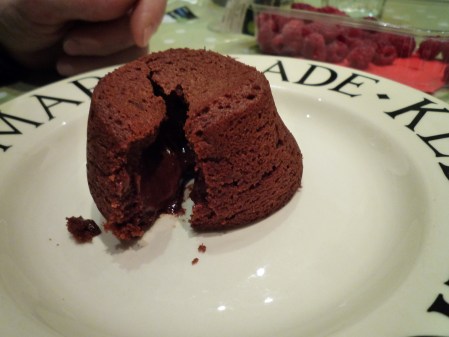
This is what the end result looked like:

Not bad huh? That said I’m not sure the flaked almonds add a great deal. The disposable foil basins are dead handy and you can pick them up in Lakeland and no doubt other places as well. Better still than the disposable foil basins are these perfectly sized non-stick metal dariole moulds, also available from Lakeland:
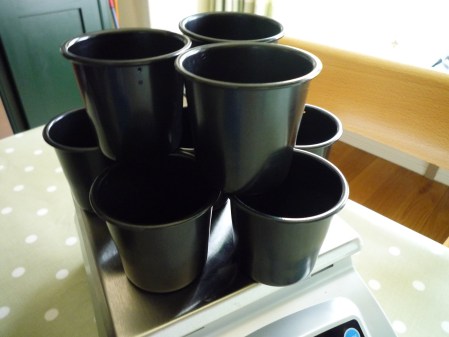
No need to grease and flour, the puddings turn out like a dream straight from the oven:
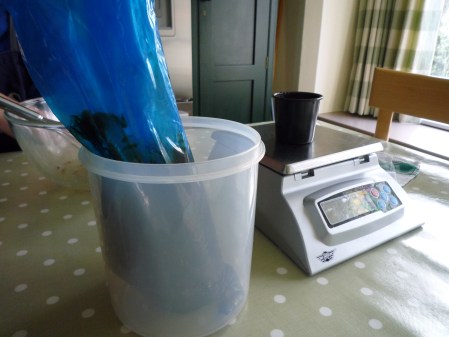
This brings me to the other piece of kit that you’ll need to make this recipe with ease, a disposable piping bag. You can buy these cheaply and easily in bulk from Amazon. They look like a roll of tear-off plastic bags which is exactly what they are but are triangular in shape to create a piping bag. I’ve found the best way to fill them cleanly is to stand them into a tall cylindrical container which supports the weight of the mixture as you spoon it in:
The most important ingredient in the recipe is of course the chocolate. We used dark couverture chocolate drops at Lenôtre. I think they favour the Barry Caillebaut brand and the recipe specifies a 70% cocoa content chocolate. The word “couverture” means a specialised chocolate with a high cocoa butter content for ease of melting. I’ve had unsatisfactory cooking results with some dark chocolates whic simply list a high cocoa solid count on their labels. My suspicion is that they’re stuffed full of cocoa powder rather than the more expensive cocoa butter which makes the chocolate dry and powdery.
I’ve used Valrhona chocolate drops in my recipe, purchased in industrial quantities from the excellent Chocolate Trading Company (see contact details below). I see from their website that they’re based nearby in Macclesfield of all places so I can even comfort myself with the thought that I’m buying local when I take my latest delivery!

Recipe for melting middle chocolate pudding
Once you have the right kit and ingredients assembled it’s a straightforward task to melt the chocolate (over simmering water please), combine it with the softened butter (you need a bit of patience here to let it soften then mash it with a wooden spoon), lightly beaten eggs, sugar, flour and baking powder.

Once baked, all you need to do is serve with a little thick cream (or raspberry coulis if you prefer) and sit back and enjoy the compliments!
Recipe for melting middle chocolate pudding
Translated and adapted from the Lenôtre pâtisserie school recipe though I have not dared tinker with the ingredients, quantities or method!
Serves 8
Ingredients
170g dark couverture chocolate drops (I use Valrhona Manjari, a 64% cocoa content couverture chocolate)
130g unsalted softened butter
95g golden caster sugar
130g whole egg – shelled weight (approximately 2 large eggs)
100g plain flour
4g baking powder
Melt the chocolate using your preferred method (Lenôtre recommend a bain-marie). Add the softened butter and mix well. Add the sugar and lightly beaten egg (whisk by hand with a fork or small whisk until there is a little froth on the surface of the egg) and mix to incorporate.
Combine the flour and baking powder in a bowl and stir well to combine. Gradually add the flour and baking powder to the chocolate mixture. Mix to combine but do not overwork the mixture.
Put the mixture into a disposable piping bag and use this to fill 8 small dariole moulds. Use scales to weigh each mould to ensure you fill them evenly. You should find that if you use a rubber spatula to empty the bowls thoroughly that you can fill the moulds with at least 72g of mixture, maybe even 75g of mixture if you’re careful.
Chill the moulds in the refrigerator for at least 30 minutes.
Bake at 200 degrees C fan for 9 minutes.
Contact details
Pâtisserie courses
Containers and moulds
Fine couverture chocolate
Bulgarian breakfast
November 11, 2012 § 1 Comment
The latest in our Breakfasts of the World Project series.
Much like Lesley Chamberlain (author of “The Food and Cooking of Eastern Europe), my first experience of Bulgarian cuisine was sausage and bread purchased from a station buffet at Plovdiv (the next major city after the capital Sofia) part-way through my five day train journey from Blackpool North to Istanbul Central aged 19. My memories of then-Communist Bulgaria witnessed solely from the train was of bad food, grey cities – the capital Sofia as well as Plovdiv – and corrupt border guards who extorted payment for what turned out to be a non-existent entry visa.
Beyond the railway line there were obviously better things to be seen. Lesley Chamberlain goes on to write “Not much is known about Bulgarian food beyond the reputation of its yoghurt, but actually, when one is not dependent on the station buffet, it is one of the world’s simplest, healthiest and most naturally elegant styles of cooking, akin to the cuisines of Turkey and Lebanon. The seasoning is light and the accent on preserving national flavours. It is the very opposite of the ‘concentrated’ food of Poland. The mountainous country of 8 million, bordered by Greece, Romania, Yugoslavia (ed now Serbia and Macedonia), Turkey and the Black Sea, is hot, with fertile valleys, and broad plains. The land, which the ancients called Thrace, yields abundant green vegetables and fruit…Many of the dishes have a middle Eastern flavour, including white beans and preserved vegetables in olive oil, peppers, olives, tomatoes, spicy sausage (pasterma)…The sausage, salami, cheese, yoghurt, vegetables and fruit that characterize this very natural table first appear at breakfast.”
My mood lightened after reading this – I’d feared a Slavic spread of sausage and cabbage with dry black bread or some such but Ms Chamberlain’s description of Bulgarian breakfast sounded fresh and inviting. I decided to serve up some spicy sausage, a sharp salty ewe’s milk cheese, home-made sourdough bread, the much-loved Bulgarian cold vegetable dish lutenitsa and of course I had to track some genuine Bulgarian yoghurt.

What makes Bulgarian yoghurt special is its combination of two bacteria, Lactobacillus Bulgaricus together with Streptococcus Thermophilus. In fact, a little delving suggests that all live yoghurts contain these two bacteria so maybe we’re all eating Bulgarian yoghurt without our realising it…
Ready-made genuine Bulgarian yoghurt was nowhere to be found, but the Bulgarian yoghurt website http://www.bacillusbulgaricus.com/ saved the day and within a few days a little sachet of yoghurt culture sent to me in a handwritten envelope amusingly with a Plovdiv postmark (that brought back memories) dropped onto my doormat:

There were no instructions on the packet which initially caused some consternation until I remembered that they could be found on the website (and I’ve summarised them below). Rather gingerly I mixed up my culture powder of indeterminate provenance with a 2 litres of milk (semi skimmed as I didn’t have whole milk in the fridge):

The milk sat quietly overnight on the top of the warm Aga. Miraculously, it fermented and thickened and turned into something that really did look like yoghurt – it was a little thinner than I might have liked but I put that down to using semi-skimmed rather than proper whole milk.

On to the lutenitsa. I came across it when I scanned through various Bulgarian food websites. This sweetened vegetable preserve, part jam, part relish, part middle-Eastern cooked vegetable salad is available in jars sold under a number of brands but I decided to make my own, devising a recipe combining the best bits of a number of different versions found on the web (“The Food and Cooking of Eastern Europe” being silent on the subject).
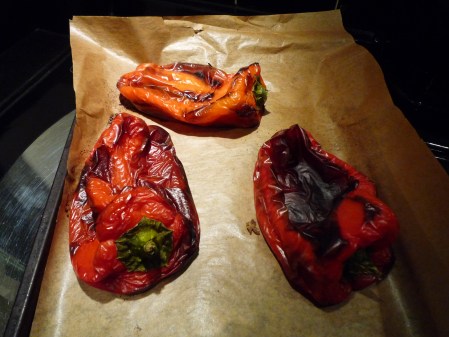
I began by roasting some sweet red peppers until the skins were lightly charred:
Then the raw vegetables were sautéd in olive oil:

The tomatoes and soft pepper pieces were added to the mix and the whole lot simmered for 10 minutes. Some recipes suggest puréeing the lutenitsa but I wanted something chunkier so went in with an old-fashioned British potato masher for a minute or so which gave me the texture I was looking for – thick and chunky with a bit of bite.
Recipe for lutenitsa – Bulgarian vegetable relish
Makes about 2lb. Having tried out a couple of different recipes found on websites dedicated to Bulgarian food, this is my small-scale chunky version of the classic lutenitsa recipe.
Ingredients
2 medium carrots, peeled and diced
1 onion, diced
1 medium aubergine, diced
2 tablespoons olive oil
3 large roasted red peppers, skin and seeds removed and then diced
1 400g can chopped tomatoes
1 tablespoon sweet paprika
1 teaspoon dried thyme (or summer savory if you have it)
2 tablespoons sugar
salt and pepper to taste
Take a medium sized saucepan and fry the onions, carrots and aubergines in the olive oil until soft. Add the red peppers and fry for a further 2-3 minutes. Add the tomatoes and seasoning, bring to the boil and simmer for 10 minutes. Add a little water if the mixture seems too dry. Mash some of the mixture using a potato masher. You are aiming for a thick ratatouille type texture. Spoon into a clean preserving jar, cool, seal and refrigerate.
Recipe for Bulgarian yoghurt
Adapted from the instructions given on the Bulgarian yoghurt website http://www.bacillusbulgaricus.com/
Ingredients
2 litres whole milk
1g (1/4 teaspoon) of freeze dried Bulgarian yoghurt starter
Bring the milk to just below boiling point in order to kill any existing bacteria which could react with the Lactobacillus Bulgaricus. Be careful not to burn it.
Cool the milk down to 110°F (43°C). Without a food thermometer, the easiest way to test for the right temperature is to dip a finger in the milk – if you can comfortably count to 5 then the milk is just right.
Pour the milk to a separate processing container eg a large bowl. Add 1/4 teaspoon of the starter. Mix well – stir well for about 5 minutes. Cover the container loosely with a lid.
Let the milk and culture mix ferment in a warm draft free place overnight.
The fermentation process will continue until the milk reaches pH of 4,7. The fresh yogurt will be set in about 5-6 hours (or overnight). If the place is too cold (50F or less), the process may take longer (10-12 hours). In general, leaving the yogurt sit for longer after it is set, will result in a denser and more acidic yogurt. When your yogurt is ready, move it to the fridge (or a cool place) for storage.
Keep the remaining yogurt starter in a Ziplock bag in the freezer.
Hedgerow chutney for autumn
October 20, 2012 § Leave a comment
A beautiful sunny autumn day today reminds me that on the last such day back in September I gathered a basketful of hedgerow fruits and made the rather good recipe below. Thanks go to Tastethewildblog.co.uk for this.

The recipe is straightforward and the suggestion of using a mixture of cooking and eating apples is inspired – the cookers thicken the chutney whereas the eaters retain their shape and provide a contrasting texture.
The finished jars of chutney look very handsome on my preserves shelf down in the cellar and one or two lucky people might find a jar in their Christmas stocking.
Recipe for Hedgerow Chutney
Adapted from a recipe found on http://tastethewildblog.co.uk/
Makes 4-5 lbs
2lb mixed hedgerow fruits – e.g Hawthorn haws, rose hips, elderberries, blackberries, rowan berries, sloes
1 pint malt vinegar
2 lbs onions chopped
2 lbs apples peeled and chopped (ideally half eating apples and half Bramleys)
4 oz sultanas
4 oz raisins
1lb Muscovado sugar
1 tsp ground cloves
1 generous pinch chilli flakes
1 tsp freshly grated nutmeg
Place the chopped apples and onions in a bowl, cover and leave overnight.
Next, make the fruit vinegar. Remove any large stalks and leaves from the berries, rinse and dry them and put them into a large pan. Cover with the malt vinegar, heat and simmer for 30 minutes until the berries are losing their colour. Strain off the liquid and discard the fruit. You should have about a pint of deep purple fruity vinegar.
The following day put the apple and onion mixture, the fruit vinegar and all the remaining chutney ingredients into a preserving pan and boil together for about 2 hours, stirring frequently. The chutney is ready when it has reduced considerably and when you draw a wooden spoon across the surface of the chutney, a channel remains for a second or two before filling up with liquid.
Put in sterilised jars and cover or seal. The chutney is best left for a month or so to mellow before eating.
Brunei breakfast and best brioche recipe
September 28, 2012 § Leave a comment
The latest in our Breakfasts of the World Project series.
Brunei is a tiny country with a population of some 400,000 shoehorned into a territory of just 2,228 square miles on the island of Borneo. Part of Borneo belongs to Malaysia and the rest (apart from Brunei of course) belongs to Indonesia. The Sultanate of Brunei was powerful regional presence whose influence was at its height between the 15th and 17th centuries. As its influence subsequently declined its territory became gradually smaller. The economic decline was reversed following the discovery of oil in Brunei in 1929. As a result, tiny Brunei became a highly developed and wealthy country whose citizens have an appetite for Western luxury goods.
Today’s breakfast idea was taken from the cosmopolitan menu of the Fleur de Lys Bakeshop in Brunei’s capital city, Bandar Seri Bagawan. The Fleur de Lys Bakeshop is a French style pâtisserie whose macarons and croissants could rival anything you’d find in Paris. My selections was “French toast kaya – brioche French toast served with our very own ‘home-made’ coconut-egg kaya”. This looked rather more appealing than the various chicken sausage and beef bacon rasher combos on offer, pork being ruled out by local Islamic dietary rules.

OK so I know how to make brioche French toast but what on earth is coconut-egg kaya? Kaya, it turns out, is a sweet, creamy coconut preserve flavoured with pandan leaves, made in a similar way to our own lemon curd (but obviously without the lemons!). Ex pat South East Asians yearn for the stuff and either get it shipped out to them or make their own.
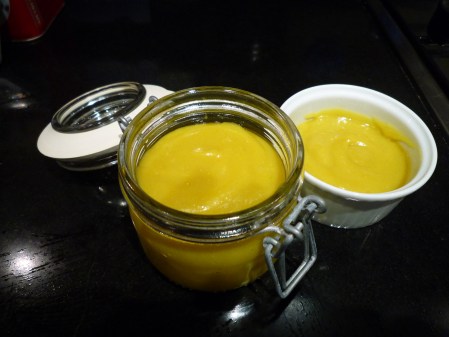
I searched around for an approachable, logical kaya recipe and fell for the lovely pictures in Malaysian-born cook and food writer Billy Law’s blog “A Table for Two”. It turns out that Billy was a finalist in the Australian extra-tough version of Masterchef winning the hearts of viewers if not ultimately the judges.
Billy’s instructions were sufficient and easy to follow. First stop is your local Asian grocer for pandan leaves and good quality 100% coconut milk. I’m lucky enough to have Kim’s Thai foodstore in Manchester’s Chinatown (see contact details below) almost on my doorstep. Walking down the steps into the tardis-like basement, you’re transported to the scents and sights of Bangkok’s Khao San Road. It was straightforward enough to pick up the specialist ingredients I needed here – a good quality 100% coconut milk and pandan leaves:

Having gone to the trouble of sourcing authentic ingredients for my kaya, I now needed a decent brioche loaf to turn into indulgent French toast. Having looked at the dry and sad little excuses for brioche offerings available at local supermarkets I decided I’d better bake my own.
I turned to Dorie Greenspan’s “Baking – from my home to yours” for inspiration, as, based on my experience with her Kugelhopf recipe, Ms Greenspan knows how to handle enriched yeasted doughs. The only quibble I have about this bible-type baking compendium is that having meticulously sourced and researched her recipes from professional European bakers in many cases, she doesn’t give accurate gram weights but turns everything into American cup sizes. I have to reverse engineer her recipes and convert everything back to grams!
Following the recipe and with the aid of my Kenwood mixer, after a day and a half (!) I produced a stretchy, silken ball of golden dough:

The golden colour is attributable not only to the eggs in the dough but also to the full 340g butter required to make the recipe. Let me repeat that – 340g butter, a pack and a half, which looks like this:
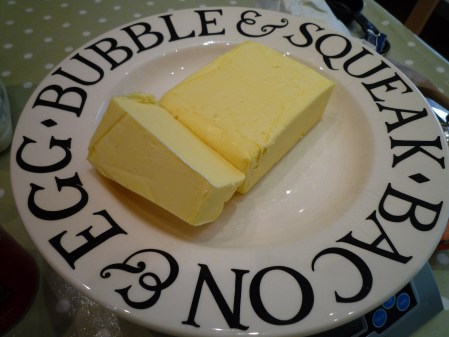
I shaped the loaves two different ways, the first like a triple bun loaf as the recipe specifies, and the second as a standard loaf shape (after the time-consuming effort of making the dough you are rewarded by one brioche loaf for now and one to stash in the freezer as a treat for later). These are loaves before proving:

They are quite slow to achieve a rise in the tin as the dough has spent the night chilling in the refrigerator before being shaped the next morning. This is what mine looked like after nearly 2 hours – not really doubled in size but I couldn’t wait for my breakfast any longer:
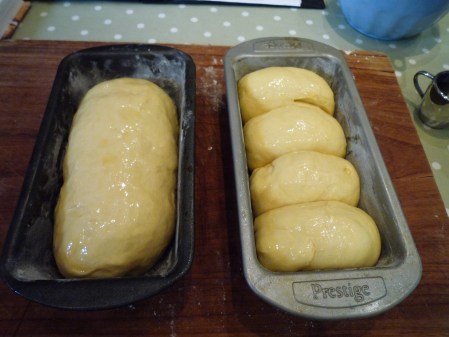
I always use steam in my oven when baking any kind of yeasted dough as I think it prevents a dry skin forming on the dough too soon which would impede its rise. Thus I added steam to my oven when baking the brioche and was very happy with the rise and end result. I have read elsewhere (specifically Tom Herbert’s comment in a baking article in October 2012’s Delicious magazine) that baking a brioche with steam will produce a thick hard crust but I have not found this to be the case so suggest steaming ahead!
Here are the loaves straight out of the oven:

That first slice, still warm, was definitely worth waiting for:
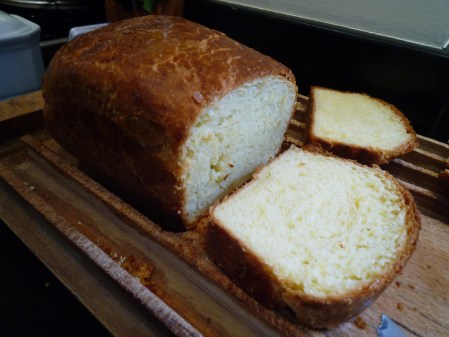
Interestingly, the loaf shaped as three buns had a more satisfactory structure and better rise than the standard loaf shape so I’d recommend this shaping method in future.
It goes without saying that the brioche made wonderful French toast, sprinkled with a little grated nutmeg and golden caster sugar before being topped with a generous dollop of the home-made kaya. Brunei is now up there in our “top ten” of world breakfasts.
Recipe for coconut egg kaya
Adapted from Australian chef and food writer Billy Law’s blog “A Table for Two”.
Makes enough to fill one small preserving jar with a bit left over.
Ingredients
3 eggs
2 egg yolks
150g golden caster sugar
250ml canned or packet coconut milk – check the small print to make sure it’s 100% coconut
3–4 pandan leaves, knotted (optional)
Set up a double boiler by placing a suitably sized mixing bowl over a large pan containing simmering water.
Having made sure the bowl will sit comfortably over the pan, take it off the heat and add the whole eggs, yolks and sugar to it and, using a balloon whisk, mix until the sugar has dissolved. Slowly pour the coconut milk into mixture while whisking until well combined. If using, drop the knotted pandan leaves into the mixture.
Swap the balloon whisk for a rubber spatula. Place the mixing bowl on top of the pan containing simmering hot water and start stirring the mixture constantly, scraping down the sides and base of the bowl. Baste the pandan leaves by using the spatula to pour the hot coconut custard over them.
The mixture will start to get thicker. This is likely to take between 20 minutes and half an hour. At this stage, remove the knotted pandan leaves, scraping and squeezing the kaya off them before discarding. Test for doneness by drawing a line right through the mixture in the bowl one swift move using the spatula. If a channel remains for a second or two before the mixture flows back, then it is ready. Remember that it will thicken further as it cools.
Spoon the mixture into a a sterilised jar, allow to cool then refrigerate. It will keep for up to a month in the fridge.
Recipe for Brioche
Adapted from Dorie Greenspan’s “Baking – from my home to yours”
Makes 2 loaves
Ingredients
7g fast action dried yeast
300g strong plain flour
225g ordinary plain flour
10g salt
80g water mixed with 80g whole milk, either at room temperature or slightly warmed
3 large eggs, lightly beaten with a fork
45g golden caster sugar
340g unsalted butter, at room temperature
To glaze
1 small egg, beaten
1 tablespoon water
In the bowl of a Kenwood or similar mixer fitted with a dough hook, stir together the flours, fast action dried yeast and salt. Pour in the milk and water mixture then turn the mixer on to a low speed and mix for one to two minutes until the flour is moistened and you have a fairly dry shaggy mixture.
Scrape down the sides of the bowl using a plastic dough scraper or rubber spatula. Turn the mixer back on to a low speed and add the egg mixture little by little, then the sugar. Increase the speed to medium and beat for about 3 minutes by which time the dough should have formed into a ball.
Reduce the mixer speed to low and add the butter in big chunks, beating until almost incorporated before adding the next. You will end up with a very soft cake-batter-like dough. Increase the mixer speed to medium and beat until the mixture comes away from the sides of the bowl, about 10 minutes.
Scrape down the sides of the bowl with a plastic dough scraper then cover the bowl with cling film and leave to prove at room temperature until the dough has nearly doubled in size, around 40 to 60 minutes depending on the ambient temperature.
Deflate the dough by picking it up and slapping it back into the bowl. Cover the bowl again with cling film and put it in the fridge. Check the dough every 30 minutes and slap it back until it stops rising. You may need to do this 4 or 5 times. Once it’s stopped rising, make sure the bowl is sealed with cling film and leave it overnight in the refrigerator.
The next morning, grease and flour two loaf tins. Loaf tins are notoriously difficult to size so I’ll tell you the measurements of the ones I used here which were both 22cm (Length) by 11cm (Width) by 6cm (Depth). Divide the brioche dough in half, and divide each half into four equal pieces (best done using an accurate set of scales). Roll each of these small pieces into a log shape (the length of which is equal to the width of your tin)and press four of the logs side by side in the base of each loaf tin. Cover the tins with an upturned plastic storage box or big mixing bowl and leave the loaves to prove until nearly doubled in size and filling the tins. This may take up to three hours as the dough is fridge cold and takes a while to get going again.
When the dough is reaching the end of its proving time, make sure your oven shelf is in a central position and preheat the oven to 190 degrees C (fan).
Make the glaze by beating the egg with the water. Brush the surface of the loaves carefully with the glaze trying not to let it run down the sides of the tin where it will prevent the loaves from rising.
Bake the loaves until well risen and a deep golden brown. I like to add steam at the beginning of the baking time (by quickly throwing a mug of cold water into a shallow preheated roasting tin placed at the bottom of the hot oven) to stop a crust from forming and allow the loaves to rise to their maximum potential.
Remove the loaves from the oven when done and allow to cool in their tins for about 15 minutes before turning them out to complete cooling on a rack. The crumb structure is quite fragile at this stage so be careful when you do this. Don’t attempt to slice until the loaves have cooled thoroughly, for at least an hour.
Contact details
Kim’s Thai Food Store
46 George Street
Manchester M1 4HF
Area: Chinatown
0161 228 6263
Spinach pie and semolina cake from Greece
September 17, 2012 § Leave a comment
Spinach and semolina sound like school dinner hell rather than fond food memories don’t they? Trust me, they really can be good given the right treatment.
The summer holidays are over and the boys are back at school, though in George’s case this is the last time I’ll be able to say this as, all being well, he’ll be a college student next September. I’m still thinking longingly of our week spent in Greece in mid August. We went back to Paleros on the Ionian Coast, a straight repeat of last summer’s holiday but it worked just as well this year too.
The village streets are still lined with enticing little tavernas:

Who wouldn’t want to retreat in here for a leisurely lunch on a hot afternoon?
I love the geometric perfection of the Greek script on a taverna menu: 
Though an English menu is more practical for the majority of us:
I fact we confined our taverna visits mainly to the evenings and most lunches were picnics in little bays like this one, a short boat across the bay from Paleros:
And our picnic foods of choice were wedges of freshly baked spinach and cheese pie from Paleros’ bustling little bakery:
I’d carry these back from the bakery, crisp, savoury and still warm. I’ve sought out an authentic Greek recipe from George Moudiotis’ excellent and informative book “Traditional Greek Cooking – The Food and Wines of Greece” which I’ve adapted and given below. The widespread availability of ready made filo pastry and bags of washed and prepared spinach make this a cinch to put together.
To complete our picnic, we’d add tomatoes and ripe pears or watermelon wedges to the bag, plus a little sweet something from the bakery. The Greeks clearly have an extraordinarily sweet tooth and, sandwiched between east and west, their baking has a combined culinary heritage. The buffet table at our hotel would be crowned by over-the-top layered and decorated sponge cakes in the western tradition adorned with swirls of crème patissière and whipped cream, highly coloured icings and glacé fruit. My preference was for the more austere but deeply sticky and sweet middle eastern influenced pastries, kourabiedes, baklava, kadaifi and the like. Here’s the simple yet enticing display of these goodies at the local bakery, reverently screened as a protection from marauding insect life: 
I tried out the moist little lozenges topped with sesame seeds and a single decorative almond for the first time. I tried desperately hard with my phrase book modern Greek to find out their proper name but ended up with me and the bakery lady smiling and helplessly shrugging shoulders as I failed to understand what these cakes were called. Whatever they are called, they were dense, moist and syrup-laden, a great energy boost after a long swim: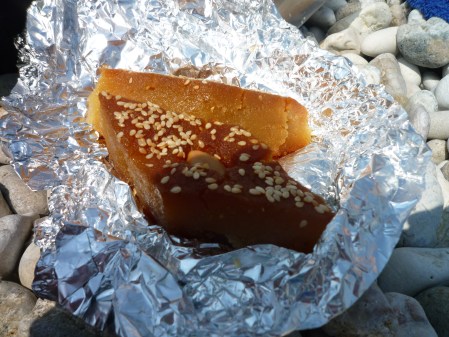
Looking for what they might be in my Greek food bible “Traditional Greek Cooking” once again, I found a recipe for a simple syruped semolina cake called Revani. This is a traditional cake from Northern Greece which I think sounds a little less dense than the cake I tried but similar in flavour and appearance. I give my adapted version of the recipe below and will be trying it out over coffee very soon to bring back those memories of summer.
Recipe for Spanakopita – Greek spinach and cheese pie
Adapted from George Moudiotis’ “Traditional Greek Cooking – The Food and Wines of Greece”
Serves 6-8
Ingredients
900g spinach, washed, stems removed and roughly chopped
1 bunch spring onions, trimmed and chopped
150ml extra virgin olive oil
225g crumbled feta cheese
4 eggs, beaten lightly with a fork
3 tablespoons chopped fresh herbs – a mixture of flat leaf parsley and dill is good
salt and freshly ground black pepper
250g filo pastry, about 12 sheets
pinch grated nutmeg
Preheat the oven to 180 degrees C (170 degrees C fan).
In a large frying pan big enough to hold all the spinach, fry the chopped spring onions in 3 tablespoons of the olive oil until soft but not browned. Tip into a large mixing bowl and set aside.
Add the spinach to the frying pan and cook for about 3 minutes until wilted. Tip into a colander and press out as much excess water as you can. Add the drained spinach to the mixing bowl which already contains the cooked spring onions and add the feta, beaten eggs, chopped fresh herbs, salt, pepper and nutmeg. When seasoning, don’t add too much salt as the feta is already quite salty. Mix well to combine.
Brush a 4cm rectangular deep baking dish with oil. Metal is best to conduct the heat and cook the pastry. Choose a tin that is a little smaller than the dimensions of the filo sheets. Lay the first sheet of filo over the base letting the edges overhang. Brush the sheet with oil. Repeat until you have used half the sheets of pastry. This constitutes the base of the pie. Spoon over the filling, spreading it evenly over the pastry. Cover with the remaining filo sheets in a similar manner, brushing each one with oil as you layer up, not forgetting to brush the top sheet with oil.
Using a really sharp knife, score the top surface of the pie marking out 6 or 8 portions. Prick the surface of the pie evenly all over to give an additional way for steam to escape. Trim the overhanging pastry edges but still leaving a small border. Fold this small border over the top and press lightly to seal. Spritz the pie with a little water to prevent the pastry from curling and bake in the preheated oven for about 45 minutes or until the pie is golden brown and crisp.
Serve warm or cold.
Recipe for Revani – syruped semolina cake from Northern Greece
Adapted from George Moudiotis’ “Traditional Greek Cooking – The Food and Wines of Greece”
Serves 10-12
Ingredients
For the cake
225g golden caster sugar
6 eggs
5 tablespoons warm milk mixed with 1 teaspoon vanilla extract
225g fine semolina
150g self raising flour
2 teaspoons baking powder
pinch of salt
For the syrup
450g golden caster or granulated sugar
400 ml water
75g unsalted butter
2 tablespoons lemon juice
finely grated zest of half a lemon
To decorate
Toasted whole blanched almonds
Line a 12 inch round cake tin with baking paper. Preheat the oven to 180 degrees C (170 degrees C fan). Mix together thoroughly the semolina, self-raising flour, baking powder and salt. Set aside.
Using an electric mixer, whisk the eggs and sugar together at high speed for about 10 minutes, adding the milk and vanilla extract mix gradually, until the mixture is pale and fluffy. Sift the flour mixture over the whisked egg mixture in three batches, gently incorporating each batch with a balloon whisk trying to retain all the whisked air bubbles in the mixture.
Pour the mixture into the prepared cake tin and bake in the preheated oven for 40 minutes or until the cake is golden brown and cooked through.
While the cake is baking, make the syrup. Put the sugar and water into a medium saucepan and bring to the boil without stirring. Once the sugar is dissolved, boil for 2 to 3 minutes. Remove from the heat and add the butter, lemon juice and zest and leave to cool.
Spoon the cooled syrup over the hot cake shortly after it comes out of the oven. Do this carefully as you do not want the cake to collapse. Leave the cake in its tin to cool completely. Cut it into lozenges and decorate with toasted whole blanched almonds.
Brazilian breakfast
August 30, 2012 § 1 Comment
The latest in our Breakfasts of the World Project series.
Breakfasts in Brazil are many and various depending on where you are in this vast country. I chose to prepare Açaí na Tigela, a breakfast dish popular on Brazil’s beaches, from Caraivo in the north to Florianópolis in the south as the Brazilian breakfast date coincided with our family beach holiday to Southwold in Suffolk.
OK so both Southwold and Florianópolis are both on the coast but that’s where the similarities end. Southwold is famous for its pastel-coloured beach huts and sedate way-of-life whereas Florianópolis is known as one of Brazil’s hippest cities with “dental floss” bikinis rather than Cath Kidston florals being the beachwear of choice.

Let’s compare and contrast some other features of these two towns/cities :
1) Population: Southwold – 1,458 (compared to a national population of 62,641,000); Florianópolis – 427,298 (compared to a national population of 196,655,014)
2) Administration: Southwold – within Waveney district council in Suffolk in the east of England; Florianópolis – capital and second largest city of Santa Catarina province in the south of Brazil
3) Distance from capital city: Southwold 154km from London (but looks a long way on the map of our crowded little island); Florianópolis – 1,673 km from Brasilia (but looks quite close on the map because of the vastness of the country)
4) Climate: Southwold – temperate (really?!); Florianópolis – sub-tropical
5) Number of beaches: Southwold – 1; Florianópolis – 42
6) Main educational establishment: Southwold – Sailors’ reading room; Florianópolis – Santa Catarina University
I needed more for this breakfast than just the Açaí na Tigela. Brazilians love their coffee so this was a must, made from Brazilian beans, naturally. Finally, rather than ordinary white rolls I made a batch of cheese rolls, Pão de queijo, which are made from tapioca starch so perfect for anyone on a gluten-free diet.
Here’s the whole spread:

Back to the Açaí na Tigela, literally “bowl of açai berries”. This turns out to be a smoothie the main ingredients of which are super-trendy (and, over here, superexpensive) açai berries and banana, topped with granola and, optionally, more banana slices. I read about it here and instantly wanted to try one.
The smoothie was quickly whizzed up with a stick blender and I added a spoonful each of ginseng, guarana and maca powders to the whole fruit and juices to give it an extra Brazilian lift. It certainly gave my 90 year old father-in-law Lawrie an extra gear in his wheelchair travels that day.

I poured the smoothie into individual serving bowls:
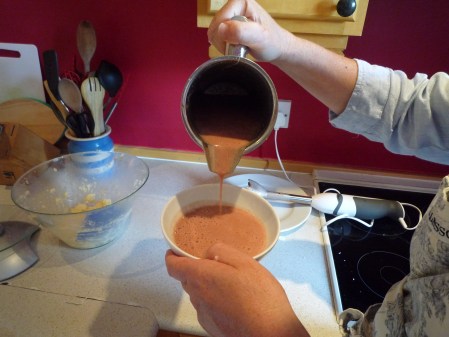
and topped it with a spoonful of homemade granola:

Yes of course you can buy granola readily these days but it’s quite satisfying to make your own now and again. I discovered this particular granola at a friend’s house a couple of years ago, asked for the recipe and was told I already had it as it’s in Nigella Lawson’s “Feast”. She in turn attributes the recipe to Andy Rolleri of The Pantry deli in Fairfield, Connecticut. It’s a cinch to make – the only remotely tricky bits are making sure you’ve bought all the items on the lengthy ingredients list and getting the correct bake – not underdone and not burnt. A long and slow toasting is what you’re aiming for, not a quick char. Be warned, it’s addictive stuff and you’ll find yourself eating it by the handful rather than rationing it just for breakfast.
I found my pão de queijo recipe on this website in 2008 but can’t remember now why I was trying to find a Brazilian cheese bread recipe back then. The list of ingredients sounds surprising – what, tapioca, the stuff that school dinner nightmares are made of? Yes , that’s right, but look for tapioca flour rather than the tapioca processed to make school dinner puddings. You can find it at specialist health food stores – mine came from Chorlton’s fantastic Unicorn deli. It’s a starch made from the cassava root and you might find it sold as manioc flour – all rather confusing. I have once made a batch using pudding tapioca which I tried to grind down to a flour in my liquidiser. It didn’t work as the stuff is rock hard. I made the recipe with it anyway and it was OK but there were occasional lumps, so do make every effort to find the right flour.
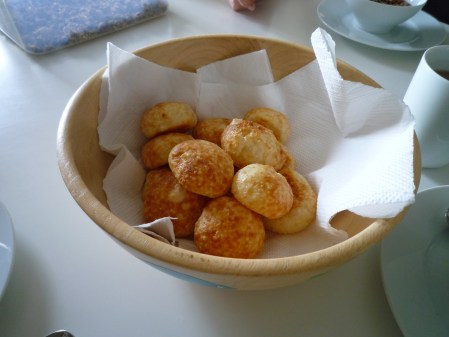
The recipe requires you to make a choux-type paste by throwing the tapioca starch into boiling water and then beating like crazy to make a smooth paste. Beaten eggs are then added before the soft dough is blobbed onto lined trays for baking.

Miraculously, these blobby balls transform when baked into light and fluffy rolls:
Recipe for granola
Adapted from a recipe in Nigella Lawson’s “Feast”.
Ingredients
450g rolled oats
120g sunflower seeds
120g white sesame seeds
175g apple compote (a little bought jar is fine)
2 teaspoons ground cinnamon
1 teaspoon ground ginger
120g brown rice syrup (from health food shops or the healthy eating aisle of your supermarket)
4 tablespoons runny honey
100g light brown sugar
250g whole unskinned almonds
1 teaspoon Maldon salt
2 tbsp sunflower oil
300g raisins
Mix everything except the raisins together very well in a large mixing bowl using 2 curved spatulas.
Spread the mixture out on 2 baking tins and bake at 170 degrees C for about 40 minutes. Keep an eye on the mixture and turn it over with a big spoon after about 20 minutes. It may need longer than 40 minutes in total. You need to achieve an even golden colour without overbaking or burning. Once cool, mix with the raisins and store in an airtight tin.
Recipe for Brazilian cheese bread (Pao de queijo)
From the website “sonia-portuguese.com”. Makes about 70 individual rolls.
Ingredients
1 cup water
1 cup milk
½ cup oil
1 teaspoon salt
450g tapioca starch
2 to 3 eggs
200g grated parmesan cheese
Bring to a boil in a big pan the water, milk, oil and salt. Remove the pan from the heat and add the tapioca starch. Mix well with a wooden spoon and allow to cool down. Put the mixture in a bowl, add the eggs and knead well. Add the grated cheese and keep kneading until the dough is smooth.
Roll into small balls (each ball requiring 1 tbsp mixture). Oil rather than flour your hands.
Place the balls on a baking tray lined with baking paper. Bake at 180 degrees C for about 20 minutes or until golden brown.
Cakes for Hansel and Gretel
July 29, 2012 § Leave a comment
The challenge for this year’s Clonter Opera (Cheshire’s answer to Glyndebourne) picnic was to produce a themed dessert which could be eaten during a 30 minute interval. This year’s production was Engelbert Humperdinck’s “Hansel and Gretel”, so a selection of German mini-cakes, plus sweets and the obligatory gingerbread seemed to fit the bill.

I love proper cheesecake, so a traditional German-style baked cheesecake cooked in a rectangular tin and cut into dainty squares was first on my list. I chose my recipe from my newly acquired baking book, Dan Lepard’s “Short and Sweet” and found it to be excellent. This was the “Classic Cheesecake” from p.458 and was everything a cheesecake should be – deep cream cheese flavour with hints of orange zest and vanilla and great texture. The Hobnob biscuit base was an inspired variation on the usual digestives and was neither too hard nor too soggy, but just right. You can see the cheesecake squares presented in pink foil cases in the picture above.
Talking of which, the dinky self-assembly cardboard three tier cake stands I used attracted at least as much interest as the cakes! These were a Caroline Gardner design, stocked by online supermarket Ocado and maybe also Waitrose and John Lewis too.
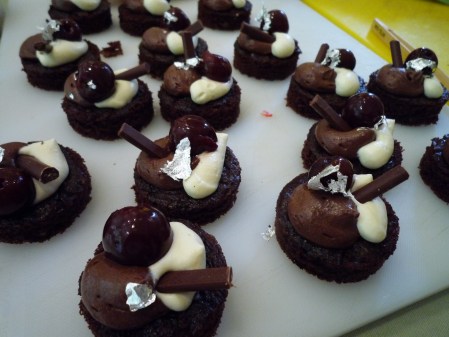
That much-bastardised 1970’s dinner party favourite, Black Forest Gâteau just had to be on the menu. Forget dry chocolate cake, too much buttercream and garish decoration, my version was constructed with featherlight chocolate génoise (I used Rose Levy Beranbaum’s recipe from “The Cake Bible”); kirsch-infused syrup; luscious smooth chocolate custard (another winner from Dan Lepard’s “Short and Sweet” book); white chocolate ganache which tastes and behaves like a super-stable whipped cream, great for a cake which has to sit in a warm room for a little time. The final decoration was a griottine-style morello cherry, a chocolate stick and for a final touch of bling, a shred of real edible silver leaf. The result was a delectable little mouthful:
So good in fact that I just had to put together another batch the next day for afternoon tea, this time with a double layer of sponge, fresh cherries and grated chocolate:

Both the chocolate génoise and custard are really good versions of these classic components and I’ve given both recipes at the end of this post.
Strawberry tartlets presented German style on a sponge cake rather than pastry base, completed my trio of mini-cakes. I used more of the white chocolate ganache and incorporated my mother’s trick of glazing the strawberries with redcurrant jelly for extra sweetness and shine. The cakes were finished off with a little edible gold leaf:

You can’t do Hansel and Gretel without a gingerbread house. I didn’t think a fully assembled gingerbread house would survive the minibus journey along bumpy country roads from home to Clonter so used the templates for mini gingerbread houses from the BBC Good Food site recipe here to make house-shaped biscuits. I didn’t use their gingerbread recipe though, opting for yet another Dan Lepard recipe from “Short and Sweet”, the gingerbread biscuit recipe from p. 243. Another winner, producing a dark, deeply spicy biscuit, its colour coming both from muscovado sugar and also a tablespoon of cocoa powder added to the dough, a neat trick producing a deep colour and rich flavour pointing up the spices but not overpowering them with obvious chocolate.
I decorated the biscuits very simply with white royal icing and a number 1.5 writing nozzle producing a stylish black and white effect:

A selection of old-fashioned sweets from Altrincham market’s pick and mix stall and Hale’s fabulous Gobstopper sweet shop (sugar mice, chevron lolly pops, candy canes, bon bons, comfits, sugared almonds..) plus squares of home-made fudge completed the spread. Shame the opera director had a slightly different vision of the story and went for a pyschedelic Affleck’s Palace style emporium complete with skateboard gear rather than a recognisable gingerbread house. Ah well, you can’t win them all…
Recipe for Chocolate Génoise
Adapted from Rose Levy Beranbaum’s “Cake Bible”. I’d recommend buying the book for all Rose’s invaluable tips and tricks though. This recipe is sufficient for a deepish 23cm diameter round cake. I wanted thinner sheets of cake so scaled up the recipe to a 7 egg version and baked two 25cm square trays of cake.
Ingredients
37g clarified beurre noisette
28g cocoa powder (I like Valrhona or Green and Blacks)
60g boiling water
4g vanilla extract
5 large eggs (250g shelled weight)
100g golden caster sugar
75g sifted plain flour
Preheat the oven to 170 degrees C (fan).
Warm the beurre noisette until almost hot and keep warm.
In a smallish bowl, whisk together the cocoa and boiling water until you have a smooth paste. Stir in the vanilla extract and set aside, covering the bowl with the whisk still in it with cling film if you don’t plan to use it immediately.
Mix the eggs and sugar together in the large mixing bowl from your Kenwood or similar mixer. Set the bowl over, not in, a pan of simmering water and stir constantly until the mixture is just lukewarm. Take care and do not allow the eggs to coagulate or you will end up with hard little lumps in the finished cake. The heating of the eggs helps stabilise the mixture when whisked which is helpful when the dense chocolate is mixed in. I wouldn’t bother with the heating for a plain génoise.
Remove the bowl from the hot water, dry it off and return it to the mixer. Whisk at high speed until the mixture has tripled in volume and leaves a trail when the whisk is lifted.
Take a couple of big spoonfuls of the egg mixture and whisk them into the cocoa mixture using a balloon whisk.
Sift the flour over the remaining egg mixture and incorporate thoroughly but carefully using a balloon whisk. Add the cocoa and egg mixture and stir with the balloon whisk until half-incorporated. Fold in the beurre noisette in two batches by which time everything will be thoroughly combined yet still aerated.
Pour immediately into the prepared cake tin (greased and base lined for a deep round tin; fully lined with baking parchment if you’re baking a sheet of cake in a shallow square or rectangular tin as I was) and bake for about 30 minutes. You can tell when the cake is done as the cake shrinks away from the sides just a little.
Turn out straightaway onto a lightly greased cooling rack and peel off the parchment after a couple of minutes.
Recipe for Chocolate Cream Custard
From Dan Lepard’s “Short and Sweet”. Makes enough to fill 30 mini cakes with plenty left over.
Ingredients
100g golden caster sugar
25g cornflour
25g cocoa powder (I like Valrhona or Green and Blacks)
2 teaspoons vanilla extract
225 ml milk (I used semi-skimmed)
2 egg yolks
50g unsalted butter cut into pieces
50g dark chocolate in small pieces (I like Valrhona Manjari buttons)
150ml double cream
In a heavy-based saucepan whisk the sugar, cornflour, cocoa powder and vanilla extract with the milk until smooth. Add the egg yolks and whisk again. Heat gently over a low to moderate heat beating with a wooden spoon all the time. As the mixture warms, gradually add the butter piece by piece, stirring all the time. As the mixture begins to thicken, beat hard to keep it smooth.
Remove from the heat, tip the mixture into a medium sized bowl (you’re going to add cream to the mixture later) and cover the surface of the custard directly with cling film to stop a sking forming. Leave to cool then chill in the fridge until completely cold.
When you’re ready to complete the custard, take it out of the fridge and remove the cling film. Using a hand-held electric whisk, whisk the custard at a slow speed. When the custard is smooth, increase the speed to medium and gradually whisk in the double cream until the mixture is very smooth, shiny and thick. The mixture will thicken up further to a consistency which can be piped and will hold its shape if returned to the fridge to chill for a while.
 The Rhubarb Fool