
Christobel Heginbotham’s ultimate parkin and other Bonfire Night treats
October 31, 2011 § 2 Comments
A name to die for isn’t it? I met the lady in question eight years ago after tucking into platefuls of cake in a scout hut at the edge of the Pennines after completing the annual “Autumn Leaves” fell race. The local running club organising the race have the inspired idea of combining it with a village cake competition and the runners get to eat the entries afterwards. Brilliant. So not only did I get to eat the most fantastic parkin (which in case you haven’t come across it is a a moist sticky gingerbread cake, a speciality from the North of England) but it had the baker’s name on it so I was able to find her and she very kindly emailed the recipe to me. I’ve been making it annually ever since, a recipe to treasure, and traditional for a Bonfire Night party.
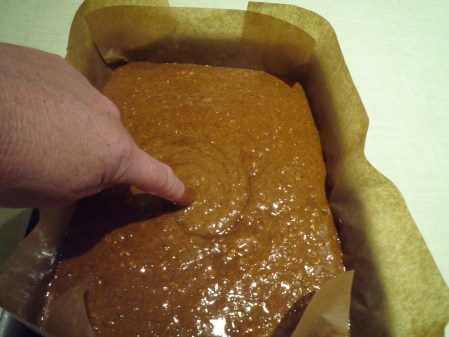
The cake mixture, made simply in a single large saucepan by the melting method, looks disconcertingly runny when poured into the prepared cake tin:
But fear not, it will turn into this sweet, sticky, spicy, springy cake when cooked:

Which, as you can see, can be eaten straightaway – no wrapping and storing for a week as some recipe suggest. No need to seek out tricky-to-find oatmeal either – the recipe works just fine with rolled oats which you probably have in your cupboard already for making porridge.
By the way, golden syrup seems to be a peculiarly British ingredient. Looking at various web forums, the best US substitute might be a dark corn syrup – hope this works for you.
Thinking about a fireworks party theme, I have a great recipe for an Argentinian-inspired beef stew served spectacularly in a serving bowl fashioned from a pumpkin. Perfect for a party as it can be made well in advance, warming, substantial and full of healthy veg! Actually it would work really well for a Halloween party too and you could then pull out all the stops and serve it with black pasta (the stuff mixed with squid ink) or black rice if you can get hold of some. Perhaps more economical would be a mix of fettucine type noodles, some black, some green and some plain. Similarly a mix of basmati and wild rice rather than just wild rice or Vietnamese or Piedmont black rice.
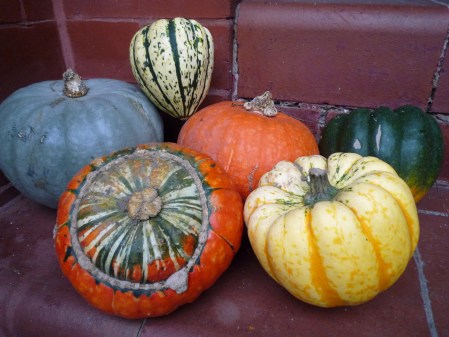
Sorry, no photos available from when I last cooked this dish but I think this consignment of squashes from Riverford Organics currently decorating my front porch are destined for this dish next weekend:
Finally, a reliable recipe for toffee apples from my ever trustworthy Good Housekeeping recipe book. It wouldn’t be a proper party without toffee apples and the recipe is literally child’s play as my son Arthur proves:
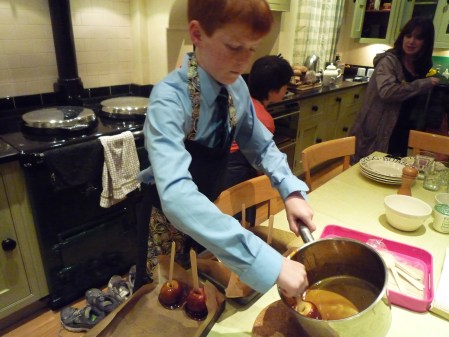
Boiling the toffee to the correct “soft crack” stage isn’t as tricky as it sounds. Drop a teaspoon of the hot toffee into a bowl of chilled water. It’s ready when the syrup doesn’t just form a ball but separates into hard but not snappable threads.

Try my trick of shoving the handle of a teaspoon into the apple as a handle if you find yourself making these at the list minute with no wooden lolly sticks in your kitchen drawer.

Recipe for parkin
With thanks to Christobel Heginbotham. I bake this in a shallow rectangular metal baking tin approx 20cm by 25cm (see pic above) but you can, as Christobel suggests, double the recipe and bake in a square deep cake tin “to make a fair sized cake”, in which case a longer cooking time may be required.
Ingredients
100g butter
50g soft brown sugar
2 large tablespoons (this weighs 75g) black treacle
2 large tablespoons (ditto) golden syrup
175 ml milk
100g plain flour
2 teaspoons (10g) baking powder
1 teaspoon (3g) ground ginger
half teaspoon ground cinnamon
half teaspoon ground cloves (or ground allspice)
100g rolled porridge oats
Preheat oven to 170 degrees C (fan). Line a 20cm square baking tin with baking paper.
In a large saucepan melt the butter, sugar and treacle together over a low heat. Be careful not to let it burn or bubble. Remove from the heat and stir in the golden syrup and milk.
Add the plain flour, baking powder, ginger, cinnamon and cloves or allspice. Mix well, beating to remove any lumps. Stir in the oats.
Pour into the baking tray and cook for 35-45 minutes. Test by pressing the top with your finger tip. It should spring back and not leave a dent. Cut into squares and leave to cool in the tin.
Recipe for Carbonada Criolla – Argentinian beef and vegetable stew served in a pumpkin
Adapted from a recipe in Jane Grigson’s Vegetable Book.
Serves 15-20
Ingredients
1 large beautiful pumpkin which will fit comfortably into your oven
For the meat stew
2 large onions, chopped
4 large cloves garlic, chopped
olive oil for frying
1.5 kg cubed chuck steak
2 tins (14oz size) chopped tomatoes
1 tablespoons tomato purée or 4 tablespoons passata
2 litres beef stock (made from cube is fine)
bouquet garni (a handful of parsley stalks, a sprig of thyme, and 2 bayleaves, tied together in a muslin bundle with a long string handle to aid removal from the pot)
1 heaped teaspoon dried oregano
2 teaspoons sweet smoked paprika (or ordinary paprika if you don’t have the smoked kind)
salt and freshly ground black pepper
1 kg sweet potato, peeled and cut into 2cm cubes
1 kg waxy potatoes, scrubbed but not peeled (unless you prefer them peeled) and cut into 2cm chunks
1 kg pumpkin or squash (choose a variety which will collapse and melt into the sauce when cooked to act as a natural thickener) peeled and cut into 2cm cubes or chunks
0.5 kg frozen sweetcorn kernels (or the equivalent canned or fresh if you prefer)
a pack of baby sweetcorn
12 canned peach halves sliced – you could use canned apricot halves if that’s what you happen to have in the cupboard – drained contents of 2 cans should be about right
Syrup from the canned peaches or apricots
Begin by preparing the pumpkin. Wash and cut out a lid from the top, keeping the stalk on to act as a handle. Cut a small nick out of lid and base to aid repositioning the lid accurately. Using your hands, a spoon and a small sharp knife, pull out and discard the central fibrous part of the pumpkin along with the seeds. Now cut and scoop away the solid pumpkin flesh, working carefully as you need to leave a good wall of pumpkin flesh for structural integrity when baked and the skin needs to be unpierced/intact. Weigh out the pumpkin flesh needed for the recipe and set aside.
Brush the inside of the pumpkin with a little olive oil. Replace the lid and set the whole thing in a shallow roasting tin.
In a frying pan, cook the onion and garlic in a little oil until soft but not browned. Transfer to a large lidded saucepan or casserole dish.
Add a little oil to the frying pan in which you cooked the onions, turn up the heat and brown the beef cubes in batches, transferring them to the large saucepan with a slotted spoon as you go. Add to the beef and onions the tomatoes, tomato purée, salt and pepper, bouquet garni, oregano and paprika. Now take about half a litre of the stock and use it to deglaze the frying pan. Tip the deglazing liquid into the saucepan containing the other ingredients along with a further half litre of stock. This means that you will have incorporated into the dish about half the stock at this stage.
Cover and simmer until the meat is almost cooked – an hour or so. Add the sweet potato, potato and pumkpkin plus more stock so that the pan contents are covered. Return to the boil and simmer with the pan lid on for a further 20 to 30 minutes until the meat is tender, the potatoes cooked and the sauce thickened with the collapsed pumpkin. Taste and correct seasoning. Remove and discard the bouquet garni.*
Finally, add the sweetcorn and peaches but not their syrup at this stage and simmer for a further 15 minutes. Taste and add a little peach syrup at this stage to sweeten the sauce if liked.
* You can prepare the beef stew ahead of time to this stage. Best not to finish the stew until you’re ready to serve to prevent the baby corn and canned fruit becoming to mushy in the reheating process.
To complete the dish, switch on your oven to 180 degrees C (fan)about 1 hour before you’re ready to serve. Bake the pumpkin for half an hour or so. Safest to keep it underdone as you don’t want the walls to collapse so check it after 20 minutes. After half an hour, ladle the hot stew into the pumpkin then pop back into the hot oven for 10-15 minutes before serving.
Recipe for toffee apples
Adapted from a recipe in UK classic cookery book “Good Housekeeping”. Mine is the 1985 edition.
Makes 6-8 apples
Ingredients
450g (1 lb) demerara sugar (turbinado sugar in the US)
50g (2 oz) butter
10 ml (t teaspoons) vinegar – I use malt vinegar but a white wine vinegar would be fine and a cider vinegar would be appropriate for apples wouldn’t it?
150 ml (1/4 pint) water
15 ml (1 tbsp) golden syrup (dark corn syrup probably OK as a substitute)
8 small/medium apples and the same number of wooden sticks
Wash and dry the apples and push the sticks into their cores, making sure they are secure.
Place the butter, sugar, vinegar, water and syrup in a medium-sized heavy based saucepan. Heat gently, stirring occasionally with a wooden spoon, until the sugar is dissolved. Bring to the boil without stirring further and boil rapidly until the syrup reaches the “soft crack” stage (143 degrees C or 290 degrees F if you’re using a sugar thermometer).
Remove from the heat and working swiftly to prevent the toffee from setting, dip the apples into the toffee, remove and twirl for a few seconds to allow excess toffee to drip off. Set on a sheet lined with baking paper to cool and harden.
Capri lemons, Vesuvius lemons, Sorrento lemons
October 28, 2011 § Leave a comment
Zingy, sunshine-yellow, mismatched, lumpy, bumpy, fragrant lemons will be the abiding memory of our recent half-term trip to Naples and the Sorrento peninsula in Italy. We found them everywhere adorning roadside granita stands:


ready to be turned into the most refreshing pick-me up ever – and I can’t abide the Americanised translation of a granita as “slush” which is just not right for something as elegant as this:

sipped overlooking a view like this one in Positano:

or maybe this one overlooking the Faraglioni rocks on Capri’s southern coast:

There were boxes of lemons stacked outside the humblest little cafés and restaurants like these spotted in Pompeii:
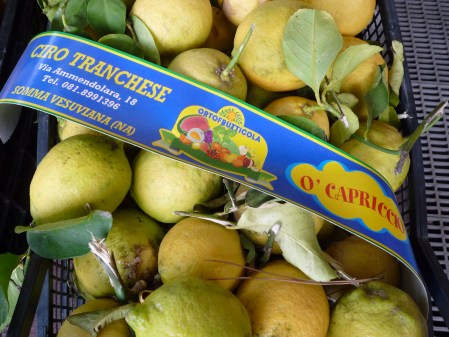
destined for a spremuta di limone, the Italian version of lemonade – fresh lemond juice and water in a tall glass with ice – add your own sugar and stir for the most refreshing drink imaginable, eye-wateringly, mouth-puckeringly sharp:

perfect for sipping on as you wait at Sorrento’s Marina Piccola harbour for the jetfoil across the bay to Naples:

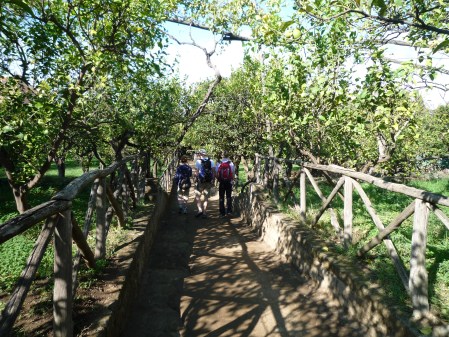
Perhaps best of all spotting the lemons growing on trees in groves right in the heart of Sorrento town, in most cases still a slightly unripe green:

and we soon worked out that strolling through the Cataldi citrus groves was a much pleasanter way of reaching Sorrento’s frenetic Piazza Tasso than braving the Lambretta and Fiat crowded narrow streets:
Sorrento lemons are turned into all sorts of lemon products of varying quality and taste. Most famously there is the signature lemon liqueur Limoncello. At its best it can be rather good, aromatic, zesty with a touch of bitterness to cut through the sweetness. At worst, it’s like a chilled LemSip decanted from a dodgy cupid-shaped bottle.
How is it that the Italians have a reputation for being stylish when they produce some of the worst tat in the world? A country of many contradictions…
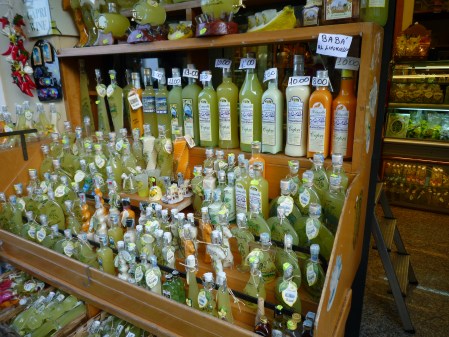
as a holiday souvenir, I left alone the lemon-flavoured bottles, packets, jams and soaps and contented myself with half a kilo of fresh lemons complete with fragrant green foliage from the local fruit and veg shop.
What to do with my precious cargo now we’re back home? I’ve collected together the following four lemon recipes I fancy having a go at in the next week or so. There’s a zesty lemon cake from Capri, a classic lemon granita, a simple pasta recipe and an unusual lemon salad. Having belatedly checked in one of my favourite cook books, Jane Grigson’s Fruit Book, I’m pleased to say that none of these recipes appear there – it would have been a bit of a downer to repeat what’s already been done! I’m sure they’ll bring a ray of Mediterranean sunshine into the approaching English autumnal gloom…
Recipe for Caprese al limone – Capri lemon cake
Caprese al limone
This cake along with its dark chocolate cousin, is served up all over the island of Capri. I’ve hunted down a number of different recipes and this one, adapted from Salvatore di Riso’s “I dolci del Sole” sounds the most workable whilst remaining authentic.
Serves 10 or more
Ingredients
100g extra virgin olive oil
120g icing sugar
200g blanched whole almonds
180g white chocolate, finely chopped
1 teaspoon vanilla extract
grated rind of 1 Amalfi lemon (or 2 medium or 3 small normal lemons)
5 medium eggs
60g caster sugar
50g cornflour
5g (1 teaspoon) baking powder
Line the base of a 22cm round cake tin (preferably springform or loose bottomed) with baking paper and butter and flour the interior.
In a food processor or liquidiser, grind the almonds to a coarse powder with the icing sugar. Set aside
Whisk together the eggs and sugar using an electric mixer for 10 minutes until you have a thick foam (as if making a génoise mixture).
In a large bowl, combine the ground almond and sugar mixture with the grated chocolate, the grated lemon rind, the cornflour and the baking powder. Mix together well.
Add the olive oil, vanilla extract and the beaten egg mixture to the bowl and mix well to combine not worrying unduly should the eggs collapse a little. This is a dense, moist cake rather than a light fluffy one.
Pour the mixture the prepared cake tin. Bake at 200 degrees C for 5 minutes then reduce the heat to 160 degrees C and bake for a further 45 minutes.
When the cake is done, cool in the tin. Turn out and serve sprinkled with icing sugar.
Recipe for lemon granita
Adapted from Marcella Hazan’s master granita recipe given in “The Classic Italian Cookbook” but incorporating the lemon water ice trick of infusing the lemon zest in the syrup for added zing. You’ll notice there’s much less sugar than in a classic water ice recipe.
Ingredients
8 tablespoons fresh lemon juice (maybe 4 lemons?)
peel of 4 lemons removed using a vegetable peeler, roughly chopped
325ml water
50g granulated sugar
Put the sugar and water into a small saucepan and bring to the boil stirring to dissolve the sugar. Once the mixture has come to the boil, turn off the heat, throw in the chopped lemon peel, cover and leave to infuse until the mixture is cold. Strain and stir in the lemon juice.
Pur the mixture into one or more shallow metal or plastic trays or boxes (a pair of old fashioned metal ice cube trays with the plastic dividers removed would be ideal). Put into the freezer and check after 15 minutes, stirring the mixture with a fork to break up the ice crystals, scraping them down from the sides and in the corners where they will form first. Repeat the process again after 15 minutes and thereafter every 8 minutes until the granita reaches the right texture. This may take 3 hours or so!
Serve in pretty glass goblets with a teaspoon, or more informally in a plastic tumbler with a strawer and spoon.
Recipe for fettucine al limone
Adapted from a recipe for “Danny’s Lemon Pasta” featured on the BBC Radio 4 programme “Woman’s Hour” aeons ago and which I’ve been storing in my recipe files for an age. The Danny in question is Danny Kaye and the chef one Ruth Reichl.
Ingredients
4oz best unsalted butter
10 fl oz double cream
2-3 tablespoons fresh lemon juice
finely grated zest of 4 small lemons
freshly ground black pepper
1-2 oz freshly grated Parmesan cheese, plus more for the table
1lb fresh egg fettuccine
Serves 4
Melt the butter in a large, heavy bottomed frying pan or sauté pan. Add the cream, lemon juice and half the lemon zest and bring to the boil over a medium heat and reduce by one quarter. Remove from the heat and cover.
Cook the pasta in a large pan of salted boiling water until al dente (this will take only 2 to 3 minutes). Reserve a little of the pasta cooking liquid and drain the pasta in a colander.
Add the drained pasta to the frying pan containing the sauce along with the reserved lemon zest, 2 tablespoons of the pasta cooking water, the grated parmesan cheese and freshly ground black pepper. Toss well.
Recipe for lemon and cucumber salad
Not for the faint hearted! Inspired by the lemon salad served on the island of Ischia where chunks of peeled and thick-pithed local pane lemons are simply dressed with olive oil and flavoured with salt, pepper and aromatic mint and flat leaf parsley.
This would work well with simply grilled fish or a thick barbecued veal chops.
Serves 4
Ingredients
3 unwaxed lemons, peel left on, very thinly sliced
1/2 cucumber peel left on, very thinly sliced using a mandolin
1 tablespoon chopped fresh mint
1 tablespoon chopped fresh flatleaf parsley
1 small medium hot red chilli, halved, deseeded and finely shredded
sea salt and freshly ground black pepper
2 tbsp extra virgin olive oil
Lay the lemon slices on a platter, sprinkle with a little salt and leave for half an hour. Once the half hour has elapsed, wipe off the salt and liquid drawn out with kitchen roll.
Arrange the salted lemon and cucumber slices attractively on a serving platter. Scatter over the chopped herbs and chilli, drizzle with olive oil and season with salt and pepper.
Final paean to Greek food: moussaka and kourabiedes
October 17, 2011 § 1 Comment
This is my third and final post on recreating Greek food back home after our recent holiday on the Ionian coast.
Whether you consider moussaka to be a classic or a cliché, you’ll find it on the menu of every little waterside taverna like this one in the port of Vathy on the island of Meganisi:

Having eaten moussaka at Paleros’ New Mill Tavern where chef/owner Kathy serves up some of the best home-cooked Greek food around, I’m convinced that it’s a classic rather than a cliché:
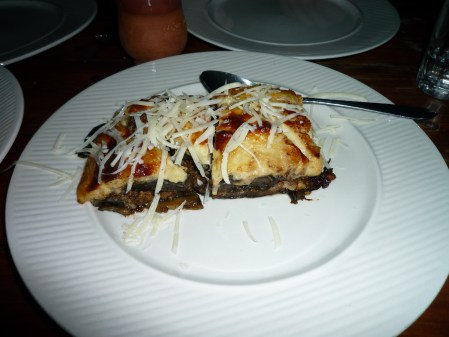
What was so good about it? Its simplicity – slow cooked lamb and unctuously soft aubergines topped with a baked cheese and egg mixture – and its fantastic flavour – the meat subtly spiced with cinnamon and the cheese deeply savoury. So many weird versions of this dish abound some of which end up tasting more like lasagne than authentic moussaka.
Back home, I started looking for an authentic recipe for moussaka wanting to recreate the New Mill Tavern experience. The moussaka you find in the UK is sometimes more like lasagne or even our homegrown shepherd’s pie than the real deal. I remember my mother cooking this dish for family teatime back in the 1970s. Her multilayered creation interspersing white sauce with layers of tomatoey meat and a vegetable mix comprising potato and courgette as well as aubergine was rather good but nothing like the moussaka I’d tasted in Greece.
Delia Smith has a pretty good version in Book One of her “How to Cook” series. The meat base is spot on but the ricotta in the topping strikes an alien note for me and gives a a less than desirable spongy mouth feel.
So it was back to my new favourite cookbook, George Moudiotis’ “Traditional Greek Cooking” to see what he has to say on the subject. Clearly my search for an authentic moussaka was misguided as Mr Moudiotis says:
“Authentic moussaka does not exist; there are some good, some bad and some very bad versions, especially those served in most restaurants and pubs. The dos and don’ts of a moussaka are too numerous to mention. In general, a moussaka should be creamy and rich but not too heavy, the ingredients should be of good quality and well balanced. The amount of oil should be carefully controlled; it is a misconception that the more oil you use in a moussaka, the tastier it will be.”
He goes on to add that as well as aubergines you can use courgettes, potatoes, artichokes and even rice, nuts and currants. So, mum, you were right all along!
Now I have an admission to make. The delicious looking moussaka pictured below was prepared in my kitchen but by Laura who comes in to help with the boys and general housekeeping. She had the rather inspired idea of cutting the aubergine into strips which to our taste are a big improvement on the usual unwieldy big slices.
Here they are during the salting process:

And again once they’ve been fried:

It’s really important to fry the aubergines thoroughly so that they are quite soft. That way they have an unctuous melting texture in the finished baked dish. Undercooked aubergines can be a bit fibrous and bitter – not what is wanted at all.
What other changes did we make to the recipe? Well, we adjusted the portion size. I think this quantity serves 8 to 10 people rather than the 6 suggested in the original recipe. They clearly have big appetites in Greece. I’ve also tweaked the meat base ingredients a little, adding a bit more tomato passata and chopped fresh mint to the mixture.
Here’s what it looks like as it reduces:

And here is the dish as it is being assembled in layers:

The other major change to the original recipe was increasing the quantity of sauce topping. I found that there wasn’t nearly enough so I’ve increased it by half and if you plan to bake the moussaka in two or more smaller dishes rather than a single big one then I’d recommend increasing the sauce quantity I’ve given by another third. Oh, and I twiddled around a bit with the grated cheese and breadcrumb quantities.
Here is the completed moussaka ready to bake:
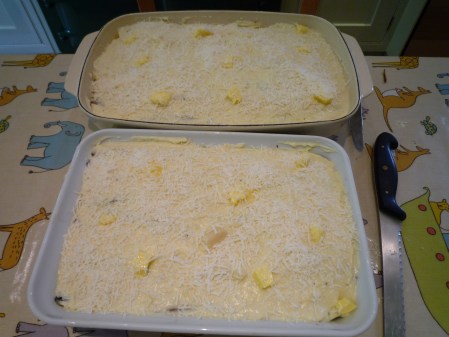
And again in all its golden baked perfection, and yes it tasted as good as it looks so congratulations Laura!
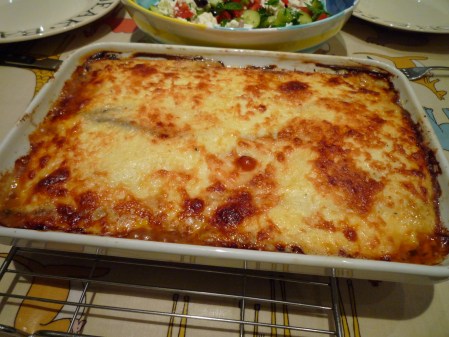
I won’t lie. This is neither a quick nor a simple dish to prepare. But it is good tempered (you can make it your own pace, it refrigerates, freezes and reheats well) and it’s well worth the effort.
Finally something sweet to conclude this three-part mini Greek epic.
The Greeks have a sweet tooth and you don’t have to look too hard to find an array of syrup-drenched pastries in bakeries and cafés – baklava, loukomades and the like. I came across this generous display of freshly baked icing sugar dusted goodies at Paleros’ town bakery:

I bought a bagful – they’re sold by weight – as a sweet conclusion for our island hopping picnic. They turned out to be the lightest, crumbliest buttery almond shortbread biscuits. I can attest to their crumbliness – packed in a rucksack they disintegrated into the tastiest bag of crumbs imaginable!
A little research back home confirmed these melt-in-the-mouth biscuits to be kourabiedes – a sweet Greek treat popular at easter, Christmas, weddings and frankly at any time. I give the recipe below but, a word of warning, I haven’t attempted these at home yet.
Our picnic destination was to have been the island of Ithaca, home of Odysseus. It proved to be too far for our slightly underpowered boat that day. Never mind. In the words of twentieth century Greek poet CP Cavafy:
“Ithaca has given you the beautiful voyage.
Without her you would have never set out on the road.”
Recipe for moussaka
Adapted from George Moudiotis’ “Traditional Greek Cooking”
Serves 8-10
Ingredients
For the meat base
4 medium aubergines
2 tablespoons flour
Olive oil for frying the aubergine strips
1 tablespoon olive oil for frying onion and meat
1 large onion, chopped finely
3 cloves of garlic, chopped
900g minced lamb
2 tablespoons chopped flatleaf parsley
2 tablespoons chopped fresh mint
150ml red wine
150ml tomato passata
1/2 teaspoon ground cinnamon
150ml stock (cube or Marigold powdered stock dissolved in water are fine here)
1/2 teaspoon honey
1 tablespoon dried oregano
Salt and freshly ground black pepper
For the sauce topping (I suggest you increase this by one third if you are dividing the mix into 2 dishes rather than 1 large one)
110g butter
9 tablespoons plain flour
900ml milk
1/2 teaspoon freshly grated nutmeg
3 egg yolks
3 tablespoons plain thick Greek yoghurt
To assemble
Butter for greasing and dotting
2 and 1/2 oz grated grana Padano or similar hard mature cheese
4 tablespoons white dry breadcrumbs
Begin by preparing the aubergines. Wash them, cut off the ends then cut lengthwise into slices and then again into chunky strips. Sprinkle with a little salt and leave for an hour to draw out the bitter juices. Rinse and pat dry and coat sprinkle with 2 tbsp flour to coat lightly.
Heat a little olive oil in a your largest frying pan and fry the strips in batches until golden brown on each side. Remove with a slotted spoon and drain on kitchen paper. Set aside.
Heat 1 tablespoon of olive oil in a deep sauté pan or failing that a shallow saucepan and fry the onion until soft but not coloured. Add the chopped garlic and fry for a minute or so more. Add the minced lamb and cook for a further 10 minutes or so. Add the parsley, wine, passata, cinnamon, stock, honey, oregano, salt and pepper. Bring to the boil, partially cover (leave the lid at an angle) and simmer for about half an hour. Check and stir from time to time and add a little more stock or water if the meat seems to dry. If after half an hour the meat is too liquid, raise the heat, remove the lid and cook to reduce. You are aiming for a moist well flavoured meat mixture with most of the liquid evaporated. Now skim off any excess oil which will have cooked out from the lamb and discard. This step is really important if you want a light and delicious moussaka rather than one drenched in oil. Remove from the heat and set aside.
Now make the sauce for the topping (an enriched béchamel). Melt the butter, stir in the flour to make a roux and cook for about 1 minute. Off the heat, beat or whisk in the milk little by little. Return the pan to a medium heat and cook, stirring all the time with a wooden spoon or whisk until the sauce thickens. Season with salt, pepper and nutmeg.
Beat the egg yolks in a bowl then add a little of the hot sauce to the eggs, whisking all the time. Now tip the egg mixture back into the sauce and whisk again. Finally add the yoghurt or cream to the sauce and beat again until the sauce is thick and creamy.
Now you’re ready to assemble the dish. If you’re baking it straightaway, preheat the oven to 170 degrees C (fan). Butter a large rectangular baking dish. I use a big white French porcelain lasagne dish which is perfect as it withstands both the heat of the oven and the cold of the freezer too if you are preparing ahead of time.
Scatter half the breadcrumbs on the base of the dish then spread one third of the aubergines on top of the crumbs. Layer half the meat sauce on top of the aubergines and one third of the grated cheese. Start again with another layer of aubergines, meat and grated cheese. End with a layer of aubergines.
Pour the sauce over the aubergines and smooth it out with a palette knife. Sprinkle the top with the remaining cheese and breadcrumbs and dot with a little butter.
If you want to prepare the dish ahead of time, then stop at this stage, cover, and refrigerate or freeze.
If cooking straightaway, bake in the oven for approximately 1 hour until golden brown and crusty.
Recipe for kourabiedes – Greek almond shortbread biscuits
Adapted from a recipe in George Moudiotis’ “Traditional Greek Cooking”.
Makes about 30 biscuits
Ingredients
200g butter at room temperature
75g icing sugar, sifted
2 teaspoons aniseed liqueur (eg ouzo) or brandy
1 teaspoon vanilla extract
100g ground almonds
450g plain flour
1 teaspoon baking powder
a little diluted aniseed liqueur (eg ouzo) or rose water, and sifted icing sugar for coating the baked biscuits
Cream the butter with the icing sugar until light and creamy. Beat in the aniseed liqueur, vanilla extract and ground almonds. Sift together the flour and baking powder then stir into the creamed butter and sugar mixture to make a soft dough. Wrap the dough in clingfilm and chill in the fridge for 30 minutes.
When you are ready to bake, preheat the oven to 150 degrees C (fan oven). Break off small walnut-sized pieces of dough and shape each into a flattened ball. Place the balls onto baking trays lined with silicone-coated baking paper spacing them 5cm apart to allow for spreading during baking.
Bake for 20-25 minutes until firm and a very pale gold colour. You may need to adjust your oven temperature to ensure they do not overbake. Cool on a rack.
Once they are cool, sprinkle with diluted aniseed liqueur or rosewater and roll in icing sugar until liberally coated (see picture above). Store in an airtight container dusted with more icing sugar until ready to eat. They keep well apparently for up to a month (they won’t last that long in my house!)
Bhutanese breakfast
October 6, 2011 § Leave a comment
The latest in our Breakfasts of the World Project series.
The appointed day for our Bhutanese breakfast fell on my birthday this year. It’s become a bit of a family joke that my lovely husband Tim always buys me items of technical outdoor wear for birthdays and Christmas rather than more frivolous items. He was true to form this year and I am now the proud owner of my own very warm down jacket. Perfect to model while eating a breakfast from the Himalayan mountain kingdom of Bhutan:

Landlocked Bhutan lies at the eastern end of the Himalayas between Tibetan China to the north and India to the south, west and east. The delightfully named young king Wangchuck ascended the throne in the capital Thimphu as recently as 2008. The official religion is Buddhism and the country’s policy of measuring Gross National Happiness (GNH) in addition to the more usual and mundane Gross Domestic Product (GDP) has raised its profile internationally.
Our menu was a slightly simplified version of this delicious sounding description of breakfast from Bhutan’s exclusive Uma Paro hotel. Lying in a verdant valley, Paro is a centre for tourism and the precipitously sited Tiger’s Nest monastery lies just to the north of the city. To quote the website blurb:
“For a fresh start to the day, try our rosewater lassi. And before a challenging mountain trek, consider a Bhutanese breakfast: pork and red rice porridge with egg crepe, hogay salad and ezay”
Rosewater lassi was straightforward enough to whip up and was a rather gorgeous birthday breakfast treat:
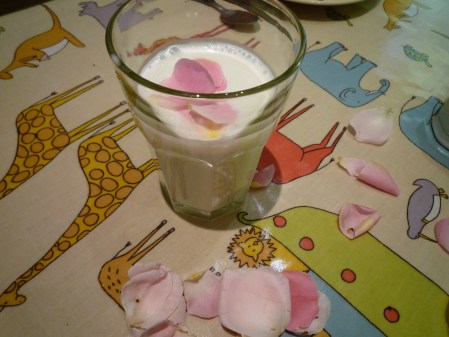
Based on what I’ve read elsewhere, red rice porridge, minus the pork, is clearly a Bhutanese staple. As Bhutan is a mountainous country, the main concern of the indigenous population seems to be the consumption of sufficient calories to survive in a cold climate. One way to achieve this is to add copious quantities of butter and cheese to pretty much every dish. Thus tea is drunk with salted butter rather than milk and rice porridge is enriched with both butter and cheese.
After an extended debate with the dozy local depot of courier firm DHL, I was thrilled to take delivery of a single precious pack of authentic red rice imported from Bhutan via a circuitous trade route involving a Californian wholefoods supplier:

Once I’d got hold of the rice, making the porridge was a straightforward, if lengthy affair. I give the recipe I used below.

I decided that an egg crepe sounded rather like an international omelette so that didn’t make the breakfast cut. Hogay and ezay are both in the salsa/relish/salad category and are pepped up with copious quantities of chilli, the favourite condiment of Bhutan. I tossed a coin and decided to make an ezay to accompany the porridge:

What did it taste like? Well, a bit like risotto with a dollop of cheesy salsa on top, a weird Italian/Mexican/Asian fusion.
Would I eat it again? Realistically, probably not as, let’s face it, it would be hard to improve on well made risotto milanese, and if I wanted salsa I’d rather roll it up in a burrito.
Recipe for Bhutanese red rice porridge
Adapted from a recipe I found on Mark T’s life in Bhutan blog. Here is the link and thank you to Mark for making the recipe available – it works! http://eyeamempty.blogspot.com/2010/01/doing-porridge-for-dad.html
Serves 4
250g Bhutanese red rice (having tried the Bhutanese rice I think Camargue red rice which is more readily available here in the UK would be just fine here)
Enough water to cover the rice by about 5 cm
3 tablespoons butter
200g block of feta cheese, roughly crumbled
a pinch of chilli powder, or more, to taste
1 1 inch piece of peeled fresh ginger root, grated (best achieved with a Microplane type grater)
Salt and pepper
In Bhutan, a pressure cooker would be used to boil the rice until soft (5 whistles!) – essential at high altitudes. I brought the rice to the boil then covered and simmered for 25 minutes until the rice was cooked.
Take the lid off and check for consistency. Add more water if needed, continuing to cook with the lid off, stirring frequently. My porridge took about 45 minutes from start to finish, so another 20 minutes after the rice had softened.
When the rice has cooked down to a thick porridge like consistency, add the butter, cheese, and seasoning ingredients. Stir, taste, check seasonings, then serve accompanied by ezay (see next recipe).
Recipe for ezay – Bhutanese salsa
Serves 4-6 as an accompaniment
My own version of this dish after reading several recipes. I’ve substantially reduced the chilli to take account of our low western chilli heat threshold and have substituted cherry tomatoes for the hard to obtain Himalayan tree tomatilloes and feta for yak’s milk cheese.
Ingredients
Small bunch of coriander, washed, dried and coarsely chopped
6 spring onions, cleaned and coarsely chopped
2 red chilli peppers, medium heat, halved, deseeded and finely sliced
about 10 cherry tomatoes
juice of a lime
salt and freshly ground black pepper (or toasted and ground szechuan pepper if you can get hold of it)
100g feta cheese, crumbled
Combine all the ingredients except the feta in a bowl. Stir to mix and set aside in the fridge for half an hour to let the flavours combine. Sprinkle over the crumbled feta cheese when you’re ready to serve.
Recipe for rosewater lassi
Again, my own recipe after experimenting a little with proportions. I think you need a liquidiser with a chunky motor rather than a food processor to cope with crushing the ice and getting a good froth on the lassi.
Serves 4
Ingredients
1 450g tub thick plain wholemilk yoghurt (I used a “Greek style” variety which worked well – a true Greek yoghurt might have been too thick here)
1 teaspoon pure rosewater (from Asian shops or larger supermarkets)
4 tbsp icing sugar
1 generous cup of ice cubes (approx same volume as the yoghurt pot)
approx 200 ml cold water
a few fragrant rose petals to garnish
Put all the ingredients except the rose petals into the goblet of your scrupulously clean liquidiser and, with a firm hand over the lid in case the ice cubes are a bit rough, whizz for about 20 seconds or until the ice cubes are broken down and the mixture is frothy. Taste and add a little more sugar or rosewater if you like, whizz again, then pour into tall chilled glasses. Scatter over the rose petals and serve.
Feta with everything: more food from Greece
October 4, 2011 § Leave a comment
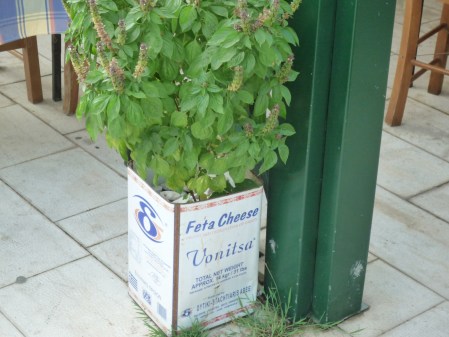
Two more Greek classics today, inspired by our recent trip to Paleros on the Ionian coast.
This was the route of our daily stroll from our hotel into Paleros town:

On the way we’d often encounter this herd of itinerant sheep. Even if you couldn’t see them, you could often hear at dawn and dusk the evocative clink-clank of their bells echoing round the surrounding mountains:

Sheep and goats seem to graze on every patch of scrub in this part of Greece. It’s ewes’ milk and occasionally goats’ milk which is used to make the crumbly, salty pure white feta cheese which appears on every Greek menu whether in a simple Greek salad or as a filling for pies and pastries.
Every taverna seems to have its own take on what a Greek salad should look like. Here’s the rather magnificent volcano-like version on offer at the Paleros Yacht Club:

But the Greek salad I like to make is based on a recipe given by Aussie chef Bill Granger in “Bill’s Food” one of his many simply written and gorgeously photographed cookery books.

You can it eat this salad on its own for lunch with a wedge of crusty bread, or serve it as an accompaniment to a simple main course. I like it with moussaka, a recipe for which will follow in new post very soon.

The salad works best if you use a tomato with a a bit of flavour – a named vine-ripened variety perhaps(or of course home-grown if you can), a tasty cucumber and authentic feta cheese, olives and extra virgin olive oil all from Greece. Just think, you’ll be giving the Greek economy a much-needed boost too!
If like me, you struggle with the harsh flavour of raw onions, then follow my tip for soaking the onion in cold water before squeezing out and chopping and adding to the salad.
Feta isn’t just for salads though- it appears in all manner of savoury stuffed pastries, like these little homemade fried cheese pies sprinked with sesame seeds and served drizzled with honey as an appetiser at Paleros’ New Mill Tavern:

And Paleros’ little bakery turns out a mean spanakopita – Greece’s famous spinach and cheese pie sold by the slice. Perfect for a beach picnic whilst touring the nearby islands of Skorpios and Meganissi:
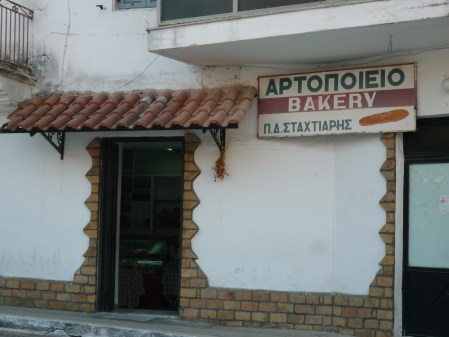
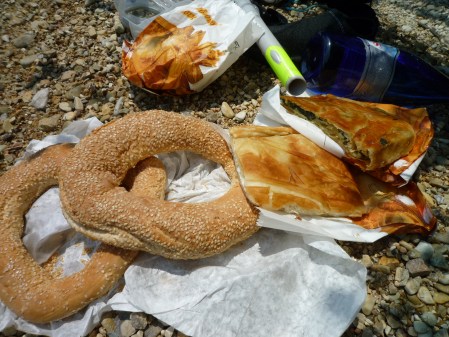
I’ve found a classic spanakopita recipe in my new favourite cookery book George Moudiotis’ “Traditional Greek Cooking” which I give below. Now all I have to do is take a bite, close my eyes and imagine I’m back by the Mediterranean…

Recipe for Greek salad
Adapted from Bill Granger’s “Bill’s Food”. Serves 6
Ingredients
12 cherry tomatoes, halved or 4 medium tomatoes cut into chunks
1 cucumber, peeled and cut into thickish slices (you can half peel the cucumber to give a decorative striped effect if you prefer
a green pepper, halved, deseeded and cut into strips
1/2 red onion
2 tablespoons extra virgin olive oil (I like the Gaea brand from Crete)
1 teaspoon Cretan balsamic vinegar or ordinary red wine vinegar
16 black olives, stoned, preferably Kalamata
1 tablespoon fresh mint leaves, left whole
3 tablespoons fresh flat-leaved parsley leaves, left whole
sea salt and freshly ground black pepper
200g piece of feta cheese
Began by preparing the red onion. Slice it thinly and throw the slices into a bowl of cold water. After half an hour, remove the onions from the water and squeeze them with your clean bare hands trying to squeeze out as much onion juice as possible. Finely chop the resulting squeezed out onion slices. This treatment should render the raw onion mild and palatable and won’t give anyone eating the salad nasty onion breath.
Put the prepared tomatoes, cucumber, green pepper and onion into a mixing bowl and mix with the olive oil. Set aside for 10 minutes to allow the flavours to meld. When you’re ready to serve, add the vinegar, olives, mint, parsley and seasoning to the bowl. Mix well and transfer to an attractive serving bowl. Scatter over the roughly crumbled feta cheese and serve.
Recipe for Spanakopita – Spinach and cheese pie
Adpted from George Moudiotis’ “Traditional Greek Cooking”
Serves 6-8
Ingredients
900g spinach, washed, stems removed, roughly chopped
1 small bunch of spring onions, trimmed and chopped
150 ml olive oil
225g feta cheese, crumbled
4 eggs, lightly beaten
3 tablespoons chopped fresh dill or flatleaf parsley
Salt and freshly ground black pepper
250g filo pastry, about 12 sheets
pinch of grated nutmeg
Preheat the oven to 180 degrees C.
In a large frying pan,sauté the spring onions in 3 tablespoons of the olive oil until soft but not brown. Set aside in a large mixing bowl. Add the spinach to the pan and, without adding extra oil or water, cook over a medium heat for about 3 minutes until wilted. Tip into a colander and squeeze out all the moisture then add the spinach to the onions. Mix in the cheese, eggs, herbs and seasonings (bear in mind that the cheese is already salty so be careful not to overseason) and mix everything together well.
Brush a rectangular metal baking tray 4cm deep with oil and lay a sheet of filo in it. Brush the pastry with oil. Repeat until you have used half the filo sheets. Spread the filling over the pastry then cover with the rest of the filo, brushing each layer with oil as you go.
Using a very sharp knife or baker’s scalpel, score the top sheets into diamonds to allow steam to escape during baking. Trim the edges and fold them over the top to seal brushing with extra oil to make them stick.
Sprinkle the top with a little water to stop the pastry from curling and bake the pie in the oven for about 45 minutes or until crisp and golden brown. Serve warm or cold.
Greek food for an Indian summer
September 29, 2011 § Leave a comment
I’ve always been a bit lukewarm about Greek food – until recently my memories were of greasy moussaka washed down with cheap retsina sampled on an Interrail trip to Athens back in the 1980s. I followed this up with lurid pink taramasalata and overcooked lamb in the Oasis Kebab house catering principally for Cambridge’s student population.
After a week on the Ionian coast of Greece this summer, I’ve changed my mind. There’s nothing glitzy or overtly spectacular about the little seaside town of Paleros, but very soon, enjoying breakfast or a drink on the terrace looking out onto the rugged hills of the island of Lefkas becomes a daily pleasure:

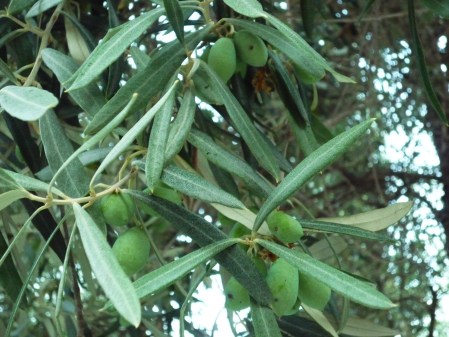
And it’s rather delightful to see olives this way rather than in a bulk white plastic container on a deli counter:
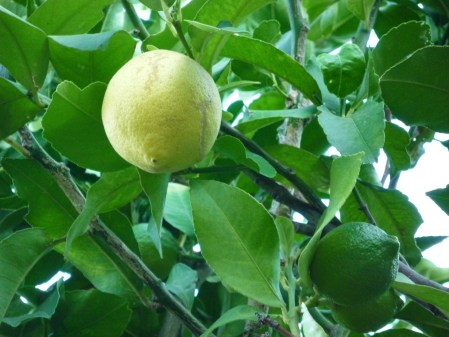
While my thoughts are still on the cocktail hour, here are lemons growing on the tree just moments before they’re sliced into your gin and tonic:
There seems to be an inviting-looking taverna terrace on every street corner like this one belonging to the New Mill Tavern in Paleros:

A glance at the guestbook shows you that the New Mill is no run-of-the-mill (sorry!) taverna. Hugh Fearnley-Whittingstall, Rick Stein and Delia Smith have all eaten here enthusiastically and and here’s what a certain Gordon Ramsay had to say:
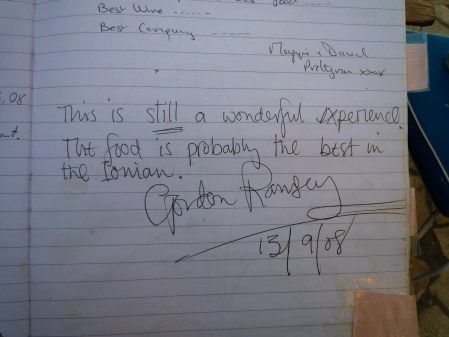
And after a memorable evening meal there, I’d have to concur.
It isn’t the usual restaurant experience as there’s no menu, no prices on display (though don’t worry, the final bill won’t be unreasonable), no chef, no professional kitchen at all in fact. Proprietor Cathy who is both head chef and runs front-of-house (though it does seem a little disrespectful to refer to this august Greek matriarch in such familiar terms) welcomes you with chilled Greek rosé and a selection of dips.

Clockwise from the right we have a beetroot dip, a garlicky skordalia made with mashed potato, the classic tzatziki, and finally a soft mild cheese dip.

Cathy’s daughter charmingly suggests that you don’t overdo it on the dips and bread and, boy, is she right as the courses keep on coming! The dips were followed by the lightest grated courgette tart flavoured with a touch of cinnamon; next deeply savoury prawns baked with wine and garlic. Two more classic Greek dishes came next, an exemplary moussaka and a stifado. Groaning, we found room for the lightest baklava and a thimbleful of Greek coffee before the moonlight stroll back to our hotel.
Cathy cooks everything herself right there in her own home kitchen with just a little help from her extended family. She prepares what’s fresh and in season that day, no choice, no fads or foibles and in my opinion you can’t fail to enjoy whatever she serves up.
The food really was wonderful and definitely my kind of cooking – simple, fresh, carefully seasoned – beating any overworked restaurant dish hands down. I couldn’t wait to recreate some of Cathy’s food back home and although I didn’t find the right opportunity to ask for any of her recipes that evening, I’ve recently bought the excellent “Traditional Greek Cooking’ by George Moudiotis and have been trying out a few dishes back home.
So far, I’ve found his instructions clear and simple to follow and the end results very successful with an authentic Greek flavour. Here are my versions of tzatziki and skordalia, perfect for eating outdoors to accompany barbecued meat, fish or vegetables during out last few days of precious Indian summer…


Recipe for Tzatziki
Adapted from a recipe in George Moudiotis’ “Traditional Greek Cooking”.
Serves 8 as part of a mezze selection. The inclusion of dill gives the dish authenticity but you can use mint if you prefer.
Ingredients
1 large cucumber
1 clove of garlic, crushed
3 tablespoons extra virgin olive oil
1/2 tablespoon white wine vinegar
2 tablespoons of chopped fresh dill or mint
salt and freshly ground black pepper
500g tub of full fat Greek yoghurt – I like Total, imported from Greece
Extra chopped herbs, a drizzle of olive oil and a few shiny black Kalamata olives to garnish
Peel the cucumber, cut it in half lengthways and scoop out the seeds with a teaspoon. Cut the cucumber into small dice (3-4mm) and place them in a sieve. Leave them to drain over a small bowl for 30 minutes.
Mix the drained cucumber with the garlic, oil, vinegar, chopped dill or mint and salt and pepper. Mix in the tub of Greek yoghurt, cover and chill in the fridge for an hour or so to allow the flavours to meld.
Spoon into a serving dish, drizzle with olive oil and sprinkle with extra chopped herbs and scatter over the olives.
Recipe for Skordalia
Adapted from a recipe in George Moudiotis’ “Traditional Greek Cooking”. This is the Greek island variant which adds mashed potatoes to the basic bread, garlic and oil mixture.
Makes 1/2 pint so serves 8 as part of a meze selection, or add a little stock and use as a thick sauce to accompany grilled fish, meat or vegetables.
Ingredients
3 cloves of garlic
2 tablespoons white wine vinegar for soaking the garlic
a further tablespoon white wine vinegar
Salt and freshly ground white pepper
3 thickish slices day-old white bread, crusts removed
3 medium waxy potatoes, boiled in their skins and left to cool then peeled and put through a food mill or potato ricer
Soak the peeled garlic cloves in the wine vinegar overnight. Reserve the wine vinegar for another salad dressing or discard. Roughl crush the garlic with the salt in a pestle and mortar then tip the crushed garlic into the bowl of a food processor.
Soak the bread in water briefly, then squeeze dry with your hands and add to the processor bowl. Pulse quickly to mix then add the vinegar, salt and pepper and a little of the olive oil. Pulse again. Add the mashed potato and a little more olive oil. Pulse again. Continue adding the olive oil little by little, pulsing as you go, until it is all incorporated. Be careful not to overblend otherwise the texture of the Skordalia will be too sticky and gloopy.
Taste and adjust seasoning adding more salt, pepper, vinegar and oil as required.
Breakfast from Benin
September 26, 2011 § 1 Comment
The latest in our Breakfasts of the World Project series.
This post could more properly be titled “Petit dejeuner Béninois” as this relatively small West African country is a former French colony. Its national tagline is not the highminded Liberté, Egalité and Fraternité of the mother country but the rather more down-to-earth “Fraternité, Justice, Travail”. Perhaps this is a nod to the country’s history of slavery as the former Kingdom of Dahomey used to be known as the Slave Coast from the king’s unedifying habit of selling his war captives into slavery.
Benin lies adjacent to its larger and better known neighbour Nigeria and most of its population lives close to the coast on the Gulf of Benin. Within this coastal strip lies the country’s capital, Porto Novo and its largest city, Cotonou.
Perhaps because of its ability to trade from coastal ports, and perhaps because of the historical importance of the former Kingdom of Dahomey, or maybe it’s the French legacy, the country’s cuisine is known for its exotic ingredients and well-flavoured dishes.
I began with a little research and found Kathy Curnow’s 5 page summary of the food of Benin succinctly useful http://www.conceptvessel.net/iyare/downloads/Iyare_Food_and_Cooking_in_Benin.pdf
along with an authentic and comprehensive recipe for the classic West African dish akara (black-eyed bean fritters) from http://www.congocookbook.com/snack_recipes/akara.html
I decided that akara would be the star of our breakfast show but also included baked yams as I felt something plain and starchy was required which could be smothered with the tomato and peanut sauces I planned to make. Another breakfast speciality was to be an omelette stuffed with plantain, and finally, sliced tropical fruit (mango and papaya) enlivened with a squeeze of lime.
Here’s how it all looked:

The akara were crisply moreish but took an absolute age to prepare. You need to get going 48 hours before you plan to eat them. After soaking the beans overnight in cold water, the next labour-intensive step is to rub-off the skins from the beans with your bare hands.
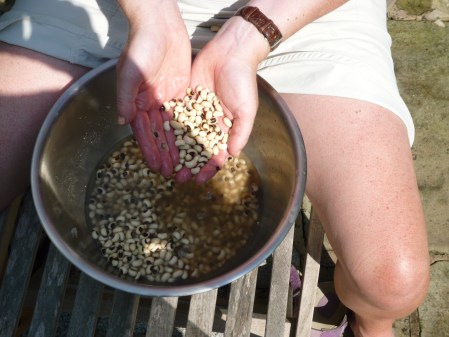
I sat outside in the sunshine to do this trying to get into the West African mood. This is one of those slow, gentle chores which might be soothing or even fun if there were a whole bunch of you rubbing away at your beans but as I was toute seule it soon became rather tedious.
The next step was to pulverise the soaked raw beans and combine them with flavouring ingredients. I’m sure that traditionally this would be done in a pestle and mortar but in my case this was a job for my trusty Magimix. I soon had the beans pulverised into submission.

The bean paste rests overnight to develop the flavour fully before frying off for breakfast the following morning.
I love this intense description of frying akara from Nigerian author Wolé Soyinka’s memoir “Aké: the years of childhood”
“In the market we stood and gazed on the deftly cupped fingers of the old women and their trainee wards scooping out the white bean-paste from a mortar in carefully gauged quantities, into the wide-rimmed, shallow pots of frying oil. The lump sank immediately in the oil but no deeper than an inch or two, bobbed instantly to the surface and turned pinkish in the oil. It spurted fat globules upwards and sometimes beyond the rim of the pot if the mix had too much water. Then, slowly forming, the outer crust of crisp, gritty light brownness which masked the inner core of baked bean paste, filled with green and red peppers, ground crayfish or chopped.”
Pretty accurate I would say though I used my thermostat controlled deep-fat fryer which made the process a doddle. I kept the fat temperature at a medium heat – 150 degrees C which meant that the akara were ready in about 8 to 10 minutes and were thoroughly cooked in the middle. The resulting crispy fritter was similar to falafel and was just perfect smothered with sauce – my preference was for the densely calorific peanut sauce though the fresh tomato sauce was pretty good too.

The other dishes (baked yam, plantain omelette and sliced tropical fruit) were straightforward in terms of preparation. The only potential difficulty was in sourcing the raw ingredients. My regular supplier for tropical fruit and veg is the Strawberry Garden stall, a little gem in Manchester’s claustrophobic and unappealing indoor Arndale market. Here are my prized purchases ready to be prepped:
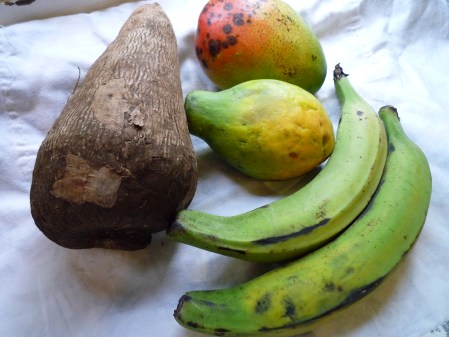
All in all, a cheerful-looking and flavoursome breakfast on the strength of which I’d definitely put Benin on any West African trip itinerary.
Recipe for akara – black-eyed bean fritters
Adapted from a recipe on the http://www.congocookbook.com site.
Ingredients
250g dried black-eyed beans
one small onion, finely chopped
pinch of salt
one finely chopped deseeded fresh chilli pepper
1/2 teaspoon freshly grated peeled ginger root
vegetable oil for deep frying (ideally peanut oil)
Soak the black eyed beans in cold water in the fridge overnight. The next day, rub them together between your hands to remove the skins. This is a time consuming process and you will need to rinse the beans frequently to wash away the skins.
Drain the water off the beans then whizz them in a food processor to form a thick, coarse paste. Add the onion, ginger and salt and sufficient water to form a thick paste of a batter that will drop stiffly from a spoon.
Allow the batter to stand for a few hours or even overnight in the fridge. When you’re ready to cook, heat the oil in your pan or deep fat fryer. While the oil is heating, beat the batter with a wire whisk or wooden spoon for a few minutes.
Drop big spoonfuls of batter formed into a rough quenelle shape into the hot oil and deep fry the until they are golden brown. Turn them frequently while frying.
Mine took 10-12 minutes at 160-170 degrees C to cook.
Serve with a sauce (such as spicy tomato or peanut) or simply sprinkled with salt, as a snack, starter or accompaniment.
Blackberrying
August 14, 2011 § 2 Comments
Nothing to do with electronic devices but the easiest and most rewarding of wild foods for the first-time forager.
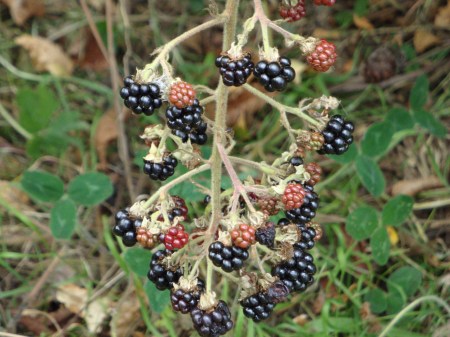
These beauties came from the grounds of the house on the North Wales coast where we holidayed last week. For us Mancunians, it’s like Cornwall but without the long car journey. Breathtaking mountain backdrops, glorious sandy beaches, quaint stone cottages – all it lacks is reliable sunshine.
The brambles love it there and there is excellent blackberrying to be had at this time of year if you can find a sunny spot against a dry stone wall where the fruit has had chance to ripen. The best blackberries are always just out of reach – but maybe the scratches and attendant cunning required to hook down the high branches are all part of the appeal, the annual repetition of childhood ritual.
What to do with your precious hard-won haul? If you’ve exhausted the repertoire of pies, crumbles and jellies, here’s an idea for an easy-to-make pudding that lets the flavour of the blackberries shine through. It’s a blackberry clafoutis, the simple French baked pudding from the Limousin region usually made with cherries. This version, which I’ve adapted from Julia Child’s “Mastering the Art of French Cooking” replaces cherries with blackberries.
The house where we stay when we come to this part of Wales is a rambling manor house remodelled in the last century by Clough Williams-Ellis, architect of nearby Portmeirion. Cooking here is a pleasure as the house is blessed with a cool slate shelved pantry and well-equipped kitchen with cupboards packed with Portmeirion pottery. But you don’t need a well-equipped kitchen to make this pudding -it’s quick and easy and the proportions are forgiving so it’s perfect to make when your’re staying in a holiday house or cottage.
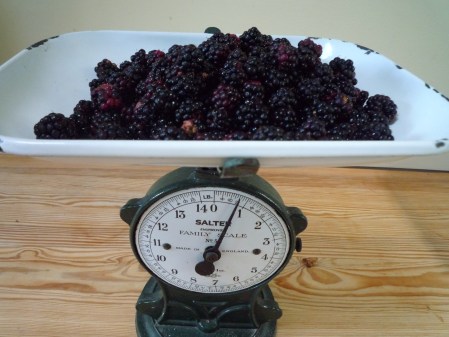
The berries are macerated in delicious Crème de Mûre, French blackberry liqueur, and the resulting juices are added to the batter mixture along with some blanched almonds which enrich the pudding and the subtle almond flavour works well with the blackberries.
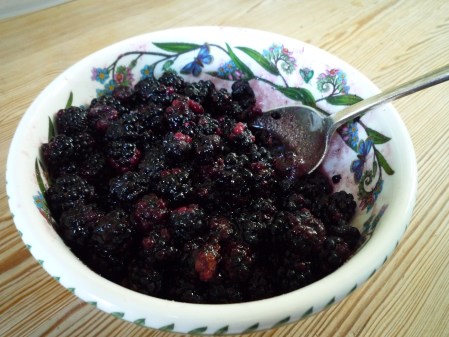
The tip in the recipe for pouring a layer of batter into the baking dish and gently letting this cook to provide a base so that the fruit can’t all sink to the bottom really does work:

Adding the macerated blackberry juices to the mixture turns the batter an appealing but shade of pink:

But don’t worry, despite starting off as pink, the baked clafoutis will puff up and become crusty and golden brown just as the recipe promises.

Dust with icing sugar or sprinkle with caster sugar and serve with chilled pouring cream. Dig in and enjoy your the fruits of your blackberrying.
Recipe for clafoutis
Adapted from Julia Child’s “Mastering the Art of French Cooking”. I give first of all the basic recipe with cherries, then variants with liqueur, almonds and blackberries. The version I cooked last week combined all 3 ie I substituted blackberries for cherries, macerated the blackberries in liqueur and added almonds to the batter as well.
Serves 6 to 8
Ingredients
For the batter
½ pint milk
2oz granulated sugar
3 eggs
1 tbsp vanilla extract
1/8 tsp salt
2 and ½ oz sifted flour
For the fruit
¾ lb stoned black cherries
2 oz granulated sugar
Place the ingredients for the batter in the jar of a liquidiser or food processor in the order listed. Cover and blend at top speed for 1 minute. If you don’t have a liquidiser, break the eggs into a well in the flour and sugar and gradually incorporate them into the batter with a whisk, adding milk as you go.
Pour a ¼ inch layer of batter into a 3 to 4 pint capacity shallow ovenproof baking dish. Place over a moderate heat or hot oven until the batter has set. Remove from the heat. Spread the cherries over the batter and sprinkle on the sugar.
Pour over the rest of the batter and smooth the surface with the back of a spoon.
Place in the middle of an oven preheated to 160 degrees C fan; 350 degrees F and bake for about an hour. The clafoutis is ready when it is puffed and brown and when a knife plunged into the centre comes out clean.
Sprinkle with icing sugar and serve hot or warm.
Variant 1 – cherries marinated in kirsch
Additional ingredients
1/8 pint kirsch
2 oz granulated sugar
Let the cherries stand in the kirsch and sugar for one hour. Substitute the liquid that results for some of the milk and all of the sugar in the master recipe.
Variant 2 – with almonds – “À la Bourdaloue”
Additional ingredients
3 oz blanched almonds
Add the almonds to the liquidizer and puree along with the other ingredients. If you don’t have access to a liquidiser, add ground almonds to the flour instead and proceed with the well mixing method as described in the master recipe above.
Variant 3 – Blackberry
Substitute 12oz stemmed and washed blackberries for the cherries.
Increase the flour from 2 and 1/2 oz to 3 and 1/2 oz as the berries are juicier than the cherries.
Just as a footnote, if you fancy having a go at the classic Limousin version of clafoutis with cherries then I can recommend the Oxo Good Grips cherry-stoning device which I picked up on Amazon.co.uk for £7.99. This gadget really is the business and the boys couldn’t get there hands on it once they realised they could fire cherry stones at one another…

Belizean breakfast
July 25, 2011 § Leave a comment
The latest in our Breakfasts of the World Project series.
Belize is a tiny little country just 180 miles long situated in Central America. Mexico lies to the North, Guatemala to the South and West and the Caribbean Sea to the East. The colony formerly known as British Honduras is now a hot tourist destination and a must-see place on the gap-year ecotourism trail according to my niece Lucy. It does sound rather idyllic – coral atolls, Mayan ruins, tropical rain forest… Maybe it’s not just for the low tax régime that Belize’s most famous resident Michael Ashcroft chooses to make his home here.
Because of the thriving tourism industry, descriptions of Belizean hospitality and specifically its breakfasts are not hard to come by on the web. I found this entry http://www.travellious.com/breakfast_in_belize pretty helpful in setting out what constitutes breakfast in Belize: refried beans, scrambled eggs, salsa, fry-jacks, and above all Marie Sharp’s hot sauce.
Here’s my version cooked up at home last Sunday morning. There’s one further addition to the Travellious list which is some greens quickly stir-fried with garlic. They’d use amaranth greens in Belize, sometimes referred to as callaloo, but I had to be content with some less exotic baby spinach:

The Marie Sharp’s hot sauce was impressively easy to obtain – a couple of mouse clicks and it arrived by post the next day. It’s a fiery red Tabasco type sauce but made authentically in Belize, and yes there really is a person called Marie Sharp who runs the company, it’s not just a marketing man’s fantasy à la Betty Crocker.

OK so menu and sauce sorted, this breakfast was beginning to take shape. Scrambled eggs, stir-fried greens and fresh salsa would be easy enough to whip-up, but what about the refried beans and those intriguingly named fry jacks?
My starting point for authentic refried beans was a recipe from the website of the rather lovely looking Chaa Creek ecolodge. Their recipe was a little sketchy so I’ve added my own tips for preparing refried beans. Despite the name, the beans are fried just once. I think I read somewhere that it’s more mellifluous in Spanish to refer to frijoles refritos rather than the uncomfortably alliterative frijoles fritos.
The soaked black beans look a dramatic inky deep purple colour as they go into the pot with the flavouring ingredients:

This softens when you come to fry and mash the beans to more of a sludgy grey. They may not look that pretty, but they do taste good:

Now for the fryjacks. I found an authentic recipe from fascinating blog Rice and Beans A Belizean in the USA which I’ve adapted and given below. My fry jacks tasted good – a bit like a savoury doughnut but didn’t puff up quite as much as expected.
First step was to make the dough and divide it into little balls:

Next, the dough balls are flattened and cut into quarters:

Finally, when you’re ready to eat, the quarters are dropped into hot deep fat to fry:
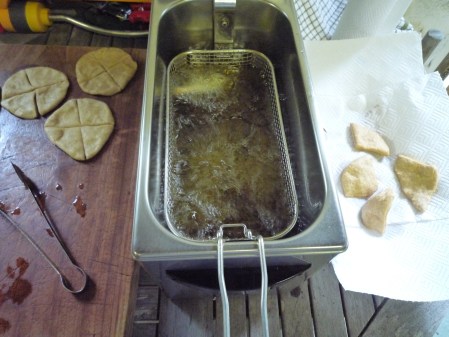
In keeping with the tropical vibe, I set up the deep fat fryer in the garage with the intention of eating our breakfast on the terrace outside. Great for containing cooking smells and conjuring up the beach shack atmosphere but unfortunately a Mancunian tropical downpour sent us scurrying back inside to eat.
Recipe for refried beans
Adapted from a recipe on the award winning Belizean eco-lodge Chaa Creek’s website.
Serves 6.
Ingredients
To cook the beans
1 lb dried black or red beans
1 small onion, peeled and quartered
2 cloves garlic, unpeeled but lightly crushed
2 bayleaves
1 sprig thyme
salt to taste
To fry the beans
3 tablespoons vegetable oil
1 small onion, finely chopped
2 cloves garlic, peeled and chopped
salt and freshly ground black pepper to taste
a little powdered cumin (optional)
handful chopped coriander (optional)
Soak the beans overnight in cold water. Next morning, drain the beans in a colander, rinse them and tip them into a deep lidded pot. Add enough fresh cold water to cover the beans adding an additional 1cm of water on top.
Add the flavouring ingredients except the salt and bring the beans to the boil leaving the lid off the pan as otherwise it will boil over. Skim off the scum, turn down to a very gentle simmer and cover the pan. Check the beans after 30 minutes – add salt as soon as the beans are nearly cooked through. Simmer until the beans are nice and soft but not too mushy. This might take anywhere between 30 minutes and an hour or longer depending on your batch of beans and how long they’ve soaked for. Don’t taste the beans until they gave boiled for at least 20 minutes as they are mildly toxic until cooked through. Remove the flavouring ingredients using a slotted spoon and leave the beans in their cooking liquid until you’re ready to fry. You can fry the beans straightaway or, once cooled, store them covered in their liquid in the fridge for a couple of days.
When you’re ready to fry, choose a heavy based deep wide sauté or frying pan and heat the vegetable oil until medium hot. Add the chopped onions and cook until soft and just turning golden. Throw in the garlic and cook for a minute or so more until just beginning to brown but not burn. Add a couple of ladlefuls of beans and their cooking liquid to the frying pan, turn down the heat to low and cook the beans and associated liquid mashing them into the base of a pan with your wooden spoon or a potato masher. Once each ladleful of beans is mashed and heated, add the next. Add more bean cooking liquid as required to form a thick paste. It won’t look too pretty – a thick, grey sludgy paste, but it will taste good. Taste and season with salt and pepper and, if using, ground cumin. Scatter over the optional chopped coriander and serve.
Recipe for Belizean fry jacks
Adapted from an authentic fry jacks recipe from the blog “Rice and Beans A Belizean in the USA”
Ingredients
1/2 cup wholewheat flour
1 and 1/2 cups white flour
1 and 1/2 tsp baking powder
1/2 tsp salt
1/4 cup vegetable oil
about 3/4 cup of water
Mix together the flour, salt and baking powder in a large mixing bowl. Add the vegetable oil and, using your hands, work the oil into the flour until you have little pebbles of oil saturated dough evenly distributed throughout the flour.
Make a well in the mixture and pour in the water a little at a time, using your other hand to stir the flour into the water in the centre of your pile. Keep adding the water and mixing it in a little at a time until you have formed the entire pile of flour into a rough ball of slightly sticky dough. You may need a little less water than specified in the list of ingredients.
Turn the dough out onto a floured work surface and knead for about 5 minutes until it is smooth and stretchy. Then roll it out into a snake shape and cut it into 8 equal sized pieces. Take each piece and roll it into a ball. Cover and leave the balls to rest on a lightly floured surface for at least 30 minutes.
Next, prepare to deep fry the fry jacks. I used an electric deep fat fryer and my chosen cooking oil was rapeseed (canola). Heat the oil until really hot. To test if the oil is hot enough, drop in a small scrap of dough. If it sizzles but doesn’t smoke, the oil is the right temperature.
Take one of the dough balls and roll or pat it out into a circle, about 6 inches across. Take a knife or pizza cutter and cut the circle into four pieces. Once your oil is hot, drop several fry jacks into the pan. I managed to cook four at once without overcrowding. The fry jacks first sink then quickly rise to the surface of the oil. After 20-30 seconds, check to see if the sides in the oil have browned. If so, flip the fry jacks over with a pair of tongs fork and let the other side cook. Lift out with a slotted spoon and drain on a plate lined with paper towels. Eat immediately.
Bring and share – two salads for summer
July 17, 2011 § Leave a comment
Help! Three words that bring on a panic attack. You know the kind of thing I mean – a communal summer event, maybe a club or choir social evening, a music teacher’s summer pupils’ concert, perhaps even a street party. Some people you’ll know well, others less so, and everyone is asked to bring a dish to create an inpromptu meal.
What to bring? It’s got to be transportable; capable of sitting around on a warm buffet table without melting/disintegrating/giving everyone food poisoning; taste good; look a teeny bit impressive but not as if you’v tried too hard, and finally not something that’s going to take all day to prepare.
My suggestion is to avoid little canapé nibble type things at all costs as these take forever to put together and to go for a generous bowl of colourful salad instead. I have two reliable standby recipes, the first an old favourite and the second a recent discovery.
My first recipe is for tabbouleh, the much-loved middle-Eastern parsley and mint salad mixed with chewy grains of burghul.

I learned how to make this from one of my all time favourite cookery books, Claudia Roden’s “A New Book of Middle Eastern Food”. My cookery book collection has grown over the years and has had to have a whole bookcase of its own set aside for it in our study. Neverthless, a selection of just ten books has crept back downstairs into the kitchen because I refer to them so often. ” A New Book of Middle Eastern Food” is one of those ten. It’s a book with no glossy photos (aside from the weird close-up of spring onions and vine leaves on the cover) yet manages to conjure up all sorts of evocative images of the Middle East in its imaginative and well-informed writing. A sort of Arabian Nights of the kitchen. And this small battered paperback is full of meticulously researched, concisely written recipes that actually work.
Tabbouleh, as Ms Roden explains, is essentially a herb salad, a mass of dense green freshness speckled with the pale grains of burghul. Quite often you’ll see something described as tabbouleh which is this idea reversed – lots of pale grains flecked with specks of grain. Salads like this may be good, but to me now they’re just not tabbouleh.
I grew up reading 1970s recipe books where herbs were mostly dried and strictly rationed – a teaspoon of chopped parsley in a white sauce to accompany boiled ham perhaps. I think that’s why I love the hugely generous quantities of fresh herbs you need for this recipe – think handfuls rather than teaspoons. Even with 2 big bunches of parsley, you need still more…

All the salad ingredients can be prepped beforehand which makes it very convenient to put together for a party. I’ve included some walnuts in this version:

You can very the garnishes according to your mood, what you have in the cupboard or fridge and what’s in season. I decorated this version with a few snipped chives and tasty chive flowers from the garden:

Is there any downside to this salad? Well, being honest, it will almost certainly leave green herby flecks on you and your guests’ teeth.
If having to check yourself in the mirror doesn’t appeal, then my second suggestion is a salad of blanched mangetout and French beans livened up with orange zest, toasted hazelnuts and freshly snipped chives. It comes from “Ottolenghi – The Cookbook”, one of those books where I turn the pages and want to eat everything in there.

This isn’t a salad you can throw together in a couple of minutes – each element has to be prepared quite carefully, be it the accurate and separate blanching and refreshing of the vegetables;

the roasting of the hazelnuts to just the right degree of toastiness without burning them;

or the careful preparation of the orange zest to give visually appealing long, thin strips without any pith.
Your efforts spent on preparation will be rewarded in a crunchy salad with a harmonious mix of intriguing flavours – the orange, hazelnut and mild onion flavour of the chives work really well together without overpowering the beans and sugar snaps.
Recipe for tabbouleh
Adapted from Claudia Roden’s “A New Book of Middle Eastern Food”. Serves 10 or more as part of a selection of dishes.
Ingredients
250g bunched flat leaf parsley – approx. 3 supermarket LARGE bunches
100g bunched mint
100g burghul
sea salt and freshly ground black pepper
Juice of 2 lemons
80 ml extra virgin olive oil
200g spring onions
Garnish – standard
2 little gem letttuces
3 medium tomatoes or 8 cherry tomatoes
2 inches cucumber
Garnish – optional additions
Handful of roughly chopped walnuts
Chive flowers, wild garlic flowers
Handful of pomegranate seeds
Wash the mint and parsley and dry carefully using a salad spinner. Pull out the thickest of the parsley stems and any discoloured leaves. The thinner parsley stalks can stay in as they are fine to eat once chopped. Remove the mint leaves from their coarse stems as these are generally too fibrous to make pleasant eating.
Chop the herbs either in a food processor or by hand as you prefer. I tend to use a food processor, pulsing carefully to chop the herbs to a medium degree without turning them into too fine a mix or worse of all, a mush. Set the chopped herbs aside in a tightly sealed plastic box and place in the fridge. If you’re preparing this dish ahead of time, the herbs will keep quite well in the fridge for 24 hours, even longer. Given that freshness is the essence of this salad, I don’t like to leave the herbs in the fridge too long though.
Finely slice the spring onions and set these aside in the fridge.
Meanwhile, prepare the burghul. Covering with cold water and leave to soak for half an hour or so. Tip into a sieve and leave to drain for 10 minutes or so, pressing out any excess water. Put in a mixing bowl and add half the lemon juice and olive oil and a little salt and pepper. Let it absorb the dressing for a further 30 minutes or so.
While the burghul is soaking, prepare your chosen garnishes. Carefully remove perfect whole leaves from the little gem lettuces and wash and dry them thoroughly. Dice the tomato and cucumber. If using, roughly chop the walnuts and/or remove seeds from a pomegranate.
Now assemble the salad. It’s best to assemble it no more than 30 minutes before you plan to serve it as otherwise the lemon juice in the dressing begins to blacken the mint leaves. Add the chopped herbs and spring onions to the dressed burghul in the mixing bowl. Add the remaining lemon juice and olive oil and more salt an pepper. Taste and check flavours. You need plenty of lemon juice and salt to make the salad really sing. Once you’re happy with the balance of flavours, line your chosen serving bowl with the prepared lettuce leaves, pile in the tabbouleh and scatter your garnish of tomato and cucumber, plus any optional additions, over the top.
Recipe for French bean and mangetout salad with orange and toasted hazelnuts
Adapted from Yotam Ottolenghi and Sami Tamimi’s “The Ottolenghi Cookbook”. Serves 8 or more as part of a selection of salads and other dishes.
Ingredients
400g French beans (trimmed weight)
400g Mangetout peas (trimmed weight)
60-80g skinned hazelnuts (use the higher quantity if you like hazelnuts)
1 unwaxed orange
1 clove garlic, crushed
5 tablespoons hazelnut oil
sea salt and freshly ground black pepper
10-20g chives, snipped into small pieces with a pair of scissors (plenty of chives perk up the flavour of this salad – use fewer if you prefer)
squeeze of lemon juice
Begin by blanching the vegetables. Bring a large pot of water to a fast rolling boil and add a little salt. Throw in the French beans and, using an accurate timer, cook them for 4 minutes, until just cooked. Using a slotted spoon, remove all the beans and throw them into a big bowl of iced water to refresh. Take the bowl to the sink and allow the cold tap to run over the beans until they are completely cold. Drain in a colander and tackle the mangetout in a similar fashion but the mangetout require just 60 seconds blanching time.
Pat the vegetables dry with kitchen paper and store in a sealed container in the fridge until needed. You can do this up to 24 hours ahead of time.
Scatter the hazelnuts on a shallow baking tray (I use a battered old Swiss roll tin) and bake in an oven preheated to 180 degrees C for 10 minutes until toasted to an even golden brown. Watch the nuts carefully as they bake and check them before 10 minutes is up to make sure they don’t burn. Chop roughly and set aside to cool.
Now prepare the dressing. I use a lidded jam jar to do this. Add to the jar the nut oil, the crushed clove of garlic and the zest of he orange. To prepare the orange zest, you need either to peel off a thin layer of orange skin without any pith using a swivel peeler. Having done this, using a sharp knife, cut the peel into long thin shreds. Much easier is to buy a special little zesting tool which you scrape over the surface of the orange which produces the desirable orange shreds in an instant. Add the juice of just half of the orange to the jar together with salt, pepper and a squeeze of lemon juice to taste. Don’t add the chives at this stage as the fruit juices will make them go soggy and dark coloured.
When you’re ready to serve, tip the beans and peas and snipped chives into a handsome serving dish. Pour over the dressing and toss lightly. Scatter over the toasted hazelnuts and serve.
 The Rhubarb Fool