
Fondue Mongolian style
August 18, 2010 § Leave a comment
The yurt phenomenon shows no sign of going away: they seem to be springing up like a rash all over the place even in Langdale and the Forest of Bowland in my far flung neck of the woods.
We saw a night in a yurt advertised by the Montreux & Vevey tourist office during our recent visit to Switzerland and decided it might be fun to give it a try. We booked from the UK using the train company Goldenpass’s (the rebranding of what was formerly known as the MOB, Montreux Oberland Bernois railway presumably to appeal to English speaking tourists) efficient website.
The yurts are perched on the summit of the Rochers de Naye high above Montreux, and, bar a 5 hour hike, the only way up is on a little rack and pinion railway. We duly boarded our train late on Thursday afternoon and 50 minutes later we were in swirling mist on the summit. So much for the promised spectacular views…

We inspected our allocated yurt no. 3 first outside:

Then in:

There was little team enthusiasm for a short walk so Tim and I explored the vicinity whilst the boys were kept entertained by the little marmot zoo just below the summit.
Dinner was served at 7.00 in the transformed self-service restaurant. We gathered at the varnished pine tables for a prosecco apéritif along with 6 other parties, mainly Swiss family groups celebrating children’s birthdays. There was a simple menu choice between cheese or Mongolian meat fondue. It had to be the Mongolian fondue for us. A bubbling cauldron of evil-looking black liquid was shortly presented, along with a vast plateful of meat – a mixture of chicken breast and, bizarrely, ostrich. This would be a first in two counts, both my first Mongolian meal (though I do have a vague recollection of Mongolian barbecue establishments being the latest thing back in London in the 1980’s) and my first taste of ostrich:
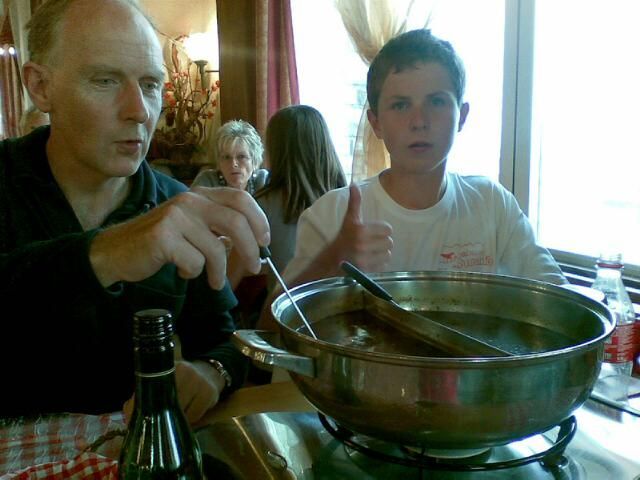
The evil black liquid turned out to be a fiercely salted and spicy broth spiked with pieces of leathery fungus. This was clearly a variant on the more usual Fondue Chinoise. We were spared having to drink the broth afterwards which is what usually happens once all the meat from a Fondue Chinoise has been cooked.
Pudding was a crème caramel served in self-service coffee cups. To complete the meal, I couldn’t resist the offer of some Vieille Prune Action, which turned out to be a surprisingly mellow Swiss plum brandy.

Searching for the perfect Pinte
August 15, 2010 § Leave a comment
No, not another piece enthusing about English beer but a story of trying to find something simple to eat in Vevey, a market town on the shores of Lac Léman (Lake Geneva) in the Swiss canton of Vaud.
During our summer tour of Switzerland I decided it was time to revisit some of my old haunts. Back in the late 80’s and early 90’s, I spent 4 winters in Vevey working in the offices of a certain international food company. There was a whole team of us out there (referred to unimaginatively as the Equipe) and we must have dined at pretty much every half-decent restaurant within a 15 mile radius of the town.
Back then, the gastronomical heights were occupied by the legendary Frédy Girardet in his restaurant in Crissier above Lausanne. Just about everywhere else was readily accessible and welcoming, serving up generous portions of Suisse Romande cuisine. It was here that I first encountered the Swiss custom of the deuxième service: finish one plate of steak, potatoes, vegetables or whatever and it is whisked away and replaced with an identical one! A blessing or a curse, depending on your point of view.
Something has happened in Vevey in the last 25 years. It’s come out in a rash of Michelin stars and Gault Millau points. For example, I remember Brent as a sleepy little village just above Vevey’s brash neighbour Montreux. It’s now home to Le Pont de Brent, celebrity chef Gérard Rabaey’s 3 Michelin star 19 Gault Millau points restaurant.
Vevey itself is home to Switzerland’s answer to Heston Blumenthal, Denis Martin, whose 2 Michelin star 18 Gault Millau point restaurant is in the Rue du Château, close to the swanky lakeside Trois Couronnes hotel.
With 2 boys in tow (one teenage and one nearly so), we weren’t really in the market for a lengthy candlelit molecular gastronomy session. We were looking for something simpler, a pinte Vaudoise in fact.
What’s a pinte Vaudoise I hear you ask. This is what the official website of the Office of Vaudois Wines www.vins-vaudois.com has to say:
“A recommended pinte vaudoise is a public establishment, all or part of which constitutes a welcoming village inn where you can have wine and a meal. Its primary purpose is to feature Vaudois terroirs, food specialties and A.O.C. wines. Their managers pay great attention to welcoming guests and training their staff to be Vaudois terroir experts. Recommended pintes vaudoises are friendly, so that guests feel like coming back and recommending them to friends.”
Talking of local wines and vineyards, even these have moved upmarket with the intricately terraced Lavaux vineyards becoming a UNESCO world heritage site in 2007. The Lavaux is the 30 km long lakeside strip of land running from the picturesque Château de Chillon in the East to the outskirts of Lausanne in the West.

Scanning the list of pintes available both from the tourist office and the Office of Vaudois wines website, we discovered that we were in luck. Included was the restaurant of our hotel, the Hôtellerie de Châtonneyre, right in the middle of the wine village of Corseaux. The Chât, as we English had christened the hotel, hadn’t changed a bit in 25 odd years. As far as décor and plumbing went, this was not necessarily a good thing, but it was good to see the menu just as I remember it. For a first night in Vevey, there was only one thing to order: Filets de perche, frais du lac:
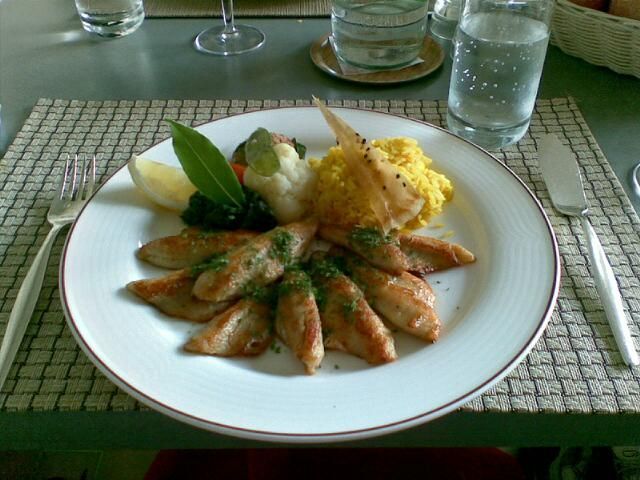
These small lake fish are found on most of the local restaurant menus. There was only one option to drink with them, a bottle of crisp white Chardonne from grapes grown on the hillside beneath which we were sitting on our sunny terrace.
The boys both ordered duck breast with potato galettes, equally delicious. Pudding was a rather wonderful gratin of raspberries (sabayon poured over fresh raspberries then the dish flashed under the grill to brown and caramelise just a little) served with a melon sorbet.
The next even we decided to visit another old haunt, the Auberge de l’Onde in the neighbouring wine village of St Saphorin. The lakeside village with traditional buildings and narrow winding streets is impossibly picturesque but not designed for the modern motor car as we discovered in an a frank exchange of views with a German registered SUV. You can sit outside on warm evenings:

We opted for the cosy dark wood panelled pinte dining room. It had about as much in common with a true traditional pinte as Heston Blumenthal’s pub does to a traditional British boozer. Why so? With the arrival of ambitious chef Patrick Zimmerman, the Auberge has been taken relentlessly upmarket and has gained a Michelin star and 15 Gault Millau points along the way. This means you won’t find many horny-handed locals supping here. On the night we dined, pretty much all the clientele were, like ourselves, tourists, from the UK, US and Italy.
Although the place felt rather precious, food and service were top class. I opted for the good value Menu du Jour featuring more lake fish, this time the féra (as far as I know unknown in the UK, Latin name Coregonus fera). This is a larger fish than the perch with firm white delicate tasting fillets, just right with the braised leeks, steamed potatoes and beurre blank type sauce with which it was served.
All well and good, but not truly authentic. It was not until we went back to the village of Chardonne where I rented apartment within the village house of Clos Jean-Louis that I spotted what I’d been looking for all along, the unassuming Café au Bon Vin. The menu features typical Vaudois dishes including the mysterious Malakoff. Apparently you can have two of these as a main course and if you like, a third in place of pudding. What were these things?
Thanks to the rather wonderful Swiss-authored food blog www.fxcuisine.com I discovered both that a malakoff is a deep-fried cheese stick and also found detailed instructions, photos and a recipe for whipping some up back home. I commend the blog to you.
Sadly, our discovery of the Café au Bon Vin was too late. We didn’t have time to try it out as we were en route to our mountaintop Mongolian yurt experience…
Edible municipal gardening in Switzerland
August 14, 2010 § Leave a comment
An idea from Switzerland that could work well back home. Municipal planting in the North of England where I come from tends to take the form of highly coloured highly regimented and highly maintained beds of marigolds, begonias, lobelia and the like. I saw recently in both Champéry and Vevey, two towns in la Suisse Romande (French speaking Switzerland), examples of edible flower beds.
In Vevey these were straightforward ornamental vegetables, rainbow chard, sweetcorn and tomatoes.
In Champéry, a more imaginative approach was taken. Herbs and edible plants were displayed in planters which formed a trail through the village with a recipe for the relevant edible plant displayed next to it. The recipes were compiled into a handy little brochure available from the tourist office.
Here are 3 of the recipes from the leaflet which appealed to me, including one featuring comfrey. Normally all my recipes are tried and tested but these are new to me. I shall be giving them a go as soon as I’m back in my own kitchen and can forage for the ingredients.
A photo of the planter containing comfrey (Symphytum officinale or consoude in French) appears at the bottom of the post.
Recipe for comfrey tzatziki
For 4 people. This recipe makes sense as tzatiki is usually made with cucumber and both comfrey and it’s cousin borage are said to have a cucumber-like taste. Rather worryingly, the original recipe states that comfrey should be consumed in moderation because of the potentially liver damaging compounds it contains. You have been warned!
Ingredients
300g natural yoghurt, ideally Greek style
6-7 young comfrey leaves
1 clove of garlic
1 tbsp olive oil
5 mint leaves, ideally wild mint
salt and pepper
Chop the comfrey and mint finely and mix with the yoghurt and olive oil. Season to taste. Leave for 1 hour in the fridge and mix again before serving.
Recipe for little elderberry cakes
Makes about 25 little cakes. These sound as if they’ll turn out like madeleines – I hope so as madeleines are just about my favourite small cakes.
Ingredients
150g flour
150g caster sugar
40g ground almonds (ideally bitter almonds)
2 teaspoons baking powder
The grated rind and juice of half a lemon
150-200g ripe elderberries removed from the stalk
3 eggs lightly beaten with a fork
150g melted butter
125g natural yoghurt
2 tbsp orange flower water
In a large bowl mix the flour, sugar, ground almonds, baking powder, grated lemon rind and elderberries. Take care not to crush the berries. In a second smaller bowl, mix the eggs, melted butter, yoghurt, lemon juice and orange flower water. Add the wet ingredients to the dry, mix and allow to rest in the fridge for 1 hour. Drop teaspoons of the mixture into prepared silicone moulds (I plan to use my silicone madeleine moulds, otherwise use patty tins). Bake for 12 to 15 minutes in an oven preheated to 220 degrees C. Leave for a few minutes before unmoulding.
Recipe for Charentais melon and wild mint salsa with melon and muscat sorbet and raw ham from the Val d’Illiez
Serves 4 I would guess. This is one of the sketchier recipes in the leaflet so please alter it as you see fit. No ingredients or method are given for the sorbet syrup so please consult your usual cookbook to see how to make this.
Ingredients
2 Charentais melons
1/2 cucumber
1 dessertspoon icing sugar
125 ml sugar syrup
Small glass Pineau de Charentes or other sweet muscat wine
4 handfuls salad leaves
4 to 8 slices Val d’Illiez or other raw thinly ham
Peel and deseed the melon and cucumber, cut into small cubes and marinate overnight in the fridge with the chopped mint and the spoonful of icing sugar. Liquidise and set aside.
To make the sorbet, peel and deseed the second melon, cube and liquids then mix with the 125 ml chilled sugar syrup and the small glass of muscat wine. Churn in an ice cream maker or freeze in a shallow plastic container stirring the mix from time to time.
Serve the smoothy and the sorbet with a few dressed salad leaves (use a vinaigrette flavoured with chopped wild mint) and scatter over the strips of raw ham.

Champéry and the Tour des Dents du Midi
August 13, 2010 § Leave a comment
The range of seven peaks known as the Dents du Midi (Teeth of the South) sits high above the Rhône valley in Western Switzerland and is tantalisingly visible from the shores of Lac Léman (lake Geneva).
After staring at these dreamy mountains for years since I first visited the area back in the 1980s I was finally going to approach them on foot via the long distance footpath called the Tour des Dents du Midi. If you were really up for it you could complete the walk in 2 long days: we decided to opt for the 4 day option making our base the picturesque alpine village of Champéry in the canton of Valais.
Wending our way up the Val d’Illiez towards Champéry we kept seeing roadside stalls selling Valais apricots. The Valais is named after the mighty Rhône valley which dominates the region. It is the warmest and sunniest part of Switzerland and is famed for its red wines and its fruit trees. I’d previously experienced Valais fruit in the winter in the form of hideously strong schnapps, pomme (apple), williamine (pear) and the like. At the third roadside stall we just had to break our journey to experience the fruit in its much more pleasant undistilled form:

Delicious, ripe and juicy, much more appealing than the bullet-hard pellets that pass for apricots in supermarkets back home.
Our base in Champéry was the comfortable and good value Beau Séjour hotel at one end of the village main street. It’s pretty as a picture, all dark wood and pink geraniums and the annexe rooms where we slept were spacious and well-equipped. The hotel doesn’t serve meals other than breakfast but this was not a problem as we strolled down to the excellent Café du Nord for dinner.
The Beau Séjour does do a fine breakfast, the highlight of which for us was cooking our own pancakes on a dinky electrically heated tabletop device. Sadly, looking out of the window from our cost breakfast table, the weather outside was, exactly as forecast, grim. Undaunted, we merely donned our waterproofs and set off from the Grand Paradis chairlift carpark. We had 6 hours walking ahead of us including 900m of ascent.
The showers stopped intermittently and we were rewarded with views of precipitous slopes and alpine meadows. We took a lunch break at the Cabane d’Antème, pretty basic with building work audibly in progress. Soup was reconstituted Maggi or similar and coffee was instant but the chocolate cake was the real deal.
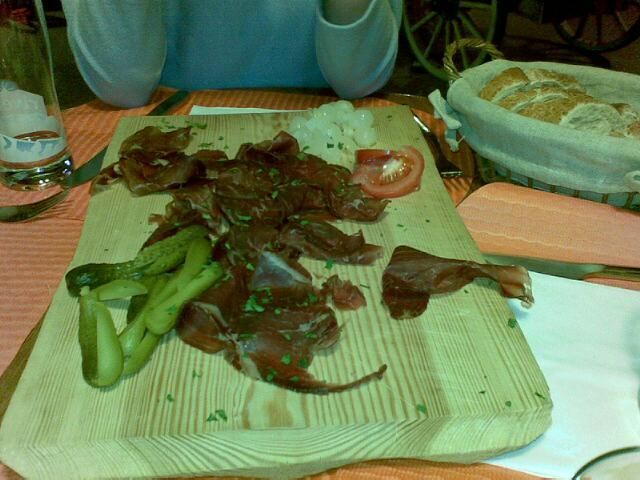
After another 3 hours’ trudging in the rain, the Alpage de Chindonne was a welcome sight bas we rounded our final corner. This was amazingly comfortable for a mountain hut, more like a small hotel, with prices too match! We were too late for the cheaper basic pasta meal, the répas du randonneur, so it was the à la carte option of viand sechée du Valais followed by the national Swiss potato dish, rösti.
Here is the board of viande sechée du Valais:
After a breakfast of bread and jam we set out on day 2 of our walk. Mercifully the rain had stopped and the sun broke through clouds and it became a beautiful day. A good thing too as we had 7 hours walking ahead of us. We spent the morning rounding the corner into the main Rhône valley arriving at the cliff top village of Mex in time for lunch. We then had a gruelling 1,000m climb up to the col du Jorat from where we could see down to our destination, the Auberge de Salanfe. By common consent this was the best hut of the tour. It has a spectacular lakeside setting, comfortable rooms, good food and efficient and friendly service. Dinner, a homemade vegetable soup and emincé de boeuf (beef casserole) with rice and vegetables, was wolfed down by all.

Day 3 turned out to be a relatively short 3 hour walk over the col to the Cabane de Susanfe as our planned peak, the Haut Cîme, 3,257m, turned out to be unobtainable because of the quantity of fresh snow down to 2,400m. We arrived at the Cabane at around lunchtime and spent a lazy afternoon in the sunshine rehydrating first on sirop de mélisse (homemade lemon balm cordial) and later on a microbrewery beer from Sion. Dinner was packet cream of asparagus soup followed by chilling con carne, then apple sauce for pudding. Sounds a little odd but it all tastes good after a day’s hiking. The Cabane de Susanfe is a genuine Swiss Alpine Club hut with just a coomunal dormitory and hut bunk sleeping arrangements. This proved the most difficult part of the walk: sharing a mattress with a pot-bellied snoring stranger is not my idea of fun….
After a slightly Spartan breakfast of homemade bread (good but not enough of it), jam and instant hot chocolate, we set off on the final leg of the journey back to Champéry and civilisation. After a tricky first hour we were through the steepest section of the walk, the Pas d’Encel, effectively the jaws of the valley. The buvette de Bonavau made a welcome break with tempting homemade fruit tarts on display:

Too soon it was back to civilization in Champéry. It was a sunny Sunday lunchtime and we were pleasantly surprised to find both the bakery open and a little market in full swing in the village centre. We stocked up on bread – both Valais rye bread with walnuts plus white bread for the softies in our party. The cheeses were a wonderfully ripe and stinky Tomme de Bruson from the neighbouring valley and a local artisan-made rinded goat cheese. The salami was chewy, flavoursome and flavoured with génepi. I think this variety of peach is called doughnut – they were small, fragantly white-fleshed and juicy.
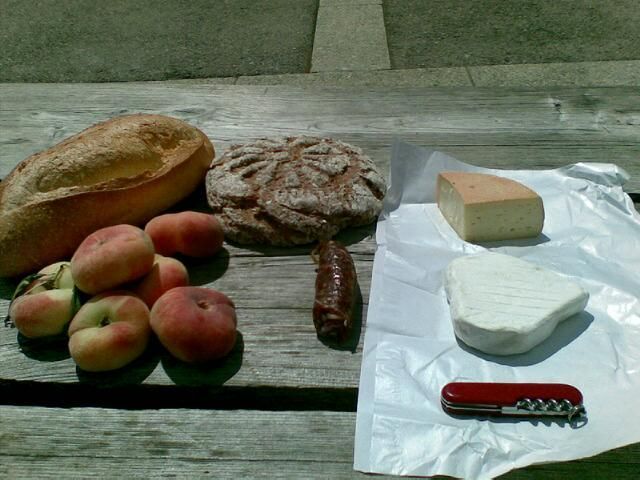
A perfect picnic to conclude a successful walk, even if the Haut Cîme remained out of reach this time.
Zermatt mountain restaurants: style meets substance
February 21, 2010 § Leave a comment
Zermatt’s mountain restaurants are legendary and looking at the view from the balcony of Chez Vrony in the hamlet of Findeln you can see why. We were in Zermatt for the busy February half term holiday week so making some key lunchtime bookings well in advance was an important part of my holiday planning.

Our first lunch was at Chez Vrony is a Zermatt institution run by Vrony Julen, daughter of one of one of Zermatt’s long established families. The food is delicious, the service is both charming and almost fearsomely efficient. Our New Zealand nephew Simon’s jaw dropped visibly as we were shown to our stunning balcony table and seated on cosy benches strewn with sheepskins. He later admitted it was a far cry from his usual eating experience in the ski fields of New Zealand where lunch means a snatched pot noodle in a utilitarian shed.
Chez Vrony caters for both hearty and more ladylike appetites. I chose the Salad Vrony, an elegant supercharged version of a chicken Caesar salad:

The salad followed by a double espresso was more than enough to set me up for the afternoon’s skiing but nephew Simon and son George were both still hungry after rösti and risotto respectively and chose the apple fritters for pudding. Needless to say, these disappeared in a flash:

Later in the week we made the obligatory hop-over the Theodul Pass into the Italian village of Cervinia. When in Italy, it has to be polenta, in this case Polenta Valdostana smothered with butter and molten cheese. As my Milanese friend Matteo said recently “no self-respecting Italian would ever eat pasta in the mountains: it has to be polenta”. Polenta is incredibly filling and has amazing heat-retentive properties. Lunch kept us going for the rest of the afternoon without any need for coffee and cake.
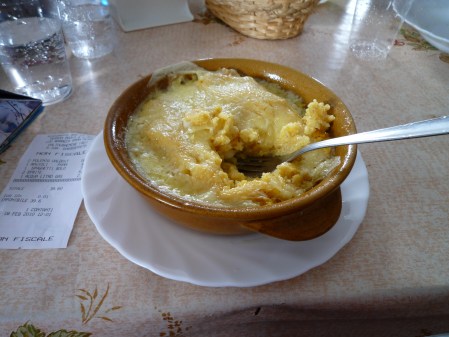
In general, Cervinia’s mountain restaurants don’t quite live up to the standards set by its Swiss cousin Zermatt. We ate our polenta at a decent enough self-service place at the foot of the Colle inferiore delle Cime Bianche chairlift on the Valtournenche side of the resort. Though the polenta was good, the place itself was nothing to write home about.
Ski Club Rep Paul Ubysz, a walking encyclopaedia when it comes to local knowledge of Zermatt and Cervinia had recommended to us the Resto-Grill Les Clochards accessible from Piste 5 on the Plan Maison side of the resort. I see that there are rave reviews for a Swedish run place called L’Etoile though I wonder if reviewers are star-struck by the lovely team of blonde waitresses. Take your pick…
We are keen skiers so some days lunch was a picnic in the snow with supplementary coffee and cake later in the day. The spectacularly situated Gandegg Hut accessible from the high Theodul glacier ski runs is a perfect place to warm up and refuel. They serve generous portions of home-made apple cake:

The restaurant at Stafel accessible from the red run down to the village from the Schwarzsee area is a similarly good place to linger. They serve excellent warming soups and their home made tarts look extremely inviting:

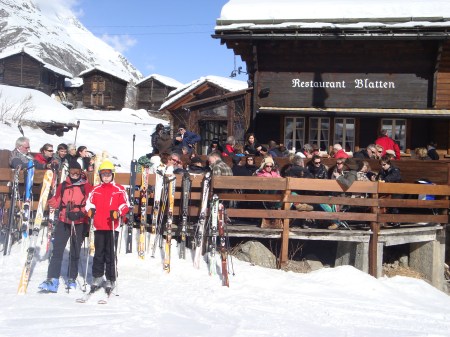
Finally, I couldn’t leave German-speaking Switzerland without at least one plate of rösti. My favourite is the classic combination of rösti with ham and fried eggs. They serve up a storming version at the Restaurant Blatten on the lower slopes of the Schwarzsee ski area:

Blatten is another restaurant in the Chez Vrony mould: family run (by Leander and Simone Taugwalder); combines rustic charm with super-efficient service and attention to detail; delicious food for a range of appetites. The interior is cosy and wood-panelled and there is a sunny terrace outside:
 </
</Here are they key details to tap into your mobile phone before you go:
Contact details
Chez Vrony
Tel +41 27 967 25 52
Gandegg Hütte
Tel +41 79 607 8868 (hut keeper’s mobile)
Restaurant Stafel
Tel +41 27 967 30 62
Restaurant Blatten
Tel +41 27 967 20 96
If you’v eaten in Zermatt or Cervinia recently, I’d love to hear your experiences. Please send me a comment.
Two very different dining experiences in Zermatt
February 19, 2010 § Leave a comment
Two very different dining experiences during a recent ski holiday in Zermatt, Switzerland.
First, the Stockhorn Grill which I first visited some 20 years ago and is still going strong. It’s a meat lover’s paradise with the speciality being various cuts of meat spit-roast over an open fire. Be warned that you need to order the whole chicken in advance as it requires an hour’s cooking time. Here’s a picture of the open-plan cooking area, the fire flickering theatrically in the dimmed light of the restaurant.

The Stockhorn formula is simple but extremely effective- salad to start, then your chosen meat which is served with generous quantities of potato gratin or chips/French fries (one has to be careful with fried potato terminology to avoid being served with a bowl of what we in the UK would call crisps!). I chose the venison fillet cooked medium rare with potato gratin. Absolutely delicious served with a bottle of full-bodied Swiss Rhône red wine colourfully named “Sang de l’Enfer”, literally “Hell’s Blood” which wasn’t hellish in the slightest. The meal was simple and robust, no need for pudding to follow. It’s a tried and tested formula which is still packing the guests in – the queue for a table was out of the door as we left the restaurant.
Our next choice was Sonnmatten, a restaurant attached to a boutique hotel in the hamlet of Winkelmatten, an appetite-enhancing 15 minute walk upwards from the centre of Zermatt.
The chef at Sonnmatten is Marco Drynda, originally from Swabia in Germany. Drynda has recently stepped-up to his first head chef position after several years as number 2 to Alain Kuster at the Mirabeau in Zermatt.
The restaurant and bar décor is delightful, bringing off the trick of looking both clean and modern yet warm and cosy at the same time. We were hungry and asked to be shown straight to our table – matt black walnut with crisp white linen napkins, no-fuss stainless steel cutlery and generously proportioned wineglasses. The young service team led by host René Foster were dressed discreetly all in black and were charming and efficient. We sipped a glass of prosecco and went through the menu. Our fellow guests were either German or Swiss German and exuded an air of understated good taste. We’d finally escaped the crowd of Brits who flock to Zermatt at this time of year. So far so good.
Starters took a little time to arrive but were worth waiting for. I’d chosen a simple pumpkin soup which was well flavoured, silky textured and delicious.

Sadly, main courses took an absolute age to turn up. The restaurant though small was quite busy and from the animated discussions the waiting staff were having it was evident that the kitchen was having problems getting the food out in time. This was a shame as it marred an otherwise very satisfactory evening.
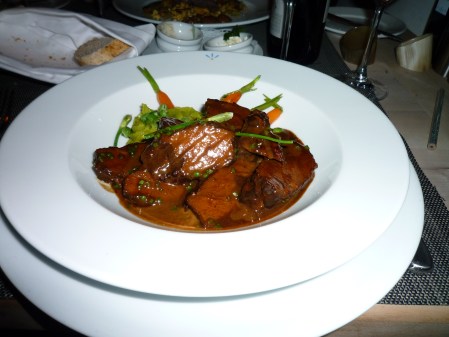
When my chosen main course of braised veal cheek finally turned up, it was generously proportioned, sticky and unctuous. It was almost too intense and meaty if that’s possible.
I should mention the wine list – lots of interesting Swiss wines as well as the usual French bottles. We chose a local Humagne Rouge – a cigar boxy red.
After two big-flavoured courses, pudding wasn’t an option for me even though the choice was enticing. My son George chose a plate of apple desserts pictured below. These disappeared in a matter of seconds!

There’s a lot to like about Sonnmatten. I love the chef’s modern take on German and Swiss classic dishes and ingredients and the restaurant makes a stylish alternative to the glitzy big name restaurants attached to the 5 star hotels in downtown Zermatt. If only the kitchen could resolve its timing issues…
Contact details
Restaurant Sonnmatten
96 Winkelmattenweg
CH3920 Zermatt
Telephone +41 27 967 3030
http://www.sonnmatten.ch/page.php?rubID=1&lan=en
Stockhorn Restaurant and Grill
CH 3920 Zermatt
Telephone +41 27 967 1747
Swiss food in London
January 18, 2010 § 1 Comment
After the New Year’s Eve feast (see previous post) it was our turn to rustle up a meal for 14 (6 adults, 8 children) on New Year’s Day. We’d prepared in advance by doing all the shopping, except for the salad ingredients, in Switzerland. Even the bread came from a lovely bakery in Zürich airport terminal. Swiss wine, an essential component of the meal, would have been too heavy to carry so we’d arranged an advance delivery to our hosts’ address by UK wine merchant Nick Dobson Wines. Nick is a man after my own heart who specialises in wines from Austria, Switzerland and Beaujolais. I’ve bought a number of items from him over the years both for home consumption and as gifts and he’s been really efficient, helpful and knowledgeable every time, plus supplied some really enjoyable wines so I would definitely recommend him if you are looking for something unusual. I give his contact details below at the end of this post.
Our Swiss themed menu was:
Bündnerfleisch (dried cured meat from Graubünden) – a mixture of beef and venison
Mixed salad
Cheese fondue
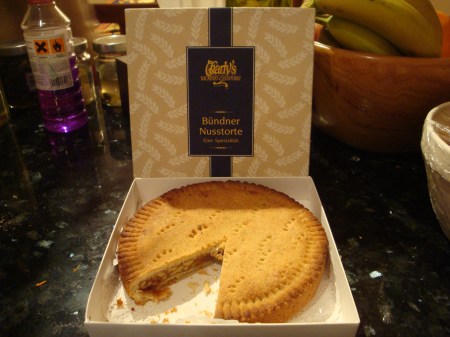
Bündner Nusstorte (caramel walnut pie from Graubünden)
We indulged in a bit of judicious cheating (or careful purchasing depending on your point of view!) and brought back from Klosters a bag of ready grated weighed and blended cheese for the fondue and the Nusstorte too. I give recipes both for cheese fondue and Nusstorte below if you want to have a go at home. Both recipes have been tried and tested more than once back home in the UK.
Our Bündnerfleisch came from an artisanal manufacturer in Klosters, a little shop on the main Landstrasse road close to the Heid ski lift. Bündnerfleisch is salted and cured meat, usually beef but we bought the venison version as well – similar but darker red with a background gamey flavour. The raw meat is first salted and mixed with a secret recipe of herbs and spices before being hung up to dry for several weeks. The meat is then pressed into a distinctive rectangular shape before being very thinly sliced and served. Bündernerfleisch is similar to the better known Italian bresaola which itself comes from the nearby Valtellina.
The people who run the Klosters business very kindly showed me round their processing and drying rooms where I was able to sea the beef pieces maturing slowly in the rafters:

You can read more about Bündnerflesich by following this link: http://www.grischuna.ch/productsE.html. I just wish we could get hold of it more readily over here as it’s delicious.
This was a really easy meal to feed a crowd of people, fun for both grown-ups an children. Neither the truly authentic Bündnerfleisch nor a pre-prepared Nusstorte are readily available here but you could easily substitute a platter of other cured meats and procure a tart from your local bakery to recreate the idea. Here is the grown-ups’ table (the riotous childrens’ table is just next door).

And here’s the beautiful Nusstorte fresh (well almost) from Charly’s in Klosters:
Recipe for cheese fondue “moitié-moitié” (half and half)
This recipe comes from my trusty little Betty Bossi Swiss Specialities cook book, a little ringbound volume with one recipe per page, clear simple and instructions and a photo of every dish. The half and half in the recipe title refers to the mixture of 2 cheeses used in this fondue. This recipe serves 4 people generously.
Ingredients
600g day-old bread from a cob or chunky baguette type of loaf (you need the right ratio of crust to crumb – a tin loaf would give too much crumb) cut into cubes
300g mature gruyère cheese
300g vacherin fribourgeois cheese (substitute emmental if vacherin fribourgeois is not available)
300 ml white wine, ideally a Swiss chasselas, otherwise whatever dry white wine you have to hand
1 peeled clove of garlic left whole
1 small glass (liqueur glass) of kirsch
1 tablespoon cornflour
a pinch each of freshly ground black pepper, paprika, freshly grated nutmeg
Grate the cheese using a coarse grater and place into the fondue pan. A traditional fondue pan is referred to as a caquelon. If, like me you bought a ready grated fondue mix of cheeses, simply tip the contents of the packet into the fondue pan. In a separate bowl, mix together the cornflour and white wine. Pour the mixture over the cheese in the fondue pan. Place the pan over a low heat and slowly bring the mixture up to boiling point, stirring constantly with a wooden spoon. Add the whole garlic clove, kirsch and seasoning to the mix. Once the mixture is smooth, creamy and bubbling, bring the fondue pan to the table and set your table burner on low. You are now ready to serve. Give the bottom of the pan a stir every so often with a bread cube on the end of your skewer to stop the cheese crust which forms on the base (known as la religieuse) from burning.
Recipe for Bündner Nusstorte
This recipe comes from a little ringbound paperback “Bündner Landfrauen Kochen” (Graubünden farmers’ wives cookbook) and was submitted both by Mrs Annina Mengiardi of Ardez (Swiss German version) and by Mrs Marta Padrun of Lavin (Romansch version) so it is certainly authentic. My Romansch is limited but as far as I can tell, the recipes are identical. The translation from Swiss German is mine as are one or two additions. I’ve made the recipe twice now so can confirm that it works. The sweet pastry dough is a little difficult to handle so be gentle with it. Caramelising the sugar for the filling has to be done carefully as well. The key thing is to seal in the filling thoroughly otherwise it bubbles out when baked. A small slice of the pie is enough so on that basis the recipe would serve 12 people. It’s usually served on its own without cream or ice-cream and is just as good with a cup of tea or coffee as it is for pudding. I wonder if this is the European precursor to the American pecan pie?
Ingredients
300g plain flour
150g caster sugar
150g butter
1 egg, lightly beaten
pinch of salt
Filling
300g caster sugar
50 ml water
250g roughly chopped walnuts
200 ml double cream
1 dessertspoon of honey
Rub the butter into the flour to which you have added the pinch of salt until it resembles fine breadcrumbs. Stir in the sugar then the beaten egg and work into a dough handling as lightly as you can. Wrap and chill the dough for half an hour. Roll out 2/3 of the dough and use it to line a loose bottomed flan tin 24-26cm in diameter. Do not trim the excess pastry as you should aim to leave an overlap of 3 cm. Wrap and return the remaining pastry dough to the refrigerator while you prepare the filling.
For the filling, melt together the sugar and water in a heavy based saucepan and allow to caramelise to a brown colour. Add the chopped walnuts, cream and honey, stir well and allow to cool to room temperature.
Fill the pie base, then roll out a lid and place it over the tart. Seal the edges well. I recommend leaving the pie edges untrimmed at this stage as you can neaten up the edges after baking. Prick the surface with a fork all over decoratively if you like (see picture above) but don’t overdo it as the filling will leak out.
Bake at 220 degrees C for the first 10 minutes then reduce the heat to 180 degrees C and bake until the tart is a light golden brown (approx another 30 minutes.
Contact details for Nick Dobson Wines
Telephone 0800 849 3078
Rustic food in Klosters and traditional dishes from Graubünden
January 10, 2010 § 2 Comments
I’m going to start this post on our recent trip to Klosters with a mention of Charly’s Chestnuts. No, this isn’t an irreverent dig at the British royal family who like to holiday here but a reference to a Klosters landmark. The eponymous Charly sets up his wagon daily just outside the station and his roast chestnuts are very good indeed.

I’ve already written about some of Klosters’ hotel restaurants and the elegant food they serve up. What I haven’t mentioned so far are some of the mountain restaurants catering for skiers. Yes, there are the busy cafeteria style establishments by the main lifts at Gotschna, Davos and Madrisa, but if you want something a bit special, you have to travel a little further afield.
Bruhin’s restaurant is virtually on the summit of the Weissfluhgipfel which at 2883m is the highest point on the Parsenn massif. The views across to the Silvretta and Rätikon are stunning and window tables here are in great demand. The menu offers either restaurant style dishes or local specialities. I haven’t eaten here recently, but they do a good cup of coffee – you can warm up on the sheepskin upholstered seats before taking the long run down to Schifer.
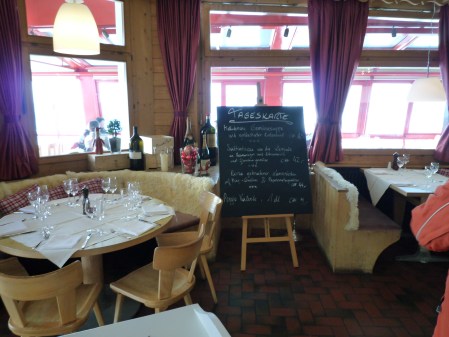
If you are skiing in the Madrisa ski area, then Berghaus Erika in the hamlet of Schlappin makes a worthwhile destination. Its plus point or drawback, depending on your point of view, is that is situated at the foot of a long tree-lined black run.
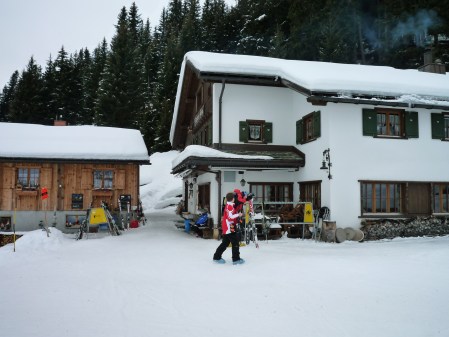
We tried the local Prättigau speciality Chäsgetschäder here, a cheesy bread bake, perfect after a hard morning’s skiing. I’ve searched out a recipe for this dish which I give below. The version in the recipe sounds more soupy and creamy than the dish we ate at Berghaus Erika – their version appears to have been baked in the oven or cooked on the stove top to produce a golden crust:

At the foot of another black run is the Hotel Kulm in Wolfgang, the hamlet on the main road between Klosters and Davos. This is another atmospheric place to eat, with lots of local specialities on the menu. The hotel sits between the main road and station at Wolfgang – there’s no ski lift back to the slopes, so time your meal to coincide with a Rhätischebahn train back to either Davos or Klosters . Here’s a view of the hotel from the station platform.
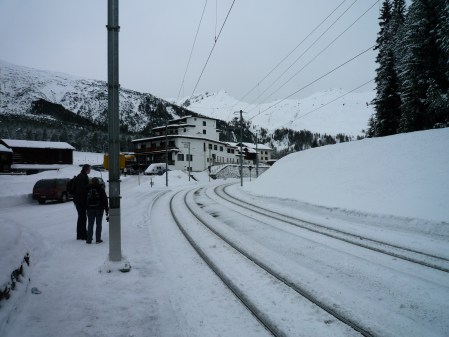
We tried Maluns, a dish of fried potatoes served with cheese and apple sauce, a typically Swiss combination. This dish looks rather basic when it arrives – essentially a plate of crispy golden crumbs, a piece of cheese and dollop of apple sauce on the side, but the combination tastes good. I’ve managed to find a recipe too which I give below.
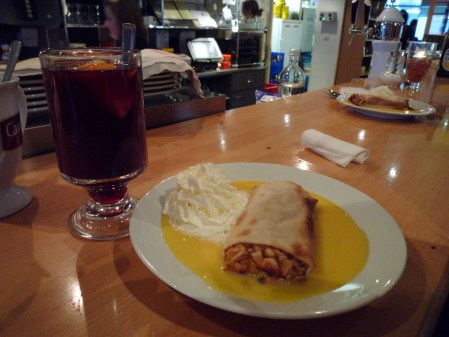
A day skiing in Klosters wouldn’t be complete without an après-ski drink and snack in Bistro Logo in the main street – this seems to be the town’s only café and is permanently busy as a result. Since Graubünden went smoke-free a couple of years ago, this is now a very pleasant place to sit and chat. My son George’s favourite order here is the apple strudel with both vanilla sauce and whipped cream:
Finally, a mention of two other regional dishes which appear frequently on menus in and around Klosters. The first is Pizokel, a gratin of potato dumplings which makes a hearty ski lunch. Here’s how it’s served locally andI give a recipe below.
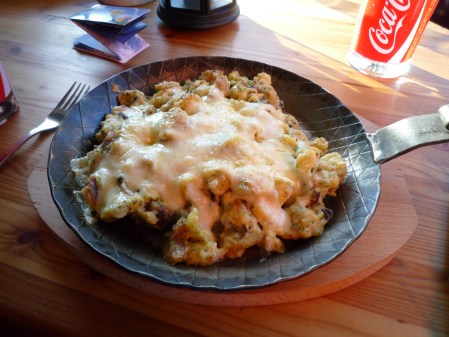
The second is Capuns, another Graubünden speciality – little parcels of savoury stuffing wrapped in Swiss chard leaves. Sadly, I didn’t have an opportunity to try these during our trip. Of all the local dishes, these seem to fit in with current cooking trends – not too much cheese, butter and starch and the use of a vegetable rather than pasta or pastry to encase a savoury filling has a contemporary feel even though this is a traditional regional dish. My trusty little Betty Bossi cookbook which I bought in Switzerland ages ago has come up trumps again – I give the recipe below and plan to give it a try as soon as I can get hold of some Swiss chard.
Recipe for Maluns – a fried potato dish, a speciality of Graubünden
This recipe comes from “Bündner Landfrauen Kochen” (the Graubünden Farmers’ Wives Cookbook), a little spiral-bound paperback book I bought in the Klosters bookshop a couple of years ago. The contributor is a Mrs Renata Canetg from Domat/Ems, a little town in the Rhine Valley near Chur.
She doesn’t say how many people this will serve – I estimate this would make 4 generous portions.
This was originally a breakfast dish eaten with and in fact mixed with milky coffee. You will find it more commonly served now as a hearty lunch or supper dish with a good-sized wedge of cheese and a dollop of apple sauce. The combination of cheese, potato and apple is typically Swiss.
Ingredients
1 kg waxy potatoes boiled in their skins and left for two days
350 g plain flour
1 teaspoon salt – more to taste
125g-150g butter (depending on how your potatoes behave)
To serve
Apple sauce
Wedges of Graubünden mountain cheese
Peel the potatoes and grate them using a coarse grater. Mix the grated potatoes with the flour and a little salt. Divide the mixture into two and fry one portion at a time in a non-stick frying pan in hot butter. When the mixture colours, turn the heat down a little and cook until golden, stirring frequently with a wooden spoon. The mixture will form into small balls. Serve immediately while hot and crispy.
Recipe for Kartoffelpizokel – potato dumplings, a speciality of Prättigau
This recipe serves 4 people and comes from a little recipe book by fictional Swiss author Betty Bossi entitled “Specialités Suisses”. The Prättigau is the region within the canton of Graubünden comprising the Landquart and Landwasser valleys in which respectively Klosters and neighbouring Davos are located.
Ingredients
700g peeled raw potatoes, floury such as Désirée
100 to 150g plain flour
1 teaspoon salt
freshly ground black pepper
For the gratin
200g grated Prättigau mountain cheese (substitute Gruyère if you like)
1 tablespoon butter
100g lardons (diced bacon)
2 medium onions halved and thinly sliced
Cranberry sauce to serve (the Swiss recipe suggests a compôte d’airelles which is similar to our cranberry sauce – the airelle is a sharp red mountain berry)
Grate the potatoes into a bowl using a fine grater. Squeeze out some of the raw potato juice with your hands. Mix in 100g of the flour, salt and pepper. Bring a large pan of salted water to the boil. With two spoons, take a small piece of the mixture, form it into a dumpling and drop it into the boiling water. If it doesn’t hold its shape, stir in the extra 50g of flour specified in the list of ingredients.
Form the mixture into dumplings and drop them into the water. Stir around. Allow to simmer for 10 minutes. They will at first drop to the bottom of the pan then rise to the surface once they are cooked, like gnocchi. Remove with a slotted spoon and place them into a buttered gratin dish. Sprinkle over the grated cheese and bake in an oven preheated to 200 degrees C for 20 minutes.
While the pizokel are in the oven, melt the butter in a frying pan, add the lardons and cook until golden. Add the sliced onions to the pan and continue cooking until the onions are golden. Spread the mixture over the baked pizokel.
Recipe for Chäsgetschäder – a rustic cheese bake, a speciality of Prättigau
Another recipe from the Betty Bossi Swiss Specialities book – serves 4.
Ingredients
100g butter
2 onions, finely chopped
250g day old white bread, crust on, cut into cubes
750 ml milk
salt and freshly ground black pepper
a little grated nutmeg
600g aged Prättigau mountain cheese, grated (or a mixture of aged Appenzell,Gruyère and Fribourg Vacherin cheeses in the ratio 250:250: 100. The recipe needs mature cheese otherwise it will lack flavour and be too stringy and indigestible)
Melt the butter in a large saucepan or enamelled casserole. Add the chopped onions and cook until golden. Add the bread cubes and fry briefly. Add the milk, bring to the boil and allow to simmer gently for 10 minutes, stirring from time to time. Season to taste with salt, pepper and nutmeg. Gradually add the grated cheese, stirring constantly, until the mixture become creamy. Serve immediately.
Recipe for Capuns – stuffed swiss chard leaves, a speciality of Graubünden
Ingredients
For the stuffing
150g flour
pinch salt
3 tablespoons milk
2 eggs
1 dessertspoon butter
1/2 onion, finely chopped
1 tablespoon finely chopped parsley
1 dessertspoon snipped chives
50g chopped air dried beef from Graubünden
100g cooked salami type sausage cut into small dice
For the wrappers
16 young tender Swiss chard leaves
To finish the dish
100 ml double cream
200 ml meat stock
salt and freshly ground black pepper
a little butter for frying the ham strips
50 g raw cured ham cut into strips
Work the flour, salt, milk and eggs into a thick paste. Put it aside and leave it to rest for 30 minutes. Melt the butter in a saucepan, sauté the onions until translucent. Add the chopped herbs, give the mixture a quick stir, then turn off the heat. When the mixture is cool, mix it with the paste. Add the chopped dried beef and sausage.
Now prepare the leaves. Blanch them briefly in abundant boiling salted water then plunge them immediately into iced water. Dry them on absorbent kitchen paper.
Place a teaspoon or so of filling onto each leaf then roll up.
Now cook the formed capuns. Pour the cream and stock into a large saucepan, season and bring to simmering point. Add the capuns to the pan, cover and allow to simmer for 5 to 10 minutes. Heat a little butter in a small frying pan and quickly fry the ham strips until crispy. Divide the capuns between 4 plates, spoon over a little cooking liquid and garnish with the fried ham strips.
Restaurant contact details
Bruhin’s Weissfluhgipfel
7260 Davos Dorf
Tel. +41 (0)81 417 66 44
Fax +41 (0)81 417 66 40
www.gourmetdavos.ch
Berghaus Erika – Schlappin
Tel +41 (0)81 422 11 17
Hotel Restaurant Kulm
7265 Davos-Wolfgang
Tel. +41 (0) 81 417 07 07
Fax +41 (0) 81 417 07 99
Bistro Logo
Bahnhofstrasse
7250 Klosters
Tel. +41 (0)81 422 19 96
Dining out in Klosters: Michelin vs Gault Millau
January 8, 2010 § 3 Comments
Finally back home after a few days skiing in Klosters and new year celebrations in London. Right now, it feels like there’s just as much snow back home as there was in Switzerland.
Klosters is a schizophrenic kind of place. It’s a favourite haunt of minor royalty (though the only familiar face I spotted was that of shadow chancellor George Osborne sporting, surprisingly not a True Tory blue but, a head-to-toe red ski outfit) yet is very much non-glitzy. In the main street you are more likely to bump into a Swiss Hausfrau wheeling a shopping trolley than a leggy supermodel wheeling a flight bag. Hardware shops rub shoulders in the main street with jewellers’ shopfronts displaying the obligatory Swiss watches. There are more churches (one catholic, one protestant) than nightclubs (just the one – the discreet but shady looking Casa Antica).

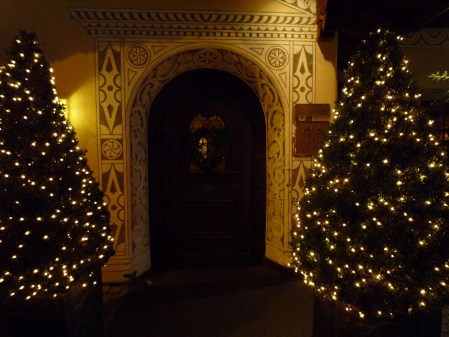
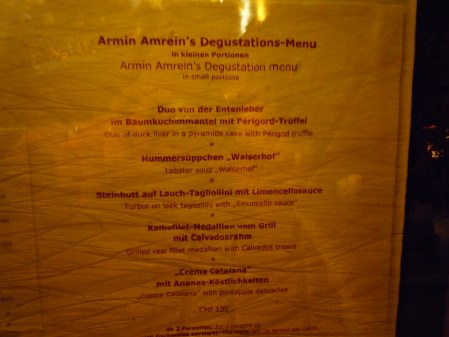
Klosters is home to a clutch of well-regarded restaurants most of which are attached to hotels. Perhaps the best known (because Prince Charles chooses to stay here) is the Walserhof. Its restaurant has 2 Michelin stars and 17 Gault Millau points. Here is its inviting front door and a view of chef Armin Amrein’s festive tasting menu.
Interestingly, the Swiss place more emphasis on the Gault Millau ranking than Michelin. Gault Millau is an alternative French restaurant rating system which awards points for food alone. A maximum of 20 points are available which until recently meant in practice that the top score was in fact 19: with a French philosophical bent, Messrs Gault and Millau determined that perfection was never attainable. Controversially, in 2004 (by which date Messrs Gault and Millau were long gone), 2 restaurants in France were awarded the magical maximum 20 points and that number has subsequently grown to a handful. Falling standards or genuine excellence I wonder?
Sadly, I’m not in a position to comment on Gault Millau ratings as all their rated restaurants in Klosters (the Alpina, the Chesa Grischuna and the Rustico as well as the Walserhof) were fully booked.
This was perhaps a blessing in disguise as there is only so much cheffy food a body can eat and on a skiing holiday something more substantial is required. We paid visits to the cosy restaurant at the Steinbock Hotel (just across the road from the Walserhof), the Grill Room at the Pardenn Hotel, the restaurant in the swanky Hotel Vereina and, finally, for a more informal evening, the Pizzeria Fellini.
The Steinbock has to be one of Klosters’ best-kept secrets. It has a charming dining-room, soft lighting, wood beams and pink linen. On the evening we visited, the clientele was mainly Swiss families out for a celebratory meal. This is us, disturbing their peace just a little:

We chose the set four-course menu. Particularly good were the pheasant consommé and the parmesan-crusted lamb main course.
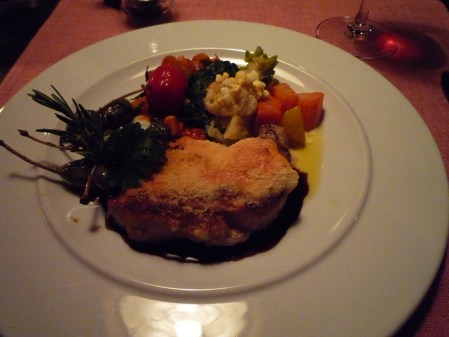
Both these dishes were undeniably old-fashioned – straight out of Escoffier in fact. My copy of Escoffier’s Guide Culinaire includes 137 consommé recipes. Whilst some of these are outlandish (swallows’ nest consommé for example), I think that a well-made simply garnished consommé is delicious, fits perfectly into a multi-course meal and deserves a revival. The lamb was served with lots of lovely vegetables and the most enormous caperberries (Kapernäpfel in German). These seem to be the latest trendy ingredient in the German speaking world – they keep cropping up in restuarant menus and German food magazines.
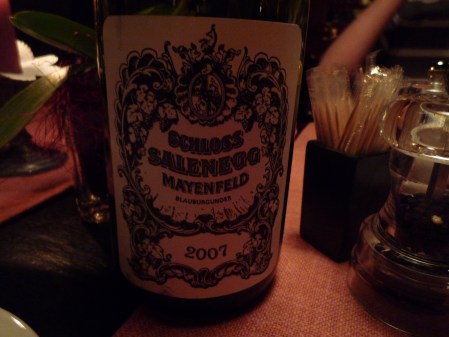
We drank a bottle of local red wine with our meal, a Blauburgunder (Pinot Noir) from Mayenfeld in the Rhine Valley a few miles away. Mayenfeld, more commonly spelt Maienfeld, is famous for being the local town mentioned in “Heidi”.
Next evening was the grill room at the Pardenn, a largish 60s hotel a little way out of town on the Monbiel road. Again, we opted for the 4 course tasting menu. The venison tartare first course was outstanding, as was my pudding choice of savarin, a dinky individual rum baba:
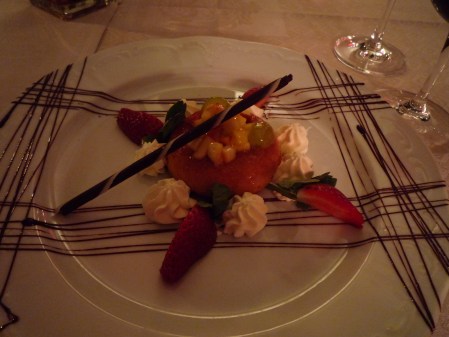
Yes, I know that the presentation looks a little stuck in a 60s/70s timewarp (as frankly does the hotel décor – alpine gemütlich it is not) but believe me, the syrup-drenched savarin was delicious.
Next evening, we chose the restaurant at the Hotel Vereina. The Vereina is an outsized Disney castle of a building plonked right in the middle of town. Unusually for Klosters, it aims to attract the kind of clientele who like to display their money. We were ushered into the dining room which looked to have had an extreme makeover back in the late 1980s – a lot of ornate steel and glass furniture combined with swags of fabric, not that easy on the eye.
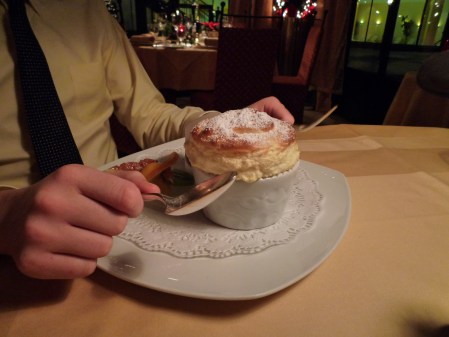
Despite the shortcomings in ambience, the staff were, seemingly as ever in Switzerland, charming and appropriately attentive. The food was for the most part pleasant but nothing to write home about, international hotel cuisine without much personality – in my case it was just a bowl of soup and piece of grilled veal, no more, no less. Then the puddings came. I don’t have a particularly sweet tooth, but the 3 choices we made (I opted just for an extra spoon to share all 3) were excellent – an unctuous crème brûlée, a chocolate fondant with a perfectly melting interior and, best of all, George’s choice of a vanilla soufflé:
Our final evening was a relaxed affair at the Pizzeria Fellini. The service was swift and efficient, the pizzas properly thin and crusty. Special mention has to go to my choice of a raclette pizza – melted raclette cheese (no tomato), gherkins and tiny pickled onions all on a pizza base. Perhaps the ultimate example of fusion food?

Walserhof
Landstrasse 141 . CH-7250 Klosters
Tel: +41 (0)81 410 29 29
Fax: + 41 (0)81 410 29 39
Steinbock
Landstrasse 146 . CH-7250 Klosters
Telefon: +41 (0)81 422 45 45
Fax: + 41 (0)81 422 16 36
http://www.steinbock-klosters.ch
Pardenn
Landstrasse 146 . CH-7250 Klosters
Tel: +41 (0)81 422 45 45
Fax: + 41 (0)81 422 16 36
Vereina
Landstrasse 179 . CH-7250 Klosters
Tel: +41 (0)81 410 27 27
Fax: + 41 (0)81 410 27 28
Pizzeria Fellini
Bahnhofstrasse 22. CH-7250 Klosters
Tel. +41 (0)81 422 22 11
 The Rhubarb Fool