
Bangladeshi breakfast
May 27, 2011 § 1 Comment
The latest in our series breakfasts of the world (https://rhubarbfool.co.uk/breakfasts-of-the-world-project/) took us to the Indian subcontinent, specifically to Bangladesh. The country is a strange mix of the familiar and the exotic. Most of the UK’s so-called Indian restaurants are in fact Bangladeshi and there is a substantial Bangladeshi immigrant community in the UK centred around London’s Brick Lane (hence the title of Monica Ali’s novel).
Looking at a map of Bangladesh, the place names are redolent of the history of British colonialism: Dacca/Dhaka, Chittagong and Cox’s Bazar. It is claimed that the beach at Cox’s Bazar, 125km of natural sand, is the longest in the world.
Thinking about Bangladesh, what immediately springs to mind are floods. Looking at satellite images of the country, Bangladesh’s predicament becomes painfully obvious – the country sits astride an enormous river delta at the confluence of the Ganges, Brahmaputra and Meghna rivers. The plus side is that the country benefits from incredibly fertile alluvial soils. All sorts of grains and vegetables can be grown here and small-scale agriculture occupies the majority of the population. This is reflected in the country’s staple cuisine – simple vegetarian meals capable of being cooked over a single gas flame or open fire.

“A typical Bangladeshi breakfast consists of Roti (flat bread), Paratha (kind of thick pancake) with Sabji (mix of overcooked vegetables that is often cold) and Dahl (lentil sauce that also is often cold). A breakfast for two persons sets you back around 30 eurocents.”
So wrote Dutch couple Ivonne and Edwin on their trip to Bangladesh’s capital city, Dhaka, in 2008. You can read the full unvarnished account of their trip to Bangladesh, and their other foreign travels here:
http://www.babakoto.eu/Articles/Bangladesh/Table-manners/Table-manners-English.htm
(Thanks Ivonne & Edwin for this – and for helpfully writing in English as well as your native Dutch)
So that made the breakfast menu for recreation at home very simple. My modification was to cook a single type of bread rather than both the Roti and Parathas (aka chapatis). Oh, and I added a little yoghurt to the breakfast table, along with fresh mangoes and the raw palm sugar eaten in the Indian subcontinent known as jaggery. The national fruit of Bangladesh is the jackfruit: I scoured the shops of Manchester’s “curry mile” to find one but in vain – maybe it’s out of season or maybe they’re not favoured by the curry mile community which is predominantly Pakistani and North Indian rather than Bangladeshi. Fortunately, finding chana dal and chapati flour was straighforward enough and added a touch of authenticity to breakfast. These products and more can be found at WH Lung oriental supermarket on Upper Brook Street, Manchester (see contact details below). There’s easy parking a real treasure trove of exotic ingredients from all over Asia, not just China. I used to work round the corner from here and when dealing with a knotty problem would wander the aisles in here to try and solve it.
I already had recipes for chapatis and dal, so it was a simple matter of typing “vegetable sabji recipe” into my search engine to come up with this recipe:
http://www.ifood.tv/recipe/vegetable_sabzi_for_roti
This sabzi recipe (the spellings sabji/sabzi transliterated from the Bengali language seem to be interchangeable) is essentially, a selection of diced vegetables (potato, cabbage, aubergine, peas, beans and so on) boiled in water and milk, flavoured with strong spices like chilli, cumin and aniseed. I’m not going to write out the recipe in full as, in all honesty, I won’t be making it again. It tasted rather less than the sum of its parts and the vegetables were soggy to boot. Ivonne and Edwin were right about this, but at least my sabji had the virtue of being piping hot.
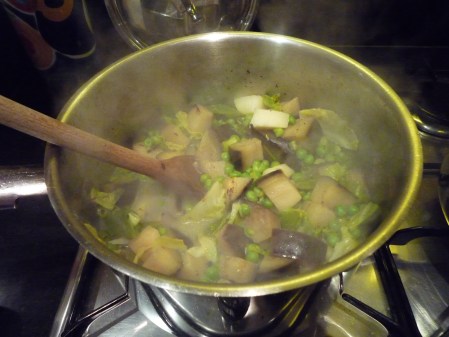
In contrast the dal and chapatis were delicious – I’d happily eat this as a regular breakfast – much tastier and more nutritious than the ubiquitous bowl of industrial refined salty cereal with milk so often found in the West.
My dal and chapati recipes both come from a well thumbed copy of Madhur Jaffrey’s BBC book “Indian Cookery”. I love dal and always order it in Indian restaurants to add a little lubrication to my curry and rice. It’s simplicity itself to make and the addition to the dal at the end of its cooking time of garlic, cumin and cayenne sizzled hot oil really lifts the flavour.

The chapatis are made from just flour and water, but by dint of a little kitchen alchemy, become delicious toasty flatbreads for perfect for scooping up the vegetables and dal. The dough is first formed into balls:

The balls are then rolled into flatbreads and cooked in a hot dry frying pan before being puffed up and ever so slightly charred over a naked gas flame. A little drama over the breakfast table. The photo shows husband Tim’s flambé skills:

Recipe for chapatis
From Madhur Jaffrey’s BBC book “Indian Cookery”. Makes about 15.
Ingredients
9oz (250g) sieved wheatmeal flour (chapati flour) plus extra for dusting
6 fl oz (175ml) water (exact quantity will vary according to your flour and local atmospheric conditions)

Put the flour in a bowl. Slowly add the water, gathering the flour as you do so, to form a soft dough. Knead the dough for 6-8 minutes or until it is smooth. Put the dough in a bowl. Cover with a damp cloth and leave for half an hour.
Set a cast iron frying pan to heat over a medium-low flame for 10 minutes. When it is very hot, turn the heat to low.
Knead the dough again and divide it roughly into 15 parts. It will be fairly sticky so rub your hands with a little flour when handling it.
Take one part of the dough and form it into a ball. Flour your work surface generously and roll the ball in it. Press down on the ball to make a patty. Now roll this patty out, dusting it very frequently with flour, until it is about 14cm in diameter. Pick up this chapati and pat it between your hands to shake off extra flour and then slap it onto the hot frying pan. Let it cook on low heat for about a minute. Its underside should develop white spots. Turn the chapati over using either your fingers or a pair of tongs and cook for about half a minute on the second side. Take the pan off the stove and put the chapati directly on top of the low flame. It should (no, will, ed) puff up in seconds.
Turn the chapati over and let the second side sit on the flame for a few seconds.
Ms Jaffrey suggests piling the cooked chapatis into a napkin lined bowl – I’m afraid we scoffed them as soon as they were cooked.
Recipe for Chana dal – yellow split peas
Another recipe from Madhur Jaffrey’s BBC book “Indian Cookery”. Serves 4-6
Ingredients
8 oz (225g) chana dal – yellow split peas/lentils obtainable from Indian grocers
2 pints (1.15 litres) water
1/2 teaspoon ground turmeric
2 thin slices unpeeled ginger root
3/4- 1tsp salt
1/4 tsp garam masala
3 tbsp ghee or vegetable oil
1/2 tsp whole cumin seeds
1-2 cloves garlic, peeled and chopped
1/4-1/2 tsp red chilli powder

Put the dal into a heavy pot along with the water. Bring to a boil and remove any surface scum. Add the turmeric and ginger. Cover, leaving the lid just very slightly ajar, turn the heat to low and simmer gently for 1 and 1/2 hours or until the dal is tender. Stir every 5 minutes or so during the last half hour of cooking to prevent sticking. Add the salt and garam masala to the dal. Stir to mix.
Heat the ghee or oil in a small frying pan over a medium flame. When hot, put in the cumin seeds. A couple of seconds later, put in the garlic. Stir and fry until the garlic pieces are lightly browned. Put the chilli powder into the pan. Immediately, lift the pan off the heat and pour its entire contents, ghee/oil and spices into the pot with the dal. Stir to mix.
Contact details
WH Lung
81-97 Upper Brook Street
Manchester M13 9TX
0161 274 3177
Bahrain breakfast
March 13, 2011 § Leave a comment

When I started researching this breakfast, Bahrain was just a small Gulf State backwater brought to international prominence by its oil industry. It’s an archipelago of 33 islands close to Saudi Arabia in the western Persian Gulf. The largest, the 34 mile long Bahrain Island, is linked to Saudi Arabia via the King Fahd Causeway which is the 16th longest bridgest in the world.
A chance encounter with Lucy Caldwell’s new novel “The Meeting Point”, courtesy of BBC Radio 4’s Book At Bedtime in February 2011 put some flesh on the bones of the life of the substantial ex-pat community in Bahrain – more than 20% of the population of 1.2m are foreign nationals. And the web is littered with references to “Aramco Brats” – children of the original Arabian-American Oil Company employees who were based in Saudi and Bahrain following the discovery of oil in Bahrain in 1932.
Then Bahrain became one of the countries of the 2011 “Arab Spring” currently sweeping across the Middle East and North Africa. There had been early intimations of trouble – another Radio 4 Programme, “Crossing Continents” presciently reported in December 2010 on the heavy-handed repression, torture even, of opponents to the ruling al-Khalifa family. So far, demonstrations in Bahrain have been stopped in their tracks with the aid of troops from neighbouring Saudi. It remains to be seen what will happen.
A lot to think about over one small breakfast.
This breakfast’s menu came to us thanks to a helpful video entitled “Friday Breakfast” shot by Mahmood from Bahrain back in 2006. His Friday breakfast looks to be the equivalent of our Western Saturday or Sunday breakfast when we might make or buy something special.
http://www.youtube.com/watch?v=7q1o7rgP9eM
Thanks to Mahmood, I decided that the menu would be khubz (Arabic flat bread, aka pitta), samboosas (which look to be similar to Indian samosas), fried tomatoes with spices, and scrambled eggs.
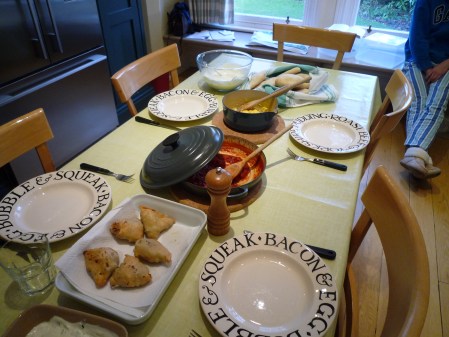
Making the pitta bread was straightforward enough – those little pockets appear as if by magic as long as there’s enough heat on the top surface of the bread. Very satisfying and deliciously fresh.
The samosas were, on the other hand, a complete faff. Making the filling of potatoes, peas herbs and spiceswas straightforward enough but forming the samosas was another matter…

I pride myself on having nimble fingers and being reasonably proficient with pastry, but shaping these wretched little tricorn parcels, coaxing them to stay open in order to push in the filling, then attempt to seal the whole thing up was the most technically challenging piece of cooking I’ve attempted in the last 2 years (and beyond that my memory fails me). I don’t often find myself saying this, but if you fancy a samosa, pop to your local Indian grocer and buy one.

Recipe for Khubz (pitta bread)
From Claudia Roden’s “A New Book of Middle Eastern Food” with occasional minor wording changes. Based on my recent breadmaking experience, I didn’t bother with warming the liquids, letting the yeast froth or oiling the baking sheets as specified in the recipe. The end result was just fine so by all means do the same if you are a confident breadmaker.
Ingredients
15g fresh yeast or 7g dried yeast
300 ml tepid water (approximate)
pinch of sugar
500g strong white flour
3g salt (1/2 teaspoon)
2 tablespoons vegetable oil (optional) plus a little extra for greasing
Dissolve the yeast in 100ml of the total amount of tepid water. Add the pinch of sugar and leave in a warm place for about 10 minutes, or until it becomes frothy and bubbly.
Sift the flour and salt into a warmed mixing bowl. Make a well in the centre and pour in the yeast mixture. Knead well by hand, adding enough of the remaining water to make a firm, soft dough. Knead the dough vigorously in the bowl, or on a floured board for about 15 minutes, until it is smooth and elastic, and no longer sticks to your fingers. Knead in 1-2 tablespoons of vegetable oil for a softer bread. Sprinkle the bottom of the bowl with a little oil and roll the ball of dough round to grease it all over. This will prevent the surface from becoming dry and crusty. Cover with a damp cloth and leave in a warm place free of draughts for at least 2 hours, until nearly doubled in size.
Punch the dough down and knead again for a few minutes. Take lumps of dough the size of a large potato or smaller (according to the size of bread you wish to have). Flatten them on a lightly floured board with a dry rolling pin sprinkled with flour, or with the palm of your hand, until about 1/2 cm thick. Dust with flour and lay the rounds on a cloth sprinkled with flour. Place them a good distance apart so that they do not touch as they grow considerably. Cover with another lightly floured cloth, and allow to rise again in a warm place.
Preheat the oven set at the maximum temperature (240 degrees C?) for at least 20 minutes, and leave the oiled baking sheets in it for the last 10 minutes to make them as hot as possible. Take care that the oil does not burn.
When the bread has risen again, slip the rounds onto the hot baking sheets, dampen them slightly with cold water to prevent them from browning, and bake for 6-10 minutes, by which time the strong yeasty aroma escaping from the oven will be replaced by the rich, earthy aroma characteristic of baking bread – a sign that it is nearly ready.
Do not open the oven during this time.
Remove from the baking sheets as soon as the bread comes out of the oven and cool on wire racks. The bread should be soft and white with a pouch inside.
If your oven does not get hot enough to make a good pouch, make the bread under the grill: put it low enough underneath so that it does not touch the grill (and burn) when it puffs up. Turn as soon as it does and leave only a minute longer.
Put the breads, while still warm, in a plastic bag to keep them soft and pliable until ready to serve.
Recipe for Vegetable Samosas
From Madhur Jaffrey’s “Indian Cookery” with a few minor wording changes of mine
Makes 16
Ingredients
For the pastry
1/2 lb (225g) plain flour
1/2 teaspoon salt
4 tablespoons vegetable oil
4 tablespoons water
For the stuffing
1lb 10 oz (725g) waxy potatoes boiled in their skins and allowed to cool
4 tablespoons vegetable oil
1 medium onion, peeled and finely chopped
6 oz (175g) peas fresh or frozen (defrost first if using frozen peas)
1 tablespoon peeled and finely grated fresh ginger
1 fresh hot green chilli, finely chopped
3 tablespoons very finely chopped fresh coriander
3 tablespoons water
1 and 1/2 teaspoons salt – or to taste
1 teaspoon ground coriander seeds
1 teaspoon garam masala
1 teaspoon ground roast cumin seeds
1/4 teaspoon cayenne pepper
2 tablespoons lemon juice
Vegetable oil for deep frying
Sift the flour and salt into a bowl. Add the 4 tablespoons of vegetable oil and rub it in with your fingers until the mixture resembles coarse breadcrumbs. Slowly add 4 tablespoons of water – or a tiny bit more – and gather the dough into a stiff ball.
Empty the ball out on to a clean work surface. Knead the dough for about 10 minutes or until it is smooth. Make a ball. Rub the ball with about 1/4 teaspoon of oil and slip it into a polythene bag. Set it aside for 30 minutes or longer.
Make the stuffing. Peel the potatoes and cut them into 5mm dice. Heat 4 tablespoons oil in a large frying pan over a medium flame. When hot, put in the onions. Stir and fry them until they begin to turn brown at the edges. Add the peas, ginger, green chilli, fresh coriander, and 3 tablespoons water. Cover, lower heat and simmer until peas are cooked. Stir every now and then and add a little more water if the frying pan seems to dry out.
Add the diced potatoes, salt, coriander, garam masala, roast cumin, cayenne, and lemon juice. Stir to mix. Cook on low heat for 3-4 minutes, stirring gently as you do so. Check balance of salt and lemon juice. You may want more of both. Turn off the heat and allow the mixture to cool.
Knead the pastry dough again and divide it into 8 balls (I did this with scales – each ball weighs 43-44g). Keep 7 covered while you work with the eighth. Roll this ball out into an 18cm round. Cut it in half with a sharp, pointed knife. Pick up one half and form a cone, making a 5mm overlapping seam. Glue this seam together with a little water. Fill the cone with about 2 and 1/2 tablespoons of the stuffing. Close the top of the cone by sticking the open edges together with a little water. Again, your seam should be about 5mm wide. Press the top seam down with the prongs of a fork or flute it with your fingers.
Make 15 more samosas.
Deep fry the samosas in small batches until they are golden brown and crisp. Drain on kitchen paper and serve hot, warm or at room temperature.
Who threw away all my grits? Bahamian breakfast
December 18, 2010 § 6 Comments
Tucking into our breakfast from the Bahamas – corned beef, grits and johnny cake felt like eating a plateful of history. That’s a big thing to be doing at 6.30 am on a dark and cold December Tuesday morning before work and school. Here’s younger son Arthur enjoying his corned beef sauté and grits, liberally sprinkled with Tabasco:
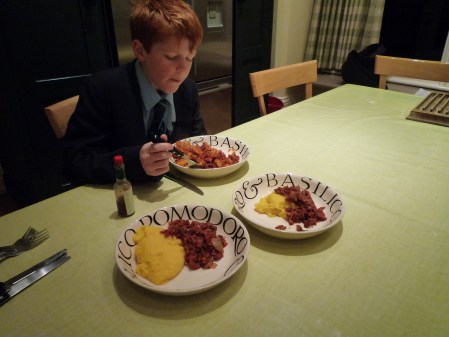
This was the latest in our series of breakfasts of the world (in alphabetical order) and after more than a year at this occasional project it feels good to be hitting the letter B for the Bahamas!
The Commonwealth of the Bahamas is an island chain close to Florida and north of Cuba. Andros is the largest island but capital Nassau is on the smaller island of New Providence. Columbus first made landfall on one of the islands of the Bahamas in 1492 but the islands were not settled by Europeans until English Puritans arrived via Bermuda in 1648. These first settlers survived by salvaging goods from wrecks. The islands became known for piracy and the infamous Edward Teach aka Blackbeard was based here.
Following the American War of Independence (1775-1783) the islands were settled by Loyalists (American colonists remaining loyal to British rule) and their slaves who established plantations on the islands. Britain abolished the slave trade in 1807 and thousands of Africans from slave ships subsequently made their home on the island.
On the menu was corned beef sauté (made from my own home-cured corned beef though the tinned variety may be more authentic) then grits – cornmeal porridge – in fact I used a quick cook polenta though I believe Bahamians prefer harder to obtain white grits. The hash was followed by a traditional Bahamian johnny cake, a simple baking powder raised scone/soda bread thing, quickly prepared then cooked in a skillet or sturdy frying pan:
Grits were the staple food of the slaves who worked on the plantations. They were a cheap carbohydrate and slave owners would give their slaves a weekly ration of cornmeal grits to boil up with water.
Corned beef reflects the British history of the islands. During the colonial period, Great Britain was the Bahamas’ major trading partner. Beef preserved in brine was shipped out in large quantities, another dietary staple for slaves and the poor. The native Bahamians made it their own, adding spices and vegetables to turn the corned beef into dishes like the sauté given below.
The name johnny cake is thought to derive from the name journey cake, so-called because it was quick and easy to make while travelling. Traditionally it’s cooked on the stove top but I opted for baking mine in the oven.
Here’s the home cured beef cubed and ready to be turned into hash:
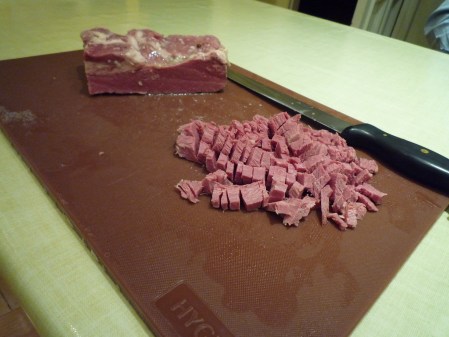
It’s wonderful stuff and very easy to do but you do need to start thinking about it 2-3 weeks before you want to eat it. This deserves to be the subject of another post sometime soon.
Here’s the freshly baked johnny cake just out of the oven:

and here it is sliced while warm ready to be thickly spread with butter and ready to be eaten Bahamian style with lots of sweet milky tea or coffee:
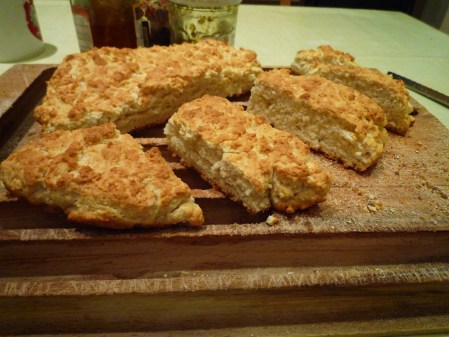
Definitely a breakfast to set you up for the day though in our case not for hard manual labour on plantations. And now the word of the Beach Boys’ Sloop John B (originally a folk son from the Bahamas) finally make sense. “The poor cook he got the fits, and threw away all my grits, and then he took and he ate up all of my corn”.
Recipe for corned beef sauté
Serves 4
From website http://www.caribbean.com which in turn credits the recipe to “Many Tastes Of The Bahamas & Culinary Influences of the Caribbean”
1 can (12 oz) corned beef
1 tsp freshly squeezed lime juice
1 tbsp vegetable oil
2 tbsp chopped onion
1-2 tsp dried thyme leaves
2 tsp tomato paste
Hot pepper to taste
A few tbsp of water
Place the corned beef into a medium-sized bowl and break up with a fork in preparation for cooking. Sprinkle with lime juice.
Heat oil in large skillet over medium heat. Sauté the corned beef with the onion and thyme for five to six mins. Stir in the tomato paste and crushed hot peppers to taste.
Add one to three tbsp of water for desired consistency and continue to cook, stirring.
Cover, reduce heat and cook for about 10 min.
Serve with grits or toast.
Recipe for Bahamian Johnny Cake
From http://foododelmundo.com/2010/03/07/bahamian-johnny-cake/
Makes one 7-8 inch round serving 4 comfortably
3 cups flour
1 tablespoon baking powder
1 teaspoon salt
1/4 cup sugar
1⁄2 cup Crisco or other shortening (such as Trex in the UK but I used butter as I’m not an avid consumer of hydrogenated fats)
2/3 cup milk
Combine dry ingredients then cut in (rub in) shortening until the size of rice grains. Add milk gradually, just enough to make dough soft. Knead dough until smooth then let it rest for about 10 minutes.
Place dough in greased 8 or 9 inch round or square pan. Pierce top of dough with a fork. Bake at 350 for 20-25 minutes or until golden.
Remove from oven and baste top of bread with milk. Return to oven and allow to bake for 5 more minutes. Remove from oven and allow to cool a few minutes.
Breakfast from Azerbaijan, Land of Jam
November 3, 2010 § Leave a comment
So says the Azerbaijani tourism and information site http://www.azerbaijan24.com/, informing us that “Azerbaijanis make jam from almost anything – walnuts, watermelon and even rose petals…the most popular jams are made from plums, raspberries, mulberries, pears, peaches, melons, figs, strawberries and cherries…grapes, pumpkin and pomegranates…even eggplants can be used as base for jam…If you visit an Azerbaijani home, undoubtedly you’ll be served homemade jam along with black tea. When tea is served, you’ll discover it’s rare in the Republic to be offered sugar. Instead, they’re more likely to offer jam. Azerbaijanis put a small spoonful of jam in their mouths and sip the tea through the jam.”
So, with their predilection for jam, Azerbaijanis are the Billy Bunters of the steppes (greedy fictional schoolboy Bunter liked nothing better than to raid his friends’ tuck parcels and devour jam straight from the jar).
I decided to make jam the centrepiece of the Azerbaijani breakfast (the latest in our A-Z series of international breakfasts). This was a cheaper and easier option than trying to get hold of my first idea which was caviar. After all, Azerbaijan, nestling between Russia, Iran, Armenia and Georgia has a border on the West side of the Caspian sea, home to the sturgeon which produce the coveted caviar.
Muslim Azerbaijan (in contrast with its largely Christian neighbour Armenia) was under Soviet control until it declared independence in 1991 under the Gorbachev glasnost era. Oil is a major earner for the country with activity centred around the capital city of Baku. You may recall that the 1990s Bond Film “The World is Not Enough” with its convoluted oil industry plot featured scenes set and filmed in Azerbaijan.
Enough of background and onto breakfast. This was the prepared table:

On the menu was of course my prize jam collection (including a weird watermelon rind jam which was my only homemade contribution), also Azeri flatbread, sheeps-milk cheese, fresh fruit (including of course the flesh of the watermelon the rind of which went into the jam).

All this was washed down with small glasses of black tea drunk Azeri style with yet more jam.
Here is my completed jar of watermelon rind jam looking distinctly pondlike:

Was the jam worth the effort? No. The resulting jam is dense, sticky and with a taste a bit like cooked marrow – ie vegetal, ever so slightly bitter and not particularly pronounced. The recipe came from the improbably specific website www.watermelonrind.com. There is an alternative recipe on the Azerbaijan 24 site I referenced earlier but that recipe makes use of a rather scary sodium hydroxide solution to crisp up the rind before cooking. Not only is this stuff hard to obtain but it’s also toxic so I thought I’d give it a miss.
Much more to my safe Western taste is the following recipe for Azeri flatbread from the comprehensive and appealing site www.azcookbook.com. My bread, pictured below, is a little more rustic than the photo on the AZ Cookbook site but in my book rustic is good and the toasted sesame seeds tasted delicious:

Recipe for Azeri flatbread
With thanks to http://www.azKitchen.com.
Ingredients
1 package (1/4 oz / 7g) dry yeast
1 ½ cups (12 fl oz/375 ml) warm water
1 teaspoon salt
3 cups bread flour, plus extra for kneading
1 beaten egg for brushing (or just the yolk for a really golden colour)
1 teaspoon poppy or sesame seeds
1. In a small bowl, mix yeast with water until the yeast is dissolved.
2. Sift flour into a large bowl. Add salt and mix well. Gradually add the yeast-water mixture and stir in using your hand until a rough ball forms.
3. Scrape the dough onto a lightly floured surface. Press any loose dough pieces into the ball and knead the dough, punching it down with your fists, folding it over and turning. Knead for about 8-10 minutes, or until smooth and elastic.
4. Shape the dough into a ball and put it back into the large bowl. Cover the bowl with a kitchen towel or a plastic wrap.
5. Leave the dough to rise in a warm spot for about 1 ½ hours, or until doubled in bulk. The dough should look puffy and be soft when poked with a finger.
6. Punch down the dough, then transfer it onto a lightly floured surface.
7. Shape the dough into a ball, and with your hands flatten slightly and stretch it lengthwise. Using a rolling pin, start rolling the dough beginning at one end until you obtain a long flat bread about ½ inch thick (1.27cm), 14 inches long (35cm) and 8 inches (20cm) wide.
8. Carefully transfer the bread onto a non-stick baking sheet, fixing the shape as necessary. Leave the dough to rest on the sheet for another 15 minutes before baking.
9. Preheat the oven to 400?F (200?C).
10. Using a knife, make shallow crosshatching slashes on the bread, 4 from right to left and 4 the opposite way, each at a slight angle. Brush the bread evenly with the egg/egg yolk and sprinkle with seeds.
11. Place the baking sheet on the middle rack of the oven and bake the bread for 20-25 minutes, or until it is golden on top and sounds hollow when tapped on the bottom.
Recipe for watermelon rind jam
Ingredients
Recipe taken from the very specific website http://www.watermelonrind.com. I can’t say I recommend the finished article but here’s the recipe to satisfy your curiosity.
1lb watermelon rind cut into 1cm cubes
water to cover
3 cardamom pods
1 tablespoon lemon juice
1 1/2 cups white granulated or preserving sugar
1 strip lemon peel
Place the watermelon rind in a large saucepan and cover with cold water. Bring to the boil, cover and simmer for half an hour until the rind is tender and translucent. Drain, reserving 1 and a half cups of cooking liquid. Add the cooked rind, reserved cooking liquid, lemon peel and sugar to your preserving pan. Bring to the boil and cook for 15 minutes. Remove from the heat, cool, cover and leave overnight.
The next day, add the cardamom pods bring the mixture back to the boil. Cook for approximately 15 minutes until a thick syrup has formed. Remove from the heat, stir in the lemon juice and pot in the usual way.
I’m going to conclude my post Azeri style by wishing you NUSH OLSUN
…and the good news is we’re through all the countries beginning with the letter A so next stop, the Bahamas!
Guten Morgen Von Österreich: Austrian breakfast
September 2, 2010 § 4 Comments
It was during winter holidays in Austria that I first began to gain an understanding of the German (in the widest sense) concept of gemütlichkeit (usually translated as cosiness but meaning much much more). At the Hotel Karl Schranz in the resort town of St Anton in the Tirol, this concept was embodied in the dining room with its wood panelling, flickering candlelight, pink linen napkins, and perfect attentive service. The eponymous Herr Schranz would occasionally grace us with his regal presence: the skiing wild child of the 1960s now transfigured into portly gentleman hotelier.
Herr Schranz clearly runs a tight ship as breakfast at his hotel was always an absolute delight – fruit juices decanted into glass jugs (my favourite being “Multivitamines” a bright orange concoction big on carrot and passion fruit juice); müsli and other cereals; delicious thick yoghurt; fruit salad; all kinds of jam, boiled eggs; and best of all wonderful bread – multigrain loaves thick with pumpkin and other seeds, rye bread, white bread and the distinctive and ubiquitous semmel white rolls.
Here is the Karl Schranz experience recreated at home as best I could:

A trip to Chorlton’s legendary Barbakan bakery and delicatessen provided most of what was needed in terms of wonderful fresh bread, cheese and ham. Chorlton is a suburb of South Manchester with a cluster of good food shops – the Unicorn grocery for fruit, vegetables and vegetarian items; Frosts the butchers for excellent meat (including unusual items like squirrel from time to time!) ; Out of the Blue fishmongers for properly fresh fish filleted in front of you, bags of clams and the like…is it worth moving house to have all this on my doorstep I wonder? For now, food shopping in Chorlton remains an occasional treat.
Here’s the Barbakan shop-front, a little unprepossessing from the outside but a real treasure-trove inside. My hands were too full and the shop too busy for me to take a good photo inside. On sunny Saturday mornings, the queue for fresh bread stretches out of the door so best to get there early.
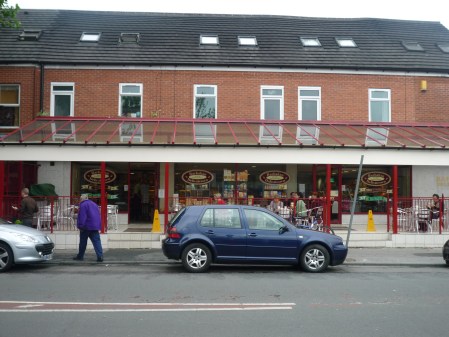
I’ve just checked out the website http://www.barbakan-deli.co.uk/ and see that they have recently won, very deservedly, the 2009/10 Manchester Food and Drink Festival’s “Best Food and Drink Retail Outlet” award.
Barbakan’s 2 founders are Polish and much of their bread has a distinctly Eastern European feel – lots of rye loaves, and both caraway and poppy seeds are a preferred flavouring. Sadly on the morning I called they were fresh out of both Vienna sticks and Kaiserbrot, both of which would have been perfect for my Austrian theme. Instead, I opted for two loaves (German Altenburg rye bread “the true taste of Bavarian rye” , and a second rye loaf this one flavoured with caraway) and and some Polish poppy seed biegles, the originator of the modern US bagel. After all, poppy seeds are popular in Austria too most startlingly in the form of a main course germknödel (poppy seed dumpling) served with lashings of custard…I digress, so back to the bread, pictured below:
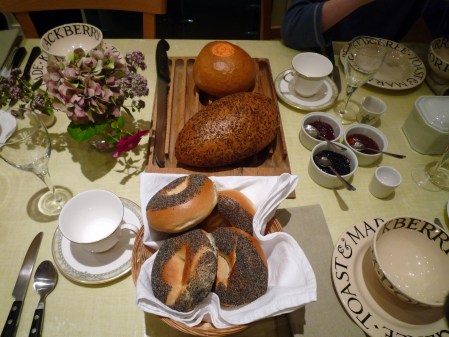
A true Austrian Hausfrau would have made all her own jams and preserves. Mine were all bought on this occasion, but as a nod to tradition I made a simple blackcurrant compôte to serve with yoghurt from the tempting looking punnet of blackcurrants that came from the Unicorn grocery just across the road:
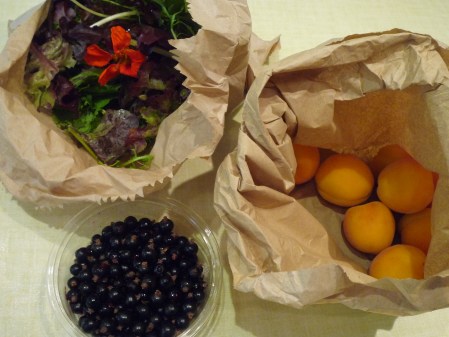
Pictured with the blackcurrants are an equally tempting bag of ripe apricots and the fabulous Glebelands Road grown salad leaves – you can’t get more locally grown salad than this unless it’s in your back garden of course.
Here’s the finished compôte together with yoghurt and some pumpkin seeds to sprinkle on top. Austrians are nuts about pumpkins in any shape or form. Especially good is the deep green roast pumpkin seed oil which gives a wonderful flavour to salad dressings and, drizzled on top, to pumpkin soup.

All very pretty, but it takes a lot of effort to keep up this gemütlichkeit business – fresh flowers from the garden, best china, freshly laundered napkins and so on. The Austrian Hausfrau must be chained to the kitchen keeping up appearances. So for now it’s back to toast and cereal on the usual crockery, until our next international breakfast, this time from Azerbaijan…
Barbakan contact details
67-71 Manchester Rd
Chorlton cum Hardy,
Manchester
M21 9PW
Telephone: 0161 881 7053
Australian breakfast
August 4, 2010 § Leave a comment
Holy Dooley! What are these Cockroaches, Crow Eaters and Cane Toads up to! And you thought nothing was going on in the GAFA. There’s clearly more to an Australian cuisine than a billy and a Dingo’s breakfast (for a translation go to http://www.koalanet.com.au/australian-slang.html )
This was the latest in our series of breakfasts from all the countries of the world starting from A and going through to Z.
I decided to dive straight into the heart of Australia for inspiration for this breakfast and typed “Alice Springs breakfast menu” into my search engine. I half expected to discover something suitable for a sheep-wrangler but instead found some rather metropolitan on-trend suggestions from the Alice Springs Convention Centre. Selecting from their breakfast menu I devised this selection of my own:
Vegetarian frittata with sweet potato, peas and oregano tomato
Wattleseed french toast
Pancake with bush honey and crispy bacon
Next problem was where to get hold of the essential wattleseed and bush honey. An internet search led me first of all to Australian native ingredients evangelist Vic Cherikoff’s informative website to http://www.cherikoff.net (some inspiring recipe ideas too). He doesn’t really seem geared up to UK online retail orders though. Fortunately http://www.foodshopaustralia.com/ is a user friendly site with a wide range of stuff both gourmet and tacky. I ended up going a bit mad and ordering native fruit jams (both quandong and rosella), macadamia nut butter, bluegum honey, vegemite and Uncle Toby’s oat cereal as well as my ground wattleseed and to finish things off, a lemon myrtle infusion instead of regular tea. There was great excitement when my stuff arrived 2 weeks later in a distinctive blue hessian sack emblazoned with the Singapore post office logo through which my goods must have passed in-transit.

and here are all the Aussie goodies:

I made the French toast in the usual way but added a couple of teaspoons of Star Kay White chocolate extract to the milk into which I dipped the bread before dipping in the egg. This complemented the chocolate hazelnut flavours of the ground wattleseed. I sprinkled the cooked French toast generously with caster sugar and ground wattleseed and served it with a dollop of quandong jam. This was described as a native peach and was gorgeous, dark and syrupy – a more intense version of apricot jam. Delicious:

I devised my own recipe for the frittata which I give below. Also very successful – I’ve made it again since so I have a new addition to the repertoire. It’s shown here on the plate with the pancakes (again I used my regular breakfast pancake recipe) and some crispy pancetta.

Can I let you into a secret? I haven’t opened the Vegemite yet and maybe as the other stuff is so good I won’t bother…
Recipe for sweet potato, pea and oregano tomato frittata
I devised this based on an authentic Marcella Hazan recipe but with different ingredients and quantities to fit my trusty 10 inch Anolon non-stick frying pan. Serves 2-3 people.
Ingredients
2 medium sweet potatoes peeled and cut into 1 inch dice
2 tablespoons olive oil plus more for drizzling and cooking the frittata
Generous handful of shelled peas steamed for 2-3 minutes (or cooked from frozen)
8 oz cherry tomatoes
teaspoon dried oregano
tablespoon chopped fresh oregano or basil or marjoram
4 large eggs
4 tablespoons freshly grated grana padano cheese
salt and freshly ground black pepper
Toss the diced sweet potatoes in oil, season and roast on a shallow tray at 180-200 degrees C until cooked through and nicely brown. This takes about 30 minutes. Once these are in the oven prepare the tomatoes by halving, drizzling with olive oil and sprinkling with salt, pepper and oregano. Place on another shallow baking tray lined with baking paper and pop into the oven on the shelf below to roast with the sweet potatoes for about 20-25 minutes – they’ll be ready at the same time.
Meanwhile beat the eggs lightly with a fork in a large bowl, add the grated cheese, seasoning and chopped fresh herbs. When the sweet potatoes and tomatoes are ready, tip them into the egg mix straight from the oven along with the cooked peas. Stir to combine.
Heat a tablespoon of olive oil in a 10 inch non stick frying pan over medium heat. When it is hot, pour in the frittata mix and ensure evenly distributed. Turn the heat down as low as possible and cook for 10-15 minutes so that the mixture is set but not browned and only the top is still runny. Flash the top under a hot grill for 30 seconds to set the top. You’re ready to eat! Best served hot rather than warm I think. Also very good cold for lunch later if you don’t eat it all now.
Armenian breakfast
July 17, 2010 § 1 Comment
This is the latest breakfast in our family project to prepare and eat a breakfast from every country in the world in alphabetical order. The highlight was without doubt these plaited brioche-type breads called Choereg or Choreg which are in fact very simple to make once your plaiting technique is sorted out. As a little girl I had long hair often plaited so this was no problem.

What do I know about Armenia? Very little. “A landlocked country with Turkey to the West and Georgia to the North, Armenia boasts striking scenery with high mountains and caves, lakes and hot springs”. So says the BBC News website, along with a few other key facts: capital city Yerevan; population 3.1 million; land area 11,484 sq miles (ed: about twice the size of the English county of Yorkshire); major religion Christianity.
Armenia has a huge diaspora and famous Armenians or people of Armenian descent can be found all over the world: the composer Aram Khachaturian (whose Spartacus theme was used as the opening music for BBC TV series The Onedin Line) and singers Charles Aznavour and Cher are just a few examples.
This means too that there are many Armenians in Europe and the US wanting to recreate a taste of home, communicating with one another and sharing recipes which conjure up a taste of the homeland. Luckily for me, Armenian recipes are relatively easy to come by on the web,
I started my research with a visit to a Manchester institution, The Armenian Taverna which for as long as most people can remember has occupied discreet basement premises in Albert Square. It looks as if I was in the nick of time as, sadly, the restaurant went on the market last month.

Owner Mafif Alamyan (reputed to be a former Olympic wrestler) was most helpful when describing typical Armenian breakfast dishes. Eggs, tomatoes and cheese featured on his list as did Armenian bread. It was in describing the fruit of Armenia, both fresh and preserved as jam, that he became almost lyrical – he talked of green walnut jam, apricots (the Latin name for the apricot is after all Prunus armeniaca) , cherries and especially mulberries. I recommend a visit to the Armenian Taverna before it vanishes for ever http://www.armeniantaverna.co.uk/
Now I needed to flesh out Mr Alamyan’s guidance with some recipes. First stop was
http://www.thearmeniankitchen.com a vast repository of Armenian food and memories compiled by the Kalajian family now living in the US. Here I found a description of egg scrambled with tomatoes which seemed to fit the bill for a simple breakfast dish – so simple it doesn’t need a recipe, just Mr Kalajian’s simple instructions. “You cut up a tomato as chunky or delicate as you like and stir it into your eggs as you scramble them. Add salt and pepper and eat with bread”.
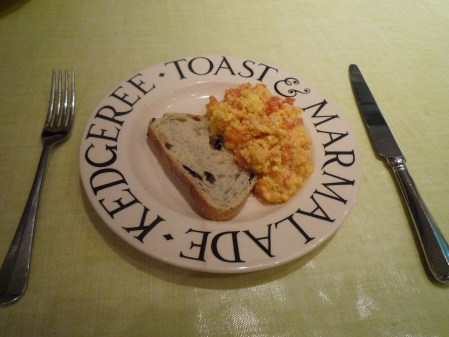
The next challenge was to try and locate mulberry jam. This could be tricky. The only mulberry tree I know of is Milton’s (so called because the poet sat and composed under its shade) in the Fellows’ Garden at Christ’s College in Cambridge. No way was I going to get permission to gather mulberries from there very easily. There had to be another way. Sadly I couldn’t find anyone selling mulberry jam made in the UK but specialist deli Mortimer & Bennett came up with the goods – a middle eastern mulberry jam made in the Lebanon. This would do nicely. Mortimer & Bennett are based in Turnham Green, West London and have a wide range of delectable and out of the ordinary deli items. They sell via their website as well as from the shop and I can vouch that they provide an efficient and personal service. My package of goodies (I just had to buy some oils and chocolate too as they offer free shipping if your order is £50 or more) arrived safe and sound a few days after ordering. Here’s the jam complete with rustic hessian lid cover:
http://www.mortimerandbennett.co.uk/

OK so the jam was now sorted so now for the bread. I found three Armenian bread/pastry recipes suitable for breakfast, the first Bishi (sometimes spelt BeeShee, sometimes also called Zeppole), a kind of doughnut, the second Keta, a walnut-stuffed Danish-type pastry and the third Choereg, a plaited sesame sprinked loaf enriched with eggs and butter (also spelt choreg and I reckon its similar to the Greek tsoureki too).
To make the most of the carefully sourced mulberry jam, I opted to make the plainest of the three breads, the choereg choosing a straightforward recipe contributed by Ani from Montreal which I found on Allrecipes.com. I give the recipe below but I did reduce the fat content of the recipe to just 8oz from the 1lb specified, similarly I used 4 eggs rather 5 – it still turned out spectacularly well.
A word on mahleb – this is a middle eastern spice made from the kernel of a special variety of cherry. I’d already started the recipe when I noticed this little bombshell in the list of ingredients so didn’t even attempt to track some down so added a slug of Amaretto and another one of Kirsch to try and provide the required almondy cherry flavours.
Recipe for Choereg – Armenian sweet plaited bread
Ingredients
1 cup whole milk (8 fl oz)
1 cup butter (8 oz or 225g)
1 cup white sugar (8 oz or 225g)
1/2 cup lukewarm water (4 fl oz or 120ml)
2 teaspoons white sugar
2 (.25 ounce) envelopes easyblend dry yeast
4 eggs (plus more beaten egg for glazing)
6 cups all-purpose flour plus more if required to obtain the right dough consistency (840g or 1 lb 14 oz) – I used a mixture of strong and ordinary plain white flour
1 1/2 teaspoons baking powder
1 1/2 tablespoons ground mahleb (see note above)
1 1/2 teaspoons salt
1 tablespoon sesame seeds
In a saucepan over medium heat, combine the milk and butter. Heat until butter is melted, but do not let it boil. Stir in 1 cup of sugar until dissolved, then set aside to cool to lukewarm. Crack the eggs into a large bowl, and stir a little to break up the yolks. Slowly pour in the heated milk mixture while whisking constantly, so as to temper the eggs and not cook them.
In a large bowl, combine the flour, sachets of easyblend yeast, baking powder, mahleb, and salt. Make a well in the centre, and pour in the wet mixture. Stir until it forms a sticky dough. Pour onto a floured surface, and knead in additional flour as needed to make a more substantial dough. Knead for about 10 minutes. Place in an oiled bowl, and set in a warm place to rise for about 2 hours, or until doubled in size.
When the dough has doubled, punch down again, and let rise until doubled. It will only take about half as long this time.
Separate the dough into 5 even portions, then separate each of those into thirds. Roll each of those into ropes about 12 inches long. Plait sets of three ropes together, pinching the ends to seal, and tucking them under for a better presentation. Place the loaves onto baking sheets. Loaves should be spaced 4 inches apart. Set in a warm place to rise until your finger leaves an impression behind when you poke the loaf gently.
Preheat the oven to 350 degrees F (175 degrees C). Brush the loaves with beaten egg, and sprinkle with sesame seeds.
Bake for 25 minutes in the preheated oven, or until nicely golden brown all over.
Buenos Dias Buenos Aires! Breakfast from Argentina
May 15, 2010 § Leave a comment
It’s been a while since we had our last international breakfast (see Breakfasts of the World category in the sidebar). The plan is to work through every country in the world in alphabetical order and it must be at least a month since Antigua.
I was pretty excited about the prospect of an Argentinian breakfast. Surely there would be mounds of barbecued steak? Sadly not. I was amused by one travel blog which recorded with disappointment that breakfast in Argentina comprises a croissant (known as medialuna), a coffee and a glass of water. The beef for which Argentina is justly famous is strictly a main meal affair.
So our breakfast was indeed medialunas (bought not made), café con leche and of course, lashings of wonderful dulce de leche. Sadly the Merchant Gourmet dulce de leche, authentically Argentinian from the evocatively named La Esmeralda farm seems to have disappeared from our local supermarket shelves and I had to make do with a Bonne Maman Confiture de Lait, a similar sweet milk caramel idea but from France and not quite as thick and unctuous.

If you too are suffering from dulce de leche withdrawal symptoms, here’s the Merchant Gourmet website dulce de leche page – you can buy it online now with free delivery if you buy in bulk.
http://www.merchant-gourmet.com/products/dulce-de-leche/dulce-de-leche-caramel-toffee/
I also noticed that the San Ignacio brand of dulce de leche has its own UK website now which gives some useful background info on what it is and how it’s made and a singularly unuseful list of retail stockists. They are listed in alphabetical order of shop name so you have to scan the whole list by eye to find a shop near you. I came up with Harvey Nichols in Manchester and a deli in Frodsham, Cheshire as possibilities for me.
I digress. Back to the proper business of breakfast. A bought croissant, a cup of coffee and a jar of caramel was OK but didn’t quite hit the spot. I had to get beef into the breakfast somehow so I trawled the internet until I found a reference to eating beef empanadas (pasties to you and me) for breakfast. I’d struck gold at last!
I found a recipe for beef empanadas in “South American Food and Cooking” by Jenni Fleetwood and Marina Filipelli – essentially a minced beef and potato stuffing encased in dinky shortcrust pastry rounds folded over to make mini pasties.
Here are the pastry circles and filling:

And here is the complete breakfast with the empanadas fresh out of the oven. I made a quick salsa with tomato, pepper, avocado, coriander and plenty of lime juice and seasoning to serve with the pasties:

Recipe for beef empanadas
I simplified the recipe I found in “South American Food and Cooking” by Fleetwood and Filipelli. I’ve halved the filling quantity which was way too much for the specified pastry quantity. I used minced beef rather than shredding it finely and baked the pasties rather than deep frying them for a lighter result. This worked well.
Ingredients
1 lb (450g) shortcrust pastry (bought or make your own with 8 oz (225g) flour; 4 oz (90g) fat)
l lb (450g) minced beef (use shin or leg if mincing your own)
4 tablespoons oil
1/4 tsp ground cumin
1 crushed garlic clove
2 tsp paprika
8 fl oz (250 ml) light stock
1lb (450g) waxy potatoes scrubbed (no need to peel) and finely diced
3 chopped canned tomatoes (or fresh ones skinned)
3 spring onions finely sliced
salt and pepper
Make the filling. Heat the oil in a heavy large frying pan. When hot, add the beef and sauté until lightly browned. Push the beef to the side of the pan and add the cumin, garlic and paprika. Reduce the heat and cook gently for about 2 minutes until the spices release their aroma.
Stir in the stock and bring to the boil. Cover and cook for 30 minutes. Stir in the potatoes, tomatoes and onions and cook for 15 minutes more until the potatoes are tender. Keep an eye on the cooking liquid adding a little more water if necessary or alternatively reducing if there is too much. You are aiming for quite a dry mixture. Season and allow to cool completely.
Roll out the pastry very thinly on a floured board. Using a pastry cutter cut out 2 and 1/2 inch (6cm) circles. Spoon about 1 and 1/2 tsp filling into the centre of each pastry circle. Brush the edges of the pastry with water. Fold the pastry over to form a half moon. Turn the edges over and press together firmly to form a good seal. Bake at 200 degrees C until the pasties are golden brown.
Serve with your favourite fresh salsa.
Enjoy your Argentian breakfast! Carlos Tevez, if you happen to read this please do drop me a line with your breakfast thoughts…
Antigua & Barbuda breakfast
February 16, 2010 § Leave a comment
I have never been to Antigua so this was a virtual voyage of discovery for me. Fancifully, I see the whole Caribbean archipelago as the curved vertebrae of some fantastic fossil creature. At the top there is Cuba, next the island of Hispaniola comprising Haiti and the Dominican Republic, then Puerto Rico. The remaining islands dwindle in size curving gracefully towards the South American mainland coast. Antigua is one of the tiny vertebrae at the base of the spine slotting in not far below Puerto Rico.
The island’s name was given to it by Christopher Columbus in 1493 in honour of the Santa Maria La Antigua (St Mary the Ancient) church in Seville. The British occupied the island from 1632 and soon established a lucrative sugar trade based on slavery. Nelson established a naval dockyard there in 1725. Antigua remained under British control until 1981 and it remains part of the Commonwealth.
Based on a quick web search for information and pictures, Antigua is clearly now reliant on tourism and is chock full of expensive hotels catering mainly for a US clientele. I settled on the Carlisle Hotel “situated on the unspoilt south coast of Antigua overlooking one of the most beautiful bays in the Caribbean”. It is one of just four hotels collectively forming the of the Campbell Gray group of four hotels. Other group members are One Aldwych and Dukes in London and rather oddly, a gaff in Beirut.
Back to the Carlisle. From the hotel’s “Indigo on the Beach” breakfast menu I picked out the following dishes with a bit of local colour:
Fresh-cut tropical fruit
Crispy bacon, avocado, fried plantains, two eggs any-way
Banana bread
Coffee and mango juice to drink
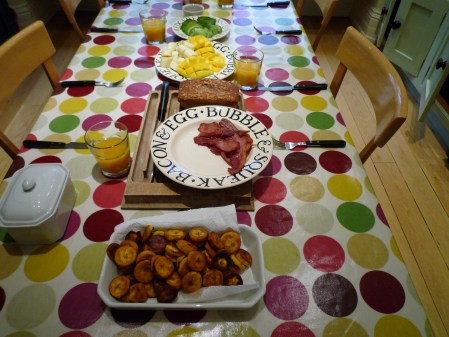
A visit to the lively “Strawberry Garden” fruit and vegetable stall in Manchester’s Arndale market provided plantains, bananas, mangos and avocadoes.
Whilst I’m on the subject, what a disaster area the Arndale Market is! It’s indoors, partly underground, and nail bars rub shoulders with food stalls resulting in a strange aroma which is an unholy combination of salt cod and acetone.
I recall that various council officials visited Barcelona’s Boqueria market to gain inspiration for the Arndale market revamp a few years back. Clearly they either suffered from a lack of imagination or else failed to put into practice what they saw. However there are a handful of stalls which buck the mainly dismal trend, Strawberry Garden being one and the fantastic looking but unimaginatively named “Direct Fish” fishmongers popular with Chinese and Caribbean cooks being the other.
Plantains can easily be mistaken for bananas but this comparison shot show the differences. Plantains are super-sized, a bit more fibrous and even when ripe rather more green than a banana.

Fried for a couple of minutes each side in hot oil they morph from soft, sallow slices into a crispy, golden-brown starchy mouthfuls of heaven. A great addition to breakfast.

Just the banana bread to bake and we’re ready to go.
There are hundreds of banana bread recipes out there. One which I use regularly is Gary Rhodes’ recipe which is really more of a sticky cake than a bread. Bill Granger has a gorgeous breakfast recipe for chocolate and banana loaf which is heavenly if made with grated unsweetened dark chocolate. I found one recipe on the web which purported to be authentically Caribbean and had a delicious flavour from the inclusion of Muscovado sugar and grated nutmeg but the texture was not good – too crumbly.
The banana bread recipe which I can recommend comes from the ever-reliable Four Seasons cookbook by Margaret Costa. I’ve swapped her caster sugar for Muscovado and added a handful of chopped walnuts and a flavouring of grated nutmeg to pick up on the best points of the Caribbean recipe.
Recipe for banana bread
Adapted from Margaret Costa
Ingredients
2 oz (55g) butter
4 oz (115g) Muscovado sugar
1 egg
2 large or 3 small ripe bananas mashed with a fork to as smooth a pulp as you can manage
8 oz self raising flour
handful chopped walnuts (about 2 oz I would guess)
1/2 teaspoon freshly grated nutmeg
1/2 teaspoon salt
3 tablespoons natural yoghurt
Cream the butter and sugar together until light and fluffy. Beat in the egg and banana pulp. Add, alternately, the flour sifted with the salt and nutmeg and the yoghurt. Fold in the chopped walnuts. Pour the mixture into a greased loaf tin and bake for an hour at 180 degrees C (350 degrees F; gas mark 4).
Slice thickly and spread with butter if you like.
In the depths of a UK winter, after a breakfast like this, you can imagine being wafted away to the warm Caribbean overlooking that beautiful bay from the Carlisle hotel terrace….
Angolan breakfast of champions
January 30, 2010 § 4 Comments
The African Cup of Nations tournament reaches a climax this weekend with the final being contested on Sunday 31 January 2010. Briefly, the spotlight will shine on Luanda, Angola’s capital when Ghana and Egypt compete for the trophy. What might the teams eat for breakfast beforehand? We can offer the following menu based on an Angolan breakfast we prepared at home a couple of weeks ago.
Our chosen menu was funje, a traditional cassava porridge; tropical fruit; pão burro literally “donkey bread” a Portuguese influenced recipe reflecting Angola’s colonial past; quince and plum preserves again reflecting the Portuguese history; and finally, coffee to drink.
I talk about Angola’s colonial past but it was as recently as 1975 that Angola achieved independence from Portugal. Civil war lasting until 2002 broke out almost immediately, a civil war that didn’t really impinge very much on our consciousness over here. I remember with some embarrassment being questioned by a sharp civil service interviewer about my views on the conflict in Angola when I attempted to join the foreign office some years ago now. As a callow twenty year old I didn’t have much to say and stared back at him blankly. No, I didn’t get the job…
In terms of geography, Angola sits just above Namibia on the west coast of southern Africa. Huge numbers of square miles or kilometres become meaningless to me after a certain size: at 481,000 square miles, Angola is very roughly twice the size of France (or twice the size of Texas for those with a more transatlantic viewpoint). I took a dreamy trip along Angola’s 1,000 mile long Atlantic coastline, courtesy of Google Earth – seemingly endless sandy beaches with Atlantic breakers hitting the shore. There must be potential for Angola to become a cult surfing destination. Sure enough, go to YouTube and you will find mesmeric scenes like this one. Those in the know would call it a left point break:
http://www.youtube.com/watch?v=khKUN5Vo-p8
How did I come up with the breakfast menu? Cassava flour is a staple food across West Africa. The name for this in Angola is funje or fufu. This is most frequently turned into a porridge. I found the instructions for making funje porridge here:
http://www.celtnet.org.uk/recipes/miscellaneous/fetch-recipe.php?rid=misc-funje
They read as follows:
Recipe for funje from Angola
“What you need for the traditional method (of preparing funje) is a deep pan and a funje stick. This is a long-handled stout wooden spoonwith a flattened oar-like blade (typically it’s 35cm or longer). Almost every West African household has one of these (we have my wife’s family version). For perfect funje you need twice the volume of water to the amount of cassava flour.
Bring the water to a boil and as soon as it’s boiling remove from the flame, sit on the floor, wrap in a cloth and hold steady with your feet. Add all the cassava flour in one go and beat energetically with the funje stick. You must beat very hard and fast as the mixture thickens rapidly and if you do not beat thoroughly you will end-up with lumps and hard ‘kernels’ rather than a smooth dough-like porridge.”
My first problem was how to get hold of the funje flour itself. Fortunately, Manchester is a thriving cosmopolitan metropolis and I quickly located a specialist African grocery, Global Africa, based in Hulme market hall (just next to Asda). I give contact details below. The two African guys running the shop viewed me with some suspicion as I walked in. Any hopes I might have had about engaging them in conversation about the tropics and picking up some recipe tips were quickly dashed. Our exchange was monosyllabic but I did end up with what I was looking for – a 3kg bag of fufu, the cheerfully packaged Tropical Sun brand.

This is how I interpreted the recipe instructions, swapping funje stick for a conventional wooden spoon:
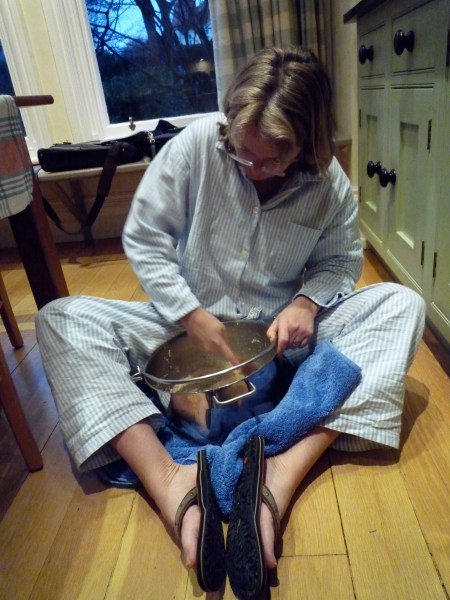
I am sorry to report that my first attempt at funje was lumpy and full of the hard pellets that the above instructions tell you to avoid. It would be an understatement to say that this was not one of my favourite breakfast foods. It had a distinctly challenging slippery, gelatinous consistency and the taste was bland but with a not altogether appealing chemical astringency. I managed a teaspoonful but then I must sheepishly report that I put the rest on our compost heap.
I read about pão burro (literally donkey bread) being a traditional Angolan food but internet searches revealed no recipes, just references to a funky sounding Angolan rapper who has adopted this as his stage name. I came up with a rustic bread recipe, half wholemeal, half white flour which is my interpretation of what something called donkey bread might taste like. To go with it, I thought quince and plum conserves (from pukka English jam makers Tiptree) had the Portuguese influence I was looking to incorporate.
Angola does produce tropical fruit and some coffee, but there’s little or no chance of finding Angolan exports over here so we made do with a Ghanaian pineapple, some bananas of indeterminate origin and a guava (which being South American isn’t in fact at all authentic!) plus our usual house coffee blend. Here’s the finished breakfast ready to be served.
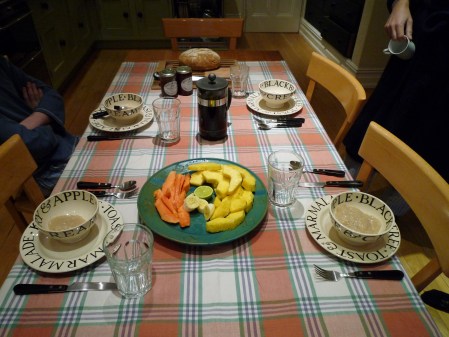
I could just about imagine myself at a beachside café in Luanda eating this kind of thing…
May the best team win on Sunday!
Contact details
Global Africa
78 Hulme High Street,
Manchester
M15 5JP
Tel 0161 232 9797
 The Rhubarb Fool