
In celebration of Chopin
July 5, 2010 § 1 Comment
2010 has been a big year for devotees of the composer Frédéric Chopin as it is the 200th anniversary of his birth. There have been all sorts of celebrations of his music going on all over the world. Last month I was lucky enough to be able to host a Chopin evening at home with my friend Andrew Wilde performing some of Chopin’s music. The format of the evening was for 20 friends to come over for drinks and canapés with Andrew playing a mini-recital for 20-25 minutes. Andrew is a concert pianist and was preparing for his all-Chopin Bridgewater Hall recital.
Given the time of year (late spring) and the weather (glorious), we decided to go for a multi-sensory experience focusing on a high point in Chopin’s life, the seven summers he spent at Nohant between 1839 and 1846. Nohant was his lover George Sand’s country house in the Berry district of central France. Chopin composed some of his finest music there, inspired by the beautiful and peaceful surroundings away from the hustle and bustle of Paris.
Here is a picture of the exterior of George Sand’s house at Nohant which we visited last summer:

For our Manchester-based Chopin evening, Andrew would take care of the music but it was over to me to take care of the visual, smell and of course taste side of things. In terms of the visuals, I went for flowers and candles, including some potted hydrangeas outside, just like in the picture. Favourite shop L’Occitane helped provide a subtle hint of cherry blossom room fragrance to help conjure up the rural French idyll.
Now for the menu. I offered the following drinks:
Kir Berrichonne – an unusual kir which is a speciality of the Berry region – it’s crème de mûre (blackberry rather than the more usual blackcurrant) mixed with chilled red wine – a local pinot noir. It sounds weird, but trust me, it’s good. As my friend Vivienne put it, “like a mulled wine for the summer”
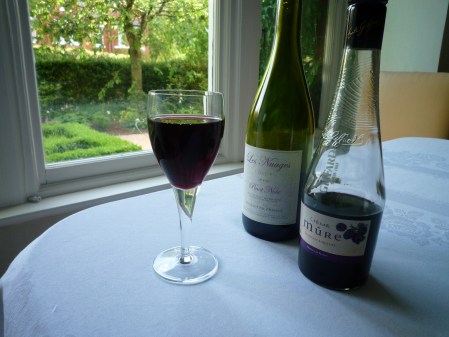
Kir Royale – the same crème de mûre but mixed with champagne, after all this was a birthday celebration for Chopin
Citron pressé – the ultimate French café soft drink
Raspberry and rose cordial – one of Belvoir’s cordials – a non-alcoholic version of the kir
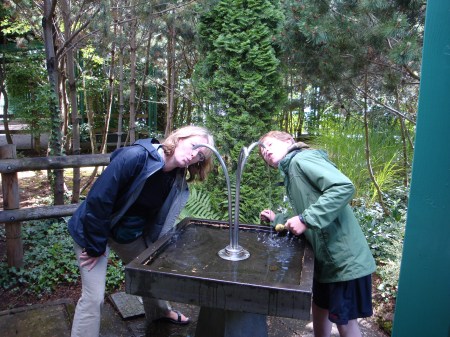
Volvic mineral water – the Volvic spring is a couple of hours drive south from Nohant in the volcano country of the Auvergne. We visited the Auvergne volcanoes on the trip to France which took in Nohant last summer. Here am Itogether with son George drinking directly from the Volvic source:
For the canapés, after a little research, I came up with the following:
Rillettes de canard with cornichons on toasted French bread
The classic rillettes du Tours is a speciality of central France and is made from slow-cooked shredded pork belly. The duck version is similar and equally good. The duck shreds very easily with a pair of forks and so, once the long slow cooking in the oven is done, there is very little for the cook to do.

Fresh goat cheese and chives on toasted French bread
Goat cheese can be found all over France but is a particular speciality of the Berry region.

Mini croque-monsieurs – a French café classic. It’s always nice to have something hot when serving nibbles with drinks. I give my recipe for the cheese mixture (in fact a modified Welsh rarebit!) which forms the foundation of a croque- monsieur and instructions for how to turn it into a toasted sandwich below.

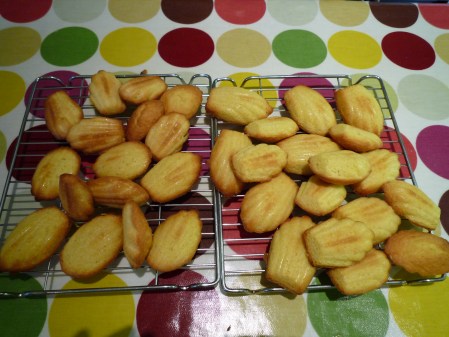
Pistachio macaroons and madeleines – it feels good to round-off the evening with something sweet. Dainty macaroons and madeleines seem to marry well with the refined nature of Chopin’s compositions.
Here are several batches of madeleines fresh from the oven cooling on a wire rack. They are quick and easy to make and, though I say so myself, put the Bonne Maman ones to shame. The one thing you have to do is invest in a couple sets of moulds. The flexible silicone ones which are on offer nowadays work just fine.
The music Andrew played that evening was:
Piano sonata no. 2 in B flat minor, Opus 35 – 1st movement only
Berceuse in D flat, Opus 57
Polonaise in A flat, Opus 35
It was amazing to hear our modest upright piano transformed at the hands of a virtuoso pianist! I hope that my efforts to recreate the mood of Nohant helped to enhance the music and sense of atmosphere that evening.
To conclude, here are the recipes I promised earlier:
Recipe for Welsh Rarebit
This is a really useful recipe which I discovered in Gary Rhodes’ cookbook “Rhodes Around Britain” published back in 1994 to accompany the BBC TV series of the same name. It makes a very superior cheese on toast, which cut into small pieces makes a delectable and easy canapé to serve with drinks. The recipe requires 1 and 1/2 lb cheese which sounds like a lock, but as the original recipe advises, this is really the minimum for a successful mixture. It keeps well in the fridge for a week or so and also freezes well.
Ingredients
700g (1 and 1/2 lb) mature hard cheese, grated – Cheddar in the original recipe but I used Comté for my French version
150 ml (5 fl oz) milk
25g (1 oz) plain flour
50g (2 oz) fresh white breadcrumbs
1 tablespoon English mustard powder (I used 2 tablespoons prepared smooth Dijon mustard for French version)
2 shakes Worcester sauce (I used an alternative flavouring of grated nutmeg and a tablespoon of dry vermouth for my French version)
salt and freshly ground white pepper to taste (very little or no salt will be needed depending on the type of cheese used)
2 eggs
2 egg yolks
Put the grated cheese into a medium heavy based saucepan and add the milk. Slowly melt them together over a low heat but do not allow the mix to boil as this will separate the cheese, a frustrating not to say expensive mistake! When the mixture is smooth and just begins to bubble, add the flour, breadcrumbs and mustard and cook for a few minutes, stirring, over a low heat until the mixture comes away from the sides of the pan and begins to form a ball shape. Add the Worcestershire sauce (or alternative flavourings) salt (if necessary) and pepper and leave to cool.
When cold, place the mixture in a food processor, turn on the motor and slowly add the whole eggs and yolks. You can beat vigorously with a wooden spoon instead if you don’t have a food processor but I haven’t ever tried the manual method. Once the eggs have been mixed in, chill for a few hours before using.
Recipe for Croque-Monsieur
A recipe of my own devising based on a Frenchified Welsh rarebit (see above) and memories of many croque monsieurs eaten in French cafés.
Ingredients
For each sandwich:
2 slices good white bread, generously buttered
1 slice cooked ham
ball of rarebit mixture about the size of a small tangerine
1 tablespoon finely grated Comté cheese
Make a ham sandwich with the buttered bread and slice of cooked ham. Take the ball of rarebit mixture and flatten it into a rectangle the same size as the sandwich. Place on top of the sandwich and sprinkle with the grated cheese. Bake in an oven preheated to 180 degrees C for 8-10 minutes until the bread is lightly toasted and the rarebit mixture has puffed up a little and is golden brown. Trim of the crusts and cut into squares or fingers for a dainty canapé, otherwise just cut into half and serve for a lunchtime snack.
Riverside picnic
June 24, 2010 § Leave a comment
At this time of year, my thoughts turn to the perfect riverside picnic. I blame my obsession with this idea on a photograph in my mother’s copy of “The Robert Carrier Cookbook” which, as a child, I would turn to repeatedly. The picture showed a bottle of Loire white wine chilling in a gently flowing river somewhere in the green heart of La France Profonde. Mature trees in full leaf shaded a table set for two on the river bank. The food on offer was freshwater crayfish and, I think, quenelles de brochet (delicate little poached pike mousses).

So now once a year my family indulges me in living out this fantasy albeit in a less elaborate form than the Robert Carrier original. When good weather is forecast for a weekend in late spring we pack up a hamper of suitable food and head off for the limestone dales of the Peak District.

What constitutes suitable foods for such a picnic? I draw inspiration from the surrounding landscape. Watercress has to feature as it grows wild in the limestone streams, also river fish, generally trout as it’s easy to come by. I give a recipe below for a quick and easy smoked trout pâté. Young goat cheese has become part of the ritual and tastes good with the watercress and a loaf of walnut bread. Nantwich based Ravens Oak dairy (now owned by Butlers) produces very likeable goat cheeses which, conveniently are stocked by Marks & Spencer. I picked up both their Kidderton Ash and regular Ravens Oak goat cheeses for this picnic. You can have a look at the Butlers range at www.butlerscheeses.co.uk The Cheese Hamlet in Didsbury stock a lovely Ticklemore goat’s cheese from Devon in the summer months too.

Asparagus is in season and adds a festive note to the proceedings. I always roast rather than steam it now as it’s a foolproof method that concentrates its flavour. A cool jambon persillé would be good too – the chunks of pink ham in its bright green parsley jelly recalling the clear river water and flowing water weed.
This year, I took along a chilled soup – a refreshing Spanish Ajo Blanco. This is an odd-sounding mixture of bread, almonds, garlic, sherry vinegar and plain cold water which which, when blended to a thin purée, chilled and garnished with halved grapes turns into an infinitely refreshing chilled soup, much more than the sum of its disparate parts. The soup seemed very appropriate as wild garlic was everywhere in all its pungent glory.

A picnic wouldn’t be a picnic without cake to finish. I try and keep the cool green theme going even here. Jane Grigson’s gooseberry pound cake has been successful on a previous picnic, but this time we took along wedges of my courgette and lemon cake: see my previous post https://rhubarbfool.co.uk/2010/05/22/relaxed-cooking-for-the-holidays/

Here are two of my recipes – both very simple for summer lunches at home as well as picnics
Recipe for smoked trout pâté
Ingredients
4 smoked trout fillets (or 2 whole smoked trout if you can buy them this way)
6 oz cream cheese
1 teaspoon grated horseradish or wasabi
juice of half a lemon
black pepper
If using whole trout, skin them, fillet them and place the trout fillets roughly broken up in a food processor. If you’re using pre-prepared trout fillets the skinning and filleting will already have been done for you. Add the remaining ingredients to the food processor bowl and pulse carefully until the desired texture is achieved. I like a slightly rough texture so this doesn’t take long. Check for seasoning and add more horseradish, lemon and pepper to taste. The wasabi was an inspired discovery one day when I ran out of horseradish. Pile into a bowl to serve (or box to transport to your picnic. Good with oatcakes or walnut bread.
I have no current photos of trout in pâté form but here are the real thing swimming in the Derbyshire River Wye, home to both rainbow and wild brown trout. We have a favourite footbridge for fish spotting and feeding – the fish are very partial to leftover bread and crumbs from Duchy Originals gingered biscuits!

Recipe for Ajo Blanco
Chilled Spanish garlic, bread and almond soup sometimes referred to as white gazpacho.
Ingredients
4 oz blanched almonds – try and use Spanish ones ie Marcona which Sainsbury’s stock as part of their Taste the Difference range
8 oz good white bread (ie from a decent unsliced loaf with a bit of flavour), crusts removed
salt
2-3 tbsp best quality extra virgin olive oil
2 tbsp best quality sherry vinegar
1 pint chilled water
2 cloves garlic, sliced
few seedless grapes, green are traditional but black fine as well

Dip the bread in cold water, squeeze out the excess and place in the goblet of a liquidiser along with the remaining ingredients except the garlic and grapes. Blend until smooth. Pour into a suitable container, add the sliced garlic which will gently infuse its flavour, and chill for several hours or overnight. Most ajo blanco recipes tell you to blend the garlic along with the other ingredients but I found that garlic pulverised in this way becomes unpleasantly intense in the finished soup. Serve garnished with halved grapes.
More rhubarb puddings
June 20, 2010 § Leave a comment
English strawberries have been late this year so rhubarb has been the home-grown fruit (yes I know it’s technically not a fruit) of choice for late spring/early summer puddings lately.
I made a fabulous rhubarb cornmeal cake for a big family gathering over the half term holidays – easy to make and just a little more celebratory than the usual rhubarb crumble that usually figures in big family meals. This is a recipe from Nigella Lawson’s Domestic Goddess book.
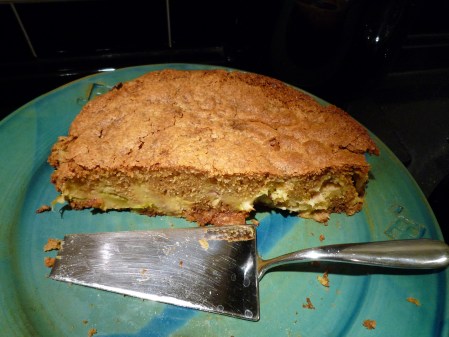
My second rhubarb recipe, a simple tart, comes from French-speaking Switzerland, in fact from the tiny wine village of Chardonne which was my second home for 4 consecutive winters back in the 1980s. I found this recipe in Marianne Kaltenbach’s “Aus Schweizer Küchen” (from the Swiss kitchen). The recipe comprises a sweet pastry enriched with ground almonds and egg and a simple filling of rhubarb, sugar and local white wine. We most often pair rhubarb with orange or ginger in English recipes so it was a refreshing change to try something a little different which lets the rhubarb flavour shine through.
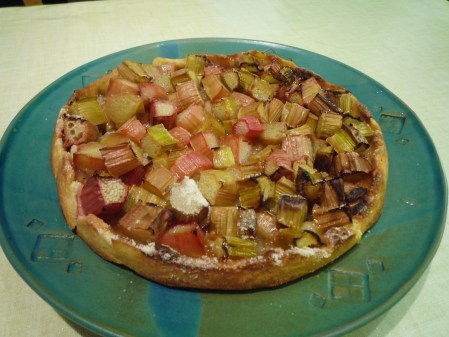
We’re well and truly into outdoor field-grown rhubarb season now (rather than the candy-pink tender forced rhubarb from Yorkshire that begins the season in February). The rhubarb variety I’ve used for both recipes is rather pleasingly called Timperley. Pleasingly because Timperley village is just a couple of miles from our front door and presumably this variety was bred by a local market gardener a hundred or so years ago.
Although I think of rhubarb as typically English, it originates from central Europe/Asia on the banks of the Volga so it is not surprising to find it appearing in different countries’ cuisines. The Scandinavians turn it into a tart sauce to serve with meat, the Persians incorporate it into a slow-cooked stew and there are a whole host of homely pudding recipes based on rhubarb like the two I give here. I’ve yet to discover whether the Italians cook with rhubarb though…That’s another train of thought altogether which I don’t have time to follow up just now… Here are the recipes:
Recipe for Rhubarb Cornmeal Cake
From Nigella Lawson’s “How to be a Domestic Goddess”. Like she says it’s very versatile – you can eat it with a cup of tea or serve it with some proper custard as a pudding.
Serves 8-10
Ingredients
500g rhubarb
300g golden caster sugar
150g plain flour
1 teaspoon bicarbonate of soda
1/4 teaspoon salt
1 teaspoon ground cinnamon
155g fine polenta/cornmeal (the quick cook stuff is fine)
2 large eggs
1 teaspoon vanilla extract
125g butter, softened at room temperature
250g thick natural yoghurt

Prepare a 23cm (9 inch) round cake tin by lining with a double thickness of baking paper. Preheat the oven to 180 degrees C/gas mark 4. Wash and trim the rhubarb and cut into 1/2 cm slices. Put into a bowl and add 100g of the sugar. Don’t let the rhubarb stand for more than 1 hour otherwise it will produce too much juice and make the cake wet.
Mix together the flour, bicarb, salt, cinnamon and polenta. Do not, as I did on one occasion, be tempted to use self raising flour as it makes the cake rise too quickly leaving the rhubarb at the bottom of the tin. With a fork, beat the eggs with the vanilla in a measuring jug or small bowl. In a large bowl, cream together the butter and the remaining sugar and gradually add the egg and vanilla mixture, beating while you do so. Then add the flour/polenta mixture alternately with the yoghurt. They just need to be combined: don’t overmix.
Finally, add the rhubarb together with its sugary juices, folding in to mix, and then spoon the batter into the prepared cake tin. Bake in the preheated oven for about 1 hour until the cake surface springs back when pressed gently with a (clean!) forefinger. Check the cake after 30 minutes’ cooking time as you will almost certainly need to turn the oven down a notch and/or cover the top of the cake with foil to prevent it browning too much.
Leave the cake to cool in the tin for at least 30 minutes before attempting to turn out.
Recipe for Chardonne Rhubarb Tart
From Marianne Kaltenbach’s “Aus Schweizer Küchen” where the recipe is titled Gâteau à la rhubarbe à la mode de Chardonne/Rhabarbekuchen. It is most definitely a tart rather than a cake. This is Swiss-German language cookbook but the recipe is from French-speaking West Switzerland, specifically the tiny wine village of Chardonne in the canton of Vaud. Ms Kaltenbach suggests drinking a glass of Chardonne wine with the tart – an excellent idea if you can get hold of some (Nick Dobson wines in the UK currently stocks several www.nickdobsonwines.co.uk). If not, any light white wine with a good balance of acidity and sweetness would be good – perhaps a Dr Loosen Riesling or similar.
Ingredients
120g plain flour
60g butter, softened at room temperature
30g golden caster sugar
pinch of salt
25g ground almonds
1 egg yolk
1/2 teaspoon vanilla extract
1 kg rhubarb
5 dessertspoons golden caster sugar
2 dessertspoons white wine
a little butter for dotting

Sift the flour together with the salt onto a clean work-surface or pastry board. Cut the butter into small pieces and add to the flour. Add the sugar and ground almonds to the pile and mix it all together loosely with your fingers. Don’t attempt to rub in the butter yet. Make a well in the centre of the mix, add the egg yolk and vanilla extract to the well and bring all the mixture together with your fingers to make a dough. Incorporate the butter into the dough using a smearing rather than rubbing-in action. If necessary, add just a little water to bring the dough together. Knead lightly then wrap in clingfilm and rest for 3 hours or so in the fridge. The original recipe suggests resting the dough for 12 hours but I found it was workable after a shorter resting period and produced a good result when baked. During the resting period, line a round cake tin 26cm (10 inches) in diameter with baking paper (the German word is Backblech – baking tin – I found that an ordinary cake tin worked well).
Preheat the oven to 220 degrees C.
Take the rested dough from the fridge and place it on a work surface. Begin to flatten the dough a little by giving it a few firm whacks with a rolling pin but don’t attempt to roll out. Place the flattened dough in the centre of the prepared tin and with your hands press the dough to the edges of the tin and up the sides to form an edge about 2cm high. This is a little fiddly but be patient, you will get there. Prick the base of the dough all over with a fork and return the tin to the fridge to rest further while you prepare the rhubarb.
Wash, dry, trim and slice the rhubarb into small chunks – about 2cm (3/4 inch) in length. The specified recipe quantity of 1kg rhubarb means unprepared weight from the garden. If buying partly trimmed stalks from a supermarket, start with 800g rhubarb which when trimmed will result in a prepared weight of about 700g.
Remove the pastry-lined tin from the fridge and spread the prepared rhubarb over the base. Sprinkle over 3 dessertspoons caster sugar, maybe a little more depending on your personal taste. Bake for 30 minutes in the preheated oven. Keep a close eye on the tart to make sure that the pastry doesn’t become too brown. After half an hour, remove the tart from the oven and sprinkle over the white wine, a further 2 dessertspoons caster sugar and a few dots of butter and return to the oven for a further 5-10 minutes to complete the baking.
Allow to cool in the tin for 30 minutes before attempting to turn out. Best served warm and needs no accompaniment other than the recommended glass of white wine.
If anyone knows the origins of Timperley rhubarb or has any Italian rhubarb recipes I would love to hear from you. Please send me a comment.
Relaxed cooking for the holidays
May 22, 2010 § 2 Comments
I was chatting to a friend on a balmy Friday evening while we watched our sons valiantly lose a cricket match. She’s rented a holiday cottage by the seaside for a week over the half term holidays. She disclosed to me that, following an afternoon spent planning meals, shopping etc, all she had on her list so far was wine and a bottle of gin. Fine as far as it goes but it won’t feed a hungry crowd!
This dilemma got me thinking so I thought I’d jot down a few uncomplicated recipes with a summery holiday feel that you might be inspired to try in a holiday cottage with unfamiliar and probably limited cooking equipment.
I’ve come up with two lunch dishes, one evening meal and of course a cake.
Recipe for Caponata
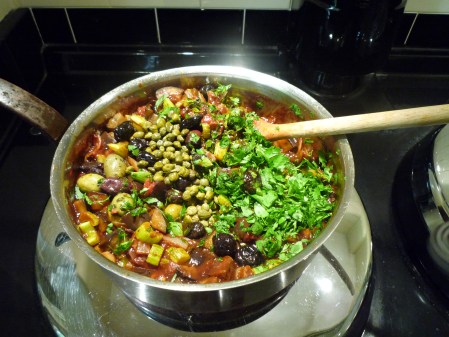
Since trying the caponata at Da Piero’s restaurant last month (see my post https://rhubarbfool.co.uk/2010/05/04/review-of-da-piero-irby-wirral/) I haven’t been able to get enough of the stuff. It’s a really useful holiday dish as you can make up a large batch and keep it in the fridge. It’s one of those dishes that improves if it’s kept and is very good natured as it is best served at room temperature. You could served it along with cold meat and cheese at lunchtime, or as a vegetable accompaniment with some simply grilled or fried fish (skate, sole, bass).
This is a dish you can experiment with and make your own – after all Da Piero’s unorthodox but good addition was chunks of waxy salad potato. So far, the version I like best is one I have adapted from a recipe in Tamasin Day Lewis’ “Good Tempered Food”. It’s quite simple and clean tasting and I like the astringency of the green rather than black olives.
Serves 6, maybe more depending on what’s with it
Ingredients
light olive oil for frying- about 4 tablespoons
6 sticks celery cut into 1/2 cm dice
2 medium aubergines cut into 2 cm cubes
sea salt and black pepper
2 tablespoons extra virgin olive oil
2 medium onions, thinly sliced
1 clove of garlic, chopped
1 and 1/2 400g tins plum tomatoes, roughly chopped
2 teaspoons brown sugar
4 tablespoons red wine vinegar
2 tablespoons capers, rinsed
3 oz good green olives stoned and halved
Handful of roughly chopped flatleaf parsley
Heat the light olive oil in a large deepish sauté pan big enough to hold all the ingredients. If you don’t have a pan large enough you’ll need to work with a frying pan (to brown the vegetables) and a casserole (to complete the cooking). When the oil is hot, add the celery and cook for about 10 minutes until soft and beginning to brown. Season then remove with a slotted spoon onto a plate and set aside. If needed, add a slosh more frying oil and when hot add the aubergines cubes. Fry until soft and brown which will take 10-15 minutes. They will shrink incredibly as the water they contain cooks away. Season and remove from the pan and set aside.

Turn the heat down to medium, add the extra virgin olive oil to the pan and gently fry the onions and garlic until soft and golden. Add the tomatoes and cook uncovered for about 10 minutes. Add salt, pepper, vinegar and sugar and cook for a further 10 minutes. Check seasoning. Add the reserved aubergine and celery, capers and olives and cook gently together for a further 5 minutes.
Allow to cool to room temperature then stir in the chopped parsley and serve.
Recipe for Rillettes de Tours
From Margaret Costa’s Four Seasons cookery book. We eat loads of rillettes, a coarse stringy pork almost pâté, when we go on holiday to France. Both the boys love it. It makes an easy picnic lunch spread thickly onto crusty French bread. It’s simplicity itself to make, especially if there should be an Aga in your holiday house – the simmering oven would be just the right temperature to make this. Any butcher should be able to sell you the belly pork but it might be worth preparing the spices in advance and taking them with you as you may find difficulty tracking down the ground cloves and allspice in a village shop.
Serves 6-8
Ingredients
2 lb (900g) belly of pork
3 tablespoons (45ml) dry white wine or dry white vermouth
5 black peppercorns lightly crushed in a pestle and mortar
salt
1/4 teaspoon ground nutmeg
pinch of ground allspice
very small pinch ground cloves
1 large clove of garlic
Remove the rind and bones from the pork, or ask your butcher to do this. Cut the meat into small cubes and put them into a deep ovenproof dish with the wine or vermouth, crushed peppercorns, salt, spices and crushed garlic. Cover and cook in a very slow oven (120 degrees C; 250 degrees F, Mark 1/2 for 2 hours (maybe more) until the pork is soft and slightly shrivelled looking, swimming in a pool of fat.
Drain off and strain the fat. Pull the meat apart with two forks to form shreds. Press into your chosen pot or pots and spoon over the strained fat to cover. Chill until set. Serve with cornichons and crusty bread straight from the pot like a pâté. No butter is necessary.
Paella de Cerdo con Chorizo y Espinaca
(Pork paella with chorizo sausage and spinach)
Another recipe from Tamasin Day-Lewis’ “Good Tempered Food”. She attributes the recipe to Sam Clark, chef-proprietor of London’s Moro restaurant. Search out and bring with you the chorizo and smoked paprika, maybe also the rice, which you do need to give an authentic flavour to the dish. For anyone in the South Manchester area, Goose Green deli in Altrincham sell lovely fresh chorizo sausages for cooking.
Serves 4
Ingredients
7 tbsp olive oil
350g/12 oz pork fillet, halved lengthwise and sliced into 5mm strips
125g/4 oz mild cooking chorizo, cut into small pieces
2 large Spanish onions finely chopped
1 large green pepper, halved, seeded and finely chopped
4 cloves garlic, finely chopped
225g/8oz paella or risotto rice (original recipe suggests Calasparra rice from Valencia)
1 tsp sweet smoked Spanish paprika
2 bottled red peppers, drained and roughly chopped (original recipe specifies dried ñora peppers, presumably soaked in hot water but as these are difficult to get hold of I’ve substituted widely available bottled sweet pimentos)
900ml/1 and 1/2 pints hot chicken or vegetable stock or water
500g/ 1lb 2oz spinach, washed and drained
1 lemon cut into wedges
sea salt and black pepper
In a 30-40cm/12-16 in paella pan (or failing this a frying pan or large casserole) heat the olive oil over a high heat. Stir-fry the pork for 2-3 minutes so it is still a little undercooked. Season with salt and pepper. Remove from the pan with a slotted spoon and set aside.
Turn down the heat to low and fry the chorizo for a minute. Add the chopped onion and green pepper and cook for 20 minutes, stirring occasionally. Add the garlic and continue cooking for a further 5-10 minutes. At this point the mixture should have begun to caramelise. Stir the rice into the pan for a minute to coat it in the mixture. Up to this point everything can be cooked in advance.
The next stage needs about 20 minutes more cooking time. Add salt and pepper to season the rice. Add the paprika and ñora or bottled peppers followed by the hot stock and simmer for 15 minutes until there is just a thin layer of liquid around the rice.
Meanwhile in a large pan briefly wilt the spinach with a little salt and put it on one side with the pork. Scatter the pork over the rice evenly then do the same with the spinach. With the back of a spoon gently push both the pork and spinach partially into the oily liquid that remains at the bottom of the pan. Tuck in the lemon wedges, cover the paella tightly with foil and let it sit for 5 minutes before serving.
Serve with a glass of Rioja and a tomato salad.
Recipe for Courgette and Lemon Cake
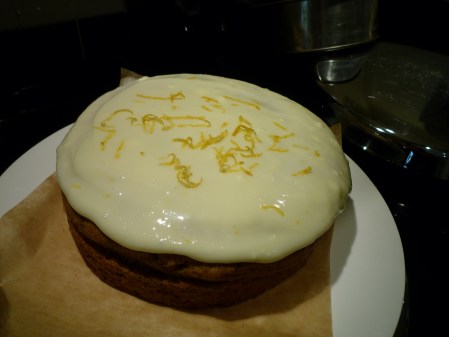
I tried a courgette, lemon and pistachio cake recently at Green’s very welcoming café and tearoom in Grasmere in the English Lake District. I searched around for a recipe and eventually found one I’d forgotten about in Nigella Lawson’s “How to be a Domestic Goddess”. She attributes the recipe to one Flora Woods. Don’t be put off by the inclusion of courgettes – they simply make the cake moist and turn it a fantastic green colour. Think of it as an interesting first cousin to a brash carrot cake. I’ve tweaked Nigella’s recipe by adding pistachios to the cake batter and simplifying the filling and icing. I’ve had trouble with cream cheese icings recently as Philadelphia and its ilk don’t have enough fat in and are packed with water and stabilisers which break down into runnyness when you beat the stuff with a wooden spoon. My friend Nadia put me onto the idea of using mascarpone with a 50% fat content instead – thanks Nadia it works! BTW the cake in the photograph contains neither raisins nor pistachios just to see how the plainer version worked out. Fine – in fact scrumptious.
Serves 8, maybe more if you’re frugal
Ingredients
60g raisins plus 2 tablespoons white wine or vermouth (optional)
250g courgettes (weighed before grating – about 2 medium ones)
2 large eggs
125 ml vegetable oil (I use light olive perhaps with a splash of deep green pistachio or pumpkin seed oil if I happen to have some in the cupboard)
150g golden caster sugar
225g self raising flour
1/2 teaspoon bicarbonate of soda
1/2 teaspoon baking powder
50g pistachio nuts roughly chopped (optional)
For the filling
1/2 jar best lemon curd
For the icing
1/2 tub mascarpone cheese
6 heaped tablespoon icing sugar, sifted
juice of half a lemon
If using the raisins, put them into a small saucepan with the wine, bring up to the boil and leave to soak and plump up for 30 minutes or so.
Prepare your cake tin(s) by greasing and/or lining with bakewell paper. Nigella’s recipe specifies 2 * 21cm sandwich tins. I don’t have sandwich tins in that size so have used a single deep 21 cm tin (about 9 inches) and extended the cooking time and reduced the heat to bake a single large cake. Once it has cooled it can be split, filled and iced in the usual way.
Wash and dry the courgettes, trim off top and bottom but don’t peel them. Grate using the coarse surface of a standard kitchen box grater, then turn the grated courgette into a sieve and let it drain for 10-15 minutes, while you prepare the rest of the ingredients, to remove excess water.
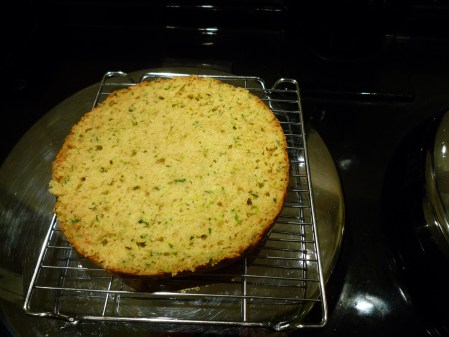
Put the eggs, oil and sugar into a mixing bowl and beat until creamy. Sift in the flour, bicarb and baking powder and beat until well combined. Stir in the grated courgette, raisins and their juices and pistachio nuts. Spoon the mixture into your prepared tin(s) and bake at 180 degrees C for 30 minutes for 2 cakes; 170 degrees C for 10 minutes then 160 degrees C for a further 35-40 minutes in the case of a single large cake. Check and cover with a disc of foil if the cake seems to browning too rapidly. Remove from the oven, leave to stand for 10 minutes then turn out and cool on a rack. Don’t attempt to split the large cake until it is completely cold.
Meanwhile make the icing by beating together the mascarpone cheese and sifted icing sugar then stirring in lemon juice to taste.
Sandwich the cakes together with lemon curd and top with the mascarpone icing. Decorate with more chopped pistachios and grated lemon zest if liked. For easy transportation to a picnic, you could use both the lemon curd and the icing to sandwich the cakes together and leave the top un-iced so the cake can be wrapped in foil.
Enjoy your holidays and don’t spend too much time in the kitchen!
Buenos Dias Buenos Aires! Breakfast from Argentina
May 15, 2010 § Leave a comment
It’s been a while since we had our last international breakfast (see Breakfasts of the World category in the sidebar). The plan is to work through every country in the world in alphabetical order and it must be at least a month since Antigua.
I was pretty excited about the prospect of an Argentinian breakfast. Surely there would be mounds of barbecued steak? Sadly not. I was amused by one travel blog which recorded with disappointment that breakfast in Argentina comprises a croissant (known as medialuna), a coffee and a glass of water. The beef for which Argentina is justly famous is strictly a main meal affair.
So our breakfast was indeed medialunas (bought not made), café con leche and of course, lashings of wonderful dulce de leche. Sadly the Merchant Gourmet dulce de leche, authentically Argentinian from the evocatively named La Esmeralda farm seems to have disappeared from our local supermarket shelves and I had to make do with a Bonne Maman Confiture de Lait, a similar sweet milk caramel idea but from France and not quite as thick and unctuous.

If you too are suffering from dulce de leche withdrawal symptoms, here’s the Merchant Gourmet website dulce de leche page – you can buy it online now with free delivery if you buy in bulk.
http://www.merchant-gourmet.com/products/dulce-de-leche/dulce-de-leche-caramel-toffee/
I also noticed that the San Ignacio brand of dulce de leche has its own UK website now which gives some useful background info on what it is and how it’s made and a singularly unuseful list of retail stockists. They are listed in alphabetical order of shop name so you have to scan the whole list by eye to find a shop near you. I came up with Harvey Nichols in Manchester and a deli in Frodsham, Cheshire as possibilities for me.
I digress. Back to the proper business of breakfast. A bought croissant, a cup of coffee and a jar of caramel was OK but didn’t quite hit the spot. I had to get beef into the breakfast somehow so I trawled the internet until I found a reference to eating beef empanadas (pasties to you and me) for breakfast. I’d struck gold at last!
I found a recipe for beef empanadas in “South American Food and Cooking” by Jenni Fleetwood and Marina Filipelli – essentially a minced beef and potato stuffing encased in dinky shortcrust pastry rounds folded over to make mini pasties.
Here are the pastry circles and filling:

And here is the complete breakfast with the empanadas fresh out of the oven. I made a quick salsa with tomato, pepper, avocado, coriander and plenty of lime juice and seasoning to serve with the pasties:

Recipe for beef empanadas
I simplified the recipe I found in “South American Food and Cooking” by Fleetwood and Filipelli. I’ve halved the filling quantity which was way too much for the specified pastry quantity. I used minced beef rather than shredding it finely and baked the pasties rather than deep frying them for a lighter result. This worked well.
Ingredients
1 lb (450g) shortcrust pastry (bought or make your own with 8 oz (225g) flour; 4 oz (90g) fat)
l lb (450g) minced beef (use shin or leg if mincing your own)
4 tablespoons oil
1/4 tsp ground cumin
1 crushed garlic clove
2 tsp paprika
8 fl oz (250 ml) light stock
1lb (450g) waxy potatoes scrubbed (no need to peel) and finely diced
3 chopped canned tomatoes (or fresh ones skinned)
3 spring onions finely sliced
salt and pepper
Make the filling. Heat the oil in a heavy large frying pan. When hot, add the beef and sauté until lightly browned. Push the beef to the side of the pan and add the cumin, garlic and paprika. Reduce the heat and cook gently for about 2 minutes until the spices release their aroma.
Stir in the stock and bring to the boil. Cover and cook for 30 minutes. Stir in the potatoes, tomatoes and onions and cook for 15 minutes more until the potatoes are tender. Keep an eye on the cooking liquid adding a little more water if necessary or alternatively reducing if there is too much. You are aiming for quite a dry mixture. Season and allow to cool completely.
Roll out the pastry very thinly on a floured board. Using a pastry cutter cut out 2 and 1/2 inch (6cm) circles. Spoon about 1 and 1/2 tsp filling into the centre of each pastry circle. Brush the edges of the pastry with water. Fold the pastry over to form a half moon. Turn the edges over and press together firmly to form a good seal. Bake at 200 degrees C until the pasties are golden brown.
Serve with your favourite fresh salsa.
Enjoy your Argentian breakfast! Carlos Tevez, if you happen to read this please do drop me a line with your breakfast thoughts…
Macaroons made in Manchester
April 14, 2010 § Leave a comment
STOP PRESS: IF YOU ARE YOU LOOKING FOR SOMEWHERE IN THE MANCHESTER AREA TO BUY MACAROONS THEN CLICK ON THE FOLLOWING LINK: https://rhubarbfool.co.uk/2011/01/04/macaroons-made-in-manchester-revisited/
IF IN FACT YOU WANT TO SEE EARLY EXPERIMENTS IN MACAROON MAKING THEN READ ON!
The dinky French macaroon (or more correctly macaron) has finally reached Manchester.
My friend Vivienne brought along to a recent recorder group practice (I jest not) a little pack of Maison Blanc macaroons (chocolate, pistachio and raspberry flavours) which, surprise surprise, are now stocked by our local branch of Waitrose.
If “macaroon” conjures up an image for you of a cracked beige saucer-sized rusk complete with a skirt of carelessly torn rice paper, then think again. The Parisian macaroon is a dainty confection of egg whites, ground almonds and sugar formed into two tiny shells sandwiched together with a butttercream or ganache filling. They come in a range of flavours with colours to match. Those made by Parisian pâtisserie Ladurée are iconic.
Since Ladurée relaunched the macaroon back in the mid 1990s, they have become a worldwide craze. Not only Ladurée but a range of chic French pâtisseries proudly make and display their own collections of macaroons. They have become an obsession to many American women if the number of blog entries is anything to go by – they apparently flock to Paris in their hundreds to buy them, photograph them, drool over them and even take classes in how to make them.
Having resisted the whole macaroon thing for a number of years now, I decided to have a go at making a batch. The colours of macaroons displayed in French shop windows is, if tastefully done, gorgeous but clearly artificial colouring is used which is really just not me. What I wanted to achieve was an entirely natural colour and flavour. I thought I’d begin with my all time favourites, pistachio macaroons. Then, inspired by the dazzling scarlet colour of a pack of dried Goji berries in my kitchen cupboard, I decided that these could be added, finely ground, to a second batch of macaroons.
My next problem was that I didn’t have a reliable recipe. From my cookery book collection, I dug out Nigella Lawson’s recipe for pistachio macaroons from her Domestic Goddess book. I’ve tried this recipe before and found it wanting (buttercream quantities are wrong and the macaroon mix is too runny and difficult to handle) but I had to start somewhere. By coincidence, the March issue of UK food magazine featured a recipe for French macaroons so I decided to compare and contrast the two.
After a somewhat frustrating afternoon in the kitchen, I nevertheless produced two extremely edible batches of, respectively, pistachio and Goji berry & orange flower macaroons.
Did they look like the dainty confections of the Parisian shop window? A resounding no! they were uneven, knobbly, charmingly homespun but a far cry from the tiny smooth shells of the French pâtissier with their technically perfect “feet”.
The texture was spot-on though – crispy on the outside and softly chewy in the centre. And, with all due modesty, the taste was sensational and the whole lot were consumed by family and friends before the afternoon was out.
Here are the finished pistachio macaroons. The colour when baked is an extremely subtle shade of jade tinged with brown which I find infinitely preferable in an understated way to the bright artificial green of the commercial product.
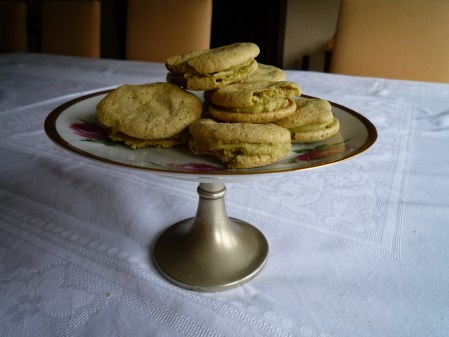
and here are the Goji berry macaroons sandwiched with a Goji buttercream filling scented with orange flower water – a further inspiration suggested by the orange colour of the baked macaroons. When this becomes Paris’ next “flavour of the season” you will know where the idea came from!

Now to compare and contrast the two recipes. I used Nigella’s recipe for the pistachio macaroons and the Delicious version for the Goji ones. Here are the different ratios of the 3 key ingredients:
Table of ratios:
1) Nigella “Domestic Goddess”
Egg white 1
37.5g ground nuts
70g sugars (a mixture of caster and icing sugar)
2) Delicious magazine
1 egg white
42g ground nuts
83g sugars (caster and icing)
The ratio of sugar to ground nuts is the same in both recipes but their is a whole 125 g of “dry matter” per egg white in the Delicious recipe compared to a meagre 107.5g in Nigella’s.
The Nigella mixture was extremely wet and practically unpipeable – I had to resort to spooning it onto the prepared baking sheet where it spread and didn’t hold its shape at all. Also, the yield figures she gives seem to be completely out – the mixture made about half as many paired macaroons as she suggested ie about 15 rather than 30 for a 2 egg white quantity.
And don’t get me started on her measurements as for the buttercream filling – though the mix of creamed butter, ground nuts and icing sugar is delicious, the quantity produced is far too much for the number of macaroon shells.
The proportions suggested in the Delicious magazine recipe produced a firmer texture which was pipeable and generally much easier to deal with. I think I would make this my starting point for any future macaroon experiments. I give my recipe for homespun macaroons below which uses the Delicious magazine ratios though not its exact method.
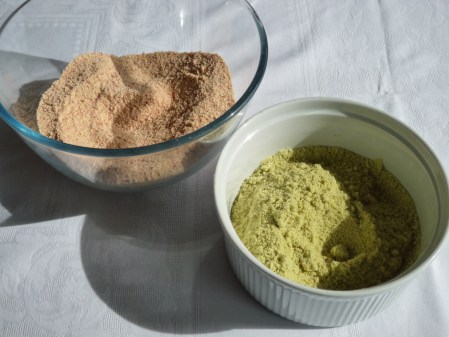
Here is the gorgeous pastel coloured “dust” of sugar, ground nuts and Goji berries which is folded into the stiffly beaten egg whites. Shame that the lovely colours don’t survive the baking process intact.
Here are the neatly piped Goji macaroons ready to go in the oven. The neat shape was somewhat altered by the heat of the oven!

Here are the pistachio macaroons ready to be sandwiched with the matching pistachio buttercream.

Recipe for Jennifer’s homespun macaroons
Don’t expect this to produce technically perfect Parisian results – it will however produce a very tasty macaroon. Assuming accurate piping of small 2cm diameter rounds, this should produce 40 shells, 20 complete macaroons:
Ingredients
For icing sugar/ground nut mix
300g icing sugar
215g whole blanched almonds or pistachios chilled in refrigerator
(makes 515g sugar nut mix in theory but some will stick to your liquidiser; recipe calls for a total of 450g sugar nut mix so there will be a little bit left over – sorry that’s the consequence of using convenient round numbers for the measurements)
For the macaroon shells
3 egg whites
300g sugar nut mix
75g caster sugar
For the buttercream filling
150g lightly salted butter, softened
150g sugar nut mix
First make up a batch of icing sugar and ground nut by whizzing the sugar and nuts together in a liquidiser or food processor until a fine powder is achieved. The idea of freezing the nuts first is to keep them cool so that they don’t turn into an oily mass. Don’t overprocess. Sift the mix into a bowl.
Whisk the egg whites with a pinch of salt to the soft peak stage then whisk in the caster sugar and keep whisking until the mixture is thick and glossy.
Fold the weighed out sugar nut mix carefully into the meringue in two batches.
Spoon into a piping bag fitted with a 1cm nozzle.
Pipe 2cm rounds of the mix onto baking-paper lined baking sheets.
Bake for 15 minutes at 140 degrees C (fan). Remove from oven and cool on sheet. Remove from sheet when cold. This is tricky as they stick easily even with the silicon baking paper.
Make the filling by creaming together the butter and sugar nut mix.
Sandwich the macaroon shells together when completely cool.
If you fancy having a go with the Goji berry flavouring, substitute 50g dried berries for the equivalent weight of nuts and whizz to a fine powder along with the nuts as in the master recipe. Also, add a teaspoon of orange flower water to the buttercream filling.
I realise I’m very late on this whole macaroon trend but I do have further macaroon posts planned after a recent trip to Fontainebleau in France.
If you have macaroon experiences to share, Mancunian or otherwise, I’d love to hear them…
Eggs for Easter
April 3, 2010 § 1 Comment

Two simple egg dishes for Easter. The first is a beautiful looking quail egg, pea and ham salad, the second a simple dish of baked eggs with cream and herbs.
They would work equally well as a starter before your Easter Sunday meal or as a lunch or supper dish.
Recipe for quail egg, pea and ham salad
This is hardly a recipe, more a culinary improvisation based on idea on the Ocado online grocery shopping website. I didn’t like the idea of hearty fried bacon in this delicate little salad so replaced it with slivers of ham. Airfreighted fresh peas and mangetout didn’t appeal either so I used lightly cooked British frozen peas which are sweet and good and bulked out the salad with some crisp Little Gem lettuce instead of the mangetout. I simplified the salad dressing too, making it light and lemony.

Ingredients
1 pack 10 quail eggs
2 generous handfuls frozen petit pois, cooked for 1 minute in boiling water and drained
4-6 slices Parma ham, torn into artful shreds
1 bag peashoots
2 little gem lettuces, washed and separated into individual leaves
For the dressing:
2-3 tablespoons of your favourite salad oil (olive, hazelnut or pistachio if you can get hold of it)
Generous squeeze of lemon juice
1 teaspoon Dijon mustard
Sea salt and freshly ground black pepper
snipped fresh soft herbs (optional)
Hardboil the quail eggs following the timings specified on the pack. Cool, peel and slice carefully in half lengthways.
Make the dressing in the usual way in a pretty serving bowl. Add the peas while still warm and leave to soak up the dressing for 5 minutes.
Then add the lettuce and peashoots and toss all together gently. Add a little more dressing if the salad needs it.
Strew the eggs and ham artfully over the top of the salad and your done.
Recipe for baked eggs in cream with fresh herbs
Otherwise known as Oeufs en Cocotte, a French classic. I use Julia Child’s instructions in “Mastering the Art of French Cooking”, a book I refer to very often (even before the film!).

For each serving
1 teaspoon butter
2 tablespoons double cream
1 egg
1-2 teaspoons mixed fresh parsley, chives, chervil and tarragon (use whatever combination you have to hand – I particularly like tarragon)
sea salt and freshly ground black pepper
You will also need a ramekin for each person and a deep tray containing 3/4 inches simmering water. I use a loaf tin if I’m just cooking for one or two people.
Butter the ramekin saving a dot for later. Add 1 tablespoon cream, half your herbs and a little seasoning and set the ramekin in the simmering water over moderate heat. When the cream is hot, break your egg into it. Pour over the remaining tablespoon of cream, season and scatter over the remaining herbs. Top with the reserved dot of butter.
Place in the middle of a moderate oven and bake for 7 to 10 minutes. The eggs are done when they are just set but will still tremble slightly.
Serve with fingers of your favourite lightly toasted bread to dip into the runny yolks and cream.
After such a light lunch, you will have plenty of room to tuck into your easter chocolate:
Happy Easter!


Hot Cross Buns
April 1, 2010 § 1 Comment

…is a recipe title that might confuse American readers but we in the UK know what we mean!
I spend most of the year going “Tsk, tsk” looking at unseasonal packets of hot cross buns on the shelf of my local Marks & Spencer food store.
Finally, Good Friday is almost upon us (yes, I know I have jumped the gun just a little) and we can eat them at their proper time.
If you fancing making a batch of your own, they are easy-peasy if you are familiar with the basics of yeast cookery (especially if you have a Kenwood or Kitchenaid electric mixer). Here’s my favourite recipe from Margaret Costa’s “Four Seasons Cookery Book”. As ever, I’ve tinkered with recipe just a little substituting half the white flour for wholemeal so you can kid yourself they’re good for you. Also I’ve added my favourite spice, cardamom, to her suggested nutmeg and cinnamon mix.
You unlikely to find cardamom in a shop-bought hot cross bun as it’s too pricy for the mass-market so you really will taste the difference (haven’t I heard that phrase somewhere before…).
Surprisingly, you can find the fresh yeast specified in the recipe at your local Sainsbury’s bakery counter. You may be able to find it at other supermarket in-store bakery counters too – Sainsbury’s just happens to be convenient for me.
I think there’s something magical about the way fresh yeast turns rapidly from an unyielding beige lump of putty into liquid when it is mashed and stirred for a few moments with a teaspoon of sugar. And it might be my imagination, but the rise, flavour and crust of bread and buns made with fresh rather dried yeast always seems superior to the result you achieve with dried yeast.
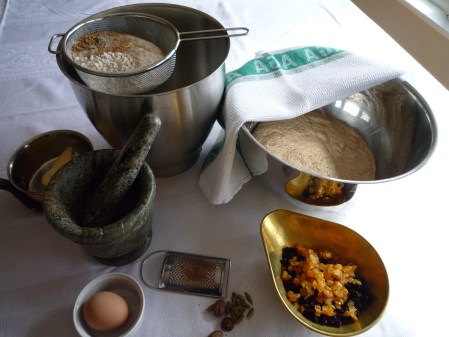
Here’s the mise en place for the hot cross buns – it’s a matter of just minutes to assemble what you need. The yeast and flour sponge after 45 minutes’ proving can be seen in the wider and shallower of the 2 stainless steel bowls.
Here are the buns after final proving ready to go into the oven. I happened to have a little ball of leftover pastry lurking at the back of my fridge so the buns are adorned with dinky crosses. I usually simply mark the crosses with sharp knife which is much quicker.

The finished product is shown at the top of the post. The aroma of warm spice and orange peel currently wafting round the kitchen is irresistible…
Recipe for Hot Cross Buns
From Margaret Costa’s Four Seasons Cookery Book with some additions of my own.
Ingredients
1 lb (450g) plain flour ( I like to use half strong wholemeal and half ordinary white or vice versa half strong plain white and half ordinary wholemeal
1 oz (25g) fresh yeast
1/2 pint (300ml) milk-and-water
1 teaspoon ground cinnamon
1 teaspoon grated nutmeg
seeds from 10 green cardamom pods pounded to as fine a dust as you can muster using a pestle and mortar
1 teaspoon salt
2 oz (55g) golden caster sugar
3 oz (85g) currants
1-2 oz (25-55g) chopped mixed candied peel
2 oz (55g) melted butter
1 egg, beaten
2 tablespoons sugar and 2 tablespoons water for glaze
Sift half the flour into a bowl. Blend the yeast into a liquid with a pinch of sugar and a little of the lukewarm (not more than blood heat otherwise you will kill the yeast) milk-and-water mixture. Pour the yeast mixture and remaining milk-and-water mixture into a well in half of the sifted flour and mix well. Cover the bowl with clingfilm and leave in a warmish place for about 45 minutes. The mixture will by then have become puffed-up and spongy.
Meanwhile sift the rest of the flour with the spices, salt and caster sugar. Stir in the currants and peel. When the first mixture has proved, add it to the flour then pour in the melted butter and egg. Mix thoroughly and knead until smooth. 5 minutes with the dough hook in your Kenwood mixer will make short shrift of this task. Cover the bowl with clingfilm and leave to prove this time for about 1 hour. The mixture should approximately double in bulk.
Now turn the dough onto a floured board, knead it lightly and cut it carefully into 16 equal pieces. Shape each piece into rounds and place not too close together on a lightly greased baking sheet. Mark each bun with a cross using a sharp knife or alternatively criss-cross the buns with narrow strips of shortcrust pastry or, even better, marzipan.
Cover the baking trays lightly with clingfilm or a clean tea towel and leave to prove for a further 15 minutes until well-risen.
Bake in a hot oven 220 degrees C (425 degrees F; gas mark 7) for about 15 minutes until golden brown and cooked through. As soon as you take them out of the oven, brush them generously with a glaze made by boiling together in a small saucepan for a minute or so the sugar and water.
Cool on a wire rack and eat them, split and spread liberally with butter, as soon as you dare!
Tartiflette, or, I need another cream, cheese and potato fix now!
March 30, 2010 § Leave a comment

Back home for 10 days now and still pining for the sunny crisp weather and the food of the French Alps.
I decided I could hold out no longer and visited the very wonderful Cheese Hamlet in Didsbury to buy a splendid Reblochon, half to savour au naturel (that is just a wedge of cheese and a glass of wine rather than me eating the cheese in my birthday suit) and the other half to turn into an unctuous Tartiflette, the potato, cheese and cream gratin which is a speciality of the Savoy Alps in France. You can find a link to the Cheese Hamlet’s site in my blogroll/links section in the sidebar. Here it is again just for good measure:
Having picked up a leaflet about Reblochon whilst in Moutiers 10 days ago I feel obliged to show off with a few cheesy facts:
• The name Reblochon is derived from the verb reblocher literally “to pinch a cow’s udder again” because the cheese is made from the more creamy milk of a cow’s second milking of the day.
• Reblochon achieved AOC (now the European AOP Appellation d’Origine Protégée) status in 1958 and is produced in a small region within the département (administrative region) of Haute-Savoie centred around the Aravis massif in the Alps.
• Reblochon is produced from unpasteurised cows’ milk from 3 permitted breeds: Abondance; Tarine; & Montbéliarde.
• The rind of an authentic AOP Reblochon cheese will bear a small edible seal made of the naturally occurring protein caseine; the very special Reblochon Fermier has a similar green seal.
That’s enough of the academic stuff. What you really need to know is that Reblochon is a creamy semi-soft cheese with an earthy nutty flavour and an apricot coloured edible rind which is dusted with a naturally occurring white mould. And if you are in the United States, sorry folks you can’t get hold of it because of your (misguided) countrywide ban on cheeses made from unpasteurised milk. Your loss I’m afraid….
Recipe for Tartiflette
This is my version of this classic Savoyarde potato gratin, pretty similar to the one found in my authentic Reblochon information leaflet. Some ersatz supermarket-derived recipes suggest cubing the cheese or, horror of horrors, cutting off and discarding the rind. No, no, no! When the cheese is halved horizontally and placed rind-side up atop the potatoes, it becomes deliciously crispy and brown when baked in a hot oven, absolutely the point of this dish.
The specified quantity is enough for 2 greedy people. Serve with a simple green salad and a glass of crisp white wine (ideally an Apremont from Savoie). The name of this dish is derived from the Franco-Provençal word for potato – tartifla.
Here’s the Tartiflette ready to go into the oven. The finished dish can be seen in at the top of this post.

Ingredients
1 medium onion finely chopped
70g lardons (I like pancetta lardons – inauthentic I know but still tasty)
750g waxy potatoes such as Charlotte, scrubbed, steamed until tender and thickly sliced
142 ml double cream
half a Reblochon cheese which should weigh approx 250g
salt, pepper, freshly grated nutmeg, a few fresh thyme leaves
Preheat the oven to 220 degrees C. Fry the onions and lardons together until golden brown. Grease a cast iron gratin dish generously with butter. Layer half the cooked sliced potatoes in the bottom. Season then spread over them half the onion and bacon mixture. Repeat with the remaining potatoes, onions and bacon. Pour over the cream and top with the Reblochon cheese, which you should cut in half first horizontally then vertically, rind and all. See picture above.
Bake for 12-15 minutes until bubbling and golden brown.
A dish for spring: potato pie with Beaufort cheese
March 27, 2010 § Leave a comment
The best thing about the Tarentaise town of Moutiers in the French alps is that it is home to a co-operative which produces the magnificent Beaufort cheese. I passed through Moutiers last weekend on the way home from my ski tour and brought home a generous wedge of the stuff.
You may know Moutiers as the road bottleneck en route to your ski holiday or indeed as a vast alpine waiting room: at weekends the coaches lumber through from the early hours of the morning and the place is thronged with dishevelled looking bleary-eyed travellers. However last weekend, Moutiers was looking uncharacteristically lovely in the spring sunshine:

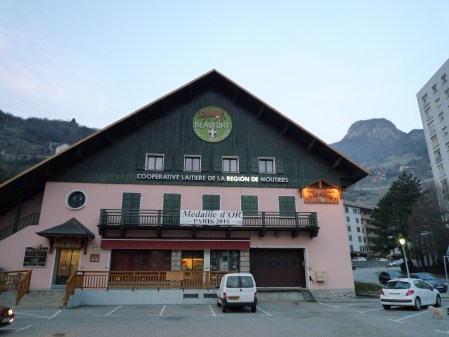
Just around the corner from the bridge over the Isère river is the redoubtable co-operative building. Solid and pink, you really can’t miss it:
And, joy of joys, there is a wonderful shop within which keeps sensible opening hours (open till 6.30 in the evening). Of course the Beaufort d’ été (cheese made from summer milk when the cows have grazed on the high alpine pastures) takes pride of place:
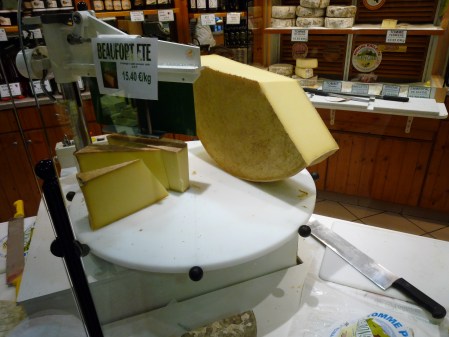
As well as the Beaufort, the shop sells a fantastic range of other local cheeses, sausages and preserves. I could have filled my shopping basket many times over but, mindful of my budget airline’s baggage weight limit and my own ability to lug the stuff home along with my ski kit, I confined myself to a single perfect generously proportioned wax paper wrapped parcel.
The co-operative offers guided tours at weekends. Sadly I didn’t have time for one of these but there are plenty of information leaflets on hand.
Time for a few Beaufort facts:
• Beaufort is produced under the EU’s “Appellation d’Origine Protégée” scheme
• Its production is limited to the Beaufortain, Tarentaise, Maurienne valleys plus part of the Val d’Arly all in the département (administrative region) of Savoie in France.
• The milk used to make the cheese must come from two special mountain cow breeds, the Tarine and the Abondance.
• There are currently 650 milk suppliers, and 45 cheesemakers collectively producing some 4,300 tonnes of cheese a year.
And one kilogramme of this lovely stuff was mine all mine to to take home and treasure! In the unlikely event that you should tire of eating your Beaufort au naturel, here is a recipe which both showcases the cheese and doesn’t require too much of it.
It comes from Simon Hopkinson’s new book “The Vegetarian Option” and combines the cheese with potatoes and cream, encasing the lot in buttery puff pastry. A scattering of fresh herbs – thyme and the first chives from the garden – give a taste of spring.
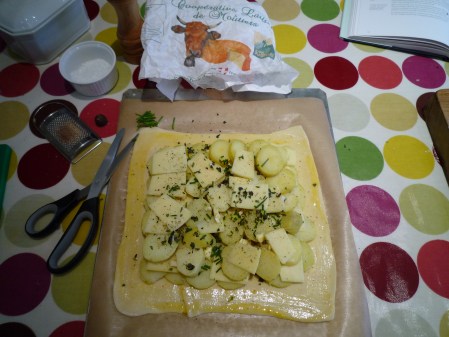
Here’s the cheese and potato filling spread onto the puff pastry base:
And here is the finished pie glazed and ready for the oven:

And here is the crispy golden brown finished article smelling deliciously of thyme, a touch of garlic and cheese.

Recipe for potato pie with Beaufort cheese
Taken from Simon Hopkinson’s “The Vegetarian Option” but with some alterations/improvements of my own. This is absolutely gorgeous eaten warm from the oven with a simply dressed peppery green salad. It’s also pretty good cold the next day perhaps as part of a superior packed lunch if by chance there’s a wedge left.
Ingredients
500g small/medium potatoes (SH suggests Desirée: I used new season Pentland Dells very successfully – they have just the right balance between flouriness and waxiness for this dish)
Salt, freshly ground black pepper, freshly grated nutmeg
100 ml double cream
2 garlic cloves, peeled and lightly bruised
10-15g butter for dotting
375g bought all-butter puff pastry in 2 equal pieces or sheets (if you have a 500g pack pastry, simply scale up the recipe)
75g Beaufort cheese, very thinly sliced
teaspoon each chopped thyme leaves and snipped chives
beaten egg to glaze the pastry
First steam or boil the potatoes in their skins until tender. Leave to cool, peel and slice thickly and put to one side.
Place the cream with the garlic in a small saucepan, bring to the boil then remove from the heat, cover and allow to infuse until the cream is cool.
Line a shallow heavy baking sheet with baking paper. Roll out the pastry into a rough square shape 2-3mm thick. Take as much care as you can as this will be the shape of your finished pie. Lay the pastry on the baking sheet.
Leaving a border of 2 cm or soCover the pastry shape with half of the potatoes, overlapping slightly. Lightly season with salt, pepper and nutmeg and cover with half the cheese, half the herbs and a few dots of butter.
Repeat these layers. Brush the border of the pastry with beaten egg. Roll out the second piece of pastry to an identical shape and place over the following. Press the edges very firmly together, rolling up to form a tight seal. Remember that you will be adding liquid cream to the filling shortly and it is imperative that it does not leak out. Press the tines of a fork into the rolled rim of your pie to further reinforce the join.
Carefully cut a hole 1 cm in diameter in the centre of the pie. This will allow you to pour cream into the pie in due course. Glaze the finished pie generously with beaten egg.
Before adding the cream and baking the pie it is a good idea to rest the whole thing in the fridge for half an hour to stop the pastry shrinking when it goes into a hot oven.
Preheat the oven to 220 degrees C/gas mark 6 while the pie rests.
Once the pie is rested and you are ready to bake it, the final step is to add the cream. Remove the garlic from the cream then carefully pour cream through the hole into the pie either using a funnel or a teaspoon. Allow the cream to settle and stop pouring as soon as the pie seems full. Reserve and set aside any leftover cream, you will have a chance to add some more once the pie has browned.
Place the pie in the oven and bake for 220 degrees C/gas mark 6 for 20 minutes until the pastry begins to crisp up and become golden. Remove from the oven and add a little more of any remaining cream.
Reduce the heat to 180 degrees/gas mark 4, return the pie to the oven and continue cooking for a further 20-25 minutes until puffed and golden brown all over. Check progress during this second phase of baking and cover with foil of necessary to stop the pastry turning too brown.
Let the pie stand for a few minutes after baking. If you are not eating it straightaway, remove carefully to a wire rack to allow to cool.
 The Rhubarb Fool