
Who threw away all my grits? Bahamian breakfast
December 18, 2010 § 6 Comments
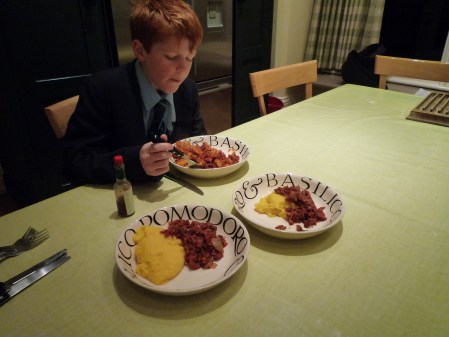
Tucking into our breakfast from the Bahamas – corned beef, grits and johnny cake felt like eating a plateful of history. That’s a big thing to be doing at 6.30 am on a dark and cold December Tuesday morning before work and school. Here’s younger son Arthur enjoying his corned beef sauté and grits, liberally sprinkled with Tabasco:
This was the latest in our series of breakfasts of the world (in alphabetical order) and after more than a year at this occasional project it feels good to be hitting the letter B for the Bahamas!
The Commonwealth of the Bahamas is an island chain close to Florida and north of Cuba. Andros is the largest island but capital Nassau is on the smaller island of New Providence. Columbus first made landfall on one of the islands of the Bahamas in 1492 but the islands were not settled by Europeans until English Puritans arrived via Bermuda in 1648. These first settlers survived by salvaging goods from wrecks. The islands became known for piracy and the infamous Edward Teach aka Blackbeard was based here.
Following the American War of Independence (1775-1783) the islands were settled by Loyalists (American colonists remaining loyal to British rule) and their slaves who established plantations on the islands. Britain abolished the slave trade in 1807 and thousands of Africans from slave ships subsequently made their home on the island.
On the menu was corned beef sauté (made from my own home-cured corned beef though the tinned variety may be more authentic) then grits – cornmeal porridge – in fact I used a quick cook polenta though I believe Bahamians prefer harder to obtain white grits. The hash was followed by a traditional Bahamian johnny cake, a simple baking powder raised scone/soda bread thing, quickly prepared then cooked in a skillet or sturdy frying pan:
Grits were the staple food of the slaves who worked on the plantations. They were a cheap carbohydrate and slave owners would give their slaves a weekly ration of cornmeal grits to boil up with water.
Corned beef reflects the British history of the islands. During the colonial period, Great Britain was the Bahamas’ major trading partner. Beef preserved in brine was shipped out in large quantities, another dietary staple for slaves and the poor. The native Bahamians made it their own, adding spices and vegetables to turn the corned beef into dishes like the sauté given below.
The name johnny cake is thought to derive from the name journey cake, so-called because it was quick and easy to make while travelling. Traditionally it’s cooked on the stove top but I opted for baking mine in the oven.
Here’s the home cured beef cubed and ready to be turned into hash:
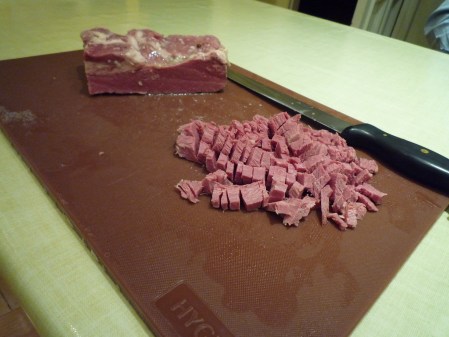
It’s wonderful stuff and very easy to do but you do need to start thinking about it 2-3 weeks before you want to eat it. This deserves to be the subject of another post sometime soon.
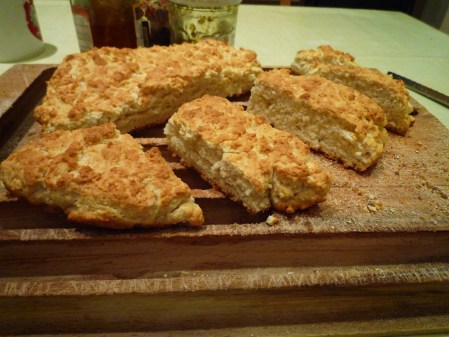
Here’s the freshly baked johnny cake just out of the oven:

and here it is sliced while warm ready to be thickly spread with butter and ready to be eaten Bahamian style with lots of sweet milky tea or coffee:
Definitely a breakfast to set you up for the day though in our case not for hard manual labour on plantations. And now the word of the Beach Boys’ Sloop John B (originally a folk son from the Bahamas) finally make sense. “The poor cook he got the fits, and threw away all my grits, and then he took and he ate up all of my corn”.
Recipe for corned beef sauté
Serves 4
From website http://www.caribbean.com which in turn credits the recipe to “Many Tastes Of The Bahamas & Culinary Influences of the Caribbean”
1 can (12 oz) corned beef
1 tsp freshly squeezed lime juice
1 tbsp vegetable oil
2 tbsp chopped onion
1-2 tsp dried thyme leaves
2 tsp tomato paste
Hot pepper to taste
A few tbsp of water
Place the corned beef into a medium-sized bowl and break up with a fork in preparation for cooking. Sprinkle with lime juice.
Heat oil in large skillet over medium heat. Sauté the corned beef with the onion and thyme for five to six mins. Stir in the tomato paste and crushed hot peppers to taste.
Add one to three tbsp of water for desired consistency and continue to cook, stirring.
Cover, reduce heat and cook for about 10 min.
Serve with grits or toast.
Recipe for Bahamian Johnny Cake
From http://foododelmundo.com/2010/03/07/bahamian-johnny-cake/
Makes one 7-8 inch round serving 4 comfortably
3 cups flour
1 tablespoon baking powder
1 teaspoon salt
1/4 cup sugar
1⁄2 cup Crisco or other shortening (such as Trex in the UK but I used butter as I’m not an avid consumer of hydrogenated fats)
2/3 cup milk
Combine dry ingredients then cut in (rub in) shortening until the size of rice grains. Add milk gradually, just enough to make dough soft. Knead dough until smooth then let it rest for about 10 minutes.
Place dough in greased 8 or 9 inch round or square pan. Pierce top of dough with a fork. Bake at 350 for 20-25 minutes or until golden.
Remove from oven and baste top of bread with milk. Return to oven and allow to bake for 5 more minutes. Remove from oven and allow to cool a few minutes.
Artisan baking part 3 white sourdough
December 9, 2010 § Leave a comment

Pictured above are the beautiful baguettes à l’ancienne that I and my fellow novice bakers managed to conjure up after just a couple of hours tuition by master baker, bread enthusiast and all round great teacher Emmanuel Hadjiandreou. This post is the 3rd in a series describing the 4 day baking course I attended recently at the School of Artisan food on the Welbeck Estate in Nottinghamshire. Emmanuel is pictured in many of my photos and in my thrilling “white sourdough” video footage which you can find here:
http://www.youtube.com/user/Apiciusblog#p/a/u/0/Xh5CWwIOCLs
Emmanuel’s white sourdough bread recipe is given at the end of this post. What the basic recipe can’t tell you is the wealth of knowhow needed to bake the perfect artisan loaf. This can only come from time spent handling dough and actually baking. All of the bread we amateurs produced on the course was outstanding. Back home, I have to say that my results with this most apparently simple of recipes have been a little more variable. I’ll try and point out the key things we learned on the course as I describe in more detail how we made this bread.
First of all, the raw ingredients. There are so few in the recipe that they have to be good. We worked exclusively with Shipton Mill organic flour in man-sized 25kg bags:

Then there’s the all-important sourdough, this time in a classroom-sized batch, bubbling away with its distinctive acetone scent:

Here’s my ingredients weighed out and ready to go. If only real life back home turned out to be clean, tidy, prepared, all weighed out…
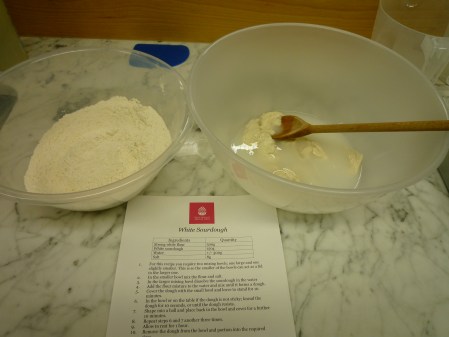
You can see the dissolving of the sourdough in water and Emmanuel’s trademark “10 second knead” in the video clip referred to above. I like the idea that there’s very little work involved in preparing this dough – the wild yeasts quietly get to work and all you have to do is be patient and create the right conditions for this living organism to thrive. Time and a degree of patience are the things needed here.
Once the dough is prepared, it’s time for the fun bit, the shaping into loaves, baguettes or whatever. Artisan loaves obtain their distinctive appearance from the patterns left by natural cane or wicker proving baskets – also known as bannetons in French or Brotförme in German. Here’s a stack of them photographed at the commercially run Welbeck Bakehouse adjacent to the School:

The baskets need to be liberally dusted with flour before you pop the bread in – we used a mix of white flour and semolina for this purpose which gives a bit of crunch to the baked crust. The cane or wicker baskets can be used just as they are, no need for the washable liners you see advertised sometimes – this way you cut down on washing and get the beautiful cane spiral marks on your bread which mark it out as being the real deal.
There’s no need to invest in a stack of pricey proving baskets before you start making bread – I’ve been managing at home lately with a couple of ordinary small wicker baskets lined with (freshly laundered) waffle teatowels. I have a notion that the plastic basket from my salad spinner would also be fit for purpose. That said, I’m now hooked on breadmaking and have just ordered myself an early Christmas present online – 6 cane baskets from specialist artisan baking supplies website
You can see Emmanuel demonstrating how to shape a loaf before popping it in a proving basket in the video clip above. It may look nonchalant but the folding and tightening of the dough at this stage is key to a well risen and shapely baked final result. As Emmanuel says “don’t be shy to use a little bit of force”.
If you’re feeling adventurous, why not try shaping your own baguettes? It’s not as daunting as it looks and you don’t need any special equipment or tins as it’s only industrial bakers that shape their baguettes in tins. Real bakers look in scorn at the telltale spot marks on the base of an industrially baked baguette which come from the tins used to shape and bake them.
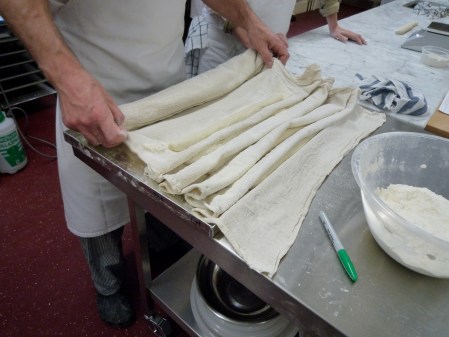
What you need to do is divide you dough into 4 equal pieces (scales are needed to do this accurately). As the video clip shows, each piece of dough is rolled into a tight sausage shape and is placed seam side down on pleated calico liberally dusted with the flour/semolina mix to prevent sticking. Back home, I’ve found that a pleated linen or waffle cotton teatowel works well here though I had to shorten the length of my baguettes to fit the size of my domestic linen. Here’s a photo of Emmanuel’s baguettes nestling in their floured calico:
Once the loaves have proved and are doubled in size and the oven is hot, there’s one more key procedure – slashing. This is not merely decorative but also vital to make the loaf rise evenly and to promote what those in the know call “oven spring”. You’re looking for a plump, pert loaf rather than something too flat and pancakey.
For slashing, a medium sized really sharp blade and a deft swift and not too light touch are needed. You don’t want to just scratch the surface as you need to make a proper incision I would say at least a centimetre deep. A really sharp blade will mean you cut the dough cleanly rather than drag and stretch it which in turn will cause your beautifully risen dough to deflate demoralisingly.
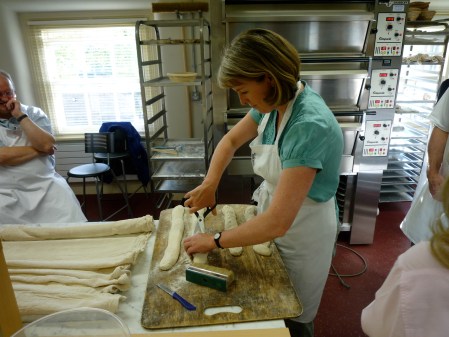
In the video clip you can see us delivering the 5 traditional diagonal slashes to a baguette. Here’s me attempting the alternative scissor and twist technique for shaping the show-off épi baguette pictured at the beginning of this post.
Getting the bread into the oven is a little tricky, especially for baguettes. At the School, we baked this first batch of sourdough loaves in the professional Tom Chandley deck oven which has several stacked ovens which delivers a really good all over crust because of the direct heat at the base.

The proved loaves were turned out onto peels – thin wooden trays – thence straight onto the base of the oven with a deft in and out sliding motion. Think of the trick of whisking away a tablecloth but leaving all the china and cutlery on it intact. Back home I’ve not gone to the trouble (yet…) of investing in a small domestic peel and baking stone but instead have preheated metal baking sheets and have tipped out my proved loaves directly into these and popped them straight back into the hot oven.
One further point on technique – the steam referred to in the recipe is absolutely essential as it delays the formation of a thick skin on the loaf which will turn into an unpleasantly thick crust.
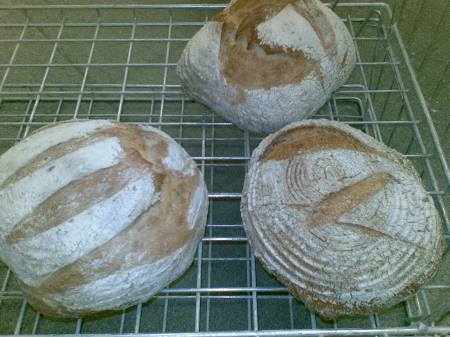
You can see the baked baguettes at the beginning of this post. This is what the baked artisan loaves should like, each decorated with its own individual slash mark:
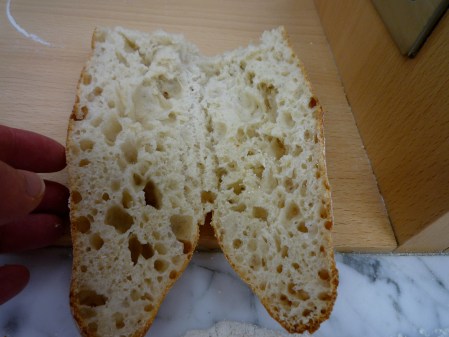
And finally, what do you see when you cut into your freshly baked loaf? This is the perfect uneven, open crumb and elastic texture.
All that’s needed now is a wedge of your favourite cheese and glass of red wine…
Recipe for white sourdough bread
Ingredients
500g strong white flour
150g white sourdough
+/- 300g water
8g salt
Mix the flour and salt in a small mixing bowl. In a larger mixing bowl, dissolve the sourdough in the water. Add the flour mixture to the water and mix until it forms a dough. Cover the dough with the small mixing bowl and leave to stand for 10 minutes.
Knead the dough, still in the bowl, for 10 seconds. Shape into a ball, scraping down the sides of the bowl if necessary. Cover and leave for 10 minutes. Repeat these two steps until the dough has been kneaded four times. Cover and rest the dough for an hour.
Remove the dough from the bowl and portion into the required sizes. This quantity of dough will make a single rustic loaf or 4 baguettes. Shape the loaf/loaves into proving baskets or into pleated calico for baguettes or into a greased tin.
Allow to prove for 3-6 hours or until approximately doubled in size. Preheat the oven to 250 degrees C with a deep tray in the base of the oven. Once the bread is ready for baking, slash with a very sharp knife. Place the loaf in the oven at 250 degrees C, put a cup of water in the hot tray to form steam then lower the oven temperature to 210 degrees C.
Bake for +/- 35 minutes until golden brown. Turn out of its tin (if you have used one) and cool on a wire rack.
Artisan baking part 2 rye sourdough
November 23, 2010 § 2 Comments
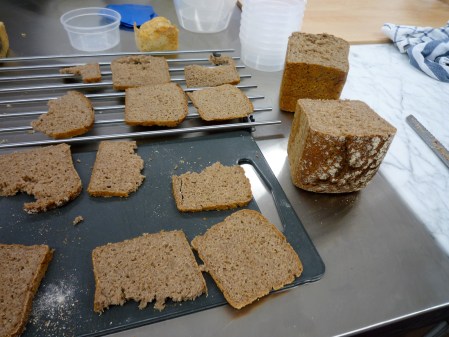
This post is the second of series describing the inspiring 4 day bread baking course I attended in last month at the School of Artisan Food in Nottinghamshire. I’ve decided to forget about describing the course contents in logical chronological order but instead to write about what inspires me at the moment. This week, that just happens to be rye bread, specifically rye sourdough.
Before the course, the inner workings of rye bread were a mystery to me: it remained an occasional eccentric supermarket purchase – cellophane-wrapped packets of pumpernickel containing dark brown strips of cardboard textured slices which seemingly last for ever had a certain masochistic expeditionary appeal.
I hadn’t appreciated that organic stone-ground rye flour was widely available and as a result I’d never have dreamed of trying to bake it myself at home. Since the course, all that has changed.
Our teacher, bread guru Emmanuel Hadjiandreou was brilliant and packed in so much information over the 4 days that it’s taken a while to sift through my photos and video clips. I’ve taken a crash course in basic video handling and editing in my latest One to One session at the Apple Store in Manchester and my very first little movie, imaginatively titled “Rye Sourdough” can be viewed by clicking on the following link.
http://www.youtube.com/watch?v=6qUNKKO1ULU
Now you can see yourself Emmanuel’s deft handiwork, the exact consistency of starter and finished dough and even hear the sound of a perfectly baked loaf.
Let’s start with Emmanuel’s recipe. The ingredients and quantities are exactly as on his beautifully typed-out recipe sheets handed out on the course but I have on occasion put his methods into my own words.
Recipe for dark rye sourdough bread
Ingredients
For the ferment
150g dark rye flour
100g rye sourdough
200g water
For the bread
1 quantity ferment (see above)
200g dark rye flour
6g salt
150g very hot water
Optional flavourings
For apple rye – add 200g chopped dried apple
For apricot rye – add 200g chopped dried apricots
For sultana rye – add 200g sultanas
For prune and pepper rye – add 200g prunes and 10g pink peppercorns
For onion rye – add 200g chopped onion, lightly fried
Begin the day before you want the bread by mixing together the ferment ingredients in a large mixing bowl. Cover with a smaller mixing bowl and leave to ferment overnight at room temperature. In another bowl, weigh out the remaining flour and salt and mix thoroughly. Set aside.
The following morning, when you’re ready to make the bread pour the flour and salt mix over the ferment in the first mixing bowl. Then pour over the measured quantity of very hot water (from a just boiled kettle). The layer of flour will protect the hot water from scalding and killing the yeast within the ferment. Mix thoroughly and add any optional flavourings at this stage. Shape into a greased tin.
Allow to rise/prove for about 2 hours. Preheat the oven to 250 degrees C. Place the proved loaf into the oven at this high temperature; add a cup of water on a hot tray in the base of the oven to form steam then lower the oven temperature to 220 degrees C.
Bake for about 30 minutes. Turn out and cool on a wire rack.
And now for the raw materials.

What we have here is a bowl of ferment (noun) – a wet dough mixture made the night before and left to ferment (verb) to activate the wild yeasts and develop the characteristic background sour flavour of good rye bread. Next to it is the weighed-out rye flour and salt. And that’s it. The rye flour had a silky texture and the prettiest more-than-pastel grey-green colour which when baked is transformed into a dark chocolate-brown loaf.
Here’s fellow student Jethro inspecting the small bubbles which have formed overnight in his ferment. Being able to see what’s going on in your dough from all sides was a bonus of using the semi-translucent plastic bowls we were provided with on the course. These lightweight bowls can be upturned and used as protective covers over fermenting doughs, another useful home-baking tip potentially saving metres of clingfilm and faffing with damp teatowels.

You can also see fellow student Diana carefully weighing out dry ingredients on the “My Weigh” (geddit?) scales we were provided with on the course. These were brilliant and so quick and easy to use and of course accurate to within a gram too – essential especially for getting the right quantity of salt in a recipe. We weighed everything on the scales, the water too, as of course 1ml of water weighs 1g and it’s much more accurate not to say speedy to weigh the water rather than use a measuring jug. Since coming home I’ve bought a set of these scales (Amazon marketplace) and consigned my retro scales with their dinky brass weights to the cellar.
Here is my brandy new all-singing, all dancing set of My Weigh scales on the kitchen table at home:

It seems very odd adding near-boiling water to a bread recipe. Rye bread is unique in requiring this step and Emmanuel talked about this causing a process within the flour called gelatinisation – the dough takes on a porridge like consistency. He showed us how to protect the ferment containing the essential wild yeasts from the hot water by using the flour as an insulating blanket with the hot water being poured over the top.
The rye dough doesn’t look very inspiring when first mixed – more like a building material. I quipped to Ben, a young chef from South Africa who was sharing my workbench that the dough reminded me of childhood holidays on the beach in Wales. He looked puzzled – it seems that beaches in South Africa are of the pure white sand variety rather than the grit, shingle and mud we’re used to over here!
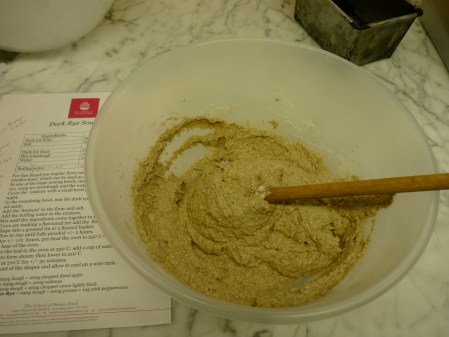
The wet dough mixture is shaped by being tipped into the oiled tin and patted and smeared using a dampened plastic scraper into a mounded loaf shape. Emmanuel advised being careful not to let water from the scraper run down the sides of the tin as this will cause the loaf to stick.

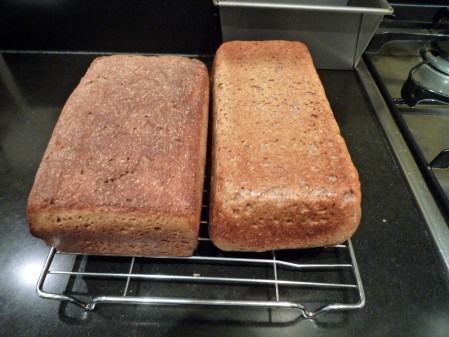
After two hours or so, the rye loaves had increased in size dramatically. We were given the option of sprinkling the top with rye flour and you can see the effect this produces in the loaf on the left in the picture below:

I’ve not stopped making this recipe since returning home after the course. I’ve been using Bacheldre organic stoneground rye flour which gives really good results (sorry Jethro but Ocado don’t stock your stuff). It’s become a bit of a weekend routine to resuscitate the rye starter on a Thursday night ready for a Friday night ferment (sounds more exciting than it really is!) and a Saturday baking session. Here’s a pic of a couple of loaves I baked at the weekend. The resulting bread is moist, flavoursome and delicious, makes fantastic sandwiches and toast and is nothing like those cardboard pumpernickel slices….
Breakfast from Azerbaijan, Land of Jam
November 3, 2010 § Leave a comment
So says the Azerbaijani tourism and information site http://www.azerbaijan24.com/, informing us that “Azerbaijanis make jam from almost anything – walnuts, watermelon and even rose petals…the most popular jams are made from plums, raspberries, mulberries, pears, peaches, melons, figs, strawberries and cherries…grapes, pumpkin and pomegranates…even eggplants can be used as base for jam…If you visit an Azerbaijani home, undoubtedly you’ll be served homemade jam along with black tea. When tea is served, you’ll discover it’s rare in the Republic to be offered sugar. Instead, they’re more likely to offer jam. Azerbaijanis put a small spoonful of jam in their mouths and sip the tea through the jam.”
So, with their predilection for jam, Azerbaijanis are the Billy Bunters of the steppes (greedy fictional schoolboy Bunter liked nothing better than to raid his friends’ tuck parcels and devour jam straight from the jar).
I decided to make jam the centrepiece of the Azerbaijani breakfast (the latest in our A-Z series of international breakfasts). This was a cheaper and easier option than trying to get hold of my first idea which was caviar. After all, Azerbaijan, nestling between Russia, Iran, Armenia and Georgia has a border on the West side of the Caspian sea, home to the sturgeon which produce the coveted caviar.
Muslim Azerbaijan (in contrast with its largely Christian neighbour Armenia) was under Soviet control until it declared independence in 1991 under the Gorbachev glasnost era. Oil is a major earner for the country with activity centred around the capital city of Baku. You may recall that the 1990s Bond Film “The World is Not Enough” with its convoluted oil industry plot featured scenes set and filmed in Azerbaijan.
Enough of background and onto breakfast. This was the prepared table:

On the menu was of course my prize jam collection (including a weird watermelon rind jam which was my only homemade contribution), also Azeri flatbread, sheeps-milk cheese, fresh fruit (including of course the flesh of the watermelon the rind of which went into the jam).

All this was washed down with small glasses of black tea drunk Azeri style with yet more jam.
Here is my completed jar of watermelon rind jam looking distinctly pondlike:

Was the jam worth the effort? No. The resulting jam is dense, sticky and with a taste a bit like cooked marrow – ie vegetal, ever so slightly bitter and not particularly pronounced. The recipe came from the improbably specific website www.watermelonrind.com. There is an alternative recipe on the Azerbaijan 24 site I referenced earlier but that recipe makes use of a rather scary sodium hydroxide solution to crisp up the rind before cooking. Not only is this stuff hard to obtain but it’s also toxic so I thought I’d give it a miss.
Much more to my safe Western taste is the following recipe for Azeri flatbread from the comprehensive and appealing site www.azcookbook.com. My bread, pictured below, is a little more rustic than the photo on the AZ Cookbook site but in my book rustic is good and the toasted sesame seeds tasted delicious:

Recipe for Azeri flatbread
With thanks to http://www.azKitchen.com.
Ingredients
1 package (1/4 oz / 7g) dry yeast
1 ½ cups (12 fl oz/375 ml) warm water
1 teaspoon salt
3 cups bread flour, plus extra for kneading
1 beaten egg for brushing (or just the yolk for a really golden colour)
1 teaspoon poppy or sesame seeds
1. In a small bowl, mix yeast with water until the yeast is dissolved.
2. Sift flour into a large bowl. Add salt and mix well. Gradually add the yeast-water mixture and stir in using your hand until a rough ball forms.
3. Scrape the dough onto a lightly floured surface. Press any loose dough pieces into the ball and knead the dough, punching it down with your fists, folding it over and turning. Knead for about 8-10 minutes, or until smooth and elastic.
4. Shape the dough into a ball and put it back into the large bowl. Cover the bowl with a kitchen towel or a plastic wrap.
5. Leave the dough to rise in a warm spot for about 1 ½ hours, or until doubled in bulk. The dough should look puffy and be soft when poked with a finger.
6. Punch down the dough, then transfer it onto a lightly floured surface.
7. Shape the dough into a ball, and with your hands flatten slightly and stretch it lengthwise. Using a rolling pin, start rolling the dough beginning at one end until you obtain a long flat bread about ½ inch thick (1.27cm), 14 inches long (35cm) and 8 inches (20cm) wide.
8. Carefully transfer the bread onto a non-stick baking sheet, fixing the shape as necessary. Leave the dough to rest on the sheet for another 15 minutes before baking.
9. Preheat the oven to 400?F (200?C).
10. Using a knife, make shallow crosshatching slashes on the bread, 4 from right to left and 4 the opposite way, each at a slight angle. Brush the bread evenly with the egg/egg yolk and sprinkle with seeds.
11. Place the baking sheet on the middle rack of the oven and bake the bread for 20-25 minutes, or until it is golden on top and sounds hollow when tapped on the bottom.
Recipe for watermelon rind jam
Ingredients
Recipe taken from the very specific website http://www.watermelonrind.com. I can’t say I recommend the finished article but here’s the recipe to satisfy your curiosity.
1lb watermelon rind cut into 1cm cubes
water to cover
3 cardamom pods
1 tablespoon lemon juice
1 1/2 cups white granulated or preserving sugar
1 strip lemon peel
Place the watermelon rind in a large saucepan and cover with cold water. Bring to the boil, cover and simmer for half an hour until the rind is tender and translucent. Drain, reserving 1 and a half cups of cooking liquid. Add the cooked rind, reserved cooking liquid, lemon peel and sugar to your preserving pan. Bring to the boil and cook for 15 minutes. Remove from the heat, cool, cover and leave overnight.
The next day, add the cardamom pods bring the mixture back to the boil. Cook for approximately 15 minutes until a thick syrup has formed. Remove from the heat, stir in the lemon juice and pot in the usual way.
I’m going to conclude my post Azeri style by wishing you NUSH OLSUN
…and the good news is we’re through all the countries beginning with the letter A so next stop, the Bahamas!
Four blissful days of artisan baking – part 1, the basics
October 19, 2010 § 4 Comments

I’m freshly returned from four days spent at the School of Artisan Food in Nottinghamshire baking bread under the watchful eyes of Master Baker Emmanuel Hadjiandreou. Emmanuel, originally from South Africa despite his Greek name has an immaculate baking pedigree having worked for the catchily named Flour Power City bakery in London, Gordon Ramsay, Daylesford Organic in Oxford and Judges Bakery in Hastings. Judges is, by the way no ordinary bakery as it’s owned by Green & Black’s chocolate founders Craig Sams and Josephine Fairley.
Here’s Emmanuel in teaching mode in the School kitchens on Day 1 of the “Artisan Baking Session”.

Emmanuel is clearly passionate about all things bread, incredibly skilful, a natural teacher, full of boundless energy and an all round nice guy. Four days spent just baking bread may sound excessive but the days passed too quickly in the idyllic rather other-wordly setting of the School of Artisan Food, a place where the sun always shines, the high-spec kitchens are always spotless, the right utensils and ingredients are always to hand and everything comes out of the oven looking and tasting pretty damn good (though I say so myself)
The School of Artisan Food is a brave new venture established on the Welbeck Estate, the rather grand rural retreat of the Duke of Portland and home to various branches of the Cavendish-Bentinck-Parente families (sorry have rather lost track of the complex family tree). The family seat itself, Welbeck Abbey, is not open to the public. The people behind the School are owners Alison & William Parente (son Joe runs the farm shop and bakery too), managing director Gareth Kennedy and an incredible stable of artisan food gurus – Randolph Hodgson founder of Neal’s Yard Dairy for cheese, Andrew Whitley author of Bread Matter for baking to name but two. It’s a not for profit organisation (a company limited by guarantee) with funding provided in part by the East Midlands Development Agency.
Coming up the drive in my taxi on day 1 of the course, I assumed this was the family seat:

but this is merely a set of almshouses known as “The Winnings” as the cost of building was funded by a former Duke’s racing habit.
Horses appear often in the family history and the estate is home to a splendid stone-built indoor riding school which in its heyday was second only in size to the famous Vienna Riding School.
The School itself is housed in the Estate’s former fire station and is approached across a handsome cobbled courtyard:
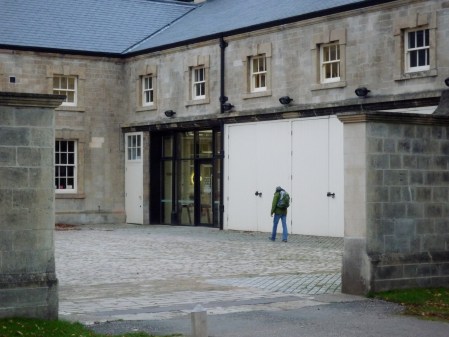
By 10 o’clock on Monday morning, the first day of the course, I and my fellow students, 15 of us in total, had settled into our workstations in the School teaching kitchen.
What sort of person goes on a 4 day artisan breadbaking course? Well, all sorts. We were approximately 50:50 men and women and ages ranged from I think late teens to early 60s. Generally a friendly and cooperative group of people with a shared interest and thankfully no hint of rivalry or competitiveness, in fact a great willingness to share ideas, knowledge and experiences.
There were a couple of chefs in the group wanting to expand their repertoire but this is not a course aimed at turning out master bakers after just 4 days. The techniques and recipe quantities were firmly aimed at the domestic rather than a commercial setting. I would say the majority of people on the course were enthusiastic amateurs – one of whom was so enthusiastic in fact that he’d built his own wood-fired bread oven with a capacity of 30 loaves in his back garden in Aberdeenshire!
Day 1 focused on the basics, the raw ingredients of breadmaking, and 3 basic recipes for white, wholemeal and malthouse loaves raised with nicely domesticated commercial yeast and shaped and baked in tins.
The basic ingredients of breadmaking are of course very simple – flour, yeast, water and salt – yet a lot of myths are propounded about them. We used Shipton Mill organic flour throughout the 4 days of the course as this was a range Emmanuel was already familiar with from his previous baking career. Quite a few myths were debunked when going through this list of basic ingredients:
1) You don’t need to use expensive crushed Maldon salt – regular table salt is just fine (excuse the pun…)
2) Either fresh or dried yeast (as long as the dried yeast hasn’t been messed about with) is equally good as long as you dissolve it in water first.
3) Neither bottled mineral water nor water warmed to blood heat are necessary to make good bread – just use room temperature water out of your tap, even when making up a sourdough starter.
4) There’s no need to add fat or sugar to your bread dough – all that you need is in the flour itself.
5) Finally, and most radically, making a sourdough starter is dead, dead simple. Simply mix together a teaspoon of rye flour and a teaspoon of water in a small container, cover and leave at room temperature for 24 hours then repeat the process and you’re away. After 4 days you’ll have a lively starter ready to be bulked up with either white or rye flour and you’re ready to bake your very own sourdough loaf.
It really was that simple. I’ve been put off sourdough baking before because of the complex recipes involving grapes, raisins, molasses, orange juice, apple juice plus other more esoteric ingredients. Then there were the tales of exploding starters, icky smells, dead starters, yellow mould, pathogens and worse. Emmanuel in his charming and direct style showed us how simple it was.Here’s the rye sourdough Emmanuel passed round on day 1, ready to be prodded and poked:

And for the sake of completeness, here’s one of Emmanuel’s white sourdough starters. Like a conjuror he breathed frothing bubbly life back into a piece of frozen sourdough, a rather pasty piece of dry sourdough and a more liquid version and all three performed fantastically.

I’m going to conclude this post with a slightly obsessive time series set of pics of my very own rye starter, conceived at Welbeck and now resident in my kitchen in Altrincham:
Here’s the flour and water freshly mixed on day 1 (iPhoto tells me it’s 11 Oct at 13.26 precisely)

and already the next day there are signs of wild yeasty fermenting life in my baby! This photo is dated 12 October at 14.27.

Fermentation is clearly well-established by the following morning 13 October at 09.26
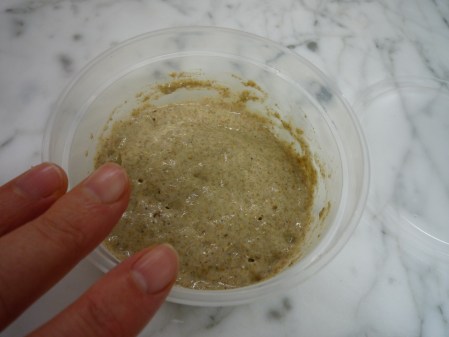
And by the end of day 4 I was ready to take home by lovely bouncing starter ready for baking!
I’m pleased to report that it’s producing great bread – a wonderfully moist and light rye loaf most recently. In fact, must go and give it a feed now…
More bread stuff to follow on my return from holiday to Egypt – let’s hope Tim can keep the starters going in my absence.
Apples of all kinds
September 30, 2010 § Leave a comment
In this season of mists and mellow fruitfulness I’ve been thinking about apples. I’ve always thought of them as the quintessential English fruit but looking at data on world apple production collated by the United States Food and Agriculture Association. I see that China rules the apple world producing an impressive 31 million tonnes in 2008. The US is in second place producing a mere 4 million tonnes. The UK languishes in 37th place with its meagre production of 243,000 tonnes, narrowly pipped (sorry I couldn’t resist the pun) by Switzerland’s 255,000 tonnes.
Apples featured during our trip to Switzerland this summer. The Swiss, like the English, claim the apple as their own. After all it was an apple that Swiss folk hero William Tell shot from his son’s head to prove his prowess in archery.
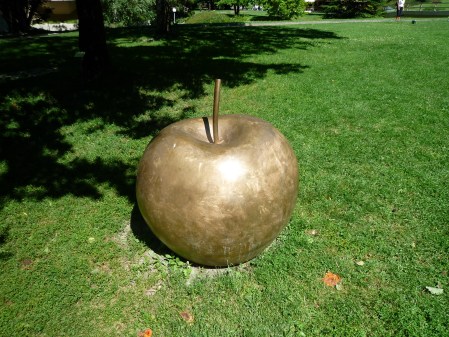
We saw this luscious golden version of William Tell’s apple in the sculpture park at Martigny, Switzerland which we visited in August. The artist is French sculptor Claude Lalanne (b. 1924)
And here is the real thing, apples growing in a ProSpecieRara orchard in what might be called William Tell Country, the shores of the Vierwaldstättersee (Lake Lucerne to the English speaking world, with iconic Swiss mountain Pilatus in the background. This was a view from the second week of our Summer 2010 Swiss trip as we ascended the Bürgenstock on foot rather than usual tourist option of funicular railway and spectacular outdoor lift.

By the way, ProSpecieRara http://www.prospecierara.ch/ is the Swiss Foundation for the Cultural and Genetic Diversity of Plants and Animals, a sort of super Brogdale. They hit the headlines recently with a taut-skinned longlived rare apple variety which is now being used in a facecream used by Michelle Obama.
I digress so back to the fruit itself. Apples from our neighbours’ garden greeted us on our return home in early September. Their enterprising daughters were giving away these beauties door to door in return for a donation to charity. I’m not sure what variety they were but they were crisp and sweet and worked well for both cooking and eating:

I was inspired to depart from the usual pie or crumble option and to try out two different apple recipes. The first was a new one for me, a traditional Brown Betty pudding, the recipe taken from the ever reliable Four Seasons cookbook. The second was the resurrection of what’s become a family classic, an apple and walnut cake from Nigella Lawson’ “How to be A Domestic Goddess”.
The apples turned out to be one that held their shape after cooking rather than “falling” into a delicious fluff in the way that Bramleys do. The Betty would have been better with a Bramley type apple I think as all the ingredients would have melded together. Served with a dollop of proper custard, it was nevertheless a satisfying conclusion to a ribsticking Sunday lunch:

Now that I’ve tinkered with Nigella Lawson’s cooking instructions (I’ve found that a lot of the recipes in the Domestic Goddess book need road testing and refining before they’re safe to use) this is a reliable recipe for an unusual but easy to make cake. The flavours of walnut oil and lemon zest, plus the grappa soaked sultanas (my refinement to the recipe which originally specified rum) marry perfectly with the apples and lift their flavour. You can almost kid yourself its good for you too.

Here are the two recipes in case you too have a glut of apples on your hands. They’re both good enough to go out and buy apples for too if you don’t have any homegrown ones.
Recipe for Apple and Apricot Brown Betty
From Margaret Costa’s Four Seasons Cookery Book. I’ve tinkered with it only to adjust the dried apricot instructions as these days all you can find are the ready to eat type so no need to soak overnight.
Ingredients
1/4 lb (115g) dried apricots, the soft type ready to eat type, roughly chopped
1 and 3/4 lb (800g) tart cooking apples, peeled, cored and roughly chopped
6 oz (175g) coarse fresh white breadcrumbs
2 and 1/2 oz (70g) melted butter
2-3 oz (55-85g) blanched almonds
grated rind of 1 small orange
4-6 oz (115-175g) brown sugar (I used a dark soft Muscovado)
more butter for dotting
Toss the crumbs into the melted butter so they absorb it evenly. Spread a thin layer of crumbs onto the base of a porcelain soufflé dish. Cover with a mixture of the coarsely chopped apples, apricots and almonds. Sprinkle with a little orange rind and some of the sugar. Repeat the layers until the dish is full, finishing with a layer of crumbs. Dot with butter and sprinkle over any remaining sugar. Bake at 180 to 190 degrees C until golden and crisp. Good with cream, perhaps clotted cream, or proper custard.
Recipe for Apple and Walnut Cake
Adapted from a recipe in “How to be a Domestic Goddess” which in turn started life in Anna del Conte’s “Secrets from an Italian Kitchen”
Ingredients
100g sultanas
75ml grappa
150 ml walnut oil (or half and half mixture of walnut oil and extra virgin English rapeseed oil which I used)
200g golden caster sugar
2 large eggs
350g plain flour
1 teaspoon ground cinnamon
1 and 1/2 teaspoons bicarbonate of soda
1/2 teaspoon cream of tartar
1/2 teaspoon salt
450g eating apples (don’t use a Bramley type apple for this recipe as distinct nuggets of cooked apple are what’s required in the finished cake) peeled, cored and cut into small cubes (1/2 cm dimension is about right)
zest of a lemon
100g walnuts
Put the sultanas into a small saucepan and bring to the boil then set aside to plump up.
Line a 20cm/8 inch round cake tin with bakewell paper and preheat your oven to 180 degrees C.
Beat the oil and sugar together in a large bowl, and add the eggs one at a time, beating until it looks a bit like mayonnaise. A wooden spoon and some elbow grease work fine here. Add the dry ingredients to the egg mixture, folding in with a metal spoon. Stir in the apples, lemon zest, sultanas with any residual grappa and walnuts. The batter should be fairly stiff.
Spoon the batter into the prepared cake tin, level the surface and place in the preheated oven. After 15 minutes, reduce the temperature to 160 degrees C. After a further 30 minutes, check the cake and if it’s browning too quickly, cover the top with a disc of foil. The cake will be ready after an hour, or maybe an hour and fifteen minutes. Check with a skewer after an hour.
Let the cake stand for 20 minutes before turning out. It’s delicious eaten slightly warm but will behave better in terms of cutting into neat slices, if left overnight, wrapped in foil before you try it. I can’t comment on its keeping qualities as it’s never lasted more than a day or so in our greedy household!
Edible municipal gardening in Switzerland
August 14, 2010 § Leave a comment
An idea from Switzerland that could work well back home. Municipal planting in the North of England where I come from tends to take the form of highly coloured highly regimented and highly maintained beds of marigolds, begonias, lobelia and the like. I saw recently in both Champéry and Vevey, two towns in la Suisse Romande (French speaking Switzerland), examples of edible flower beds.
In Vevey these were straightforward ornamental vegetables, rainbow chard, sweetcorn and tomatoes.
In Champéry, a more imaginative approach was taken. Herbs and edible plants were displayed in planters which formed a trail through the village with a recipe for the relevant edible plant displayed next to it. The recipes were compiled into a handy little brochure available from the tourist office.
Here are 3 of the recipes from the leaflet which appealed to me, including one featuring comfrey. Normally all my recipes are tried and tested but these are new to me. I shall be giving them a go as soon as I’m back in my own kitchen and can forage for the ingredients.
A photo of the planter containing comfrey (Symphytum officinale or consoude in French) appears at the bottom of the post.
Recipe for comfrey tzatziki
For 4 people. This recipe makes sense as tzatiki is usually made with cucumber and both comfrey and it’s cousin borage are said to have a cucumber-like taste. Rather worryingly, the original recipe states that comfrey should be consumed in moderation because of the potentially liver damaging compounds it contains. You have been warned!
Ingredients
300g natural yoghurt, ideally Greek style
6-7 young comfrey leaves
1 clove of garlic
1 tbsp olive oil
5 mint leaves, ideally wild mint
salt and pepper
Chop the comfrey and mint finely and mix with the yoghurt and olive oil. Season to taste. Leave for 1 hour in the fridge and mix again before serving.
Recipe for little elderberry cakes
Makes about 25 little cakes. These sound as if they’ll turn out like madeleines – I hope so as madeleines are just about my favourite small cakes.
Ingredients
150g flour
150g caster sugar
40g ground almonds (ideally bitter almonds)
2 teaspoons baking powder
The grated rind and juice of half a lemon
150-200g ripe elderberries removed from the stalk
3 eggs lightly beaten with a fork
150g melted butter
125g natural yoghurt
2 tbsp orange flower water
In a large bowl mix the flour, sugar, ground almonds, baking powder, grated lemon rind and elderberries. Take care not to crush the berries. In a second smaller bowl, mix the eggs, melted butter, yoghurt, lemon juice and orange flower water. Add the wet ingredients to the dry, mix and allow to rest in the fridge for 1 hour. Drop teaspoons of the mixture into prepared silicone moulds (I plan to use my silicone madeleine moulds, otherwise use patty tins). Bake for 12 to 15 minutes in an oven preheated to 220 degrees C. Leave for a few minutes before unmoulding.
Recipe for Charentais melon and wild mint salsa with melon and muscat sorbet and raw ham from the Val d’Illiez
Serves 4 I would guess. This is one of the sketchier recipes in the leaflet so please alter it as you see fit. No ingredients or method are given for the sorbet syrup so please consult your usual cookbook to see how to make this.
Ingredients
2 Charentais melons
1/2 cucumber
1 dessertspoon icing sugar
125 ml sugar syrup
Small glass Pineau de Charentes or other sweet muscat wine
4 handfuls salad leaves
4 to 8 slices Val d’Illiez or other raw thinly ham
Peel and deseed the melon and cucumber, cut into small cubes and marinate overnight in the fridge with the chopped mint and the spoonful of icing sugar. Liquidise and set aside.
To make the sorbet, peel and deseed the second melon, cube and liquids then mix with the 125 ml chilled sugar syrup and the small glass of muscat wine. Churn in an ice cream maker or freeze in a shallow plastic container stirring the mix from time to time.
Serve the smoothy and the sorbet with a few dressed salad leaves (use a vinaigrette flavoured with chopped wild mint) and scatter over the strips of raw ham.

Australian breakfast
August 4, 2010 § Leave a comment
Holy Dooley! What are these Cockroaches, Crow Eaters and Cane Toads up to! And you thought nothing was going on in the GAFA. There’s clearly more to an Australian cuisine than a billy and a Dingo’s breakfast (for a translation go to http://www.koalanet.com.au/australian-slang.html )
This was the latest in our series of breakfasts from all the countries of the world starting from A and going through to Z.
I decided to dive straight into the heart of Australia for inspiration for this breakfast and typed “Alice Springs breakfast menu” into my search engine. I half expected to discover something suitable for a sheep-wrangler but instead found some rather metropolitan on-trend suggestions from the Alice Springs Convention Centre. Selecting from their breakfast menu I devised this selection of my own:
Vegetarian frittata with sweet potato, peas and oregano tomato
Wattleseed french toast
Pancake with bush honey and crispy bacon
Next problem was where to get hold of the essential wattleseed and bush honey. An internet search led me first of all to Australian native ingredients evangelist Vic Cherikoff’s informative website to http://www.cherikoff.net (some inspiring recipe ideas too). He doesn’t really seem geared up to UK online retail orders though. Fortunately http://www.foodshopaustralia.com/ is a user friendly site with a wide range of stuff both gourmet and tacky. I ended up going a bit mad and ordering native fruit jams (both quandong and rosella), macadamia nut butter, bluegum honey, vegemite and Uncle Toby’s oat cereal as well as my ground wattleseed and to finish things off, a lemon myrtle infusion instead of regular tea. There was great excitement when my stuff arrived 2 weeks later in a distinctive blue hessian sack emblazoned with the Singapore post office logo through which my goods must have passed in-transit.

and here are all the Aussie goodies:

I made the French toast in the usual way but added a couple of teaspoons of Star Kay White chocolate extract to the milk into which I dipped the bread before dipping in the egg. This complemented the chocolate hazelnut flavours of the ground wattleseed. I sprinkled the cooked French toast generously with caster sugar and ground wattleseed and served it with a dollop of quandong jam. This was described as a native peach and was gorgeous, dark and syrupy – a more intense version of apricot jam. Delicious:

I devised my own recipe for the frittata which I give below. Also very successful – I’ve made it again since so I have a new addition to the repertoire. It’s shown here on the plate with the pancakes (again I used my regular breakfast pancake recipe) and some crispy pancetta.

Can I let you into a secret? I haven’t opened the Vegemite yet and maybe as the other stuff is so good I won’t bother…
Recipe for sweet potato, pea and oregano tomato frittata
I devised this based on an authentic Marcella Hazan recipe but with different ingredients and quantities to fit my trusty 10 inch Anolon non-stick frying pan. Serves 2-3 people.
Ingredients
2 medium sweet potatoes peeled and cut into 1 inch dice
2 tablespoons olive oil plus more for drizzling and cooking the frittata
Generous handful of shelled peas steamed for 2-3 minutes (or cooked from frozen)
8 oz cherry tomatoes
teaspoon dried oregano
tablespoon chopped fresh oregano or basil or marjoram
4 large eggs
4 tablespoons freshly grated grana padano cheese
salt and freshly ground black pepper
Toss the diced sweet potatoes in oil, season and roast on a shallow tray at 180-200 degrees C until cooked through and nicely brown. This takes about 30 minutes. Once these are in the oven prepare the tomatoes by halving, drizzling with olive oil and sprinkling with salt, pepper and oregano. Place on another shallow baking tray lined with baking paper and pop into the oven on the shelf below to roast with the sweet potatoes for about 20-25 minutes – they’ll be ready at the same time.
Meanwhile beat the eggs lightly with a fork in a large bowl, add the grated cheese, seasoning and chopped fresh herbs. When the sweet potatoes and tomatoes are ready, tip them into the egg mix straight from the oven along with the cooked peas. Stir to combine.
Heat a tablespoon of olive oil in a 10 inch non stick frying pan over medium heat. When it is hot, pour in the frittata mix and ensure evenly distributed. Turn the heat down as low as possible and cook for 10-15 minutes so that the mixture is set but not browned and only the top is still runny. Flash the top under a hot grill for 30 seconds to set the top. You’re ready to eat! Best served hot rather than warm I think. Also very good cold for lunch later if you don’t eat it all now.
Armenian breakfast
July 17, 2010 § 1 Comment
This is the latest breakfast in our family project to prepare and eat a breakfast from every country in the world in alphabetical order. The highlight was without doubt these plaited brioche-type breads called Choereg or Choreg which are in fact very simple to make once your plaiting technique is sorted out. As a little girl I had long hair often plaited so this was no problem.

What do I know about Armenia? Very little. “A landlocked country with Turkey to the West and Georgia to the North, Armenia boasts striking scenery with high mountains and caves, lakes and hot springs”. So says the BBC News website, along with a few other key facts: capital city Yerevan; population 3.1 million; land area 11,484 sq miles (ed: about twice the size of the English county of Yorkshire); major religion Christianity.
Armenia has a huge diaspora and famous Armenians or people of Armenian descent can be found all over the world: the composer Aram Khachaturian (whose Spartacus theme was used as the opening music for BBC TV series The Onedin Line) and singers Charles Aznavour and Cher are just a few examples.
This means too that there are many Armenians in Europe and the US wanting to recreate a taste of home, communicating with one another and sharing recipes which conjure up a taste of the homeland. Luckily for me, Armenian recipes are relatively easy to come by on the web,
I started my research with a visit to a Manchester institution, The Armenian Taverna which for as long as most people can remember has occupied discreet basement premises in Albert Square. It looks as if I was in the nick of time as, sadly, the restaurant went on the market last month.

Owner Mafif Alamyan (reputed to be a former Olympic wrestler) was most helpful when describing typical Armenian breakfast dishes. Eggs, tomatoes and cheese featured on his list as did Armenian bread. It was in describing the fruit of Armenia, both fresh and preserved as jam, that he became almost lyrical – he talked of green walnut jam, apricots (the Latin name for the apricot is after all Prunus armeniaca) , cherries and especially mulberries. I recommend a visit to the Armenian Taverna before it vanishes for ever http://www.armeniantaverna.co.uk/
Now I needed to flesh out Mr Alamyan’s guidance with some recipes. First stop was
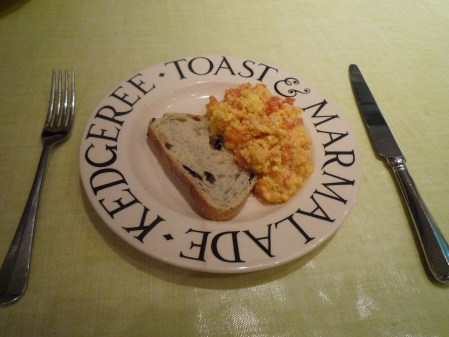
http://www.thearmeniankitchen.com a vast repository of Armenian food and memories compiled by the Kalajian family now living in the US. Here I found a description of egg scrambled with tomatoes which seemed to fit the bill for a simple breakfast dish – so simple it doesn’t need a recipe, just Mr Kalajian’s simple instructions. “You cut up a tomato as chunky or delicate as you like and stir it into your eggs as you scramble them. Add salt and pepper and eat with bread”.
The next challenge was to try and locate mulberry jam. This could be tricky. The only mulberry tree I know of is Milton’s (so called because the poet sat and composed under its shade) in the Fellows’ Garden at Christ’s College in Cambridge. No way was I going to get permission to gather mulberries from there very easily. There had to be another way. Sadly I couldn’t find anyone selling mulberry jam made in the UK but specialist deli Mortimer & Bennett came up with the goods – a middle eastern mulberry jam made in the Lebanon. This would do nicely. Mortimer & Bennett are based in Turnham Green, West London and have a wide range of delectable and out of the ordinary deli items. They sell via their website as well as from the shop and I can vouch that they provide an efficient and personal service. My package of goodies (I just had to buy some oils and chocolate too as they offer free shipping if your order is £50 or more) arrived safe and sound a few days after ordering. Here’s the jam complete with rustic hessian lid cover:
http://www.mortimerandbennett.co.uk/

OK so the jam was now sorted so now for the bread. I found three Armenian bread/pastry recipes suitable for breakfast, the first Bishi (sometimes spelt BeeShee, sometimes also called Zeppole), a kind of doughnut, the second Keta, a walnut-stuffed Danish-type pastry and the third Choereg, a plaited sesame sprinked loaf enriched with eggs and butter (also spelt choreg and I reckon its similar to the Greek tsoureki too).
To make the most of the carefully sourced mulberry jam, I opted to make the plainest of the three breads, the choereg choosing a straightforward recipe contributed by Ani from Montreal which I found on Allrecipes.com. I give the recipe below but I did reduce the fat content of the recipe to just 8oz from the 1lb specified, similarly I used 4 eggs rather 5 – it still turned out spectacularly well.
A word on mahleb – this is a middle eastern spice made from the kernel of a special variety of cherry. I’d already started the recipe when I noticed this little bombshell in the list of ingredients so didn’t even attempt to track some down so added a slug of Amaretto and another one of Kirsch to try and provide the required almondy cherry flavours.
Recipe for Choereg – Armenian sweet plaited bread
Ingredients
1 cup whole milk (8 fl oz)
1 cup butter (8 oz or 225g)
1 cup white sugar (8 oz or 225g)
1/2 cup lukewarm water (4 fl oz or 120ml)
2 teaspoons white sugar
2 (.25 ounce) envelopes easyblend dry yeast
4 eggs (plus more beaten egg for glazing)
6 cups all-purpose flour plus more if required to obtain the right dough consistency (840g or 1 lb 14 oz) – I used a mixture of strong and ordinary plain white flour
1 1/2 teaspoons baking powder
1 1/2 tablespoons ground mahleb (see note above)
1 1/2 teaspoons salt
1 tablespoon sesame seeds
In a saucepan over medium heat, combine the milk and butter. Heat until butter is melted, but do not let it boil. Stir in 1 cup of sugar until dissolved, then set aside to cool to lukewarm. Crack the eggs into a large bowl, and stir a little to break up the yolks. Slowly pour in the heated milk mixture while whisking constantly, so as to temper the eggs and not cook them.
In a large bowl, combine the flour, sachets of easyblend yeast, baking powder, mahleb, and salt. Make a well in the centre, and pour in the wet mixture. Stir until it forms a sticky dough. Pour onto a floured surface, and knead in additional flour as needed to make a more substantial dough. Knead for about 10 minutes. Place in an oiled bowl, and set in a warm place to rise for about 2 hours, or until doubled in size.
When the dough has doubled, punch down again, and let rise until doubled. It will only take about half as long this time.
Separate the dough into 5 even portions, then separate each of those into thirds. Roll each of those into ropes about 12 inches long. Plait sets of three ropes together, pinching the ends to seal, and tucking them under for a better presentation. Place the loaves onto baking sheets. Loaves should be spaced 4 inches apart. Set in a warm place to rise until your finger leaves an impression behind when you poke the loaf gently.
Preheat the oven to 350 degrees F (175 degrees C). Brush the loaves with beaten egg, and sprinkle with sesame seeds.
Bake for 25 minutes in the preheated oven, or until nicely golden brown all over.
World cup final sandwich
July 7, 2010 § Leave a comment
Looking for a snack to sustain you through the World Cup final next week? It’s looking as if it might be Germany v Holland, a grudge match if ever there was one, making Germany v England seem like a friendly….Now that England is out of the running, it’s possible to enjoy the football and contemplate eating whilst doing so.
I decided to take my inspiration from America, the nation of the sporting snack par excellence. I fished out the Superbowl edition of American food magazine Bon Appétit and decided to recreate the epic looking grilled cheese short rib sandwich with caramelized onions featured on the front cover.

It turns out that this is a speciality of restaurant Joan’s On Third in Los Angeles and was featured in the “RSVP” section of the magazine where readers’ favourite restaurant recipes are tracked down. Joan’s On Third looks amazing www.joansonthird.com: New York deli meets California cuisine. Imagine having somewhere like that on your doorstep…I digress. Back to the sandwich for which I give the full recipe below. Truthfully, the recipe is a little involved but the beef and onions can be prepared in advance ready to assemble into a sandwich at the right moment.
My first problem was finding out what the heck a short rib was. First stop David Rosengarten’s “It’s All American Food”. He says “Interest in cooking short ribs at home has been rekindled by the short rib boom in trendy restaurants. Americans across the map have rediscovered the comforting deliciousness of collagen-rich cuts of meat…melting down in a pot… into soft and buttery puddles of protein.” OK I get the picture and my appetite is whetted but what is it?
Hugh Fearnley Whittingstall to the rescue in his “Meat Book”: it’s a small rack of ribs from the flank, ie the forequarter just behind the front leg. This is the cow version of the more familiar rack of pork spare ribs and shares with that cut its sticky, juicy characteristics best brought out by a long slow cooking. Happily, my local butcher in Hale knew the cut (sometimes referred to as Jacob’s Ladder) and, with a couple of days’ notice, came up with the goods – a Desperate Dan super-sized rack of ribs which he helpfully sawed into manageable chunks.
Here they are, ready to begin the recipe which follows:

Recipe for grilled cheese and short rib sandwiches with pickled caramelized onions and arugula (rocket)
Serves 8
Ingredients – short ribs
5 pounds beef short ribs
1/2 stick (4 oz) butter
3 celery stalks, chopped
2 large carrots, peeled and chopped
1 medium onion chopped
1 and 1/4 cups (10 fl oz ) red wine
1/2 cup (4 fl oz) low salt beef stock
1/2 cup (4 fl oz) medium dry sherry
2 garlic cloves, peeled
2 bay leaves
1 large fresh thyme sprig
Here are my ingredients ready to go. I used all-American Quady’s Vya Vermouth instead of the sherry as that’s what I happened to have open.

Ingredients – pickled caramelized onions
1 tablespoon butter
2 large red onions, halved and thinly sliced crosswise
4 and 1/2 tablespoons red wine vinegar
1 and 1/2 teaspoons sugar
Ingredients – final assembly
Softened butter
16 slices country-style crusty white bread (or a crusty sourdough if you like)
12 oz Petit Basque or Monterey Jack cheese, sliced (or your favourite semi hard cheese suitable for melting- Taleggio would be good; I used a stunning unpasteurised Gorwydd Caerphilly)
4 cups (generous handfuls) baby arugula (rocket)
SHORT RIBS. Sprinkle beef with salt and pepper. Melt butter in a large wide pot over medium-high heat. Working in 2 batches, cook beef until browned, about 6 minutes per batch. Transfer to large rimmed baking sheet (to catch the juices). Add celery, carrots and onions to pot and sauté until beginning to soften and brown, stirring often, about 5 minutes. Add wine, broth, sherry, garlic, bay leaves and thyme sprig; bring to boil, scraping up browned bits. Season with salt and pepper. Return ribs to pot, propping up on sides and arranging in single layer.
Here’s what they look like at this stage:

Cover, reduce heat to medium-low, and simmer 1 hour. Using tongs, turn the ribs over in the pot. Cover and simmer until ribs are tender and sauce is very thick, occasionally rearranging ribs in pot to prevent sticking, about 1 and 1/2 hours longer.
This is what the cooked ribs look like:

Uncover and cool 30 minutes. Transfer ribs to work surface. Discard bay leaves and thyme sprig. Spoon off fat from sauce in pot. Remove meat from bones; discard bones. Cut meat into 3/4 to 1 inch pieces, trimming any fat. Return meat to pot. DO AHEAD. Can be made 2 days ahead. Chill until cold; cover and keep chilled. Rewarm just until lukewarm before using.
PICKLED CARAMELIZED ONIONS.

Melt butter in large skillet (heavy-based frying pan) over medium-high heat. Add onions, sprinkle with salt and sauté until beginning to brown, stirring frequently, about 10 minutes. Add vinegar and sugar and cook until almost all vinegar is absorbed, about 1 minute. Season with salt and pepper. Transfer to microwave-safe bowl; cool. DO AHEAD. Can be made 2 days ahead. Cover; chill. Microwave in 15 second intervals until lukewarm before using.

ASSEMBLY. Line 2 large baking sheets with waxed paper. Butter 16 slices bread. Lay 8 slices, buttered side down onto the the prepared sheet. Divide the short rib mixture among the bread slices. Divide cheese among sandwiches. Spoon onions over sandwiches. Place handful of arugula (rocket) atop the onions. Top with remaining 8 bread slices, buttered side up. DO AHEAD. Can be prepared 1 hour ahead. Cover with plastic wrap and store at room temperature.
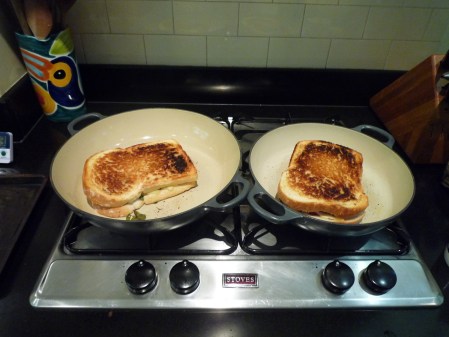
Heat 2 large skillets (frying pans) over medium heat. Working in batches, cook sandwiches until bread is golden brown and cheese melts, about 3 minutes per side.
Here are my sandwiches in the pan. I slipped the pans into a 180 degree C oven for 3 or 4 minutes to complete the cooking without burning the bread.
Transfer cooked sandwiches to work surface. Cut each in half on diagonal. Transfer to plates and serve.
And Voilà! Here is my completed sandwich ready for consumption during the game. Your favourite beer is the perfect accompaniment. Awesome. May the best team win.

 The Rhubarb Fool