
Bajan breakfast
June 15, 2011 § 3 Comments
Bajan being the correct adjective to describe something from Barbados, this was the latest in our series of breakfasts of the world.
At 431 square kilometres, Barbados is a tiny country, approximately one third of the size of my own UK county, Greater Manchester which clocks in at 1,276 square kilometres. It was one of the earliest British colonies with settlers arriving in 1627. The British heritage is evident in the island’s organisation and placenames – it’s divided into parishes each named after a saint. The capital and main city, the very British sounding Bridgetown is in the parish of St Michaels.
Barbados may be a small country but it’s a familiar one. That Desmond Dekker song, sugar, rum, cricket and of course the larger-than-life Rihanna all come immediately to mind. That’s not all that’s larger than life as Barbados can put on a big breakfast. The Bajan breakfast option priced at $22 on the menu from Simply Gigi’s, a hotel restaurant which looks out over Barbados’ Dover Beach reads “Flying Fish, Bakes, Eggs, Onions, Peppers, Plantain”. Much more adventurous sounding than the Full English or bog-standard American options. After a little research and judicious cheating, this is the colourful plate of food I came up with:

First find your flying fish, the favourite fish and symbol of Barbados. This is not as easy as it sounds. I did track down a UK wholesale supplier of frozen flying fish fillets but couldn’t face ordering the industrial-sized minimum order quantity.
Next step was a trip to the cornucopic fish stall on Manchester’s Arndale Market which goes by the very mundane name of “Direct Fisheries”. They had all sorts of exotic species on offer as you can see:

but sadly, flying fish wasn’t one of them – it’s occasionally requested, said the fishmonger, but a bit pricey for most people so they’ve stopped selling it. I opted for a couple of seabass instead. No idea whether it’s like flying fish but it’s a very adaptable fish which works with all sorts of flavours.
The recipe involves a brief period in which the fish fillets are first marinaded/infused with aromatic flavourings (herbs, green pepper and lime juice), then, top side only, lightly coated in egg and breadcrumbs and quickly shallow fried.

Far from being just a regional curiosity, this is a handy little recipe which I’ll definitely be trying again. The marinading period gives the fish zingy flavours and the crispy golden crust gives a bit of fast food type appeal.
Next step was to find out what Bakes were. This is by no means a selection of bread rolls on the side but a little doughy Bajan treat which paradoxically is shallow-fried rather than baked. Bajan chef John Hazzard’s (pronounced Has-Ard rather than as in traffic obstruction, moral or Dukes of) little videoclip on was helpful in showing exactly how to whip up a batch of bakes.
I had planned to put in here the link to John’s handy little video which I found on a site called theholidaychannel.net but sadly the site appears to have been suspended. You’ll just have to take my word for it that he had a great relaxed manner and his lilting accent was rather lovely to listen to as well.
I followed Chef Hazzard’s instructions to the letter and he end result was rather good – a cross between a Scotch pancake and a doughnut. The brown sugar and spices provide flavour and the cornmeal a pleasing chewy crunch. I can see why the islanders get so passionate about bakes.

Sugar has been the mainstay of the Barbadian (or should that be Bajan?) economy for centuries so it seemed fitting to round off breakfast with something sweet. My choice was Bajan sweet bread, not a true bread but a coconut cake baked in a loaf tin. This beauty is made with refined sugar rather than what we know now as Barbados or Muscovado sugar, it’s studded with garish glacé cherries and raisins and has extra sugar and coconut strip concealed within the cake like so:
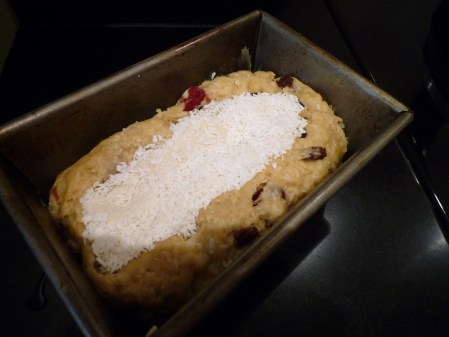
With all that refined sugar, coconut and artificially coloured dried fruit it could almost be a Scottish delicacy couldn’t it?

The end result looked impressive in a bulky golden brown homespun kind of way but sadly it was a bit disappointing. It was a bit dry and oversweet, it crumbled rather than slicing neatly, the coconut stuffing fell out rather than maintaining structural integrity and it went stale within 24 hours. For that reason I’m not going to painstakingly copy out the recipe here. If you’re interested, here’s where I found my recipe, a Paul Hollywood (not so) special – he’s the sleek silver haired judge on last year’s BBC programme “Great British Bake Off” you may recall.
http://uktv.co.uk/food/recipe/aid/515131
Recipe for fried flying fish fillets
I found this recipe in a Barbados travel blog http://barbadostravel.squarespace.com so thank you to blog author Linda Thompkins.
Works well for other medium to large fillets of firm white fish such as seabass.
Serves 4 (generous portions)
Ingredients
8 flying fish fillets
1 small onion
1 small green pepper, chopped
1 teaspoon chopped thyme leaves
t tablespoon chopped parsley
salt and pepper
juice of a lime
1 egg, beaten
dry natural breadcrumbs
oil for frying
to serve, lime wedges
Mix the seasoning ingredients together and spread over the meaty side of the fish. Leave for about 1 hour. Remove the fish from the seasoning mix, pat it dry it on kitchen paper. Dip the meaty side of the fish fish into the beaten egg and then into the breadcrumbs. Fry gently in a little oil for 3-4 minutes on each side until cooked through and crumbed surface is crisp and golden. Serve with lime wedges.
Recipe for Bajan bakes
Bajan chef John Hazzard’s recipe. John has twice been awarded the title “Caribbean Chef of the Year” so he should know what he’s talking about.
Ingredients
1 cup of plain flour
4 oz cornmeal (polenta)
3 oz brown sugar (I used demerara)
1/2 teaspoon salt
1/2 teaspoon baking powder
pinch allspice
pinch freshly grated nutmeg
6 oz water
to fry, 2 tablespoons flavourless vegetable oil
Combine the first 7 ingredients in a mixing bowl. Add most but not all of the water and mix well with a spoon to form a batter with a stiff dropping consistency. Add the reserved water if required to achieve the right consistency.
Heat the oil in a frying plan until it reaches 300 degrees Fahrenheit (what I would call a medium heat)
Drop generous spoonfuls of the mixture into the frying pan and cook for a few minutes on each side until golden brown.
Drain on kitchen paper and serve.
Bahrain breakfast
March 13, 2011 § Leave a comment

When I started researching this breakfast, Bahrain was just a small Gulf State backwater brought to international prominence by its oil industry. It’s an archipelago of 33 islands close to Saudi Arabia in the western Persian Gulf. The largest, the 34 mile long Bahrain Island, is linked to Saudi Arabia via the King Fahd Causeway which is the 16th longest bridgest in the world.
A chance encounter with Lucy Caldwell’s new novel “The Meeting Point”, courtesy of BBC Radio 4’s Book At Bedtime in February 2011 put some flesh on the bones of the life of the substantial ex-pat community in Bahrain – more than 20% of the population of 1.2m are foreign nationals. And the web is littered with references to “Aramco Brats” – children of the original Arabian-American Oil Company employees who were based in Saudi and Bahrain following the discovery of oil in Bahrain in 1932.
Then Bahrain became one of the countries of the 2011 “Arab Spring” currently sweeping across the Middle East and North Africa. There had been early intimations of trouble – another Radio 4 Programme, “Crossing Continents” presciently reported in December 2010 on the heavy-handed repression, torture even, of opponents to the ruling al-Khalifa family. So far, demonstrations in Bahrain have been stopped in their tracks with the aid of troops from neighbouring Saudi. It remains to be seen what will happen.
A lot to think about over one small breakfast.
This breakfast’s menu came to us thanks to a helpful video entitled “Friday Breakfast” shot by Mahmood from Bahrain back in 2006. His Friday breakfast looks to be the equivalent of our Western Saturday or Sunday breakfast when we might make or buy something special.
http://www.youtube.com/watch?v=7q1o7rgP9eM
Thanks to Mahmood, I decided that the menu would be khubz (Arabic flat bread, aka pitta), samboosas (which look to be similar to Indian samosas), fried tomatoes with spices, and scrambled eggs.
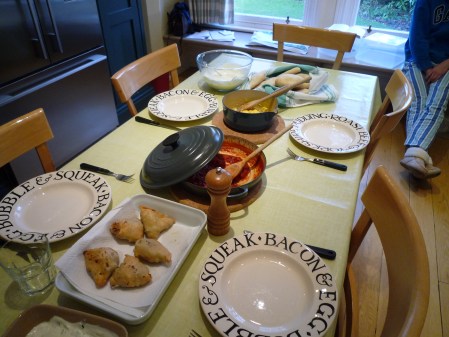
Making the pitta bread was straightforward enough – those little pockets appear as if by magic as long as there’s enough heat on the top surface of the bread. Very satisfying and deliciously fresh.
The samosas were, on the other hand, a complete faff. Making the filling of potatoes, peas herbs and spiceswas straightforward enough but forming the samosas was another matter…

I pride myself on having nimble fingers and being reasonably proficient with pastry, but shaping these wretched little tricorn parcels, coaxing them to stay open in order to push in the filling, then attempt to seal the whole thing up was the most technically challenging piece of cooking I’ve attempted in the last 2 years (and beyond that my memory fails me). I don’t often find myself saying this, but if you fancy a samosa, pop to your local Indian grocer and buy one.

Recipe for Khubz (pitta bread)
From Claudia Roden’s “A New Book of Middle Eastern Food” with occasional minor wording changes. Based on my recent breadmaking experience, I didn’t bother with warming the liquids, letting the yeast froth or oiling the baking sheets as specified in the recipe. The end result was just fine so by all means do the same if you are a confident breadmaker.
Ingredients
15g fresh yeast or 7g dried yeast
300 ml tepid water (approximate)
pinch of sugar
500g strong white flour
3g salt (1/2 teaspoon)
2 tablespoons vegetable oil (optional) plus a little extra for greasing
Dissolve the yeast in 100ml of the total amount of tepid water. Add the pinch of sugar and leave in a warm place for about 10 minutes, or until it becomes frothy and bubbly.
Sift the flour and salt into a warmed mixing bowl. Make a well in the centre and pour in the yeast mixture. Knead well by hand, adding enough of the remaining water to make a firm, soft dough. Knead the dough vigorously in the bowl, or on a floured board for about 15 minutes, until it is smooth and elastic, and no longer sticks to your fingers. Knead in 1-2 tablespoons of vegetable oil for a softer bread. Sprinkle the bottom of the bowl with a little oil and roll the ball of dough round to grease it all over. This will prevent the surface from becoming dry and crusty. Cover with a damp cloth and leave in a warm place free of draughts for at least 2 hours, until nearly doubled in size.
Punch the dough down and knead again for a few minutes. Take lumps of dough the size of a large potato or smaller (according to the size of bread you wish to have). Flatten them on a lightly floured board with a dry rolling pin sprinkled with flour, or with the palm of your hand, until about 1/2 cm thick. Dust with flour and lay the rounds on a cloth sprinkled with flour. Place them a good distance apart so that they do not touch as they grow considerably. Cover with another lightly floured cloth, and allow to rise again in a warm place.
Preheat the oven set at the maximum temperature (240 degrees C?) for at least 20 minutes, and leave the oiled baking sheets in it for the last 10 minutes to make them as hot as possible. Take care that the oil does not burn.
When the bread has risen again, slip the rounds onto the hot baking sheets, dampen them slightly with cold water to prevent them from browning, and bake for 6-10 minutes, by which time the strong yeasty aroma escaping from the oven will be replaced by the rich, earthy aroma characteristic of baking bread – a sign that it is nearly ready.
Do not open the oven during this time.
Remove from the baking sheets as soon as the bread comes out of the oven and cool on wire racks. The bread should be soft and white with a pouch inside.
If your oven does not get hot enough to make a good pouch, make the bread under the grill: put it low enough underneath so that it does not touch the grill (and burn) when it puffs up. Turn as soon as it does and leave only a minute longer.
Put the breads, while still warm, in a plastic bag to keep them soft and pliable until ready to serve.
Recipe for Vegetable Samosas
From Madhur Jaffrey’s “Indian Cookery” with a few minor wording changes of mine
Makes 16
Ingredients
For the pastry
1/2 lb (225g) plain flour
1/2 teaspoon salt
4 tablespoons vegetable oil
4 tablespoons water
For the stuffing
1lb 10 oz (725g) waxy potatoes boiled in their skins and allowed to cool
4 tablespoons vegetable oil
1 medium onion, peeled and finely chopped
6 oz (175g) peas fresh or frozen (defrost first if using frozen peas)
1 tablespoon peeled and finely grated fresh ginger
1 fresh hot green chilli, finely chopped
3 tablespoons very finely chopped fresh coriander
3 tablespoons water
1 and 1/2 teaspoons salt – or to taste
1 teaspoon ground coriander seeds
1 teaspoon garam masala
1 teaspoon ground roast cumin seeds
1/4 teaspoon cayenne pepper
2 tablespoons lemon juice
Vegetable oil for deep frying
Sift the flour and salt into a bowl. Add the 4 tablespoons of vegetable oil and rub it in with your fingers until the mixture resembles coarse breadcrumbs. Slowly add 4 tablespoons of water – or a tiny bit more – and gather the dough into a stiff ball.
Empty the ball out on to a clean work surface. Knead the dough for about 10 minutes or until it is smooth. Make a ball. Rub the ball with about 1/4 teaspoon of oil and slip it into a polythene bag. Set it aside for 30 minutes or longer.
Make the stuffing. Peel the potatoes and cut them into 5mm dice. Heat 4 tablespoons oil in a large frying pan over a medium flame. When hot, put in the onions. Stir and fry them until they begin to turn brown at the edges. Add the peas, ginger, green chilli, fresh coriander, and 3 tablespoons water. Cover, lower heat and simmer until peas are cooked. Stir every now and then and add a little more water if the frying pan seems to dry out.
Add the diced potatoes, salt, coriander, garam masala, roast cumin, cayenne, and lemon juice. Stir to mix. Cook on low heat for 3-4 minutes, stirring gently as you do so. Check balance of salt and lemon juice. You may want more of both. Turn off the heat and allow the mixture to cool.
Knead the pastry dough again and divide it into 8 balls (I did this with scales – each ball weighs 43-44g). Keep 7 covered while you work with the eighth. Roll this ball out into an 18cm round. Cut it in half with a sharp, pointed knife. Pick up one half and form a cone, making a 5mm overlapping seam. Glue this seam together with a little water. Fill the cone with about 2 and 1/2 tablespoons of the stuffing. Close the top of the cone by sticking the open edges together with a little water. Again, your seam should be about 5mm wide. Press the top seam down with the prongs of a fork or flute it with your fingers.
Make 15 more samosas.
Deep fry the samosas in small batches until they are golden brown and crisp. Drain on kitchen paper and serve hot, warm or at room temperature.
Breakfast from Azerbaijan, Land of Jam
November 3, 2010 § Leave a comment
So says the Azerbaijani tourism and information site http://www.azerbaijan24.com/, informing us that “Azerbaijanis make jam from almost anything – walnuts, watermelon and even rose petals…the most popular jams are made from plums, raspberries, mulberries, pears, peaches, melons, figs, strawberries and cherries…grapes, pumpkin and pomegranates…even eggplants can be used as base for jam…If you visit an Azerbaijani home, undoubtedly you’ll be served homemade jam along with black tea. When tea is served, you’ll discover it’s rare in the Republic to be offered sugar. Instead, they’re more likely to offer jam. Azerbaijanis put a small spoonful of jam in their mouths and sip the tea through the jam.”
So, with their predilection for jam, Azerbaijanis are the Billy Bunters of the steppes (greedy fictional schoolboy Bunter liked nothing better than to raid his friends’ tuck parcels and devour jam straight from the jar).
I decided to make jam the centrepiece of the Azerbaijani breakfast (the latest in our A-Z series of international breakfasts). This was a cheaper and easier option than trying to get hold of my first idea which was caviar. After all, Azerbaijan, nestling between Russia, Iran, Armenia and Georgia has a border on the West side of the Caspian sea, home to the sturgeon which produce the coveted caviar.
Muslim Azerbaijan (in contrast with its largely Christian neighbour Armenia) was under Soviet control until it declared independence in 1991 under the Gorbachev glasnost era. Oil is a major earner for the country with activity centred around the capital city of Baku. You may recall that the 1990s Bond Film “The World is Not Enough” with its convoluted oil industry plot featured scenes set and filmed in Azerbaijan.
Enough of background and onto breakfast. This was the prepared table:

On the menu was of course my prize jam collection (including a weird watermelon rind jam which was my only homemade contribution), also Azeri flatbread, sheeps-milk cheese, fresh fruit (including of course the flesh of the watermelon the rind of which went into the jam).

All this was washed down with small glasses of black tea drunk Azeri style with yet more jam.
Here is my completed jar of watermelon rind jam looking distinctly pondlike:

Was the jam worth the effort? No. The resulting jam is dense, sticky and with a taste a bit like cooked marrow – ie vegetal, ever so slightly bitter and not particularly pronounced. The recipe came from the improbably specific website www.watermelonrind.com. There is an alternative recipe on the Azerbaijan 24 site I referenced earlier but that recipe makes use of a rather scary sodium hydroxide solution to crisp up the rind before cooking. Not only is this stuff hard to obtain but it’s also toxic so I thought I’d give it a miss.
Much more to my safe Western taste is the following recipe for Azeri flatbread from the comprehensive and appealing site www.azcookbook.com. My bread, pictured below, is a little more rustic than the photo on the AZ Cookbook site but in my book rustic is good and the toasted sesame seeds tasted delicious:

Recipe for Azeri flatbread
With thanks to http://www.azKitchen.com.
Ingredients
1 package (1/4 oz / 7g) dry yeast
1 ½ cups (12 fl oz/375 ml) warm water
1 teaspoon salt
3 cups bread flour, plus extra for kneading
1 beaten egg for brushing (or just the yolk for a really golden colour)
1 teaspoon poppy or sesame seeds
1. In a small bowl, mix yeast with water until the yeast is dissolved.
2. Sift flour into a large bowl. Add salt and mix well. Gradually add the yeast-water mixture and stir in using your hand until a rough ball forms.
3. Scrape the dough onto a lightly floured surface. Press any loose dough pieces into the ball and knead the dough, punching it down with your fists, folding it over and turning. Knead for about 8-10 minutes, or until smooth and elastic.
4. Shape the dough into a ball and put it back into the large bowl. Cover the bowl with a kitchen towel or a plastic wrap.
5. Leave the dough to rise in a warm spot for about 1 ½ hours, or until doubled in bulk. The dough should look puffy and be soft when poked with a finger.
6. Punch down the dough, then transfer it onto a lightly floured surface.
7. Shape the dough into a ball, and with your hands flatten slightly and stretch it lengthwise. Using a rolling pin, start rolling the dough beginning at one end until you obtain a long flat bread about ½ inch thick (1.27cm), 14 inches long (35cm) and 8 inches (20cm) wide.
8. Carefully transfer the bread onto a non-stick baking sheet, fixing the shape as necessary. Leave the dough to rest on the sheet for another 15 minutes before baking.
9. Preheat the oven to 400?F (200?C).
10. Using a knife, make shallow crosshatching slashes on the bread, 4 from right to left and 4 the opposite way, each at a slight angle. Brush the bread evenly with the egg/egg yolk and sprinkle with seeds.
11. Place the baking sheet on the middle rack of the oven and bake the bread for 20-25 minutes, or until it is golden on top and sounds hollow when tapped on the bottom.
Recipe for watermelon rind jam
Ingredients
Recipe taken from the very specific website http://www.watermelonrind.com. I can’t say I recommend the finished article but here’s the recipe to satisfy your curiosity.
1lb watermelon rind cut into 1cm cubes
water to cover
3 cardamom pods
1 tablespoon lemon juice
1 1/2 cups white granulated or preserving sugar
1 strip lemon peel
Place the watermelon rind in a large saucepan and cover with cold water. Bring to the boil, cover and simmer for half an hour until the rind is tender and translucent. Drain, reserving 1 and a half cups of cooking liquid. Add the cooked rind, reserved cooking liquid, lemon peel and sugar to your preserving pan. Bring to the boil and cook for 15 minutes. Remove from the heat, cool, cover and leave overnight.
The next day, add the cardamom pods bring the mixture back to the boil. Cook for approximately 15 minutes until a thick syrup has formed. Remove from the heat, stir in the lemon juice and pot in the usual way.
I’m going to conclude my post Azeri style by wishing you NUSH OLSUN
…and the good news is we’re through all the countries beginning with the letter A so next stop, the Bahamas!
Armenian breakfast
July 17, 2010 § 1 Comment
This is the latest breakfast in our family project to prepare and eat a breakfast from every country in the world in alphabetical order. The highlight was without doubt these plaited brioche-type breads called Choereg or Choreg which are in fact very simple to make once your plaiting technique is sorted out. As a little girl I had long hair often plaited so this was no problem.

What do I know about Armenia? Very little. “A landlocked country with Turkey to the West and Georgia to the North, Armenia boasts striking scenery with high mountains and caves, lakes and hot springs”. So says the BBC News website, along with a few other key facts: capital city Yerevan; population 3.1 million; land area 11,484 sq miles (ed: about twice the size of the English county of Yorkshire); major religion Christianity.
Armenia has a huge diaspora and famous Armenians or people of Armenian descent can be found all over the world: the composer Aram Khachaturian (whose Spartacus theme was used as the opening music for BBC TV series The Onedin Line) and singers Charles Aznavour and Cher are just a few examples.
This means too that there are many Armenians in Europe and the US wanting to recreate a taste of home, communicating with one another and sharing recipes which conjure up a taste of the homeland. Luckily for me, Armenian recipes are relatively easy to come by on the web,
I started my research with a visit to a Manchester institution, The Armenian Taverna which for as long as most people can remember has occupied discreet basement premises in Albert Square. It looks as if I was in the nick of time as, sadly, the restaurant went on the market last month.

Owner Mafif Alamyan (reputed to be a former Olympic wrestler) was most helpful when describing typical Armenian breakfast dishes. Eggs, tomatoes and cheese featured on his list as did Armenian bread. It was in describing the fruit of Armenia, both fresh and preserved as jam, that he became almost lyrical – he talked of green walnut jam, apricots (the Latin name for the apricot is after all Prunus armeniaca) , cherries and especially mulberries. I recommend a visit to the Armenian Taverna before it vanishes for ever http://www.armeniantaverna.co.uk/
Now I needed to flesh out Mr Alamyan’s guidance with some recipes. First stop was
http://www.thearmeniankitchen.com a vast repository of Armenian food and memories compiled by the Kalajian family now living in the US. Here I found a description of egg scrambled with tomatoes which seemed to fit the bill for a simple breakfast dish – so simple it doesn’t need a recipe, just Mr Kalajian’s simple instructions. “You cut up a tomato as chunky or delicate as you like and stir it into your eggs as you scramble them. Add salt and pepper and eat with bread”.
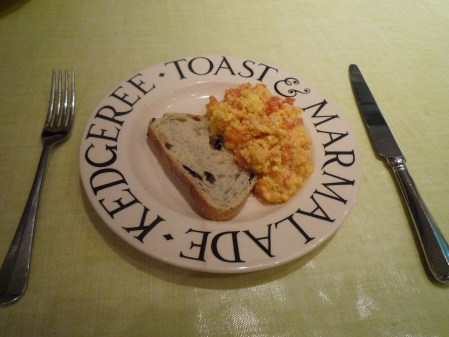
The next challenge was to try and locate mulberry jam. This could be tricky. The only mulberry tree I know of is Milton’s (so called because the poet sat and composed under its shade) in the Fellows’ Garden at Christ’s College in Cambridge. No way was I going to get permission to gather mulberries from there very easily. There had to be another way. Sadly I couldn’t find anyone selling mulberry jam made in the UK but specialist deli Mortimer & Bennett came up with the goods – a middle eastern mulberry jam made in the Lebanon. This would do nicely. Mortimer & Bennett are based in Turnham Green, West London and have a wide range of delectable and out of the ordinary deli items. They sell via their website as well as from the shop and I can vouch that they provide an efficient and personal service. My package of goodies (I just had to buy some oils and chocolate too as they offer free shipping if your order is £50 or more) arrived safe and sound a few days after ordering. Here’s the jam complete with rustic hessian lid cover:
http://www.mortimerandbennett.co.uk/

OK so the jam was now sorted so now for the bread. I found three Armenian bread/pastry recipes suitable for breakfast, the first Bishi (sometimes spelt BeeShee, sometimes also called Zeppole), a kind of doughnut, the second Keta, a walnut-stuffed Danish-type pastry and the third Choereg, a plaited sesame sprinked loaf enriched with eggs and butter (also spelt choreg and I reckon its similar to the Greek tsoureki too).
To make the most of the carefully sourced mulberry jam, I opted to make the plainest of the three breads, the choereg choosing a straightforward recipe contributed by Ani from Montreal which I found on Allrecipes.com. I give the recipe below but I did reduce the fat content of the recipe to just 8oz from the 1lb specified, similarly I used 4 eggs rather 5 – it still turned out spectacularly well.
A word on mahleb – this is a middle eastern spice made from the kernel of a special variety of cherry. I’d already started the recipe when I noticed this little bombshell in the list of ingredients so didn’t even attempt to track some down so added a slug of Amaretto and another one of Kirsch to try and provide the required almondy cherry flavours.
Recipe for Choereg – Armenian sweet plaited bread
Ingredients
1 cup whole milk (8 fl oz)
1 cup butter (8 oz or 225g)
1 cup white sugar (8 oz or 225g)
1/2 cup lukewarm water (4 fl oz or 120ml)
2 teaspoons white sugar
2 (.25 ounce) envelopes easyblend dry yeast
4 eggs (plus more beaten egg for glazing)
6 cups all-purpose flour plus more if required to obtain the right dough consistency (840g or 1 lb 14 oz) – I used a mixture of strong and ordinary plain white flour
1 1/2 teaspoons baking powder
1 1/2 tablespoons ground mahleb (see note above)
1 1/2 teaspoons salt
1 tablespoon sesame seeds
In a saucepan over medium heat, combine the milk and butter. Heat until butter is melted, but do not let it boil. Stir in 1 cup of sugar until dissolved, then set aside to cool to lukewarm. Crack the eggs into a large bowl, and stir a little to break up the yolks. Slowly pour in the heated milk mixture while whisking constantly, so as to temper the eggs and not cook them.
In a large bowl, combine the flour, sachets of easyblend yeast, baking powder, mahleb, and salt. Make a well in the centre, and pour in the wet mixture. Stir until it forms a sticky dough. Pour onto a floured surface, and knead in additional flour as needed to make a more substantial dough. Knead for about 10 minutes. Place in an oiled bowl, and set in a warm place to rise for about 2 hours, or until doubled in size.
When the dough has doubled, punch down again, and let rise until doubled. It will only take about half as long this time.
Separate the dough into 5 even portions, then separate each of those into thirds. Roll each of those into ropes about 12 inches long. Plait sets of three ropes together, pinching the ends to seal, and tucking them under for a better presentation. Place the loaves onto baking sheets. Loaves should be spaced 4 inches apart. Set in a warm place to rise until your finger leaves an impression behind when you poke the loaf gently.
Preheat the oven to 350 degrees F (175 degrees C). Brush the loaves with beaten egg, and sprinkle with sesame seeds.
Bake for 25 minutes in the preheated oven, or until nicely golden brown all over.
Buenos Dias Buenos Aires! Breakfast from Argentina
May 15, 2010 § Leave a comment
It’s been a while since we had our last international breakfast (see Breakfasts of the World category in the sidebar). The plan is to work through every country in the world in alphabetical order and it must be at least a month since Antigua.
I was pretty excited about the prospect of an Argentinian breakfast. Surely there would be mounds of barbecued steak? Sadly not. I was amused by one travel blog which recorded with disappointment that breakfast in Argentina comprises a croissant (known as medialuna), a coffee and a glass of water. The beef for which Argentina is justly famous is strictly a main meal affair.
So our breakfast was indeed medialunas (bought not made), café con leche and of course, lashings of wonderful dulce de leche. Sadly the Merchant Gourmet dulce de leche, authentically Argentinian from the evocatively named La Esmeralda farm seems to have disappeared from our local supermarket shelves and I had to make do with a Bonne Maman Confiture de Lait, a similar sweet milk caramel idea but from France and not quite as thick and unctuous.

If you too are suffering from dulce de leche withdrawal symptoms, here’s the Merchant Gourmet website dulce de leche page – you can buy it online now with free delivery if you buy in bulk.
http://www.merchant-gourmet.com/products/dulce-de-leche/dulce-de-leche-caramel-toffee/
I also noticed that the San Ignacio brand of dulce de leche has its own UK website now which gives some useful background info on what it is and how it’s made and a singularly unuseful list of retail stockists. They are listed in alphabetical order of shop name so you have to scan the whole list by eye to find a shop near you. I came up with Harvey Nichols in Manchester and a deli in Frodsham, Cheshire as possibilities for me.
I digress. Back to the proper business of breakfast. A bought croissant, a cup of coffee and a jar of caramel was OK but didn’t quite hit the spot. I had to get beef into the breakfast somehow so I trawled the internet until I found a reference to eating beef empanadas (pasties to you and me) for breakfast. I’d struck gold at last!
I found a recipe for beef empanadas in “South American Food and Cooking” by Jenni Fleetwood and Marina Filipelli – essentially a minced beef and potato stuffing encased in dinky shortcrust pastry rounds folded over to make mini pasties.
Here are the pastry circles and filling:

And here is the complete breakfast with the empanadas fresh out of the oven. I made a quick salsa with tomato, pepper, avocado, coriander and plenty of lime juice and seasoning to serve with the pasties:

Recipe for beef empanadas
I simplified the recipe I found in “South American Food and Cooking” by Fleetwood and Filipelli. I’ve halved the filling quantity which was way too much for the specified pastry quantity. I used minced beef rather than shredding it finely and baked the pasties rather than deep frying them for a lighter result. This worked well.
Ingredients
1 lb (450g) shortcrust pastry (bought or make your own with 8 oz (225g) flour; 4 oz (90g) fat)
l lb (450g) minced beef (use shin or leg if mincing your own)
4 tablespoons oil
1/4 tsp ground cumin
1 crushed garlic clove
2 tsp paprika
8 fl oz (250 ml) light stock
1lb (450g) waxy potatoes scrubbed (no need to peel) and finely diced
3 chopped canned tomatoes (or fresh ones skinned)
3 spring onions finely sliced
salt and pepper
Make the filling. Heat the oil in a heavy large frying pan. When hot, add the beef and sauté until lightly browned. Push the beef to the side of the pan and add the cumin, garlic and paprika. Reduce the heat and cook gently for about 2 minutes until the spices release their aroma.
Stir in the stock and bring to the boil. Cover and cook for 30 minutes. Stir in the potatoes, tomatoes and onions and cook for 15 minutes more until the potatoes are tender. Keep an eye on the cooking liquid adding a little more water if necessary or alternatively reducing if there is too much. You are aiming for quite a dry mixture. Season and allow to cool completely.
Roll out the pastry very thinly on a floured board. Using a pastry cutter cut out 2 and 1/2 inch (6cm) circles. Spoon about 1 and 1/2 tsp filling into the centre of each pastry circle. Brush the edges of the pastry with water. Fold the pastry over to form a half moon. Turn the edges over and press together firmly to form a good seal. Bake at 200 degrees C until the pasties are golden brown.
Serve with your favourite fresh salsa.
Enjoy your Argentian breakfast! Carlos Tevez, if you happen to read this please do drop me a line with your breakfast thoughts…
 The Rhubarb Fool