
Review of Da Piero, Irby (Wirral)
May 4, 2010 § 3 Comments
The arrival of warm spring weather coincided with the Delicious magazine’s Italian issue appearing on the shelves earlier this month. Browsing through its glossy pages I noticed a feature on an Italian restaurant that wasn’t (as usual) in London but in the small village of Irby on the Wirral (south of Liverpool) less than an hour’s drive from Manchester.
Da Piero gained recognition beyond its local loyal customer base earlier this year when it was named “Best Newcomer” in the 2010 edition of the Good Food Guide. Hot on the heels of this accolade came recognition (in the form of two knives and forks) in the latest Michelin Guide. It’s owned and run by the Di Bella family, with father Piero in the kitchen, wife Dawn front of house and son Alan sous-chef in training. Piero grew up in Sicily and the restaurant specialises in authentic Sicilian dishes.
Sicilian food in a village on the Wirral? It sounds unlikely doesn’t it? Maybe a Mafia money-laundering operation with links to the Liverpool underworld? Undaunted we booked a table and, on a beautiful Wednesday evening we drove off into the sunset.
Here’s what we found:

Apparently just a small neighbourhood restaurant in a quiet street. Going inside, it was as if you had walked into your gran’s front room into which someone has unaccountably placed four tables. There are just 15 covers in the restaurant. A couple of black and white family photos hang on a magnolia painted wall and that’s it in terms of decoration. Thankfully no Chianti bottles in straw, red-checked tablecloths that kind of thing.
We were greeted and waved to what was evidently our table by a smiling Dawn. All the other tables were occupied and there was a hum of contented post-meal chat over Italian pop music playing in the background (you may not like piped music but Zucchero is at least authentic).
We browsed the handsomely large menus which are laid out in traditional Italian style (antipasti, primi piatti; secondi piatti and dolci) and the interesting wine list.
Piero is clearly a man who knows what his customers want – the menu is by no means exclusively Sicilian: there are Northern Italian specialities (osso bucco) plus Italian restaurant favourites (spaghetti carbonara) as well. We later discovered that Piero’s family has roots in mainland Italy so the menu is almost a blended family history.
I was determined to have the full authentic Sicilian experience so chose a classic caponata to start, then a pasta with garlic, parsley and hot pepper, followed by home-made salsiccia (sausage) Siciliana with lentils.
Following Dawn’s advice about portion sizes, Tim elected to share the pasta course with me and chose osso bucco as his main course.
The caponata, correctly served warm rather than piping hot, was simple and delicious, each vegetable cooked to perfection. If you don’t know the dish, think of it as a Sicilian version of ratatouille, enlivened with capers and olives. Unusually it contained nuggets of potato along with the aubergines and tomato. A bit odd but entirely successful.
The pasta was good quality factory-made tagliatelle simply dressed with best quality olive oil, browned garlic, flecks of parsely and chilli flakes. I asked Dawn later about whether they made their own pasta – she said they generally used factory pasta but made their own if there was a ravioli special on the menu. This sounds like an entirely sensible decision for such a small restaurant but don’t go there expecting mounds of beautiful home-made pasta.
Here’s Tim’s rich and meaty osso bucco:

And here is my glorious dish of home-made sausage and lentils:

The sausage was rustic and flavoursome with just the right amount of chilli heat and the lentils were the perfect accompaniment and cooked to just the right degree of tenderness. One of those dishes you could eat again and again…
I think it was Ed Balls who that very day (during the election campaign) said he wanted to give one-parent families more money so they wouldn’t have to feed their children lentils every day. Ed, get down here and eat your words!
We’d chosen from the short but interesting wine list a reasonably priced organic red wine (Nero d’Avola) from Sicily (Cerasuolo di Vittoria 2008) which was earthy and just right with the rustic food.
We were too full for puddings so just had a skilfully made espresso each. By now there were just two tables left occupied in the restaurant and as Piero had finished cooking he came out from the kitchen unprompted to meet the remaining guests. He’s a distinguished looking man who, dressed in a toga rather than immaculate chef’s whites, could pass for a Roman senator. He’s passionate about his food and utterly charming. Who can resist a man who’ll share a caponata recipe with you (the addition of potatoes was his own idea) and is such a perfectionist that he makes his own candied orange peel?
What a lovely evening. Don’t come here expecting refined food or a slick city restaurant experience. Simplicity and freshness are what it’s all about together with a genuinely warm welcome. My advice would be to get here while you still can.
Contact details
Da Piero
5 Mill Hill Road
Irby
Wirral CH61 4UB
0151 648 7373
www.dapiero.co.uk
Dinner at Les Prémices, Bourron-Marlotte near Fontainebleau
April 16, 2010 § Leave a comment
We took a deep breath and decided to book a table for all four of us at this French restaurant which takes itself very seriously. Time to teach the boys some proper table manners.
We visit Fontainebleau pretty much every Easter mainly for the rock-climbing (in fact bouldering which is climbing with no more equipment than a chalk bag and crash mat). This is younger son Arthur doing his thing with the help of 2 “spotters”.

Just once during the week it’s good to have a change of milieu so we dress up as smartly as our holiday wardrobe permits and head off to this Michelin and Gault-Millau recognised establishment situated in the grounds of Bourron Marlotte’s château.
Based on previous visits, the place is clearly kept going by its proximity to INSEAD, the Fontainebleau based business school. We’ve quietly sniggered to ourselves as job interviews are conducted in loud American English at neighbouring tables or as professors hold court surrounded by a clique of adoring students hanging on their every word. A great place to play bullshit bingo as phrases such as “framing the argument”, “low hanging fruit” or worst of all “paradigm shift” bounce off the walls.
Tonight though we were alone until pudding arrived, albeit we were early having booked a table for 7.30. A sign of recessionary times perhaps? Given the behaviour of elder son George who was on top boisterous teenage form that evening this was perhaps a blessing…
The dining room has been completely refurbished since our last visit. Previously it had a bit of shabby suburban conservatory feel with cane furniture and green carpet. The new look is much more chic and sharp, discreetly elegant in shades of steel grey and aubergine. Tables are still opulently dressed with generous white napery, designer stainless steel cutlery and plain crystal glasses. As a passing nod to Easter, each table was decorated with a solitary enormous ostrich egg. George thought it would make a good rugby ball and started to demonstrate. Aagh!
Here is our miraculously intact egg pictured with canapés served on trendy roofing slates. The toffee and sesame cherry tomatoes were weird but strangely good.

The ratio of front-of-house staff to customers was almost one to one. We were looked after by 2 charming young waitresses who exuded French chic and were snappily dressed in perfectly tailored trouser suits. I received the distinct impression that they hadn’t encountered children before though.
Our request for Orangina as an apéritif was enough to turn renowned sommelier Laurent Piro’s face white with shock. It clearly upset him so much he forgot to bring my glass of champagne.
Amusingly, the restaurant’s idea of a children’s menu was foie gras with toasted brioche, poached chicken breast with noodles and a chocolate fondant pudding. To be fair, Arthur did enjoy the last 2 courses but not the foie gras which we shared between the three of us spilling crumbs across the table much to the consternation of the staff.
The various multi-course tasting menus seemed too much for the children to take so, having sorted Arthur out with the children’s menu, the rest of us opted for the basic (relatively speaking) four-course market menu instead.
Our first course was a modern take on a prawn cocktail – avocado mousse, crayfish and some pink tomato foam all served in a massive martini glass. It looked extremely tacky but this was meant to be so in a post-modern ironic sort of way I think. It tasted good – zingy, fresh and light.

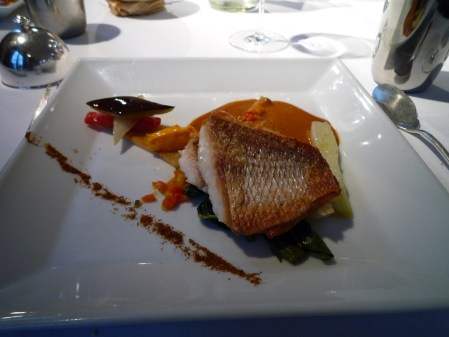
Next came dorade (translated as gilthead bream? must check this later) with Mediterranean vegetables and a bouillabaisse sauce – a really successful dish and portions not too large and overfacing. The bream was firm fleshed and subtly flavoured and all the tomato, saffron, shellfish, wine and garlic flavours of a good bouillabaisse were concentrated into the spoonful of sauce served with it.
Next was the cheese course. The restaurant’s speciality is a baked camembert with caramelised apples and salad. This may seem like a novelty in France but back here in the UK we are used to all sorts of fruit and cheese combinations. What I would much have preferred is one of those old fashioned French cheese trolleys. Never mind.

Pudding was a rather lovely poached pear and gingerbread confection:

And afterwards with coffee came not one but two trays of dinky petit fours. Here’s arguably the prettier of the two served this time on a hunk of pink marble:

Frankly, I was then rather relieved to make our escape as the children were becoming restless and there was talk of initiating an armpit farting competition. We made our hasty excuses and left.
Les Prémices is a lovely restaurant and I think you would see the best of head chef Dominique Maës’ craft by sampling one of the multi course tasting or surprise menus.
It’s not the place to come for a quick or informal meal though – I wonder if current tastes have moved on and perhaps what people want is a little more informality without compromising on quality. The emptiness of the restaurant on what should have been a bustling Thursday night would suggest this might be so.
Contact details
12 bis Rue Blaise de Montesquiou, 77780 Bourron-Marlotte, France
00 33 (0)1 64 78 33 00
From the sublime to the not so ridiculous: food in the French Alps
March 25, 2010 § 2 Comments
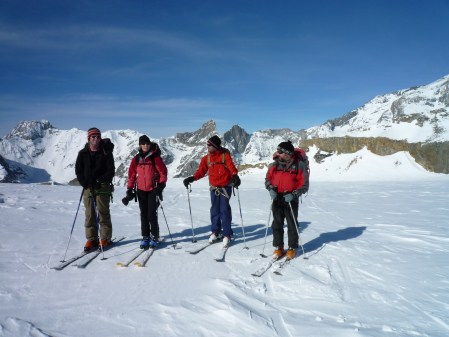
I’m fresh back from my annual ski touring week which this year was a traverse of the Vanoise National Park. Our group comprised me, David, a Glasgow-based classical music composer and Matteo, a Milanese financier now settled in London. We were led by mountain guide Bruce Goodlad together with aspirant guide Phil Ashby.
For the skiers amongst you, our trip involved setting off from the Val Thorens lift system on Sunday morning and arriving in Val d’Isère five days later on Friday afternoon. Accomodation and most importantly meals were in a different alpine hut or refuge each each evening.
This might sound like hardship but we ate some fabulous food on the trip with the only dud meal being an indifferent tartiflette down in the valley in Moutiers on the Saturday night before our team set off into the wilderness.
After a relatively gentle start to the trip (a short climb followed by a long ski down) we arrived at the Roc de la Pêche hut at the head of the Pralognan valley. This is more mountain hotel than hut with running water and hot showers in the dormitory rooms. We had not really worked up sufficient appetite to do justice to our huge platefuls of jambon à l’os, sauce madère, gratin savoyarde and grilled sweet peppers. Afterwards, we felt like the pet hut St Bernard must have done in the picture below:

Our second night in the Dent Parrachée hut was the real deal. This is a wilderness cabin at the foot of the majestic striated mountain which gives the hut its name. We were given a warm welcome by hut guardian Franck and his Sherpa assistant Kaptan, known affectionately as the “Prince of the Vanoise”. They sound like characters created by Hergé for an episode of Tin Tin.
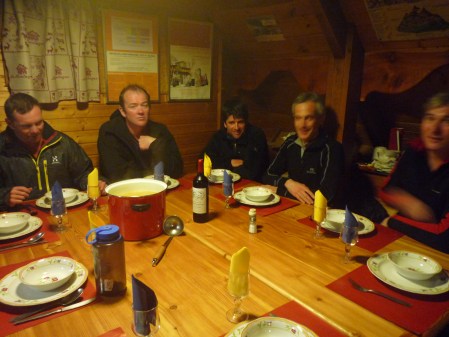
Franck invited us to the inner sanctum, his kitchen table for an apéritif of local white wine accompanied by delicious olives. Dinner then followed: a first course of vegetable soup followed by a main course of local sausages, diots, braised in white wine and accompanied by a generous dish of gratineéd rice and vegetables. Salad, a wedge of reblochon and Kaptan’s freshly baked apple tart completed the meal. Hearty and delicious, just right after a long day in the mountains.
Here’s a picture of our convivial dining table as the soup is served. The presence of a Bordeaux winemaker in the group meant that Franck raided the cellar for a superior bottle of red.
Here’s a link to the Dent Parrachée recipe for braised diots this time cooked with potatoes.
http://www.dentparrachee.refuges-vanoise.com/actualites.pl?id_evenement=29
Day 3 took us the the Arpont Hut in the heart of the Vanoise national park, perched on the moraine of the Arpont glacier. With no guardian arriving until the end of the month we were staying in the hut’s winter room and cooking for ourselves. This felt like the real wilderness experience emphasised by the golden eagle and ptarmigan we saw along the way.
Arriving at the hut in glorious late afternoon sunshine we set to work chopping the wood, lighting the fire, melting snow and brewing a cup of tea. Having made ourselves at home, we set to work to produce a four course meal: first soup – dehydrated vegetable but tasting good after a long day out. Next the pièce de résistance, chilli con carne with rice. How did we do it? The rice was long-grain boil-in-bag which after 12 minutes was cooked to perfection – tender separate grains. The chilli con carne was a dehydrated meal in a foil pouch – just add boiling water, leave to stand for 10 minutes and your meal is ready ta da! If dried food brings back memories of Vesta curries, then think again.
Our chilli was made by high tech German firm Simpert Reiter marketed under the brandname Travellunch. It’s proper food, nutritionally balanced, packed with calories and actually tastes quite decent. This was the not so ridiculous element of our diet this week.
Here’s a link to the website if you’d like to see the full Travellunch range and read the nutritional data:
We followed the chilli with Beaufort cheese and, for the greediest member of the group (me!) a Travellunch pudding – vanilla dessert with raspberries – an upmarket version of Angel Delight packed with almost 500 calories. The rest of the group sensibly chose to eat their puddings with muesli for breakfast the following morning.
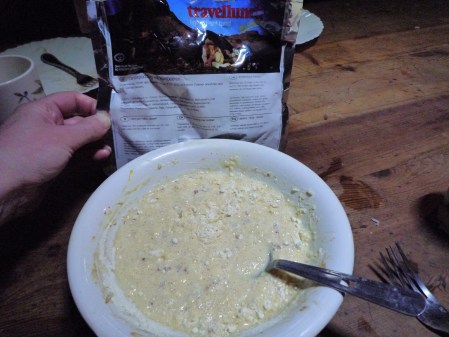
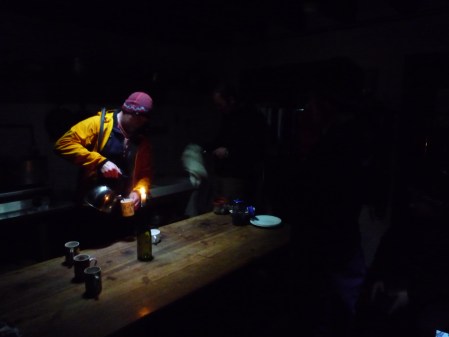
The meal was completed with a delicate tisane prepared for us by guide Bruce and drunk by flickering candlelight. I rather like the Rembrandtesque lighting of this photo:
Next day, an arduous trek up the glacier was followed by a satisfying ski down to the Col de la Vanoise hut. Here we were welcomed by a charming gardienne who could easily have passed for a vendeuse in a chic Parisian boutique. She plied us with locally brewed organic Chardon beers and then produced the most delicious creamy sauté of chicken with tarragon. A surprisingly refined dish to find in the mountains.
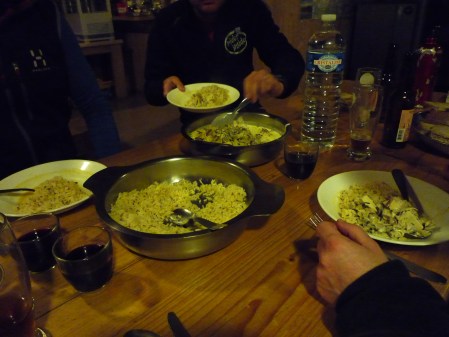
I’d be hard pressed to choose whether this was our best meal of the trip or whether that prize should go to the team at the Femma hut the following evening.
We didn’t reach the Femma hut until 5.00pm – this is a long day in ski-touring terms – normally you might expect to arrive at the hut around 2.30pm. We were tired and hungry and looking forward to a good meal.
The comfortable modern Femma hut is blessed with running water from the river running through the valley but despite its large size it still has bags of character. It’s run by a team of mountain women who really know their stuff. After a fresh leek and potato soup they produced the most fantastic deeply savoury dish of braised pork with prunes, garlicky green beans and a generous helping of crozets, a rustic square cut buckwheat pasta typical of the Savoy region.

This was followed by not just a single wedge but a whole board of local cheeses including an unpasteurised soft cows’ milk one made by the hut guardian’s sister as well as the (by now) more usual Beaufort, Reblochon and Tomme.
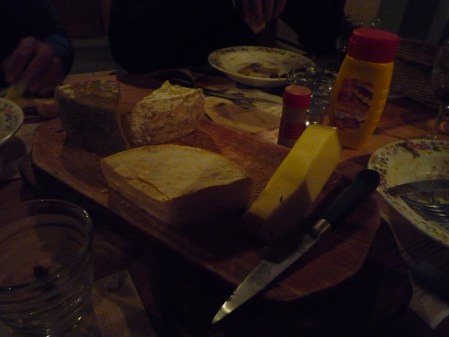
By the narrowest of margins, we collectively decided that the Femma hut took the prize for best meal of the week.
Having eaten and slept well, we were well set-up for the last push over the col and back to civilisation in the form of Val d’Isère. After a not so short, sharp climb up to the col we admired the magnificent view over to Mont Blanc before our final descent into Val d’ Isère.
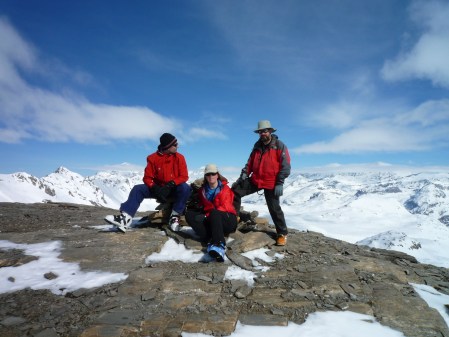
A most satisfying end to my ski season this year. Thanks guys for a great trip. Standing on the scales back home I see I’m exactly the same weight as when I left – success!
Contact details
Refuge Roc de la Pêche
Tel +33 4 79 08 79 75
http://www.rocdelapeche.com/
Refuge Dent Parrachée
Tel +33 4 79 20 32 87
http://www.dentparrachee.refuges-vanoise.com/index.pl
Refuge Arpont
Tel +33 4 79 20 51 51
http://www.arpont.refuges-vanoise.com/
Col de la Vanoise
Tel +33 4 79 08 25 23
http://www.coldelavanoise.refuges-vanoise.com/
Refuge Femma
Tel +33 4 79 20 33 00
Zermatt mountain restaurants: style meets substance
February 21, 2010 § Leave a comment
Zermatt’s mountain restaurants are legendary and looking at the view from the balcony of Chez Vrony in the hamlet of Findeln you can see why. We were in Zermatt for the busy February half term holiday week so making some key lunchtime bookings well in advance was an important part of my holiday planning.

Our first lunch was at Chez Vrony is a Zermatt institution run by Vrony Julen, daughter of one of one of Zermatt’s long established families. The food is delicious, the service is both charming and almost fearsomely efficient. Our New Zealand nephew Simon’s jaw dropped visibly as we were shown to our stunning balcony table and seated on cosy benches strewn with sheepskins. He later admitted it was a far cry from his usual eating experience in the ski fields of New Zealand where lunch means a snatched pot noodle in a utilitarian shed.
Chez Vrony caters for both hearty and more ladylike appetites. I chose the Salad Vrony, an elegant supercharged version of a chicken Caesar salad:

The salad followed by a double espresso was more than enough to set me up for the afternoon’s skiing but nephew Simon and son George were both still hungry after rösti and risotto respectively and chose the apple fritters for pudding. Needless to say, these disappeared in a flash:

Later in the week we made the obligatory hop-over the Theodul Pass into the Italian village of Cervinia. When in Italy, it has to be polenta, in this case Polenta Valdostana smothered with butter and molten cheese. As my Milanese friend Matteo said recently “no self-respecting Italian would ever eat pasta in the mountains: it has to be polenta”. Polenta is incredibly filling and has amazing heat-retentive properties. Lunch kept us going for the rest of the afternoon without any need for coffee and cake.
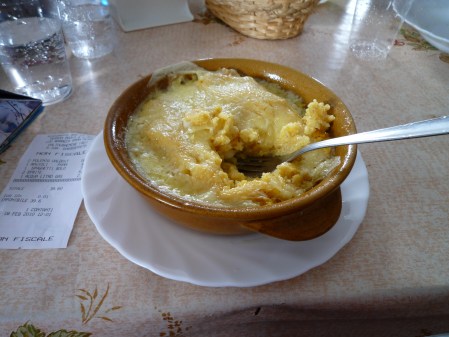
In general, Cervinia’s mountain restaurants don’t quite live up to the standards set by its Swiss cousin Zermatt. We ate our polenta at a decent enough self-service place at the foot of the Colle inferiore delle Cime Bianche chairlift on the Valtournenche side of the resort. Though the polenta was good, the place itself was nothing to write home about.
Ski Club Rep Paul Ubysz, a walking encyclopaedia when it comes to local knowledge of Zermatt and Cervinia had recommended to us the Resto-Grill Les Clochards accessible from Piste 5 on the Plan Maison side of the resort. I see that there are rave reviews for a Swedish run place called L’Etoile though I wonder if reviewers are star-struck by the lovely team of blonde waitresses. Take your pick…
We are keen skiers so some days lunch was a picnic in the snow with supplementary coffee and cake later in the day. The spectacularly situated Gandegg Hut accessible from the high Theodul glacier ski runs is a perfect place to warm up and refuel. They serve generous portions of home-made apple cake:

The restaurant at Stafel accessible from the red run down to the village from the Schwarzsee area is a similarly good place to linger. They serve excellent warming soups and their home made tarts look extremely inviting:

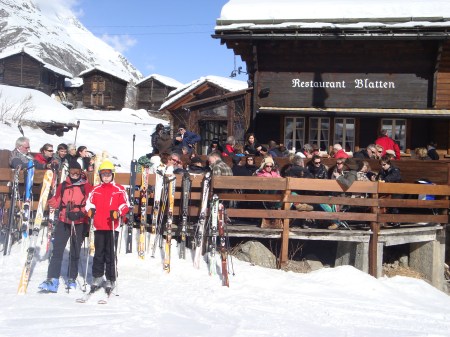
Finally, I couldn’t leave German-speaking Switzerland without at least one plate of rösti. My favourite is the classic combination of rösti with ham and fried eggs. They serve up a storming version at the Restaurant Blatten on the lower slopes of the Schwarzsee ski area:

Blatten is another restaurant in the Chez Vrony mould: family run (by Leander and Simone Taugwalder); combines rustic charm with super-efficient service and attention to detail; delicious food for a range of appetites. The interior is cosy and wood-panelled and there is a sunny terrace outside:
 </
</Here are they key details to tap into your mobile phone before you go:
Contact details
Chez Vrony
Tel +41 27 967 25 52
Gandegg Hütte
Tel +41 79 607 8868 (hut keeper’s mobile)
Restaurant Stafel
Tel +41 27 967 30 62
Restaurant Blatten
Tel +41 27 967 20 96
If you’v eaten in Zermatt or Cervinia recently, I’d love to hear your experiences. Please send me a comment.
Two very different dining experiences in Zermatt
February 19, 2010 § Leave a comment
Two very different dining experiences during a recent ski holiday in Zermatt, Switzerland.
First, the Stockhorn Grill which I first visited some 20 years ago and is still going strong. It’s a meat lover’s paradise with the speciality being various cuts of meat spit-roast over an open fire. Be warned that you need to order the whole chicken in advance as it requires an hour’s cooking time. Here’s a picture of the open-plan cooking area, the fire flickering theatrically in the dimmed light of the restaurant.

The Stockhorn formula is simple but extremely effective- salad to start, then your chosen meat which is served with generous quantities of potato gratin or chips/French fries (one has to be careful with fried potato terminology to avoid being served with a bowl of what we in the UK would call crisps!). I chose the venison fillet cooked medium rare with potato gratin. Absolutely delicious served with a bottle of full-bodied Swiss Rhône red wine colourfully named “Sang de l’Enfer”, literally “Hell’s Blood” which wasn’t hellish in the slightest. The meal was simple and robust, no need for pudding to follow. It’s a tried and tested formula which is still packing the guests in – the queue for a table was out of the door as we left the restaurant.
Our next choice was Sonnmatten, a restaurant attached to a boutique hotel in the hamlet of Winkelmatten, an appetite-enhancing 15 minute walk upwards from the centre of Zermatt.
The chef at Sonnmatten is Marco Drynda, originally from Swabia in Germany. Drynda has recently stepped-up to his first head chef position after several years as number 2 to Alain Kuster at the Mirabeau in Zermatt.
The restaurant and bar décor is delightful, bringing off the trick of looking both clean and modern yet warm and cosy at the same time. We were hungry and asked to be shown straight to our table – matt black walnut with crisp white linen napkins, no-fuss stainless steel cutlery and generously proportioned wineglasses. The young service team led by host René Foster were dressed discreetly all in black and were charming and efficient. We sipped a glass of prosecco and went through the menu. Our fellow guests were either German or Swiss German and exuded an air of understated good taste. We’d finally escaped the crowd of Brits who flock to Zermatt at this time of year. So far so good.
Starters took a little time to arrive but were worth waiting for. I’d chosen a simple pumpkin soup which was well flavoured, silky textured and delicious.

Sadly, main courses took an absolute age to turn up. The restaurant though small was quite busy and from the animated discussions the waiting staff were having it was evident that the kitchen was having problems getting the food out in time. This was a shame as it marred an otherwise very satisfactory evening.
When my chosen main course of braised veal cheek finally turned up, it was generously proportioned, sticky and unctuous. It was almost too intense and meaty if that’s possible.
I should mention the wine list – lots of interesting Swiss wines as well as the usual French bottles. We chose a local Humagne Rouge – a cigar boxy red.
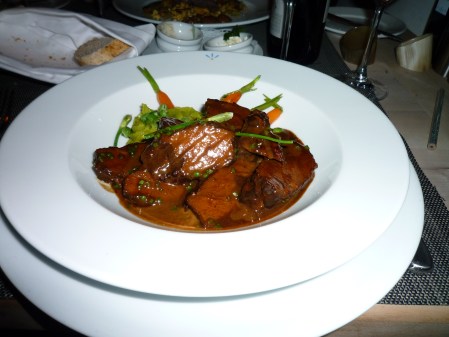
After two big-flavoured courses, pudding wasn’t an option for me even though the choice was enticing. My son George chose a plate of apple desserts pictured below. These disappeared in a matter of seconds!

There’s a lot to like about Sonnmatten. I love the chef’s modern take on German and Swiss classic dishes and ingredients and the restaurant makes a stylish alternative to the glitzy big name restaurants attached to the 5 star hotels in downtown Zermatt. If only the kitchen could resolve its timing issues…
Contact details
Restaurant Sonnmatten
96 Winkelmattenweg
CH3920 Zermatt
Telephone +41 27 967 3030
http://www.sonnmatten.ch/page.php?rubID=1&lan=en
Stockhorn Restaurant and Grill
CH 3920 Zermatt
Telephone +41 27 967 1747
Rustic food in Klosters and traditional dishes from Graubünden
January 10, 2010 § 2 Comments
I’m going to start this post on our recent trip to Klosters with a mention of Charly’s Chestnuts. No, this isn’t an irreverent dig at the British royal family who like to holiday here but a reference to a Klosters landmark. The eponymous Charly sets up his wagon daily just outside the station and his roast chestnuts are very good indeed.

I’ve already written about some of Klosters’ hotel restaurants and the elegant food they serve up. What I haven’t mentioned so far are some of the mountain restaurants catering for skiers. Yes, there are the busy cafeteria style establishments by the main lifts at Gotschna, Davos and Madrisa, but if you want something a bit special, you have to travel a little further afield.
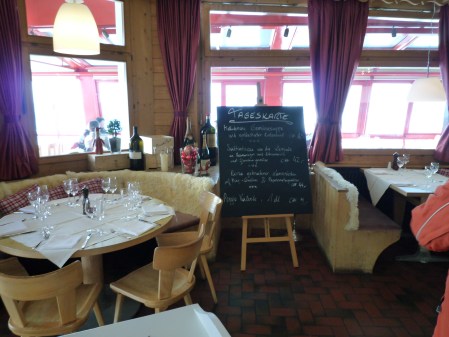
Bruhin’s restaurant is virtually on the summit of the Weissfluhgipfel which at 2883m is the highest point on the Parsenn massif. The views across to the Silvretta and Rätikon are stunning and window tables here are in great demand. The menu offers either restaurant style dishes or local specialities. I haven’t eaten here recently, but they do a good cup of coffee – you can warm up on the sheepskin upholstered seats before taking the long run down to Schifer.
If you are skiing in the Madrisa ski area, then Berghaus Erika in the hamlet of Schlappin makes a worthwhile destination. Its plus point or drawback, depending on your point of view, is that is situated at the foot of a long tree-lined black run.
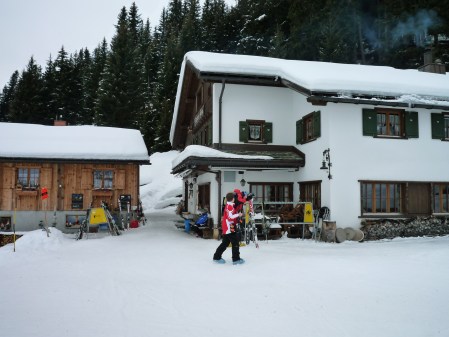
We tried the local Prättigau speciality Chäsgetschäder here, a cheesy bread bake, perfect after a hard morning’s skiing. I’ve searched out a recipe for this dish which I give below. The version in the recipe sounds more soupy and creamy than the dish we ate at Berghaus Erika – their version appears to have been baked in the oven or cooked on the stove top to produce a golden crust:

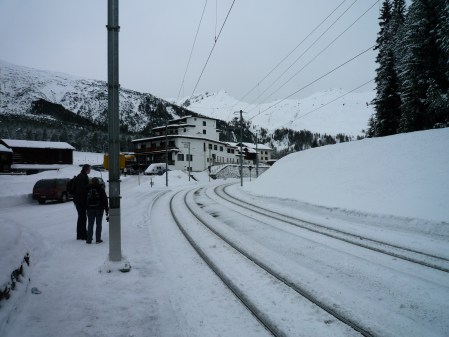
At the foot of another black run is the Hotel Kulm in Wolfgang, the hamlet on the main road between Klosters and Davos. This is another atmospheric place to eat, with lots of local specialities on the menu. The hotel sits between the main road and station at Wolfgang – there’s no ski lift back to the slopes, so time your meal to coincide with a Rhätischebahn train back to either Davos or Klosters . Here’s a view of the hotel from the station platform.
We tried Maluns, a dish of fried potatoes served with cheese and apple sauce, a typically Swiss combination. This dish looks rather basic when it arrives – essentially a plate of crispy golden crumbs, a piece of cheese and dollop of apple sauce on the side, but the combination tastes good. I’ve managed to find a recipe too which I give below.
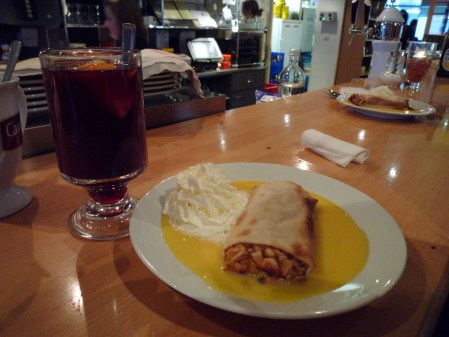
A day skiing in Klosters wouldn’t be complete without an après-ski drink and snack in Bistro Logo in the main street – this seems to be the town’s only café and is permanently busy as a result. Since Graubünden went smoke-free a couple of years ago, this is now a very pleasant place to sit and chat. My son George’s favourite order here is the apple strudel with both vanilla sauce and whipped cream:
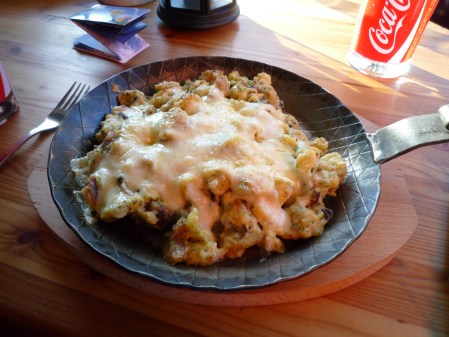
Finally, a mention of two other regional dishes which appear frequently on menus in and around Klosters. The first is Pizokel, a gratin of potato dumplings which makes a hearty ski lunch. Here’s how it’s served locally andI give a recipe below.
The second is Capuns, another Graubünden speciality – little parcels of savoury stuffing wrapped in Swiss chard leaves. Sadly, I didn’t have an opportunity to try these during our trip. Of all the local dishes, these seem to fit in with current cooking trends – not too much cheese, butter and starch and the use of a vegetable rather than pasta or pastry to encase a savoury filling has a contemporary feel even though this is a traditional regional dish. My trusty little Betty Bossi cookbook which I bought in Switzerland ages ago has come up trumps again – I give the recipe below and plan to give it a try as soon as I can get hold of some Swiss chard.
Recipe for Maluns – a fried potato dish, a speciality of Graubünden
This recipe comes from “Bündner Landfrauen Kochen” (the Graubünden Farmers’ Wives Cookbook), a little spiral-bound paperback book I bought in the Klosters bookshop a couple of years ago. The contributor is a Mrs Renata Canetg from Domat/Ems, a little town in the Rhine Valley near Chur.
She doesn’t say how many people this will serve – I estimate this would make 4 generous portions.
This was originally a breakfast dish eaten with and in fact mixed with milky coffee. You will find it more commonly served now as a hearty lunch or supper dish with a good-sized wedge of cheese and a dollop of apple sauce. The combination of cheese, potato and apple is typically Swiss.
Ingredients
1 kg waxy potatoes boiled in their skins and left for two days
350 g plain flour
1 teaspoon salt – more to taste
125g-150g butter (depending on how your potatoes behave)
To serve
Apple sauce
Wedges of Graubünden mountain cheese
Peel the potatoes and grate them using a coarse grater. Mix the grated potatoes with the flour and a little salt. Divide the mixture into two and fry one portion at a time in a non-stick frying pan in hot butter. When the mixture colours, turn the heat down a little and cook until golden, stirring frequently with a wooden spoon. The mixture will form into small balls. Serve immediately while hot and crispy.
Recipe for Kartoffelpizokel – potato dumplings, a speciality of Prättigau
This recipe serves 4 people and comes from a little recipe book by fictional Swiss author Betty Bossi entitled “Specialités Suisses”. The Prättigau is the region within the canton of Graubünden comprising the Landquart and Landwasser valleys in which respectively Klosters and neighbouring Davos are located.
Ingredients
700g peeled raw potatoes, floury such as Désirée
100 to 150g plain flour
1 teaspoon salt
freshly ground black pepper
For the gratin
200g grated Prättigau mountain cheese (substitute Gruyère if you like)
1 tablespoon butter
100g lardons (diced bacon)
2 medium onions halved and thinly sliced
Cranberry sauce to serve (the Swiss recipe suggests a compôte d’airelles which is similar to our cranberry sauce – the airelle is a sharp red mountain berry)
Grate the potatoes into a bowl using a fine grater. Squeeze out some of the raw potato juice with your hands. Mix in 100g of the flour, salt and pepper. Bring a large pan of salted water to the boil. With two spoons, take a small piece of the mixture, form it into a dumpling and drop it into the boiling water. If it doesn’t hold its shape, stir in the extra 50g of flour specified in the list of ingredients.
Form the mixture into dumplings and drop them into the water. Stir around. Allow to simmer for 10 minutes. They will at first drop to the bottom of the pan then rise to the surface once they are cooked, like gnocchi. Remove with a slotted spoon and place them into a buttered gratin dish. Sprinkle over the grated cheese and bake in an oven preheated to 200 degrees C for 20 minutes.
While the pizokel are in the oven, melt the butter in a frying pan, add the lardons and cook until golden. Add the sliced onions to the pan and continue cooking until the onions are golden. Spread the mixture over the baked pizokel.
Recipe for Chäsgetschäder – a rustic cheese bake, a speciality of Prättigau
Another recipe from the Betty Bossi Swiss Specialities book – serves 4.
Ingredients
100g butter
2 onions, finely chopped
250g day old white bread, crust on, cut into cubes
750 ml milk
salt and freshly ground black pepper
a little grated nutmeg
600g aged Prättigau mountain cheese, grated (or a mixture of aged Appenzell,Gruyère and Fribourg Vacherin cheeses in the ratio 250:250: 100. The recipe needs mature cheese otherwise it will lack flavour and be too stringy and indigestible)
Melt the butter in a large saucepan or enamelled casserole. Add the chopped onions and cook until golden. Add the bread cubes and fry briefly. Add the milk, bring to the boil and allow to simmer gently for 10 minutes, stirring from time to time. Season to taste with salt, pepper and nutmeg. Gradually add the grated cheese, stirring constantly, until the mixture become creamy. Serve immediately.
Recipe for Capuns – stuffed swiss chard leaves, a speciality of Graubünden
Ingredients
For the stuffing
150g flour
pinch salt
3 tablespoons milk
2 eggs
1 dessertspoon butter
1/2 onion, finely chopped
1 tablespoon finely chopped parsley
1 dessertspoon snipped chives
50g chopped air dried beef from Graubünden
100g cooked salami type sausage cut into small dice
For the wrappers
16 young tender Swiss chard leaves
To finish the dish
100 ml double cream
200 ml meat stock
salt and freshly ground black pepper
a little butter for frying the ham strips
50 g raw cured ham cut into strips
Work the flour, salt, milk and eggs into a thick paste. Put it aside and leave it to rest for 30 minutes. Melt the butter in a saucepan, sauté the onions until translucent. Add the chopped herbs, give the mixture a quick stir, then turn off the heat. When the mixture is cool, mix it with the paste. Add the chopped dried beef and sausage.
Now prepare the leaves. Blanch them briefly in abundant boiling salted water then plunge them immediately into iced water. Dry them on absorbent kitchen paper.
Place a teaspoon or so of filling onto each leaf then roll up.
Now cook the formed capuns. Pour the cream and stock into a large saucepan, season and bring to simmering point. Add the capuns to the pan, cover and allow to simmer for 5 to 10 minutes. Heat a little butter in a small frying pan and quickly fry the ham strips until crispy. Divide the capuns between 4 plates, spoon over a little cooking liquid and garnish with the fried ham strips.
Restaurant contact details
Bruhin’s Weissfluhgipfel
7260 Davos Dorf
Tel. +41 (0)81 417 66 44
Fax +41 (0)81 417 66 40
www.gourmetdavos.ch
Berghaus Erika – Schlappin
Tel +41 (0)81 422 11 17
Hotel Restaurant Kulm
7265 Davos-Wolfgang
Tel. +41 (0) 81 417 07 07
Fax +41 (0) 81 417 07 99
Bistro Logo
Bahnhofstrasse
7250 Klosters
Tel. +41 (0)81 422 19 96
Dining out in Klosters: Michelin vs Gault Millau
January 8, 2010 § 3 Comments
Finally back home after a few days skiing in Klosters and new year celebrations in London. Right now, it feels like there’s just as much snow back home as there was in Switzerland.
Klosters is a schizophrenic kind of place. It’s a favourite haunt of minor royalty (though the only familiar face I spotted was that of shadow chancellor George Osborne sporting, surprisingly not a True Tory blue but, a head-to-toe red ski outfit) yet is very much non-glitzy. In the main street you are more likely to bump into a Swiss Hausfrau wheeling a shopping trolley than a leggy supermodel wheeling a flight bag. Hardware shops rub shoulders in the main street with jewellers’ shopfronts displaying the obligatory Swiss watches. There are more churches (one catholic, one protestant) than nightclubs (just the one – the discreet but shady looking Casa Antica).

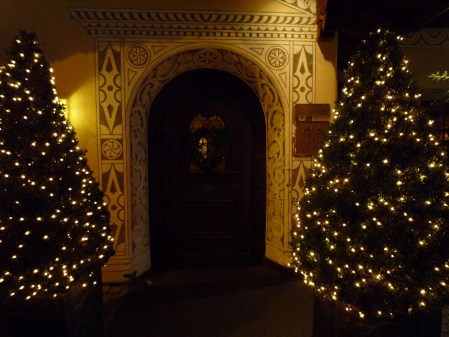
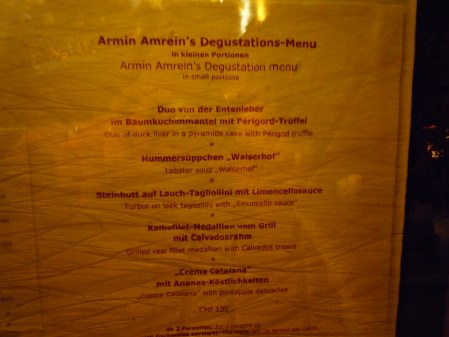
Klosters is home to a clutch of well-regarded restaurants most of which are attached to hotels. Perhaps the best known (because Prince Charles chooses to stay here) is the Walserhof. Its restaurant has 2 Michelin stars and 17 Gault Millau points. Here is its inviting front door and a view of chef Armin Amrein’s festive tasting menu.
Interestingly, the Swiss place more emphasis on the Gault Millau ranking than Michelin. Gault Millau is an alternative French restaurant rating system which awards points for food alone. A maximum of 20 points are available which until recently meant in practice that the top score was in fact 19: with a French philosophical bent, Messrs Gault and Millau determined that perfection was never attainable. Controversially, in 2004 (by which date Messrs Gault and Millau were long gone), 2 restaurants in France were awarded the magical maximum 20 points and that number has subsequently grown to a handful. Falling standards or genuine excellence I wonder?
Sadly, I’m not in a position to comment on Gault Millau ratings as all their rated restaurants in Klosters (the Alpina, the Chesa Grischuna and the Rustico as well as the Walserhof) were fully booked.
This was perhaps a blessing in disguise as there is only so much cheffy food a body can eat and on a skiing holiday something more substantial is required. We paid visits to the cosy restaurant at the Steinbock Hotel (just across the road from the Walserhof), the Grill Room at the Pardenn Hotel, the restaurant in the swanky Hotel Vereina and, finally, for a more informal evening, the Pizzeria Fellini.
The Steinbock has to be one of Klosters’ best-kept secrets. It has a charming dining-room, soft lighting, wood beams and pink linen. On the evening we visited, the clientele was mainly Swiss families out for a celebratory meal. This is us, disturbing their peace just a little:

We chose the set four-course menu. Particularly good were the pheasant consommé and the parmesan-crusted lamb main course.
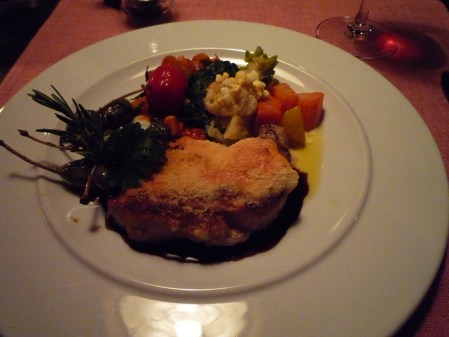
Both these dishes were undeniably old-fashioned – straight out of Escoffier in fact. My copy of Escoffier’s Guide Culinaire includes 137 consommé recipes. Whilst some of these are outlandish (swallows’ nest consommé for example), I think that a well-made simply garnished consommé is delicious, fits perfectly into a multi-course meal and deserves a revival. The lamb was served with lots of lovely vegetables and the most enormous caperberries (Kapernäpfel in German). These seem to be the latest trendy ingredient in the German speaking world – they keep cropping up in restuarant menus and German food magazines.
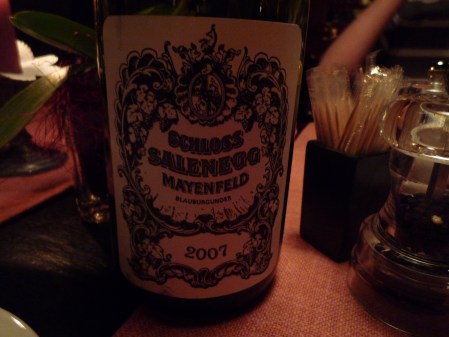
We drank a bottle of local red wine with our meal, a Blauburgunder (Pinot Noir) from Mayenfeld in the Rhine Valley a few miles away. Mayenfeld, more commonly spelt Maienfeld, is famous for being the local town mentioned in “Heidi”.
Next evening was the grill room at the Pardenn, a largish 60s hotel a little way out of town on the Monbiel road. Again, we opted for the 4 course tasting menu. The venison tartare first course was outstanding, as was my pudding choice of savarin, a dinky individual rum baba:
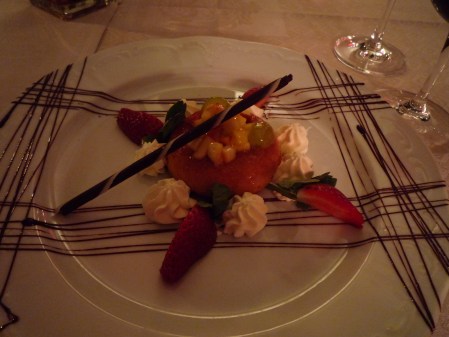
Yes, I know that the presentation looks a little stuck in a 60s/70s timewarp (as frankly does the hotel décor – alpine gemütlich it is not) but believe me, the syrup-drenched savarin was delicious.
Next evening, we chose the restaurant at the Hotel Vereina. The Vereina is an outsized Disney castle of a building plonked right in the middle of town. Unusually for Klosters, it aims to attract the kind of clientele who like to display their money. We were ushered into the dining room which looked to have had an extreme makeover back in the late 1980s – a lot of ornate steel and glass furniture combined with swags of fabric, not that easy on the eye.
Despite the shortcomings in ambience, the staff were, seemingly as ever in Switzerland, charming and appropriately attentive. The food was for the most part pleasant but nothing to write home about, international hotel cuisine without much personality – in my case it was just a bowl of soup and piece of grilled veal, no more, no less. Then the puddings came. I don’t have a particularly sweet tooth, but the 3 choices we made (I opted just for an extra spoon to share all 3) were excellent – an unctuous crème brûlée, a chocolate fondant with a perfectly melting interior and, best of all, George’s choice of a vanilla soufflé:
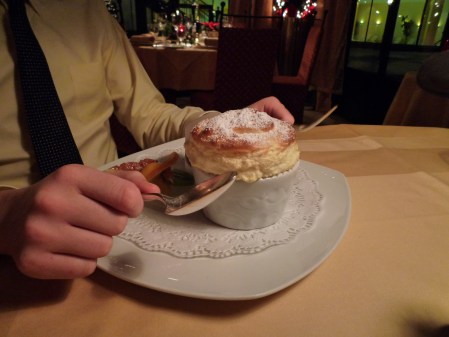
Our final evening was a relaxed affair at the Pizzeria Fellini. The service was swift and efficient, the pizzas properly thin and crusty. Special mention has to go to my choice of a raclette pizza – melted raclette cheese (no tomato), gherkins and tiny pickled onions all on a pizza base. Perhaps the ultimate example of fusion food?

Walserhof
Landstrasse 141 . CH-7250 Klosters
Tel: +41 (0)81 410 29 29
Fax: + 41 (0)81 410 29 39
Steinbock
Landstrasse 146 . CH-7250 Klosters
Telefon: +41 (0)81 422 45 45
Fax: + 41 (0)81 422 16 36
http://www.steinbock-klosters.ch
Pardenn
Landstrasse 146 . CH-7250 Klosters
Tel: +41 (0)81 422 45 45
Fax: + 41 (0)81 422 16 36
Vereina
Landstrasse 179 . CH-7250 Klosters
Tel: +41 (0)81 410 27 27
Fax: + 41 (0)81 410 27 28
Pizzeria Fellini
Bahnhofstrasse 22. CH-7250 Klosters
Tel. +41 (0)81 422 22 11
Dinner at Michael Caines Restaurant at ABode Manchester
November 5, 2009 § 2 Comments
Tim and I finally made it to Michael Caines Restaurant at ABode on a wet and windy Wednesday night in early November.
First, a little background on the Abode concept (sorry I can’t keep up the tricksy capitalisation any longer). Abode is a small chain of boutique city centre hotels each with a Michael Caines restaurant attached. Looking at the website, they aim to attract a hip and trendy crowd, but looking round at the lobby the real clientele is somewhat older, more portly but no doubt more monied. The man with the money behind the concept is one Andrew Brownsword, an entrepreneur with a taste for discreet self-publicity, hence the AB in ABode and the sponsoring of Brownsword Hall in Poundbury, Prince Charles’ model village. Yes, Brownsword is numbered amongst Prince Charles’ best mates.
Brownsword has featured regularly in the Sunday Times Rich List for a decade or so. He made his money in greetings cards and Forever Friends teddy bears, businesses which he sold to Hallmark Cards in the early 90s reputedly for some £190 million. He used the money to establish a hotel business and is also majority owner of Bath Rugby Club.
Brownsword and Caines met after a lunch at Exeter’s Royal Clarence Hotel in 2003 where Caines was executive chef. Brownsword enjoyed his meal so much that, in a Victor Kiam moment, he bought not just the restaurant but the hotel as well and the Abode concept was born. There are now Abode hotels in Glasgow, Canterbury, Chelsea and Chester as well as Manchester and Exeter.
Enough of background and onto the dinner experience. We descended from the hotel lobby into the basement where you will find the champagne bar and restaurant. Manchester is famous for being the centre of cotton industry in the nineteenth century and the building where Abode is now situated is very evidently a former cotton warehouse. It has been sympathetically converted, keeping the roomy expanse of space you associate with a warehouse and making a feature of the sturdy cast iron columns which support the roof. Clever use of translucent glass panels breaks up the room and gives its various spaces an intimate feel within the large basement area.
The comedy French maître d’ (is he for real?) whisked away my bags of early Christmas shopping and seated us in the champagne bar, a space adjoining the the main dining area with plenty of scope for people watching. The basement is softly lit, lots of dark wood, brown and orange and a Paul Smith striped carpet. There are black and white photos of rock stars on the walls and napery is limited to generously sized white napkins. The problem any basement encounters is that there is no natural light. On a cold and wet evening in late autumn this didn’t matter at all but I probably wouldn’t come here for lunch for that reason despite the remarkably good value £12 “grazing” menu lunch offer.
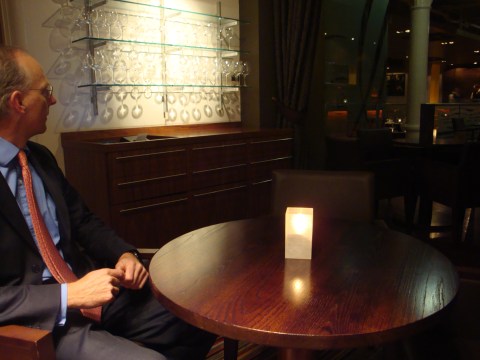
The cocktail list is impressive, naming the Head Mixologist as one Adrian Vipond. I liked the sound of the wittily named Lady Macbeth (blended Scotch plus various red fruit liqueurs shaken over ice) but Tim and I both plumped for a flute of the house champagne. This was acceptable but I wasn’t blown away by it. Being bone dry, it would have been good in one of the various Champagne cocktails on offer. I’d love to come back and try a cocktail sometime – the only downer was the rather damp smell lingering in this corner which resulted from a leaking skylight. Our fellow drinkers didn’t seem to notice that the sofa they were perched on was damp from dripping rainwater. I think they’d had a few…
After a little difficulty identifying the right member of staff – there were lots of staff in the dining room but working apparently to strict lines of demarcation- we succeeded in getting hold of menus. The first decision you have to make is whether to go with the grazing menu, multi-course tasting menu or standard à la carte selection. Prices didn’t look too unreasonable – for instance the tasting menu is a headline £65 per head (sorry I failed to make a note of whether this included VAT and service). Our hostess patiently explained how the grazing menu worked: these are small portions of stand-alone dishes which function either as starter or main. You order as many or as few as you like in whatever order takes your fancy. In effect it’s a design-your-own tasting menu.
Unsure of portion sizes and how the grazing concept would work in practice we decided to dip a toe in the water and choose 2 grazing dishes each as a starter followed by an à la carte main. My choices were (i) crab cannelloni with pink grapefruit jelly and lemon thyme foam, and (ii) tuna tartare with pickled beetroot and turnip, wasabi mayonnaise and sweet raisin vinaigrette. Both dishes were pretty as a picture as you can see below and modishly served on a square glass plate and slate tile respectively.

Head chef Ian Matfin clearly knows what he is doing. The flavour combinations were logical, classic even but presented in a new way and both dishes showcased high levels of skill in the kitchen. After tasting these two dishes, I wish I’d gone for the full grazing option rather than a single main.
My main course was roast mallard with jus (known in my kitchen as gravy) celeriac mash and winter berries (these were cranberries and blueberries I think). The mallard was cooked to an accurate medium rare as requested and was pink and juicy. It came unexpectedly with a tiny jug of bread sauce which, given the presence of celeriac mash, was not entirely necessary, nor is it a classic roast duck accompaniment. My only gripe (a perennial one) was that we had to order a selection of vegetables and potatoes to accompany the our main courses. These were dinkily served in a lidded white china sugar bowl but were nevertheless the same old boring boiled broccoli, cauliflower and carrot.
We chose a bottle of Gigondas to accompany our meal which appeared ostentatiously in the separate Fine Wine section of the menu. Why the wine list couldn’t simply be presented by region with wines listed in price order rather than by grape type I don’t know. This leads to weird anomalies such as Châteauneuf du Pape being grouped with Beaujolais under “Red wines – other”. Given the excellence and variety of the grazing dishes it would have been good to see more wines offered by the glass too – crab cannelloni and Gigondas is definitely not a match made in heaven.
We were offered the pudding menu with lots of interesting sounding choices. I chose the pumpkin crème brûlée with chocolate ice cream. It sounded weird and it was. Frankly it was a bit yucky. Like pumpkin pie filling but without the benefit of pumpkin spice. An obsession with inventiveness had clearly clouded the chef’s judgement here. Never mind, the espresso which came next was just right.
I’d love to come again and would try the full-blown grazing option skipping the pudding next time.
Weekend in Paris: Restaurant Hélène Darroze
September 20, 2009 § 2 Comments
My aunt who lives in Paris, Marjorie, was celebrating her 70th birthday with a Wild West party on Saturday 19 September and I decided to make a long weekend of it and take the opportunity to explore Paris.
I travelled to Paris in leisurely comfort taking the train all the way from our front door. It takes longer than the plane but is a comfortable and relaxing way to travel. I hopped onto the metro, breathing in the distinctive smell it has and positively enjoying the bustle and excitement of Paris. I checked into my cheap (for Paris..) and cheerful hotel, the Vendôme on the Rue d’Arras on the Left Bank and was very touched to find that husband Tim had thoughtfully sent a bouquet of flowers to the room.
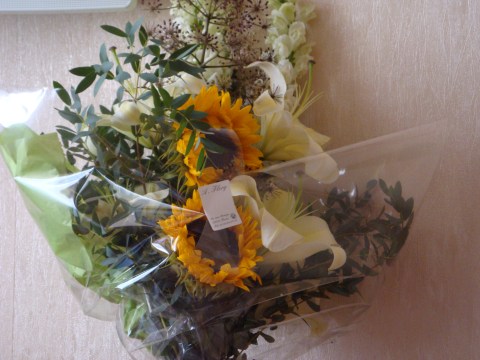
There was just time to unpack, bathe and change before setting out to that evening’s destination, Restaurant Hélène Darroze on the Rue D’Assas, also on the Left Bank, a couple of metro stops away. You may have guessed that I thought my hotel was on the same street as the restaurant but I didn’t check carefully before booking and confused rr with ss. Never mind, I was approximately in the vicinity and the exercise did me good.
I was amused to catch on the TV in my room a few minutes of “Un Dîner Presque Parfait” (an almost perfect dinner) a reality TV show which is evidently the French equivalent of “Come Dine With Me”. The French contestants had taken the whole thing a lot more seriously than we do in the UK: in this week’s episode filmed in the lakeside mountain town of Annecy, hostess with the mostest Carole had recreated an alpine meadow by turfing over her dining table with real grass onto which were dotted toy animals and artificial flowers. You can check out the latest episode of the show here: http://undinerpresqueparfait.m6.fr
Suitably refreshed and in the mood for dinner after watching the lovely Carole prepare foie gras for her guests, I set out for Restaurant Hélène Darroze which is located on the discreetly affluent Rue d’Assas just off the bustling Boulevard Raspail.

It felt good walking in through the sleekly dark doorway and being shown in the Salon, the less formal (and less expensive) way to sample to cooking here. It had been surprisingly easy to book a table – I had phoned and booked in the main restaurant just 10 days’ earlier without any difficulty. A sign of the recession perhaps. Plan A, dinner for two (me and Auntie Madge) in the restaurant, changed to Plan B, dinner for three in the salon when we realised Cousin Eileen was in town. Eileen, like many members of my extended family has led a colourful life and is now married to a Turkish Cypriot and runs a beachside bar, The Soho Lounge, in a resort not far from Kyrenia.
As I was a little early and was the first to arrive, I settled down in the boudoir-like salon with a glass of Laurent Perrier rosé and took in the delicious sounding “Menu Tapas” realising with pleasure that there were no difficult decisions to make as all of these dishes would be served up during the course of the evening. The salon décor is a mix of funky minimalism (citrus green walls and dinky dark wood dining tables) and Arabian nights glamour (screen of butterfly wings and jewel-coloured silk cushions).
The Tapas menu is shown in the photograph below, along with the mildly eye-watering price of Euro 88 per head (in fact not unreasonable for Paris given the number of different dishes and sheer quantity of skilful cooking involved – to put this into context, a single main course of sea bass at the Restaurant Jules Verne on the Eiffel Tower is also coincidentally Euro 88, a spotted on the menu during next day’s sightseeing)

My fellow guests arrived and joined me in a glass of pink champagne. The waiters (all good looking sharp suited young men) were gently flirtatious and were happy to take our picture. Cousin Eileen is on the left, Auntie Madge in the middle and me on the right.
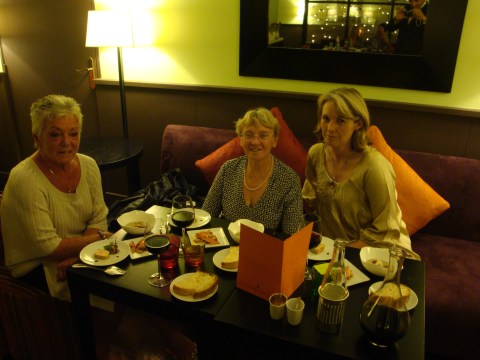
Why did I choose Restaurant Hélène Darroze? Because she’d appeared as an example of a top-class Michelin-starred chef on BBC’s Masterchef last year and had stuck in my mind as being quietly competent and observing the highest standards in the kitchen. I toyed with the idea of trying out Pierre Gagnaire’s restaurant but in the end thought I’d like to visit a restaurant run by a female chef. She is now in her early 40s, at the top of her game and, like Angela Hartnett before her, has taken over the running of the restaurant of London’s flagship Connaught Hotel.
I knew next to nothing about Darroze’s style of cooking before visiting the restaurant so this was all a new discovery. I now know that she is a native of Landes in South West France and this certainly showed in the cooking on the menu this evening.
The first course of 3 “tapas” comprised, transcribing from the photographed menu above:
Foie gras de canard confit au naturel, chutney de figue de chez ‘Pierre Bau’, réduction Mas Amiel
Haricots maïs du Béarn, homard bleu, olives Taggiashe, roquette
Ris d’agneau et kokotxas de morue en fricasseé aux noisettes fraîches, velouté d’artichauts bretons
Here’s what the dishes looked like when they arrived at the table:

As you can see, all the dishes were served in tiny portions, just right for a greedy person like me. I tend to like my plates and bowls round, finding the various square receptacles, wooden boards, jars and the like that modern chefs feel compelled to employ rather faddish. The delicate little shell shaped bowls that were used here were however rather lovely and suited the dainty nature of the food and portion sizes. Wine glasses I recognised as Riedel and felt good in the hand. We chose a Beaujolais (a Fleurie I think) as a cost effective and versatile wine which lasted all through the meal.
The course which stood out for me was the lamb sweetbreads – these were tiny morsels packed with flavour and were served with what the waiter informed us were the lower cheeks of a salt cod! Obscure this ingredient may the cheek too were dainty and delicious and worked incredibly well with the lamb and the velvety artichoke purée.
Next up were:
Riz acquarello noir et crémeux, chipirons, chorizo et tomates confites
Maigre de ligne, déclinaison de fenouil, moules de Bouchot et palourdes au jus d’herbes
Effiloché de poularde jaune des Landes, cèpes, espouma de pommes de terre
These dishes are in the next photograph:
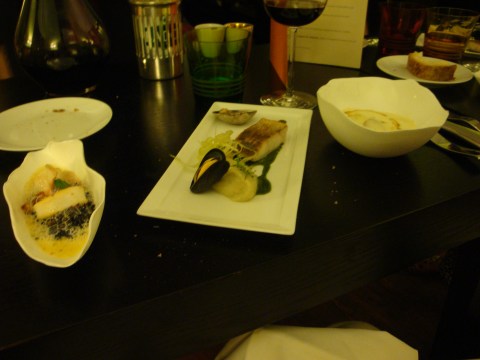
The rice dish was a refined take on the traditional Catalan black rice dish found on Barcelona restaurant menus, though Darroze prefers to use a type of Carnaroli rice from Italy as the waiter knowledgeably informed us. Chipirons turned out to be baby squid. The waiter was also helpful in explaining what maigre was – a fish native to the Atlantic Charentes Maritime coast, a little like a sea bass. Whilst chatting to us, he also solved the mystery of what bar and loup de mer are – both sea bass but the former is the name used for fish from the Atlantic coast and the latter the name used for Mediterranean fish.
On returning home, I looked up maigre in my trusty Jane Grigson Fish Book and was delighted to find that it was in there – just a couple of sentences but there nevertheless – she is a woman you can count on. Apparently this fish is known in English as a meagre or a croaker and is a bit like a gurnard. Hats off to Darroze for using something unusual and from her home region rather than the more obvious turbot or sole.
The menu French was getting a little up itself at this point – I mean, a declension of fennel! This turned out to be fennel three ways with the purée turning out to be a revelation – I made a mental note to try this it at home. And effiloché of chicken? This seems to have something to do with knitting or crocheting but turned out to be a delectable miniature chicken shepherd’s pie with the espouma or cheffy foam of potato being the lightest mash imaginable.
Finally, on to the puddings. These were:
Madeleine a l’huile d’olive, sorbet fromage blanc, salade de mûres et myrtilles, meringue au cassis
Crème au chocolat carapuno du Vénézuela, praline d’amandes fait maison et écume de thym citron
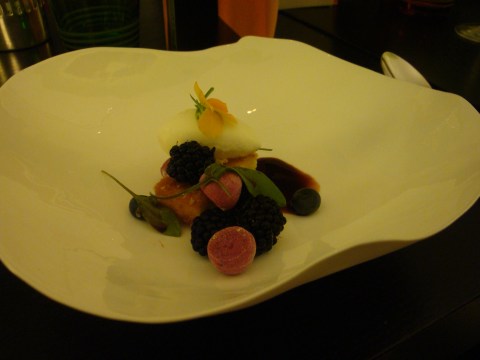
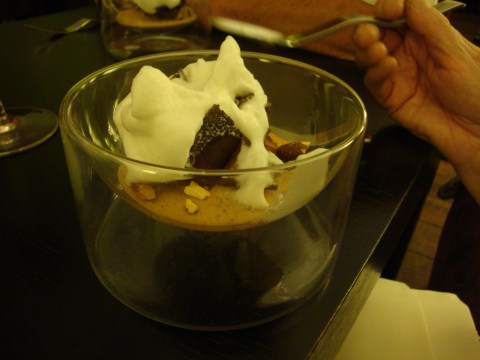
Both pretty as a picture and as good to eat as to look at. Sorry to be a pedant (actually I’m not sorry really) but I think the menu should actually describe the chocolate as Carupano rather than carapuno. Arthur Knapp in his 2008 book “Cocoa and Chocolate” describes the criollo beans from this part of Venezuela as “the finest in the world”. Nothing but the best for Darroze and they certainly made a heavenly mousse. I was not sure about the combination of lemon thyme (in another of those modish foams) with chocolate but both Madge and Eileen enjoyed the contrasting tastes. All this sounds positively gushing but it really was very good. Searching round for something negative to say, the sound of heavy duty machinery from the open plan kitchen, probably employed in whipping up those foams, was perhaps the only (slightly) jarring note during the evening.
The dinky little madeleine was served with the most amazing mini blackcurrant meringues that exploded in the mouth like a refresher. I would guess that they were not concocted from the usual egg white but from blackcurrant foam. A touch of the Heston Blumenthal, and a little culinary magic to end the meal.
Review of The Church Green, Lymm, Cheshire
September 5, 2009 § Leave a comment
It was our wedding anniversary yesterday and Tim and I visited the Church Green in Lymm for dinner last night to celebrate. This is chef Aiden Byrne’s latest venture and though it opened back in March I think it’s still the new place to go round here. Aiden Byrne is familiar to our family as one of the chef’s on TV programme Great British Menu. This year he represented the North West but was trounced (rightly) by stalwart Nigel Haworth. I remember Aiden Byrne’s TV persona as that of an overawed Scouser fresh out of catering college. His food on the programme was meticulously prepared with flashes of inspiration. I made his chilled broad bean soup with goat curd recipe for a family celebration dinner in June. Cold soups are practical and can be distinctly underwhelming but this one really was a thing of beauty with its herb and flower garnish and the balance of tastes and textures was spot on. I recall his overall Great British Menu was unbalanced and that he was a self-confessed novice pastry chef so puddings were not his forte.
My only other preparation for this visit was reading Matthew Norman’s damning Guardian Online review from March 2009 a couple of weeks after the place opened. The article strapline goes “Michelin poncery in a village pub leaves Matthew Norman with a nasty taste in his mouth”. Oh dear – overall rating only 4 out of 10.
The Church Green is indeed a converted village pub right in the middle of desirable Cheshire commuter village Lymm. We arrived, parked up on the battered tarmac apron which sadly obscures most of the front façade of the building and took a look.

There’s no denying that this place looks like a pub, despite the flash conservatory tacked on the side. The impression was reinforced when we walked inside as part of the original bar is still intact complete with dodgy carpet and painted flock wallpaper on the ceiling. We’d dressed up a little for the occasion so it was slightly odd to find a group of hikers in red cagoules propping up the bar. They’d clearly popped in for a drink after the day’s exertions. No matter – I really hate dress codes in hotels and restaurants and have in fact been thrown out of the Ritz in London twice for being incorrectly attired and won’t go near the place now.
The two glasses of champagne we ordered as an aperitif took an age to arrive – service is a little nervous and less than slick but this gave us plenty of time to take in the ambience and décor. The impression is that not that much has been spent on doing the place up. They don’t bother with white linen – the small polished wood tables give a bistro feel (but without bistro prices). The other impression was that the restaurant was nowhere near full which really on a Friday night no longer in school holidays it should have been. Maybe it’s the price issue again.
We were shortly ushered to our table and our first courses arrived. I’d ordered borlotti bean soup with smoked duck foie gras. This was a shallow bowl of pale puréed creamy soup topped with a generous slice of duck liver, fresh out of the pan. This turned out to be, without exaggeration, one of the most delicious things I’ve ever eaten. The duck liver was perfectly cooked, a light crust on the outside, meltingly soft within and the hint of smoke flavour was just perceptible in the background. The soup was full flavoured and velvety smooth.
My main course was lamb three ways – the chef’s favourite cut of rack, plus a neat cube of pressed slow-cooked shoulder and a sticky braised lamb’s tongue. Main courses came with only minimal vegetables and no potatoes so at the waitress’s suggestion we ordered a portion of French beans and some thick cut chips to share. I resent having to order side dishes and would much prefer the chef to have considered and presented a complete dish with a balance of tastes and textures. I particularly dislike the habit of presenting a half moon side-dish of supposed “seasonal vegetables” which usually comprised boiled broccoli, carrot and a bit of overcooked cauliflower. They don’t fall into that trap here but it is nevertheless a bit gastro-pub to have to share a big portion of chips. They were really good chips – crispy on the outside and fluffy within – so I’m not complaining too much. My lamb was delicious and skilfully and inventively cooked -I applaud the use of different parts of the animal, the cheaper cuts as well as the best ones. The meat and accompanying reduction were all so intensely flavoured that I was overwhelmed by an impression of brown stickiness and, unusually for me, couldn’t finish my plate.
We chose New Zealand Pinot Noir to accompany our meal. The wine list is short and rather idiosyncratic and contains a number of glaring gaps. Wine knowledge is clearly not Aiden’s thing and there were I think no half bottles available and a very limited selection of wines by the glass which is disappointing.
I was unable to manage pudding but tried a little of Tim’s tiramisu. Pudding choice was underwhelming – nothing to really tempt the tastebuds and the tiramisu that arrived was not at all dainty – a great lumpen thing served inappropriately in a knickerbocker glory glass. Looking at the Church Green’s website this morning I see they are advertising for an experienced pastry chef – it shows!
My overall impression mirrors the Great British Menu experience – flashes of inspiration (Byrne is clearly a wizard when it comes to beans whether broad or borlotti! ) but his cooking lacks balance – when it comes to brown stickiness you can have too much of a good thing – and he needs to employ a decent pastry chef soon.
The Church Green,
Higher Lane ,
Lymm,
Cheshire
Telephone: 01925 752 068
 The Rhubarb Fool