
Bahrain breakfast
March 13, 2011 § Leave a comment

When I started researching this breakfast, Bahrain was just a small Gulf State backwater brought to international prominence by its oil industry. It’s an archipelago of 33 islands close to Saudi Arabia in the western Persian Gulf. The largest, the 34 mile long Bahrain Island, is linked to Saudi Arabia via the King Fahd Causeway which is the 16th longest bridgest in the world.
A chance encounter with Lucy Caldwell’s new novel “The Meeting Point”, courtesy of BBC Radio 4’s Book At Bedtime in February 2011 put some flesh on the bones of the life of the substantial ex-pat community in Bahrain – more than 20% of the population of 1.2m are foreign nationals. And the web is littered with references to “Aramco Brats” – children of the original Arabian-American Oil Company employees who were based in Saudi and Bahrain following the discovery of oil in Bahrain in 1932.
Then Bahrain became one of the countries of the 2011 “Arab Spring” currently sweeping across the Middle East and North Africa. There had been early intimations of trouble – another Radio 4 Programme, “Crossing Continents” presciently reported in December 2010 on the heavy-handed repression, torture even, of opponents to the ruling al-Khalifa family. So far, demonstrations in Bahrain have been stopped in their tracks with the aid of troops from neighbouring Saudi. It remains to be seen what will happen.
A lot to think about over one small breakfast.
This breakfast’s menu came to us thanks to a helpful video entitled “Friday Breakfast” shot by Mahmood from Bahrain back in 2006. His Friday breakfast looks to be the equivalent of our Western Saturday or Sunday breakfast when we might make or buy something special.
http://www.youtube.com/watch?v=7q1o7rgP9eM
Thanks to Mahmood, I decided that the menu would be khubz (Arabic flat bread, aka pitta), samboosas (which look to be similar to Indian samosas), fried tomatoes with spices, and scrambled eggs.
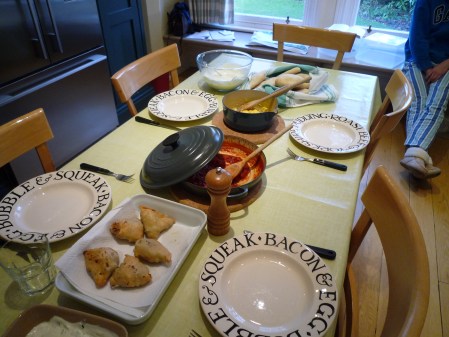
Making the pitta bread was straightforward enough – those little pockets appear as if by magic as long as there’s enough heat on the top surface of the bread. Very satisfying and deliciously fresh.
The samosas were, on the other hand, a complete faff. Making the filling of potatoes, peas herbs and spiceswas straightforward enough but forming the samosas was another matter…

I pride myself on having nimble fingers and being reasonably proficient with pastry, but shaping these wretched little tricorn parcels, coaxing them to stay open in order to push in the filling, then attempt to seal the whole thing up was the most technically challenging piece of cooking I’ve attempted in the last 2 years (and beyond that my memory fails me). I don’t often find myself saying this, but if you fancy a samosa, pop to your local Indian grocer and buy one.

Recipe for Khubz (pitta bread)
From Claudia Roden’s “A New Book of Middle Eastern Food” with occasional minor wording changes. Based on my recent breadmaking experience, I didn’t bother with warming the liquids, letting the yeast froth or oiling the baking sheets as specified in the recipe. The end result was just fine so by all means do the same if you are a confident breadmaker.
Ingredients
15g fresh yeast or 7g dried yeast
300 ml tepid water (approximate)
pinch of sugar
500g strong white flour
3g salt (1/2 teaspoon)
2 tablespoons vegetable oil (optional) plus a little extra for greasing
Dissolve the yeast in 100ml of the total amount of tepid water. Add the pinch of sugar and leave in a warm place for about 10 minutes, or until it becomes frothy and bubbly.
Sift the flour and salt into a warmed mixing bowl. Make a well in the centre and pour in the yeast mixture. Knead well by hand, adding enough of the remaining water to make a firm, soft dough. Knead the dough vigorously in the bowl, or on a floured board for about 15 minutes, until it is smooth and elastic, and no longer sticks to your fingers. Knead in 1-2 tablespoons of vegetable oil for a softer bread. Sprinkle the bottom of the bowl with a little oil and roll the ball of dough round to grease it all over. This will prevent the surface from becoming dry and crusty. Cover with a damp cloth and leave in a warm place free of draughts for at least 2 hours, until nearly doubled in size.
Punch the dough down and knead again for a few minutes. Take lumps of dough the size of a large potato or smaller (according to the size of bread you wish to have). Flatten them on a lightly floured board with a dry rolling pin sprinkled with flour, or with the palm of your hand, until about 1/2 cm thick. Dust with flour and lay the rounds on a cloth sprinkled with flour. Place them a good distance apart so that they do not touch as they grow considerably. Cover with another lightly floured cloth, and allow to rise again in a warm place.
Preheat the oven set at the maximum temperature (240 degrees C?) for at least 20 minutes, and leave the oiled baking sheets in it for the last 10 minutes to make them as hot as possible. Take care that the oil does not burn.
When the bread has risen again, slip the rounds onto the hot baking sheets, dampen them slightly with cold water to prevent them from browning, and bake for 6-10 minutes, by which time the strong yeasty aroma escaping from the oven will be replaced by the rich, earthy aroma characteristic of baking bread – a sign that it is nearly ready.
Do not open the oven during this time.
Remove from the baking sheets as soon as the bread comes out of the oven and cool on wire racks. The bread should be soft and white with a pouch inside.
If your oven does not get hot enough to make a good pouch, make the bread under the grill: put it low enough underneath so that it does not touch the grill (and burn) when it puffs up. Turn as soon as it does and leave only a minute longer.
Put the breads, while still warm, in a plastic bag to keep them soft and pliable until ready to serve.
Recipe for Vegetable Samosas
From Madhur Jaffrey’s “Indian Cookery” with a few minor wording changes of mine
Makes 16
Ingredients
For the pastry
1/2 lb (225g) plain flour
1/2 teaspoon salt
4 tablespoons vegetable oil
4 tablespoons water
For the stuffing
1lb 10 oz (725g) waxy potatoes boiled in their skins and allowed to cool
4 tablespoons vegetable oil
1 medium onion, peeled and finely chopped
6 oz (175g) peas fresh or frozen (defrost first if using frozen peas)
1 tablespoon peeled and finely grated fresh ginger
1 fresh hot green chilli, finely chopped
3 tablespoons very finely chopped fresh coriander
3 tablespoons water
1 and 1/2 teaspoons salt – or to taste
1 teaspoon ground coriander seeds
1 teaspoon garam masala
1 teaspoon ground roast cumin seeds
1/4 teaspoon cayenne pepper
2 tablespoons lemon juice
Vegetable oil for deep frying
Sift the flour and salt into a bowl. Add the 4 tablespoons of vegetable oil and rub it in with your fingers until the mixture resembles coarse breadcrumbs. Slowly add 4 tablespoons of water – or a tiny bit more – and gather the dough into a stiff ball.
Empty the ball out on to a clean work surface. Knead the dough for about 10 minutes or until it is smooth. Make a ball. Rub the ball with about 1/4 teaspoon of oil and slip it into a polythene bag. Set it aside for 30 minutes or longer.
Make the stuffing. Peel the potatoes and cut them into 5mm dice. Heat 4 tablespoons oil in a large frying pan over a medium flame. When hot, put in the onions. Stir and fry them until they begin to turn brown at the edges. Add the peas, ginger, green chilli, fresh coriander, and 3 tablespoons water. Cover, lower heat and simmer until peas are cooked. Stir every now and then and add a little more water if the frying pan seems to dry out.
Add the diced potatoes, salt, coriander, garam masala, roast cumin, cayenne, and lemon juice. Stir to mix. Cook on low heat for 3-4 minutes, stirring gently as you do so. Check balance of salt and lemon juice. You may want more of both. Turn off the heat and allow the mixture to cool.
Knead the pastry dough again and divide it into 8 balls (I did this with scales – each ball weighs 43-44g). Keep 7 covered while you work with the eighth. Roll this ball out into an 18cm round. Cut it in half with a sharp, pointed knife. Pick up one half and form a cone, making a 5mm overlapping seam. Glue this seam together with a little water. Fill the cone with about 2 and 1/2 tablespoons of the stuffing. Close the top of the cone by sticking the open edges together with a little water. Again, your seam should be about 5mm wide. Press the top seam down with the prongs of a fork or flute it with your fingers.
Make 15 more samosas.
Deep fry the samosas in small batches until they are golden brown and crisp. Drain on kitchen paper and serve hot, warm or at room temperature.
Lunch in Lucerne
March 3, 2011 § 1 Comment
Next stop after Zürich airport en route to Engelberg for our half term ski holiday was Lucerne. The city is spectactularly situated by the lake we know in the English speaking world as Lake Lucerne but is known in Switzerland as the Vierwaldstättersee (lake of the 4 forest cantons).

Lucerne missed by a whisker being nominated as Switzerland’s capital city (rather than sleepy Berne) and has a definite cosmopolitan European capital feel with its lakeside concert hall, museums and galleries.
We spent a few days here last summer too and had one of the most perfect al fresco meals ever in the grounds of the lakeside Hermitage Hotel:

Lucerne can lay claim to a number of local specialities. Luzerner Birnenbrot, a giant fig-roll type affair crammed full of dried pears and nuts, can be found in most bakeries.
But arguably, Lucerne’s most famous dish is the “Ächti Lozärner Chügelipaschtete”, a giant vol-au-vent type pastry case filled with chunks of veal, sweetbread, sausage and tiny mushrooms in a savoury saffron flavoured sauce. With its magnificent egg-wash gilding and pastry decoration and its saffron flavouring, the dish has a medieval banquet feel and is unusual and delicious. Here’s the version we tried, toned down a little for modern appetites:

Back home, I’ve combed through my collection of cookery books for a recipe for this dish and have come across an authentic sounding one from Marianne Kaltenbach’s “Aus Schweizer Küchen” which I translate and paraphrase below. This version doesn’t include saffron or sweetbreads which is a pity as they add to the character of this dish and were certainly present in the version we ate.
I also found this beautifully photographed and meticulously written Swiss blog entry on how to make a miniature version of this delicacy. I give the link below but you’ll need to brush up on your German if you want to read it!
http://lamiacucina.wordpress.com/2011/02/23/luzerner-chugelipastete-fritschipastete/
Recipe for Ächti Lozärner Chügelipaschtete
From Marianne Kaltenbach’s “Aus Schweizer Küchen”. Apologies in advance for any errors in translation which are mine alone!
Serves 4-5 people
Ingredients
For the pastry case
600-700g puff pastry
1 small bread roll plus a handful of tissue paper
2 egg yolks
For the filling
250g lean pork
250g lean veal
1 onion
3 dessertspoons butter
1/2 litre white wine
approx 150g pork and veal sausagemeat
1 teaspoon each of ground coriander seed and chopped marjoram (more to taste if liked)
300 ml stock
2 dessertspoons flour
50g grapes macerated in 1 dessertspoon of Swiss pear Schnapps or Kirsch
Salt, pepper, grated nutmeg
a little cream
1 dessertspoon chopped almonds
Roll out the puff pastry to a thickness of 4mm and cut out from it 2 circles approx 24cm and 32cm in diameter. Place the smaller circle on a dampened baking sheet. Wrap the bread roll in sheets of tissue paper until it forms a ball approx 37-38cm in circumference. Place it on the centre of the smaller pastry circle. Brush the border with water and place the larger circle over the top. Seal the join and crimp the border.
Roll out the rest of the pastry and cut strips approx 3mm thick and 6mm wide. Brush them with egg yolk and stick them onto the pastry dome laying 4 strips in the form of a cross and 2 others in the form of a ring. Place further strips around the base to cover the ends of the strips neatly.
Preheat the oven to 180 degrees C.
Further decorate the pastry dome with star, heart and half-moon shapes cut from the pastry remnants. Finish with a large pastry rosette on top. Brush the lot with egg yolk wash.
Bake in the lower part of the oven where the temperature will be only 160 degrees C for 40 minutes. After 25 minutes, cover with aluminium foil. Remove from the oven when cooked and leave to rest for 5 minutes. Remove the top part of the pastry shell from the upper ring and take out the paper-wrapped bread roll.
(This all sounds a bit complex but the lovely photos from the La Mia Cucina blog to which a link is given above make it all visually clearer).
Now make the filling. Cut the meat into small cubes. Peel and chop the onions. Melt 1 and 1/2 dessertspoons of butter in a pan and brown the meat and onions. Add 50ml white wine to the pan and cook for 10 minutes.
Mix the sausagemeat with coriander and marjoram and form into small balls. Bring the stock to the boil in a medium saucepan and poach the sausagemeat balls for 10 minutes.
For the sauce, melt the remainder of the butter and add the flour to form a roux. Off the heat, gradually beat in the rest of the wine. Add the collected meat juices from the previous cooking steps to the pan together with the grapes and their soaking alcohol. Cook for 20 minutes. Add the meat and sausagemeat balls, heat through, season and thin the sauce if necessary with a little cream or additional stock.
Toast the almonds. Fill the pastry dome with the meat and sauce mixture, scatter over the almonds and top with the pastry lid
Variations: add a grated apple to the sauce; replace some of the meat with button mushrooms.
This dish is especially associated with “Fastnacht”, the night before the Lenten carnival, what we would call Shrove Tuesday or Mardi Gras. It makes whipping up a few pancakes seem like a doddle!
Luxemburgerli – macarons from Zürich
March 1, 2011 § Leave a comment
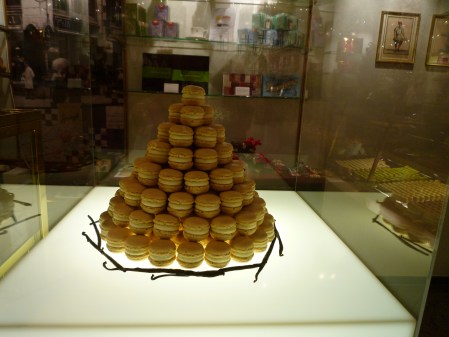
We’re still all going crazy for dainty pastel-coloured Parisian macarons. Meanwhile the Swiss firm of Sprüngli has quietly been making its own version going under the odd name of Luxemburgerli (little Luxemburgers) for some years now.
Above and below are displays at the very conveniently located Zürich airport branch of Sprüngli where we passed through last week en route to our half term ski holiday:
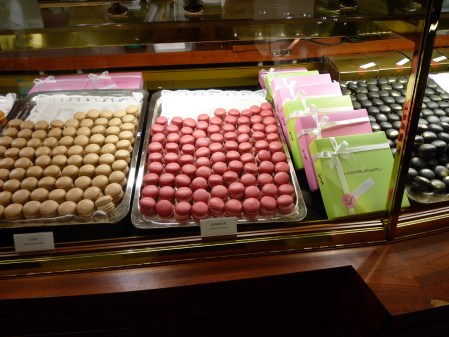
Pictured are a pyramid of vanilla Luxemburgerli plus trays of cinnamon (Zimt) and raspberry (Himbeer) flavours – I forgot to check what flavour the dramatic black ones on the left were. Dare I say it, these are daintier and more delicate even than the Parisian macaron, perfect for nibbling with coffee on the train journey to Luzern and beyond:
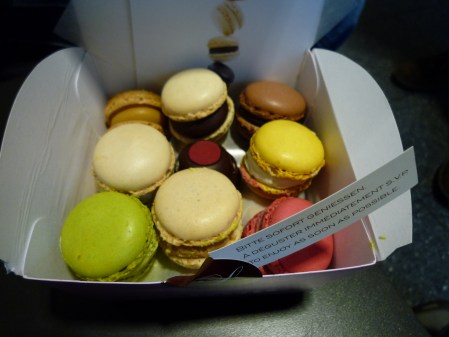
How do they come to be made in Zürich and how did they come by their odd name? According to the Sprüngli website www.spruengli.com the recipe originated at the Confiserie Namur in Luxembourg, a business with which the Sprüngli family had close ties. Patissiers from Zürich would go and work in the Duchy of Luxembourg and vice versa. It was in the late 1950s that one of the Luxembourg trainees started producing macarons in Zürich and they were given the nickname Luxemburgerli (the Swiss are very fond of the diminutive) in his honour.
Demand grew gradually and Sprüngli today produces 650kg of Luxemburgerli every day making them the company’s best seller.
So maybe the current trend for Parisian macarons is more than a fad and is here to stay?
Silver medal Seville orange marmalade 2011
February 28, 2011 § 2 Comments
I posted recently about my silver medal winning marmalade at the World Marmalade Awards at Dalemain in Cumbria and promised to divulge my new marmalade recipe. OK folks here’s how it’s done:

Recipe for Thin Cut Seville Orange Marmalade
This is the recipe which was enclosed with my Riverford Organics “marmalade kit” (a big brown paper bag containing 1.5kg of spanking fresh Seville oranges and 2 lemons, all unwaxed and organic of course). Many thanks to Riverford and owner Guy Watson for this recipe which Guy demonstrates at www.riverford.co.uk/marmalade
I’ve quoted it exactly as printed with my editorial comments included in brackets.

Ingredients
1.5kg Seville oranges
2 lemons
2.5 litres cold water
Approximate 2kg granulated sugar
1. With a sharp knife (or vegetable peeler) peel the skin from the oranges and lemons, leaving as much white pith on the fruit as possible. Chop the peel into 3mm strips (or thinner if you have the patience) and put into a large pan (lidded stock type pot rather than a preserving pan best for this stage).

2. Line a large bowl with a piece of muslin, leaving plenty to overhang the sides of the bowl. Cut the oranges and lemons in half. With your hands, squeeze the juice from the fruit over the bowl, dropping the leftover squeezed fruit, pith, pips and flesh, into the muslin. Lift the muslin out of the bowl, gather the sides and squeeze any remaining juice into the bowl. Tie the muslin together to keep the fruit in and form a bag.

3. Place the muslin bag in the saucepan with the peel, leaving the top of the muslin overhanging the saucepan. Add the squeezed fruit juice and 2.5 litres cold water to the pan. Heat until boiling, then reduce the heat and simmer for 2 hours, until the peel is tender.
4. Remove the muslin bag and squeeze all the sticky juice from the bag into the pan. An easy way to do this is to put the bag in a colander and use a spoon to press it out. Measure the contents of the pan in a jug (or weigh in the pan using a suitable pair of scales having had the foresight to weigh your pan in advance). Return to the pan and add 450g of sugar for every 500ml liquid. Gently heat for 15 minutes, until the sugar crystals have dissolved. Increase the heat and boil rapidly for 15 minutes. (Knowing what I know now, I would start testing after just 5 minutes of rapid boiling especially if the oranges are very fresh).

5. Test that the marmalade has reached setting point by putting a teaspoon of the liquid on a cold saucer and gently pushing with the back of a spoon. If the liquid starts to wrinkle, setting point has been reached. If no wrinkling happens, keep boiling and retest every 10 minutes. (I would in fact retest every 5 minutes). Turn off the heat as soon as you reach setting point.

6. Skim any scum from the surface. Leave the mixture to stand for 15 minutes. Stir gently, then carefully spoon into warmed sterilised jars. If using screw top lids, put the lids on while the marmalade is still hot and turn upside down for 5 minutes (surely should be 5 seconds?) to sterilise the lids. If using cellophane, put a wax disc on the marmalade while warm, then seal with cellophane and an elastic band.
So that’s it – the time consuming part is cutting the peel into appropriately thin shreds, and removing the glue from recycled jam jars of course…
After attending a really helpful marmalade making workshop given by Jane Maggs at Dalemain, I have a few extra pointers for success. Jane runs an artisanal preserving business “Wild & Fruitful” from her home kitchen in Cumbria and took double gold in the artisanal producers category at last year’s Marmalade Awards with her Lemon and Lavender Marmalade so could not be better qualified to advise all us would-be winners. An added bonus to the workshop was the presence in the audience of previous amateur winner Dr Yen-Chung Chong. Dr Chong, a retired biochemist now living in Brighton struck gold with his Campari and blood orange marmalade. He helped us out by adding a good dose of scientific method to marmalade-making and debunking one or two marmalade making old wives’ tales along the way.
Pointers for marmalade success:
1) DO try and use really fresh Seville oranges from early in the season – they become available in late December. The fresher they are, the more flavour they have and the higher the pectin content meaning a set will be achieved with less boiling. Less boiling means more fresh flavour and no caramelisation (a marmalade fault in the judges’ eyes).
2) DON’T omit the lemons – these sound in some recipes as if they are optional but a good set can only be achieved if the mixture has the correct acidity – a pH of 2.5-3.5 is apparently optimal. No need for litmus paper, just aim for breakfast orange juice acidity. Jane tasted her mixture after adding and dissolving the sugar, adding the juice of 2-3 more lemons to the mix at this stage. Don’t be afraid to do the same.
3) DO soak the peel, juice, water and muslin bag of pith mix overnight. This helps dissolve the pectin and soften the peel. Given that it takes a while to cut up all those oranges, it helps in terms of time management to be able to spread the process over 2 days.
4) DO make sure the peel is boiled until it is thoroughly softened. This may take 2 hours or even more. Tough peel is a common marmalade making fault picked up by the judges. And don’t imagine that the peel will continue to soften when the sugar is added – in fact it firms up a little at this stage.
5) DON’T be afraid to add extra water during the peel softening stage if it boils off too quickly. And you can measure whether your mixture has reduced by half by using a wooden spoon handle or chopstick calibrated with a discreet pencil mark.
6) DO squeeze your muslin bag to extract all of that vital pectin – it really won’t make your marmalade unduly cloudy.
7) DO consider warming your sugar in the oven to make sure it dissolves quickly.
8) DON”T bother with expensive big-crystal preserving sugar (no need for jam sugar with pre-added pectin either). Ordinary white granulated sugar is just fine. There was a consensus that cane sugar just had the edge on beet sugar in terms of flavour, clarity and set. You can salve your conscience about the extra food miles in cane sugar by buying the fair trade version.
9) DON”T add too much alcohol if you like a boozy marmalade as it will prevent it from setting. Keep the alcohol content down to 2% of the finished product if you want to achieve a set without boiling for too long. Dr Chung informed us that alcohol will help to clarify your marmalade and will not all be boiled away but will reduce proportionately with the rest of the liquid.
10) Don’t try and reduce the sugar content in your marmalade recipe too much. Sugar, acidity and temperature are all contributory factors to achieving a good set. Jane reckons that a 65% sugar content for marmalade is about right and counsels not taking the percentage below 59%. In fact for anyone selling marmalade commercially, 56% is the minimum sugar content set by Trading Standards so go below this at your peril…
11) DO start testing for a set early on in the boiling process. Jane reckons on achieving a set with really fresh oranges early in the season after just 4-5 minutes. So start testing after 5 minutes and every 5 minutes thereafter.
12) DON’T overboil as a rubber set is not good! Jane removed her pan from the heat during the testing process and spent quite a bit of time testing for a set, waiting for the marmalade to go cold before pushing the surface of the gel with a clean finger to test for that all important wrinkling. Experienced marmalade makers can simply lift the spoon from the pan and if the liquid falls in thick droplets “flakes” from the spoon, they can tell at a glance that it’s ready.
13) DON”T wait too long before potting if you want your marmalade to keep well and not go mouldy. Waiting 15 minutes before potting is probably too long. We’re told to do this to make sure the peel is evenly distributed and doesn’t all rise to the top. Jane reckons that if the peel has absorbed the sugar syrup correctly it will have the same specific gravity as the surrounding liquid and won’t rise to the top even if potted when very hot. She advises potting hot, filling the jars very full, screwing on the lids straightaway and, with a hand suitably protected from the heat, gently inverting the filled jars after 10 minutes to correct any tendency in the peel to rise. Doing it this way stops bubbles forming in your marmalade too.
14) DO use new lids if you want to a win a competition – also try and fill your jars with a jam funnel so the jar top is left completely clean. And only use the wax discs if you’re covering with cellophane rather than a screw top lid – some entrants were marked down for using a redundant wax disc with a screw top lid.
All that remains is to affix a pleasing label neatly to the side of your jar, package the jar well in bubble wrap and cardboard and pop it in the post.
Best of luck for next year’s competition!
Preserving pans at dawn – return to the Dalemain marmalade competition 2011
February 19, 2011 § Leave a comment
Husband Tim and I decided to go head to head this year and both enter jars of marmalade into the World Marmalade Awards at Dalemain in Cumbria. Tim achieved modest success last year and achieving 16 marks out of a possible 20 and hoped to up his game. Risking marital tension but unable to resist the challenge I decided to take him on and enter a jar of my own.
This was perhaps a little rash as I am practically a novice at marmalade making having only made one batch before. I was inspired by a slightly different recipe for marmalade which accompanied our Riverford organic fruit and veg box in mid January this year. This was accompanied by a little video clip of hunky Guy Watson, proprietor of the Riverford business nonchalantly cutting peel to make his version of marmalade. The differences are that the peel is removed from the orange using a sharp knife or vegetable peeler before shredding, resulting in delicate shreds rather than chunks, also there is markedly less sugar in his recipe. I thought that this less sweet marmalade might play well with the judges.
We decided to visit the Marmalade Awards in person as they take place up the road in Cumbria so it was the perfect excuse for a weekend away. We arrived early, parking on the sweeping lawns which front this rather lovely stately home. On into the courtyard to pay our entrance fee then with bated breath we entered the main house searching for our jars amongst the thousand plus entries…
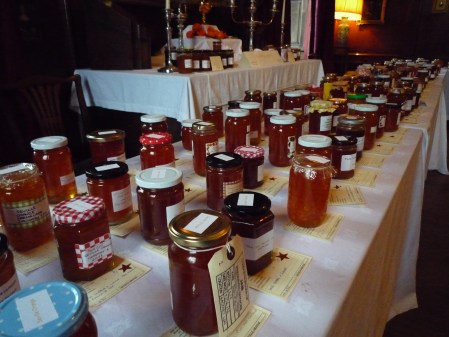
I was surprised and delighted to discover my jar (Thin cut Seville category) with a silver award and 18 marks out of a possible 20…
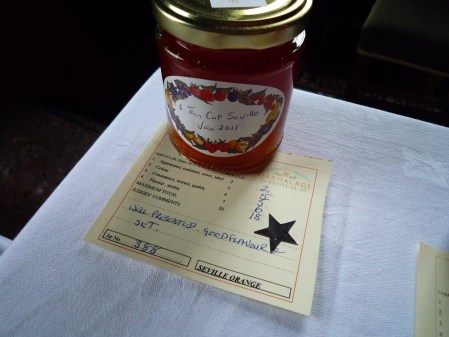
But poor Tim (Man Made Seville category) was robbed with just 14 marks…

Still basking in my triumph a week later but hope I haven’t upset Tim too much.
It was a really fun day out and I was surprised to find both my sons enthralled by the marmalade making demo given by the very knowledgeable Jane Maggs who makes artisanal preserves under the name “Wild and Fruitful”:
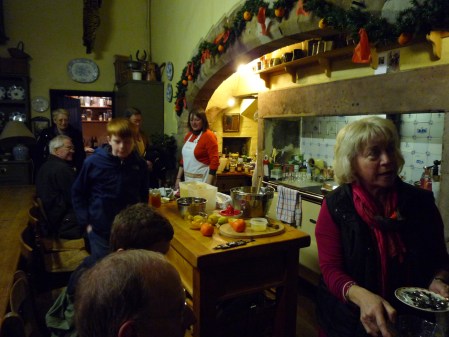
The range and inventiveness of commercial marmalades on display was an eye-opener too. Clearly I wasn’t the only one attracted to this “Breakfast Mojito” marmalade made with limes, muddled mint and a healthy dash of white rum:

I can see that the Marmalade Awards are going to become an annual event in our household from now on with even younger son Arthur keen to enter a jar of his own next year.
My next post will be on the new recipe I used this year, annotated with top tips picked up from the demo plus ideas on how to pick up those extra marks from the demanding Women’s Institute judges.
Artisan baking part 4: tin loaves
January 28, 2011 § Leave a comment
Just remembered that I still haven’t documented everything I learned at my 4 day bread baking course held at the School of Artisan Food in Welbeck, Nottinghamshire last October. I’ve already posted about wild yeasts, rye sourdough and white sourdough.
Part 1
https://rhubarbfool.co.uk/2010/10/19/four-blissful-days-of-artisan-baking-part-1-the-basics/
Part 2
https://rhubarbfool.co.uk/2010/11/23/artisan-baking-part-2-rye-sourdough/
Part 3
https://rhubarbfool.co.uk/2010/12/09/artisan-baking-part-3-white-sourdough/
Now it’s the turn of perhaps the simplest loaves to make – tin loaves made with ordinary yeast (rather than a wild yeast sourdough starter).
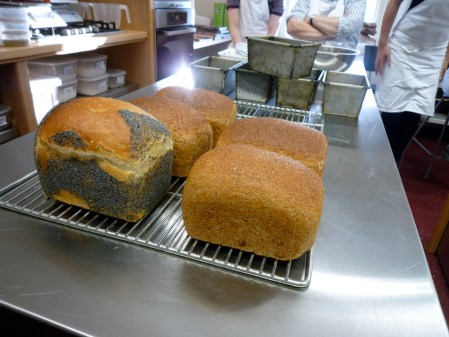
Day 1 of the course started with baking 3 types of tin loaf – a white, wholemeal and a malthouse. Course teacher Emmanuel Hadjiandreou introduced us to the basic techniques – the ten second knead, proving, shaping and baking at a good high temperature with the aid of steam to just the right degree of doneness. You can see these demonstrated on a short video clip here:
http://www.youtube.com/watch?v=C3Iv-z6kcpU
Emmanuel’s take on breadmaking is a delightfully lazy yet extremely effective one – it lets time and the yeast do the work for you. The flour, yeast and salt are combined then rested for 10 minutes. The dough is kneaded for 10 seconds then rested for 10 minutes. This step is repeated 4 times so that, if you are efficient, the dough has only 40 seconds’ kneading in total!
Emmanuel’s recipes for white, wholemeal and granary loaves are given below, as provided by on the course with the tiniest of wording changes – I haven’t meddled with the quantities at all -wouldn’t dare!
Scanning the list of ingredients you’ll see that there is just flour, salt, yeast and water in these recipes – no lard, oil, sugar etc – bread made just from the basic raw materials. What I immediately noticed was the small quantities of yeast used. The proportions in all 3 recipes are, for whatever quantity of flour is used, 1% of its weight in fresh yeast, 2% in salt. This is the so called Bakers’ Percent system so you can feel like a real pro doing it this way.
Emmanuel’s proportions really do work and the resulting loaves are well risen with a good flavour, especially if proved overnight, and avoid the overly yeasty taste which is a common fault of home breadmaking.
We worked with fresh yeast on the course – an enormous block of the stuff. You can buy it at any kind of bakery, even supermarket instore ones. In a loosely tied plastic bag in the fridge it will keep for 2 maybe even 3 weeks.

Unlike the hurly burly and controlled chaos of ordinary life at home, we worked in a quasi laboratory style environment on the course with all the ingredients for our 3 tin loaves (white, wholemeal and malthouse) weighed out to 1g accuracy before we started:

We made the dough for each of the loaves in succession, first wholemeal, then granary and finally white. Here’s the white dough after its 4 kneads about to undergo its 1 hour resting and proving period:

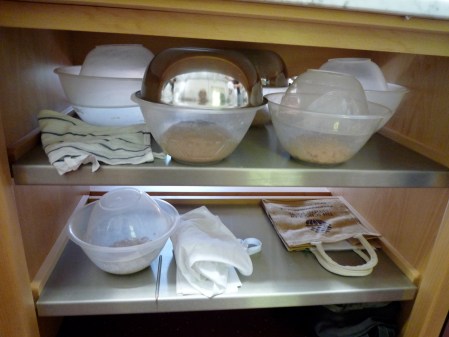
We stored our proving doughs, neatly covered with plastic bowls (a trick I’ve replicated at home using transparent plastic picnic plates atop my mixing bowls – saves on clingfilm) on handy shelves underneath the work surfaces:
One hour later, the white dough looked like this:

All that remains is to shape the dough (see video clip above). With first the palm then the fingertips it’s patted then rolled before being placed seam side down in the tin.
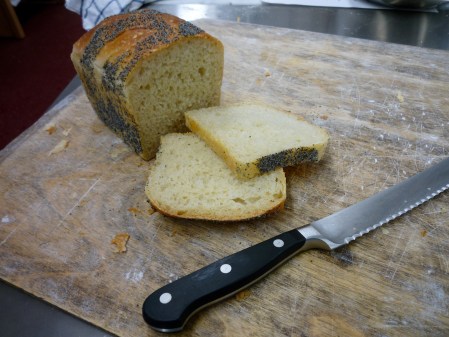
We were given the option of adding seeds to our crust – simply sprinkle lightly the top surface of the dough with water and, cradling the loaf your hand, gently press and roll the top surface onto your chosen seeds – sesame, poppy or whatever – which you have spread out on a flat plate or tray.
The loaf is then proved, again with the tin covered by a plastic bowl, until nearly doubled in size. If you’re not ready to bake, the proving can be retarded by refrigerating the loaves overnight. Then you can have freshly baked bread for breakfast. We tasted bread that had been proved overnight and compared it to bread with a normal 1-2 hour proving. The overnight proved bread had a slightly more intense flavour – hard to describe exactly what the difference is – a subtle yet perceptible difference, a fuller flavour.
Judging whether a loaf is fully proved and being able to accelerate or retard the process using a warm place or fridge respectively is one of the hardest bits of baking knowhow to acquire. It’s something you learn by experience. In the following picture, the wholemeal loaf is clearly ready to bake whereas the granary one needs another 20 minutes or so:

These are a couple of loaves that went a bit wrong. They door of the fridge in which they were supposedly proving slowly overnight was accidentally left open. The fermentation went over the top and after a spectacular rise, the dough collapsed and flattened. In the interests of research we baked and ate the errant loaves – they still tasted fine but didn’t quite look as they should and the crumb size was uneven.
What a lot I seem to have written about loaves that are a quick and easy to make. I’ve hardly been encouraging have I? Just one final point to get across.
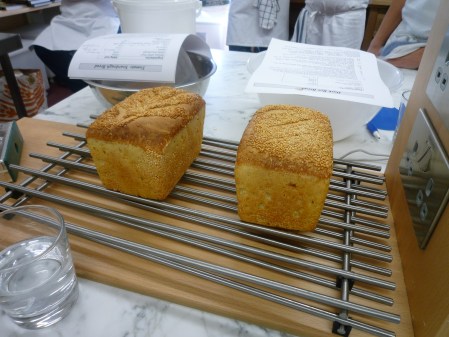
I’ve already written in previous artisan baking posts about the importance of a really hot oven and creating steam – just do what the recipe below says. My final point is that before the loaves go into the hot oven, you can slash them with a sharp knife. This looks attractive and helps the loaf rise evenly when baked but it’s not essential for a tin loaf (unlike the freeform rustic breads which need slashing in order to avoid bursting). The white loaf shown in the picture at the top of this post is both seeded and slashed so you can see the combined effect.
Here’s how the end results should look, first the white and then the malthouse.
Happy baking!

Recipe for white bread
Ingredients
300g strong white flour
6g salt
3g fresh yeast (2g dried)
200g water at room temperature
1. In a small mixing bowl, mix the flour and salt. In a large mixing bowl, dissolve the yeast in the water.
2. Add the flour and salt to the larger bowl containing the yeast and water. Mix using a wooden spoon and/or your hands until the mixture becomes a dough.
3. Cover the dough with either another bowl, a plate or cling film to prevent it drying out and leave to stand for 10 minutes.
4. Knead the dough in the bowl for 10 seconds (see video clip above), form into a ball, cover as before and leave for 10 minutes.
5. Repeat step 4. a further 3 times – the dough will have been kneaded 4 times. Cover and leave for 1 hour.
6. Punch the dough down, shape into a loaf (see video clip above) and place in an oiled 1lb loaf tin.
7. Cover the tin with an upturned mixing bowl to prevent a skin forming and and let the loaf rise until slightly less than double in volume. This is likely to take about 45 minutes.
8. When the dough is almost fully proved, preheat the oven to 250 degrees C placing a deep baking tray on the base of the oven.
9. Place the loaf in the oven at 250 degrees C, throw a cup of cold water into the hot tray to produce steam, close the oven door quickly and reduce the oven temperature to 200 degrees C.
10. Bake for approx 35 minutes until golden brown and sounding hollow when the loaf is turned out and tapped (refer video clip above). Turn out of the tin and cool on a wire rack.
Recipe for wholemeal bread
Ingredients
300g strong wholemeal flour
6g salt
3g fresh yeast (2g dried)
230g water at room temperature
Method as for white loaf above.
Recipe for malthouse bread
Ingredients
300g malthouse flour
6g salt
3g fresh yeast (2g dried)
200g water at room temperature
Method as for white loaf above.
Scottish macaroon bars made in Manchester
January 24, 2011 § 1 Comment

My lovely neighbour Deborah (who is married to a Scot), knowing of my interest in all things macaroon introduced me to the Scottish macaroon a couple of weeks ago. To accompany a cup of coffee she brought out a Lees original macaroon bar. This is more a confectionery item than a cake or biscuit – a very sweet fondant centre coated in chocolate and toasted coconut. Apparently this Scottish delicacy was originally made with a sweetened mashed potato (I kid you not…) centre but as this goes off very quickly it’s now made with vegetable fat and sugar.
As its Burns Night tomorrow, I thought I’d have a go at an authentic homemade version, a sweet something to follow our haggis and neeps.
It wasn’t hard to track down a recipe on the web. I consulted these 3 sources:
http://shirlsbaking.blogspot.com/2005/12/scottish-macaroon-bars.html
http://www.glesga.ukpals.com/mlrecipes.htm
http://www.madestuff.co.uk/2009/08/10/traditional-scottish-macaroon/
All the recipes were pretty similar but the third one has the clearest instructions and good pics as well.
I set to work on my unlikely quest to turn a couple of potatoes into a sort of deconstructed bounty bar.
I started with 125g prepared weight of mashed potato – this is just one and a bit medium potatoes – as I discovered, you don’t need much.

I had planned to weigh and document accurately but these ambitions went out of the door when I ran out of icing sugar part way through the process and had to put the project on hold overnight until I could buy some more.
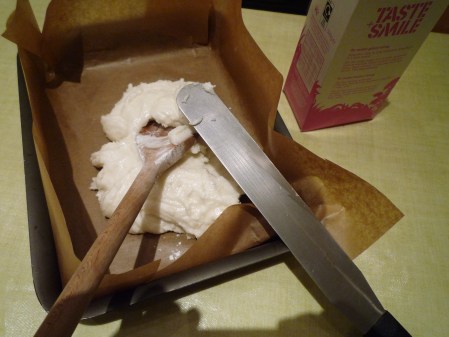
Into the mashed potato I beat an unbelievable quantity of icing sugar – I would guess 375g, maybe even 500g. You just keep going until the mixture is thick and doughy enough to handle.
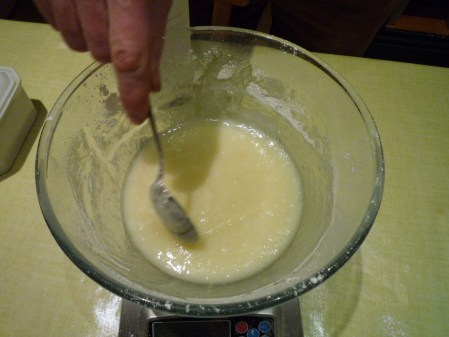
A very odd thing happened as I started beating in the sugar – the mixture liquefied and became a translucent wallpaper pasty gloop. Never fear, just keep adding more icing sugar and I promise you, it will come together to form a fondant like substance.
Next, I pressed my mixture into a tray and popped it into the freezer for 20 minutes or so to firm up a little.
Meanwhile I toasted quickly in a hot oven 50g or so of dessicated coconut. Beware, the difference between toasted and burnt coconut is about 45 seconds as I learned to my cost. So I began again with another 50g of dessicated coconut…I then mixed the toasted coconut with about twice the quantity of untoasted to produce a lovely tweedy effect – very appropriate for a Scottish sweet.

Next, i melted 2 whole bars (200g) of Green and Black’s chocolate – a mixture of milk and dark. All dark would have been just too restrained and sophisticated. I wanted the full milky sugary hit to complement the toothrotting supersweet centre.
With the mise en place sorted, it was time to complete the bars. I cut my potato fondant into 7 or 8 fingers. I then picked up a finger and shaped it into a sausage before half dipping, half rolling it in the melted chocolate, thence into the toasted coconut (a bit like egg and breadcrumbing a croquette or escalope). As I dipped and coated I held the bar very lightly, shaping and patting as I went. The completed bar was then placed onto silicone paper and popped into the fridge to set.
Here’s one of the little beauties ready to eat – despite inauspicious beginnings, it actually tasted rather good…

Pimp that coleslaw
January 22, 2011 § Leave a comment

This salad is simply the best thing that’s ever been done with raw cabbage. I was introduced to it during the Christmas holidays by my friend Janet and I’ve made it every weekend since then. It’s a recipe from Israeli chef Yotam Ottolenghi and I tracked it down via his Guardian newspaper column.
Don’t be put off by the weird list of ingredients (mixing lemongrass with maple syrup?) – it works. It’s colourful, crunchy, zingy and you feel uplifted after eating it – what more can I say to brighten up your winter mealtimes?
By the way, the title of this post is in deference to one of my favourite quirky websites http://www.pimpthatsnack.com – take a look if you have a few minutes to spare… I’ve gone for ornamentation rather than size though.

Recipe for Sweet Winter ‘Slaw
A recipe from Yotam Ottolenghi featured in UK newspaper the Guardian. My own suggestions are that if you can’t get hold of papaya, then either use 2 mangoes or a handful of diced roast butternut squash – it’s sweet pulpy texture is not dissimilar to papaya.
Serves 6
Ingredients
For the dressing
100ml lime juice
1 lemon grass, chopped into small pieces
3 tbsp maple syrup
2 tbsp sesame oil
1 tsp soy sauce
½ tsp chilli flakes
4 tbsp light olive oil
For the salad
150g macadamia nuts
10g butter
2 tbsp sugar
½ tsp salt
½ tsp chilli flakes
7 inner leaves Savoy cabbage (170g), shredded
½ red cabbage (270g), shredded
1 mango, peeled, stoned and cut into thin strips
1 papaya, peeled, deseeded and cut into strips
1 red chilli, deseeded and cut into thin slices
15g fresh mint leaves
20g fresh coriander leaves
To make the dressing, put all the ingredients except the olive oil into a small saucepan, and reduce for five to 10 minutes, until thick and syrupy. Remove from the heat. Once it has cooled down, strain into a bowl, stir in the oil and set aside.

Put the macadamias in a hot frying pan and dry-roast for a few minutes, stirring occasionally, until lightly coloured on all sides. Add the butter and, once it has melted, the sugar, salt and chilli. Use a wooden spoon to stir constantly, to keep the nuts coated in the sugar as it caramelises. Be careful because this will take only a minute or two and the nuts can burn very quickly. Turn out the nuts on to a sheet of greaseproof paper and, once cool, roughly chop them.

Put the shredded cabbage in a large mixing bowl, along with the rest of the salad ingredients. Add the cool dressing, toss and taste. Add salt if you need to, and serve immediately.
A birthday Zuger Kirschtorte for Vivienne
January 8, 2011 § Leave a comment
After a teeny bit of excess over Christmas, it seems it’s the time for reinvention and self improvement which in food terms seems to mean restraint and raw vegetables. Well I’m going to buck the trend and write about a cake I made in December for a friend’s special birthday. This was a Zuger Kirschtorte, a traditional almond and cherry liqueur flavoured cake from the canton of Zug in central Switzerland.
Click here to view a short movie featuring the whole process. The kitchen scenes were shot by my son George who provides that authentic edgy camera wobble.
http://www.youtube.com/watch?v=n0wxHIfKYcs&feature=mfu_in_order&list=UL
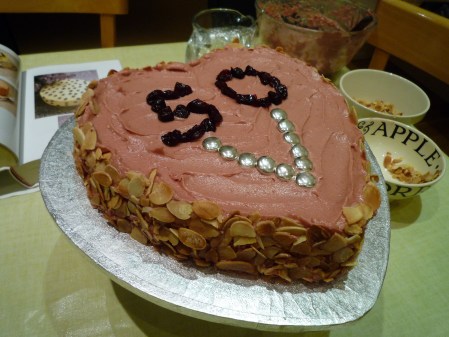
The cake idea came from Rose Levy Beranbaum’s amazing book “The Cake Bible” and she calls it “A Taste of Heaven”, a light as air heart-shaped confection of crisp almond meringue discs sandwiching a cherry liqueur-sprinkled sponge, frosted with cherry-flavoured buttercream and finished with toasted almonds.

I discovered The Cake Bible a decade or so ago on the shelves of the Mayfair library on South Audley Street in London round the corner from where I worked at GEC’s head office on Stanhope Gate. When work pressures became too much I would occasionally seek sanctuary here at lunchtimes, leafing through the pages of Rose Levy Beranbaum’s book and marvelling at her descriptions of pistachio marzipan, white spice pound cake, orange fruit mousseline and the like.
It turns out that “A Taste of Heaven” is Ms Beranbaum’s version of the classic Swiss cake, a Zuger Kirschtorte. I find myself drawn to all things Swiss so it was funny I’d picked this cake not knowing its Swiss origins at the time.
The different components of the cake are two heart-shaped Dacquoise (nut meringue) discs; 1 Génoise Classique (whisked sponge) heart-shaped cake; syrup flavoured with kirsch for moistening the Génoise; kirsch flavoured buttercream; and finally a handful or so of toasted flaked almonds.
The crisp Dacquoise discs were spread with a thin layer of buttercream and used to sandwich the kirsch-syrup moistened Génoise. The top and sides of the cake were frosted with the remaining buttercream and the flaked toasted almonds were gently pressed around the sides of the cake.
I suggest just two changes to Ms Beranbaum’s recipe:
1) To halve the quantity of buttercream from the full heart attack-inducing 1 pound 9.25 ounces to a more modest 12.5 ounces.
2) If, like me, you like to avoid artificial food colouring, you can achieve a pink buttercream by beating into the mix 4-6 tablespoons of puréed cherry compôte instead of a few drops of red food colouring. This gives a gorgeous ever so slightly sour true cherry flavour to the buttercream.
I went ever so slightly over the top when I added the cherry purée to my buttercream and ended up with an in-your-face pink frosting which, I assure you, despite its garish looks, is 100% natural.
I give the recipe for the Génoise Classique below as this is arguably the most useful and versatile component of the cake. Ms Beranbaum’s special twists to the classic French recipe are to substitute browned butter (beurre noisette) for the usual plain melted butter and to use half cornflour half cake flour rather than just cake flour. If I were to attempt to reproduce here the recipes for all the cake components, plus all the advice and troubleshooting tips in the Cake Bible I’d be writing this post for days. If you are at all serious about baking I’d urge you to buy or borrow a copy.
I started by making the Dacquoise (nut meringue) discs. There was nowhere near enough mixture to pipe the heart shaped discs so instead I piped a border a few millimetres inside the template I’d drawn (to allow for a slight spreading of the mixture as it bakes) and spooned the meringue mixture into the centre and gently spread it to fill the outline using a small crank-handled palette knife.

This is how the cooked Dacquoise disc looked:

The next step was to make the Génoise Classique whisked egg sponge. Ms Beranbaum’s special twist is to fold in not ordinary melted butter but browned clarified butter. This imparts a subtle nutty depth of flavour to the finished cake. Here’s my browned butter and the dregs left behind to show the depth of toasting achieved without going so far as to burn the butter:

Ms Beranbaum’s other handy tips when making Génoise are to use a mixture of cornflour and cake flour and is to whisk a spoonful or so of the beaten egg mix into the melted butter before adding the butter to the main bowl. This certainly helps incorporation of the butter. Whenever I’ve made Génoise before I’ve always encountered the problem of the melted butter sinking to the bottom of the bowl which didn’t happen this time.
Here’s the bowl of butter and egg mix ready for incorporation, along with the flours, into the big bowl of super-foamy whisked egg:

The cake batter was carefully spooned into the prepared heart-shaped cake tin, base lined with a double thickness of baking paper. This is how the finished cake looked:

It wasn’t quite as deep as I was expecting so I decided not to attempt trimming it before drizzling with the kirsch-flavoured syrup.
The next major cake component was the cherry buttercream. Here are some of the raw ingredients – note the authentic Alpine butter for this Alpine cake (though my butter was in fact German rather than Swiss).
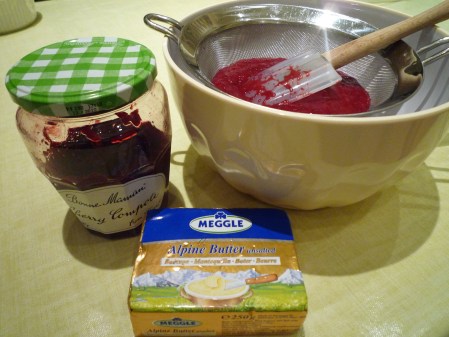
The Bonne Maman cherry compôte was a real find – intense sour cherry flavour, gorgeous colour and not too sweet. Definitely a new store-cupboard standby for whipping up a sauce for duck or adding to a pudding.
The buttercream is no mere amalgamation of icing sugar and butter. Looking at the recipe it’s immediately apparent that there is quite a low ratio of sugar to butter which means that the end result is silkily textured yet not too sweet. I began by beating a hot sugar syrup into my egg yolks, a slightly tense step without a sugar thermometer relying on the cold water test, speed and a bit of luck. The resulting mix if it all turns out right is a pale, foamy mass. The picture shows a 6 egg yolk quantity which turned out to be way too much for one cake.

The next step involves combining the egg yolk foam with the softened butter:
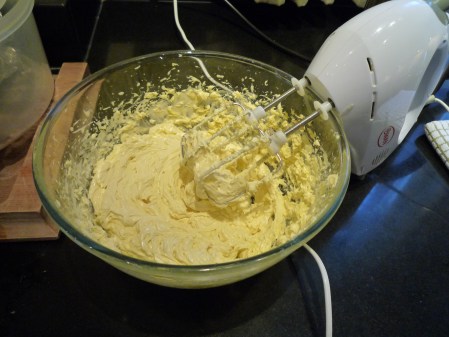
And the final step was to beat in the kirsch and sieved cherry compôte to flavour the buttercream and tint it a 100% natural totally girly pink:

A word of warning – do stick to Ms Beranbaum’s guidelines when it comes to beating in extras to buttercream: I went above her recommended ratios when beating in the water-based cherry compôte to the fat-based buttercream. Although it was fine at first, I set the bowl aside in a cool room to use later and, horror of horrors, when I attempted to beat the mixture to soften it it split! I managed to re-emulsify it by warming the bowl very gently, adding a little more sifted icing sugar and beating like crazy.
The end result was a beautifully flavoured, unusual cake, a welcome change from the current surfeit of chocolate (and would be a great choice for a Valentine’s Day treat too).

Recipe for Génoise Classique
From Rose Levy Beranbaum’s “The Cake Bible”. She says “Since this recipe first appeared in print in 1981, I have received more calls about it from readers than for any other recipe. Many say that for the first time in their lives they have succeeded in making the perfect génoise”. Praise indeed.
For a 9 inch by 2 inch round or heart shaped cake tin or 8 inch by 2 inch square cake tin, greased, bottom lined with parchment, and then greased again and floured.
Ingredients
37g clarified beurre noisette*
4 g vanilla extract
4 whole large eggs, 200g weighed without shells
100g sugar
50g sifted cake flour (not self raising)
50g cornflour
*In a heavy saucepan melt 4 tablespoons butter over medium heat, partially covered to prevent splattering. When the butter looks clear, cook uncovered, watching carefully until the solids drop and begin to brown. Pour immediately through a fine strainer or a strainer lined with cheesecloth.
Preheat the oven to 350 degrees F (175 degrees C). Warm the beurre noisette until almost hot. Add the vanilla and keep warm.
In a large mixing bowl set over a pan of simmering water heat the eggs and sugar until just lukewarm, stirring constantly to prevent curdling.
Using the whisk beater, beat the mixture on high speed for 5 minutes or until triple in volume.
While the eggs are beating, sift together the flour and cornflour.
Remove 1 scant cup of the egg mixture and thoroughly whisk it into the beurre noisette.
Sift half the flour mixture over the remaining egg mixture and fold it in gently but rapidly with a large balloon whisk, slotted skimmer, or rubber spatula until almost all the flour has disappeared. Repeat with the remaining flour mixture until the flour has disappeared completely. Fold in the butter mixture until just incorporated.
Pour immediately into the prepared tin (it will be about 2/3 full) and bake 25-35 minutes, or until the cake is golden brown and starts to shrink slightly from the sides of the pan. (No need for a cake tester. Once the sides shrink the cake is done.) Avoid opening the oven door before the minimum time or the cake could fall. Test toward the end of baking by opening the door slightly and, if at a quick glance it does not appear done, close door back at once and check again in 5 minutes.
Loosen the sides of the cake with a small metal spatula and turn out at once onto a lightly greased rack.
Many Happy Returns Vivienne and here’s to the next decade!
Tour de France around the North Circular
January 5, 2011 § Leave a comment
We’ve been celebrating New Year’s Eve with two other families for a number of years now – in fact over a pre-dinner glass of champagne we worked out that 2010/2011 would be unbelievably our twelfth such celebration.
This year it fell to Shelley and Neal to host the event at their home in North London and the chosen theme was “Tour de France”. This left the dress code wide open and host Neal led the way by sporting slinky black and white lycra…

Fortunately Shelley had decided not to continue in this vein by serving up carbohydrate gels, bananas and a cocktail of hard drugs. We began in a very civilised manner with the silkiest Côte Atlantique smoked salmon mousse canapés to accompany our Laurent Perrier champagne:

Our first course looked to the mountains for inspiration – charcuterie from the Alps accompanied by rustic pain de campagne. The delicious ham was snaffled up too quickly for me to take a photo but here’s the batch of pain de campagne I made earlier – using the pain au levain recipe learned on my School of Artisan food baking course in October 2010.

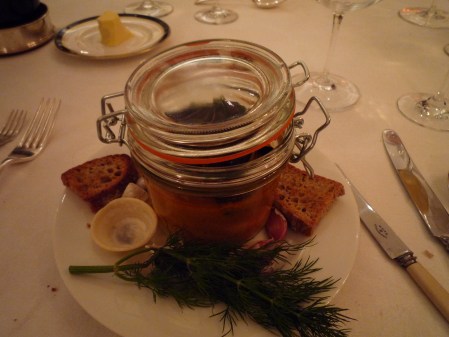
The race now headed south with bouillabaisse à la marseillaise served en verrine. This was the course Shelley had tasked me with preparing so I’m able to give the recipe below. Verrines (small glass containers for serving food) are all the rage in France so we just had to give them a try.
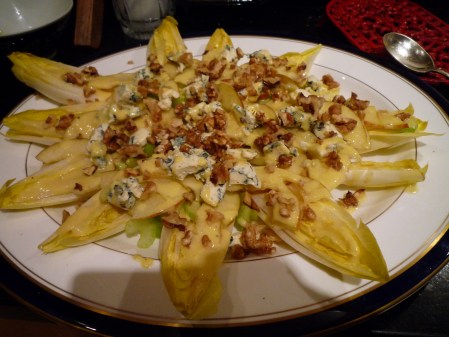
We continued our tour clockwise with the next stage ending in the Aveyron département of Southern France, home to the limestone caves where Roquefort cheese is matured. Our next course was a crunchy salade d’endive, noix et roquefort prepared by Shelley using a Raymond Blanc recipe:
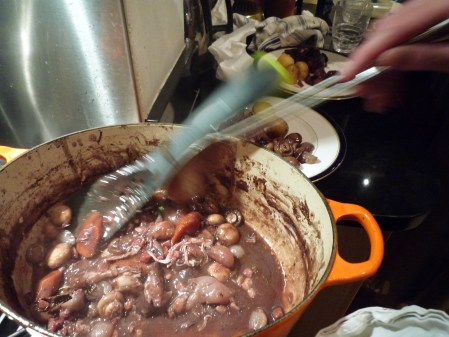
It was then onwards and upwards to red wine country with Shelley’s deeply savoury Coq au vin, again using a Raymond Blanc recipe:
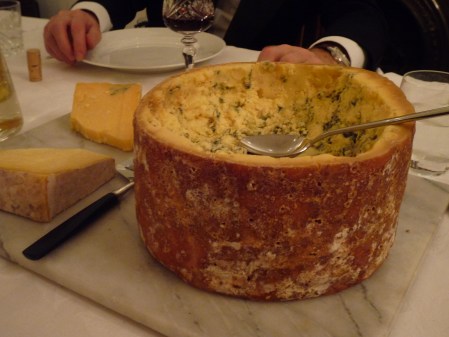
Next up was France’s favourite English cheese, le stilton – yes I know we departed from our theme somewhat but stilton this good (Colston Bassett from Neal’s Yard (no relation) Dairy) is too good not to serve at a special dinner. And of course the 2007 prologue was in London wasn’t it?
Next we recalled France’s Atlantic coast islands (Belle Île, the Archipel des Glénans and the like) with Îles flottantes, façon Maman Blanc – yes you guessed it, a Raymond Blanc favourite. Janet prepared this technically demanding course involving poached meringue and egg custard thickened without the aid of stabilising cornflour. She also had to handle deftly the caramelised sugar final decoration at close to midnight:

The final stage is always in Paris around the Arc de Triomphe which we recalled in culinary fashion with a dainty plateful of pistachio flavoured macarons parisiens :

As we nibbled on a macaroon at midnight we heard he patter of not-so-tiny feet as 8 children celebrated a real midnight feast – a landmark occasion as they’ve been fast asleep by midnight in previous years.
Happy new year to all and huge thanks to our generous hosts Neal and Shelley once again for a magnificent meal. Now we’re off the tour it’s on to the wagon for my annual no alcohol January semi-detox. Fantasising already about what my first glass of wine will be in February…
To conclude here’s the recipe for bouillabaisse – I know it’s lengthy but it’s really not as complex as it looks.
Recipe for bouillabaisse cooked and served en verrine
I used as my starting point the fish soup and rouille recipes from “Mastering the Art of French Cooking” by Julia Child, Simone Beck and Louisette Bertholle and tweaked them to turn them into a refined version of bouillabaisse suitable for serving as part of a multi-course dinner.
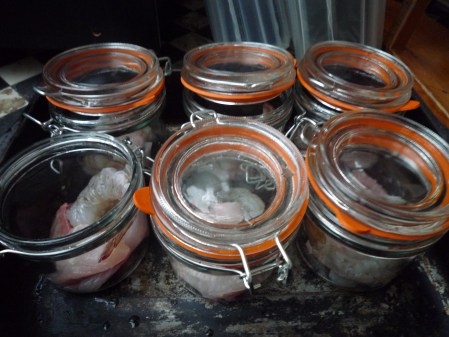
Using the kilner jars is not merely a modish presentation but is an easy and stress-free way of gently cooking the pieces of fish in the broth, sealing in all the flavours and ensuring that the delicate fish like bass does not break up when cooked and served.
These ingredients will fill 8 small (12 oz) kilner jars and leave you with plenty of fish soup left over which sets to a gelatinous firmness and freezes well.
Ingredients for the fish soup base
4 oz chopped onions
3 oz chopped leek
2 oz chopped celery (my addition, no celery in Julia Child recipe)
1/4 pint olive oil
4 cloves mashed garlic
1 lb ripe tomatoes roughly chopped or 1 tin tomatoes roughly chopped (I used a standard tin of tomatoes – 14 oz/400g including all the juice whereas Julia Child recipe suggests draining the tomatoes)
3 and 1/2 pints water
6 parsley sprigs
1 bay leaf
1/2 teaspoon thyme or basil (I used fresh thyme leaves stripped from the stalk)
1/8 teaspoon fennel (not sure whether original recipe wants dried fennel, fennel seeds – I used a few leaves of fresh tarragon for a similar aniseedy hit)
A 2 inch piece of orange peel (I used a vegetable peeler to remove this)
1/8 teaspoon pepper
1 tablespoon salt (I added this gradually to taste rather than all at once as salt is a personal thing)
3 to 4 lb lean fish heads, bones and trimmings, raw shellfish remains, lean fish or frozen raw fish.
Note on fish choice
Julia Child, catering for her US and Northern European readership suggests choosing fish from the following list: cod, conger or sea eel, gurnard, haddock, hake or whiting, halibut, John Dory, lemon sole, perch, plaice, pollack, coalfish or saithe, red or grey mullet, rock or sea bass, sea bream, sea devil, frogfish or angler, freshwater trout, sea trout, turbot, weever, wrasse, shellfish – scallops, mussels, crab, lobster. Many will tell you that an authentic bouillabaisse can’t be made without rascasse – by all means add this to the list if you can get hold of it but providing you include plenty of lean bony fish in the soup it will turn out just fine.
Making this recipe in the dark period (in food distribution terms) between Christmas and New Year all that was available at my local fishmonger was sea bass and sea bream bones heads and trimmings. Despite the lack of variety of fish, the soup was nevertheless suitably flavoursome – it need not be an enormous production and can be varied according to what you have. It’s probably best to avoid oily fish such as salmon and mackerel though as these won’t give the right flavour to the soup.
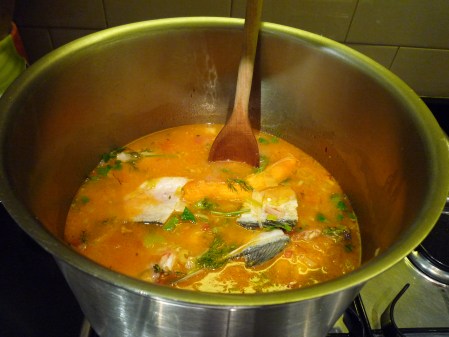
In a large saucepan, cook the onions, leeks and celery slowly in the olive oil for 5 minutes or untll almost tender but not browned. Stir in the garlic and tomatoes. Raise heat to moderate and cook 5 minutes more. Add the water, herbs, seasonings and fish to the pan and cook uncovered at a moderate boil for 30 to 40 minutes.
The Julia Child recipe specifies straining the soup at this point, pressing the juice out of the ingredients. I wanted a slightly thickened soup but without resorting to flour so I lifted out the fish bones and heads with a slotted spoon and gave the soup a blast with a stick blender to liquidise partially the soup vegetables. I then strained the resulting soup through a coarse sieve, pressing it through as per the original recipe.
Correct seasoning adding a bit more saffron if you feel it necessary.
Soup can be cooled at this stage until you are ready to complete the bouillabaisse. I froze my soup and took it down to London with me and defrosted it a couple of days later to turn it into my finished dish.
Additional ingredients to turn the soup into bouillabaisse
Purchased from the redoubtable Walter Purkis & Sons fishmongers in Crouch End

6 fish fillets (I used 2 sea bass and 1 sea bream – again all that was available in the intra Christmas and New Year dark period) cut on the diagonal into generous bite-sized pieces
8 giant raw prawns, peeled except for tail and deveined
Sufficient mussels to allow 3 per serving once any duds discarded – scrubbed and debearded
a tablespoon each of chopped onion and celery plus generous glass of white wine for steaming the mussels
generous pinch saffron strands
zest of 1 orange
tablespoon shredded basil
tablespoon pernod
small slices of pain de campagne drizzled lightly with olive oil and baked until crisp plus a bowl of rouille to serve (recipe below)
Set the kilner jars into a deep roasting tin. Divide the fish fillet pieces evenly between the jars and drop in 1 giant prawn per jar, tail pointing upwards for easy removal. Ladle in reheated fish stock to cover. Season each jar with a few saffron strands, a couple of drops of pernod and a couple of shreds of orange zest and seal the kilner jars. Pour boiling water from the kettle into the roasting tin. The jars should be at least half covered. Put the roasting tin into an oven preheated to 125 degrees C and bake for 15-20 minutes.
Meanwhile, steam the mussels for a few minutes in a lidded sauté pan or large saucepan with the chopped onion and celery and glass of white wine until they open. Discard any that do not open. Set aside until you are ready to serve.
Remove the kilner jars from the oven. Using rubber gloves or similar to protect your hands from the heat remove each jar from the water bath roasting tin, flip open the lid and drop in 3 cooked mussels in their shell. Half close lid but do not reseal and place the hot jar on an individual serving plate. Place 2 baked bread croutons onto each plate and serve.
Pass the bowl of rouille separately. Diners can spread the rouille on the croutons and dip into the soup and/or drop a spoonful of rouille directly into their soup once it’s half eaten to enrich the remaining broth.
As this was a party, I decorated my plates with seashells and a few fronds of fennel arranged artfully to look like strands of seaweed on the shore…
Ingredients for the red pepper and garlic sauce – rouille
For about 1/2 pint sauce

1 oz chopped red pepper simmered for several minutes in salted water and drained or tinned pimento
(these days one might bake a red pepper until charred and remove the skin – I cheated as time was short on New Year’s Eve and used a couple of pieces of chargrilled red pepper preserved in oil from a jar)
A small chilli pepper boiled until tender, or drops of Tabasco sauce
1 peeled medium potato cooked in the soup
4 cloves mashed garlic
1 teaspoon chopped basil, thyme or savory
4-6 tablespoons fruity olive oil
Salt and pepper
Pound all the ingredients in a large pestle and mortar for several minutes to form a very smooth, sticky paste. I found it difficult to achieve a smooth paste so went with a slightly rough, rustic paste which was fine. I avoided using a food processor as this would turn the potato into a gloopy paste.
Drop by drop, pound or beat in the olive oil as for making a mayonnaise. Season to taste.

If liked, just before serving, beat in drop by drop 2-3 tablespoons hot fish soup before decanting sauce into serving bowl or sauceboat.
 The Rhubarb Fool