
Macaroons made in Manchester revisited
January 4, 2011 § 1 Comment
Just had a look at my blog stats for 2010 and apparently had over 12,000 visits last year. That’s the good news. The bad news is that the page most visited was a post entitled “Macaroons Made in Manchester” which detailed my first not particularly successful attempt at making Parisian style macarons.
I imagine most people were looking for a supplier for these dainty morsels not wanting to see what some bumbling amateur was attempting to turn out.
I hate to disappoint so I’m delighted to report that there are at least 3 places where you can buy macaroons in Manchester now:
1) English Rose Bakery http://www.englishrosebakery.com/ was started up in June 2010 by friends Emma Brown and Wendy Lewis – they bake from premises in Oldham Street Manchester and sell at farmers’ and food markets in Chorlton and around Manchester. Website pics look gorgeousm very professional – I haven’ tried them yet but hope to catch up at their next event on Jan 15th.
2) My friend Gywneth and business partner Mike have set up “Vintage Afternoon Teas” and I believe sell a box of 10 macaroons for £6.00. Phone 07811 684 365 with enquiries.
3) Finally the mass-market option – Waitrose now with stores in Manchester, Altrincham and Wilmslow stock a box of 12 Maison Blanc macaroons priced at £6.49.
Happy shopping!
Happy new year 2011 and review of 2010
January 4, 2011 § Leave a comment
The stats helper monkeys at WordPress.com mulled over how my blog did in 2010, and here’s a high level summary of its overall blog health:

The Blog-Health-o-Meter™ reads This blog is on fire!.
Crunchy numbers

A Boeing 747-400 passenger jet can hold 416 passengers. This blog was viewed about 12,000 times in 2010. That’s about 29 full 747s.
In 2010, there were 55 new posts, growing the total archive of this blog to 93 posts. There were 358 pictures uploaded, taking up a total of 1gb. That’s about 7 pictures per week.
The busiest day of the year was December 23rd with 77 views. The most popular post that day was Macaroons made in Manchester.
Where did they come from?
The top referring sites in 2010 were en.wordpress.com, google.co.uk, twitter.com, facebook.com, and google.com.
Some visitors came searching, mostly for rhubarb fool, macaroons manchester, kabuni, breakfast in afghanistan, and albanian recipes.
Attractions in 2010
These are the posts and pages that got the most views in 2010.
Macaroons made in Manchester April 2010
Breakfast in Afghanistan July 2009
Albanian Adventure October 2009
2 comments
Preparing for Christmas: recipes for cake, pudding and mincemeat November 2009
6 comments
The Rhubarb Recipe Page May 2010
Christmas recipes: turkey and some of the trimmings
December 20, 2010 § Leave a comment
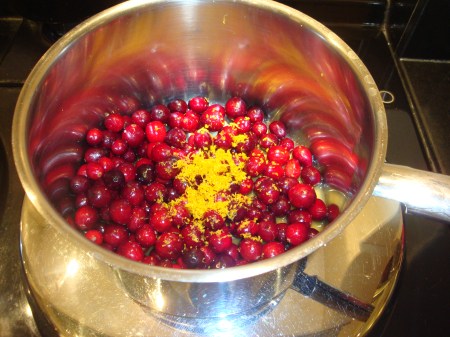
In 2009 I wrote down my pudding, cake and mincemeat recipes. This year I’ve decided to write about turkey, stuffings and cranberry sauce. Sometimes we have a goose at Christmas, sometimes turkey. A number of people have told me recently that goose is more traditional than turkey, but it is an enormous turkey which features in the closing scenes of Charles Dickens’ “A Christmas Carol” and you can’t get more traditional than that in my book.
I’ve done terrible things to turkeys over the years tending to over- rather than undercook them. Worst of all was when I took someone’s advice to put the turkey into the Aga simmering oven and leave it to cook overnight for 12 + hours. The turkey was cooked alright but swimming in a bath of caramel brown juice that should have been retained within the bird – the most wasteful turkey stock ever…
Since I discovered the slightly odd method suggested in “Leith’s Cookery Bible” of draping over the stuffed bird before it goes into the oven a folded piece of muslin soaked in an unfeasible quantity of melted butter, I’ve never looked back. Doing this and investing in a decent meat thermometer, I really don’t think you can go wrong.
This method produces a moist, perfectly cooked turkey with a deep burnished gold skin:

Family Christmases when I was growing up always involved a turkey with two different stuffings – sage and onion and chestnut and sausagemeat. When we have turkey now, that’s how it still has to be. Preparing the stuffings on Christmas eve was a family affair (although when I say family I mean the women in the family…) Tiny Auntie Em would always boil and chop the onions for the sage and onion stuffing but my mother would take charge of the chestnut and sausagemeat one. My mother was a fantastic but instinctive cook so never wrote her recipes down. I learned by watching and tasting. I have made the sage and onion stuffing recipe my own over time preferring now to fry rather than boil the onions and adding a handful of
oatmeal really lifts the texture of the stuffing and stops it being too stodgy.
Just 4 days to go now…

I found my cranberry sauce recipe in a pre Christmas newspaper article written by Simon Hopkinson. The brown sugar, port and orange zest add fantastic flavour and fill the kitchen with wonderful scents as the sauce cooks. I treasure this recipe and am now very happy to have set it down in writing as it currently exists as a single brown stained piece of newsprint. I got very, very twitchy one year when I couldn’t find it.
Recipe for perfect roast turkey
Adapted from a recipe in “Leith’s Cookery Bible”. Serves 12
Ingredients
1 turkey unstuffed weight 10-13lb/5-6kg
1 recipe sage and onion stuffing
1 recipe chestnut and sausagemeat stuffing
1 large square fine muslin about 4 times the size of the turkey
6 oz butter

Stuff the cavity of the turkey with some of the sage and onion stuffing. Stuff the neck end of the turkey with the chestnut and sausagemeat stuffing. Draw the skin flap down to cover the stuffing and secure with a skewer. Weigh the stuffed turkey and calculate the cooking time. Put any leftover stuffing into a shallow greased baking dish and bake at 180 degrees C for 45 minutes or so until cooked through and crusty on top.
Preheat the oven to 180 degrees C/350 degrees F/gas mark 4. Melt the butter and in it soak the piece of muslin until all the butter has been absorbed.
Completely cover the bird with the doubled butter muslin and roast in the preheated oven for the calculated time – a 12lb/5.35kg turkey should take 3 to 3 and 3/4 hours.
I roast my turkey in the roasting oven of a two oven Aga on the lowest set of runners. The oven has quite a high temperature, 200 degrees C at the bottom, higher at the top, so the bird cooks a little more quickly. I turn it round after an hour or so to ensure it cooks evenly.
Other than this, there’s no need to turn, baste change the temperature, just leave it to do its thing in the oven.
I use a meat thermometer to make sure the turkey is cooked through, removing it from the oven when the internal temperature is 10 degrees C below the temperature I’m looking for (ie I take it out at 72 degrees C) degrees C). As the bird rests, the internal temperature rises to the required 82 degrees C.
A long resting time (at least 1 hour, in fact up to 2 hours for a good sized turkey) will ensure the bird is easy to carve and gives you time to prepare the gravy, finish the vegetables, and generally have a more relaxing time.
Recipe for sage and onion stuffing
Ingredients
2 oz butter
3 medium onions, finely chopped
15-20 fresh medium sized sage leaves, finely shredded
12 oz fresh white breadcrumbs
4 oz medium oatmeal
salt and freshly ground black pepper
Melt the butter in a large frying pan. Fry the onion until translucent but not browned. Stir in the breadcrumbs, sage and seasoning to taste.
Recipe for chestnut and sausagemeat stuffing
Ingredients
2 medium onions, finely chopped
1 tablespoon light olive oil
1 and 1/2 lb of your favourite sausagemeat
1 lb cooked peeled chestnuts (I like Merchant Gourmet vacuum packed chestnuts)
1 beaten egg
salt and freshly ground black pepper
Fry the onions in the oil in a small frying pan until tranlucent. Cool. Roughly mash the chestnuts with a fork. Combine the cooled cooked onions, sausagemeat, mashed chestnuts, a teaspoon of salt and a couple of twists of black pepper in a large bowl. Add the beaten egg and go in with your hands to mix and combine all the ingredients. Don’t try and taste this to check seasoning as it contains raw sausagemeat.
Recipe for cranberry sauce
Ingredients
8oz (200g) brown sugar (demerara or light soft brown or even golden granulated)
1/2 pint (1/4 litre) port – ruby or LBV is fine, don’t use your best stuff for cooking
12 oz (340g) cranberries, rinsed and drained
grated zest of 2 oranges
Put the sugar and port into a medium non-reactive (stainless steel or enamelled cast iron) saucepan. Mix well and bring to the boil over a gentle heat, stirring from time to time until the sugar is dissolved. Add the cranberries and orange zest and simmer until the skins of the cranberries have burst. Be careful not to overcook at this stage as otherwise you’ll get a rubber set.
Who threw away all my grits? Bahamian breakfast
December 18, 2010 § 6 Comments
Tucking into our breakfast from the Bahamas – corned beef, grits and johnny cake felt like eating a plateful of history. That’s a big thing to be doing at 6.30 am on a dark and cold December Tuesday morning before work and school. Here’s younger son Arthur enjoying his corned beef sauté and grits, liberally sprinkled with Tabasco:
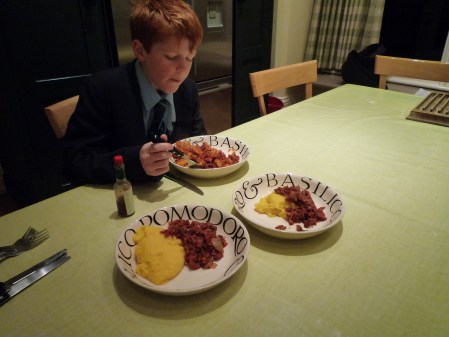
This was the latest in our series of breakfasts of the world (in alphabetical order) and after more than a year at this occasional project it feels good to be hitting the letter B for the Bahamas!
The Commonwealth of the Bahamas is an island chain close to Florida and north of Cuba. Andros is the largest island but capital Nassau is on the smaller island of New Providence. Columbus first made landfall on one of the islands of the Bahamas in 1492 but the islands were not settled by Europeans until English Puritans arrived via Bermuda in 1648. These first settlers survived by salvaging goods from wrecks. The islands became known for piracy and the infamous Edward Teach aka Blackbeard was based here.
Following the American War of Independence (1775-1783) the islands were settled by Loyalists (American colonists remaining loyal to British rule) and their slaves who established plantations on the islands. Britain abolished the slave trade in 1807 and thousands of Africans from slave ships subsequently made their home on the island.
On the menu was corned beef sauté (made from my own home-cured corned beef though the tinned variety may be more authentic) then grits – cornmeal porridge – in fact I used a quick cook polenta though I believe Bahamians prefer harder to obtain white grits. The hash was followed by a traditional Bahamian johnny cake, a simple baking powder raised scone/soda bread thing, quickly prepared then cooked in a skillet or sturdy frying pan:
Grits were the staple food of the slaves who worked on the plantations. They were a cheap carbohydrate and slave owners would give their slaves a weekly ration of cornmeal grits to boil up with water.
Corned beef reflects the British history of the islands. During the colonial period, Great Britain was the Bahamas’ major trading partner. Beef preserved in brine was shipped out in large quantities, another dietary staple for slaves and the poor. The native Bahamians made it their own, adding spices and vegetables to turn the corned beef into dishes like the sauté given below.
The name johnny cake is thought to derive from the name journey cake, so-called because it was quick and easy to make while travelling. Traditionally it’s cooked on the stove top but I opted for baking mine in the oven.
Here’s the home cured beef cubed and ready to be turned into hash:
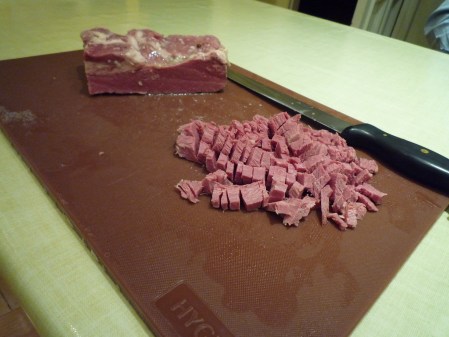
It’s wonderful stuff and very easy to do but you do need to start thinking about it 2-3 weeks before you want to eat it. This deserves to be the subject of another post sometime soon.
Here’s the freshly baked johnny cake just out of the oven:

and here it is sliced while warm ready to be thickly spread with butter and ready to be eaten Bahamian style with lots of sweet milky tea or coffee:
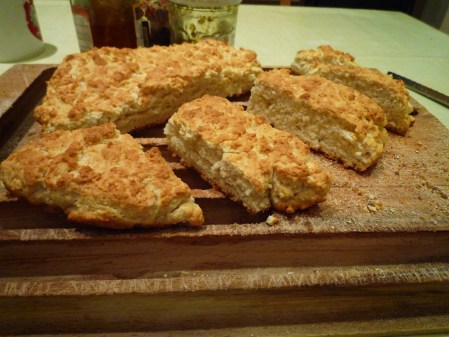
Definitely a breakfast to set you up for the day though in our case not for hard manual labour on plantations. And now the word of the Beach Boys’ Sloop John B (originally a folk son from the Bahamas) finally make sense. “The poor cook he got the fits, and threw away all my grits, and then he took and he ate up all of my corn”.
Recipe for corned beef sauté
Serves 4
From website http://www.caribbean.com which in turn credits the recipe to “Many Tastes Of The Bahamas & Culinary Influences of the Caribbean”
1 can (12 oz) corned beef
1 tsp freshly squeezed lime juice
1 tbsp vegetable oil
2 tbsp chopped onion
1-2 tsp dried thyme leaves
2 tsp tomato paste
Hot pepper to taste
A few tbsp of water
Place the corned beef into a medium-sized bowl and break up with a fork in preparation for cooking. Sprinkle with lime juice.
Heat oil in large skillet over medium heat. Sauté the corned beef with the onion and thyme for five to six mins. Stir in the tomato paste and crushed hot peppers to taste.
Add one to three tbsp of water for desired consistency and continue to cook, stirring.
Cover, reduce heat and cook for about 10 min.
Serve with grits or toast.
Recipe for Bahamian Johnny Cake
From http://foododelmundo.com/2010/03/07/bahamian-johnny-cake/
Makes one 7-8 inch round serving 4 comfortably
3 cups flour
1 tablespoon baking powder
1 teaspoon salt
1/4 cup sugar
1⁄2 cup Crisco or other shortening (such as Trex in the UK but I used butter as I’m not an avid consumer of hydrogenated fats)
2/3 cup milk
Combine dry ingredients then cut in (rub in) shortening until the size of rice grains. Add milk gradually, just enough to make dough soft. Knead dough until smooth then let it rest for about 10 minutes.
Place dough in greased 8 or 9 inch round or square pan. Pierce top of dough with a fork. Bake at 350 for 20-25 minutes or until golden.
Remove from oven and baste top of bread with milk. Return to oven and allow to bake for 5 more minutes. Remove from oven and allow to cool a few minutes.
Artisan baking part 3 white sourdough
December 9, 2010 § Leave a comment

Pictured above are the beautiful baguettes à l’ancienne that I and my fellow novice bakers managed to conjure up after just a couple of hours tuition by master baker, bread enthusiast and all round great teacher Emmanuel Hadjiandreou. This post is the 3rd in a series describing the 4 day baking course I attended recently at the School of Artisan food on the Welbeck Estate in Nottinghamshire. Emmanuel is pictured in many of my photos and in my thrilling “white sourdough” video footage which you can find here:
http://www.youtube.com/user/Apiciusblog#p/a/u/0/Xh5CWwIOCLs
Emmanuel’s white sourdough bread recipe is given at the end of this post. What the basic recipe can’t tell you is the wealth of knowhow needed to bake the perfect artisan loaf. This can only come from time spent handling dough and actually baking. All of the bread we amateurs produced on the course was outstanding. Back home, I have to say that my results with this most apparently simple of recipes have been a little more variable. I’ll try and point out the key things we learned on the course as I describe in more detail how we made this bread.
First of all, the raw ingredients. There are so few in the recipe that they have to be good. We worked exclusively with Shipton Mill organic flour in man-sized 25kg bags:

Then there’s the all-important sourdough, this time in a classroom-sized batch, bubbling away with its distinctive acetone scent:

Here’s my ingredients weighed out and ready to go. If only real life back home turned out to be clean, tidy, prepared, all weighed out…
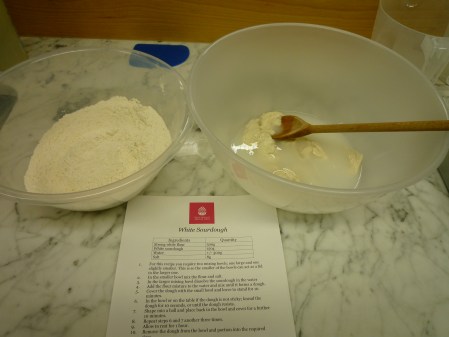
You can see the dissolving of the sourdough in water and Emmanuel’s trademark “10 second knead” in the video clip referred to above. I like the idea that there’s very little work involved in preparing this dough – the wild yeasts quietly get to work and all you have to do is be patient and create the right conditions for this living organism to thrive. Time and a degree of patience are the things needed here.
Once the dough is prepared, it’s time for the fun bit, the shaping into loaves, baguettes or whatever. Artisan loaves obtain their distinctive appearance from the patterns left by natural cane or wicker proving baskets – also known as bannetons in French or Brotförme in German. Here’s a stack of them photographed at the commercially run Welbeck Bakehouse adjacent to the School:

The baskets need to be liberally dusted with flour before you pop the bread in – we used a mix of white flour and semolina for this purpose which gives a bit of crunch to the baked crust. The cane or wicker baskets can be used just as they are, no need for the washable liners you see advertised sometimes – this way you cut down on washing and get the beautiful cane spiral marks on your bread which mark it out as being the real deal.
There’s no need to invest in a stack of pricey proving baskets before you start making bread – I’ve been managing at home lately with a couple of ordinary small wicker baskets lined with (freshly laundered) waffle teatowels. I have a notion that the plastic basket from my salad spinner would also be fit for purpose. That said, I’m now hooked on breadmaking and have just ordered myself an early Christmas present online – 6 cane baskets from specialist artisan baking supplies website
You can see Emmanuel demonstrating how to shape a loaf before popping it in a proving basket in the video clip above. It may look nonchalant but the folding and tightening of the dough at this stage is key to a well risen and shapely baked final result. As Emmanuel says “don’t be shy to use a little bit of force”.
If you’re feeling adventurous, why not try shaping your own baguettes? It’s not as daunting as it looks and you don’t need any special equipment or tins as it’s only industrial bakers that shape their baguettes in tins. Real bakers look in scorn at the telltale spot marks on the base of an industrially baked baguette which come from the tins used to shape and bake them.
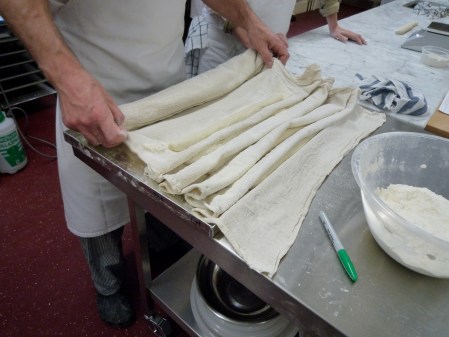
What you need to do is divide you dough into 4 equal pieces (scales are needed to do this accurately). As the video clip shows, each piece of dough is rolled into a tight sausage shape and is placed seam side down on pleated calico liberally dusted with the flour/semolina mix to prevent sticking. Back home, I’ve found that a pleated linen or waffle cotton teatowel works well here though I had to shorten the length of my baguettes to fit the size of my domestic linen. Here’s a photo of Emmanuel’s baguettes nestling in their floured calico:
Once the loaves have proved and are doubled in size and the oven is hot, there’s one more key procedure – slashing. This is not merely decorative but also vital to make the loaf rise evenly and to promote what those in the know call “oven spring”. You’re looking for a plump, pert loaf rather than something too flat and pancakey.
For slashing, a medium sized really sharp blade and a deft swift and not too light touch are needed. You don’t want to just scratch the surface as you need to make a proper incision I would say at least a centimetre deep. A really sharp blade will mean you cut the dough cleanly rather than drag and stretch it which in turn will cause your beautifully risen dough to deflate demoralisingly.
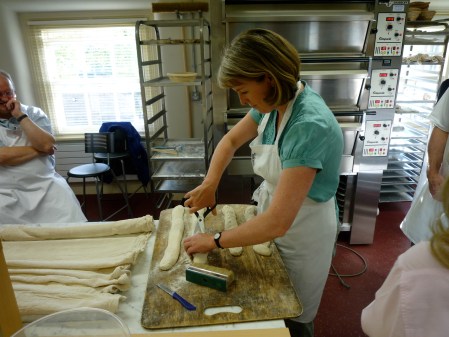
In the video clip you can see us delivering the 5 traditional diagonal slashes to a baguette. Here’s me attempting the alternative scissor and twist technique for shaping the show-off épi baguette pictured at the beginning of this post.
Getting the bread into the oven is a little tricky, especially for baguettes. At the School, we baked this first batch of sourdough loaves in the professional Tom Chandley deck oven which has several stacked ovens which delivers a really good all over crust because of the direct heat at the base.

The proved loaves were turned out onto peels – thin wooden trays – thence straight onto the base of the oven with a deft in and out sliding motion. Think of the trick of whisking away a tablecloth but leaving all the china and cutlery on it intact. Back home I’ve not gone to the trouble (yet…) of investing in a small domestic peel and baking stone but instead have preheated metal baking sheets and have tipped out my proved loaves directly into these and popped them straight back into the hot oven.
One further point on technique – the steam referred to in the recipe is absolutely essential as it delays the formation of a thick skin on the loaf which will turn into an unpleasantly thick crust.
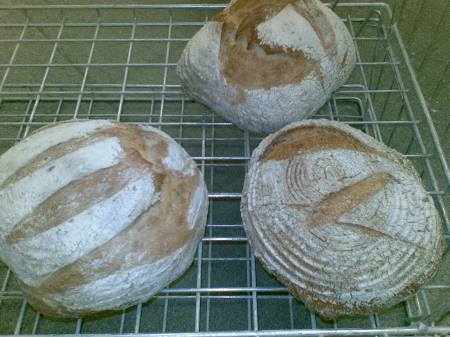
You can see the baked baguettes at the beginning of this post. This is what the baked artisan loaves should like, each decorated with its own individual slash mark:
And finally, what do you see when you cut into your freshly baked loaf? This is the perfect uneven, open crumb and elastic texture.
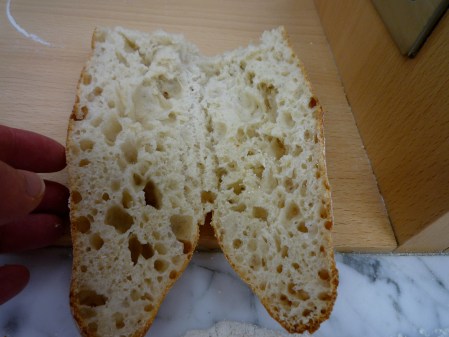
All that’s needed now is a wedge of your favourite cheese and glass of red wine…
Recipe for white sourdough bread
Ingredients
500g strong white flour
150g white sourdough
+/- 300g water
8g salt
Mix the flour and salt in a small mixing bowl. In a larger mixing bowl, dissolve the sourdough in the water. Add the flour mixture to the water and mix until it forms a dough. Cover the dough with the small mixing bowl and leave to stand for 10 minutes.
Knead the dough, still in the bowl, for 10 seconds. Shape into a ball, scraping down the sides of the bowl if necessary. Cover and leave for 10 minutes. Repeat these two steps until the dough has been kneaded four times. Cover and rest the dough for an hour.
Remove the dough from the bowl and portion into the required sizes. This quantity of dough will make a single rustic loaf or 4 baguettes. Shape the loaf/loaves into proving baskets or into pleated calico for baguettes or into a greased tin.
Allow to prove for 3-6 hours or until approximately doubled in size. Preheat the oven to 250 degrees C with a deep tray in the base of the oven. Once the bread is ready for baking, slash with a very sharp knife. Place the loaf in the oven at 250 degrees C, put a cup of water in the hot tray to form steam then lower the oven temperature to 210 degrees C.
Bake for +/- 35 minutes until golden brown. Turn out of its tin (if you have used one) and cool on a wire rack.
Red sea fish? I’ll have chips with mine please…
December 6, 2010 § 1 Comment
The recent scary news of shark attacks at Sharm el Sheikh reminds me that I’m due to write a sequel to my previous post describing our attempts to find a taste of the real Egypt during a recent package holiday.
That phrase “a taste of the real Egypt” has taken on a gruesome tint following the news of the death of one tourist and the maiming of three others – though they were not Egyptian but respectively German, Ukrainian and Russian. The news reports are big on sensationalism but short on key detail but a bit of delving reveals that the shark attacks all happened in the Middle Garden reef, adjacent to all the 5 star luxury establishments in the resort. We were some 10 miles further south in the mid-range price bracket – I knew there had to be a good reason for trading down…
Scenes like this one (not a brilliant picture I know but you try holding your breath and snapping through the minuscule viewfinder of a dodgy disposable underwater camera) look to be temporarily on hold while the guilty white-tip shark is hunted down. I feel shades of Moby Dick coming on…

Having spent most of our week in the water gazing at the incredible colours of the tropical fish, by the end of the week we decided it was time to eat some. This meant leaving the hotel compound and taking a taxi to the Old Market area of Sharm. This was the location of the first of the July 2005 terrorist attacks (it’s not just sharks you have to worry about here). The Old Market turned out to be a misnomer is it’s neither old nor is there a market there. You will find more marble shopping malls and inside you can get the bazaar feel by visiting one of the spice shops like this one:
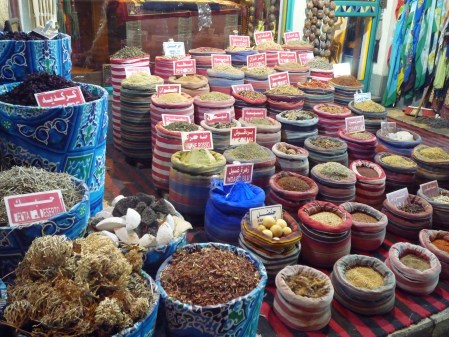
I duly went in and haggled over the price of an odd selection of goodies: Bedouin tea, karkade (dried hibiscus flowers), kurkuma (I’m pretty sure this yellow powder is turmeric), and “black seeds” which appear very frequently on Egyptian bread (nigella also known as kalonji or, confusingly, onion seeds). Here I am clinching the deal after protracted negotiations and tea-drinking.

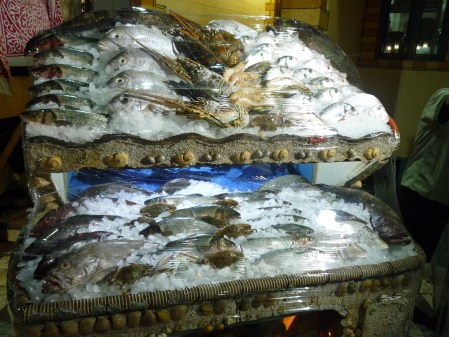
Transaction complete, our next task was to find somewhere authentic to eat. After asking round during the week and consulting our Lonely Planet guidebook I’d narrowed the choice down to two possibilities. The first was the straightforwardly named Red Sea Fish restaurant whose splendid display is pictured below:
Younger son Arthur decided that fish wasn’t for him this evening so that meant dinner was to be in local Sharm institution El Masrien:
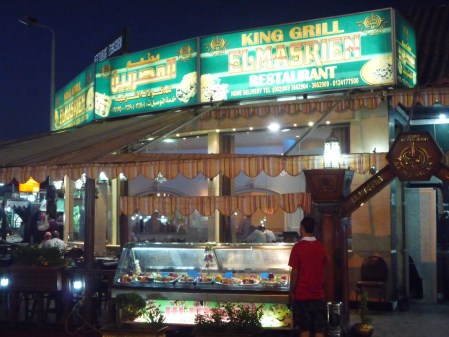
The hotel staff had looked at me oddly when I’d asked if I needed to book here. Walking in it soon became apparent why. It’s more of a working man’s café than a restaurant – spotless formica tables, speedy service, TV in the corner and a short grill-based menu. Prices are cheap, very cheap as local Egyptians eat here and we saw that rare sight in Sharm, an Egyptian woman as, tourists aside, it’s a very male-based society.
We began on familiar territory with hummus, baba ganoush and pita bread (please excuse the random spelling of these Arabic words). All spanking fresh and full of flavour.

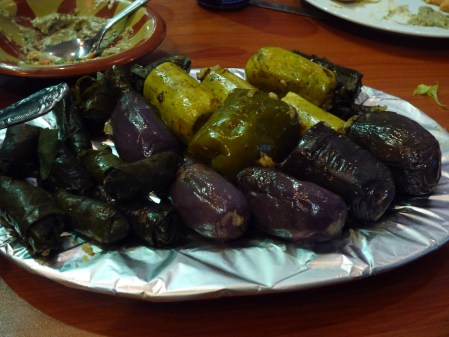
Thinking (wrongly) this wouldn’t be enough, I’d also ordered some grilled stuffed vegetables. This huge platter arrived which we failed to do full justice to:
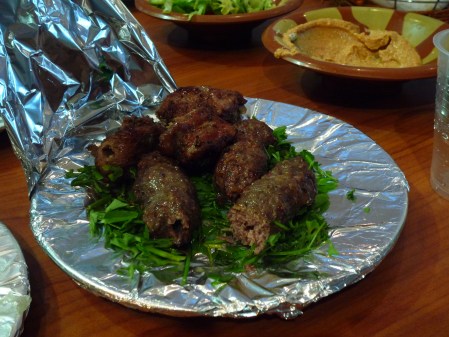
The boys opted for kebabs as a straightforward choice – a mixture of shish (whole pieces of marinated lamb) and kofte (minced lamb with spices) both grilled over hot coals. These were wolfed down in seconds – I barely got a look in:
My choice was the more adventurous one of rice-stuffed pigeon. This splendid creature duly arrived allaying my fears of the scrawny feral birds pecking at detritus on the streets of Manchester:

The pigeon was impressive but my abiding memory of that evening will be watching a woman in full burqa delicately eating forkfuls of lamb – one hand would raise the fork to her facial area and at the last minute the other hand would dart up and swiftly swing aside the black veil and the speared morsel would disappear. I was transfixed but far too polite to try and video the performance.
So, next time you feel inclined to brave shark and terrorist attacks and visit Sharm, do consider leaving the gilded cage of your hotel compound and check out what the Old Market has to offer.
Artisan baking part 2 rye sourdough
November 23, 2010 § 2 Comments
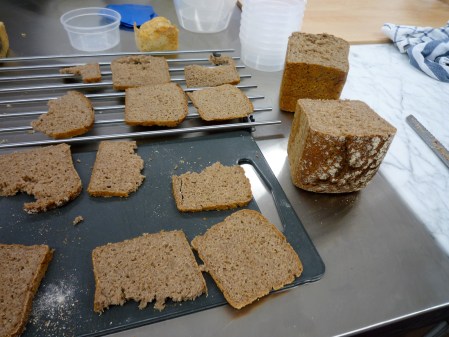
This post is the second of series describing the inspiring 4 day bread baking course I attended in last month at the School of Artisan Food in Nottinghamshire. I’ve decided to forget about describing the course contents in logical chronological order but instead to write about what inspires me at the moment. This week, that just happens to be rye bread, specifically rye sourdough.
Before the course, the inner workings of rye bread were a mystery to me: it remained an occasional eccentric supermarket purchase – cellophane-wrapped packets of pumpernickel containing dark brown strips of cardboard textured slices which seemingly last for ever had a certain masochistic expeditionary appeal.
I hadn’t appreciated that organic stone-ground rye flour was widely available and as a result I’d never have dreamed of trying to bake it myself at home. Since the course, all that has changed.
Our teacher, bread guru Emmanuel Hadjiandreou was brilliant and packed in so much information over the 4 days that it’s taken a while to sift through my photos and video clips. I’ve taken a crash course in basic video handling and editing in my latest One to One session at the Apple Store in Manchester and my very first little movie, imaginatively titled “Rye Sourdough” can be viewed by clicking on the following link.
http://www.youtube.com/watch?v=6qUNKKO1ULU
Now you can see yourself Emmanuel’s deft handiwork, the exact consistency of starter and finished dough and even hear the sound of a perfectly baked loaf.
Let’s start with Emmanuel’s recipe. The ingredients and quantities are exactly as on his beautifully typed-out recipe sheets handed out on the course but I have on occasion put his methods into my own words.
Recipe for dark rye sourdough bread
Ingredients
For the ferment
150g dark rye flour
100g rye sourdough
200g water
For the bread
1 quantity ferment (see above)
200g dark rye flour
6g salt
150g very hot water
Optional flavourings
For apple rye – add 200g chopped dried apple
For apricot rye – add 200g chopped dried apricots
For sultana rye – add 200g sultanas
For prune and pepper rye – add 200g prunes and 10g pink peppercorns
For onion rye – add 200g chopped onion, lightly fried
Begin the day before you want the bread by mixing together the ferment ingredients in a large mixing bowl. Cover with a smaller mixing bowl and leave to ferment overnight at room temperature. In another bowl, weigh out the remaining flour and salt and mix thoroughly. Set aside.
The following morning, when you’re ready to make the bread pour the flour and salt mix over the ferment in the first mixing bowl. Then pour over the measured quantity of very hot water (from a just boiled kettle). The layer of flour will protect the hot water from scalding and killing the yeast within the ferment. Mix thoroughly and add any optional flavourings at this stage. Shape into a greased tin.
Allow to rise/prove for about 2 hours. Preheat the oven to 250 degrees C. Place the proved loaf into the oven at this high temperature; add a cup of water on a hot tray in the base of the oven to form steam then lower the oven temperature to 220 degrees C.
Bake for about 30 minutes. Turn out and cool on a wire rack.
And now for the raw materials.

What we have here is a bowl of ferment (noun) – a wet dough mixture made the night before and left to ferment (verb) to activate the wild yeasts and develop the characteristic background sour flavour of good rye bread. Next to it is the weighed-out rye flour and salt. And that’s it. The rye flour had a silky texture and the prettiest more-than-pastel grey-green colour which when baked is transformed into a dark chocolate-brown loaf.
Here’s fellow student Jethro inspecting the small bubbles which have formed overnight in his ferment. Being able to see what’s going on in your dough from all sides was a bonus of using the semi-translucent plastic bowls we were provided with on the course. These lightweight bowls can be upturned and used as protective covers over fermenting doughs, another useful home-baking tip potentially saving metres of clingfilm and faffing with damp teatowels.

You can also see fellow student Diana carefully weighing out dry ingredients on the “My Weigh” (geddit?) scales we were provided with on the course. These were brilliant and so quick and easy to use and of course accurate to within a gram too – essential especially for getting the right quantity of salt in a recipe. We weighed everything on the scales, the water too, as of course 1ml of water weighs 1g and it’s much more accurate not to say speedy to weigh the water rather than use a measuring jug. Since coming home I’ve bought a set of these scales (Amazon marketplace) and consigned my retro scales with their dinky brass weights to the cellar.
Here is my brandy new all-singing, all dancing set of My Weigh scales on the kitchen table at home:

It seems very odd adding near-boiling water to a bread recipe. Rye bread is unique in requiring this step and Emmanuel talked about this causing a process within the flour called gelatinisation – the dough takes on a porridge like consistency. He showed us how to protect the ferment containing the essential wild yeasts from the hot water by using the flour as an insulating blanket with the hot water being poured over the top.
The rye dough doesn’t look very inspiring when first mixed – more like a building material. I quipped to Ben, a young chef from South Africa who was sharing my workbench that the dough reminded me of childhood holidays on the beach in Wales. He looked puzzled – it seems that beaches in South Africa are of the pure white sand variety rather than the grit, shingle and mud we’re used to over here!
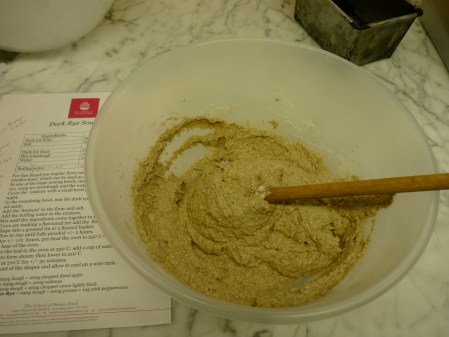
The wet dough mixture is shaped by being tipped into the oiled tin and patted and smeared using a dampened plastic scraper into a mounded loaf shape. Emmanuel advised being careful not to let water from the scraper run down the sides of the tin as this will cause the loaf to stick.

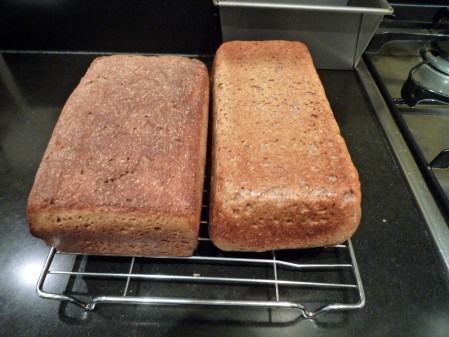
After two hours or so, the rye loaves had increased in size dramatically. We were given the option of sprinkling the top with rye flour and you can see the effect this produces in the loaf on the left in the picture below:

I’ve not stopped making this recipe since returning home after the course. I’ve been using Bacheldre organic stoneground rye flour which gives really good results (sorry Jethro but Ocado don’t stock your stuff). It’s become a bit of a weekend routine to resuscitate the rye starter on a Thursday night ready for a Friday night ferment (sounds more exciting than it really is!) and a Saturday baking session. Here’s a pic of a couple of loaves I baked at the weekend. The resulting bread is moist, flavoursome and delicious, makes fantastic sandwiches and toast and is nothing like those cardboard pumpernickel slices….
Kentucky Fried Camel anyone?
November 4, 2010 § 2 Comments

Here are my 2 sons George and Arthur wandering down the main drag in Naama Bay, Sharm El Sheikh, looking in vain for a real taste of Egypt. Diving in the Red Sea has been something I’ve hankered after doing since my first scuba attempts in the cold Atlantic waters off Pembroke in Wales in my early 20s. The 2 week half-term break this year meant we had the opportunity to travel a little further afield than usual so I thought why not take the boys snorkelling in the Red Sea?
Sharm El Sheikh (or just Sharm as it’s universally known in the travel industry) is a package holiday Mecca. It processes thousands of foreign tourists from the northern climes of the UK, Russia, Poland and Germany who are jetted and bussed in for a week’s guaranteed sunshine and sent back home a week later without having left the grounds of their all-inclusive resort-style hotels. Astoundingly, many of them don’t even bother to dip a toe into the truly exquisite clear warm waters of the Red Sea, preferring the hotel pools and waterparks.
The Red Sea did not disappoint and the boys took to snorkelling like the proverbial ducks:

But what of the food? Before our trip I had dreams of Bedouin-style charcoal-roasted lamb, aromatic spices and orange-flower water scented sherbets. One of my most-thumbed cookbooks is Claudia Roden’s Book of Middle Eastern Food. Claudia grew up in Egypt and I’ve long been bewitched by her evocative descriptions of the food of her childhood, the ful medames (fava beans), Sephardic Jewish dense orange and almond cakes, salads fragrant with parsley and mint.
You can imagine that the all-inclusive “international buffet” served in the ersatz surroundings of the “Andalusia” restaurant of our hotel, the Dreams Vacation, was a bit of a rude awakening. Remember the Leyton Buzzards’ 1979 hit “Saturday Night Beneath the Plastic Palm Trees”?

Sharing mealtimes with the tattooed classes was quite an experience. The sight of a middle-aged Geordie sporting nothing but a pair of Speedos tucking into his lunch washed down by as much free lager as he could drink is one that will live long in the memory for all the wrong reasons.
Then there were the Russians. We’ve all laughed about Germans bagging all the best poolside spots but over here it’s practically a Russian invasion. The menfolk were securing beach sun loungers at 6.00 in the morning, bikini clad babushkas were throwing themselves into the water with wild abandon, and the imperious way they treated the local staff was nothing less than shocking at times.
The food on offer at the “international buffet” was at first sight not particularly appealing. The chef clearly knew on which side his bread was buttered and tried to please his Russian and Polish customers with his command of Communist Cuisine – a lot of indeterminate grey boiled meats and stodge.
As we became more familiar with the place we searched out some of the better things to eat which surprise surprise were local Egyptian staples. At breakfast time I developed quite a taste for the falafel served with soft fresh pitta, tahina and sour pickles – I know it sounds weird but pickles at breakfast time are appealing in a hot climate, especially after an early morning swim.
At lunchtime the cucumber and yoghurt salad was the star attraction for me, along with gloriously sticky Levantine pastries. The Egyptians clearly have a sweet tooth and can fashion a pudding out of almost any ingredient it seems.
Here’s a pic of that well-known school dinner classic cornflake pie, Egyptian style:

The chef had more up his sleeve: he’d also prepared a branflake pie, unconscious of the irony of turning such a Puritan and unappealing cardboard-like product into a calorie-laden syrupy treat:

The most confusing cross-cultural experience of the week has to be the night we ate in the hotel’s Mexican restaurant. The sensation of sitting in an Egyptian hotel eating Mexican food listening to piped German music (a Beethoven symphony!) surrounded by Russians and Poles was nothing if not bizarre.
So did we ever find a taste of the real Egypt? You’ll have to read the next post to find out…
Breakfast from Azerbaijan, Land of Jam
November 3, 2010 § Leave a comment
So says the Azerbaijani tourism and information site http://www.azerbaijan24.com/, informing us that “Azerbaijanis make jam from almost anything – walnuts, watermelon and even rose petals…the most popular jams are made from plums, raspberries, mulberries, pears, peaches, melons, figs, strawberries and cherries…grapes, pumpkin and pomegranates…even eggplants can be used as base for jam…If you visit an Azerbaijani home, undoubtedly you’ll be served homemade jam along with black tea. When tea is served, you’ll discover it’s rare in the Republic to be offered sugar. Instead, they’re more likely to offer jam. Azerbaijanis put a small spoonful of jam in their mouths and sip the tea through the jam.”
So, with their predilection for jam, Azerbaijanis are the Billy Bunters of the steppes (greedy fictional schoolboy Bunter liked nothing better than to raid his friends’ tuck parcels and devour jam straight from the jar).
I decided to make jam the centrepiece of the Azerbaijani breakfast (the latest in our A-Z series of international breakfasts). This was a cheaper and easier option than trying to get hold of my first idea which was caviar. After all, Azerbaijan, nestling between Russia, Iran, Armenia and Georgia has a border on the West side of the Caspian sea, home to the sturgeon which produce the coveted caviar.
Muslim Azerbaijan (in contrast with its largely Christian neighbour Armenia) was under Soviet control until it declared independence in 1991 under the Gorbachev glasnost era. Oil is a major earner for the country with activity centred around the capital city of Baku. You may recall that the 1990s Bond Film “The World is Not Enough” with its convoluted oil industry plot featured scenes set and filmed in Azerbaijan.
Enough of background and onto breakfast. This was the prepared table:

On the menu was of course my prize jam collection (including a weird watermelon rind jam which was my only homemade contribution), also Azeri flatbread, sheeps-milk cheese, fresh fruit (including of course the flesh of the watermelon the rind of which went into the jam).

All this was washed down with small glasses of black tea drunk Azeri style with yet more jam.
Here is my completed jar of watermelon rind jam looking distinctly pondlike:

Was the jam worth the effort? No. The resulting jam is dense, sticky and with a taste a bit like cooked marrow – ie vegetal, ever so slightly bitter and not particularly pronounced. The recipe came from the improbably specific website www.watermelonrind.com. There is an alternative recipe on the Azerbaijan 24 site I referenced earlier but that recipe makes use of a rather scary sodium hydroxide solution to crisp up the rind before cooking. Not only is this stuff hard to obtain but it’s also toxic so I thought I’d give it a miss.
Much more to my safe Western taste is the following recipe for Azeri flatbread from the comprehensive and appealing site www.azcookbook.com. My bread, pictured below, is a little more rustic than the photo on the AZ Cookbook site but in my book rustic is good and the toasted sesame seeds tasted delicious:

Recipe for Azeri flatbread
With thanks to http://www.azKitchen.com.
Ingredients
1 package (1/4 oz / 7g) dry yeast
1 ½ cups (12 fl oz/375 ml) warm water
1 teaspoon salt
3 cups bread flour, plus extra for kneading
1 beaten egg for brushing (or just the yolk for a really golden colour)
1 teaspoon poppy or sesame seeds
1. In a small bowl, mix yeast with water until the yeast is dissolved.
2. Sift flour into a large bowl. Add salt and mix well. Gradually add the yeast-water mixture and stir in using your hand until a rough ball forms.
3. Scrape the dough onto a lightly floured surface. Press any loose dough pieces into the ball and knead the dough, punching it down with your fists, folding it over and turning. Knead for about 8-10 minutes, or until smooth and elastic.
4. Shape the dough into a ball and put it back into the large bowl. Cover the bowl with a kitchen towel or a plastic wrap.
5. Leave the dough to rise in a warm spot for about 1 ½ hours, or until doubled in bulk. The dough should look puffy and be soft when poked with a finger.
6. Punch down the dough, then transfer it onto a lightly floured surface.
7. Shape the dough into a ball, and with your hands flatten slightly and stretch it lengthwise. Using a rolling pin, start rolling the dough beginning at one end until you obtain a long flat bread about ½ inch thick (1.27cm), 14 inches long (35cm) and 8 inches (20cm) wide.
8. Carefully transfer the bread onto a non-stick baking sheet, fixing the shape as necessary. Leave the dough to rest on the sheet for another 15 minutes before baking.
9. Preheat the oven to 400?F (200?C).
10. Using a knife, make shallow crosshatching slashes on the bread, 4 from right to left and 4 the opposite way, each at a slight angle. Brush the bread evenly with the egg/egg yolk and sprinkle with seeds.
11. Place the baking sheet on the middle rack of the oven and bake the bread for 20-25 minutes, or until it is golden on top and sounds hollow when tapped on the bottom.
Recipe for watermelon rind jam
Ingredients
Recipe taken from the very specific website http://www.watermelonrind.com. I can’t say I recommend the finished article but here’s the recipe to satisfy your curiosity.
1lb watermelon rind cut into 1cm cubes
water to cover
3 cardamom pods
1 tablespoon lemon juice
1 1/2 cups white granulated or preserving sugar
1 strip lemon peel
Place the watermelon rind in a large saucepan and cover with cold water. Bring to the boil, cover and simmer for half an hour until the rind is tender and translucent. Drain, reserving 1 and a half cups of cooking liquid. Add the cooked rind, reserved cooking liquid, lemon peel and sugar to your preserving pan. Bring to the boil and cook for 15 minutes. Remove from the heat, cool, cover and leave overnight.
The next day, add the cardamom pods bring the mixture back to the boil. Cook for approximately 15 minutes until a thick syrup has formed. Remove from the heat, stir in the lemon juice and pot in the usual way.
I’m going to conclude my post Azeri style by wishing you NUSH OLSUN
…and the good news is we’re through all the countries beginning with the letter A so next stop, the Bahamas!
Four blissful days of artisan baking – part 1, the basics
October 19, 2010 § 4 Comments
I’m freshly returned from four days spent at the School of Artisan Food in Nottinghamshire baking bread under the watchful eyes of Master Baker Emmanuel Hadjiandreou. Emmanuel, originally from South Africa despite his Greek name has an immaculate baking pedigree having worked for the catchily named Flour Power City bakery in London, Gordon Ramsay, Daylesford Organic in Oxford and Judges Bakery in Hastings. Judges is, by the way no ordinary bakery as it’s owned by Green & Black’s chocolate founders Craig Sams and Josephine Fairley.
Here’s Emmanuel in teaching mode in the School kitchens on Day 1 of the “Artisan Baking Session”.

Emmanuel is clearly passionate about all things bread, incredibly skilful, a natural teacher, full of boundless energy and an all round nice guy. Four days spent just baking bread may sound excessive but the days passed too quickly in the idyllic rather other-wordly setting of the School of Artisan Food, a place where the sun always shines, the high-spec kitchens are always spotless, the right utensils and ingredients are always to hand and everything comes out of the oven looking and tasting pretty damn good (though I say so myself)
The School of Artisan Food is a brave new venture established on the Welbeck Estate, the rather grand rural retreat of the Duke of Portland and home to various branches of the Cavendish-Bentinck-Parente families (sorry have rather lost track of the complex family tree). The family seat itself, Welbeck Abbey, is not open to the public. The people behind the School are owners Alison & William Parente (son Joe runs the farm shop and bakery too), managing director Gareth Kennedy and an incredible stable of artisan food gurus – Randolph Hodgson founder of Neal’s Yard Dairy for cheese, Andrew Whitley author of Bread Matter for baking to name but two. It’s a not for profit organisation (a company limited by guarantee) with funding provided in part by the East Midlands Development Agency.
Coming up the drive in my taxi on day 1 of the course, I assumed this was the family seat:

but this is merely a set of almshouses known as “The Winnings” as the cost of building was funded by a former Duke’s racing habit.
Horses appear often in the family history and the estate is home to a splendid stone-built indoor riding school which in its heyday was second only in size to the famous Vienna Riding School.
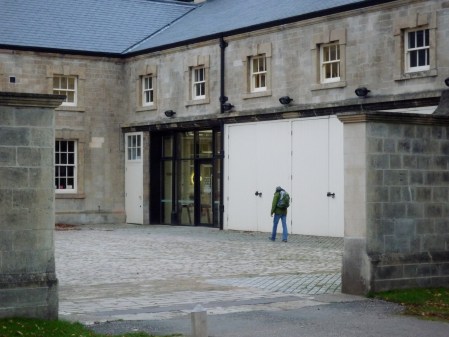
The School itself is housed in the Estate’s former fire station and is approached across a handsome cobbled courtyard:
By 10 o’clock on Monday morning, the first day of the course, I and my fellow students, 15 of us in total, had settled into our workstations in the School teaching kitchen.
What sort of person goes on a 4 day artisan breadbaking course? Well, all sorts. We were approximately 50:50 men and women and ages ranged from I think late teens to early 60s. Generally a friendly and cooperative group of people with a shared interest and thankfully no hint of rivalry or competitiveness, in fact a great willingness to share ideas, knowledge and experiences.
There were a couple of chefs in the group wanting to expand their repertoire but this is not a course aimed at turning out master bakers after just 4 days. The techniques and recipe quantities were firmly aimed at the domestic rather than a commercial setting. I would say the majority of people on the course were enthusiastic amateurs – one of whom was so enthusiastic in fact that he’d built his own wood-fired bread oven with a capacity of 30 loaves in his back garden in Aberdeenshire!
Day 1 focused on the basics, the raw ingredients of breadmaking, and 3 basic recipes for white, wholemeal and malthouse loaves raised with nicely domesticated commercial yeast and shaped and baked in tins.
The basic ingredients of breadmaking are of course very simple – flour, yeast, water and salt – yet a lot of myths are propounded about them. We used Shipton Mill organic flour throughout the 4 days of the course as this was a range Emmanuel was already familiar with from his previous baking career. Quite a few myths were debunked when going through this list of basic ingredients:
1) You don’t need to use expensive crushed Maldon salt – regular table salt is just fine (excuse the pun…)
2) Either fresh or dried yeast (as long as the dried yeast hasn’t been messed about with) is equally good as long as you dissolve it in water first.
3) Neither bottled mineral water nor water warmed to blood heat are necessary to make good bread – just use room temperature water out of your tap, even when making up a sourdough starter.
4) There’s no need to add fat or sugar to your bread dough – all that you need is in the flour itself.
5) Finally, and most radically, making a sourdough starter is dead, dead simple. Simply mix together a teaspoon of rye flour and a teaspoon of water in a small container, cover and leave at room temperature for 24 hours then repeat the process and you’re away. After 4 days you’ll have a lively starter ready to be bulked up with either white or rye flour and you’re ready to bake your very own sourdough loaf.
It really was that simple. I’ve been put off sourdough baking before because of the complex recipes involving grapes, raisins, molasses, orange juice, apple juice plus other more esoteric ingredients. Then there were the tales of exploding starters, icky smells, dead starters, yellow mould, pathogens and worse. Emmanuel in his charming and direct style showed us how simple it was.Here’s the rye sourdough Emmanuel passed round on day 1, ready to be prodded and poked:

And for the sake of completeness, here’s one of Emmanuel’s white sourdough starters. Like a conjuror he breathed frothing bubbly life back into a piece of frozen sourdough, a rather pasty piece of dry sourdough and a more liquid version and all three performed fantastically.

I’m going to conclude this post with a slightly obsessive time series set of pics of my very own rye starter, conceived at Welbeck and now resident in my kitchen in Altrincham:
Here’s the flour and water freshly mixed on day 1 (iPhoto tells me it’s 11 Oct at 13.26 precisely)

and already the next day there are signs of wild yeasty fermenting life in my baby! This photo is dated 12 October at 14.27.

Fermentation is clearly well-established by the following morning 13 October at 09.26
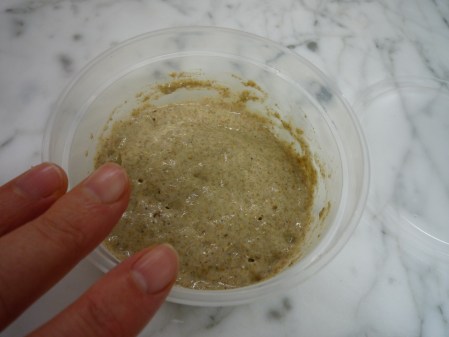
And by the end of day 4 I was ready to take home by lovely bouncing starter ready for baking!
I’m pleased to report that it’s producing great bread – a wonderfully moist and light rye loaf most recently. In fact, must go and give it a feed now…
More bread stuff to follow on my return from holiday to Egypt – let’s hope Tim can keep the starters going in my absence.
 The Rhubarb Fool