
Open season for Haggis – ideas for a Burns supper
January 25, 2010 § Leave a comment
Today is 25 January, Robert Burns’ birthday which means that the traditional Burns supper of haggis, neeps, tatties (mashed swede and mashed potatoes)and of course plenty of Scotch whisky will be served up to Scots both at home and abroad tonight. We Sassenachs got in on the act early this year, on Saturday night in fact, when we were invited to a Burns supper at nearby Manchester Grammar School.
You might well ask why would anyone voluntarily go and spend an evening eating school dinners? In fact the school did us proud and produced food of a high standard. Pride of place went to a splendidly proportioned haggis (Macsweens of course – I did check with the catering manager!) which was preceded by a bagpiper and ceremonially stabbed with the Skean dhu/Sgian Dubh (the dagger a Scotsman tucks into his sock). You can clearly see the victim’s entry and exit wounds…

I realise this picture may not look appealing to those of a nervous disposition but, honestly, it was delicious.
Eating my meal on Saturday night, it occurred to me that hosting a Burns supper at home would be a fun evening and the food would be pretty straightforward. To start, the obvious choice would be Scottish smoked salmon. You could serve this as a canapé beforehand on tiny oatcakes and dispense with a starter if that suited. Smoked venison too with redcurrant or, better still, rowanberry jelly would be good if you could source some. A smoked loch trout or kipper pâté with oatcakes would be another option. Don’t turn your nose up at kipper pâté – it may not sound glamorous but I can still remember some that I ate in Tiddy Dol’s (sadly now closed) restaurant in Mayfair some 20 years ago – velvety smooth and absolutely delicious with just a hint of a peaty malt whisky in the background.
The main course would obviously be a haggis (there are vegetarian versions too to cater for all tastes) and the aforementioned neeps and tatties – these can be prepped in advance and heated through when you are ready to serve. A little whisky poured over the haggis is all the sauce you need but you could serve a little gravy (or jus as restaurants insist on calling it) if you liked. I like Francis Bissell’s idea from her book “Entertaining” of serving haggis Parmentier, a Scottish take on the bistro classic hachis Parmentier (a French version of shepherd’s pie). Cooked haggis, carefully spooned out of its casing forms the based of the dish with a smooth mixture of mashed potato and swede forming the top. Some finely shredded curly Scots kale, steamed for just a minute or two to retain its vibrant greenness, would make a good accompaniment.
Pudding is a little bit of a challenge given the quantity of food you will already have consumed. Cranachan (a combination of whipped cream, toasted oatmeal, whisky, heather honey and raspberries) would be traditionally Scottish and you could use very acceptable frozen Scottish raspberries. If you wanted something very light and refreshing then a raspberry water ice or sorbet would fit the bill. An individual baked or steamed pudding made with whisky and Dundee marmalade would be good for traditional pudding lovers. My final pudding thoughts would be a Caledonian ice cream as served at Glasgow’s Ubiquitous Chip. This is a witty take on a French style praline ice cream with frugal toasted oatmeal taking the place of the usual almonds. You could serve this with a sauce of melted Mars bars – a nod to that other most traditional of Scots puddings, the deep-fried Mars bar….
I also give a recipe for an oatmeal shortbread biscuit as featured in the BBC Great British Menu programme. Chef Jeremy Lee turned them into a neat stack with cream and raspberries but they are a good crisp biscuit either to eat on their own or to provide a contrasting texture to a creamy pudding.
Recipe for Caledonian ice cream
This is a recipe from Glasgow’s Ubiquitous Chip restaurant brought to the masses by Delia Smith in her Summer Collection book. Serves 8. I’ve tried this recipe at home and it works well with our without an ice cream maker.
Ingredients
For the caramelised oatmeal
3 oz (75g) caster sugar
4 tablespoons water
2 oz (50g) pinhead oatmeal
For the syrup
4 oz (110g) caster sugar
4 tablespoons water
For the ice cream
1 pint whipping cream
1/2 teaspoon vanilla extract
Start by making the caramelised oatmeal. Put the caster sugar and water into a small saucepan over a low heat and leave it for 5 minutes. Then take a medium sized frying pan, place it on a medium heat and when the pan is hot, add the oatmeal and swirl it round the pan constantly so that it browns evenly – which it will do in about 5 minutes. Remove the oatmeal to a plate to prevent it becoming over-brown. By now the sugar in the saucepan will have dissolved so you can turn the heat up and let it boil. Watch it very closely until it becomes a rich brown caramel colour. Stir in the toasted oatmeal, remove from the heat and quickly pour the mixture onto a baking sheet lined with baking parchment. Put to one side to get cold and firm (about 15 minutes). Then take off small pieces at a time and pound them in a pestle and mortar until they are the size of large salt crystals (you could do this carefully in a food processor too but don’t overdo it and reduce it to too fine a powder). Put to one side in an airtight container until you are ready to make the ice cream.
To make the sugar syrup, measure the sugar and water into a small saucepan, place it over a gentle heat and stir until the sugar has dissolved – about 5 minutes. Then remove from the heat and allow to become completely cold.
To make the ice cream, pour the cold syrup into a mixing bowl along with the whipping cream and vanilla extract. Whisk with an electric whisk or mixer until the mixture just begins to thicken and hold its shape. Then pour into an ice cream maker and freeze according to manufacturer’s instructions until firm but still pliable. If you don’t have an ice cream maker, freeze the mixture until firm but pliable in a large plastic container, beating vigorously every half hour or so with a wooden spoon. Transfer to a bowl, stir in the oatmeal mixture, fold it in then spoon the ice cream into a loaf tin 7 1/2 by 4 1/2 by 3 1/2 inches. Cover with a double thickness of foil and freeze until needed.
To serve, remove from the freezer to the refrigerator about 30 minutes before you need it. Dip the base and sides of the loaf tin into hot water for 10 seconds or so, loosen round the edges with a palette knife, then turn onto a plate. Using a sharp knife dipped in hot water, cut into neat slices.
Recipe for almond shortbread thins
The original recipe title is for raspberry shortcake but I think this is confusing as shortcake to me means the American scone type soft cake. It comes from The Great British Menu Cookbook accompanying the BBC TV series of the same name. This recipe was cooked by chef Jeremy Lee. Jeremy is a native Scot who is the longstanding head chef at London’s Blueprint café. I have tried this recipe at home and it does work – the biscuits are delicious. It makes about 20 biscuits from memory (recipe says serves 4).
Ingredients
125g soft unsalted butter
40g caster sugar
1 tsp finely grated orange zest
40g best quality blanched almonds such as Marcona ground in a food processor quite fine but still with some texture
40 g toasted white breadcrumbs (from 70g bread chopped up, crusts on, baked at 150 degrees C/fan 130 degrees C/gas mark 2 for 30 minutes or until lightly toasted then processed to crumbs in a food processor)
To serve
250 ml double cream, softly whipped; a great bowl of raspberries, a small bowl of caster sugar, a little icing sugar for sifting
Beat the butter and sugar together well until pale. Pop in the orange zest and beat very well. Add the flour, ground almonds and breadcrumbs, and mix thoroughly into a soft dough.
Cut a large piece of baking parchment. Place the dough at one end of the paper, then roll it in the paper to make a sausage shape roughly 5cm in diameter. Seal the sausage in the paper and chill for a few hours or ideally overnight.
Preheat the oven to 170 degrees C/fan 150 degrees C/gas mark 3. Line a large baking sheet with baking parchment. Cut the roll of dough into 3mm thick slices (about the thickness of a UK £1 coin) and lay them on a baking sheet. Bake for 12-15 minutes or until golden brown. Let cool and become crisp.
You can eat them as they are or sandwich 3 of them together with raspberries and whipped cream to form a neat stack for pudding.
Producer/other details
Macsween’s haggis
Stockan and Garden oatcakes from Orkney
http://www.stockan-and-gardens.co.uk/
Glasgow’s Ubiquitous Chip restaurant
http://www.ubiquitouschip.co.uk/index.html
Please do leave a comment if you have Burns supper experiences or Scottish recipe ideas to share
Comforting casseroles part 2: beef
January 24, 2010 § 2 Comments
The snow has melted here in but the weather outside remains wintry in a dank Mancunian kind of way so casseroles are still the order of the day. I started off thinking about pork earlier in the month:
https://rhubarbfool.co.uk/2010/01/09/comforting-casseroles-part-1-pork/
I’ve now moved on to beef. I made a carbonnade last week and for the first time ever finished it off properly with toasted bread on top -it worked a treat and wasn’t fiddly at all as I had supposed it might be. The end result was I suppose a Belgian take on the familiar stew and dumplings, deeply savoury with the beer adding an extra dimension to the taste.
Here’s the finished dish:

This is what it looked like before the addition of the bread:

And here is the mise en place:

The origins of the word carbonnade are somewhat confusing. A couple of web sources I checked out suggested the word meant (i) something to do with grilling the meat or (ii) had a Spanish derivation. Neither of these seem immediately plausible to me. Though on reflection, given that Spain controlled the Netherlands (in the wider sense encompassing modern day Belgium) for 150 years or so beginning in the mid sixteenth century, maybe there is something in the Spanish connection. My own conjecture is that, like spaghetti carbonara being a hearty meal for Roman charcoal burners, this could possibly be a favourite dish of Belgian coal miners.
This particular version comes from Leith’s cookery bible.When I made this a couple of weeks ago there was still snow on the ground so I had to do my shopping on foot at our local Marks & Spencers. I bought a couple of pieces of topside which worked a treat. Topside is often sold as a roasting joint but invariably disappoints when served as roast beef. The beer was a dark ale from Adnams of Suffolk, Marks and Spencers own label but uncannily like an Adnams Broadside.
I give a second beef recipe too, a daube from Julia Child’s book. I did think about quoting her Boeuf Bourgignon recipe instead which is really good but a little involved requiring separate sautéing of the the component parts. Let’s face it, sometimes all we have time for is to throw a few things on the pot and leave the oven to work its magic over the next 3 hours. If you don’t have much time for preparation then this daube recipe is for you.
Recipe for carbonnade of beef
This recipe which serves 4 comes from Leith’s cookery bible. As ever, I can’t leave a recipe alone and so have tweaked one or two of the ingredients to suit what I tend to keep in the cupboard. I’d recommend making a double quantity and stashing the other half (minus the French bread topping) in the freezer.
Ingredients
675g/1 1/2lb chuck steak (or topside which I used successfully) trimmed weight
1 tablespoon beef dripping (in fact I used some goose fat leftover from Christmas)
2-3 onions thinly sliced
1 clove garlic finely chopped
2 teaspoons muscovado sugar
2 teaspoons plain flour
435 ml/3/4 pint brown ale
145 ml/1/4 pint brown stock or vegetable stock or water
1 teaspoon balsamic vinegar
1 bay leaf
pinch chopped fresh or dried thyme
pinch freshly grated nutmeg
salt and freshly ground black pepper
To serve
8 slices French bread or Ciabatta type loaf spread thickly with Dijon mustard
Cut the beef into small steaks, cutting across the grain of the meat. Heat half of the dripping or oil in a large frying pan and fry the steaks a few at a time until browned. Put them into an ovenproof lidded casserole (Le Creuset type ideal) as they are done. If the bottom of the pan becomes very dark or too dry, put in a little water, deglaze and pour over the meat. Heat up a little more dripping or oil and continue to brown the meat. Once the meat is done, deglaze the pan, add the remaining dripping or oil and fry the onions slowly (you may need a little extra dripping at this stage depending on how much you used to brown the meat). When the onions begin to brown, add the garlic and sugar and continue to cook for a further minute or two until nicely brown.
Stir in the flour and cook for a further minute stirring as you do so. Remove the heat and pour in the brown ale and stock.
Return to the heat and bring slowly to the boil, then simmer for 2 minutes, stirring continuously. Pour into the casserole and add the vinegar, bay leaf, thyme, nutmeg, salt and pepper.
Cover and bring to simmering point then cook in a preheated oven (150 degrees C/300 degrees F/gas mark 2) for 1 1/2 – 2 hours or until the meat is tender. Remove the casserole from the oven and increase the heat to 200 degrees C/400 degrees F/gas mark 6. Place the slices of bread, mustard-side up, on tope of the stew. They will absorb the flavoursome fat on the top. Return the casserole, lid off, to the oven until the bread is toasted and golden-brown (5-10 minutes).
Recipe for daube de boeuf à la Provençale
From “Mastering the Art of French Cooking” by Julia Child, Simone Beck and Louisette Bertholle. This recipe serves 6 but I find the quantities tend to be on the generous side – this would imply 8oz meat per person whereas the carbonnade recipe above allows 6oz per person which is about right for me. Another good recipe for doubling up and freezing.
Recommended cuts of beef for the daube are rump, chuck, thick flank, topside or silverside.
Ingredients
3lb lean stewing steak cut into 2 1/2 inch squares, 1 inch thick
1/2 pint red wine
1/8 pint brandy
2 tablespoons olive oil
2 teaspoons salt
1/4 teaspoon pepper
1/2 teaspoon thyme
1 crumbled bay leaf
2 cloves mashed garlic
1/2 lb thinly sliced onions
1/2 lb thinly sliced carrots
1/2 lb bacon lardons
6 oz sliced fresh mushrooms
1 1/2 lb ripe tomatoes peeled seeded juiced and chopped or 2 400g/14oz tins tomatoes, chopped or 1 pint passata
approximately 4oz sifted plain flour on a plate for coating the beef
1/2 to 3/4 pint beef stock (or water or additional red wine)
For the Provençal seasoning
10 flat anchovy fillets packed in olive oil
2 tablespoons capers
3 tablespoons wine vinegar
3 tablespoons olive oil either from the anchovy tin and/or plain
2 cloves mashed garlic
2 tablespoons chopped parsley
Place the beef in a bowl and mix with the wine, brandy, olive oil, seasonings. herbs and vegetables. Cover and marinate for at least 3 hours, stirring every so often. Remove the beef from marinade and drain through a sieve. Reserve both the vegetables and the marinade liquid.
Line the bottom of a large ovenproof lidded casserole (again, Le Creuset type is perfect) with one third f lardons. Strew one third of the marinade vegetables and mushrooms over them then add a third of the tomatoes. Piece by piece, roll the beef in the flour and shake off the excess. Place closely together in a layer over the vegetables. Continue with another layer of bacon and vegetables, then a second layer of beef. Conclude with a final layer of bacon and vegetables.
Pour in the marinade liquid and enough stock (or water or wine) to almost cover the contents of the casserole. Bring to simmering point on top of the stove, cover tightly and place in the lower part of an oven preheated to 150 degrees C/325 degrees F/gas mark 2. Regulate the heat so that the liquid simmers slowly for 3 to 4 hours. The meat is done when a fork pierces it easily.
While the daube is cooking, prepare the Provençal seasoning. Using a fork, mash the anchovies and capers to a paste in a bowl. Beat in the other ingredients. After the daube has cooked for 2 1/2 to 3 hours, remove it from the oven and skim off the fat. Pour on the Provençal seasoning mixture and baste the beef with the cooking juices from the casserole. Cover and return to the oven for a final half hour of cooking.
Serve with noodles or plain boiled potatoes , a green salad or vegetable and of course a glass of your favourite wine.
Do you have a great beef casserole recipe or a fresh insight into why a carbonnade is so named? If so, please leave a comment.
Swiss food in London
January 18, 2010 § 1 Comment
After the New Year’s Eve feast (see previous post) it was our turn to rustle up a meal for 14 (6 adults, 8 children) on New Year’s Day. We’d prepared in advance by doing all the shopping, except for the salad ingredients, in Switzerland. Even the bread came from a lovely bakery in Zürich airport terminal. Swiss wine, an essential component of the meal, would have been too heavy to carry so we’d arranged an advance delivery to our hosts’ address by UK wine merchant Nick Dobson Wines. Nick is a man after my own heart who specialises in wines from Austria, Switzerland and Beaujolais. I’ve bought a number of items from him over the years both for home consumption and as gifts and he’s been really efficient, helpful and knowledgeable every time, plus supplied some really enjoyable wines so I would definitely recommend him if you are looking for something unusual. I give his contact details below at the end of this post.
Our Swiss themed menu was:
Bündnerfleisch (dried cured meat from Graubünden) – a mixture of beef and venison
Mixed salad
Cheese fondue
Bündner Nusstorte (caramel walnut pie from Graubünden)
We indulged in a bit of judicious cheating (or careful purchasing depending on your point of view!) and brought back from Klosters a bag of ready grated weighed and blended cheese for the fondue and the Nusstorte too. I give recipes both for cheese fondue and Nusstorte below if you want to have a go at home. Both recipes have been tried and tested more than once back home in the UK.
Our Bündnerfleisch came from an artisanal manufacturer in Klosters, a little shop on the main Landstrasse road close to the Heid ski lift. Bündnerfleisch is salted and cured meat, usually beef but we bought the venison version as well – similar but darker red with a background gamey flavour. The raw meat is first salted and mixed with a secret recipe of herbs and spices before being hung up to dry for several weeks. The meat is then pressed into a distinctive rectangular shape before being very thinly sliced and served. Bündernerfleisch is similar to the better known Italian bresaola which itself comes from the nearby Valtellina.
The people who run the Klosters business very kindly showed me round their processing and drying rooms where I was able to sea the beef pieces maturing slowly in the rafters:

You can read more about Bündnerflesich by following this link: http://www.grischuna.ch/productsE.html. I just wish we could get hold of it more readily over here as it’s delicious.
This was a really easy meal to feed a crowd of people, fun for both grown-ups an children. Neither the truly authentic Bündnerfleisch nor a pre-prepared Nusstorte are readily available here but you could easily substitute a platter of other cured meats and procure a tart from your local bakery to recreate the idea. Here is the grown-ups’ table (the riotous childrens’ table is just next door).

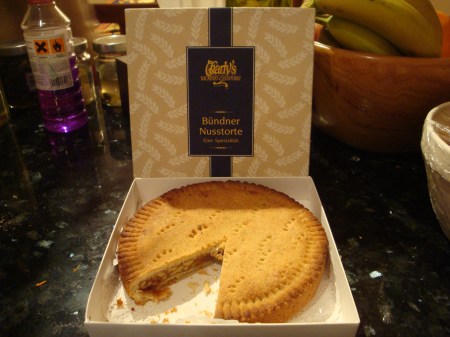
And here’s the beautiful Nusstorte fresh (well almost) from Charly’s in Klosters:
Recipe for cheese fondue “moitié-moitié” (half and half)
This recipe comes from my trusty little Betty Bossi Swiss Specialities cook book, a little ringbound volume with one recipe per page, clear simple and instructions and a photo of every dish. The half and half in the recipe title refers to the mixture of 2 cheeses used in this fondue. This recipe serves 4 people generously.
Ingredients
600g day-old bread from a cob or chunky baguette type of loaf (you need the right ratio of crust to crumb – a tin loaf would give too much crumb) cut into cubes
300g mature gruyère cheese
300g vacherin fribourgeois cheese (substitute emmental if vacherin fribourgeois is not available)
300 ml white wine, ideally a Swiss chasselas, otherwise whatever dry white wine you have to hand
1 peeled clove of garlic left whole
1 small glass (liqueur glass) of kirsch
1 tablespoon cornflour
a pinch each of freshly ground black pepper, paprika, freshly grated nutmeg
Grate the cheese using a coarse grater and place into the fondue pan. A traditional fondue pan is referred to as a caquelon. If, like me you bought a ready grated fondue mix of cheeses, simply tip the contents of the packet into the fondue pan. In a separate bowl, mix together the cornflour and white wine. Pour the mixture over the cheese in the fondue pan. Place the pan over a low heat and slowly bring the mixture up to boiling point, stirring constantly with a wooden spoon. Add the whole garlic clove, kirsch and seasoning to the mix. Once the mixture is smooth, creamy and bubbling, bring the fondue pan to the table and set your table burner on low. You are now ready to serve. Give the bottom of the pan a stir every so often with a bread cube on the end of your skewer to stop the cheese crust which forms on the base (known as la religieuse) from burning.
Recipe for Bündner Nusstorte
This recipe comes from a little ringbound paperback “Bündner Landfrauen Kochen” (Graubünden farmers’ wives cookbook) and was submitted both by Mrs Annina Mengiardi of Ardez (Swiss German version) and by Mrs Marta Padrun of Lavin (Romansch version) so it is certainly authentic. My Romansch is limited but as far as I can tell, the recipes are identical. The translation from Swiss German is mine as are one or two additions. I’ve made the recipe twice now so can confirm that it works. The sweet pastry dough is a little difficult to handle so be gentle with it. Caramelising the sugar for the filling has to be done carefully as well. The key thing is to seal in the filling thoroughly otherwise it bubbles out when baked. A small slice of the pie is enough so on that basis the recipe would serve 12 people. It’s usually served on its own without cream or ice-cream and is just as good with a cup of tea or coffee as it is for pudding. I wonder if this is the European precursor to the American pecan pie?
Ingredients
300g plain flour
150g caster sugar
150g butter
1 egg, lightly beaten
pinch of salt
Filling
300g caster sugar
50 ml water
250g roughly chopped walnuts
200 ml double cream
1 dessertspoon of honey
Rub the butter into the flour to which you have added the pinch of salt until it resembles fine breadcrumbs. Stir in the sugar then the beaten egg and work into a dough handling as lightly as you can. Wrap and chill the dough for half an hour. Roll out 2/3 of the dough and use it to line a loose bottomed flan tin 24-26cm in diameter. Do not trim the excess pastry as you should aim to leave an overlap of 3 cm. Wrap and return the remaining pastry dough to the refrigerator while you prepare the filling.
For the filling, melt together the sugar and water in a heavy based saucepan and allow to caramelise to a brown colour. Add the chopped walnuts, cream and honey, stir well and allow to cool to room temperature.
Fill the pie base, then roll out a lid and place it over the tart. Seal the edges well. I recommend leaving the pie edges untrimmed at this stage as you can neaten up the edges after baking. Prick the surface with a fork all over decoratively if you like (see picture above) but don’t overdo it as the filling will leak out.
Bake at 220 degrees C for the first 10 minutes then reduce the heat to 180 degrees C and bake until the tart is a light golden brown (approx another 30 minutes.
Contact details for Nick Dobson Wines
Telephone 0800 849 3078
An Antipodean New Year in London
January 13, 2010 § Leave a comment
For the past 10 years we have spent New Year’s Eve with a group of friends, taking turns to host and organise a special meal. All of us enjoy good food and wine and we make a bit of an effort each year to come up with a different theme. In the past we’ve covered French, Italian, Middle Eastern, Spanish and American cuisines to name but a few. This year we were in Highgate, North London and our hosts decided to choose an Australian theme.
This was a real eye-opener for me as I’ve never visited Australia. I know there’s a lively food scene down under particularly in Sydney but my knowledge of Australian chefs and cookery writers was, until last week, restricted to Bill Granger’s books (of which I have seven at last count!), Jill Dupleix’s magazine articles and of course those handy little Australian Womens’ Weekly cookbooks.
Here is our fabulous menu:
Wasabi almonds and macadamia nuts
Fillet of wild kangaroo with anchovy butter; olive and bush tomato focaccia
Barbecued giant prawns; tarator; pepperberry bark
Spiced orange granita; orange, date and mint salad
Neil Perry’s slow-roast rib of beef; potato and celeriac gratin; green beans
Kiwi, blueberry and strawberry Pavlova; macadamia tuiles
It tasted as brilliant as it sounds and I discovered some brand new ingredients (bush tomatoes and pepperberry as well as the more obvious kangaroo), two new chefs/cookery writers (Neil Perry and Juleigh Robins) and a better tarator recipe than the previous one I’ve posted.
This is the amazing looking pepperberry bark, a paper thin crispbread which has dried Australian pepperberries both in the dough and sprinkled on top. I give the recipe later on in this post.

According to cookery writer Juleigh Robins (whose book “Wild Food” was the source of some of the evening’s recipes) the pepperberry bush Tasmannia Lanceolata grows in the subalpine rainforests and gullies of Tasmania. It can be used like black pepper – it has a distinctive spicy taste, a bit like a Szechuan peppercorn. Juleigh Robins’ book lists other exotic and enticing ingredients too – anisata, bush tomato, Davidson’s plum, and best of all the miraculously chocolate flavoured wattleseed. Only two of her ingredients were familiar to me, the macadamia nut and wild rosella. I have come across wild rosella flowers referred to as hibiscus. They are preserved in syrup and make a superior edible garnish for champagne or soft drinks.
The pepperberry bark accompanied giant prawns which were cooked in true Australian style on the barbie, despite freezing temperatures outside. You’ll see from the work-in-progress photo below that we dressed appropriately for the occasion:

The orange granita which followed made a refreshing palate cleanser before we moved on to the rare beef and then pudding. Here’s a picture of the granita and I’m afraid this is the last photo as the evening was too much fun to stop and take pictures.

Recipe for pepperberry bark
This recipe for a paper thin crispbread akin to Sardinian carta da musica comes from Juleigh Robins’ book “Wild Food.” The dried pepperberries impart a subtle purple colour to the dough and warm aromatic flavour to the finished bread.
Ingredients
375g plain flour
2 teaspoons salt
2 teaspoons caster sugar
2 teaspoons dried crushed pepperberries
40g butter at room temperature
2 tablespoons milk
100 ml water
1 egg yolk
2 teaspoons sesame seeds
extra crushed pepperberry for sprinkling
Using the paddle attachment on an electric mixer, mix the flour, salt, sugar, crushed pepperberry and butter together. Once the butter is well incorporated into the flour, add the milk, water and egg yolk and work until the mixture forms a firm dough. Cover and rest in the refrigerator for one hour or so.
Preheat the oven to 170 degrees C and line a large baking tray with baking paper.
Divide the dough into four. Roll each piece as thinly as possible preferably using a pasta machine. It should be as thick as a tortilla/corn chip. Work quickly not overworking the dough. Let it rest for 20 minutes. Tear each sheet of dough into 5 or 6 lengths making 20-30 pieces in all. Carefully place the dough strips on the lined baking tray. With a pastry brush dipped in water lightly brush the surface of the bread. Sprinkle with sesame seeds and crushed pepperberries. Bake for 15 minutes until a light golden brown.
Recipe for barbecued marinated giant or king prawns
This recipe and the two that follow are from star Australian chef Neil Perry’s book “The Food I Love”. Neil Perry is the chef behind Sydney’s legendary Rockpool restaurant but his book is full of recipes designed to cook at home without too much restaurant-style frippery. Just checked and it’s readily available on Amazon if you’re interested. This recipe serves 4.
Ingredients
for the marinade
2 cloves garlic
2 tablespoons chopped fresh ginger
1 lemongrass stalk peeled and chopped
2 tablespoons chopped coriander
2 tablespoons chopped mint
1 teaspoon ground cumin
1 teaspoon ground coriander seeds
1 teaspoon smoked paprika
2 red chillies
zest of half a lemon plus juice of one lemon
1 teaspoon sea salt
125 ml extra virgin olive oil
to grill and serve the prawns
20 large king prawns cut in half lengthways and deveined (for our multi-course meal we made do with just 3 monster prawns, half per person, each the size of a small lobster!)
Extra virgin olive oil
Freshly ground black pepper
125 ml tarator (see next recipe)
lemon wedges
To make the marinade, put all the marinade ingredients in a food processor and blend until smooth. Put the prawns into a large bowl, pour over the marinade, cover and leave for 30-45 minutes.
Preheat the barbecue to hot. Make sure the grill bars are clean. Put the prawns on the grill cut side down. Cook for one minute (a little longer for a giant prawn). Turn and cook for one minute more (again a little longer for a giant prawn).
Remove the prawns from the grill and pile onto four plates. Drizzle with olive oil, season with a few twists of pepper and serve with a dollop of tarator and a lemon wedge or two.
Recipe for tarator
Another Neil Perry recipe. This is a better tasting tarator than the one I posted back in September. It calls for pounding by hand in a pestle and mortar. I’m not sure if our hostess did this on new year’s eve – I would be tempted to use a food processor.
Ingredients
50g walnuts, lightly roasted
sea salt
2 garlic cloves
40g fresh breadcrumbs
freshly ground black pepper
juice of a lemon
125 ml extra virgin olive oil
Put the walnuts, salt and garlic in a mortar. Pound to a paste. Add breadcrumbs and a dash of water and pound to mix through. Add pepper and lemon juice then slowly add the olive oil a little at a time, pounding to a creamy consistency.
Recipe for date, orange and mint salad with orange granita
A final Neil Perry recipe. This makes a zingy and refreshing intermediate course or pudding. On new year’s eve we had a simplified version with just the granita and a few dates scattered on the side. This recipe serves 8.
Ingredients
for the granita
550 ml orange juice, freshly squeezed
115g caster sugar
1/2 teaspoon ground cinnamon
pinch ground cardamom
5 drops orange flower water
125 ml water
for the salad
16 fresh dates soaked in hot water for 10 minutes then skins removed and pitted
4 segmented oranges
8 finely sliced mint leaves
Strain the juice through a fine sieve and put in a bowl with the sugar, spices,orange flower water and 125ml water. Stir until the sugar dissolves. Strain into a container such that the mixture is approximately 2 inches deep. Freeze. Fork through every 30 minutes or so. The mixture will take 4-5 hours to freeze into granular crystals.
To make the salad, quarter the dates and mix together with the segmented oranges and sliced mint leaves. Divide between 8 glasses and add a spoonful of granita.
If you had a special meal on New Year’s Eve I would love to hear about it.
Rustic food in Klosters and traditional dishes from Graubünden
January 10, 2010 § 2 Comments
I’m going to start this post on our recent trip to Klosters with a mention of Charly’s Chestnuts. No, this isn’t an irreverent dig at the British royal family who like to holiday here but a reference to a Klosters landmark. The eponymous Charly sets up his wagon daily just outside the station and his roast chestnuts are very good indeed.

I’ve already written about some of Klosters’ hotel restaurants and the elegant food they serve up. What I haven’t mentioned so far are some of the mountain restaurants catering for skiers. Yes, there are the busy cafeteria style establishments by the main lifts at Gotschna, Davos and Madrisa, but if you want something a bit special, you have to travel a little further afield.
Bruhin’s restaurant is virtually on the summit of the Weissfluhgipfel which at 2883m is the highest point on the Parsenn massif. The views across to the Silvretta and Rätikon are stunning and window tables here are in great demand. The menu offers either restaurant style dishes or local specialities. I haven’t eaten here recently, but they do a good cup of coffee – you can warm up on the sheepskin upholstered seats before taking the long run down to Schifer.
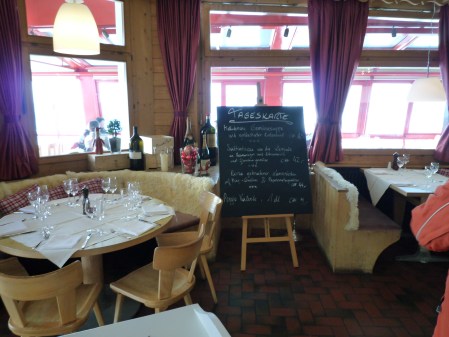
If you are skiing in the Madrisa ski area, then Berghaus Erika in the hamlet of Schlappin makes a worthwhile destination. Its plus point or drawback, depending on your point of view, is that is situated at the foot of a long tree-lined black run.
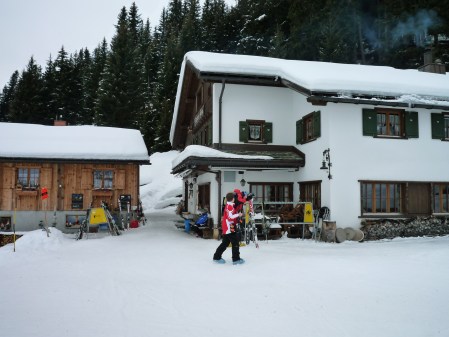
We tried the local Prättigau speciality Chäsgetschäder here, a cheesy bread bake, perfect after a hard morning’s skiing. I’ve searched out a recipe for this dish which I give below. The version in the recipe sounds more soupy and creamy than the dish we ate at Berghaus Erika – their version appears to have been baked in the oven or cooked on the stove top to produce a golden crust:

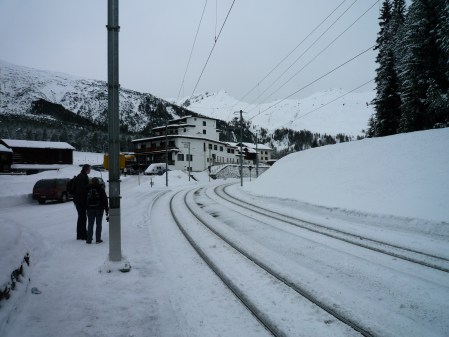
At the foot of another black run is the Hotel Kulm in Wolfgang, the hamlet on the main road between Klosters and Davos. This is another atmospheric place to eat, with lots of local specialities on the menu. The hotel sits between the main road and station at Wolfgang – there’s no ski lift back to the slopes, so time your meal to coincide with a Rhätischebahn train back to either Davos or Klosters . Here’s a view of the hotel from the station platform.
We tried Maluns, a dish of fried potatoes served with cheese and apple sauce, a typically Swiss combination. This dish looks rather basic when it arrives – essentially a plate of crispy golden crumbs, a piece of cheese and dollop of apple sauce on the side, but the combination tastes good. I’ve managed to find a recipe too which I give below.
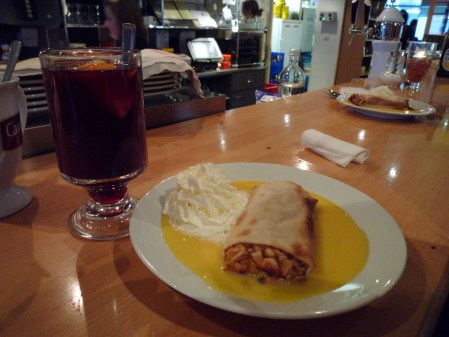
A day skiing in Klosters wouldn’t be complete without an après-ski drink and snack in Bistro Logo in the main street – this seems to be the town’s only café and is permanently busy as a result. Since Graubünden went smoke-free a couple of years ago, this is now a very pleasant place to sit and chat. My son George’s favourite order here is the apple strudel with both vanilla sauce and whipped cream:
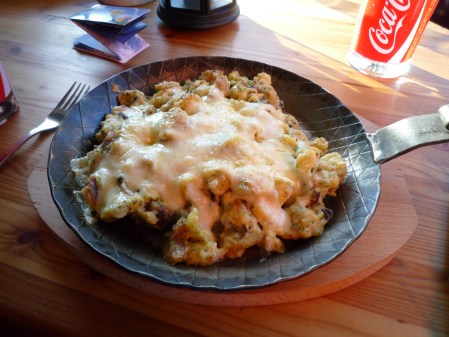
Finally, a mention of two other regional dishes which appear frequently on menus in and around Klosters. The first is Pizokel, a gratin of potato dumplings which makes a hearty ski lunch. Here’s how it’s served locally andI give a recipe below.
The second is Capuns, another Graubünden speciality – little parcels of savoury stuffing wrapped in Swiss chard leaves. Sadly, I didn’t have an opportunity to try these during our trip. Of all the local dishes, these seem to fit in with current cooking trends – not too much cheese, butter and starch and the use of a vegetable rather than pasta or pastry to encase a savoury filling has a contemporary feel even though this is a traditional regional dish. My trusty little Betty Bossi cookbook which I bought in Switzerland ages ago has come up trumps again – I give the recipe below and plan to give it a try as soon as I can get hold of some Swiss chard.
Recipe for Maluns – a fried potato dish, a speciality of Graubünden
This recipe comes from “Bündner Landfrauen Kochen” (the Graubünden Farmers’ Wives Cookbook), a little spiral-bound paperback book I bought in the Klosters bookshop a couple of years ago. The contributor is a Mrs Renata Canetg from Domat/Ems, a little town in the Rhine Valley near Chur.
She doesn’t say how many people this will serve – I estimate this would make 4 generous portions.
This was originally a breakfast dish eaten with and in fact mixed with milky coffee. You will find it more commonly served now as a hearty lunch or supper dish with a good-sized wedge of cheese and a dollop of apple sauce. The combination of cheese, potato and apple is typically Swiss.
Ingredients
1 kg waxy potatoes boiled in their skins and left for two days
350 g plain flour
1 teaspoon salt – more to taste
125g-150g butter (depending on how your potatoes behave)
To serve
Apple sauce
Wedges of Graubünden mountain cheese
Peel the potatoes and grate them using a coarse grater. Mix the grated potatoes with the flour and a little salt. Divide the mixture into two and fry one portion at a time in a non-stick frying pan in hot butter. When the mixture colours, turn the heat down a little and cook until golden, stirring frequently with a wooden spoon. The mixture will form into small balls. Serve immediately while hot and crispy.
Recipe for Kartoffelpizokel – potato dumplings, a speciality of Prättigau
This recipe serves 4 people and comes from a little recipe book by fictional Swiss author Betty Bossi entitled “Specialités Suisses”. The Prättigau is the region within the canton of Graubünden comprising the Landquart and Landwasser valleys in which respectively Klosters and neighbouring Davos are located.
Ingredients
700g peeled raw potatoes, floury such as Désirée
100 to 150g plain flour
1 teaspoon salt
freshly ground black pepper
For the gratin
200g grated Prättigau mountain cheese (substitute Gruyère if you like)
1 tablespoon butter
100g lardons (diced bacon)
2 medium onions halved and thinly sliced
Cranberry sauce to serve (the Swiss recipe suggests a compôte d’airelles which is similar to our cranberry sauce – the airelle is a sharp red mountain berry)
Grate the potatoes into a bowl using a fine grater. Squeeze out some of the raw potato juice with your hands. Mix in 100g of the flour, salt and pepper. Bring a large pan of salted water to the boil. With two spoons, take a small piece of the mixture, form it into a dumpling and drop it into the boiling water. If it doesn’t hold its shape, stir in the extra 50g of flour specified in the list of ingredients.
Form the mixture into dumplings and drop them into the water. Stir around. Allow to simmer for 10 minutes. They will at first drop to the bottom of the pan then rise to the surface once they are cooked, like gnocchi. Remove with a slotted spoon and place them into a buttered gratin dish. Sprinkle over the grated cheese and bake in an oven preheated to 200 degrees C for 20 minutes.
While the pizokel are in the oven, melt the butter in a frying pan, add the lardons and cook until golden. Add the sliced onions to the pan and continue cooking until the onions are golden. Spread the mixture over the baked pizokel.
Recipe for Chäsgetschäder – a rustic cheese bake, a speciality of Prättigau
Another recipe from the Betty Bossi Swiss Specialities book – serves 4.
Ingredients
100g butter
2 onions, finely chopped
250g day old white bread, crust on, cut into cubes
750 ml milk
salt and freshly ground black pepper
a little grated nutmeg
600g aged Prättigau mountain cheese, grated (or a mixture of aged Appenzell,Gruyère and Fribourg Vacherin cheeses in the ratio 250:250: 100. The recipe needs mature cheese otherwise it will lack flavour and be too stringy and indigestible)
Melt the butter in a large saucepan or enamelled casserole. Add the chopped onions and cook until golden. Add the bread cubes and fry briefly. Add the milk, bring to the boil and allow to simmer gently for 10 minutes, stirring from time to time. Season to taste with salt, pepper and nutmeg. Gradually add the grated cheese, stirring constantly, until the mixture become creamy. Serve immediately.
Recipe for Capuns – stuffed swiss chard leaves, a speciality of Graubünden
Ingredients
For the stuffing
150g flour
pinch salt
3 tablespoons milk
2 eggs
1 dessertspoon butter
1/2 onion, finely chopped
1 tablespoon finely chopped parsley
1 dessertspoon snipped chives
50g chopped air dried beef from Graubünden
100g cooked salami type sausage cut into small dice
For the wrappers
16 young tender Swiss chard leaves
To finish the dish
100 ml double cream
200 ml meat stock
salt and freshly ground black pepper
a little butter for frying the ham strips
50 g raw cured ham cut into strips
Work the flour, salt, milk and eggs into a thick paste. Put it aside and leave it to rest for 30 minutes. Melt the butter in a saucepan, sauté the onions until translucent. Add the chopped herbs, give the mixture a quick stir, then turn off the heat. When the mixture is cool, mix it with the paste. Add the chopped dried beef and sausage.
Now prepare the leaves. Blanch them briefly in abundant boiling salted water then plunge them immediately into iced water. Dry them on absorbent kitchen paper.
Place a teaspoon or so of filling onto each leaf then roll up.
Now cook the formed capuns. Pour the cream and stock into a large saucepan, season and bring to simmering point. Add the capuns to the pan, cover and allow to simmer for 5 to 10 minutes. Heat a little butter in a small frying pan and quickly fry the ham strips until crispy. Divide the capuns between 4 plates, spoon over a little cooking liquid and garnish with the fried ham strips.
Restaurant contact details
Bruhin’s Weissfluhgipfel
7260 Davos Dorf
Tel. +41 (0)81 417 66 44
Fax +41 (0)81 417 66 40
www.gourmetdavos.ch
Berghaus Erika – Schlappin
Tel +41 (0)81 422 11 17
Hotel Restaurant Kulm
7265 Davos-Wolfgang
Tel. +41 (0) 81 417 07 07
Fax +41 (0) 81 417 07 99
Bistro Logo
Bahnhofstrasse
7250 Klosters
Tel. +41 (0)81 422 19 96
Comforting casseroles part 1: pork
January 9, 2010 § 2 Comments
I was vaguely thinking about preparing some Indian vegetarian food in the new year – cleansing, soothing and lightly spiced, but the arrival of snow has put paid to that idea and I find I am craving casseroles – something warming simmering away on the hob to keep out the winter chill.
Here are two of my favourite pork recipes. One is a modified version of a Delia Cheat recipe, Spanish influenced and incredibly easy to throw together. The second comes from one of my favourite Italian cookery writers, Marcella Hazan, and is also quick and simple to put together. With its combination of juniper, bay and dried wild mushrooms, the pork becomes something special acquiring a gamey flavour a little like wild boar.
Both are just the ticket after returning from an outing on skis along the A56 main Manchester Road!
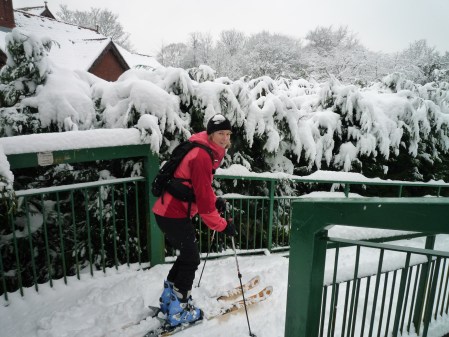
Here’s the mise en place for the Spanish pork stew with potatoes and chorizo – this is for a double quantity – half to serve now and half to go in the freezer.

Here’s the assembled dish before cooking:
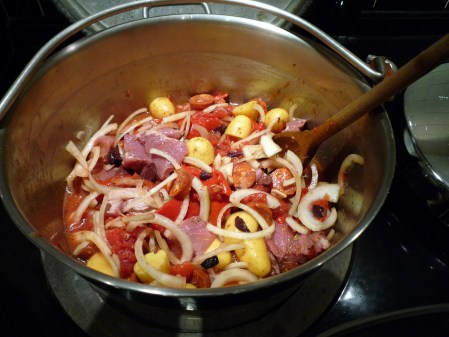
And here is the end result!
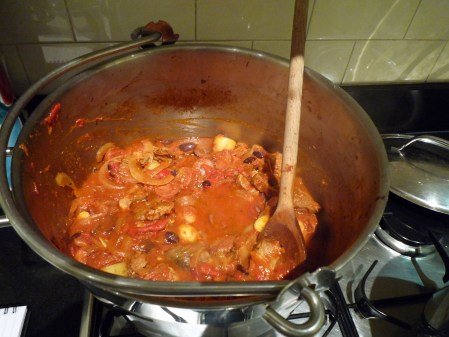
I served the stew with some lightly steamed spinach and a chunk of home-made bread. It is a one-pot dish complete with potatoes and vegetables but I do think it needs something green to go with it, be that salad or your favourite vegetable.

Recipe for Spanish pork stew with potatoes, beans and chorizo
Serves 4. Adapted from recipe found on http://www.deliaonline.com. My changes are to use ordinary canned tomatoes rather than the specified tomato frito and to use a mixture of cooked butterbeans and potatoes rather than just potatoes. Also, I couldn’t find pork shoulder so I used pork fillet instead. This is not an ideal cut for a casserole because it contains very little fat and doesn’t need long cooking to make it tender. Accordingly, I reduced the cooking time to 45 minutes rather than the specified 1 and a half hours.
Ingredients
1lb (450g) piece trimmed shoulder of pork cut into 1 inch (2.5cm) chunks.
8 oz (225g) small salad potatoes, halved or quartered if necessary to make bite-sized chunks. A variety such as Charlotte or Nicola is good – floury potatoes are not suitable for this recipe
1 standard tin or half a large jar of cooked, drained and rinsed butterbeans
4 oz (110g) chorizo sausage peeled if necessary and cut into bite sized chunks – either the cooked or raw kind is OK providing it’s a whole sausage – the ready sliced kind is not suitable for this recipe
1 350g jar roasted peppers on oil, drained but left whole (reserve the oil to add to the pot)
1 fat clove garlic, peeled and thinly sliced
1 large red onion, peeled and sliced (a normal onion is OK if you don’t have a red one)
6 sprigs fresh thyme (or 2 teaspoons dried thyme)
1 tablespoon olive oil (use the oil reserved from the jar of peppers if you like)
1/4 teaspoon saffron strands, crumbled into the pot between your fingertips
2 tablespoons white wine vinegar
5 fl oz dry white wine (I like to use dry Vermouth for cooking as I find it less acidic and with an aromatic herby background flavour which works well with food. I like Noilly Prat or an American vermouth from Andrew Quady called Vya)
1 standard-sized can plum tomatoes, roughly chopped (to save time and washing up, I do this by opening the can and snipping the contents with pair of kitchen scissors)
1 oz (25g) pitted black olives, cut in half (you can use green if you prefer, in fact the anchovy or pimento stuffed kind might work pretty well in this recipe)
salt and freshly ground black pepper
Preheat the oven to 140 degrees C (275 degrees F or gas mark 1). Put all the ingredients into a lidded, ovenproof casserole dish. Give everything a good stir, then put the casserole on the hob and bring the contents up to simmering point. Then transfer the casserole to the preheated oven for one and a half hours. That’s it! No browning etc – it practically cooks itself.
Recipe for braised pork with wild mushrooms and juniper berries -stufatino di maiale alla boscaiola
This recipe comes from Marcella Hazan’s Second Classic Italian Cookbook. The pork becomes something really special given this treatment and I’ve served this dish at more than one dinner party as it is a good-natured main course that can be prepared in advance needing no last minute attention from the cook. The hand of pork is the front leg equivalent to the back leg ham joint and thus lies just below the shoulder. I’ve made this dish successfully with other cuts – leg and even fillet on occasion but you do need to be careful not to overcook leaner, more tender cuts. Marcella Hazan suggests serving the pork with mounds of steaming polenta and braised leeks or fried broccoli florets. I’ve noticed that a lot of people don’t like polenta – if you’re one of them, then try serving it with mash instead – an olive oil or parmesan flavoured mash would be good.
Serves 4
Ingredients
25-30g (3/4-1 oz) dried wild porcini mushrooms
1/2 small onion, chopped fine
350 ml (2/3 pint) water
6 tablespoons olive oil
680g (1 and 1/2 lb) boned hand of pork, cut into pieces about 2.5cm (1 inch) thick and 5cm (2 inches) square
8 tablespoons dry white wine (or vermouth such as Noilly Prat or Vya – see comments in preceding recipe)
2 tablespoons good wine vinegar (I use balsamic which gives a lovely dark colour to the sauce)
3 flat preserved anchovy fillets, chopped (these melt into the sauce imparting a savoury flavour)
1/4 teaspoon dried marjoram
2 dried bayleaves, crumbled (or chopped fresh ones)
20 juniper berries, lightly crushed in a pestle and mortar – aim for bruising rather than complete destruction
salt and freshly ground black pepper
Soak the mushrooms for at least 30 minutes in a small bowl with 350 ml (2/3 pint) lukewarm water. When they have finished soaking, carefully lift out the mushrooms without disturbing the water. Rinse them in several changes of cold water to rid them of any grit still clinging to them. Chop them into not too fine pieces, and set aside. Filter the water in which they have soaked through a fine wire strainer lined with kitchen paper and reserve.
Choose a sauté pan or flameproof casserole that can later contain all the meat in no more than two layers, put in the onion and oil, and cook over medium heat. When the onion becomes translucent, put in the pork. Turn the heat up to medium high and brown the meat all over. Put in the wine and the vinegar, raise the heat a little, and let them bubble away for a minute or two.
Put in the chopped mushrooms, their strained water, the chopped anchovies, the marjoram, the bayleaves and the crushed juniper berries. Stir all the contents of the pan, and turn the heat down to low. Put in two or three generous pinches of salt, a liberal grinding of pepper, stir again, and cover the pan tightly.
Cook at a very gentle simmer for 1 and 1/2 to 2 hours, or until the meat is tender when pricked with a fork. When the meat is done, if the juices in the pan are thin and runny, uncover, and turn up the heat to medium high. Reduce the juices until the fat separates out from them and skim off any excess fat. The pork is now ready to serve.
Do you have any good pork casserole recipes you’d care to share with me? I would love to discover some new ones.
Dining out in Klosters: Michelin vs Gault Millau
January 8, 2010 § 3 Comments
Finally back home after a few days skiing in Klosters and new year celebrations in London. Right now, it feels like there’s just as much snow back home as there was in Switzerland.
Klosters is a schizophrenic kind of place. It’s a favourite haunt of minor royalty (though the only familiar face I spotted was that of shadow chancellor George Osborne sporting, surprisingly not a True Tory blue but, a head-to-toe red ski outfit) yet is very much non-glitzy. In the main street you are more likely to bump into a Swiss Hausfrau wheeling a shopping trolley than a leggy supermodel wheeling a flight bag. Hardware shops rub shoulders in the main street with jewellers’ shopfronts displaying the obligatory Swiss watches. There are more churches (one catholic, one protestant) than nightclubs (just the one – the discreet but shady looking Casa Antica).

Klosters is home to a clutch of well-regarded restaurants most of which are attached to hotels. Perhaps the best known (because Prince Charles chooses to stay here) is the Walserhof. Its restaurant has 2 Michelin stars and 17 Gault Millau points. Here is its inviting front door and a view of chef Armin Amrein’s festive tasting menu.

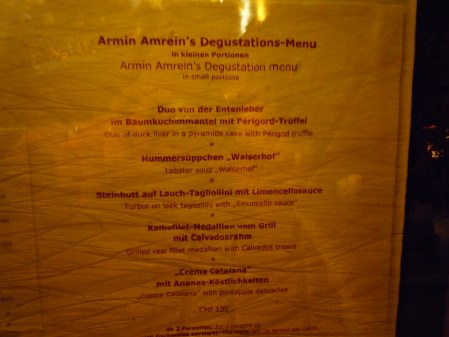
Interestingly, the Swiss place more emphasis on the Gault Millau ranking than Michelin. Gault Millau is an alternative French restaurant rating system which awards points for food alone. A maximum of 20 points are available which until recently meant in practice that the top score was in fact 19: with a French philosophical bent, Messrs Gault and Millau determined that perfection was never attainable. Controversially, in 2004 (by which date Messrs Gault and Millau were long gone), 2 restaurants in France were awarded the magical maximum 20 points and that number has subsequently grown to a handful. Falling standards or genuine excellence I wonder?
Sadly, I’m not in a position to comment on Gault Millau ratings as all their rated restaurants in Klosters (the Alpina, the Chesa Grischuna and the Rustico as well as the Walserhof) were fully booked.
This was perhaps a blessing in disguise as there is only so much cheffy food a body can eat and on a skiing holiday something more substantial is required. We paid visits to the cosy restaurant at the Steinbock Hotel (just across the road from the Walserhof), the Grill Room at the Pardenn Hotel, the restaurant in the swanky Hotel Vereina and, finally, for a more informal evening, the Pizzeria Fellini.
The Steinbock has to be one of Klosters’ best-kept secrets. It has a charming dining-room, soft lighting, wood beams and pink linen. On the evening we visited, the clientele was mainly Swiss families out for a celebratory meal. This is us, disturbing their peace just a little:

We chose the set four-course menu. Particularly good were the pheasant consommé and the parmesan-crusted lamb main course.
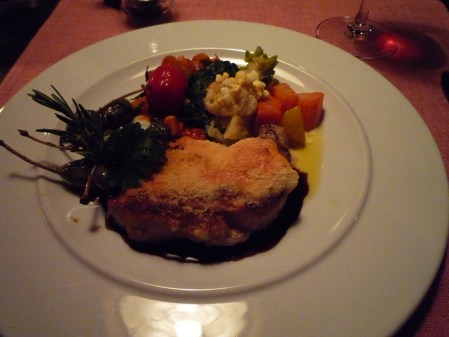
Both these dishes were undeniably old-fashioned – straight out of Escoffier in fact. My copy of Escoffier’s Guide Culinaire includes 137 consommé recipes. Whilst some of these are outlandish (swallows’ nest consommé for example), I think that a well-made simply garnished consommé is delicious, fits perfectly into a multi-course meal and deserves a revival. The lamb was served with lots of lovely vegetables and the most enormous caperberries (Kapernäpfel in German). These seem to be the latest trendy ingredient in the German speaking world – they keep cropping up in restuarant menus and German food magazines.
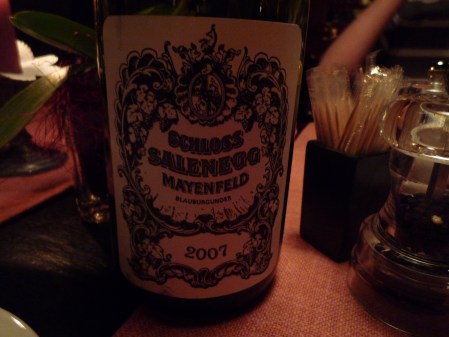
We drank a bottle of local red wine with our meal, a Blauburgunder (Pinot Noir) from Mayenfeld in the Rhine Valley a few miles away. Mayenfeld, more commonly spelt Maienfeld, is famous for being the local town mentioned in “Heidi”.
Next evening was the grill room at the Pardenn, a largish 60s hotel a little way out of town on the Monbiel road. Again, we opted for the 4 course tasting menu. The venison tartare first course was outstanding, as was my pudding choice of savarin, a dinky individual rum baba:
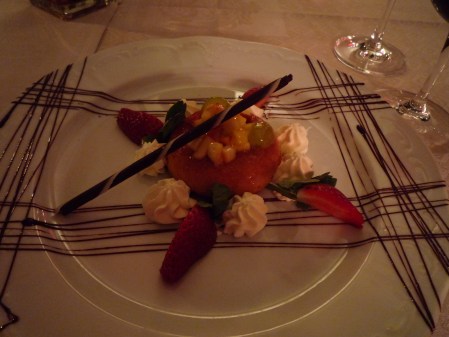
Yes, I know that the presentation looks a little stuck in a 60s/70s timewarp (as frankly does the hotel décor – alpine gemütlich it is not) but believe me, the syrup-drenched savarin was delicious.
Next evening, we chose the restaurant at the Hotel Vereina. The Vereina is an outsized Disney castle of a building plonked right in the middle of town. Unusually for Klosters, it aims to attract the kind of clientele who like to display their money. We were ushered into the dining room which looked to have had an extreme makeover back in the late 1980s – a lot of ornate steel and glass furniture combined with swags of fabric, not that easy on the eye.
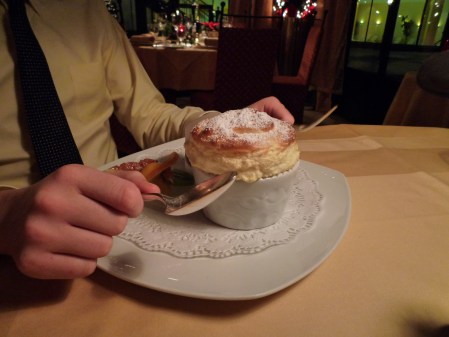
Despite the shortcomings in ambience, the staff were, seemingly as ever in Switzerland, charming and appropriately attentive. The food was for the most part pleasant but nothing to write home about, international hotel cuisine without much personality – in my case it was just a bowl of soup and piece of grilled veal, no more, no less. Then the puddings came. I don’t have a particularly sweet tooth, but the 3 choices we made (I opted just for an extra spoon to share all 3) were excellent – an unctuous crème brûlée, a chocolate fondant with a perfectly melting interior and, best of all, George’s choice of a vanilla soufflé:
Our final evening was a relaxed affair at the Pizzeria Fellini. The service was swift and efficient, the pizzas properly thin and crusty. Special mention has to go to my choice of a raclette pizza – melted raclette cheese (no tomato), gherkins and tiny pickled onions all on a pizza base. Perhaps the ultimate example of fusion food?

Walserhof
Landstrasse 141 . CH-7250 Klosters
Tel: +41 (0)81 410 29 29
Fax: + 41 (0)81 410 29 39
Steinbock
Landstrasse 146 . CH-7250 Klosters
Telefon: +41 (0)81 422 45 45
Fax: + 41 (0)81 422 16 36
http://www.steinbock-klosters.ch
Pardenn
Landstrasse 146 . CH-7250 Klosters
Tel: +41 (0)81 422 45 45
Fax: + 41 (0)81 422 16 36
Vereina
Landstrasse 179 . CH-7250 Klosters
Tel: +41 (0)81 410 27 27
Fax: + 41 (0)81 410 27 28
Pizzeria Fellini
Bahnhofstrasse 22. CH-7250 Klosters
Tel. +41 (0)81 422 22 11
‘Twas the night before Christmas
December 25, 2009 § 3 Comments
Which means it’s time to bake mince pies and finish decorating the Christmas cake.
With a bit of arm twisting, making mince pies becomes a family affair. It’s certainly more fun with three helpers in the kitchen and don’t let anyone tell you children don’t like mince pies. You can watch us by following the link below:
http://www.youtube.com/watch?v=9a0uywaI6Hs

I always plan to have my Christmas cake finished by mid December, but it ends up inevitably a last minute job on Christmas Eve. To be fair, the marzipan went on a couple of days ago. I give below my recipes for apricot glaze, marzipan and royal icing. I used to buy both marzipan and roll-out icing as they do give a perfectly smooth surface but the taste (I make a point of adding no flavouring whether almond or vanilla to the marzipan to let the taste of the almonds speak for itself) and texture of home-made are far superior even if the decorated cake looks a little home-spun.
I make the marzipan then divide it into two. Half is for the top of the cake and the other half for the sides. (In fact accurately and greedily because we have two cakes, I make one and a half times the marzipan recipe and divide it into three as one cake is fully decorated whereas just the top but not the sides of the second cake are decorated. I begin with the top of the cake, coating it with apricot glaze (not the sides yet as otherwise you will get sticky fingers when you pick the cake up). I roll out a piece of marzipan to a rough circle shape approximately the same size as the cake and invert the cake onto it. I then trim the edges neatly whilst the cake is still upside down. Keep the trimmings to mould into marzipan fruit if you’re feeling creative or to stuff Medjool dates with if you’re not.
Next, I turn the cake over and place it in final position on its board. I then prepare a template out of greaseproof paper, a strip to go round the outside of the cake. I cut the strip in half as the cake sides will be covered in two pieces of marzipan. I roll out the second piece of marzipan to a rough rectangle the same shape as my template pieces stacked on top of each other and cut 2 pieces of marzipan using the template as a guide.
Now it’s time to coat the sides of the cake with apricot glaze. Once this is done, I stick the two side pieces neatly to the cake, trimming and smoothing the seams. I then use my (clean) hands to pat and smooth the marzipan over the cake. This is what the end result looks like. Good enough for a wedding cake rather than the rough snow I plan to plaster over it. Also pictured are my last minute decorations – the sugar pearls I picked up in Paris earlier in the year and some white chocolate snowmen, reflecting the snowy weather conditions outside – it’s all set to be the first White Christmas in ages.

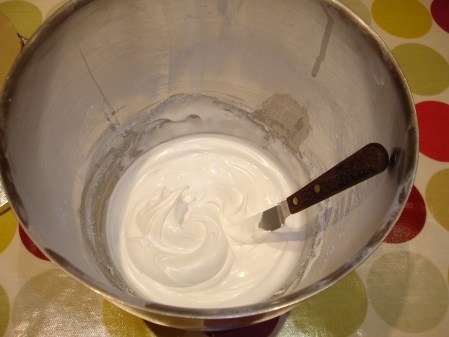
I made the royal icing following my usual recipe. This is what the starting sugar and egg white mixture looks like before whisking. The recipe advises that you should add icing sugar to the egg whites “until the mixture falls thickly from a spoon”.

And here is the same icing after 10 minutes’ whisking. It now holds its shape and forms little peaks. My long serving Kenwood mixer makes light work of this job. I think you do need electrical assistance here, whether a hand-held whisk or free standing mixer with whisk attachment. The icing dries to a deliciously powdery and crisp texture thanks to the air it contains. Don’t forget the teaspoon of glycerine to avoid the icing setting to a tooth-breaking plaster consistency.
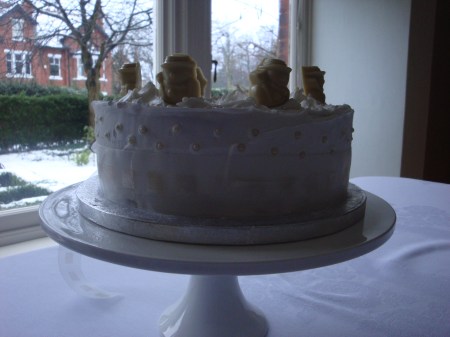
Here’s the finished cake taking pride of place on the Christmas dining table with the white chocolate snowmen gazing out onto the snowy scene outside.
Time to get on with the Christmas dinner preparations now and finally enjoy a little time off. I’ve concentrated on Christmas baking on the blog this year so you’ll just have to imagine the goose roasted to mahogany crispness appearing out of our oven on Christmas day…
Merry Christmas!
Recipe for apricot glaze
This recipe (which is hardly long enough to deserve the name!) is my own. It makes enough to cover an eight inch cake, top and sides with some leftover. Spread what’s leftover on some toasted panettone for a Christmas breakfast or mid-morning treat.
Ingredients
Half standard jar of apricot jam (look for conserve or extra jam with a high fruit content)
2 tablespoons apricot brandy (or your favourite spirit)
2 teaspoons lemon juice
Melt the apricot jam and apricot brandy together in a small saucepan. Add the lemon juice and stir well. Rub the mixture through a sieve using a wooden spoon, pressing hard so that as much fruit pulp as possible goes through.
Reheat in a small saucepan boiling until the right consistency is achieved if the cooled glaze looks too runny.
Recipe for cooked marzipan
This comes from Leith’s Cookery Bible, and as the book says, it gives a softer, easier to handle paste than the more usual uncooked marzipan. A hand held electric whisk is I think essential before you embark on this recipe. I have removed the suggested almond and vanilla extracts from the list of ingredients in the original recipe as I like the natural taste of the almonds themselves to shine through unadorned.
I have found that the texture of the finished paste is variable. Sometimes it comes out just right, sometimes a little too soft for rolling. Presumably this is because of variations in the size of the eggs and the age of the ground almonds. If this happens, simply add more ground almonds, caster sugar and sifted icing sugar in a 50:25:25 ratio (as per recipe) until the paste is the right texture for rolling out.
This quantity of paste is just enough to cover an 8 inch cake, top and sides.
Ingredients
2 medium eggs
170g/6oz caster sugar (I use the golden variety)
170g/6oz icing sugar, sifted
(if you find, as I did, that there is nothing except granulated sugar in your cupboard and the shops are closed, fear not! I ground the sugar into a coarse powder in my electric liquidiser and used this rather than a mixture of caster and icing sugar. The end result was good – perhaps even better than using different sugars)
340g/12 oz ground almonds
1 teaspoon lemon juice
Beat the eggs lightly in a heatproof bowl. Sift the sugars together and mix with the eggs. Stand the bowl in a saucepan of simmering water and whisk until light and creamy or until the mixture just leaves a trail when the whisk is lifted. Remove from the heat and whisk until the bowl is cold.
Add the ground almonds and lemon juice. Check consistency and adjust if necessary as described above. Lightly dust a board or scrupulously clean work surface with sifted icing sugar. Carefully need the paste until just smooth. Do not overwork as the oils will be drawn out resulting in a greasy paste. Wrap in cling film and keep at a cool room temperature until you a ready to use.
Recipe for royal icing
This recipe comes, like the fruit cake it covers, from Delia Smith’s “Complete Cookery Course”. The addition of a little lemon juice which cuts the sweetness of the icing ever so slightly is my own. I wouldn’t attempt this without an electric mixer of some kind. Don’t be tempted to add more glycerine than suggested as otherwise your icing may not set.
Ingredients
3 egg whites
1 teaspoon lemon juice
Approximately 1 lb 2 oz (500g) icing sugar, sifted
1 teaspoon glycerine
Place the egg whites in a perfectly clean grease-free bowl. Stir in the icing sugar, a spoonful at a time, until the icing falls thickly from the spoon (see picture above). You will probably not use all the icing sugar you have sifted – just spoon it carefully back into its box.
At that point, stop adding any more sugar and whisk with an electric mixer for 10 minutes or until the icing stands up in peaks. Then stir in the glycerine. Spooned into a jar, the icing will keep happily in the fridge for several days.
Exotic fruits in winter: medlars and kumquats
December 24, 2009 § Leave a comment
The first proper frost arrived earlier this month which meant it was finally time to gather the first tiny crop of medlars from the tree we planted the summer before last. Jane Grigson writes about the medlar in her “Fruit Book” as follows. “The medlar makes a charming tree in the garden. It grows and droops over to make a sheltered house for children to play in. In spring, the flowers are white spreading cups. In autumn the leaves turn a deep yet brilliant red, and fall to show the greenish brown medlars displaying their ancient name. Pick them when they begin to turn soft and darker brown, and do not despise the windfalls. The best can be eaten as they are. Turn the others into medlar jelly.” She is quite right – the medlar has so far proved to be an excellent small tree though not yet large enough to droop into the sheltered house for children she refers to.
Amusingly, the ancient descriptive English name for the medlar is openarse (similarly cul de chien in French) You will understand why we politely refer to it as the medlar now (nèfle in French).
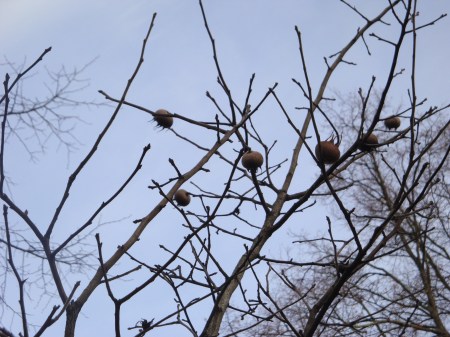
Here are my medlars, silhouetted against a palest blue wintry sky.
As the crop was so tiny and as I’ve never eaten them before, I decided the only thing to do was to eat the medlars, now yieldingly soft (the proper term is bletted) au naturel with a teaspoon. I arranged them artfully on a plate with some other seasonal items to form a cut-down version of the 13 desserts of Provence (for an explanation see http://en.wikipedia.org/wiki/Thirteen_desserts)
I took my first mouthful rather nervously but needn’t have worried as they tasted rather good – like stewed apple with a fudgy texture and pleasant acidity. A small glass of tawny port and a few walnuts were the perfect accompaniment. The 5 or so large seeds each fruit contains were unexpected but easily dealt with.
Other ideas for medlars are the jelly recipe which Jane Grigson gives and stewed medlars/compote of medlars which is the only suggestion given in Larousse Gastronomique.

I lazily popped one of the kumquats on the above platter into my mouth expecting an aromatic little sweetmeat. I nearly spat the thing out. Aromatic it certainly was but sour and bitter too in equal measure. Referring back to my trusty Jane Grigson Fruit Book I discovered that she recommends coating them in fondant to make a tart, sweet and crisp petit four. She also gives a recipe for pickled kumquats with orange slices which I though might go well with the wild duck I was planning to roast for Sunday dinner. Here are the duck (plus two brace of partridge) which my hunter gatherer husband Tim brought back from a day’s shooting at Carlton Towers in Yorkshire in the autumn. He cleaned and plucked them too and they have been waiting in my freezer for their moment to shine ever since.

I made the pickle and we ate it the same day with the duck notwithstanding that it is meant to mature for at least a month before you eat it. The recipe is given below.
Unsurprisingly, the pickle was rather sharp! The flavour of the kumquats was definitely right with the wild duck but it was too sweet and sharp in this pickle. The pickle would however be very good with Christmas ham.
If anyone has any kumquat or medlar recipes I would love to hear them.
As a final postscript, peeking into my Christmas stocking I see that my sister-in-law Angela who lives in Bristol has given me, quite by coincidence, a jar of stewed medlars. I would guess that these were sourced from her local farmer’s market – I’m looking forward to trying them.
Recipe for pickled kumquats with orange slices
From Jane Grigson’s Fruit Book
My own suggestion is that fragrant clementine slices can be substituted for orange slices very successfully.
For each 250g (8oz) kumquats, provide one large orange (or 3 small clementines) which has been well scrubbed. The kumquats only need rinsing.
Slice away and discard the peel ends of the orange, then cut the rest into slices and put them in a wide pan with the kumquats and enough water to cover generously. Bring to simmering point, and leave until the orange slices are tender. If the kumquats show signs of over-cooking and collapse, remove them.
Meanwhile dissolve 300g (10 oz) sugar in 250 ml (8 fl oz) wine vinegar. Add a 5 cm (2 inch) cinnamon stick, 8 whole cloves and 2 blades of mace. Once the liquid is clear and reaches boiling point, stop stirring.
Drain the cooking liquor from the oranges and kumquats into a bowl. Pour the syrup onto them, adding enough cooking liquor to cover the fruit. Simmer until the orange slices look transparent and slightly candied, adding extra cooking liquor as required.
Arrange the fruit in a wide glass jar, rinsed and dried upside down in a low oven. Cut the slices in two, three, four if you like. Pour on the boiling vinegar syrup, making sure that the fruit is covered. Fasten the lid tightly and leave in a cool dark place for at least a month to mature.
Pre Christmas literary lunch
December 9, 2009 § Leave a comment
There are 7 of us in the book group to which I’ve belonged for a few years now. We meet every month to discuss our chosen book but in December we put the books aside and just get together for a meal and conversation. Following on from last year’s very successful cheese fondue at Gwyneth’s I offered to host lunch on a Friday in early December.
December is a busy time. At work everyone wants the job done before Christmas. At school there are fairs to be organised and costumes to be prepared for christmas plays and concerts. At home there are cards, presents and food to be taken care of as well as all the usual routines. Inevitably the washing machine or fridge will pack up in December (as mine just has) and to round things off nicely, the workmen who’ve been promising to turn up all year will finally make an appearance just when they’re no longer wanted. I decided that what we all needed was a Superfoods Lunch. The ideas was to boost our energy levels and immune systems before the rigours of Christmas preparations. And of course the food had to taste good and look inviting.
There seems to be no standard definition of what a Superfood is. This BBC article is a helpful and quick summary of the status of superfoods – really a marketing tag more than anything. http://www.bbc.co.uk/food/food_matters/superfoods.shtml. Nevertheless, running through the lists of superfoods that various celebrity nutrionists have put together (take you pick from what’s available on the web), I soon had inspiration for a lunch. We would have a spicy butternut squash soup to start, packed with sage, chilli and garlic for extra flavour. Next, there would be two salads, one based on quinoa and roast vegetables (beetroot and red onion as well as yet more squash) together with cranberries and seeds, the other a more green leafy one featuring watercress and spinach, avocado, pistachio nuts and pomegranate seeds. I managed to find a red quinoa for the roast vegetable salad which both looked more appetising than the regular white kind and retained a bit more bite.
I neither followed nor wrote down a proper recipe for the salads, it was more a question of tasting and adding as I went along but resisting the urge to throw in too many ingredients. For the quinoa salad, I cooked the red quinoa according the packet instructions and dressed it with olive oil, balsamic vinegar and lemon juice while it was still warm. I then stirred in chopped parsley and chives, lightly cooked cranberries, and salt and pepper. I tipped the dressed quinoa into a salad bowl lined with crisp red radicchio leaves then topped the salad with chunks of roast beetroot, squash and red onion. I then blobbed on pieces of mild goats cheese and sprinkled everything with linseeds and roast sesame and sunflower seeds. Finally I snipped some extra chives over for colour.
The other salad was an assembly of different salad leaves and chopped avocado in a lemony vinaigrette with pomegranate seeds and pistachios sprinkled over the top.

My guests brought either bread for the soup (special mention to Gwyneth’s tomato bread fresh baked that morning) or something for pudding. Alison made a stunning dish of apple pancakes from windfalls in her garden (thanks for the extras Alison – I’ve used them variously in soup, as and addition to braised red cabbage and finally in an Eve’s Pudding). Pictured below are Marian’s muesli slices and Nadia’s chocolate cake – both absolutely delicious.

Lunch concluded with an exchange of Secret Santa gifts, which were of course books. I received “The Secret Scripture” by Sebastian Barry which will be my reading over the Christmas holidays. Can’t wait to get started on it.
Recipe for butternut squash soup with garlic and chilli
This recipe is the pumpkin soup recipe from from Lindsey Bareham’s book “A Celebration of Soup”. A decent cooking pumpkin is hard to find at the best of times but butternut squash, its close relation, is readily available. Lindsey Bareham tells us that this recipe is chef Sally Clarke’s version from the book “Women Chefs of Britain”. The ingredients given below serve 6.
Ingredients
1 large butternut squash (original recipe specifies 1 medium pumpkin, preferably a green-skinned variety)
75 ml (scant 3 fl oz olive oil)
6 cloves garlic, crushed
1 tablespoon chopped fresh sage leaves
1 large onion, roughly chopped
1 leek, roughly chopped
2 sticks celery, roughly chopped
1/2 fennel bulb, roughly chopped
2 small red chilli peppers chopped very fine
1.75 litres (3 pints) – maybe a little less if your pumpkin/squash is on the small side
salt to taste (recipe suggests 2 teaspoons)
to garnish – any or all of the following:
roast pumpkin seeds sprinkled with a little salt, either seeds from the pumpkin you used to make the soup or a packet of pumpkin seeds which you roast yourself (see below)
chopped parsley
extra virgin olive oil or chilli flavoured oil
Prepare the pumpkin or squash by peeling, seeding and cutting into 2.5 cm/ 1 inch cubes. Reserve the seeds for roasting if you like.
Heat the 75ml/3 fl oz olive oil and stir fry the garlic and sage until aromatic but don’t let it burn. Add the onion, leek, celery, fennel, pumpkin/squash and chillis, and increase the heat slightly, stirring around until the vegetables begin to soften. Cover with the water (the recipe suggests 3 pints but I’ve found through trial and error that this can be a bit too much – try 2 pints and add more during cooking if required) and bring to the boil, then simmer gently, half-covered, until all the vegetables are soft. Purée to a smooth consistency. If you like your soup very smooth, pass through a medium sieve into a clean pan. I use a stick blender directly in the soup pan and don’t bother with a sieve. Check for consistency. Boil to reduce if too thin, add more water if too thick. Check seasoning.
If you are roasting the seeds you extracted earlier from the pumpkin, wash them under cold running water then lay the cleaned seeds on a baking tray, drizzle them with a little vegetable oil and sprinkle with a little salt. Bake for 10-15 minutes at 375 degrees F, 190 degrees C, gas mark 5, turning with a spoon occasionally, until they are golden brown and crisp to the bite. If you are using a packet of seeds, proceed in the same way (but no need to rinse them under cold water first) but they will need less time in the oven as they are drier. Watch them like a hawk as they will turn from golden to burnt in a matter of moments.
Serve garnished with the roast pumpkin seeds plus a drizzle of olive oil or chilli flavoured oil and chopped parsley if you like.
 The Rhubarb Fool