
A summery salad from Southwold
May 24, 2015 § Leave a comment
Whilst on our annual pilgrimage to Southwold on the bracing Suffolk coast I tried out a new salad recipe inspired by the cover recipe on this month’s Delicious magazine. It combines two of the season’s best ingredients – asparagus and baby new potatoes and adds to them crunchy radishes and a fresh herby dressing. The Delicious magazine recipe requires you to whip up a herb hollandaise sauce to dress the salad but creating a vinegar reduction, separating eggs and creating a delicate emulsion is not my idea of fun for a quick holiday lunch, and frankly, the idea of all that butter is a little off-putting. I replaced the herb hollandaise with a quick and easy yoghurt and herb dressing that worked really well with the other ingredients.
At this time of year, Southwold’s greengrocer, the Crab Apple in the Market Place is heaving with local Seabreeze asparagus, so much so that one no longer feels the need to treat it reverentially. Wild fennel grows in abundance by the beach and a little of this thrown into the herb dressing adds a fresh aniseed flavour note that works well with the asparagus and potatoes.
The genius part of this salad is that the potatoes are not just plain boiled but after a quick parboil are smashed and roasted in olive oil in a hot oven becoming deliciously crispy.
In terms of aesthetics, the long thin white tipped Breakfast variety of radish look prettiest, especially if you leave on a little of the green radish top. If you can’t get hold of these then the regular scarlet globe-shaped type works just fine.
Here’s the recipe. I’d recommend it to anyone wanting to pep up a holiday lunch and it provides welcome relief from yet another carb-heavy pork pie and sandwich picnic.

Southwold asparagus and crispy potato salad
Serves 4
Adapted from a recipe in the Delicious magazine May 2015 edition.
Ingredients
450-500g baby new potatoes (e.g. Jersey Royals), scrubbed
4-5 tablespoons olive oil
400g asparagus, woody parts trimmed-off and ends peeled
200g radishes, washed, trimmed and halved lengthwise (the long thin white-tipped Breakfast variety look prettiest but the regular
For the dressing
250g full fat natural yoghurt
sea salt and freshly ground black pepper
small clove of garlic, peeled, smashed and finely chopped
generous handful of fresh herbs – whatever you can get hold of – I used fennel foraged from the beach, basil and chives
Optional garnish
a spoonful of extra chopped herbs
a little balsamic vinegar or pomegranate molasses
Heat the oven to 200 degrees C fan. Line a shallow roasting tin with baking paper
Cook the potatoes in boiling salted water for 7-8 minutes until you can just pierce them with a knife point but they are not quite tender. Drain thoroughly and tip the potatoes onto the prepared roasting tin. Press each potato with a fork to squash it partially. Drizzle over the olive oil, season and toss lightly to coat. Slip the roasting tin into the oven and roast the potatoes for about 30 minutes, turning them half way through the cooking time.
While the potatoes are in the oven, make the dressing. Put all the dressing ingredients into a medium bowl, stir to mix, cover and set aside in the fridge.
Steam or boil the prepared asparagus until just tender – about 5 minutes for the plump spears shown in the photograph. Slice each asparagus spear into two halves carefully on the diagonal.
When the potatoes are ready, tip them onto a platter and spread them out. Scatter over the asparagus and then the radishes. Dollop the herbed yoghurt dressing over the salad and, if liked, scatter over a few chopped herbs and drizzle with just a little balsamic vinegar or pomegranate molasses.
Lamb (or vegetables) for a springtime celebration
April 8, 2015 § Leave a comment
Last weekend, some 50 family and friends descended on the Northern Lake District hamlet of Fellside near Caldbeck to share our friend Bruce’s 50th birthday. As my contribution to the celebrations, I offered to cook a meal for all the guests staying over on the Saturday night.
This is the menu I put together with its foundations in the Lake District classics of Herdwick lamb sourced from Yew Tree Farm in Rosthwaite and Sticky Toffee pudding, a recipe that originated at Ullswater’s Sharrow Bay hotel.
Menu for Bruce’s Saturday night
Olives
Hummus
Tzatziki
Dukkah and olive oil
All with pitta
*****
Herdwick lamb tagine
Seven vegetable tagine
Both with preserved lemons and harissa
Couscous
Date and orange salad
Root vegetable slaw
Chargrilled broccoli with chilli and garlic
*****
Sticky toffee pudding
Toffee sauce and cream
Cheeseboard with water biscuits and Winter Tarn Farm organic butter
Mrs Kirkham’s Lancashire
Keverigg (like Caerphilly) from Winter Tarn Farm near Penrith
Burt’s Blue from Altrincham


The lamb tagine/sticky toffee pudding formula is a tried and tested way of feeding a crowd and I’m indebted to my friend Shelley for introducing me to this lamb tagine recipe which can be made ahead of time and will appeal even to those who, like me, are not lovers of stewed lamb. The fell-bred Herdwick lamb shoulder becomes meltingly delicious, sweet and spicy after two and a half hours of slow-cooking.


And for those who prefer vegetables to lamb, I offer a recipe for a Moroccan-inspired seven vegetable tagine. The vegetables are given flavour twice over first by being marinaded in olive oil, garlic and harissa and second by being roasted in a hot oven to concentrate their flavour further. As the sauce is made from pureéd vegetables and a little stock, this recipe is both gluten and dairy-free, an added bonus when feeding vegetarians with different dietary requirements.


Both recipes are straightforward to make, freeze and reheat well and are equally good eaten for supper at home or scaled up for a celebration.
Contact details for Yew Tree Farm, Borrowdale (for Herdwick Lamb via mail order or in person from the farm shop)
017687 77675
http://borrowdaleyewtreefarm.co.uk/herdwick/
Joe and Hazel Relph
Yew Tree Farm
Rosthwaite
Borrowdale
Cumbria
CA12 5KB
Tagine of Herdwick lamb
Adapted from Antony Worrall Thompson recipe on the BBC Food website. Serves 6 generously or up to 10 if served with salads and side dishes. Doubled up, this fits comfortably into a preserving pan and if making ahead and freezing, the double quantity can be ladled into 5 pour and store bags each serving four people and holding 1.1 litres/kg tagine.
The quantity of spices given in the recipe if measured accurately with cook’s measuring spoons will give quite a spicy tagine, particularly so if your spices are fresh. If you prefer a milder tagine, put in a quarter (for a mild end result) or half (for a medium end result) of the stated quantities of cayenne, ground ginger and black pepper. Replace the hot spices with more of the milder ones (paprika, cinnamon and turmeric). Taste the sauce half way through the cooking time and crank up spices according to your taste at that stage.
Ingredients
1 teaspoon cayenne pepper
2 teaspoons ground black pepper
1 and a half tablespoons mild paprika
1 and a half tablespoons ground ginger
1 tablespoon turmeric
2 teaspoons ground cinnamon
1 boned shoulder of Herdwick lamb, trimmed carefully to remove excess fat and sinew and cut into 5cm chunks. There should be approx 1kg trimmed weight of meat
2 large onions, very finely chopped in a food processor (original recipe calls for grated onion)
2 tablespoon light olive oil
2 tablespoon argan oil
3 cloves garlic finely chopped
570ml tomato juice
400g can chopped tomatoes
115g natural colour (unsulphured) dried apricots, halved
55g Deglet Nour dates, stoned and halved
55g organic sultanas
85g flaked almonds
1 teaspoon best quality saffron stamens (I like Brindisa Belefran brand from Spain)
570ml lamb stock
1 tbsp clear strong tasting honey (I like heather honey)
1 can drained rinsed chickpeas
chopped fresh flatleaf parsley and coriander to garnish
Combine the dried spices in a small bowl and mix well to combine. Place the trimmed lamb pieces in a large bowl and toss together with half the spice mix. Cover with cling film and refrigerate overnight.
The next day, preheat your oven to 140 degrees C fan.
Heat 1 tablespoon light olive oil and 1 tablespoon argan oil in a large casserole dish. Add the finely chopped onion and the remaining half of the spice mix to the pan and cook over a gentle heat for about 7 minutes. Add the chopped garlic and cook for a further 3 minutes then turn off the heat.
While the onion and spices are cooking, heat the remaining 1 tablespoon each of olive and argan oils in a large frying pan and brown the pieces of lamb a few at a time.
Add the browned lamb pieces to the casserole along with any juices. Deglaze the frying pan with a quarter of the tomato juice and add these juices to the pan.
Add the remaining tomato juice, chopped tomatoes, dried fruits, flaked almonds, saffron, lamb stock and honey to the casserole dish. Bring to the boil, cover, place in the oven and cook for 2 and a half hours. Cool, skim off and discard any excess fat. Add the chickpeas, stir in well and heat through when ready to serve. Garnish generously with chopped fresh herbs and serve with couscous.
Seven Vegetable Tagine
Source: adaptation and combination of several recipes from Paula Wolfert’s book “Moroccan Cuisine”. Apparently, in both Fez and Marrakesh, the number 7 is considered lucky and this recipe has both seven vegetables and seven flavourings so is doubly so.
This recipe was originally devised for a Moroccan-themed party to suit a vegetarian family member who cannot eat tomatoes.
Serves 7-8 as a main course; 12-15 as a vegetable accompaniment
Ingredients
The 7 vegetables
1 butternut squash, peeled and quartered
2 medium aubergines
2 red peppers
1 medium turnip (not swede), peeled and quartered
3 medium onions, peeled
1 large bulb fennel, trimmed
1 can white cannellini beans (400 g can, drained weight 225g) drained and rinsed
4 tablespoons olive oil
The 7 flavourings
4 crushed cloves garlic
3 teaspoons harissa
3 tsp cumin seeds
1-2tsp salt
few twists pepper
2 tsp dried thyme
1 generous pinch saffron threads
Three quarters to one pint vegetable stock (I use Marigold vegetable stock powder)
Cut all the vegetables, other than the beans, into bite sized chunks (roughly 1” cubes). Don’t worry if the the onions and fennel fall apart.
Put the flavouring ingredients except the saffron into a large mixing bow, add the olive oil and, tip in the vegetable chunks (but not the beans) and mix everything together with your hands, making sure all the vegetables are well coated with the flavoured oil.
Tip into large roasting tin – don’t cram them into too small a tin otherwise the vegetables will steam rather than roast – and roast for approx half an hour in a hot oven – 220 degrees C in a domestic fan oven. The vegetables are ready when they are soft but not mushy and the top layer are toasted and golden brown with darker brown edges – don’t let them blacken and burn. Stir them about once or twice while they are roasting.
While the vegetables are roasting, soak the saffron threads in a little hot water (1-2 fl oz) in a measuring jug for 15 minutes or so. Top up the measuring jug to the three quarter pint level with vegetable stock.
When the vegetables are cooked, remove from the oven, tip in the drained beans and stir to mix. Remove approximately one quarter of the vegetable mix and liquidize or blend with the saffron stock liquid to make the sauce. Add up to a further quarter pint of vegetable stock if the liquidized sauce seems to thick. Tip the sauce back into the roasting tin and stir gently to mix, scraping any toasty brown bits from the base of the roasting tin as you do so, but being careful not to break up the roast vegetables too much.
To serve – warm through and garnish with chopped fresh coriander and offer extra harissa and chopped preserved lemons separately.
Fillet steak for Valentine’s Day
February 13, 2015 § 1 Comment
Yes I know it sounds hackneyed and a teeny bit boring but this is what I will be cooking up at home on February 14th. It won’t be just any old steak and chips but one of my all-time favourite special occasion recipes, Tournedos with Polenta and Salsa Verde, the signature dish of chef Alastair Little’s restaurant in Soho back in the nineties.
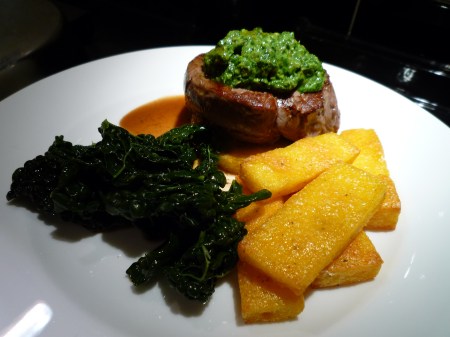
The recipe comes from the book “Keep It Simple” co-authored by chef Alastair and food-writer Richard Whittington and first published in 1993 at the height of the restaurant’s fame. It’s a slim volume arranged in four seasonal chapters with attractive photographs and drawings and clearly laid-out recipes. It’s a book I turn to time and time again and as I leaf through the pages I marvel that it doesn’t seem dated at all. Every single recipe is true to the book’s title, the flavour combinations are spot-on, and the mixture of classic and eclectic dishes means it’s book you keep coming back to.
The tournedos recipe is really three dishes in one – a polenta croûte enriched with parmesan and butter, crunchy golden-brown on the outside but with a soft inside perfect for soaking up the steak juices; a perfectly cooked fillet steak medallion with the pan juices turned into a sauce with the addition of stock and madeira; a lively and unexpected salsa verde that freshens-up the dish and makes all the flavours sing.
Most of the prep can, in fact needs, to be done in advance making it ideal for dîner à deux when you don’t want to be spending hours in the kitchen. I suppose that the raw garlic in the salsa verde should make this a no-no for a romantic meal but, what the heck, we’ve known each other long enough now not to mind a little mutual garlic breath.


Tournedos with polenta and salsa verde
Serves 4.
Ingredients
For the polenta croûtes
200g instant polenta
50g grated parmesan cheese
30g unsalted butter
salt and pepper
light olive oil for oiling the baking tray and croûtes
For the salsa verde
1 large garlic clove, peeled and chopped
large bunch flatleaf parsley, washed, dried and largest stalks discarded (about 40g prepared weight)
small bunch basil, just the leaves (about 20g prepared weight)
half a small bunch mint, washed, dried and stalks discarded (about 10g prepared weight)
2 tablespoons capers
1 tablespoon Dijon mustard
1 tablespoon white wine vinegar
a little coarse salt and freshly ground black pepper to taste
150ml extra virgin olive oil
For the tournedos and sauce
Four 140g tournedos
A little light olive oil
Maldon salt and freshly ground black pepper
150ml beef stock
5 tablespoons dry sherry or Madeira
15-20g cold unsalted butter, cut into chunks
Make the polenta croûtes at least 2 hours before you plan to cook the steaks. Cook the instant polenta in a medium saucepan following the packet instructions. Stir in the grated parmesan cheese and butter and season generously. Spread the polenta out onto a lightly oiled baking tray and spread out into a sheet about 1cm thick (a small crank-handled palette knife is ideal for this). Cool, then refrigerate for an hour or so. When set firm, cut out 4 rounds using a cutter a little larger than the tournedos. Brush lightly with oil and transfer to a second baking sheet lined with baking paper.
If you like, you can cut the remaining polenta into chunky fingers and brush these with oil and bake them along with the croûtes to make a stack of crispy polenta “oven chips” to serve alongside the tournedos.
And don’t waste the offcuts either. Cut into the neatest pieces you can manage and keep them in a sealed container in the fridge. Brush them with oil and bake them off and they will form the basis of a light lunch served eg with chunks of dolcelatte or goats cheese or chopped tomatoes and basil.
The salsa verde should also be made ahead of time. Put all the ingredients except the oil into the bowl of a food processor. Pulse until chopped then with the motor running pour the oil through the spout and whizz until you have an emulsified sauce. You will need to scrape down the sides of the processor bowl with a spatula several times. Decant the salsa verde into a small bowl, cover with cling film and set aside in a cool place (not the fridge which is too cold) until ready to serve.
Remove the steaks from the fridge about an hour and a half before you plan to eat and allow to come up to room temperature.
About half an hour before you plan to eat, slip the baking sheet on which you laid out earlier the oiled polenta croûtes and “oven chips” into an oven preheated to 210 degrees C fan. Bake for about 25 minutes, turning halfway during the cooking process, until crisp and golden brown.
About 10 minutes before you plan to eat, heat a heavy-based frying pan (large enough to hold all the steaks and with an ovenproof handle) over a medium to high heat. Brush the steaks with light olive oil and, when the frying pan is hot cook the steaks for exactly 2 minutes each side, season, then transfer to the preheated oven (210 degrees C fan) for further 4 minutes. These timings work to cook a thick steak to medium rare.
Remove the steaks from the frying pan and place them on top of the croûtes on prewarmed plates and leave to rest for a minute or two while you complete the sauce. Make sure you protect your hand with a dry cloth from the super-heated pan handle and add the stock and Madeira to the frying pan in which you cooked the steaks. Boil fiercely for a minute or two until the liquid is reduced by about two thirds and is becoming thick and syrupy. Quickly whisk in chunks of cold butter and a little seasoning. Spoon over the steaks and serve straightaway.
Arancini from Sicily – new year comfort food
January 16, 2015 § 1 Comment
It’s only mid January and I’m heartily sick of reading about detox diets and the like. So much so that I’ve perversely made a slightly late new year’s resolution to make more use of the deep-fat fryer that lurks in my garage.
I’ve made a great start already with this lengthy but easy-to-follow recipe for the ultimate Sicilian snack arancini aka deep-fried rice balls. I first came across arancini in a Sunday magazine supplement when I was a university student. I was much taken with the concept and had a go at making them but made the fatal error of assuming that Uncle Ben’s rice would be an OK substitute for the the then hard-to-find risotto rice.
Over the years I’ve toyed with the idea of having another go now that risotto rice has become a supermarket staple but what put me off was the distinct lack of leftover risotto. There is very rarely any leftover risotto in our house as it just gets hoovered up. On the odd occasion that there is a portion left in the pan it invariably gets transformed into refried risotto à la Raffle topped with a poached egg as part of a hearty breakfast the next morning.
We visited Sicily and the Aeolian Islands recently for an inspiring autumn break. Arancini were the lunchtime snack of choice to be found on every street corner. These beautifully shaped arancini, one containing mozzarella and pesto and the other meltingly soft aubergines were photographed in a small café by the waterfront in Syracuse in the South East of Sicily. They invariably contain a nugget of savoury filling and are always served warm, something I hadn’t taken on board previously.

Back in the UK it was finally time to take the plunge and have a go at making arancini at home. I hunted around for authoritative recipes and found Felicity Cloake’s instructions in her carefully researched “Cook the Perfect..” series for The Guardian newspaper to be pretty helpful.
There are a number of steps to be followed to make the arancini but each step is relatively simple and the arancini themselves are quite robust and don’t fall apart or burst in the deep-fat fryer. Also, if you really want to take it slowly, you can make the rice mixture one day, shape it the next and coat and fry the day after that. Best of all, there’s no need to go to the trouble of making a full risotto recipe as the simple method of simmering the rice in stock, giving it just an occasional stir, works perfectly.
The end result is well worth while and the jolly round shape of the rice balls and glorious saffron gold colour of the rice within is very cheering on a dank January day, not to mention the oozing mozzarella pieces and hit of unctuous ragù filling in the centre….
Definitely a recipe I’ll be making again.


Arancini
Adapted from a number of different sources especially Felicity Cloake’s Cook The Perfect..” article from the Guardian online.
Makes 8-10
Ingredients
For the rice base
850 ml stock
generous splash (50ml) dry vermouth or white wine
250g risotto rice (I used Carnaroli)
½ teaspoon salt (you may not need this if your stock is salty and remember that a generous helping of salty grated parmesan will be added to the rice when it is cooked)
generous pinch saffron strands
50g grated parmesan
freshly ground black pepper
150g cow’s milk mozzarella cut into smallish chunks
To complete the arancini
8-10 heaped teaspoons of the filling of your choice eg few spoonfuls of ragù; pesto; sautéed aubergines
1 large egg
180g plain flour
Cold water to mix
Box of Panko breadcrumbs (and maybe a second box)
Flavourless vegetable oil such as rapeseed or peanut for deep-fat frying
Bring the stock and wine or vermouth to the boil in a large saucepan. Add the rice, salt and saffron to the pan then turn down the heat to medium and cook at a brisk simmer for 12-15 minutes until the rice is tender and has absorbed most of the liquid and looks like a finished risotto. You will need to stir the rice with a wooden spoon four or five times while it simmers but it does not need the constant stirring called for when making risotto.
When the rice is cooked to your satisfaction, stir in the grated parmesan and season with black pepper. You are unlikely to need additional salt at this stage but do taste and check.
Leave the rice mixture to cool to room temperature then stir in the mozzarella chunks making sure they are distributed evenly. Cool completely and store in the fridge until you are ready to proceed to the next stage.
When you are ready to complete the arancini, first prepare the coating by whisking together the egg, flour and sufficient cold water to form a thickish batter. You are aiming for the consistency of a not too thick white sauce. Next, tip out some Panko breadcrumbs onto a plate.
Now shape the arancini by rolling a generous spoonful of the rice mixture between clean wet hands into an orange or lemon-shaped ball (as per the pictures above). Using the handle of a wooden spoon, poke a hole into the middle and carefully ease in a generous teaspoonful of the filling of your choice. Plug the gap either by filling with a little extra rice mixture or by gently massaging back the rice walls to cover the hole.
Dip each rice ball into the batter to coat thoroughly, then transfer to the plate of breadcrumbs and coat carefully with the crumbs, spooning them over and patting them into place. There’s no need to double-dip and coat. Place each coated rice ball onto a tray lined with greaseproof paper.
Finally, you’re ready to fry. Cook the rice balls in small batches (no more than four at a time) in a deep fat fryer at 160 degrees C for about 12 minutes until crisp, golden brown and piping hot in the centre. Drain on kitchen paper and eat while hot or warm.
Peasant girl with veil
August 25, 2014 § 2 Comments
I’ve been researching Danish food over the past couple of weeks in readiness for a forthcoming special occasion and yesterday decided to try out a recipe for the charmingly named dessert “Peasant girl with veil”. In its original form, it’s layers of stewed apple, whipped cream and fried breadcrumbs arranged in decorative layers in a glass bowl. It’s a really simple and effective formula that ends up tasting a bit like a deconstructed cheesecake.
I decided to serve up my version in small glasses and decorate the layers with edible flowers to pretty it up and make it suitable for a party.

I lightened up the whipped cream by combining it with Greek yoghurt, pepped up the stewed apple with spices and Calvados and replaced the fried breadcrumbs with one of my guilty pleasures, crushed HobNob biscuits (for non-UK readers, these are an oat-crunch type biscuit made by UK manufacturer McVities).
To make the layering-up of the dessert more precise, I spooned the stewed apple and the cream into separate piping bags which worked a treat. Next time I make this I’m going to make sure the apple purée is really smooth to make the piping easier, and I won’t make the top layer of biscuit crumbs so thick as they showered everywhere when we dug our spoons in!
These tasted good yesterday after dinner and equally good 24 hours later straight from the refrigerator.


Peasant girl with veil
My version of this classic Scandinavian dessert claimed as their own by both the Danes and the Norwegians.
Serves 12 dainty portions or 8 more substantial ones.
Ingredients
For the apple purée
3 Bramley apples, peeled, cored and cut into rough slices
6 tablespoons golden caster sugar (or to taste)
2 tablespoons water (if required)
1-2 teaspoons mixed spice
1-2 tablespoons Calvados
For the cream
150ml whipping cream
170g Greek yoghurt
2 teaspoons vanilla extract
2 tablespoons icing sugar
To assemble
8 Hobnob (oat crunch) biscuits, crushed to fine crumbs (about 120g crumbs)
fresh or dried edible flowers (optional)
Begin by making the apple purée. Combine the prepared apple, sugar and mixed spice in a medium heavy-based saucepan. Cover and place over a gentle heat, stirring regularly to dissolve the sugar and make sure the mixture doesn’t stick and burn. Add the 2 tablespoons of water if the mixture seems to dry. Cook the mixture gently for about 15 minutes, stirring the apples vigorously with a wooden spoon so that they “fall” ie become a thick puree.
If you’re going for a dainty presentation involving piping the purée into small glasses then you need to cool it then run it through a food processor to remove any lumps that would otherwise clog your piping nozzle. Set aside and chill.
Now prepare the cream. Combine the cream with half of the icing sugar and vanilla extract and whip to the very soft peak stage. In a separate bowl, beat the Greek yoghurt with the rest of the icing sugar and vanilla extract. Now carefully combine the two mixtures by folding one into the other.
You are now ready to assemble the dessert. The layering-up is made very straightforward if the apple purée and cream are decanted into disposable piping bags each fitted with a 1cm nozzle.
Spoon or pipe a layer apple purée into the bottom of each serving glass or bowl. Top with a layer of cream, again piped or spooned as you prefer. Now spoon over a thick layer of crumbs. Repeat the process to fill the glasses but keep the top layer of crumbs very thin otherwise they scatter everywhere when you dig in with a spoon. If liked, decorate the top of each dessert glass with a piped blob of the cream and one or two edible flowers. Enjoy straightaway or cover and keep in the refrigerator until ready to serve.
A simnel cake for Easter
April 3, 2014 § 1 Comment
I baked myself a traditional simnel cake last weekend just in time for Mothering Sunday. I was pleased with the end result and felt moved, albeit prematurely, to dig out the easter eggs I’d previously painstakingly blown and painted to complete the decoration of our Sunday lunch table.


Simnel cake was traditionally made for Mothering Sunday but has now become more usually associated with easter. It struck me as I gathered together the copious quantities of marzipan, butter, sugar, eggs and dried fruit needed for the cake that these ingredients seemed very much at odds with the spirit of the Lent fasting season. After all if we can’t even eat the humble pancake comprising just milk, flour and eggs after Shrove Tuesday how on earth would a cake like this be permitted?
I did a bit of research into the subject. One commentator suggests that the simnel cake was given as a gift on Mothering Sunday but put aside and not eaten until easter . This sounds unlikely and peculiarly ungenerous. I found a more likely explanation on a website devoted to the rites of Catholicism. Mothering Sunday coincides with Laetare “Rejoicing” Sunday close to the midpoint of Lent and on this day worshippers are permitted a bit of a breather from the strictures of the Lenten fast and may have a bit of a blow-out before resuming the fast the following day. This sounds much more plausible to me.


A properly made simnel cake is a lovely thing with the buried marzipan layer a delightful and finely flavoured surprise in its centre. I’m sorry but you really should make your own marzipan as the bought stuff is much sweeter than homemade and always has far too much almond flavouring added for my taste imparting a harsh chemical flavour to your otherwise lovely mellow cake
The Four Seasons Cookbook recipe on which I based my version of a simnel cake has perfect proportions for the specified 8 inch/20cm cake tin. The completed cake is golden in colour with a distinct citrus flavour from the combination of zest and candied peel. I found some rather pleasing golden sultanas (see pic) to heighten the golden colour of the cake.
Baking the cake presents something of a technical challenge as the usual test for doneness, sticking a skewer into the cake and seeing if it comes out clean, doesn’t work. The buried marzipan layer clings to the skewer come what may so the baker has to draw on other knowhow – checking for a slight shrinkage from the side and gently pressing the cake surface feeling for just the right degree of resistance. As always with rich fruit cakes, a long slow bake works best.
Simnel cake
Adapted from a recipe in Margaret Costa’s Four Seasons Cookery Book.
Ingredients
750g prepared weight of marzipan (homemade is best) divided into two pieces one slightly larger than the other plus a little sifted icing sugar for rolling out
175g unsalted butter
175g Demerara butter
3 eggs
1 tablespoon golden syrup
grated zest of 1 orange and 1 lemon
225g plain flour
½ teaspoon salt
¼ teaspoon each of freshly grated nutmeg, ground cinnamon and ground allspice
450g currants
225g sultanas
115g chopped mixed candied peel
up to 150ml milk
To finish the cake
The second piece of marzipan plus a little sifted icing sugar (see above)
2 tablespoons sieved apricot jam or marmalade (or light coloured fruit jelly if you have some to hand)
a few Cadbury’s mini eggs or similar
an easter chick or two
pretty ribbon to tie around the cake
Roll out the smaller piece of marzipan into a round the exact size of the cake tin. No need to trim as it won’t be visible but will form a layer baked inside the cake, just press this disc into shape with your hands. Do this before lining the tin so you can use the base as a template.
Preheat the oven to 140 degrees C fan and fully line with double thickness of baking parchment a deep 20cm/ 8 inch loose-bottomed round cake tin.
Cream together the butter and sugar until pale and fluffy. Beat in first the tablespoon of golden syrup and grated orange and lemon zests then the eggs one at a time adding a tablespoon of flour after each addition of egg to help the mixture emulsify.
Stir the salt and spices into the remaining flour and fold into the mixture with the dried fruit. Finally stir in just enough milk to make the mixture a not too soft dropping consistency like a Christmas cake batter. If it’s too soft it won’t support the weight of all that dried fruit and the internal marzipan layer.
Spoon half the cake mixture into the prepared tin and level off. Carefully place the preshaped marzipan round onto the cake mixture and top with the remaining cake mixture. Level off and place into the preheated oven and bake until done, up to 3 and a half hours but could well be less depending on how your oven behaves at lower temperatures.
The usual technique of inserting a skewer into the cake and seeing if it comes out clean won’t work as even when the cake is baked into oblivion the marzipan layer leaves a false trace on the skewer. Instead, press the cake top gently to make sure it resists and look to see if the cake has shrunk just a little from the sides of the lined tin.
Leave the cake to cool in its tin for several hours or overnight until it is quite cold. This gives you time to gather together the bits and pieces needed to decorate and finish the cake.
Remove the cake from the tin and peel off and discard the layers of baking parchment. Knead and roll out the reserved marzipan to a thickness of no more than 1cm.
Brush the top of the cake with warmed sieved apricot jam, marmalade, apple jelly or similar – something with a suitably golden colour.
Invert the cake onto the rolled out marzipan and trim to a neat circle, reserving the trimmings for the traditional marzipan ball decoration.
Turn the cake the right way up and gently mark the top into large squares or, prettier still, into lozenges using a large cook’s knive. Try not to cut right through the marzipan.
To mark the top into lozenges first mark horizontal lines across the cake at a distance of c.2.5cm from each other. Then rotate the cake and mark another set of lines not at a 90 degree angle but offset so that the intersecting lines form lozenge or diamond shapes.
Slip the cake under a heated grill to lightly toast the surface to give an attractive finish to the cake. Be sure to watch it carefully at this stage so that it doesn’t catch and burn.
Make 11 small marzipan balls (the traditional number representing the apostles minus Judas) with the reserved marzipan trimmings and set these evenly around the cake, sticking them into place with a little more warmed jam if you like.
Complete the decoration by adding a few pastel coloured mini eggs and an Easter chick or two to the top of the cake and tying a decorative ribbon around its sides.
Central African Republic breakfast
January 30, 2014 § 2 Comments
The latest in our Breakfasts of the World Project series.
I’ve been well and truly caught out by events. When I began investigating the Central African Republic (“CAR”), it seemed to me to be one of the world’s most anonymous nations but has since been catapulted into the headlines following the outbreak of civil war.
The country’s population is estimated to be some 4.5 million in a country comparable in size to France, coincidentally the former colonial power. Much of the country is taken up by the Ubangi and Chari river basins. The capital city, Bangui, is on the banks of the mighty Ubangi river that flows south to Congo and defines the border between the Central African Republic and the Democratic Republic of the Congo for much of its length.
Since gaining independence in 1960 the CAR seems to have suffered more of its fair share of misfortunes. The notorious Jean-Bédel Bokassa 1 was crowned “emperor” 1977 in a lavish ceremony watched by the world’s media. Since then, coup has followed coup more or less to the present day. Michel Djotodia, leader of the Séléka rebel alliance seized power March 2013 deposing President François Bozizé. The country has since descended into anarchy with the Christian anti-balaka militia (balaka means machete) retaliating against the mainly Muslim Séléka rebel group. Djotodia has now stepped down leaving a peacekeeping force of 1,600 French and 4,600 African troops vainly trying to control the violence. One can only hope that the new interim civilian government can deliver on its pledges to halt the violence and to organise elections by February 2015.
From this country of diamonds, timber, virgin rainforest and fertile river basins comes a recipe for the freshwater fish Nile Perch cooked in banana leaves. It seems somewhat frivolous to say so but is nevertheless true that this is a very attractive way of cooking and presenting any white fish fillets (I give the recipe below).
Given the circumstances, this was a somewhat sombre breakfast.


Somewhat to my surprise, I was able to source authentic Nile perch from online specialist retailer The Fish Society and found banana leaves in one of the specialist food shops in Manchester’s Chinatown.


Steamed Nile Perch in banana leaves
Serves 4. Recipe adapted from various internet sources.
Ingredients
4 fillets of Nile perch (capitaine in French)
4 banana leaves, halved
1 medium onion, finely chopped
1 garlic clove, crushed
handful flatleaf parsley, roughly chopped
1 chilli, deseeded and finely chopped
3 small tomatoes, peeled, deseeded and sliced
salt and pepper to taste
Mix thoroughly together in a small bowl the chopped onion, garlic, parsley and chilli.
Arrange four pairs of halved banana leaves into rough cross shapes.
Put a quarter of the onion mixture in the centre of each pair of leaves then sit a fish fillet on top, followed by another spoonful of the onion mixture. Top with the tomato slices then wrap the banana leaves over the top to form a parcel and tie each one securely with string.
Place the banana leaf parcels on a rack set over a deep roasting dish half-filled with water.
Carefully transfer to an oven pre-heated to 200°C and bake for 20-25 minutes, or until the fish is tender. Serve directly from the parcels and accompanied with fried plantains and/or boiled rice.
Filipino Pop-Up Restaurant: Typhoon Haiyan Fundraiser
November 30, 2013 § Leave a comment
It’s just over a week ago that my friend Gwyneth and I joined forces with our lovely cleaning lady Fe Silva and her formidable team drawn from our local Filipino community to put on a very special fundraising event to raise money for the UK Disaster Emergency Committees Philippines Typhoon Appeal.
Last Friday, 22 November, St Luke’s Church, Bowdon Vale in Cheshire was transformed from an austere place of worship into a lively restaurant packed with well-wishers and supporters:


It was Gwyneth’s young son Bill who came up with the idea. Moved by the plight of the Filipino people filling our television screens after the onslaught of Typhoon Haiyan and wanting to help Fe with whom he has a special bond, he came up with the idea of a cake stall outside his house to raise money. Within 48 hours, this seed of an idea quickly germinated and grew into a plan for a full-scale Pop-Up restaurant catering for up to 50 people, offering authentic Filipino food prepared and served by a team comprising Gwyneth and myself and members of the local Filipino community – Fe, Kai, her husband Russell, their daughter Maru, Vicky, Jane, her daughter Jasmine, Helen, Mira and Meridel.
Another 24 hours later, our local church – St Mary’s and St Luke’s had offered a venue free of charge, an initial donation to the appeal of £1,000 and just as importantly, encouragement and help with publicity.
Next step was to decide on the menu. This is what we came up with:
MENU
Empanadas – miniature pasties
(contain chicken and pork)
Asian salad (V)
Pan de Sal – Filipino bread rolls with crunchy breadcrumb topping
Chicken Adobo
Picadillo (minced beef and vegetables in spicy but not hot tomato sauce)
Vegetable chop suey (V)
Steamed rice
Filipino Cream Puffs
Tropical fruit platter
Mango ice-cream
Filipino coconut macaroons
Coffee, tea, mint tea
Gwyneth took on the empanadas, salad and chop suey; I opted for the Pan de Sal, Picadillo, ice cream, and shopping for the tropical fruit platetrs. Kai volunteered to make an authentic Chicken Adobo and Fe co-ordinated a battery of rice cookers and sack of imported Filipino rice. Further help came from the locally-based MD of Bakkavor Laurens Patisseries who offered several stacks of profiteroles aka Filipino cream puffs, an offer we gratefully accepted.
The next few days were focused on shopping for and preparing the various dishes and of course publicising the event and co-ordinating all the guests.
Here are Gwyneth’s beautiful-looking empanadas and chop suey vegetables (thanks to Jenny Peachey too for helping with the veg prep). It’s a shame we don’t have more pictures but to be honest we were focused on getting the event up and running:


Here are some of the mango ice-cream and tropical fruit platters. I discovered that canned mango makes an absolutely superb ice-cream with no need to search out the ripest mangoes and laboriously purée and sieve them. My knowledge of tropical fruit has been expanded too after a trip to the specialist Asian groceries of Chinatown, Levenshulme and Chorlton to track down papaya, custard apple, persimmons and the unusually flavoured guava as well as the more familiar mango, pineapple and grapes.


The Picadillo was quick and easy to make, incorporates loads of veggies so no need for a separate side dish. Served with rice, it’s going to become part of our family mealtime repertoire:

Greatest fun for me was making the Pan de Sal rolls – delicious soft and puffy brioche-like rolls made with the secret Filipino ingredient, evaporated milk, and with an intriguing breadcrumb topping:


Sorry there are no pictures of the coconut macaroons – they disappeared in a flash!
All bar two of the evening’s recipes are given below in case you’d like to try them yourselves at home. Kai has yet to divulge the secret of an authentic Adobo, and similarly Gwyneth’s husband Graeme is keeping his crunchy and vibrant Asian salad recipe close to his chest.
We’re so grateful for all the help and support we received and absolutely delighted to have raised the sum of £7,467.50 for such a worthwhile cause.
Pan de Sal – Filipino bread rolls
Adapted from a recipe on Allrecipes.com. Makes 20.
Ingredients
6g fast action instant dried yeast (the kind that can be mixed directly with the flour)
5g salt
500g strong plain flour
50g golden caster sugar
50g butter
2 eggs
240g canned evaporated milk
1-2 tablespoons milk sufficient to form a soft pliable dough
50g fine dried breadcrumbs
additional evaporated milk for dipping
Mix the yeast, flour, sugar and salt together in a large mixing bowl. Rub in the butter then pour in the eggs and evaporated milk and mix well together adding a little additional milk to the mixture to form into a soft dough. Knead for 12 minutes. A mixer with a dough hook makes this job easy but you will need to scrape down the sides of the bowl several times during the process. Form the dough into a ball, oil lightly, cover and leave to prove for 2 hours until the dough has increased in bulk noticeably. It probably won’t have doubled in size.
Divide the dough into quarters using scales, then divide each quarter into 5 small balls. Each ball will weigh 48-49g.
Form the mixture into small balls (weigh each one) and shape into rolls with a smooth top. Dip each ball in more evaporated milk then in dry crumbs. Place the rolls on a baking sheet crumb side up. Cover and prove for up to a further hour until noticeably enlarged (again they won’t quite double in size).
Preheat the oven to 220 degrees C. Slip the rolls into the oven and immediately reduce the heat to 180 degrees C. Bake for 8 minutes then reduce the heat again to 170 degrees C and bake for 5 more minutes until the rolls are golden-brown top and bottom and are completely baked. Cool on a wire rack.
Filipino Empanadas
A hybrid recipe: the filling comes from Charmaine Solomon’s “The Complete Asian Cookbook” paired with an empanada pastry recipe suitable for baking rather than deep frying. Makes about 20.
Ingredients
Pastry
300g unsalted butter
600g plain flour
teaspoon salt
2 large eggs, lightly beaten
6-8 tablespoons water
more beaten egg to glaze
Filling
3 rashers bacon
1 tbsp lard or oil
2 cloves garlic, finely chopped
1 medium onion
250g pork and veal mince or Spanish sausage, finely chopped
125g finely chopped raw chicken
¾ tsp salt
¼ tsp ground black pepper
2 tbsp tomato sauce
3 hardboiled eggs, chopped
2 tbsp chopped pickled gherkins
Begin by making the pastry. Melt the butter in a small saucepan and set aside to cool a little. Sift flour and salt into a bowl and mix well. Add the melted butter and beaten egg to the flour and salt and mix to incorporate, adding a little water as you do so to make a soft, pliable dough. Turn out onto a lightly floured board and need for about 2 minutes until smooth. Return the dough to the bowl, cover and set aside while you prepare the filling.
Remove any rind then chop the bacon into small pieces and fry until the fat runs. Remove the bacon from pan, add lard or oil and fry garlic and onion over a low heat until soft and golden. Increase the heat, add the meats and fry, stirring, until they change colour. Add salt, pepper and tomato sauce, stir well. Lower the heat, cover and cook for 15 minutes. Stir in hardboiled eggs and pickled gherkins and allow to cool before using the filling. Taste and add more seasoning if necessary.
Preheat the oven to 200 degrees C and line 2 large baking trays with parchment.
Divide the dough in half and roll out the first piece to 3mm thickness. Stamp out as many discs as you can using a 12cm cutter. You can of course make smaller empanadas by using a smaller diameter cutter and less filling. Put a dessertspoon of filling onto the centre of each disc, brush the edges with water and fold in half to make a semicircle. Press the edges together firmly and either mark with the tines of a fork or crimp to seal decoratively. Place on a baking tray. Repeat with the second piece of dough then reroll the trimmings and repeat once more. You can of course make smaller empanadas by using a smaller diameter cutter and less filling
Brush the empanadas on the tray with beaten egg and bake in the preheated oven for 15-20 minutes until golden brown. Best served warm.
Filipino Style Picadillo
A recipe collated from various sources. Kai says that to be authentic, this should be runny, almost a soup. To make serving easier, we cooked the mixture down until it was thick and reduced, more like a chili.
Ingredients
2-3 tbsp vegetable oil
1 onion, chopped
1 clove garlic, chopped
500g lean minced beef
1 beef stock cube
240ml water
1 can chopped tomatoes (14oz)
2 tbsp tomato ketchup
1 tbsp fish sauce
150g (approx) waxy potatoes (eg Charlotte variety) unpeeled, scrubbed and diced
gnerous handful of frozen peas
1-2 peeled diced carrots
1 small diced red pepper
salt and pepper to taste
Fry the onions and garlic in the vegetable oil until soft and golden(about 10 minutes). Add the minced beef and cook until brown. Add the tomato sauce, fish sauce, ketchup, stock cube and water Add potatoes and bring to the boil. Cook, uncovered over a medium heat for about 20 minutes. Add the vegetables and a little salt and pepper and bring back to the boil then simmer for 5 minutes to cook the vegetables. Taste and add more salt, pepper, ketchup and/or fish sauce if required.
Filipino Vegetable Chop Suey
A recipe compiled from various sources. We made our version suitable for vegetarians but non-vegetarians can use chicken rather than vegetable stock and fish sauce rather than soy sauce to boost the flavour.
Ingredients
1-2 tablespoons vegetable oil
3 garlic cloves, chopped
1 onion, sliced
2 medium carrots, peeled and cut into batons
1 small head cauliflower, separated into small florets
7-8oz baby corn, trimmed and halved lengthwise
1 small head broccoli, head cut into small florets, stalk peeled and cut into batons
1 stalk celery, cut into batons
1 green or red pepper, halved, deseeded and cut into strips
8-9 oz green beans, trimmed
1 small chayote, cut into batons (courgette suggested as substitute or make up with more of the other vegetables)
4 oz mangetout, trimmed
half head cabbage, outer leaved removed, quartered and thick stalks removed then shredded
2 teaspoons vegetable stock powder
1 tablespoon cornflour
235 ml milk
235 ml water
salt, pepper, soy sauce to season
In a wok or large pan heat the oil then fry the garlic and onion until golden brown.
Add the vegetables except the cabbage in the order listed above (firmest first) to the pan stir fry each for a few minutes before adding the next. This process should take 15-20 minutes in total.
Meanwhile slake the cornflour with some of the water.
Sprinkle the stock powder over the vegetables then add the water, milk and slaked cornflour to the pan and bring to the boil, stirring as the cornflour thickens the mixture.
Season with salt, pepper and soy sauce, stir, then throw in the shredded cabbage, cover with a lid and allow the cabbage to steam until just done, about 3 minutes. Stir and it’s ready to serve.
Mango ice-cream
Charmaine Solomon recipe from Philippines chapter of Asian Cookbook modified by me. She says it serves 6 – I think this quantity will serve 12 or more.
Ingredients
2 large egg yolks (70g)
1 teaspoon cornflour
50g golden caster sugar
470g milk, whole or semi-skimmed
further 33g golden caster sugar
2.5 sheets leaf gelatine soaked in a little cold water for 5 minutes
450-500g mango pulp (I used approx. 3 cans Sainsbury’s canned mango in light syrup drained, pureed and sieved to remove fibrous bits)
2.5 sheets leaf gelatine
200g whipping or double cream
Whisk the egg yolks with 50g sugar and the teaspoon of cornflour in a bowl until thick and light. Heat the milk with the remaining 33g sugar in a small saucepan until nearly boiling. Be sure to stir to dissolve the sugar while the milk heats. Pour the hot milk onto the yolks whisking constantly then return the mixture to the saucepan and cook over a very low heat until it coats the back of a spoon. Remove from the heat, allow to cool for a minute or two then add the softened gelatine and stir to dissolve.
Now stir in the mango pulp followed by the cream. Chill then pour the mixture into an ice-cream machine. Churn until frozen then pack into a freezer box and freeze until firm. Transfer the ice-cream from the freezer to the refrigerator approx. 40 minutes before serving to soften.
Filipino Coconut Macaroons
Adapted from various internet recipes hence the US cup measures. Unlike a traditional coconut macaroon that can be a touch dry, these macaroons are soft, chewy and tooth-achingly sweet and we think they’re best enjoyed petit-four sized to serve with coffee. Makes 40-50 petit four sized macaroons.
Ingredients
1/3 cup butter, softened
3/4 cup golden caster sugar
2 eggs
1 can (14 ounces) sweetened condensed milk
1/2 cup flour
2 cups desiccated coconut
1/2 teaspoon vanilla extract
Cream together the butter and sugar until light and fluffy. Beat in the eggs one at time, then add condensed milk and vanilla extract and continue to beat until blended. A hand blender makes short work of this task.
In a medium bowl, combine flour and desiccated coconut. Add to egg mixture and beat until combined.
Spoon or pipe the mixture into petit four cases and bake in a 170 degrees C oven for about 15 to 20 minutes or until golden. Cool on a wire rack.
Bat cakes for a Night at the Opera
September 1, 2013 § Leave a comment
The opera in question was Die Fledermaus (The Bat), Clonter Opera Cheshire’s summer production. We’ve been going to Clonter for a number of years now and theming the dessert course of our opera picnic seems to have become my speciality.
Die Fledermaus is a light-hearted operetta composed by Johann Strauss the younger in 1874. It’s location is Vienna and the plot revolves around a ball set-piece scene, lots of disguises (including the bat costume) and all the silliness ends happily with forgiveness and reconciliation.
The combination of the bat image combined with the Viennese setting led me to the idea of a chocolate-bat decorated individual Sachertorte, Vienna’s iconic cake, as the centrepiece of my dessert. The Hotel Sacher has updated its chocolate cake offering by selling indvidual ganache-enrobed cubes of chocolate cake each topped with a chocolate seal. I loved the idea of these and thought they would look great topped with a discreet dark chocolate bat rather than the corporate Sacher logo.
Where on earth would I find bat-shaped confectionery in summer? There were various Halloween-themed bits and pieces available online but nothing the right size. Then I thought of Slattery’s, North Manchester’s own chocolatier. A quick phone call to John Slattery himself and two dozen bats were lined up ready for collection in two days’ time. I was even offered a choice of sizes. What service!
A single piece of chocolate cake was not going to be a show-stopper on its own so I decided that the Sachertorte would be one component within a dessert Bento-style box.
Our local cake shop supplied me (for a price!) with 12 cupcake boxes, one per guest, in a clean white card and cellophane window design that were perfect for my requirements. Sturdy enough for stacking and transport and flat-pack disposable for an easy clean-up at the end of the evening.
Now with box dimensions to work with I could visualise more easily what else I needed to complete the box. Vienna is famous for its cakes, in particular luscious layered tortes. After researching classic Viennese cakes I chose to construct a miniaturised version of the Esterházy Torte, a multilayered construction sandwiching nut sponge layers with a vanilla and nut flavoured cream, topped with a traditional feather-iced pattern.
That was two corners of the box taken care of. Now for the other two. I needed something to offset the sweet and dense cakes. A simple fruit compôte would be perfect and I chose apricot as both the Sacher and Esterházy Tortes use lots of sieved apricot jam in their construction so the flavours should be harmonious. Also, the best reason of all, apricots were in season and in peak condition.
Next I needed cream to set off both the tortes and the compôte. Sachertorte is traditionally served with a cloud of whipped cream but I like to combine Greek yoghurt and softly whipped cream 50:50, flavour it with real vanilla extract and lightly sweeten with icing sugar for a lighter, fresher result.
The apricot compôte and whipped cream could be served in transparent deli-style sealed cartons stacked one on top of each other. That left the final corner of the box to fill. What could I do here? I thought of chocolate-dipped Viennese fingers or sandwiched Viennese whirls, but these seemed to owe more to Mr Kipling than any true Viennese heritage. I then frantically thought of mini Kugelhopfs, perhaps marbled chocolate and vanilla, then had a memory flash back to my childhood when elaborate pink decorated tins of Viennese coffee flavoured with dried fig seasoning (can that really taste good?) used to be on sale. Maybe I could come up with a mini coffee meringue topped with fresh figs?
Finally I told myself to STOP and follow my own mantra of Less is More. I need not rush round the kitchen becoming frazzled before an evening at the opera. I filled the last corner of the box with a napkin, some disposable wooden cutlery (so much nicer than plastic) and the most elegant disposable plastic wine glass I could find. I then packed some half bottles of Hungary’s famous dessert wine Tokaji to serve alongside. Perfect.
Here’s the end result first with the box open:

and then closed ready for packing and transport to Clonter:

OK so that’s the overview, now for detail on the construction of the individual elements.
The Hotel Sacher recipe for Sachertorte is a closely guarded secret but fortunately it’s Mary Berry to the rescue. I used her Great British Bake Off recipe featured on the BBC Food website as the base for my Sachertorte cubes. Interestingly this is similar but not identical to the Sachertorte recipe featured in her Baking Bible. I doubled the recipe quantity given below and baked it in two 23cm (9 inch) square tins.
I then sandwiched the cakes together a generous quantity with sieved apricot jam flavoured with a little Amaretto liqueur (perfect as it is itself made from the bitter almond flavoured apricot kernels) and sharpened up with a spritz of lemon juice.
I trimmed the cakes, cut them neatly into 16 cubes and brushed each cube generously with more of that sieved apricot jam.
It was shaping up to be a warm, humid day so rather than a classic cream and chocolate ganache icing I chose to make the chocolate and butter ganache I’ve used before on the Ottolenghi golden clementine cake. You can find the recipe here. This worked a treat setting to a glossy sheen thanks to the honey and butter in the recipe. I needed to make a double quantity of the icing to coat all of the cubes but could probably have got away with 1 and a half times the recipe.
Finally, each individual cube was topped with one of those chocolate bats carefully transported home from Slattery’s and they were left in the cool cellar until being packed up in double white fluted cake cases later in the afternoon.


Moving on the Esterházy Torte. A classic version of this cake comprises a majestic 5 layers of nut flavoured cake sandwiched with nut and vanilla flavoured cream. The nuts might be toasted almonds or hazelnuts depending on your preferred version of the cake. There seem to be countless subtly different versions of this recipe out there so I combined features of several recipes and scaled the quantities down in order to come up with the recipe I give below for mini Esterházy tortes comprising just 2 cake layers sandwiching a layer of vanilla nut cream.
These were straightforward enough to make being similar to a macaroon batter but much easier to handle thanks to the differing proportions of egg whites, nuts and sugar.
For the filling, I reached for my failsafe Lenôtre vanilla buttercream recipe which I learned when making macarons a couple of years ago. To complete the vanilla cream I folded in some more of the toasted ground hazelnuts.
The next step before assembling the tortes was to ice the tops with the distinctive feathered icing which is an essential feature of the Esterházy torte. Despite my many years of baking this was to be a first for me and the result was going to be on show to 12 opera guests so no pressure… I decided to ice a few extra tops to make sure that at least 12 of the lids would make the grade. This proved to be a wise decision as there are plenty of pitfalls for the unwary…
The cake tops were first brushed with sieved apricot jam to create a barrier preventing the icing from being absorbed into the cake surface. I’d made my water icing using a newly available product on my local supermarket shelves, fondant icing sugar. I’d hoped this would give me the smooth glossy effect of true fondant icing but this stuff is a bit of a cheat as it’s merely regular icing sugar with a little added powdered glucose. This does give a nice sheen to the finished product but produces a slow-setting permanently soft icing which frankly is a pain to work with. Next time I will use ordinary icing sugar.
The contrasting colour in the feathered icing comes from melted dark chocolate. The addition of a little vegetable oil to the chocolate produces a softer slower-setting result giving you time to work the feathered pattern. I forgot the oil which made life difficult as by the time I had piped lines of dark chocolate onto a row of lids, the chocolate had set rock-solid before I had chance to try out my feathering skills.
I changed tack and piped a single lid with 3 neat parallel lines of chocolate and immediately ran the wooden skewer through in a perpendicular direction. This worked fine except that I set the lids down to dry at a slight angle and 5 minutes later the slow-setting fondant icing (see my comments above) had slid off onto the kitchen work surface. Very frustrating.
I managed to turn out 12 acceptable lids and left the rejects for home consumption later. Once the icing had dried for a couple of hours, it was time for final assembly. I chose to transport the Esterházy tortes in clear plastic clamshells designed for cupcakes and these proved to be perfect for protecting the delicate tortes. I place a torte base in the bottom of the clamshell, piped a disc of buttercream on top and gently placed the iced top-layer in position, applying just a little pressure to hold everything together.


On to the apricot compôte. This was relatively straightforward to make after the two complex mini-cakes, but with its sharp refreshing sweetness a very welcome element in the dessert box. I didn’t want a babyfood-smooth purée, nor did I want something resembling a can of apricot halves in syrup. What was required was something nice and thick but with a bit of chunky texture. I thought I could achieve the texture I wanted by gently poaching the peeled apricot slices in vanilla-scented sugar syrup, carefully draining the fruit then puréeing half of it before combining it with the remainder of the fruit cut into pieces. This worked a treat. The compôte was thoroughly chilled in the fridge before spooning neatly into small clear plastic deli-style containers.
The final step was to pipe my Greek yoghurt and vanilla cream into similar deli-style pots in a relaxed swirl – more elegant than just dolloping it in to the pots.


After 2 days’ work I was finally all done and packed up. The boxes and their contents travelled brilliantly and, sigh, were consumed in the interval in a matter of minutes.
Recipe for Sachertorte
Adapted from a Mary Berry Great British Bake Off recipe on bbc.co.uk/food. This quantity of cake batter makes a single layer cake. A double quantity is required to make 16 cake cubes.
Ingredients
140g plain chocolate broken into small pieces (or use professional baking drops or buttons)
140g unsalted butter, softened
115g golden caster sugar
½ teaspoon vanilla extract
5 eggs, separated
85g ground almonds
55g sifted plain flour
1. Preheat the oven to 170 degrees C (fan). Grease and line with silicone paper your chosen cake tin. This quantity of cake batter will make a slim single layer cake if baked in a 23cm round tin, or a chunky layer for a two layer cake if baked in a 23cm square tin.
2. Melt the chocolate over a pan of simmering water. Remove and cool slightly.
3. Cream the butter and sugar together very well until really light. There is no raising agent in this cake so the only lift comes from air incorporated at this stage and when the beaten egg whites are incorporated.
4. Add the cooled melted chocolate and vanilla extract and beat again. Beat in the egg yolks one at a time then fold in the ground almonds and sifted flour.
5. In a separate bowl, whisk the egg whites until they are stiff but not dry. Add about one third of the whisked egg whites to the chocolate mixture and stir will to mix in. This will lighten the mixture and make it easier to incorporate the remaining whisked egg white without beating all the air out.
6. Gently fold in the remaining egg whites.
7. Pour the mixture into the prepared tin and level the surface with a palette knife.
8. Bake for 40-50 minutes until well risen and the top springs back when gently pressed with your forefinger. The shallower 23cm square cake will cook more quickly whereas the deeper 23cm round cake will need a little longer in the oven.
9. Leave the cake to cool in the tin for 15-20 minutes then turn out onto a wire rack to complete cooling.
10. Glaze, ice, fill and decorate according to your chosen recipe and desired finish. A sieved apricot jam glaze topped with chocolate ganache icing is traditional.
Recipe for mini Esterházy Tortes
Makes 16-18 sandwich cakes (32-36 individual cake discs).
Ingredients
For the cake layers
210g egg white (whites of approx. 6 eggs)
250g golden caster sugar
125g ground hazelnuts, lightly toasted
2 and a half tablespoons flour
To complete
1 quantity vanilla buttercream
85g ground hazelnuts, lightly toasted
Sieved apricot jam
1 quantity thick water icing made with 200g icing sugar, a squeeze of lemon juice, a tablespoon of schnapps and water to mix
50g dark chocolate melted with a teaspoon of flavourless oil
Begin by making the mini cake layers. Preheat the oven to 150 degrees C (fan). Whisk the egg whites until foamy then add the sugar a couple of tablespoons at a time whisking after each addition. Continue whisking until the meringue mixture is stiff. Fold in the flour and toasted ground hazelnuts. Transfer the mixture to a piping bag fitted with a 1cm nozzle and pipe small discs 4-5cm in diameter onto baking sheets lined with silicone paper or a non-stick liner. Leave about 2cm space between each disc to allow air to circulate to achieve an even bake. They don’t spread as they bake. Bake for about 15 minutes until the discs are a light golden colour. Allow to cool on the baking sheets for 5 minutes or so before carefully transferring to a rack with a palette knife to complete cooling.
Prepare the vanilla buttercream using the recipe given in the link above. Stir in the ground almonds. Set aside.
Divide the cake discs into two halves, one group will be the tops and the other the bottoms. Brush the smooth side of the tops with sieved apricot jam and leave to set for a few minutes. Feather-ice the tops by piping 3 parallel evenly spaced lines of dark chocolate across the freshly applied thick water icing layer and immediately drawing a wooden skewer through the chocolate lines at right angles. The chocolate is easily piped from a small piping bag made from a folded triangle of greaseproof paper with a tiny hole snipped off at the pointed end. Each draw of the skewer should be evenly spaced and parallel to form the feathered pattern. Three or four draws of the skewer should be about right for these small cakes. The feathering technique is more easily explained with diagrams and pictures so I’d suggest looking first at a detailed cake decorating book or at some of the videos available online (search terms marbled or feathered icing) if you’re trying this for the first time.
Leave the iced tops to set for a couple of hours before final assembly.
Assemble the cakes by piping a disc of buttercream onto the cake base. Use a disposable piping bag fitted with a 1cm nozzle. Set the iced layer on top and press gently to adhere.
Recipe for stone fruit compôte
Ingredients
800g-1kg ripe but not overripe stone fruit (eg apricots, peaches, nectarines or plums) peeled, stones removed and sliced
750 ml water
375g golden granulated or caster sugar
1 vanilla pod, split in half
2-3 strips lemon peel
juice of a lemon
Make a syrup by bringing to the boil the sugar and water. Add the vanilla pod, lemon peel strips and lemon juice.
Poach the prepared fruit for 5-10 minutes until tender but not too pulpy. You may need to do this in batches.
Remove the poached fruit from the syrup with a slotted spoon. Purée about half of the poached fruit in a food processor or liquidiser. Cut the remaining poached fruit into bite sized chunks. Combine the fruit purée and chunks adding a little more poaching syrup if needed.
Chill until ready to serve. Don’t throw the deliciously scented poaching syrup away – keep it in the fridge and use as the base for a soft drink or cocktail.
Easy summer recipes: slow-roast beet salad
August 23, 2013 § 2 Comments
I used to think of beetroot as an autumn or winter vegetable until, rather taking me unawares, the deep red globes ready for harvest bulged through the soil of our first year vegetable plot earlier this month.
Here’s an idea to make the most of summer beets – it makes a light lunch for two or would stretch to 3 or 4 if served with other salads.
My photo is nothing to write home about – truth be told I added the watercress to the bowl before the beets had cooled sufficiently which made it wilt rather unattractively. It tasted really good though and I’m looking forward to making it again as soon as the next batch of beetroot is ready.

Recipe for slow roast beet salad with watercress, blue cheese and walnuts
Ingredients
2 medium beetroot, washed with taproot trimmed and leaves removed but leaving an inch or two of stalk
scant handful of walnut pieces
half a bunch watercress
scant handful of crumbled blue cheese – I used Cashel Blue made in Ireland and stocked by Marks & Spencer as well as specialist cheese shops
For the dressing
4 tablespoons extra virgin olive oil
Maldon salt and freshly ground black pepper
Squeeze of clear honey (approx 1 dessertspoon)
1 dessertspoon balsamic vinegar
grated zest and juice of half a large orange
1 small clove of garlic, finely chopped
1 tablespoon snipped chives
Preheat the oven to 160 degrees C (fan).
Wrap the beets together in a foil parcel, place the parcel on a baking tray to catch any leaking beet juices. Bake for 1 1/2 to 2 hours until tender. Test by piercing the beets with a sharp knife which should slide in easily when they are ready.
Meanwhile make the dressing by whisking together all the dressing ingredients in the medium bowl in which you plan to serve the salad. Taste and correct seasoning.
Once the roast beets are cool enough to handle but are still quite warm, peel them with the help of a sharp knife if necessary, slice them into wedges and add to the bowl containing the salad dressing. Stir to combine and leave for 15 minutes or so to allow the beets to absorb some of the dressing.
Add the watercress to the bowl and toss gently to combine. Finally scatter over the walnut pieces and crumbled blue cheese and you’re ready to serve.
 The Rhubarb Fool