
Cape Verdean breakfast
August 16, 2013 § Leave a comment
“Imagine unspoilt castaway islands. With bone-white beaches that you can bag all to yourself. And a unique blend of African, Portuguese and Brazilian cultures. No wonder summer holidays to Cape Verde are the hottest buzzword in travel right now. Marooned off the west coast of Africa, they sit serenely and modestly – almost as if they’re hoping to shirk the limelight.”
So says the blurb on the Thomson holidays website which is a pretty good introduction to the Cape Verde archipelago. This group of 10 main islands and 5 smaller islets, most of which are mountainous but with some fertile land, was uninhabited until its discovery by Portuguese explorers in 1456. Just for the record, the largest island is Santiago, the capital city is Praia and the islands gained independence from Portugal in 1975.
The strategic location of the islands lying in the Atlantic off the coast of West Africa meant that they became an important staging post in both the slave and whaling trades. Interestingly, there are more Cape Verdeans and their descendants living abroad than there are on the islands themselves having left the islands during various waves of emigration. Music and football are clearly important elements of the Cape Verdean culture. Famous musicians of Cape Verdean descent include Lena Horne and the Tavares Brothers – Ralph, Pooch, Chubby, Butch and Tiny – perhaps most famous for their rendition of “More Than A Woman” on the seminal Saturday Night Fever soundtrack from the seventies. Well known footballers of Cape Verdean descent include Nani, Henrik Larsson, Gelson Fernandes and Patrice Evra.
The food of the islands is very much a reflection of its history and geography – a fusion of Portuguese, South American and African ingredients. Nowhere is this more true than in Cachupa, the islands’ national dish, a hearty stew of hominy corn, red kidney beans, spicy linguiça sausage, salt pork, sweet potato, potato, tomatoes, onion and cabbage. Fortunately for me, Cachupa refogada, left over cachupa reheated and fried with plenty of softened onion is a typical breakfast dish so it had to go on the menu.


The recipe I used for Cachupa is adapted from this one http://www.mistress-of-spices.com/2011/03/cachupa-national-dish-of-cape-verde.html
I decided to add another typical Cape Verdean dish, cuscus, to round off my breakfast menu. I found a video recipe here presented by the charming but oddly named Ideally Ilca on her Island Cuisine channel. White cornmeal is mixed with water to form little pellets. The resulting cuscus is steamed in a cake shape then served as a breakfast cereal flavoured with sugar and powdered cinnamon and eaten with cold milk. I followed Ms Ilca’s instructions to the letter and ended up with a successful plateful of Cape Verdean comfort food, agreeably soothing after the spicy Cachupa refogada:


Finding the recipes was the easy part: somewhat more of a challenge was tracking down authentic ingredients. Let’s start with hominy corn. I didn’t even know precisely what it was until I consulted Harold McGee. His encyclopaedic “On Food and Cooking” explains succinctly that “hominy consists of whole corn kernels…cooked for 20-40 minutes in a solution of lime or lye then washed of their hulls and excess alkaline solution.” The process is known as nixtamalization from an Aztec word and though it sounds a bit yucky and chemical-infused in fact produces a tasty, chewy and nutritious end result.
I tracked my hominy corn plus white cornmeal for my Cape Verdean cuscus down from ever-reliable Mexican food specialists The Cool Chile company. I sourced my linguiça sausage, plus a few extra Portuguese goodies, from the straightforwardly named www.portuguesefood.co.uk.
I packed up my specialist ingredients and headed for the coast to prepare and cook my Cape Verdean breakfast – nowhere exotic, just the good old British seaside. We were joined for a long weekend by friends Mike, Theo and Christopher who tucked in manfully (though I suspect they were hoping for a full English…)
Pass the piri piri sauce please. Did someone say it’s just like Nando’s?


Recipe for Cachupa Rica
Adapted from a recipe on “Mistress of Spices” blog.
Serves 8-12 depending on appetite.
500g dried hominy corn
250g dried red kidney beans
8 tablespoons extra-virgin olive oil
2 onions, chopped
2 bay leaves
1 litre water
1 litre vegetable or chicken stock
3 cloves of garlic, finely chopped
250g linguiça (or chorizo) cut into 1cm dice
500g thick piece of unsmoked bacon into 1cm dice
1 tablespoon chilli powder
4 small waxy potatoes scrubbed and quartered
1 sweet potato, peeled and quartered
1/4 white cabbage, sliced
2 carrots, chopped
2 tomatoes, peeled, seeded and finely chopped
Rinse the corn and the beans. Drain and set aside.
Heat 4 tablespoons of the olive oil in a large lidded saucepan or stockpot. Add half of the chopped onion and one bay leaf. Sauté until the onions are translucent. Add the corn and the beans. Stir well and add the water. Bring to the boil, then cover, reduce the heat and simmer for 2 hours. Add the stock and continue simmering until the corn and beans are soft and cooked through (this may take a further 2 hours ie 4 hours in total).
In a second large lidded pot, heat the remaining 4 tablespoons of olive oil. Add the remaining chopped onion, garlic and one bay leaf. Stir well and sauté until the onions are translucent.
Add the linguiça, bacon and chili powder. Stir gently over a low heat until cooked through, about 15-20 minutes.
Add the cooked corn and beans and their cooking liquid to the meat mixture. Then add the potatoes and cabbage, mix well, add tomatoes and cook until the vegetables are tender and the liquid reduced, about 15-20 minutes.
Taste and correct seasoning. Cachupa tastes even better the next day sautéed with some chopped onion for breakfast, called Cachupa refogada.
Recipe for Cape Verdean Cuscus
From the Island Cuisine channel on Youtube.
3 cups finely ground white cornmeal
Sugar to taste
Cinnamon
1 cup water
Add the water to the cornmeal very slowly. Mix with your hands to form a clumpy mix. Put in double boiler (I used a steamer set over a pan of boiling water). Sprinkle with plenty of powdered cinnamon.
Steam for 25 mins. It will form a sliceable cake. Serve with cold milk, honey, butter and coffee.
Supplier details
http://www.coolchile.co.uk/ Supplier of hominy corn and authentic Mexican ingredients
www.portuguesefood.co.uk Supplier of Portuguese sausages, hams, wine and other goodies.
Cod from the Suffolk coast
June 6, 2013 § 2 Comments


We’re just back from our family holiday to Southwold on the Suffolk coast. I went with intentions of cooking lots of the wonderful fresh fish you can buy there straight from the fishermens’ boats. We did indeed eat plenty of fresh fish – crab salad with new potatoes, skate wing with black butter and capers, crispy battered fish and chips, flavourful fish stew with French bread – but embarrassingly this was all eaten in Southwold’s many pubs and restaurants.
Shamed, as we prepared to drive home on Saturday morning, we called in at Samantha K’s fish shack on Southwold’s Blackshore harbour, to pick up whatever looked most tempting. That turned out to be a lovely piece of cod, from a fish caught on the tiny fishing boat Laura K and landed the evening before, its grey-green mottled skin a thing of beauty.
Back home that evening, I cooked one of my favourite fish recipes, Cod with Cabbage, Bacon and Peas from Gary Rhodes’ 1994 cookbook “Rhodes around Britain”. The cod is skinned (on reflection this isn’t necessary) and briefly seared in a hot pan before being finished in a hot oven. It’s served with mashed potato and a butter-enriched broth containing pieces of smoked bacon, onion, shredded green cabbage and peas. It’s a perfect dish for late spring combining all that’s good about fish pie with the lightness of a flavoursome broth and new season green vegetables.
I still haven’t found an entirely satisfactory fish cookery book – I get a little bored as they descend into encylopaedic lists of uncommon fish species (am I really likely to come across a walleye, pompano or porgy on my local market stall?) or obscure definitions (pelagic, epipelagic, demersal and the like…). My favourite fish recipes are dotted about here and there in different books, clippings and folders.
When deciding what to do with my lovely piece of cod it was a close run thing between the Gary Rhodes recipe and one from Simon Hopkinson’s best book, coincidentally also from 1994 “Roast Chicken and Other Stories”. This recipe requires the cod to be poached and served with braised Puy lentils and a punchy salsa verde. I’ve included it as a second recipe here as it sounds so good and I don’t want to forget about it.


Recipe for cod with cabbage, bacon and peas
Adapted from a recipe in Gary Rhodes’ “Rhodes around Britain”.
Ingredients
4 smoked back bacon rashers, rinded and cut into strips
2 onions, finely chopped
25g unsalted butter
1 tablespoon olive oil
600ml chicken stock (homemade or a good quality bought fresh stock rather than from a cube)
½ green cabbage, finely shredded
100g fresh podded or frozen peas
25-50g soft unsalted butter
sea salt and freshly ground black pepper
4 thick pieces cod fillet, skin on, each one 175-225g
a little vegetable oil
knob of unsalted butter
To serve
1 quantity mashed potatoes made with 900g floury potatoes (Maris Piper or Vivaldi); plenty of unsalted butter, salt, pepper and a little grated nutmeg
Make sure you have all the recipe ingredients, pans and utensils prepped and ready before you begin cooking as the vegetables and fish each take only a few minutes to cook. Preheat the oven to 170 degrees C fan.
Prepare the mashed potatoes and keep warm.
Gently fry the bacon and onions in 25g of the butter and the tablespoon of olive oil until soft (about 10 minutes). Add the chicken stock and bring to the boil. Cover, turn off the heat and set aside for a moment while you start the cooking of the fish.
Heat a little vegetable oil and a knob of unsalted butter in a large frying pan with a heatproof handle. When hot, put in the pieces of cod fillet skin-side down and fry for 2 minutes. Place the frying pan into the preheated oven for 3-4 minutes (170 degrees C fan), depending on the thickness of your fish.
While the fish is in the oven, bring the stock back to the boil and add the shredded cabbabge and peas and cook at a brisk boil until tender but retaining a little bite and vibrant green colour.This will take only a few minutes.
The fish will now be ready. Remove it from the oven but keep it warm while you finish the bacon and vegetable broth by whisking in 25-50g unsalted butter in pieces (the amount you choose to whisk in is up to you).
Divide the hot mashed potato between 4 shallow bowls. Sit the fish on top of the mashed potato skin side up and spoon the broth and vegetables around.
Recipe for poached cod with lentils and salsa verde
From Simon Hopkinson’s 1994 book “Roast Chicken and Other Stories”. Serves 4.
Ingredients
700g cod, descaled, filleted and cut into 4 pieces (leave the skin on)
water for poaching
juice of a lemon
enough salt to season the cooking water lightly (a teaspoon)
For the lentils
225g Puy lentils, washed and drained
450ml water
½ chicken stock cube
1 clove
1 bay leaf
1 small onion, peeled
salt and pepper
For the salsa verde
Bunch of flat-leaf parsley, leaves only
10 basil leaves
15 mint leaves
2 garlic cloves, peeled and crushed
1 tablespoon Dijon mustard
6 anchovy fillets
1 tablespoon capers, drained
150ml extra virgin olive oil
salt and pepper
To serve
1 lemon, cut into wedges
extra virgin olive oil
sea salt
pepper
a few sprigs of flat-leaf parsley
First cook the lentils. Place them in a saucepan and cover with the water. Push the clove through the bayleaf and into the onion. Add the onion to the pan. Bring to the boil, then reduce the heat and simmer gently for 20 minutes. Now add the stock cube (I don’t add this at the outset as salt in the cube can toughen the lentils and prevent them from softening) and simmer for 10 to 20 minutes more until the liquid has been absorbed and the lentils are tender. Season with salt and pepper and keep warm.
While the lentils are cooking, make the salsa verde. Put the herbs, garlic, mustard, anchovies and capers into the food processor with a few tablespoons of the olive oil. Process for a few minutes, stopping and scraping down the sides of the bowl with a rubber spatula from time to time. Once the mixture is smooth, with the motor running add the remaining olive oil to the mixture in a thin stream through the processor bowl lid’s funnel. The process is akin to making mayonnaise. Season with salt and pepper once the oil has all been incorporated. Transfer to a serving bowl.
Once the lentils and salsa verde are ready, it’s time to poach the fish. Bring a large pan of water with some salt and the juice of a lemon added to it to the boil. Slide in the fish fillets carefully, bring the pan back to the boil, cover and switch off the heat. After 5 minutes, carefully lift the fish out onto a hot plate
To serve, place a portion of fish onto each individual plate with a wedge of lemon. Drizzle a little olive oil and sprinkle a little sea salt and a grinding of black pepper over each piece of fish and scatter over a sprig or so of parsley. Pass the lentils and salsa verde separately.
Lemon meringue pie
June 2, 2013 § Leave a comment
What a delicious thing a carefully made lemon meringue pie can be. With its combination of crisp shortcrust pastry, sharp lemony filling and pillowy meringue it proves a worthy rival to a French tarte au citron.
For the past 11 months I’ve been helping out one day a week at a café staffed by learning-disabled students from local charity Stockdales. My speciality slot has become “dessert of the day” and at the conclusion of lunchtime service we decide on what next week’s “dessert of the day” will be.
During winter and early spring We’ve run through the gamut of crumbles, steamed and baked puddings, pies and tarts until finally, as spring turned towards summer the challenge of lemon meringue pie came up.
What could be simpler, I thought. After all, this was a dessert my mother used to whip up back in the 1970s. How wrong I was! It’s one of the most technically challenging things I’ve been asked to cook recently and, what with broken blind-baked bases, a filling that didn’t set and weepy meringue it took 3 attempts to perfect.
What are the secrets to success?
1) A sturdy blind-baked pastry case without cracks.
2) Carefully measured filling ingredients with the ratio of liquid to cornflour strictly observed. It’s a good idea to let the filling cool completely before topping with meringue and baking.
3) Italian meringue prepared in advance gives a reliable, stable meringue to work with.
Here’s star student Elaine piping the Italian meringue in place. It’s the first time she’s done any piping work and as you can see, she’s a natural!

Recipe for Lemon Meringue Pie
My own recipe compiled by scouring recipe books for different versions and choosing the best of each. Serves 6.
8 inch flan ring
Ingredients
Shortcrust pastry made with 180g plain flour, 90g fat (I like to use half butter and half lard) and sufficient cold water to bind
For the lemon filling
200ml lemon juice
100ml orange juice or water
175g caster sugar
30g cornflour
3 egg yolks
30g unsalted butter
For the Italian meringue
3 egg whites 30g each
180g granulated sugar (double the weight of the egg white)
70g water (1 and ½ tablespoons ie 22.5g per egg white)
Bake the pastry blind for 25 minutes at 180 degrees C fan, remove the beans and foil, reduce the oven temperature to 170 degrees C (fan)then bake for a further 15-20 minutes until an even biscuit colour and thoroughly cooked through.
Slake the cornflour with a little of the orange juice taken from the measured quantity. Put the lemon juice and rest of the orange juice, sugar, yolks in a saucepan, add the slaked cornflour and whisk until smooth. Heat over a moderate flame, whisking and stirring frequently and when the mixture becomes warm, add the unsalted butter and bring to the boil, stirring often. Allow to bubble whilst stirring for a good 30 seconds or so. Spoon the filling into the tart case (there should be a gap at the top of 1/2 cm or so) then leave to cool until completely cold.
Meanwhile make the Italian meringue. Heat the sugar and water in a small saucepan to form a syrup. Heat to 118-120 degrees C. Whilst the syrup is boiling, whisk the egg whites in a medium grease-free bowl until stiff.
Pour the boiling syrup over the egg whites at the same time as whisking with a hand held electric whisk. Keep whisking until ther meringue is cool.
Fill a piping bag with the meringue and pipe as much as required onto the cooled pie filling. Start at the outside edge and pipe partly onto the pastry to anchor. You may not need all the meringue.
Bake at 150 degrees C (fan) for a 20-25 minutes. I find it best to bake rather than blowtorch the meringue to make sure the meringue is fully cooked to a safe temperature. Also it catches fire when blowtorched leaving unattractive little black wicks on the piped meringue peaks!
Canadian breakfast
May 4, 2013 § Leave a comment
The latest in our Breakfasts of the World Project series.
We cheated ever so slightly on this one, eating it out of synch with the rest of the series to coincide with visiting family and friends the morning after a certain Big Birthday late last year (my husband Tim’s not mine I hasten to add).
Here are various family members and friends tucking into classic breakfast pancakes, back bacon and, of course, lashings of maple syrup.

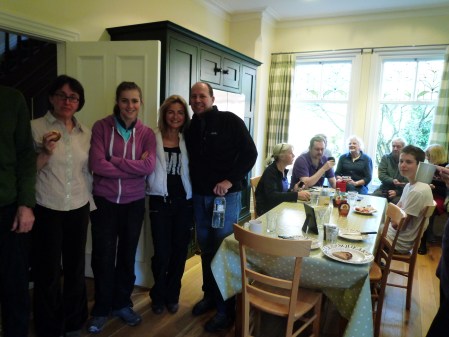
We can buy maple syrup pretty readily here in the UK – you can see in the picture below two different grades of syrup – No 1 and No 2 Amber (I’ve not yet found the elusive Grade 3 Dark syrup on supermarket shelves here). It was also time to bring out the prized bottle of rare Nova Scotia maple syrup, a gift from cousin Paul and family who live in Halifax, Nova Scotia.

I delved briefly into the details of maple syrup production and it seems that the Canadian province of Québec is responsible for some 75% of the world’s output of maple syrup. Anything calling itself Canadian maple syrup must be made exclusively from the concentrated sap of predominantly three types of maple tree – the sugar, red and black maples. It can take up to 50 litres of raw sap to be boiled down and concentrated into 1 litre of syrup.
Also on the menu were muffins (English muffins though we call them just muffins in England much as Canadian bacon is known as such anywhere but Canada) and delicious wild Pacific smoked salmon. If I’d felt more perky that morning, I might have conjured this into a Vancouver-style take on Eggs Benedict but we had to make do with just cream cheese on our muffins to accompany the salmon.
There are lots of fascinating Canadian breakfast dishes I could have tried – fellow breakfast blogger Shawna has alerted me to cretons, a Québecquois take on French rillettes (small pieces of pork and onion gently cooked in the fat rendered from the meat to form a pâté-like mixture)served on toast as part of a traditional breakfast.
Browsing through my recipe book “Out of Old Nova Scotia Kitchens” by Marie Nightingale, I see we’ve missed out too on the “Old-Fashioned Lunenburg Breakfast or Supper Dish” of cooked apples and onions baked with onions and cream. Then there’s my Blomidon Inn bread recipe from Wolfville, Nova Scotia for a loaf flavoured with oats, cornmeal and molasses…I’ll have to return to Canadian breakfasts some time soon.
Recipe for breakfast pancakes
These are a perennial favourite at home and the recipe comes from my trusty and ancient Good Housekeeping Cookery Book where these pancakes are referred to as Scotch Pancakes or Drop Scones.
Makes 10-12 small pancakes.
Ingredients
100g plain flour
2 teaspoons baking powder
30g golden caster sugar (about 2 tablespoons)
1 egg, lightly beaten with a fork
Milk to mix – about 150ml
1 teaspoon vanilla extract or ground cinnamon (optional)
Mix together the flour, sugar and baking powder in a medium mixing bowl. Make a well in the centre and pour in the egg and a little of the milk. Stir with a balloon whisk, bringing in the flour from the edges of the well and gradually adding more milk as you do so. When the batter reaches the consistency of thick custard. Beat with the whisk for 10-20 seconds until any remaining lumps have gone. Whisk in some more milk until you have a thickish smooth batter the consistency of extra-thick single cream that will drop from a spoon. Whisk in the vanilla extract or ground cinnamon if using.
Drop the mixture in large spoonfuls (I use a small ladle) onto a hot lightly greased non-stick frying pan. Keep the pan at a steady heat and when bubbles start to rise to the surface of the pancakes (after about 2 minutes, maybe earlier), flip them over using a small crank-handled palette knife and cook for a minute or so on the other side until golden brown and cooked through. Store in a folded clean linen teatowel as you make them to keep them warm and soft.
Serve with maple syrup and bacon or butter and jam. They’re pretty good cold with butter and jam if ever you find you have some left over.
Mediocre marmalade and some handy ratios
April 25, 2013 § 3 Comments
Oh dear. I’ve been silent on the subject of the World Marmalade Awards at Dalemain this year which were held at the beginning of March.
It’s time to disclose that this year I achieved marks of only 15 out of 20 for my Seville orange marmalade and, slightly better, 17 for the bergamot. This compares to the almost perfect score of 19 last year and, worst of all, to husband Tim’s respectable score of 18!

So what went wrong? I did go and chat to the white-coated WI judges this year. It seems I went a little bit too far with my liking for a soft set, and once again my marmalade was criticised for being cloudy. This is a tough one to crack but their advice was NOT to squeeze the muslin bag containing the pectin-rich peel and pips.Just to remind myself for next year, previous advice on achieving clarity was NOT to add the knob of butter when boiling but to skim, skim and skim again, also to add a just a dash of alcohol at the end when ready to pot.
On reflection, my peel was slightly unevenly distributed within the jar. Thinking back, I potted hot straight from the pan relying on a gentle shake to redistribute the peel but was distracted from doing this by a teenage tantrum shortly before setting off to a match at the Etihad stadium…The lesson is that marmalade cannot be rushed.
So far so fair. I felt somewhat peeved to have been docked a mark for having placed my label a few millimetres too high up on the jar. The WI ladies like it low it seems. I did subsequently have a look at The National Federation of Womens’ Institutes “On the Show” publication which states:
“Labels should be plain, neat and straight and of suitable size for the container. Place label between the seams of the jar. Label should state contents and day, month and year of making.”
Hmmm, nothing about vertical positioning of labels here. I think I was robbed.
Bitterly disappointed but undaunted I went along to the marmalade Q&A session to learn how to correct my mistakes and also to try and answer a couple of queries raised by a like-minded friend Shelley who had written a week or so earlier as follows:
“Really nice to talk to you about marmalade last week. Looking at your notes and reading various recipes gave me quite a bit to think about. The part in the recipes that was puzzling when I made mine this year was in the Riverford recipe which states 1.5 kg oranges, 2 lemons and approx 2.5kg sugar BUT in the video on the Riverford website the guy says after boiling there should be approx 1.7litres of liquid and then to add 450g sugar per 500ml which would only require 1.53 kg sugar so big discrepancy. As I mentioned to you I have always been a bit puzzled by the fact that the amount the liquid reduces by can vary between batches so I quite liked some guidelines on how much liquid should be left.
Also in your notes from the Marmalade workshop with Jane Maggs the optimum sugar content was 59-65% but if you add 450g sugar per 500ml liquid then sugar content is (450/950)*100% = 47% unless I am missing something.
I would like to try another batch just to see if I can get a different result but it is getting late in the season and I’m not sure we could eat it all anyway.”
First of all Shelley, I have to admit to a typo of my own – the recipe actually said 2kg of sugar and I then typed it incorrectly as 2.5kg. There’s still a discrepancy but not as bad as it first appears.
I put the water question to the panel comprising from L to R Jane Maggs of Wild and Fruitful; Jonathan Miller preserves buyer for Fortnum & Mason, compère Dan “Master Baker” (careful how you say that) Lepard, Pam “The Jam” Corbin all round preserving expert and author of Preserves: River Cottage Handbook No.2, and finally Rosemary Jameson, the Jam Jar Shop lady.

There was unanimous agreement that it would make perfect sense to put a lid on your pan and use less water. For reasons of custom, tradition and utility most recipes expect you to add water to the peels in a non-lidded preserving pan, boil for 2 hours to soften the peel by which time approximately half the liquid will have boiled away. Most people used to have just one large unlidded preserving pan thus recipes were drafted to take account of the larger amount of water needed.
Jane Maggs said that most standard marmalade recipes adopted a rule of thumb by which for every 1lb fruit, 2 pints water and 2lb sugar were required. If half the water boils away then you’re left with 1lb fruit and 1 pint water which is matched to 2lb sugar giving approximately a 50:50 ratio. There is approximately 5% natural fruit sugar in the boiled peel liquid so that plus the small amount of evaporation that takes place when boiling for a set will give you the right sugar percentage of around 60% to achieve a set.
Thinking afterwards, there’s an unstated assumption that 1 pint water weighs 1lb. It doesn’t unless you use a US style pint which is just 16 floz rather than our UK 20 fl oz pint.
Looking again at the Riverford recipe, I think it’s never going to work matching 450g sugar to 500ml liquid. All that will happen is that the liquid has to boil away until the correct balance is achieved. Next time I’m going to work with a 1:1 ratio. This will require 1.7kg sugar for 1.7 litres liquid, so still a discrepancy with the 2kg weight of sugar stated in the ingredients list but not so great any more.
The other difference between the Riverford marmalade recipe and the standard ratios is the proportion of water added (2.5 litres) to weight of fruit (1.7kg once lemons are taken into account). The standard ratios would suggest 3.4 litres water (twice the weight of the fruit). I wondered why this might be and remembered that the Riverford recipe uses only finely shredded peel removed from the whole fruit using a peeler. This means that all the pith which is used still attached to the peel in a standard recipe is discarded in the muslin bag. As less fruit is used, so the quantity of water needs to be less. I assume that what the recipe wants is for the boiled liquid to be equivalent to the weight of fruit you first started with (1.7kg fruit for 1.7 litres water) which sounds both nice and neat and inherently sensible in terms of achieving a good concentration of flavour.
So that’s it – rather technical I know but at least I’ve recorded my thinking ready for next year. And if I can’t achieve a clear marmalade I can be happy in the knowledge that Jonathan Miller, buyer for Fortnums will only ever consider cloudy marmalades as these have more flavour.
Tardivo radicchio
April 17, 2013 § Leave a comment
I wrote about Castelfranco radicchio last year after saying I’d becoming obsessed with trying every radicchio variety I could lay my hands on. It’s high time I returned to radicchio, originating from the Veneto region of Italy, and this time it’s the turn of the striking radicchio Tardivo. As I’ve mentioned before, I sourced my radicchio from the Natoora range of speciality vegetables and salads stocked by online supermarket Ocado. Others may get their fix from buying expensive shoes or handbags. It’s a new vegetable that does it for me…
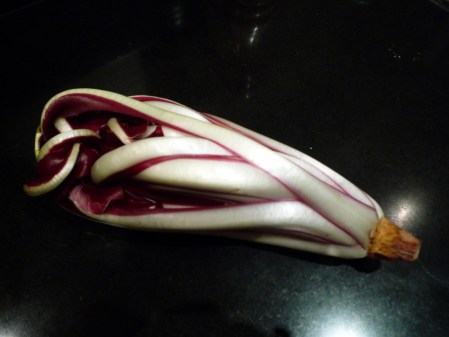
Many varieties are named after local towns but this one bucks the trend, tardivo simply meaning “late” in Italian. It’s produced by starting with the more common Radicchio di Treviso (which is a town in Italy) which then undergoes ra complex growing-forcing method of cultivation. This somewhat akin to our own home-grown Yorkshire rhubarb and producing a similarly startlingly-coloured beautiful plant to brighten up late winter meals. Sorry, but the season ended in March so you’ll have to wait until, say, next November to try it. Looks like I’ve been somewhat tardiva myself.

Don’t try and put tardivo into a salad – it’s best cooked either simply as a roast vegetable (see my recipe below) or used as an intriguing ingredient in other recipes.
I was searching around for more radicchio tardivo recipes and came across this one from on Italian recipe site Giallozafferano which in turn comes from the lovely blog La Salsa Aurora.
I’ve rather freely translated it and adapted it for flour we can easily buy in the UK. Be warned I haven’t tried the recipe myself yet so can’t vouch 100% for the quantities and timings. I really like the sound of a dark rolled-up pizza-style affair and think the inclusion of rye flour should work really well with the gutsy flavour of the radicchio.
Recipe for roast radicchio tardivo
This is my own tried and tested way of cooking radicchio more or less the way the Italians do it. It makes a good accompaniment to roast pork or veal. The slight bitterness of the roast leaves is very agreeable with rich-tasting fatty meats. Sadly the glorious magenta of the leaves turns to workaday brown when roasted.
Serves 4
Ingredients
4 good-sized heads of radicchio tardivo
4 tablespoons olive oil
Maldon salt and freshly ground black pepper
Preheat the oven to 180 degrees C (fan). Strip off any bruised outer leaves from the tardivo, rinse it under cold running water and shake/pat it to remove excess water. Cut in half lengthwise and cut out the bottom of the root by making a small V shaped notch in each half but keeping the half piece intact. Lay the halves on a baking tray, overlapping a little if necessary. Drizzle with 2-3 tbsp of the olive oil and sprinkle with salt and pepper. Bake for about 10 minutes, remove from the oven and drizzle with the remaining oil. Bake for 5 minutes’ more. It is done when the root is tender. The leaves will be thoroughly wilted and brown.
Recipe for savoury strudel with radicchio tardivo and mozzarella
Adapted from a recipe found on the Italian blog La Salsa Aurora.
Makes 2 strudels – serves 6 in total
Ingredients
150g rye flour
150g Allinson Seed and Grain bread flour
3/4 teaspoon instant dried yeast
3/4 teaspoon salt
160g water
a little extra virgin olive oil
150g approx of radicchio tardivo
3 mozzarella balls
salt and black pepper
2 tablespoons chopped parsley
Mix together the flours, salt and yeast. Add the water and mix with a wooden spoon. Leave for 10 minutes, covered, then knead in the bowl briefly and rest again for 10 minutes. Repeat twice more then lightly oil the dough, cover and leave to prove for 1 hour.
Whilst the dough is proving, prepare the filling. Drain the mozzarella balls and tear into rough pieces with your fingers. Set aside.
Wash, dry and trim the radicchio and separate it into individual leaves. Set aside.
Preheat the oven to 200 degrees C (fan).
Once the dough has proved, knock it back and divide it into two equal pieces. Roll out the first piece reasonably thinly into a rough rectangle (as if you were making a rectangular pizza) and transfer it onto a baking sheet, stretching it into shape. Scatter over half of the mozzarella and radicchio and drizzle liberally with olive oil. Season with salt and pepper and sprinkle over half the chopped parsley. Roll up and press the dough edges together, moistening the dough to achieve a good seal. Drizzle with more olive oil and scatter a little sea salt over the surface.
Repeat with the second piece of dough.
Bake for approximately 20 minutes.
Cameroon breakfast
March 30, 2013 § 2 Comments
The latest in our Breakfasts of the World Project series.
Until the recent kidnapping of a French family in the far north of the country, football had been the only reason Cameroon hit the international headlines. The national team “Les Lions Indomptables” in their red, green and yellow strip echoing the national flag, has the best World Cup track record of any African nation. Cameroonian player Samuel Eto’o is reputedly football’s highest paid player under his contract with far-flung FC Anzhi Makhachkala (Russian Premier League).
Irregularly-shaped Cameroon is situated on Africa’s West coast between Nigeria to the North and West and Equatorial Guinea and Gabon to the South. The country’s name derives from Rio dos Camarões – river of shrimps – the name Portuguese explorers gave to the region. Cameroon first became a German colony but was divided between France and Britain post First World War. Independence and the merging of the two parts of the country occurred between 1960 and 1961 with Yaoundé as capital city.
Our chosen menu was beignets, also known as Puff-Puffs – a simple deep-fried yeasted doughnut, and also bouilli d’arachides, a peanut-butter enriched version of sweetened maize porridge.
Inspiration for the menu came from Californian aid worker and blogger Mara’s post here and also the clear and eminently readable Cameroonian and African food blog Ma Cocote. Reading through these posts you immediately gain a snapshot of this incredibly varied country. The food names – bouilli and beignets are French words, a legacy of the country’s colonial past. Mara talks about the bouilli being the evening meal breaking the Ramadan daylong fast. Although Christianity is nominally the dominant religion, a significant minority of the population (about 20%) are Muslim. Cameroon extends north to the fringes of the Sahara desert with its Extrême Nord province bordering on Lake Chad. In contrast, the south east of the country is equatorial rain forest territory, home to the Baka people (formerly referred to as pygmies).
Mara gives a sketchy recipe for bouilli so rather than following her instructions to the letter I did my own thing. I used a quick-cook polenta made up according to the packet instructions but with half milk and water instead of water alone. I then added sugar to taste and finally a big dollop of peanut butter plus an extra drizzle of milk.


The resulting mush was pronounced “OK” by the family – a bit bland perhaps but a soothing easy-to-eat breakfast that, with the addition of peanut butter, really packs in the calories.
The Puff Puff doughnuts were a different story altogether. These disappeared in seconds! I give below the recipe I adapted from the Ma Cocote blog. It’s a simple yeast-raised batter made with just milk, water, flour, salt, sugar and instant yeast which, after proving, is dropped into your deep-fat fryer. For authenticity I fried the doughnuts in peanut oil which gives a very good non-greasy and nicely flavoured result (I find sunflower oil has an unpleasant greasy taste). To achieve a perfectly spherical Puff Puff the recommended technique is to get in with your hands and extrude the batter from your partially clenched fist. I wasn’t brave enough to try this in the frying-station I’d set up in our garage but I think the spoon-shaped ones were pretty creditable for a first attempt.


Recipe for Beignets (Puff-Puffs) – Cameroonian doughnuts
Adapted from a recipe in Cameroonian food blog http://www.macocote.com
Makes about 20.
Ingredients
175g strong plain flour
175g ordinary plain flour
5g fast action dried yeast (the type that can be mixed straight into the flour without the need for prior activation)
75 golden caster sugar
1/2 teaspoon salt
300ml milk and water mixed at room temperature (no need to warm)
MIx the dry ingredients together thoroughly in a large mixing bowl.Add the milk and water mixture and stir well to combine into a thick batter. Cover and leave to prove until the batter has become very bubbly and puffed-up. This is likely to take at least an hour, maybe two and will happen more quickly if the bowl is left in a warm place.
Drop tablespoons of the mixture into a deep-fat fryer ideally using peanut oil. Fry at 190 degrees C for about 7 minutes, turning the doughnuts over halfway through the cooking time. They are ready when they are a deep golden brown. Drain on kitchen paper, sprinkle with caster sugar and serve immediately.
More Proper Puddings – Individual Spotted Dicks
March 5, 2013 § Leave a comment
It was back in February 2010 that I last wrote about good old-fashioned English puddings so it’s high time I returned to the subject. Yes I know it’s March now so technically we’re in what the Met Office calls Spring but looking out of the window this morning there’s a sharp frost on the ground so a warming suet pudding would still be very welcome.
I have a weakness for traditional suet puddings which have an undeserved reputation for heaviness. Carefully made, ideally with freshly grated beef suet rather than Atora, they can be beautifully light.
Tracking down an authentic Spotted Dick recipe from my quite extensive collection of recipe books proved surprisingly tricky. After leafing through Mrs Beeton, Jane Grigson, Delia, Prue Leith et al I’d drawn a blank. The only recipe named Spotted Dick I could find was in my trusty battered old copy of The Good Housekeeping Cookery book. This very simple recipe includes just suet, flour, breadcrumbs, currants,milk to bind and a flavouring of grated lemon peel. It’s shaped into a neat roll shape, enclosed in greaseproof paper and foil and steamed for 2 hours.


The traditional roll-shaped pudding worked just fine but I was after something a little daintier and more appealing to a suet pudding first-timer. I tried the same mixture shaped in individual pudding moulds first steamed and another batch water-bath baked for just an hour. This didn’t work half so well and in the case of the baked pudding was really quite unpleasant – stodgy and oily. I concluded that long steaming to allow the ingredients to meld properly was important.
I then sought inspiration from 2 further places – 1) the ingredients list on the pack of Marks and Spencer individual Spotted Dick puddings (yes,really, and rather good too!) and Mrs Beeton. Mrs Beeton may not have a pudding called Spotted Dick but she does list countless different suet puddings many of which contain eggs and more flour than my recipe.
After a little tweaking and experimentation (adding eggs and more milk to give a softer batter-like texture, increasing the flour, soaking the currants in cold tea overnight to make them beautifully moist, adding a little ground allspice to lift the flavour) I came up with my own recipe below which I think is a winner and can hold its own with its Marks and Spencer counterpart both in terms of appearance, flavour and texture:
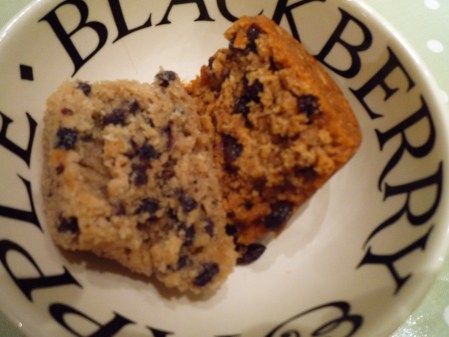
Don’t forget to serve with plenty of proper custard!
Recipe for Individual Spotted Dicks
Adapted from a recipe in “The Good Housekeeping Cookery Book”. Makes 7
Ingredients
150g plain flour
3 level teaspoons baking powder
150g fresh white breadcrumbs
112g suet
210g currants soaked for several hours or overnight in tea
75g golden caster sugar
level teaspoon ground allspice
grated rind of 1 and 1/2 lemons
2 medium eggs, beaten until lightly frothy
75ml-125ml milk (3-5 tablespoons) to mix to a soft dough consistency
1. Lay out 7 individual pudding basins in one or two large lidded casseroles or saucepans. There’s no need to grease as the suet will do this for you as it melts during steaming. I use Lakeland foil disposable basins available in packs of 50. Preheat an oven to 160 degrees C if you plan to steam in the oven.
2. In a mixing bowl stir together thoroughly the flour and baking powder. Add the crumbs, suet, sugar and lemon rind to the bowl and stir to mix.
3. Add the drained currants, beaten eggs and 75ml (3 tablespoons) milk. Stir until well blended adding a little more milk if necessary until you achieve a soft dough consistency.
4. Divide the mixture between the pudding basins, placing them back in the steaming pan. Cover each one tightly with foil. You can judge whether the basins are equally filled either by eye or more accurately by weighing them on some digital scales. My filled basins weighed 140g each including the 4g weight of the empty foil basin ie the weight of mixture was 136g each.
5. If you’re steaming in the oven, place the pan in the oven then fill with boiling water from the kettle to come half way up the sides of the puddings. If you’re steaming on the hob, again place the pan in position and add boiling water from the kettle.
6. Steam for 2 hours. Turn out (you may need to run a knife round the edge of the basis first) and serve with lashings of proper custard.
Castelfranco radicchio
February 22, 2013 § Leave a comment
Since discovering the Natoora range of unusual vegetables and salads now supplied by Ocado I’ve become obsessed by trying every kind of radicchio on offer. Radicchio originates from the Veneto region of Italy and many of the varieties are named after local towns.
First up is the gorgeous Castelfranco radicchio with its cream and deep-red variegated leaves:
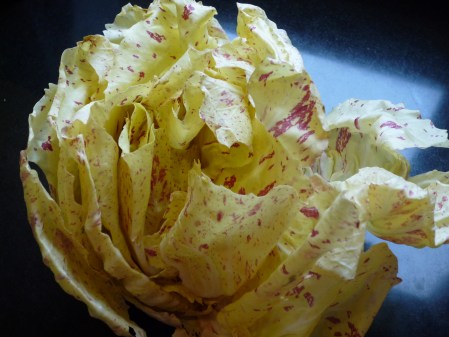
It’s as pretty as an old-fashioned rose and you just have to admire it before adding it to your salad bowl:
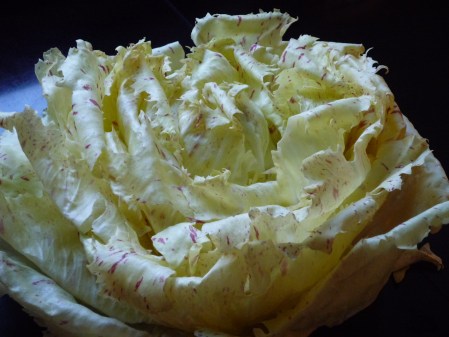
The delicately bitter leaves of Castelfranco are best suited to salads which brighten up the winter table. The leaves are not as delicate as they look either in flavour or texture so partner well with robust ingredients such as bacon, citrus fruits and nuts.
Here’s one of my recent slightly over-the-top lunchtime creations:

Here are the recipes for two simpler salad recipes, the first from Italy’s legendary “Il Cucchaio d’Argento” cookbook, and the second inspired by a Skye Gyngell recipe published in 2011 in her Independent column. Finally, another “Il Cucchaio d’Argento” recipe, this time for ricotta and walnut stuffed Castelfranco leaves which are briefly blanched in boiling water before being used to encase the filling.
Recipe for Castelfranco radicchio and pancetta salad
Adapted from a recipe in Il Cucchaio d’Argento. Serves 4.
Ingredients
250g Castelfranco radicchio
200g cubed pancetta
Maldon salt and freshly ground black pepper
A few spritzes of white balsamic vinegar (optional)
Lightly toasted small slices of baguette/ciabatta/country bread to serve
Detach the leaves from the radicchio head and wash and dry them carefully. Arrange them attractively on a large salad plate.
Place the cubed pancetta in a frying pan and heat gently to render the fat. Once the fat is rendered increase the heat and cook until the pancetta is lightly browned.
Pour the pancetta and its rendered fat over the Castelfranco leaves, crumble over a flew flakes of Maldon salt and a few twists of black pepper and quickly toss the salad to distribute the pancetta and its fat evenly. If likes, spritz the leaves lightly with white balsamic vinegar (you can buy it in plastic bottles fitted with an atomiser top).
Serve with lightly toasted small slices of toasted bread alongside.
Recipe for Castelfranco radicchio, orange and hazelnut salad
Adapted from Skye Gyngell’s recipe published in the Independent on Sunday in January 2011. As the author says, it makes a refreshing winter salad, perfect as a light first course.
Serves 4
Ingredients
1 small to medium head Castelfranco radicchio
handful shelled blanched hazelnuts
2 oranges, preferably blood oranges
1 teaspoon Dijon mustard
1 tablespoon red wine vinegar
3-4 tablespoons hazelnut oil
Maldon salt and freshly ground black pepper
Remove the leaves of the radicchio from the head, wash, dry carefully and tear into large pieces. Arrange in a salad bowl or on a serving platter.
Lightly toast the hazelnuts in a dry frying pan being careful not to let the toast too much. Chop roughly and sprinkle over the salad leaves.
Cut the peel and pith off the oranges using a very sharp and/or serrated small knife. Slice the naked oranges into pinwheel shapes and arrange these over the salad.
Finally make the dressing by whisking together in a small bowl the mustard, red wine vinegar, 3 tablespoons hazelnut oil and a little salt and pepper. Taste and add more oil,salt and pepper if required to balance out the flavours. Spoon the dressing over the salad using just as much as required as the salad should not be overdressed.
Recipe for Castelfranco radicchio rolls stuffed with ricotta and walnut
Adapted from a recipe in Il Cucchaio d’Argento. Serves 4.
Ingredients
10 large handsome Castelfranco radicchio leaves
100g ricotta
2 tablepoons freshly grated parmesan cheese
20 walnut halves (I like Serr walnuts from Chile available from Sainsbury’s)
1 egg yolk
salt and pepper
butter for the baking dish
Preheat the oven to 180 degrees C.
Blanch the radicchio leaves a few at a time in a large pan of boiling salted water for 1 minute. Remove and set out to dry carefully on clean teatowels.
Roughly chop the walnuts and put them into a bowl along with the ricotta, a little freshly grated parmesan, salt, pepper and egg yolk. Mix thoroughly.
Put a tenth of the ricotta mixture onto each blanched radicchio leaf and roll to form a neat rolled bundle. Place each stuffed roll into a generously buttered baking dish, arranging neatly side by side.
Bake for 15 minutes and serve straight from the baking dish.
Bergamot preserves
February 8, 2013 § 3 Comments
I drink quite lot of Earl Grey tea and enjoy the instant flavour hit that bergamot can bring to an otherwise indifferent teabag. So when I recently saw bergamots on sale in their natural state for the first time ever I just had to buy a bagful. They’re a spherical greenish-gold citrus fruit the size of a small orange, a speciality of Calabria in Southern Italy. They don’t look anything special but scratch the surface of the skin and the powerful and unmistakeable aroma is released.

Having inspected and admired by bag of bergamots, the question was what on earth to do with them? They look a bit like small oranges and have a sour juice so they are obvious candidates for marmalade. I decided that for starters, I’d make a half-size batch of marmalade, modifying my favourite seville orange recipe to suit these strange and exotic citrus fruits.
I decided that a fine shred marmalade would be most appropriate so as not to overpower the preserve with overly-thick chunks of that highly aromatic peel. This requires carefully peeling the fruit with a sharp potato peeler, in a single spiral if you’re up for the challenge, then cutting the peel into the finest shreds possible with a sharp knife.
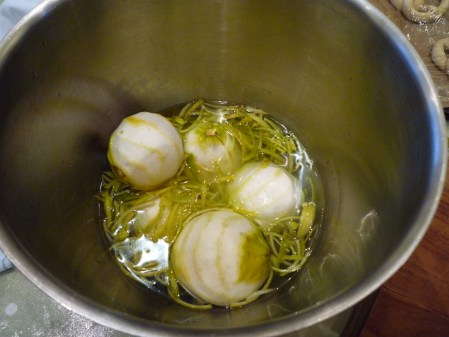
The shreds of peel together with a muslin bag containing the peeled half-fruit shells and pips are soaked overnight in the quantity of cold water specified in the recipe to which the squeezed fruit juice is added. This soaking has a dual purpose: it begins to soften the peel and helps dissolve the all-important pectin which is mainly contained in the white pith and pips.

The next day, the peel is boiled, partly covered, for a full 2 hours so that it softens thoroughly. It should be meltingly soft, the texture of overcooked pasta at this stage as, weirdly, once the sugar is added it stiffens up again.
The boiled liquid, once cool enough to handle is measured (or weighed if you prefer) in order to calculate the required quantity of sugar (450g sugar per 500ml liquid). Also at this stage you can decide whether you want to remove some of the precious bergamot shreds to achieve the right balance between clear jelly and pieces of peel. You could always try and crystallise any spare peel for an unusual cake ingredient.
You’re then finally ready to combine the calculated amount of sugar with the citrus liquid in a preserving pan to achieve a set. This shouldn’t take long so it’s essential to have all your preserving bits and pieces laid out and ready (sterilised jam jars and clean lids ready; jam thermometer and funnel to hand; and several saucers chilled in the freezer). It’s also worth tasting the liquid before you begin boiling to check acidity levels. The liquid should taste distinctly sour and if it doesn’t, you can add the juice of a further bergamot (or a lemon if you have bergamots to hand!) to the pan.
I would guess that the bergamots have a high pectin content as I achieved a set quite quickly (less than 15 minutes’ boiling) and rather suddenly. I took the mixture off the boil at about 103 degrees C, ie before the mixture reached my seville orange soft set temperature of 104.5 degrees C. The set I ended up with was quite firm though not the dreaded “rubber set” but ideally I’d have gone for something softer.
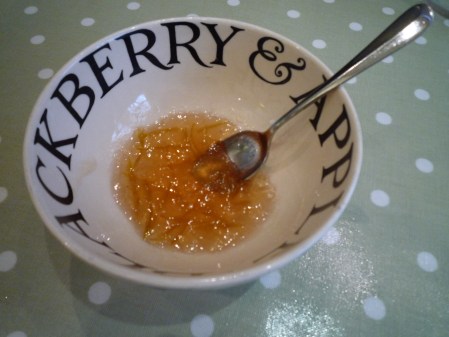
The end result was a delicately coloured marmalade with greenish tinge and, though I say so myself, exquisite flavour, not too sweet with plenty of acidity. My only quibble was that in a jar the marmalade looks a tad cloudy, and as I mentioned before, the set was just a little firmer than my personal ideal.
Rereading my notes from last year (should have done this before I started!) I see that one suggestion to avoid cloudiness is to skim regularly during boiling rather than adding a knob of butter to prevent scumming
I reckon the marmalade is still good enough to send off to the 2013 World Marmalade Competition so a jar is winging its way to Dalemain in Cumbria as we speak, entered under the “Any Citrus” category. Fingers crossed…
A fortnight later, the rest of the bergamots had ripened a little and become more golden in colour:
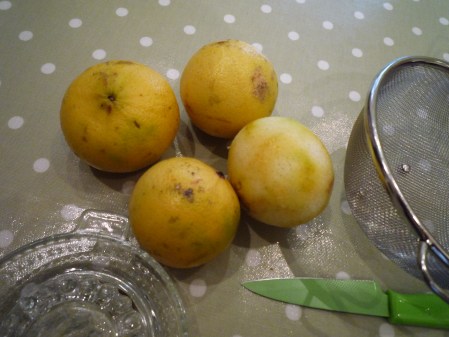
This lot were destined for an experimental batch of bergamot curd. I decided to use a lemon curd recipe, swapping the lemons for bergamots which are approximately the size of large lemons and have similar acidity levels. Recipes for lemon curd are many and various so, for simplicity, I chose one using whole eggs rather than just egg yolks. This gives the curd a tendency to become a little lumpy as the coagulation temperatures of yolk and white are different, but this is not a problem as the finished curd is sieved before potting.
You need to rig up an impromptu double boiler but this is easily achieved by setting a heatproof bowl into a pan of water and then it’s simplicity itself to combine the zest and juice with the eggs, butter and sugar:

The curd will thicken quite quickly but does requires constant stirring with a wooden spoon or balloon whisk as it does so. Once it’s passed through a sieve you’re ready to pot:
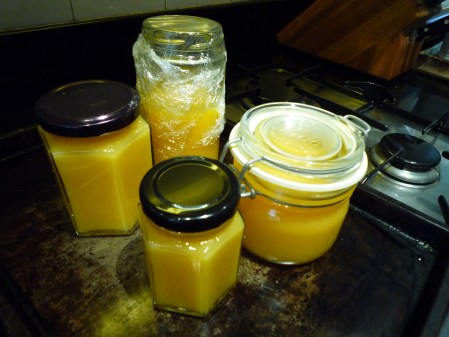
The end result is silky smooth, golden and packs a punch in terms of a powerful perfumed bergamot aroma. Personally I think it’s a bit much spread on your morning toast but it’s perfect for puddings, swirled through Greek yoghurt or combined with crème fraîche and fruit for a pavlova or roulade filling.
Recipe for Bergamot Marmalade
Makes approximately 1.1kg marmalade – 3 regular sized jars
Ingredients
850g bergamots
1.3 litres cold water
Approximate 1kg granulated sugar
1. With a potato peeler peel the skin from the bergamots, leaving as much white pith on the fruit as possible. Slice the peel into thin shreds and put into a large pan lidded pan.
2. Line a large bowl with a piece of muslin, leaving plenty to overhang the sides of the bowl. Cut the bergamots in half. With your hands, squeeze the juice from the fruit over the bowl, dropping the leftover squeezed fruit, pith, pips and flesh, into the muslin. Lift the muslin out of the bowl, gather the sides and squeeze any remaining juice into the bowl. Tie the muslin together to keep the fruit in and form a bag.
3. Place the muslin bag in the saucepan with the peel, leaving the top of the muslin overhanging the saucepan. Add the squeezed fruit juice and 1.3 litres cold water to the pan. Heat until boiling, then reduce the heat and simmer for 2 hours, until the peel is tender.
4. Remove the muslin bag and squeeze all the sticky juice from the bag into the pan. An easy way to do this is to put the bag in a colander and use a spoon to press it out. Measure the contents of the pan in a jug (or weigh in the pan using a suitable pair of scales having had the foresight to weigh your pan in advance). Return to the pan and add 450g of sugar for every 500ml liquid. Gently heat until the sugar crystals have dissolved. Increase the heat and boil rapidly for 5 minutes.
5. Test that the marmalade has reached setting point by putting a teaspoon of the liquid on a cold saucer and gently pushing with the back of a spoon. If the liquid starts to wrinkle, setting point has been reached. If no wrinkling happens, keep boiling and retest every 5 minutes. If using a sugar thermometer, setting point is likely to be achieved at about 102 degrees C. Turn off the heat as soon as you reach setting point.
6. Skim any scum from the surface. Leave the mixture to stand for 15 minutes. Stir gently, then carefully spoon into warmed sterilised jars. Put screw top lids on while the marmalade is still hot and turn upside down for 5 seconds to sterilise the lids.
Recipe for Bergamot Curd
Makes about 600g curd enough to fill 3 or 4 small jars.
Ingredients
4 bergamots
4 whole eggs, lightly beaten
150g unsalted butter, cut into cubes
350g golden caster sugar
Before you begin, you need to set up an impromptu double boiler. I did this by setting a medium sized metal mixing bowl over a large saucepan of cold water. It’s OK in fact desirable that the bowl sits in rather than over the water as it would if you were aiming to melt chocolate.
Grate the zest and squeeze the juice from the bergamots and put into the bowl part of your double-boiler set-up. A microplane grater makes grating the zest a doddle. Add the eggs, butter and sugar to the bowl, set it over the pan and turn on the heat. Stir with a wooden spoon regularly as it slowly warms through.
Once the water is boiling, keep stirring as the eggs coagulate and the curd thickens.
As I’m a curd-making novice, I checked the temperature of my curd once it looked sufficiently thickened and removed the bowl from the heat once it reached a temperature of 80 degrees C. This worked well as the finished product has a soft spreading consistency and for my taste is neither too runny nor too thick.
Don’t worry if your curd is not perfectly smooth as the next step is to push it through a sieve into another very clean and dry medium bowl. This removes the grated zest and any stray eggy lumps that may have formed.
Once the curd has been sieved, carefully spoon it into small jam jars sterilised in your preferred way. As the flavour of this curd is so intense, small jars are best. I like to warm them in the oven set to its lowest temperature of around 120 degrees C. Cover and once cool, the curd is best stored in the fridge.
 The Rhubarb Fool