
Apples of all kinds
September 30, 2010 § Leave a comment
In this season of mists and mellow fruitfulness I’ve been thinking about apples. I’ve always thought of them as the quintessential English fruit but looking at data on world apple production collated by the United States Food and Agriculture Association. I see that China rules the apple world producing an impressive 31 million tonnes in 2008. The US is in second place producing a mere 4 million tonnes. The UK languishes in 37th place with its meagre production of 243,000 tonnes, narrowly pipped (sorry I couldn’t resist the pun) by Switzerland’s 255,000 tonnes.
Apples featured during our trip to Switzerland this summer. The Swiss, like the English, claim the apple as their own. After all it was an apple that Swiss folk hero William Tell shot from his son’s head to prove his prowess in archery.
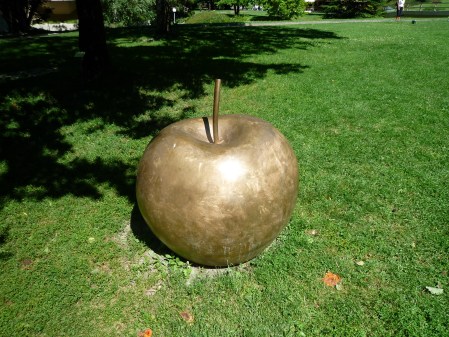
We saw this luscious golden version of William Tell’s apple in the sculpture park at Martigny, Switzerland which we visited in August. The artist is French sculptor Claude Lalanne (b. 1924)
And here is the real thing, apples growing in a ProSpecieRara orchard in what might be called William Tell Country, the shores of the Vierwaldstättersee (Lake Lucerne to the English speaking world, with iconic Swiss mountain Pilatus in the background. This was a view from the second week of our Summer 2010 Swiss trip as we ascended the Bürgenstock on foot rather than usual tourist option of funicular railway and spectacular outdoor lift.

By the way, ProSpecieRara http://www.prospecierara.ch/ is the Swiss Foundation for the Cultural and Genetic Diversity of Plants and Animals, a sort of super Brogdale. They hit the headlines recently with a taut-skinned longlived rare apple variety which is now being used in a facecream used by Michelle Obama.
I digress so back to the fruit itself. Apples from our neighbours’ garden greeted us on our return home in early September. Their enterprising daughters were giving away these beauties door to door in return for a donation to charity. I’m not sure what variety they were but they were crisp and sweet and worked well for both cooking and eating:

I was inspired to depart from the usual pie or crumble option and to try out two different apple recipes. The first was a new one for me, a traditional Brown Betty pudding, the recipe taken from the ever reliable Four Seasons cookbook. The second was the resurrection of what’s become a family classic, an apple and walnut cake from Nigella Lawson’ “How to be A Domestic Goddess”.
The apples turned out to be one that held their shape after cooking rather than “falling” into a delicious fluff in the way that Bramleys do. The Betty would have been better with a Bramley type apple I think as all the ingredients would have melded together. Served with a dollop of proper custard, it was nevertheless a satisfying conclusion to a ribsticking Sunday lunch:

Now that I’ve tinkered with Nigella Lawson’s cooking instructions (I’ve found that a lot of the recipes in the Domestic Goddess book need road testing and refining before they’re safe to use) this is a reliable recipe for an unusual but easy to make cake. The flavours of walnut oil and lemon zest, plus the grappa soaked sultanas (my refinement to the recipe which originally specified rum) marry perfectly with the apples and lift their flavour. You can almost kid yourself its good for you too.

Here are the two recipes in case you too have a glut of apples on your hands. They’re both good enough to go out and buy apples for too if you don’t have any homegrown ones.
Recipe for Apple and Apricot Brown Betty
From Margaret Costa’s Four Seasons Cookery Book. I’ve tinkered with it only to adjust the dried apricot instructions as these days all you can find are the ready to eat type so no need to soak overnight.
Ingredients
1/4 lb (115g) dried apricots, the soft type ready to eat type, roughly chopped
1 and 3/4 lb (800g) tart cooking apples, peeled, cored and roughly chopped
6 oz (175g) coarse fresh white breadcrumbs
2 and 1/2 oz (70g) melted butter
2-3 oz (55-85g) blanched almonds
grated rind of 1 small orange
4-6 oz (115-175g) brown sugar (I used a dark soft Muscovado)
more butter for dotting
Toss the crumbs into the melted butter so they absorb it evenly. Spread a thin layer of crumbs onto the base of a porcelain soufflé dish. Cover with a mixture of the coarsely chopped apples, apricots and almonds. Sprinkle with a little orange rind and some of the sugar. Repeat the layers until the dish is full, finishing with a layer of crumbs. Dot with butter and sprinkle over any remaining sugar. Bake at 180 to 190 degrees C until golden and crisp. Good with cream, perhaps clotted cream, or proper custard.
Recipe for Apple and Walnut Cake
Adapted from a recipe in “How to be a Domestic Goddess” which in turn started life in Anna del Conte’s “Secrets from an Italian Kitchen”
Ingredients
100g sultanas
75ml grappa
150 ml walnut oil (or half and half mixture of walnut oil and extra virgin English rapeseed oil which I used)
200g golden caster sugar
2 large eggs
350g plain flour
1 teaspoon ground cinnamon
1 and 1/2 teaspoons bicarbonate of soda
1/2 teaspoon cream of tartar
1/2 teaspoon salt
450g eating apples (don’t use a Bramley type apple for this recipe as distinct nuggets of cooked apple are what’s required in the finished cake) peeled, cored and cut into small cubes (1/2 cm dimension is about right)
zest of a lemon
100g walnuts
Put the sultanas into a small saucepan and bring to the boil then set aside to plump up.
Line a 20cm/8 inch round cake tin with bakewell paper and preheat your oven to 180 degrees C.
Beat the oil and sugar together in a large bowl, and add the eggs one at a time, beating until it looks a bit like mayonnaise. A wooden spoon and some elbow grease work fine here. Add the dry ingredients to the egg mixture, folding in with a metal spoon. Stir in the apples, lemon zest, sultanas with any residual grappa and walnuts. The batter should be fairly stiff.
Spoon the batter into the prepared cake tin, level the surface and place in the preheated oven. After 15 minutes, reduce the temperature to 160 degrees C. After a further 30 minutes, check the cake and if it’s browning too quickly, cover the top with a disc of foil. The cake will be ready after an hour, or maybe an hour and fifteen minutes. Check with a skewer after an hour.
Let the cake stand for 20 minutes before turning out. It’s delicious eaten slightly warm but will behave better in terms of cutting into neat slices, if left overnight, wrapped in foil before you try it. I can’t comment on its keeping qualities as it’s never lasted more than a day or so in our greedy household!
Guten Morgen Von Österreich: Austrian breakfast
September 2, 2010 § 4 Comments
It was during winter holidays in Austria that I first began to gain an understanding of the German (in the widest sense) concept of gemütlichkeit (usually translated as cosiness but meaning much much more). At the Hotel Karl Schranz in the resort town of St Anton in the Tirol, this concept was embodied in the dining room with its wood panelling, flickering candlelight, pink linen napkins, and perfect attentive service. The eponymous Herr Schranz would occasionally grace us with his regal presence: the skiing wild child of the 1960s now transfigured into portly gentleman hotelier.
Herr Schranz clearly runs a tight ship as breakfast at his hotel was always an absolute delight – fruit juices decanted into glass jugs (my favourite being “Multivitamines” a bright orange concoction big on carrot and passion fruit juice); müsli and other cereals; delicious thick yoghurt; fruit salad; all kinds of jam, boiled eggs; and best of all wonderful bread – multigrain loaves thick with pumpkin and other seeds, rye bread, white bread and the distinctive and ubiquitous semmel white rolls.
Here is the Karl Schranz experience recreated at home as best I could:

A trip to Chorlton’s legendary Barbakan bakery and delicatessen provided most of what was needed in terms of wonderful fresh bread, cheese and ham. Chorlton is a suburb of South Manchester with a cluster of good food shops – the Unicorn grocery for fruit, vegetables and vegetarian items; Frosts the butchers for excellent meat (including unusual items like squirrel from time to time!) ; Out of the Blue fishmongers for properly fresh fish filleted in front of you, bags of clams and the like…is it worth moving house to have all this on my doorstep I wonder? For now, food shopping in Chorlton remains an occasional treat.
Here’s the Barbakan shop-front, a little unprepossessing from the outside but a real treasure-trove inside. My hands were too full and the shop too busy for me to take a good photo inside. On sunny Saturday mornings, the queue for fresh bread stretches out of the door so best to get there early.
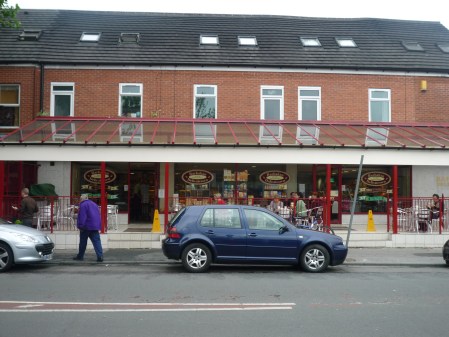
I’ve just checked out the website http://www.barbakan-deli.co.uk/ and see that they have recently won, very deservedly, the 2009/10 Manchester Food and Drink Festival’s “Best Food and Drink Retail Outlet” award.
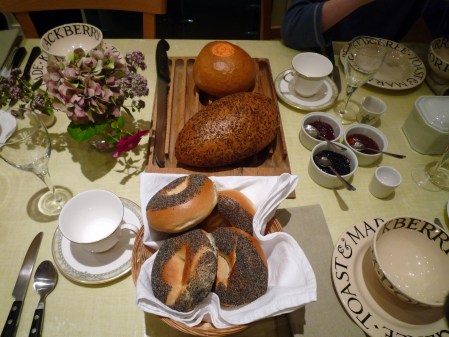
Barbakan’s 2 founders are Polish and much of their bread has a distinctly Eastern European feel – lots of rye loaves, and both caraway and poppy seeds are a preferred flavouring. Sadly on the morning I called they were fresh out of both Vienna sticks and Kaiserbrot, both of which would have been perfect for my Austrian theme. Instead, I opted for two loaves (German Altenburg rye bread “the true taste of Bavarian rye” , and a second rye loaf this one flavoured with caraway) and and some Polish poppy seed biegles, the originator of the modern US bagel. After all, poppy seeds are popular in Austria too most startlingly in the form of a main course germknödel (poppy seed dumpling) served with lashings of custard…I digress, so back to the bread, pictured below:
A true Austrian Hausfrau would have made all her own jams and preserves. Mine were all bought on this occasion, but as a nod to tradition I made a simple blackcurrant compôte to serve with yoghurt from the tempting looking punnet of blackcurrants that came from the Unicorn grocery just across the road:
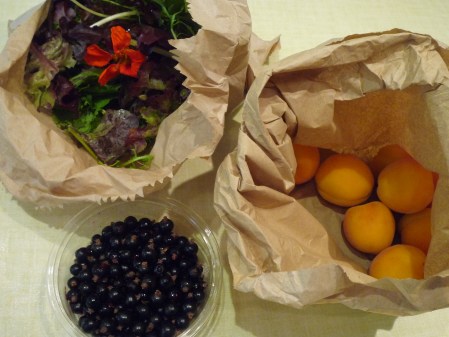
Pictured with the blackcurrants are an equally tempting bag of ripe apricots and the fabulous Glebelands Road grown salad leaves – you can’t get more locally grown salad than this unless it’s in your back garden of course.
Here’s the finished compôte together with yoghurt and some pumpkin seeds to sprinkle on top. Austrians are nuts about pumpkins in any shape or form. Especially good is the deep green roast pumpkin seed oil which gives a wonderful flavour to salad dressings and, drizzled on top, to pumpkin soup.

All very pretty, but it takes a lot of effort to keep up this gemütlichkeit business – fresh flowers from the garden, best china, freshly laundered napkins and so on. The Austrian Hausfrau must be chained to the kitchen keeping up appearances. So for now it’s back to toast and cereal on the usual crockery, until our next international breakfast, this time from Azerbaijan…
Barbakan contact details
67-71 Manchester Rd
Chorlton cum Hardy,
Manchester
M21 9PW
Telephone: 0161 881 7053
Swiss Cheese
August 19, 2010 § 1 Comment
Swiss cheese is much in evidence at the show dairy in the hamlet of Pringy on the outskirts of the village of Gruyères in Western Switzerland. And I don’t just mean the vast wheels of the stuff in the maturing cellars. There’s lots in evidence in the twee on-site restaurant and most of all in the knick-knack laden gift shop.
Picture-perfect Gruyères with its castle, quaint winding streets and Maison de Gruyère show-dairy is definitely a tourist magnet. On the day of our visit it was overrun with visitors of all nationalities including two improbably grown-up and portly troupes of boy scouts. We duly joined the queue for tour and museum tickets and after a short wait we were taken step by step through the story of the cheese. It all starts here with the alpine pasture:
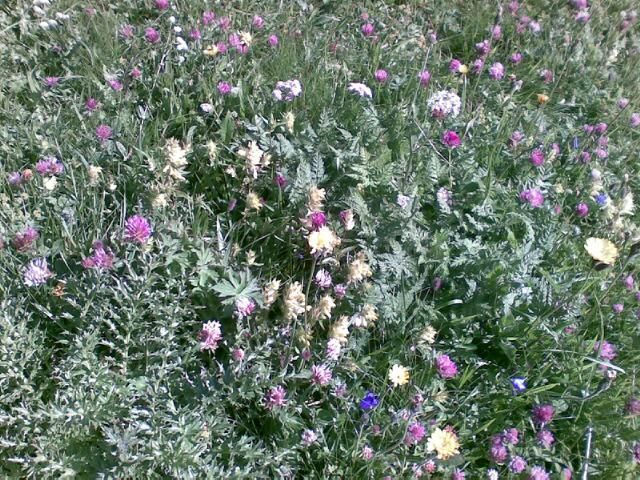
Well it does and it doesn’t as only the specially designated Gruyère d’Alpage is made in the summer from the milk of cows grazing the high mountain pastures. Just 56 dairies produce 400 tonnes per annum of this rare commodity whereas a total of 200 dairies produce 27,500 tonnes per annum of Swiss AOC (Appellation d’Origine) gruyère. Talking of AOC gruyère, the museum maintains a dignified silence on the subject of so-called French gruyère. The French cheekily awarded their own product national AOC status back in 2001 and subsequently went a step too far going for Europe wide PDO (protected designation of origin) status. Earlier this month the European authorities, quite correctly in my view, threw out the French claim. It’s a bit rich the French trying to protect their own so called gruyère cheese when they come down like a ton of bricks on smalltime producers of elderflower champagne…
Back to the genuine article. Swiss AOC gruyère can only be produced in a relatively small area centred around Gruyères itself within the cantons of Fribourg, Vaud, Neuchâtel and Bern. The milk comes not from what I think of as a traditional Swiss light brown cow but from the black and white or reddish-brown and white Fribourg breed. Each cow eats an astonishing 100kg of grass per day and produces as a result just 25 litres of milk. The traditional 35kg round of cheese is made from a generous 400 litres of milk. At the show dairy, they work with vats holding 4,800 litres of milk to produce 12 cheeses at a time. The morning milk is added to the previous evening’s milk (which has been stored overnight at a temperature of between 15 and 18 degrees C) before the cheesemaking process begins.
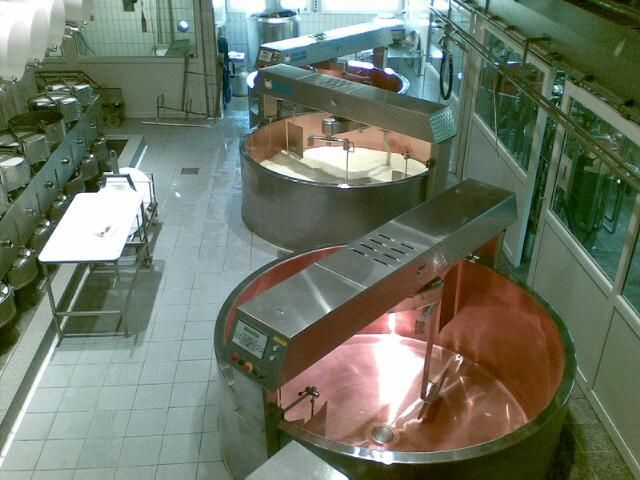
Gruyère cheese is often described as unpasteurised, but as the museum visit makes clear, the milk is gently heat-treated (to 57 degrees C compared to the 71 degrees C of the pasteurisation process) during the production of the cheese. The milk (presumably skimmed to remove the luscious Gruyère crème double much fêted in this part of Switzerland) is first heated to 32 degrees C before adding a natural starter culture (lactic acid fermentation agent in whey) and subsequently animal rennet. The starter culture matures the milk and the rennet causes it to coagulate into a mass. The coagulated milk or curd is then cut using large blades into small pieces. Judging the exact moment to begin the cutting is reckoned to be the trickiest part of the whole process.
The cut curds are then heated to 57 degrees C until the mixture becomes elastic and firm to the touch and the cut curds shrink to the size of small peas. At this point the whey is drained off and the curds ladled into moulds and pressed to form the virgin gruyère cheeses.

The fresh cheeses, vulnerably pliable at this stage, are soaked in a 20% brine solution which gives the cheese half of its ultimate salt content. Finally, the cheeses are placed on shelves of untreated pine (picea abies, the Norway spruce aka the Christmas tree) and left for a lengthy maturation process at a constant temperature of 13 to 14 degrees C. The cheeses are turned daily and brushed with salt solution as they mature. This no doubt used to be carried out by hand but the ever-ingenious Swiss have devised a robot to carry out this repetitive task. There is a certain fascination to be had watching the robot progress up and down the aisles of cheese.
5 to 6 months’ maturation produces a doux (mild) cheese; 7 to 8 months’ a mi-salé; 9 to 10 months’ a salé; +10 months’ a réserve; and finally 15 months’ a vieux. Older is not necessarily better in my book and I rather enjoyed the mild flavour of the youngest gruyère. Visiting the show dairy is a multi-sensory experience and helpfully you are given samples of 3 different ages of cheese to taste the difference. They become progressively more intense and savoury as they age.
You’re not normal if at this stage you haven’t developed an intense salivating urge to buy more cheese to take home. Might I suggest that you restrain yourself from joining the horrendous crush in the end-of-tour store and take a stroll up a grassy hill in the direction of the town of Gruyères itself. On the way, you will pass this traditional farmhouse:
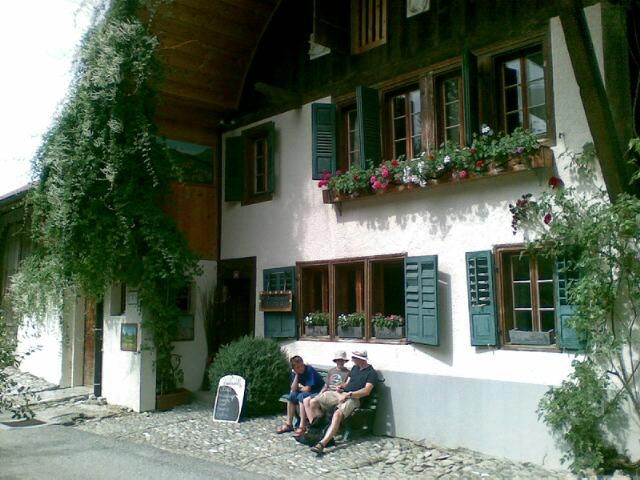
Ring the bell and the farmer’s wife will cut for you a wedge of authentic Gruyère d’Alpage. She also sells the fresh whey cheese known as sérac, a by-product of the gruyère cheese making process. This is what the local farmers used to eat themselves as the gruyère itself was far too lucrative a commodity for home consumption.
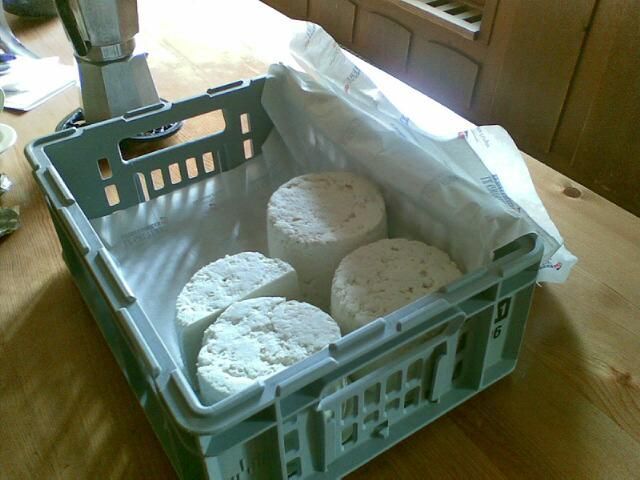
I initially thought that sérac must be a marketing man’s invention to make a plain cheese more enticing with a mountain-themed brand identity. A sérac is, as any mountaineer will tell you, the name of the rough ice lumps that form when a glacier undulates. It transpires that it’s the other way round. The cheese was named sérac first, with a possible derivation from the Latin word for whey, serum, and the glacial formation was named after the cheese in a fit of whimsy.
The farmer’s wife suggested eating the sérac as it came with salt, pepper and fresh herbs or using it as a cooking ingredient. I found a handy recipe for cooked sérac posted on the www.genevalunch.com website on 15 March 2010 by Jonell Galloway.
Finally, if all this sounds too touristy for you, how about a day’s foraging for wild plants in the lush Fribourg countryside? I saw an enticing little flyer for just such an adventure pinned up on the Maison de Gruyère noticeboard but didn’t have the time to take up the opportunity. The lady leading the foraging walks is Christine Brinkerhoff-Meier tel 00 41 (0)26 928 1429 ortieenfolie@hotmail.com. The tours run from 9.00 till 16.00 on Wednesdays, Saturdays and Sundays during the summer months.
Fondue Mongolian style
August 18, 2010 § Leave a comment
The yurt phenomenon shows no sign of going away: they seem to be springing up like a rash all over the place even in Langdale and the Forest of Bowland in my far flung neck of the woods.
We saw a night in a yurt advertised by the Montreux & Vevey tourist office during our recent visit to Switzerland and decided it might be fun to give it a try. We booked from the UK using the train company Goldenpass’s (the rebranding of what was formerly known as the MOB, Montreux Oberland Bernois railway presumably to appeal to English speaking tourists) efficient website.
The yurts are perched on the summit of the Rochers de Naye high above Montreux, and, bar a 5 hour hike, the only way up is on a little rack and pinion railway. We duly boarded our train late on Thursday afternoon and 50 minutes later we were in swirling mist on the summit. So much for the promised spectacular views…

We inspected our allocated yurt no. 3 first outside:

Then in:

There was little team enthusiasm for a short walk so Tim and I explored the vicinity whilst the boys were kept entertained by the little marmot zoo just below the summit.
Dinner was served at 7.00 in the transformed self-service restaurant. We gathered at the varnished pine tables for a prosecco apéritif along with 6 other parties, mainly Swiss family groups celebrating children’s birthdays. There was a simple menu choice between cheese or Mongolian meat fondue. It had to be the Mongolian fondue for us. A bubbling cauldron of evil-looking black liquid was shortly presented, along with a vast plateful of meat – a mixture of chicken breast and, bizarrely, ostrich. This would be a first in two counts, both my first Mongolian meal (though I do have a vague recollection of Mongolian barbecue establishments being the latest thing back in London in the 1980’s) and my first taste of ostrich:
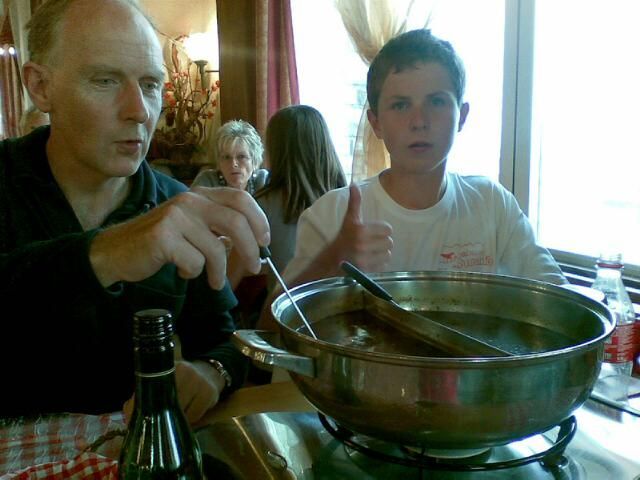
The evil black liquid turned out to be a fiercely salted and spicy broth spiked with pieces of leathery fungus. This was clearly a variant on the more usual Fondue Chinoise. We were spared having to drink the broth afterwards which is what usually happens once all the meat from a Fondue Chinoise has been cooked.
Pudding was a crème caramel served in self-service coffee cups. To complete the meal, I couldn’t resist the offer of some Vieille Prune Action, which turned out to be a surprisingly mellow Swiss plum brandy.

Searching for the perfect Pinte
August 15, 2010 § Leave a comment
No, not another piece enthusing about English beer but a story of trying to find something simple to eat in Vevey, a market town on the shores of Lac Léman (Lake Geneva) in the Swiss canton of Vaud.
During our summer tour of Switzerland I decided it was time to revisit some of my old haunts. Back in the late 80’s and early 90’s, I spent 4 winters in Vevey working in the offices of a certain international food company. There was a whole team of us out there (referred to unimaginatively as the Equipe) and we must have dined at pretty much every half-decent restaurant within a 15 mile radius of the town.
Back then, the gastronomical heights were occupied by the legendary Frédy Girardet in his restaurant in Crissier above Lausanne. Just about everywhere else was readily accessible and welcoming, serving up generous portions of Suisse Romande cuisine. It was here that I first encountered the Swiss custom of the deuxième service: finish one plate of steak, potatoes, vegetables or whatever and it is whisked away and replaced with an identical one! A blessing or a curse, depending on your point of view.
Something has happened in Vevey in the last 25 years. It’s come out in a rash of Michelin stars and Gault Millau points. For example, I remember Brent as a sleepy little village just above Vevey’s brash neighbour Montreux. It’s now home to Le Pont de Brent, celebrity chef Gérard Rabaey’s 3 Michelin star 19 Gault Millau points restaurant.
Vevey itself is home to Switzerland’s answer to Heston Blumenthal, Denis Martin, whose 2 Michelin star 18 Gault Millau point restaurant is in the Rue du Château, close to the swanky lakeside Trois Couronnes hotel.
With 2 boys in tow (one teenage and one nearly so), we weren’t really in the market for a lengthy candlelit molecular gastronomy session. We were looking for something simpler, a pinte Vaudoise in fact.
What’s a pinte Vaudoise I hear you ask. This is what the official website of the Office of Vaudois Wines www.vins-vaudois.com has to say:
“A recommended pinte vaudoise is a public establishment, all or part of which constitutes a welcoming village inn where you can have wine and a meal. Its primary purpose is to feature Vaudois terroirs, food specialties and A.O.C. wines. Their managers pay great attention to welcoming guests and training their staff to be Vaudois terroir experts. Recommended pintes vaudoises are friendly, so that guests feel like coming back and recommending them to friends.”
Talking of local wines and vineyards, even these have moved upmarket with the intricately terraced Lavaux vineyards becoming a UNESCO world heritage site in 2007. The Lavaux is the 30 km long lakeside strip of land running from the picturesque Château de Chillon in the East to the outskirts of Lausanne in the West.

Scanning the list of pintes available both from the tourist office and the Office of Vaudois wines website, we discovered that we were in luck. Included was the restaurant of our hotel, the Hôtellerie de Châtonneyre, right in the middle of the wine village of Corseaux. The Chât, as we English had christened the hotel, hadn’t changed a bit in 25 odd years. As far as décor and plumbing went, this was not necessarily a good thing, but it was good to see the menu just as I remember it. For a first night in Vevey, there was only one thing to order: Filets de perche, frais du lac:
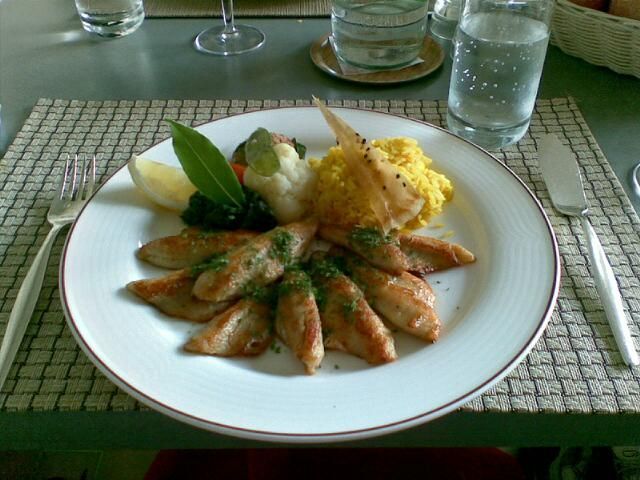
These small lake fish are found on most of the local restaurant menus. There was only one option to drink with them, a bottle of crisp white Chardonne from grapes grown on the hillside beneath which we were sitting on our sunny terrace.
The boys both ordered duck breast with potato galettes, equally delicious. Pudding was a rather wonderful gratin of raspberries (sabayon poured over fresh raspberries then the dish flashed under the grill to brown and caramelise just a little) served with a melon sorbet.
The next even we decided to visit another old haunt, the Auberge de l’Onde in the neighbouring wine village of St Saphorin. The lakeside village with traditional buildings and narrow winding streets is impossibly picturesque but not designed for the modern motor car as we discovered in an a frank exchange of views with a German registered SUV. You can sit outside on warm evenings:

We opted for the cosy dark wood panelled pinte dining room. It had about as much in common with a true traditional pinte as Heston Blumenthal’s pub does to a traditional British boozer. Why so? With the arrival of ambitious chef Patrick Zimmerman, the Auberge has been taken relentlessly upmarket and has gained a Michelin star and 15 Gault Millau points along the way. This means you won’t find many horny-handed locals supping here. On the night we dined, pretty much all the clientele were, like ourselves, tourists, from the UK, US and Italy.
Although the place felt rather precious, food and service were top class. I opted for the good value Menu du Jour featuring more lake fish, this time the féra (as far as I know unknown in the UK, Latin name Coregonus fera). This is a larger fish than the perch with firm white delicate tasting fillets, just right with the braised leeks, steamed potatoes and beurre blank type sauce with which it was served.
All well and good, but not truly authentic. It was not until we went back to the village of Chardonne where I rented apartment within the village house of Clos Jean-Louis that I spotted what I’d been looking for all along, the unassuming Café au Bon Vin. The menu features typical Vaudois dishes including the mysterious Malakoff. Apparently you can have two of these as a main course and if you like, a third in place of pudding. What were these things?
Thanks to the rather wonderful Swiss-authored food blog www.fxcuisine.com I discovered both that a malakoff is a deep-fried cheese stick and also found detailed instructions, photos and a recipe for whipping some up back home. I commend the blog to you.
Sadly, our discovery of the Café au Bon Vin was too late. We didn’t have time to try it out as we were en route to our mountaintop Mongolian yurt experience…
Edible municipal gardening in Switzerland
August 14, 2010 § Leave a comment
An idea from Switzerland that could work well back home. Municipal planting in the North of England where I come from tends to take the form of highly coloured highly regimented and highly maintained beds of marigolds, begonias, lobelia and the like. I saw recently in both Champéry and Vevey, two towns in la Suisse Romande (French speaking Switzerland), examples of edible flower beds.
In Vevey these were straightforward ornamental vegetables, rainbow chard, sweetcorn and tomatoes.
In Champéry, a more imaginative approach was taken. Herbs and edible plants were displayed in planters which formed a trail through the village with a recipe for the relevant edible plant displayed next to it. The recipes were compiled into a handy little brochure available from the tourist office.
Here are 3 of the recipes from the leaflet which appealed to me, including one featuring comfrey. Normally all my recipes are tried and tested but these are new to me. I shall be giving them a go as soon as I’m back in my own kitchen and can forage for the ingredients.
A photo of the planter containing comfrey (Symphytum officinale or consoude in French) appears at the bottom of the post.
Recipe for comfrey tzatziki
For 4 people. This recipe makes sense as tzatiki is usually made with cucumber and both comfrey and it’s cousin borage are said to have a cucumber-like taste. Rather worryingly, the original recipe states that comfrey should be consumed in moderation because of the potentially liver damaging compounds it contains. You have been warned!
Ingredients
300g natural yoghurt, ideally Greek style
6-7 young comfrey leaves
1 clove of garlic
1 tbsp olive oil
5 mint leaves, ideally wild mint
salt and pepper
Chop the comfrey and mint finely and mix with the yoghurt and olive oil. Season to taste. Leave for 1 hour in the fridge and mix again before serving.
Recipe for little elderberry cakes
Makes about 25 little cakes. These sound as if they’ll turn out like madeleines – I hope so as madeleines are just about my favourite small cakes.
Ingredients
150g flour
150g caster sugar
40g ground almonds (ideally bitter almonds)
2 teaspoons baking powder
The grated rind and juice of half a lemon
150-200g ripe elderberries removed from the stalk
3 eggs lightly beaten with a fork
150g melted butter
125g natural yoghurt
2 tbsp orange flower water
In a large bowl mix the flour, sugar, ground almonds, baking powder, grated lemon rind and elderberries. Take care not to crush the berries. In a second smaller bowl, mix the eggs, melted butter, yoghurt, lemon juice and orange flower water. Add the wet ingredients to the dry, mix and allow to rest in the fridge for 1 hour. Drop teaspoons of the mixture into prepared silicone moulds (I plan to use my silicone madeleine moulds, otherwise use patty tins). Bake for 12 to 15 minutes in an oven preheated to 220 degrees C. Leave for a few minutes before unmoulding.
Recipe for Charentais melon and wild mint salsa with melon and muscat sorbet and raw ham from the Val d’Illiez
Serves 4 I would guess. This is one of the sketchier recipes in the leaflet so please alter it as you see fit. No ingredients or method are given for the sorbet syrup so please consult your usual cookbook to see how to make this.
Ingredients
2 Charentais melons
1/2 cucumber
1 dessertspoon icing sugar
125 ml sugar syrup
Small glass Pineau de Charentes or other sweet muscat wine
4 handfuls salad leaves
4 to 8 slices Val d’Illiez or other raw thinly ham
Peel and deseed the melon and cucumber, cut into small cubes and marinate overnight in the fridge with the chopped mint and the spoonful of icing sugar. Liquidise and set aside.
To make the sorbet, peel and deseed the second melon, cube and liquids then mix with the 125 ml chilled sugar syrup and the small glass of muscat wine. Churn in an ice cream maker or freeze in a shallow plastic container stirring the mix from time to time.
Serve the smoothy and the sorbet with a few dressed salad leaves (use a vinaigrette flavoured with chopped wild mint) and scatter over the strips of raw ham.

Champéry and the Tour des Dents du Midi
August 13, 2010 § Leave a comment
The range of seven peaks known as the Dents du Midi (Teeth of the South) sits high above the Rhône valley in Western Switzerland and is tantalisingly visible from the shores of Lac Léman (lake Geneva).
After staring at these dreamy mountains for years since I first visited the area back in the 1980s I was finally going to approach them on foot via the long distance footpath called the Tour des Dents du Midi. If you were really up for it you could complete the walk in 2 long days: we decided to opt for the 4 day option making our base the picturesque alpine village of Champéry in the canton of Valais.
Wending our way up the Val d’Illiez towards Champéry we kept seeing roadside stalls selling Valais apricots. The Valais is named after the mighty Rhône valley which dominates the region. It is the warmest and sunniest part of Switzerland and is famed for its red wines and its fruit trees. I’d previously experienced Valais fruit in the winter in the form of hideously strong schnapps, pomme (apple), williamine (pear) and the like. At the third roadside stall we just had to break our journey to experience the fruit in its much more pleasant undistilled form:

Delicious, ripe and juicy, much more appealing than the bullet-hard pellets that pass for apricots in supermarkets back home.
Our base in Champéry was the comfortable and good value Beau Séjour hotel at one end of the village main street. It’s pretty as a picture, all dark wood and pink geraniums and the annexe rooms where we slept were spacious and well-equipped. The hotel doesn’t serve meals other than breakfast but this was not a problem as we strolled down to the excellent Café du Nord for dinner.
The Beau Séjour does do a fine breakfast, the highlight of which for us was cooking our own pancakes on a dinky electrically heated tabletop device. Sadly, looking out of the window from our cost breakfast table, the weather outside was, exactly as forecast, grim. Undaunted, we merely donned our waterproofs and set off from the Grand Paradis chairlift carpark. We had 6 hours walking ahead of us including 900m of ascent.
The showers stopped intermittently and we were rewarded with views of precipitous slopes and alpine meadows. We took a lunch break at the Cabane d’Antème, pretty basic with building work audibly in progress. Soup was reconstituted Maggi or similar and coffee was instant but the chocolate cake was the real deal.
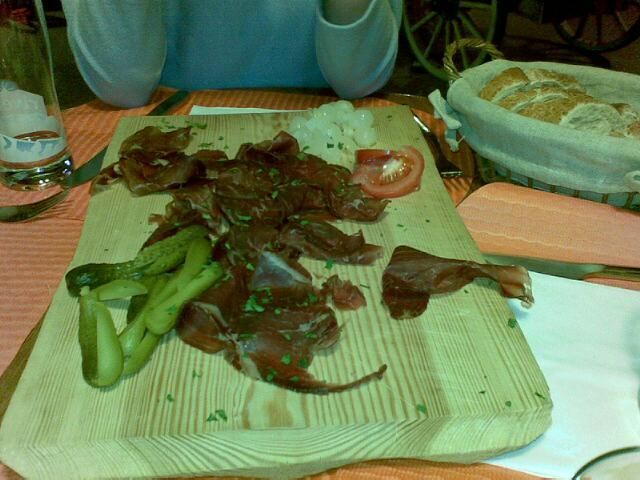
After another 3 hours’ trudging in the rain, the Alpage de Chindonne was a welcome sight bas we rounded our final corner. This was amazingly comfortable for a mountain hut, more like a small hotel, with prices too match! We were too late for the cheaper basic pasta meal, the répas du randonneur, so it was the à la carte option of viand sechée du Valais followed by the national Swiss potato dish, rösti.
Here is the board of viande sechée du Valais:
After a breakfast of bread and jam we set out on day 2 of our walk. Mercifully the rain had stopped and the sun broke through clouds and it became a beautiful day. A good thing too as we had 7 hours walking ahead of us. We spent the morning rounding the corner into the main Rhône valley arriving at the cliff top village of Mex in time for lunch. We then had a gruelling 1,000m climb up to the col du Jorat from where we could see down to our destination, the Auberge de Salanfe. By common consent this was the best hut of the tour. It has a spectacular lakeside setting, comfortable rooms, good food and efficient and friendly service. Dinner, a homemade vegetable soup and emincé de boeuf (beef casserole) with rice and vegetables, was wolfed down by all.

Day 3 turned out to be a relatively short 3 hour walk over the col to the Cabane de Susanfe as our planned peak, the Haut Cîme, 3,257m, turned out to be unobtainable because of the quantity of fresh snow down to 2,400m. We arrived at the Cabane at around lunchtime and spent a lazy afternoon in the sunshine rehydrating first on sirop de mélisse (homemade lemon balm cordial) and later on a microbrewery beer from Sion. Dinner was packet cream of asparagus soup followed by chilling con carne, then apple sauce for pudding. Sounds a little odd but it all tastes good after a day’s hiking. The Cabane de Susanfe is a genuine Swiss Alpine Club hut with just a coomunal dormitory and hut bunk sleeping arrangements. This proved the most difficult part of the walk: sharing a mattress with a pot-bellied snoring stranger is not my idea of fun….
After a slightly Spartan breakfast of homemade bread (good but not enough of it), jam and instant hot chocolate, we set off on the final leg of the journey back to Champéry and civilisation. After a tricky first hour we were through the steepest section of the walk, the Pas d’Encel, effectively the jaws of the valley. The buvette de Bonavau made a welcome break with tempting homemade fruit tarts on display:

Too soon it was back to civilization in Champéry. It was a sunny Sunday lunchtime and we were pleasantly surprised to find both the bakery open and a little market in full swing in the village centre. We stocked up on bread – both Valais rye bread with walnuts plus white bread for the softies in our party. The cheeses were a wonderfully ripe and stinky Tomme de Bruson from the neighbouring valley and a local artisan-made rinded goat cheese. The salami was chewy, flavoursome and flavoured with génepi. I think this variety of peach is called doughnut – they were small, fragantly white-fleshed and juicy.
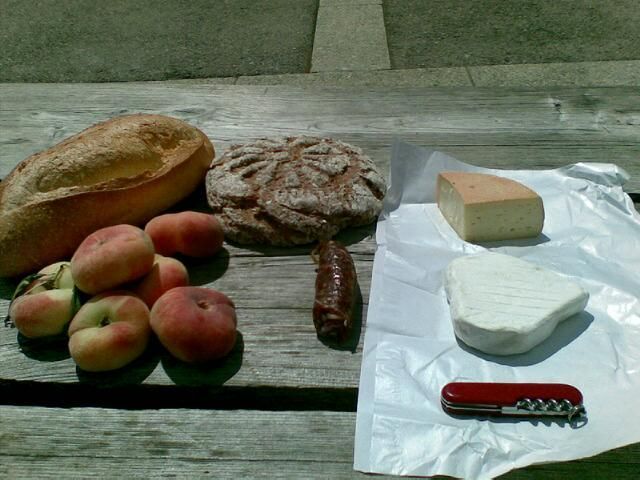
A perfect picnic to conclude a successful walk, even if the Haut Cîme remained out of reach this time.
Australian breakfast
August 4, 2010 § Leave a comment
Holy Dooley! What are these Cockroaches, Crow Eaters and Cane Toads up to! And you thought nothing was going on in the GAFA. There’s clearly more to an Australian cuisine than a billy and a Dingo’s breakfast (for a translation go to http://www.koalanet.com.au/australian-slang.html )
This was the latest in our series of breakfasts from all the countries of the world starting from A and going through to Z.
I decided to dive straight into the heart of Australia for inspiration for this breakfast and typed “Alice Springs breakfast menu” into my search engine. I half expected to discover something suitable for a sheep-wrangler but instead found some rather metropolitan on-trend suggestions from the Alice Springs Convention Centre. Selecting from their breakfast menu I devised this selection of my own:
Vegetarian frittata with sweet potato, peas and oregano tomato
Wattleseed french toast
Pancake with bush honey and crispy bacon
Next problem was where to get hold of the essential wattleseed and bush honey. An internet search led me first of all to Australian native ingredients evangelist Vic Cherikoff’s informative website to http://www.cherikoff.net (some inspiring recipe ideas too). He doesn’t really seem geared up to UK online retail orders though. Fortunately http://www.foodshopaustralia.com/ is a user friendly site with a wide range of stuff both gourmet and tacky. I ended up going a bit mad and ordering native fruit jams (both quandong and rosella), macadamia nut butter, bluegum honey, vegemite and Uncle Toby’s oat cereal as well as my ground wattleseed and to finish things off, a lemon myrtle infusion instead of regular tea. There was great excitement when my stuff arrived 2 weeks later in a distinctive blue hessian sack emblazoned with the Singapore post office logo through which my goods must have passed in-transit.

and here are all the Aussie goodies:

I made the French toast in the usual way but added a couple of teaspoons of Star Kay White chocolate extract to the milk into which I dipped the bread before dipping in the egg. This complemented the chocolate hazelnut flavours of the ground wattleseed. I sprinkled the cooked French toast generously with caster sugar and ground wattleseed and served it with a dollop of quandong jam. This was described as a native peach and was gorgeous, dark and syrupy – a more intense version of apricot jam. Delicious:

I devised my own recipe for the frittata which I give below. Also very successful – I’ve made it again since so I have a new addition to the repertoire. It’s shown here on the plate with the pancakes (again I used my regular breakfast pancake recipe) and some crispy pancetta.

Can I let you into a secret? I haven’t opened the Vegemite yet and maybe as the other stuff is so good I won’t bother…
Recipe for sweet potato, pea and oregano tomato frittata
I devised this based on an authentic Marcella Hazan recipe but with different ingredients and quantities to fit my trusty 10 inch Anolon non-stick frying pan. Serves 2-3 people.
Ingredients
2 medium sweet potatoes peeled and cut into 1 inch dice
2 tablespoons olive oil plus more for drizzling and cooking the frittata
Generous handful of shelled peas steamed for 2-3 minutes (or cooked from frozen)
8 oz cherry tomatoes
teaspoon dried oregano
tablespoon chopped fresh oregano or basil or marjoram
4 large eggs
4 tablespoons freshly grated grana padano cheese
salt and freshly ground black pepper
Toss the diced sweet potatoes in oil, season and roast on a shallow tray at 180-200 degrees C until cooked through and nicely brown. This takes about 30 minutes. Once these are in the oven prepare the tomatoes by halving, drizzling with olive oil and sprinkling with salt, pepper and oregano. Place on another shallow baking tray lined with baking paper and pop into the oven on the shelf below to roast with the sweet potatoes for about 20-25 minutes – they’ll be ready at the same time.
Meanwhile beat the eggs lightly with a fork in a large bowl, add the grated cheese, seasoning and chopped fresh herbs. When the sweet potatoes and tomatoes are ready, tip them into the egg mix straight from the oven along with the cooked peas. Stir to combine.
Heat a tablespoon of olive oil in a 10 inch non stick frying pan over medium heat. When it is hot, pour in the frittata mix and ensure evenly distributed. Turn the heat down as low as possible and cook for 10-15 minutes so that the mixture is set but not browned and only the top is still runny. Flash the top under a hot grill for 30 seconds to set the top. You’re ready to eat! Best served hot rather than warm I think. Also very good cold for lunch later if you don’t eat it all now.
Meringues like Katy Perry’s nipple tassels: lunch at Northcote
July 21, 2010 § 1 Comment
You know the ones I mean at the end of her fun “California Gurls” pop video feat. Snoop Dogg? http://www.katyperry.com/ Here they are balancing on my strawberry pudding with Kendal mint cake water ice:

So this is what funky head chef Lisa Allen gets up to in her spare time…
After years of thinking about it, I finally made it to Northcote (they’ve quietly dropped the Manor part of the name in an effort to sound up to date I think) in Langho, near Blackburn, Lancashire for lunch with my father Bob and stepmother Kath. It’s about an hour’s drive away which has been the problem all along – a bit too far for a convenient night out and a bit too close for a weekend away. By the way this Northcote is not to be confused with its namesake in Devon some 300 miles away in the SW of England.
A bit of background – Northcote is a small country house hotel founded in 1983. The business is owned 50:50 by chef Nigel Haworth and business partner from the hotel and wine trade Craig Bancroft. The restaurant gained a Michelin star in 1996 and has successfully held on to it ever since. Nigel has become well known throughout the UK in part thanks to regular appearances on BB TV’s “Great British Menu.” New head chef Lisa Allen stepped into Nigel’s shoes (he’s now executive chef) at Northcote 6 years ago aged just 23 and made her Great British Menu début earlier this year.
As you pull into the carpark, you wouldn’t immediately know that there’s anything special about the place. The hotel looks like what it is, a late Victorian gentleman merchant’s residence, comfortable, practical and solid looking rather than drop-dead gorgeous like its Devon namesake.
It soon becomes apparent that this is a slick and well run operation – everything happens smoothly and runs like clockwork. We were shown into the lounge area for drinks and the maître d’ quickly took us through the menu choices. I was delighted to find Lisa’s Great British Menu available in a number of formats as a lunchtime special so all 3 of us opted for that. Decision made. Here it is:
EITHER Levens Hall Wild Rabbit
& Leek Turnover, Piccalilli
OR
Wild Morecambe Bay Seabass, Shrimp Toastie,
Growing Well Tomato, Samphire
~~
Salt Marsh Lamb, Crushed Peas, Woodland Mushrooms,
English Onion and Sweetbread Fritter
~~
Sunny Bank Farm Strawberries, Meringue,
Quiggin’s Kendal Mint Cake Water Ice
I opted for the rabbit turnover, Bob and Kath for the seabass. After drinks in the bar served with the lightest-ever pea mousse with bread crisps as a nibble, we were shown to our table.
The dining room itself is simply decorated in pale colours eschewing the overpowering brocade and dark stained wood look that some of the houses of this period have. I liked the plain white napery, solid cutlery and understated glassware. Nothing too fancy and all of good quality which I suppose is the house style. The ladies’ cloakroom, always a bellwether of whether the management pay attention to detail, was rather lovely in a cosseting kind of way:

The only lapse of good taste was my flashy “lay” plate which seemed at first to be blue and white willow pattern type of decoration but on closer inspection proved to be a faux-aged mugshot of Nigel… Fortunately the lay-plate was soon whisked away and the more aesthetically pleasing starters arrived. Here’s my dinky rabbit turnover with deconstructed piccalilli:

The pastry was crisp and the rabbit fillet within flavoursome and juicy. I was reminded as I ate what a good pickle picalilli is making use of the now sadly out-of-favour cauliflower. I really should make some soon.
Next up was the rack of saltmarsh lamb- a suitably summery dish made by the inclusion of the sweetbread and onion fritter. Delicious with a lipsmacking contrast of textures and flavours. The portion sizes are not too large which is perfect for lunch:
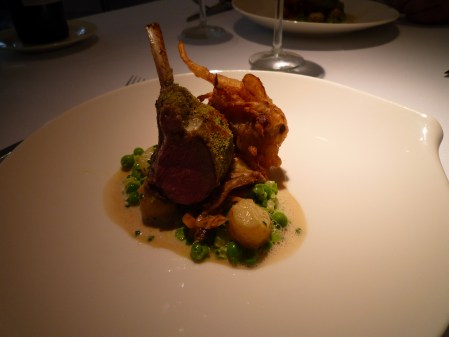
And then the rather glamorous strawberry pudding served in its Eero Arnio bubble-chair bowl on the now obligatory slate. I enjoyed the strawberry elements – a thin layer of jelly on top of strawberry mousse, plus whole fruit, also the textural contrast provided by those naughty little meringues but remain unconvinced about the mint flavour. The problem with mintcake is that it is a very pure mint flavour with all the green herbal elements removed but it is in fact these green herbal flavours that marry best with the strawberries. Having checked my trusty Harold McGee I think it’s the menthol which gives the pure almost medicinal mint flavour which is too predominant in mint cake whereas it’s the various terpenes and pyridines within the spearmint plant which give its fresh leaves their special aroma.
I felt quite starstruck when Lisa came out to meet us afterwards in her chef’s whites and clogs: she’s slender and elfin in appearance with a shock of ash-blonde hair, a bit like a young Annie Lennox. She is also down-to-earth and charming and is clearly passionate about what she does in the kitchen. It was a lovely way to round off our meal, along with the delectable miniature Eccles cakes.
Contact details
Northcote
Northcote Road, Langho,
Blackburn, Lancs
BB6 8BE
Tel: 01254 240555
Fax: 01254 246568
E-mail: reception@northcote.com
http://www.northcote.com/
Armenian breakfast
July 17, 2010 § 1 Comment
This is the latest breakfast in our family project to prepare and eat a breakfast from every country in the world in alphabetical order. The highlight was without doubt these plaited brioche-type breads called Choereg or Choreg which are in fact very simple to make once your plaiting technique is sorted out. As a little girl I had long hair often plaited so this was no problem.

What do I know about Armenia? Very little. “A landlocked country with Turkey to the West and Georgia to the North, Armenia boasts striking scenery with high mountains and caves, lakes and hot springs”. So says the BBC News website, along with a few other key facts: capital city Yerevan; population 3.1 million; land area 11,484 sq miles (ed: about twice the size of the English county of Yorkshire); major religion Christianity.
Armenia has a huge diaspora and famous Armenians or people of Armenian descent can be found all over the world: the composer Aram Khachaturian (whose Spartacus theme was used as the opening music for BBC TV series The Onedin Line) and singers Charles Aznavour and Cher are just a few examples.
This means too that there are many Armenians in Europe and the US wanting to recreate a taste of home, communicating with one another and sharing recipes which conjure up a taste of the homeland. Luckily for me, Armenian recipes are relatively easy to come by on the web,
I started my research with a visit to a Manchester institution, The Armenian Taverna which for as long as most people can remember has occupied discreet basement premises in Albert Square. It looks as if I was in the nick of time as, sadly, the restaurant went on the market last month.

Owner Mafif Alamyan (reputed to be a former Olympic wrestler) was most helpful when describing typical Armenian breakfast dishes. Eggs, tomatoes and cheese featured on his list as did Armenian bread. It was in describing the fruit of Armenia, both fresh and preserved as jam, that he became almost lyrical – he talked of green walnut jam, apricots (the Latin name for the apricot is after all Prunus armeniaca) , cherries and especially mulberries. I recommend a visit to the Armenian Taverna before it vanishes for ever http://www.armeniantaverna.co.uk/
Now I needed to flesh out Mr Alamyan’s guidance with some recipes. First stop was
http://www.thearmeniankitchen.com a vast repository of Armenian food and memories compiled by the Kalajian family now living in the US. Here I found a description of egg scrambled with tomatoes which seemed to fit the bill for a simple breakfast dish – so simple it doesn’t need a recipe, just Mr Kalajian’s simple instructions. “You cut up a tomato as chunky or delicate as you like and stir it into your eggs as you scramble them. Add salt and pepper and eat with bread”.
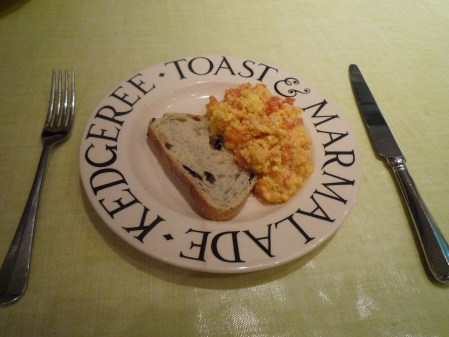
The next challenge was to try and locate mulberry jam. This could be tricky. The only mulberry tree I know of is Milton’s (so called because the poet sat and composed under its shade) in the Fellows’ Garden at Christ’s College in Cambridge. No way was I going to get permission to gather mulberries from there very easily. There had to be another way. Sadly I couldn’t find anyone selling mulberry jam made in the UK but specialist deli Mortimer & Bennett came up with the goods – a middle eastern mulberry jam made in the Lebanon. This would do nicely. Mortimer & Bennett are based in Turnham Green, West London and have a wide range of delectable and out of the ordinary deli items. They sell via their website as well as from the shop and I can vouch that they provide an efficient and personal service. My package of goodies (I just had to buy some oils and chocolate too as they offer free shipping if your order is £50 or more) arrived safe and sound a few days after ordering. Here’s the jam complete with rustic hessian lid cover:
http://www.mortimerandbennett.co.uk/

OK so the jam was now sorted so now for the bread. I found three Armenian bread/pastry recipes suitable for breakfast, the first Bishi (sometimes spelt BeeShee, sometimes also called Zeppole), a kind of doughnut, the second Keta, a walnut-stuffed Danish-type pastry and the third Choereg, a plaited sesame sprinked loaf enriched with eggs and butter (also spelt choreg and I reckon its similar to the Greek tsoureki too).
To make the most of the carefully sourced mulberry jam, I opted to make the plainest of the three breads, the choereg choosing a straightforward recipe contributed by Ani from Montreal which I found on Allrecipes.com. I give the recipe below but I did reduce the fat content of the recipe to just 8oz from the 1lb specified, similarly I used 4 eggs rather 5 – it still turned out spectacularly well.
A word on mahleb – this is a middle eastern spice made from the kernel of a special variety of cherry. I’d already started the recipe when I noticed this little bombshell in the list of ingredients so didn’t even attempt to track some down so added a slug of Amaretto and another one of Kirsch to try and provide the required almondy cherry flavours.
Recipe for Choereg – Armenian sweet plaited bread
Ingredients
1 cup whole milk (8 fl oz)
1 cup butter (8 oz or 225g)
1 cup white sugar (8 oz or 225g)
1/2 cup lukewarm water (4 fl oz or 120ml)
2 teaspoons white sugar
2 (.25 ounce) envelopes easyblend dry yeast
4 eggs (plus more beaten egg for glazing)
6 cups all-purpose flour plus more if required to obtain the right dough consistency (840g or 1 lb 14 oz) – I used a mixture of strong and ordinary plain white flour
1 1/2 teaspoons baking powder
1 1/2 tablespoons ground mahleb (see note above)
1 1/2 teaspoons salt
1 tablespoon sesame seeds
In a saucepan over medium heat, combine the milk and butter. Heat until butter is melted, but do not let it boil. Stir in 1 cup of sugar until dissolved, then set aside to cool to lukewarm. Crack the eggs into a large bowl, and stir a little to break up the yolks. Slowly pour in the heated milk mixture while whisking constantly, so as to temper the eggs and not cook them.
In a large bowl, combine the flour, sachets of easyblend yeast, baking powder, mahleb, and salt. Make a well in the centre, and pour in the wet mixture. Stir until it forms a sticky dough. Pour onto a floured surface, and knead in additional flour as needed to make a more substantial dough. Knead for about 10 minutes. Place in an oiled bowl, and set in a warm place to rise for about 2 hours, or until doubled in size.
When the dough has doubled, punch down again, and let rise until doubled. It will only take about half as long this time.
Separate the dough into 5 even portions, then separate each of those into thirds. Roll each of those into ropes about 12 inches long. Plait sets of three ropes together, pinching the ends to seal, and tucking them under for a better presentation. Place the loaves onto baking sheets. Loaves should be spaced 4 inches apart. Set in a warm place to rise until your finger leaves an impression behind when you poke the loaf gently.
Preheat the oven to 350 degrees F (175 degrees C). Brush the loaves with beaten egg, and sprinkle with sesame seeds.
Bake for 25 minutes in the preheated oven, or until nicely golden brown all over.
 The Rhubarb Fool