
Why don’t women drink beer?
July 13, 2010 § Leave a comment
I will certainly be drinking more beer after my recent Adnams of Southwold brewery tour. After all, what could be more refreshing than a pint of bitter on a warm summer’s evening? This particular beauty was pulled at the Red Lion on South Green in Southwold, Suffolk:

My fellow guests on the brewery tour were exclusively male and sadly mostly fitted the real ale stereotype of bellies, beards and sandals. It doesn’t need to be this way as, happily, our guide for the tour was master brewer Belinda, a no-nonsense microbiology graduate who seemed to have found her perfect niche in life. In a little over an hour, she gently demystified the brewing process throwing in a dashes of chemistry, history and folklore for good measure.
We started with the simple list of ingredients for making beer – malted barley, hops, water and yeast.
Barley first. Appropriately, the most commonly used variety is named “Tipple”. The degree to which the barley is roasted is key to the character of the finished beer – think of how different roast beans produce differently flavoured coffee. Here are some different samples of barley with different degrees of roasting:

My favourite for munching on (we were encouraged throughout to smell, taste and of course drink) was the enticingly named crystal malt (so called because the processing of the barley results in a glassy crystallised finish to the grain or endosperm as the experts call it). Crystal malt contributes biscuity, caramel flavours to the finished beer.
On to the hops. This was the part of the brewing process I particularly wanted to understand. I can’t count the times I have heard someone sniff their freshly pulled pint of beer and enthuse over its hoppy characteristics when all I could distinguish was a general beery smell. What would a hop smell like in isolation?
Belinda tipped a generous heap of dried hops onto a napkin on the table and invited us to smell them. I was first in the queue, almost sticking my nose into the heap, inhaling deeply. I smelt…absolutely nothing!

Belinda explained that the hop’s aroma is concentrated in the resin which is concentrated in the base of the dried flower in areas which have a brighter yellow colour. Rub these between your finger and thumb and the aroma is released…aah yes it worked. What I smelt was something a little floral, aromatic, even just a little acrid. A bit like the crushed leaves of pineapple mayweed or even camomile flowers. So this was the characteristic hop aroma I’d wondered about all these years.
I did some homework after the tour. Harold McGee’s amazing food science book “On Food and Cooking” (Heston Blumenthal’s bible) didn’t let me down when it came to hops. He explains that hops (Latin name Humulus lupulus) provide 2 different flavour elements in beer: bitterness from phenolic alpha acids (humulone and lupulone) in its resins and aroma from its essential oils. The aroma of ordinary hops is dominated by the terpene myrcene also found in bayleaf and verbena whereas other more exotic hop varieties are dominated by the more delicate humulene, also other terpenes such as pinene, limonene and citral which give piny and citrus aromas to the hops.
There’s a balance to be struck with hops – the bitterness only comes out after prolonged heating of the brew which of course destroys the aroma. To give the finished beer more aroma, a practice known as dry-hopping is used which means that hop pellets (they are most conveniently used in this form) are thrown into the brew after it has been boiled and they slowly infuse their flavours and aromas at a lower temperature. So beer has a lot in common with herb teas and tisanes and you can’t get much more ladylike than that!
Now for the yeast. This is perhaps the most mysterious of the ingredients. At Adnams they use their own special natural yeast strain which has been kept alive for years. It’s not the same as regular baking yeast but has in fact been used successfully for breadmaking by a Lowestoft baker in the past.
Finally the water, the simplest of the ingredients. Adnams now use the town supply carbon-filtered to remove unwanted chlorine rather than, as previously, water from their own well. Calcium chloride is added to the water to act as a catalyst for the various necessary enzyme processes.
In overview, the process for making beer is relatively straightforward: after all it used to be produced in the home as women’s work in the mediaeval period. It can be divided into 4 stages:
1. Preparing the wort. A mash is made with water and malt which is soaked for 1 and 1/2 hours then heated for 3 hours to produce a sweet coloured liquid which is drawn of ready for stage 2.
2. Boiling the wort – hops are added and the liquid is boiled both to add bitterness from the hops and to inactivate the malt enzymes and so fix the sugar and carbohydrate levels in the mix. The liquid is drawn off and sent to the fermentation tank ready for stage 3.
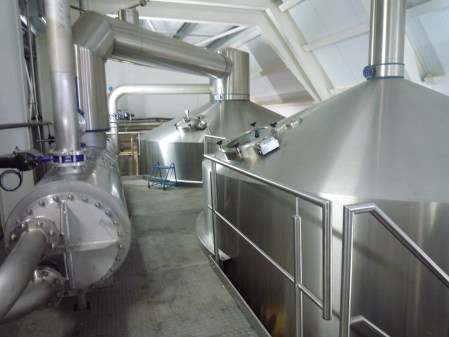
3. Fermentation. Yeast is added and the mixture is kept at a controlled temperature for fermentation to occur over a period of 2-10 days. During this period the yeast converts the sugar into alcohol and its byproduct carbon dioxide which gives the beer its fizz. Top fermentation is carried out at a higher temperature (up to 25 degrees C) and gives the beer a strong acidic flavour with fruity spicy notes. Fermentation at lower temperatures produces beer with a drier, crisper flavour and bready notes.
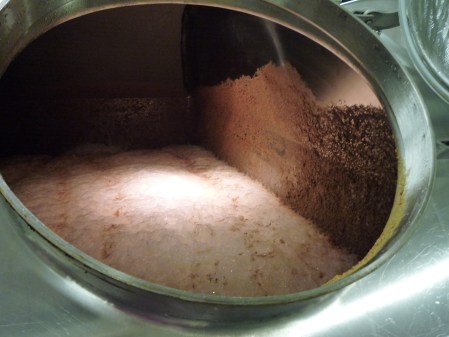
4. Clarification and conditioning
The yeast foam and from fermentation and dead yeast cells are removed by a combination of filtration and fining (adding an agent that attracts and collects the detritus in the beer making it easy to remove the whole lot in a lump. Intriguingly, isinglass, a gelatine like substance derived from fish swim bladders (originally sturgeon) is still used by Adnams as the preferred fining agent. Technically then vegetarians can’t drink beer. With a degree of pragmatism overcoming principle, it seems that the beers can still be deemed suitable for vegetarians as the fish derived content of the beer is so small.
The beer is then transferred to cask or bottle and the bottled beers are pasteurised to increase the shelf life. Secondary fermentation occurs in the cask so it is a living thing with a shelf life of just a few weeks hence the importance of a publican who knows how to keep his beer properly.
So, 4 ingredients, 4 processes – sounds simple but 8 building blocks can give you a seemingly infinite variety of outcomes. Think of music built on 8 notes of the scale or DNA built from just 4 bases…
Going back to my opening question, why don’t women drink beer, I think much of it is in the marketing. Scanning the list of names they give a distinctly masculine old fashioned wartime image (Bombardier, Spitfire, Barnstormer…) or else give an impression of a warm cloudy brew fit only for yokels (Tanglefoot, Waggle Dance, Grumpling). There are so many different beer styles out there that there must be something for everyone. If we could cut the old fart marketing and come up with something cleaner, simpler and more explanatory I think the breweries could be on to a winner in terms of opening up a whole new market beyond the CAMRA afficionados.
And yes, the tour did conclude with a comprehensive tasting of the Adnams range – drink all you like within reason!
World cup final sandwich
July 7, 2010 § Leave a comment
Looking for a snack to sustain you through the World Cup final next week? It’s looking as if it might be Germany v Holland, a grudge match if ever there was one, making Germany v England seem like a friendly….Now that England is out of the running, it’s possible to enjoy the football and contemplate eating whilst doing so.
I decided to take my inspiration from America, the nation of the sporting snack par excellence. I fished out the Superbowl edition of American food magazine Bon Appétit and decided to recreate the epic looking grilled cheese short rib sandwich with caramelized onions featured on the front cover.

It turns out that this is a speciality of restaurant Joan’s On Third in Los Angeles and was featured in the “RSVP” section of the magazine where readers’ favourite restaurant recipes are tracked down. Joan’s On Third looks amazing www.joansonthird.com: New York deli meets California cuisine. Imagine having somewhere like that on your doorstep…I digress. Back to the sandwich for which I give the full recipe below. Truthfully, the recipe is a little involved but the beef and onions can be prepared in advance ready to assemble into a sandwich at the right moment.
My first problem was finding out what the heck a short rib was. First stop David Rosengarten’s “It’s All American Food”. He says “Interest in cooking short ribs at home has been rekindled by the short rib boom in trendy restaurants. Americans across the map have rediscovered the comforting deliciousness of collagen-rich cuts of meat…melting down in a pot… into soft and buttery puddles of protein.” OK I get the picture and my appetite is whetted but what is it?
Hugh Fearnley Whittingstall to the rescue in his “Meat Book”: it’s a small rack of ribs from the flank, ie the forequarter just behind the front leg. This is the cow version of the more familiar rack of pork spare ribs and shares with that cut its sticky, juicy characteristics best brought out by a long slow cooking. Happily, my local butcher in Hale knew the cut (sometimes referred to as Jacob’s Ladder) and, with a couple of days’ notice, came up with the goods – a Desperate Dan super-sized rack of ribs which he helpfully sawed into manageable chunks.
Here they are, ready to begin the recipe which follows:

Recipe for grilled cheese and short rib sandwiches with pickled caramelized onions and arugula (rocket)
Serves 8
Ingredients – short ribs
5 pounds beef short ribs
1/2 stick (4 oz) butter
3 celery stalks, chopped
2 large carrots, peeled and chopped
1 medium onion chopped
1 and 1/4 cups (10 fl oz ) red wine
1/2 cup (4 fl oz) low salt beef stock
1/2 cup (4 fl oz) medium dry sherry
2 garlic cloves, peeled
2 bay leaves
1 large fresh thyme sprig
Here are my ingredients ready to go. I used all-American Quady’s Vya Vermouth instead of the sherry as that’s what I happened to have open.

Ingredients – pickled caramelized onions
1 tablespoon butter
2 large red onions, halved and thinly sliced crosswise
4 and 1/2 tablespoons red wine vinegar
1 and 1/2 teaspoons sugar
Ingredients – final assembly
Softened butter
16 slices country-style crusty white bread (or a crusty sourdough if you like)
12 oz Petit Basque or Monterey Jack cheese, sliced (or your favourite semi hard cheese suitable for melting- Taleggio would be good; I used a stunning unpasteurised Gorwydd Caerphilly)
4 cups (generous handfuls) baby arugula (rocket)
SHORT RIBS. Sprinkle beef with salt and pepper. Melt butter in a large wide pot over medium-high heat. Working in 2 batches, cook beef until browned, about 6 minutes per batch. Transfer to large rimmed baking sheet (to catch the juices). Add celery, carrots and onions to pot and sauté until beginning to soften and brown, stirring often, about 5 minutes. Add wine, broth, sherry, garlic, bay leaves and thyme sprig; bring to boil, scraping up browned bits. Season with salt and pepper. Return ribs to pot, propping up on sides and arranging in single layer.
Here’s what they look like at this stage:

Cover, reduce heat to medium-low, and simmer 1 hour. Using tongs, turn the ribs over in the pot. Cover and simmer until ribs are tender and sauce is very thick, occasionally rearranging ribs in pot to prevent sticking, about 1 and 1/2 hours longer.
This is what the cooked ribs look like:

Uncover and cool 30 minutes. Transfer ribs to work surface. Discard bay leaves and thyme sprig. Spoon off fat from sauce in pot. Remove meat from bones; discard bones. Cut meat into 3/4 to 1 inch pieces, trimming any fat. Return meat to pot. DO AHEAD. Can be made 2 days ahead. Chill until cold; cover and keep chilled. Rewarm just until lukewarm before using.
PICKLED CARAMELIZED ONIONS.

Melt butter in large skillet (heavy-based frying pan) over medium-high heat. Add onions, sprinkle with salt and sauté until beginning to brown, stirring frequently, about 10 minutes. Add vinegar and sugar and cook until almost all vinegar is absorbed, about 1 minute. Season with salt and pepper. Transfer to microwave-safe bowl; cool. DO AHEAD. Can be made 2 days ahead. Cover; chill. Microwave in 15 second intervals until lukewarm before using.

ASSEMBLY. Line 2 large baking sheets with waxed paper. Butter 16 slices bread. Lay 8 slices, buttered side down onto the the prepared sheet. Divide the short rib mixture among the bread slices. Divide cheese among sandwiches. Spoon onions over sandwiches. Place handful of arugula (rocket) atop the onions. Top with remaining 8 bread slices, buttered side up. DO AHEAD. Can be prepared 1 hour ahead. Cover with plastic wrap and store at room temperature.
Heat 2 large skillets (frying pans) over medium heat. Working in batches, cook sandwiches until bread is golden brown and cheese melts, about 3 minutes per side.
Here are my sandwiches in the pan. I slipped the pans into a 180 degree C oven for 3 or 4 minutes to complete the cooking without burning the bread.
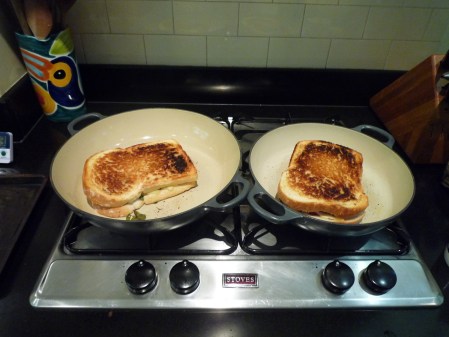
Transfer cooked sandwiches to work surface. Cut each in half on diagonal. Transfer to plates and serve.
And Voilà! Here is my completed sandwich ready for consumption during the game. Your favourite beer is the perfect accompaniment. Awesome. May the best team win.

In celebration of Chopin
July 5, 2010 § 1 Comment
2010 has been a big year for devotees of the composer Frédéric Chopin as it is the 200th anniversary of his birth. There have been all sorts of celebrations of his music going on all over the world. Last month I was lucky enough to be able to host a Chopin evening at home with my friend Andrew Wilde performing some of Chopin’s music. The format of the evening was for 20 friends to come over for drinks and canapés with Andrew playing a mini-recital for 20-25 minutes. Andrew is a concert pianist and was preparing for his all-Chopin Bridgewater Hall recital.
Given the time of year (late spring) and the weather (glorious), we decided to go for a multi-sensory experience focusing on a high point in Chopin’s life, the seven summers he spent at Nohant between 1839 and 1846. Nohant was his lover George Sand’s country house in the Berry district of central France. Chopin composed some of his finest music there, inspired by the beautiful and peaceful surroundings away from the hustle and bustle of Paris.
Here is a picture of the exterior of George Sand’s house at Nohant which we visited last summer:

For our Manchester-based Chopin evening, Andrew would take care of the music but it was over to me to take care of the visual, smell and of course taste side of things. In terms of the visuals, I went for flowers and candles, including some potted hydrangeas outside, just like in the picture. Favourite shop L’Occitane helped provide a subtle hint of cherry blossom room fragrance to help conjure up the rural French idyll.
Now for the menu. I offered the following drinks:
Kir Berrichonne – an unusual kir which is a speciality of the Berry region – it’s crème de mûre (blackberry rather than the more usual blackcurrant) mixed with chilled red wine – a local pinot noir. It sounds weird, but trust me, it’s good. As my friend Vivienne put it, “like a mulled wine for the summer”
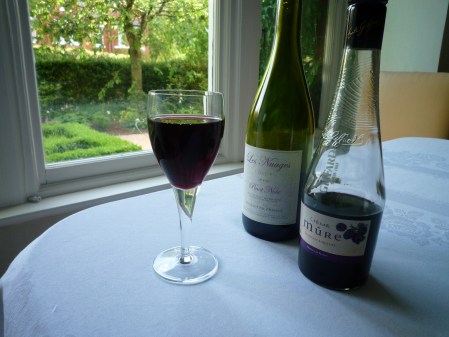
Kir Royale – the same crème de mûre but mixed with champagne, after all this was a birthday celebration for Chopin
Citron pressé – the ultimate French café soft drink
Raspberry and rose cordial – one of Belvoir’s cordials – a non-alcoholic version of the kir
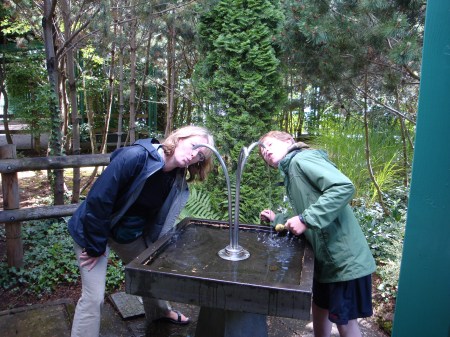
Volvic mineral water – the Volvic spring is a couple of hours drive south from Nohant in the volcano country of the Auvergne. We visited the Auvergne volcanoes on the trip to France which took in Nohant last summer. Here am Itogether with son George drinking directly from the Volvic source:
For the canapés, after a little research, I came up with the following:
Rillettes de canard with cornichons on toasted French bread
The classic rillettes du Tours is a speciality of central France and is made from slow-cooked shredded pork belly. The duck version is similar and equally good. The duck shreds very easily with a pair of forks and so, once the long slow cooking in the oven is done, there is very little for the cook to do.

Fresh goat cheese and chives on toasted French bread
Goat cheese can be found all over France but is a particular speciality of the Berry region.

Mini croque-monsieurs – a French café classic. It’s always nice to have something hot when serving nibbles with drinks. I give my recipe for the cheese mixture (in fact a modified Welsh rarebit!) which forms the foundation of a croque- monsieur and instructions for how to turn it into a toasted sandwich below.

Pistachio macaroons and madeleines – it feels good to round-off the evening with something sweet. Dainty macaroons and madeleines seem to marry well with the refined nature of Chopin’s compositions.
Here are several batches of madeleines fresh from the oven cooling on a wire rack. They are quick and easy to make and, though I say so myself, put the Bonne Maman ones to shame. The one thing you have to do is invest in a couple sets of moulds. The flexible silicone ones which are on offer nowadays work just fine.

The music Andrew played that evening was:
Piano sonata no. 2 in B flat minor, Opus 35 – 1st movement only
Berceuse in D flat, Opus 57
Polonaise in A flat, Opus 35
It was amazing to hear our modest upright piano transformed at the hands of a virtuoso pianist! I hope that my efforts to recreate the mood of Nohant helped to enhance the music and sense of atmosphere that evening.
To conclude, here are the recipes I promised earlier:
Recipe for Welsh Rarebit
This is a really useful recipe which I discovered in Gary Rhodes’ cookbook “Rhodes Around Britain” published back in 1994 to accompany the BBC TV series of the same name. It makes a very superior cheese on toast, which cut into small pieces makes a delectable and easy canapé to serve with drinks. The recipe requires 1 and 1/2 lb cheese which sounds like a lock, but as the original recipe advises, this is really the minimum for a successful mixture. It keeps well in the fridge for a week or so and also freezes well.
Ingredients
700g (1 and 1/2 lb) mature hard cheese, grated – Cheddar in the original recipe but I used Comté for my French version
150 ml (5 fl oz) milk
25g (1 oz) plain flour
50g (2 oz) fresh white breadcrumbs
1 tablespoon English mustard powder (I used 2 tablespoons prepared smooth Dijon mustard for French version)
2 shakes Worcester sauce (I used an alternative flavouring of grated nutmeg and a tablespoon of dry vermouth for my French version)
salt and freshly ground white pepper to taste (very little or no salt will be needed depending on the type of cheese used)
2 eggs
2 egg yolks
Put the grated cheese into a medium heavy based saucepan and add the milk. Slowly melt them together over a low heat but do not allow the mix to boil as this will separate the cheese, a frustrating not to say expensive mistake! When the mixture is smooth and just begins to bubble, add the flour, breadcrumbs and mustard and cook for a few minutes, stirring, over a low heat until the mixture comes away from the sides of the pan and begins to form a ball shape. Add the Worcestershire sauce (or alternative flavourings) salt (if necessary) and pepper and leave to cool.
When cold, place the mixture in a food processor, turn on the motor and slowly add the whole eggs and yolks. You can beat vigorously with a wooden spoon instead if you don’t have a food processor but I haven’t ever tried the manual method. Once the eggs have been mixed in, chill for a few hours before using.
Recipe for Croque-Monsieur
A recipe of my own devising based on a Frenchified Welsh rarebit (see above) and memories of many croque monsieurs eaten in French cafés.
Ingredients
For each sandwich:
2 slices good white bread, generously buttered
1 slice cooked ham
ball of rarebit mixture about the size of a small tangerine
1 tablespoon finely grated Comté cheese
Make a ham sandwich with the buttered bread and slice of cooked ham. Take the ball of rarebit mixture and flatten it into a rectangle the same size as the sandwich. Place on top of the sandwich and sprinkle with the grated cheese. Bake in an oven preheated to 180 degrees C for 8-10 minutes until the bread is lightly toasted and the rarebit mixture has puffed up a little and is golden brown. Trim of the crusts and cut into squares or fingers for a dainty canapé, otherwise just cut into half and serve for a lunchtime snack.
Riverside picnic
June 24, 2010 § Leave a comment
At this time of year, my thoughts turn to the perfect riverside picnic. I blame my obsession with this idea on a photograph in my mother’s copy of “The Robert Carrier Cookbook” which, as a child, I would turn to repeatedly. The picture showed a bottle of Loire white wine chilling in a gently flowing river somewhere in the green heart of La France Profonde. Mature trees in full leaf shaded a table set for two on the river bank. The food on offer was freshwater crayfish and, I think, quenelles de brochet (delicate little poached pike mousses).

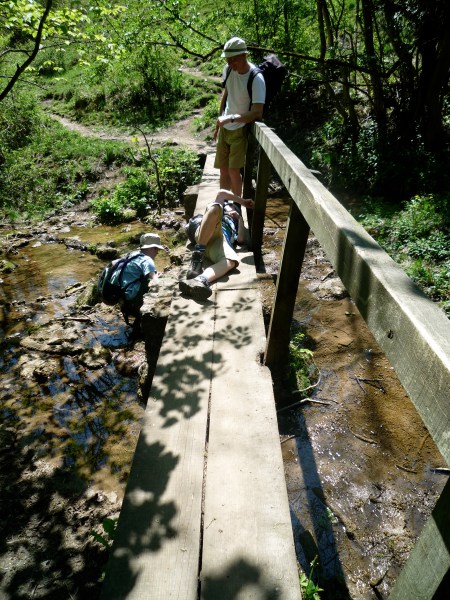
So now once a year my family indulges me in living out this fantasy albeit in a less elaborate form than the Robert Carrier original. When good weather is forecast for a weekend in late spring we pack up a hamper of suitable food and head off for the limestone dales of the Peak District.
What constitutes suitable foods for such a picnic? I draw inspiration from the surrounding landscape. Watercress has to feature as it grows wild in the limestone streams, also river fish, generally trout as it’s easy to come by. I give a recipe below for a quick and easy smoked trout pâté. Young goat cheese has become part of the ritual and tastes good with the watercress and a loaf of walnut bread. Nantwich based Ravens Oak dairy (now owned by Butlers) produces very likeable goat cheeses which, conveniently are stocked by Marks & Spencer. I picked up both their Kidderton Ash and regular Ravens Oak goat cheeses for this picnic. You can have a look at the Butlers range at www.butlerscheeses.co.uk The Cheese Hamlet in Didsbury stock a lovely Ticklemore goat’s cheese from Devon in the summer months too.

Asparagus is in season and adds a festive note to the proceedings. I always roast rather than steam it now as it’s a foolproof method that concentrates its flavour. A cool jambon persillé would be good too – the chunks of pink ham in its bright green parsley jelly recalling the clear river water and flowing water weed.
This year, I took along a chilled soup – a refreshing Spanish Ajo Blanco. This is an odd-sounding mixture of bread, almonds, garlic, sherry vinegar and plain cold water which which, when blended to a thin purée, chilled and garnished with halved grapes turns into an infinitely refreshing chilled soup, much more than the sum of its disparate parts. The soup seemed very appropriate as wild garlic was everywhere in all its pungent glory.

A picnic wouldn’t be a picnic without cake to finish. I try and keep the cool green theme going even here. Jane Grigson’s gooseberry pound cake has been successful on a previous picnic, but this time we took along wedges of my courgette and lemon cake: see my previous post https://rhubarbfool.co.uk/2010/05/22/relaxed-cooking-for-the-holidays/

Here are two of my recipes – both very simple for summer lunches at home as well as picnics
Recipe for smoked trout pâté
Ingredients
4 smoked trout fillets (or 2 whole smoked trout if you can buy them this way)
6 oz cream cheese
1 teaspoon grated horseradish or wasabi
juice of half a lemon
black pepper
If using whole trout, skin them, fillet them and place the trout fillets roughly broken up in a food processor. If you’re using pre-prepared trout fillets the skinning and filleting will already have been done for you. Add the remaining ingredients to the food processor bowl and pulse carefully until the desired texture is achieved. I like a slightly rough texture so this doesn’t take long. Check for seasoning and add more horseradish, lemon and pepper to taste. The wasabi was an inspired discovery one day when I ran out of horseradish. Pile into a bowl to serve (or box to transport to your picnic. Good with oatcakes or walnut bread.
I have no current photos of trout in pâté form but here are the real thing swimming in the Derbyshire River Wye, home to both rainbow and wild brown trout. We have a favourite footbridge for fish spotting and feeding – the fish are very partial to leftover bread and crumbs from Duchy Originals gingered biscuits!

Recipe for Ajo Blanco
Chilled Spanish garlic, bread and almond soup sometimes referred to as white gazpacho.
Ingredients
4 oz blanched almonds – try and use Spanish ones ie Marcona which Sainsbury’s stock as part of their Taste the Difference range
8 oz good white bread (ie from a decent unsliced loaf with a bit of flavour), crusts removed
salt
2-3 tbsp best quality extra virgin olive oil
2 tbsp best quality sherry vinegar
1 pint chilled water
2 cloves garlic, sliced
few seedless grapes, green are traditional but black fine as well

Dip the bread in cold water, squeeze out the excess and place in the goblet of a liquidiser along with the remaining ingredients except the garlic and grapes. Blend until smooth. Pour into a suitable container, add the sliced garlic which will gently infuse its flavour, and chill for several hours or overnight. Most ajo blanco recipes tell you to blend the garlic along with the other ingredients but I found that garlic pulverised in this way becomes unpleasantly intense in the finished soup. Serve garnished with halved grapes.
More rhubarb puddings
June 20, 2010 § Leave a comment
English strawberries have been late this year so rhubarb has been the home-grown fruit (yes I know it’s technically not a fruit) of choice for late spring/early summer puddings lately.
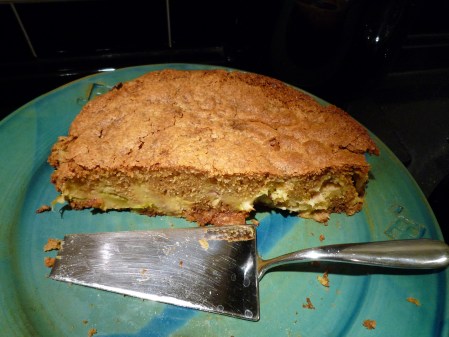
I made a fabulous rhubarb cornmeal cake for a big family gathering over the half term holidays – easy to make and just a little more celebratory than the usual rhubarb crumble that usually figures in big family meals. This is a recipe from Nigella Lawson’s Domestic Goddess book.
My second rhubarb recipe, a simple tart, comes from French-speaking Switzerland, in fact from the tiny wine village of Chardonne which was my second home for 4 consecutive winters back in the 1980s. I found this recipe in Marianne Kaltenbach’s “Aus Schweizer Küchen” (from the Swiss kitchen). The recipe comprises a sweet pastry enriched with ground almonds and egg and a simple filling of rhubarb, sugar and local white wine. We most often pair rhubarb with orange or ginger in English recipes so it was a refreshing change to try something a little different which lets the rhubarb flavour shine through.
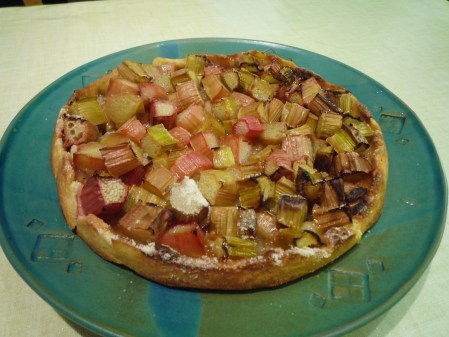
We’re well and truly into outdoor field-grown rhubarb season now (rather than the candy-pink tender forced rhubarb from Yorkshire that begins the season in February). The rhubarb variety I’ve used for both recipes is rather pleasingly called Timperley. Pleasingly because Timperley village is just a couple of miles from our front door and presumably this variety was bred by a local market gardener a hundred or so years ago.
Although I think of rhubarb as typically English, it originates from central Europe/Asia on the banks of the Volga so it is not surprising to find it appearing in different countries’ cuisines. The Scandinavians turn it into a tart sauce to serve with meat, the Persians incorporate it into a slow-cooked stew and there are a whole host of homely pudding recipes based on rhubarb like the two I give here. I’ve yet to discover whether the Italians cook with rhubarb though…That’s another train of thought altogether which I don’t have time to follow up just now… Here are the recipes:
Recipe for Rhubarb Cornmeal Cake
From Nigella Lawson’s “How to be a Domestic Goddess”. Like she says it’s very versatile – you can eat it with a cup of tea or serve it with some proper custard as a pudding.
Serves 8-10
Ingredients
500g rhubarb
300g golden caster sugar
150g plain flour
1 teaspoon bicarbonate of soda
1/4 teaspoon salt
1 teaspoon ground cinnamon
155g fine polenta/cornmeal (the quick cook stuff is fine)
2 large eggs
1 teaspoon vanilla extract
125g butter, softened at room temperature
250g thick natural yoghurt

Prepare a 23cm (9 inch) round cake tin by lining with a double thickness of baking paper. Preheat the oven to 180 degrees C/gas mark 4. Wash and trim the rhubarb and cut into 1/2 cm slices. Put into a bowl and add 100g of the sugar. Don’t let the rhubarb stand for more than 1 hour otherwise it will produce too much juice and make the cake wet.
Mix together the flour, bicarb, salt, cinnamon and polenta. Do not, as I did on one occasion, be tempted to use self raising flour as it makes the cake rise too quickly leaving the rhubarb at the bottom of the tin. With a fork, beat the eggs with the vanilla in a measuring jug or small bowl. In a large bowl, cream together the butter and the remaining sugar and gradually add the egg and vanilla mixture, beating while you do so. Then add the flour/polenta mixture alternately with the yoghurt. They just need to be combined: don’t overmix.
Finally, add the rhubarb together with its sugary juices, folding in to mix, and then spoon the batter into the prepared cake tin. Bake in the preheated oven for about 1 hour until the cake surface springs back when pressed gently with a (clean!) forefinger. Check the cake after 30 minutes’ cooking time as you will almost certainly need to turn the oven down a notch and/or cover the top of the cake with foil to prevent it browning too much.
Leave the cake to cool in the tin for at least 30 minutes before attempting to turn out.
Recipe for Chardonne Rhubarb Tart
From Marianne Kaltenbach’s “Aus Schweizer Küchen” where the recipe is titled Gâteau à la rhubarbe à la mode de Chardonne/Rhabarbekuchen. It is most definitely a tart rather than a cake. This is Swiss-German language cookbook but the recipe is from French-speaking West Switzerland, specifically the tiny wine village of Chardonne in the canton of Vaud. Ms Kaltenbach suggests drinking a glass of Chardonne wine with the tart – an excellent idea if you can get hold of some (Nick Dobson wines in the UK currently stocks several www.nickdobsonwines.co.uk). If not, any light white wine with a good balance of acidity and sweetness would be good – perhaps a Dr Loosen Riesling or similar.
Ingredients
120g plain flour
60g butter, softened at room temperature
30g golden caster sugar
pinch of salt
25g ground almonds
1 egg yolk
1/2 teaspoon vanilla extract
1 kg rhubarb
5 dessertspoons golden caster sugar
2 dessertspoons white wine
a little butter for dotting

Sift the flour together with the salt onto a clean work-surface or pastry board. Cut the butter into small pieces and add to the flour. Add the sugar and ground almonds to the pile and mix it all together loosely with your fingers. Don’t attempt to rub in the butter yet. Make a well in the centre of the mix, add the egg yolk and vanilla extract to the well and bring all the mixture together with your fingers to make a dough. Incorporate the butter into the dough using a smearing rather than rubbing-in action. If necessary, add just a little water to bring the dough together. Knead lightly then wrap in clingfilm and rest for 3 hours or so in the fridge. The original recipe suggests resting the dough for 12 hours but I found it was workable after a shorter resting period and produced a good result when baked. During the resting period, line a round cake tin 26cm (10 inches) in diameter with baking paper (the German word is Backblech – baking tin – I found that an ordinary cake tin worked well).
Preheat the oven to 220 degrees C.
Take the rested dough from the fridge and place it on a work surface. Begin to flatten the dough a little by giving it a few firm whacks with a rolling pin but don’t attempt to roll out. Place the flattened dough in the centre of the prepared tin and with your hands press the dough to the edges of the tin and up the sides to form an edge about 2cm high. This is a little fiddly but be patient, you will get there. Prick the base of the dough all over with a fork and return the tin to the fridge to rest further while you prepare the rhubarb.
Wash, dry, trim and slice the rhubarb into small chunks – about 2cm (3/4 inch) in length. The specified recipe quantity of 1kg rhubarb means unprepared weight from the garden. If buying partly trimmed stalks from a supermarket, start with 800g rhubarb which when trimmed will result in a prepared weight of about 700g.
Remove the pastry-lined tin from the fridge and spread the prepared rhubarb over the base. Sprinkle over 3 dessertspoons caster sugar, maybe a little more depending on your personal taste. Bake for 30 minutes in the preheated oven. Keep a close eye on the tart to make sure that the pastry doesn’t become too brown. After half an hour, remove the tart from the oven and sprinkle over the white wine, a further 2 dessertspoons caster sugar and a few dots of butter and return to the oven for a further 5-10 minutes to complete the baking.
Allow to cool in the tin for 30 minutes before attempting to turn out. Best served warm and needs no accompaniment other than the recommended glass of white wine.
If anyone knows the origins of Timperley rhubarb or has any Italian rhubarb recipes I would love to hear from you. Please send me a comment.
Relaxed cooking for the holidays
May 22, 2010 § 2 Comments
I was chatting to a friend on a balmy Friday evening while we watched our sons valiantly lose a cricket match. She’s rented a holiday cottage by the seaside for a week over the half term holidays. She disclosed to me that, following an afternoon spent planning meals, shopping etc, all she had on her list so far was wine and a bottle of gin. Fine as far as it goes but it won’t feed a hungry crowd!
This dilemma got me thinking so I thought I’d jot down a few uncomplicated recipes with a summery holiday feel that you might be inspired to try in a holiday cottage with unfamiliar and probably limited cooking equipment.
I’ve come up with two lunch dishes, one evening meal and of course a cake.
Recipe for Caponata
Since trying the caponata at Da Piero’s restaurant last month (see my post https://rhubarbfool.co.uk/2010/05/04/review-of-da-piero-irby-wirral/) I haven’t been able to get enough of the stuff. It’s a really useful holiday dish as you can make up a large batch and keep it in the fridge. It’s one of those dishes that improves if it’s kept and is very good natured as it is best served at room temperature. You could served it along with cold meat and cheese at lunchtime, or as a vegetable accompaniment with some simply grilled or fried fish (skate, sole, bass).
This is a dish you can experiment with and make your own – after all Da Piero’s unorthodox but good addition was chunks of waxy salad potato. So far, the version I like best is one I have adapted from a recipe in Tamasin Day Lewis’ “Good Tempered Food”. It’s quite simple and clean tasting and I like the astringency of the green rather than black olives.
Serves 6, maybe more depending on what’s with it
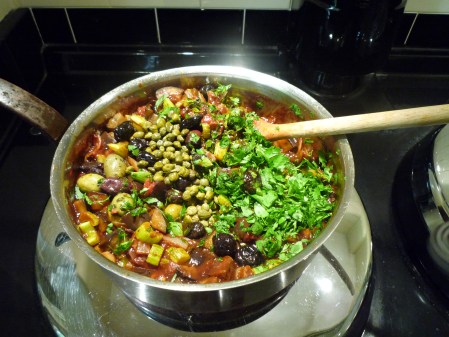
Ingredients
light olive oil for frying- about 4 tablespoons
6 sticks celery cut into 1/2 cm dice
2 medium aubergines cut into 2 cm cubes
sea salt and black pepper
2 tablespoons extra virgin olive oil
2 medium onions, thinly sliced
1 clove of garlic, chopped
1 and 1/2 400g tins plum tomatoes, roughly chopped
2 teaspoons brown sugar
4 tablespoons red wine vinegar
2 tablespoons capers, rinsed
3 oz good green olives stoned and halved
Handful of roughly chopped flatleaf parsley
Heat the light olive oil in a large deepish sauté pan big enough to hold all the ingredients. If you don’t have a pan large enough you’ll need to work with a frying pan (to brown the vegetables) and a casserole (to complete the cooking). When the oil is hot, add the celery and cook for about 10 minutes until soft and beginning to brown. Season then remove with a slotted spoon onto a plate and set aside. If needed, add a slosh more frying oil and when hot add the aubergines cubes. Fry until soft and brown which will take 10-15 minutes. They will shrink incredibly as the water they contain cooks away. Season and remove from the pan and set aside.

Turn the heat down to medium, add the extra virgin olive oil to the pan and gently fry the onions and garlic until soft and golden. Add the tomatoes and cook uncovered for about 10 minutes. Add salt, pepper, vinegar and sugar and cook for a further 10 minutes. Check seasoning. Add the reserved aubergine and celery, capers and olives and cook gently together for a further 5 minutes.
Allow to cool to room temperature then stir in the chopped parsley and serve.
Recipe for Rillettes de Tours
From Margaret Costa’s Four Seasons cookery book. We eat loads of rillettes, a coarse stringy pork almost pâté, when we go on holiday to France. Both the boys love it. It makes an easy picnic lunch spread thickly onto crusty French bread. It’s simplicity itself to make, especially if there should be an Aga in your holiday house – the simmering oven would be just the right temperature to make this. Any butcher should be able to sell you the belly pork but it might be worth preparing the spices in advance and taking them with you as you may find difficulty tracking down the ground cloves and allspice in a village shop.
Serves 6-8
Ingredients
2 lb (900g) belly of pork
3 tablespoons (45ml) dry white wine or dry white vermouth
5 black peppercorns lightly crushed in a pestle and mortar
salt
1/4 teaspoon ground nutmeg
pinch of ground allspice
very small pinch ground cloves
1 large clove of garlic
Remove the rind and bones from the pork, or ask your butcher to do this. Cut the meat into small cubes and put them into a deep ovenproof dish with the wine or vermouth, crushed peppercorns, salt, spices and crushed garlic. Cover and cook in a very slow oven (120 degrees C; 250 degrees F, Mark 1/2 for 2 hours (maybe more) until the pork is soft and slightly shrivelled looking, swimming in a pool of fat.
Drain off and strain the fat. Pull the meat apart with two forks to form shreds. Press into your chosen pot or pots and spoon over the strained fat to cover. Chill until set. Serve with cornichons and crusty bread straight from the pot like a pâté. No butter is necessary.
Paella de Cerdo con Chorizo y Espinaca
(Pork paella with chorizo sausage and spinach)
Another recipe from Tamasin Day-Lewis’ “Good Tempered Food”. She attributes the recipe to Sam Clark, chef-proprietor of London’s Moro restaurant. Search out and bring with you the chorizo and smoked paprika, maybe also the rice, which you do need to give an authentic flavour to the dish. For anyone in the South Manchester area, Goose Green deli in Altrincham sell lovely fresh chorizo sausages for cooking.
Serves 4
Ingredients
7 tbsp olive oil
350g/12 oz pork fillet, halved lengthwise and sliced into 5mm strips
125g/4 oz mild cooking chorizo, cut into small pieces
2 large Spanish onions finely chopped
1 large green pepper, halved, seeded and finely chopped
4 cloves garlic, finely chopped
225g/8oz paella or risotto rice (original recipe suggests Calasparra rice from Valencia)
1 tsp sweet smoked Spanish paprika
2 bottled red peppers, drained and roughly chopped (original recipe specifies dried ñora peppers, presumably soaked in hot water but as these are difficult to get hold of I’ve substituted widely available bottled sweet pimentos)
900ml/1 and 1/2 pints hot chicken or vegetable stock or water
500g/ 1lb 2oz spinach, washed and drained
1 lemon cut into wedges
sea salt and black pepper
In a 30-40cm/12-16 in paella pan (or failing this a frying pan or large casserole) heat the olive oil over a high heat. Stir-fry the pork for 2-3 minutes so it is still a little undercooked. Season with salt and pepper. Remove from the pan with a slotted spoon and set aside.
Turn down the heat to low and fry the chorizo for a minute. Add the chopped onion and green pepper and cook for 20 minutes, stirring occasionally. Add the garlic and continue cooking for a further 5-10 minutes. At this point the mixture should have begun to caramelise. Stir the rice into the pan for a minute to coat it in the mixture. Up to this point everything can be cooked in advance.
The next stage needs about 20 minutes more cooking time. Add salt and pepper to season the rice. Add the paprika and ñora or bottled peppers followed by the hot stock and simmer for 15 minutes until there is just a thin layer of liquid around the rice.
Meanwhile in a large pan briefly wilt the spinach with a little salt and put it on one side with the pork. Scatter the pork over the rice evenly then do the same with the spinach. With the back of a spoon gently push both the pork and spinach partially into the oily liquid that remains at the bottom of the pan. Tuck in the lemon wedges, cover the paella tightly with foil and let it sit for 5 minutes before serving.
Serve with a glass of Rioja and a tomato salad.
Recipe for Courgette and Lemon Cake
I tried a courgette, lemon and pistachio cake recently at Green’s very welcoming café and tearoom in Grasmere in the English Lake District. I searched around for a recipe and eventually found one I’d forgotten about in Nigella Lawson’s “How to be a Domestic Goddess”. She attributes the recipe to one Flora Woods. Don’t be put off by the inclusion of courgettes – they simply make the cake moist and turn it a fantastic green colour. Think of it as an interesting first cousin to a brash carrot cake. I’ve tweaked Nigella’s recipe by adding pistachios to the cake batter and simplifying the filling and icing. I’ve had trouble with cream cheese icings recently as Philadelphia and its ilk don’t have enough fat in and are packed with water and stabilisers which break down into runnyness when you beat the stuff with a wooden spoon. My friend Nadia put me onto the idea of using mascarpone with a 50% fat content instead – thanks Nadia it works! BTW the cake in the photograph contains neither raisins nor pistachios just to see how the plainer version worked out. Fine – in fact scrumptious.
Serves 8, maybe more if you’re frugal
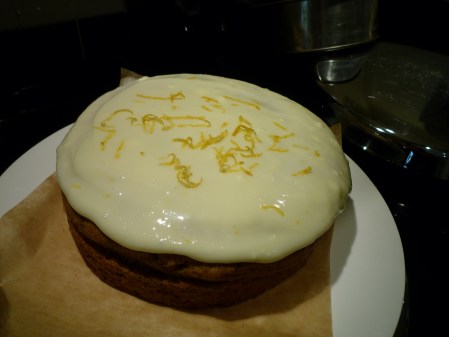
Ingredients
60g raisins plus 2 tablespoons white wine or vermouth (optional)
250g courgettes (weighed before grating – about 2 medium ones)
2 large eggs
125 ml vegetable oil (I use light olive perhaps with a splash of deep green pistachio or pumpkin seed oil if I happen to have some in the cupboard)
150g golden caster sugar
225g self raising flour
1/2 teaspoon bicarbonate of soda
1/2 teaspoon baking powder
50g pistachio nuts roughly chopped (optional)
For the filling
1/2 jar best lemon curd
For the icing
1/2 tub mascarpone cheese
6 heaped tablespoon icing sugar, sifted
juice of half a lemon
If using the raisins, put them into a small saucepan with the wine, bring up to the boil and leave to soak and plump up for 30 minutes or so.
Prepare your cake tin(s) by greasing and/or lining with bakewell paper. Nigella’s recipe specifies 2 * 21cm sandwich tins. I don’t have sandwich tins in that size so have used a single deep 21 cm tin (about 9 inches) and extended the cooking time and reduced the heat to bake a single large cake. Once it has cooled it can be split, filled and iced in the usual way.
Wash and dry the courgettes, trim off top and bottom but don’t peel them. Grate using the coarse surface of a standard kitchen box grater, then turn the grated courgette into a sieve and let it drain for 10-15 minutes, while you prepare the rest of the ingredients, to remove excess water.
Put the eggs, oil and sugar into a mixing bowl and beat until creamy. Sift in the flour, bicarb and baking powder and beat until well combined. Stir in the grated courgette, raisins and their juices and pistachio nuts. Spoon the mixture into your prepared tin(s) and bake at 180 degrees C for 30 minutes for 2 cakes; 170 degrees C for 10 minutes then 160 degrees C for a further 35-40 minutes in the case of a single large cake. Check and cover with a disc of foil if the cake seems to browning too rapidly. Remove from the oven, leave to stand for 10 minutes then turn out and cool on a rack. Don’t attempt to split the large cake until it is completely cold.
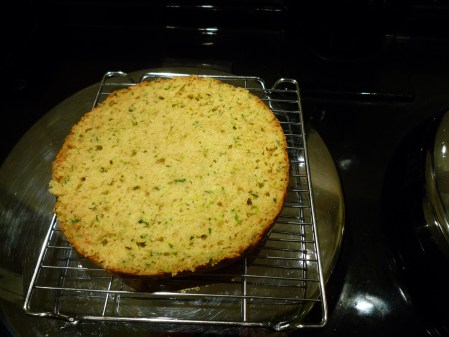
Meanwhile make the icing by beating together the mascarpone cheese and sifted icing sugar then stirring in lemon juice to taste.
Sandwich the cakes together with lemon curd and top with the mascarpone icing. Decorate with more chopped pistachios and grated lemon zest if liked. For easy transportation to a picnic, you could use both the lemon curd and the icing to sandwich the cakes together and leave the top un-iced so the cake can be wrapped in foil.
Enjoy your holidays and don’t spend too much time in the kitchen!
Buenos Dias Buenos Aires! Breakfast from Argentina
May 15, 2010 § Leave a comment
It’s been a while since we had our last international breakfast (see Breakfasts of the World category in the sidebar). The plan is to work through every country in the world in alphabetical order and it must be at least a month since Antigua.
I was pretty excited about the prospect of an Argentinian breakfast. Surely there would be mounds of barbecued steak? Sadly not. I was amused by one travel blog which recorded with disappointment that breakfast in Argentina comprises a croissant (known as medialuna), a coffee and a glass of water. The beef for which Argentina is justly famous is strictly a main meal affair.
So our breakfast was indeed medialunas (bought not made), café con leche and of course, lashings of wonderful dulce de leche. Sadly the Merchant Gourmet dulce de leche, authentically Argentinian from the evocatively named La Esmeralda farm seems to have disappeared from our local supermarket shelves and I had to make do with a Bonne Maman Confiture de Lait, a similar sweet milk caramel idea but from France and not quite as thick and unctuous.

If you too are suffering from dulce de leche withdrawal symptoms, here’s the Merchant Gourmet website dulce de leche page – you can buy it online now with free delivery if you buy in bulk.
http://www.merchant-gourmet.com/products/dulce-de-leche/dulce-de-leche-caramel-toffee/
I also noticed that the San Ignacio brand of dulce de leche has its own UK website now which gives some useful background info on what it is and how it’s made and a singularly unuseful list of retail stockists. They are listed in alphabetical order of shop name so you have to scan the whole list by eye to find a shop near you. I came up with Harvey Nichols in Manchester and a deli in Frodsham, Cheshire as possibilities for me.
I digress. Back to the proper business of breakfast. A bought croissant, a cup of coffee and a jar of caramel was OK but didn’t quite hit the spot. I had to get beef into the breakfast somehow so I trawled the internet until I found a reference to eating beef empanadas (pasties to you and me) for breakfast. I’d struck gold at last!
I found a recipe for beef empanadas in “South American Food and Cooking” by Jenni Fleetwood and Marina Filipelli – essentially a minced beef and potato stuffing encased in dinky shortcrust pastry rounds folded over to make mini pasties.
Here are the pastry circles and filling:

And here is the complete breakfast with the empanadas fresh out of the oven. I made a quick salsa with tomato, pepper, avocado, coriander and plenty of lime juice and seasoning to serve with the pasties:

Recipe for beef empanadas
I simplified the recipe I found in “South American Food and Cooking” by Fleetwood and Filipelli. I’ve halved the filling quantity which was way too much for the specified pastry quantity. I used minced beef rather than shredding it finely and baked the pasties rather than deep frying them for a lighter result. This worked well.
Ingredients
1 lb (450g) shortcrust pastry (bought or make your own with 8 oz (225g) flour; 4 oz (90g) fat)
l lb (450g) minced beef (use shin or leg if mincing your own)
4 tablespoons oil
1/4 tsp ground cumin
1 crushed garlic clove
2 tsp paprika
8 fl oz (250 ml) light stock
1lb (450g) waxy potatoes scrubbed (no need to peel) and finely diced
3 chopped canned tomatoes (or fresh ones skinned)
3 spring onions finely sliced
salt and pepper
Make the filling. Heat the oil in a heavy large frying pan. When hot, add the beef and sauté until lightly browned. Push the beef to the side of the pan and add the cumin, garlic and paprika. Reduce the heat and cook gently for about 2 minutes until the spices release their aroma.
Stir in the stock and bring to the boil. Cover and cook for 30 minutes. Stir in the potatoes, tomatoes and onions and cook for 15 minutes more until the potatoes are tender. Keep an eye on the cooking liquid adding a little more water if necessary or alternatively reducing if there is too much. You are aiming for quite a dry mixture. Season and allow to cool completely.
Roll out the pastry very thinly on a floured board. Using a pastry cutter cut out 2 and 1/2 inch (6cm) circles. Spoon about 1 and 1/2 tsp filling into the centre of each pastry circle. Brush the edges of the pastry with water. Fold the pastry over to form a half moon. Turn the edges over and press together firmly to form a good seal. Bake at 200 degrees C until the pasties are golden brown.
Serve with your favourite fresh salsa.
Enjoy your Argentian breakfast! Carlos Tevez, if you happen to read this please do drop me a line with your breakfast thoughts…
Review of Da Piero, Irby (Wirral)
May 4, 2010 § 3 Comments
The arrival of warm spring weather coincided with the Delicious magazine’s Italian issue appearing on the shelves earlier this month. Browsing through its glossy pages I noticed a feature on an Italian restaurant that wasn’t (as usual) in London but in the small village of Irby on the Wirral (south of Liverpool) less than an hour’s drive from Manchester.
Da Piero gained recognition beyond its local loyal customer base earlier this year when it was named “Best Newcomer” in the 2010 edition of the Good Food Guide. Hot on the heels of this accolade came recognition (in the form of two knives and forks) in the latest Michelin Guide. It’s owned and run by the Di Bella family, with father Piero in the kitchen, wife Dawn front of house and son Alan sous-chef in training. Piero grew up in Sicily and the restaurant specialises in authentic Sicilian dishes.
Sicilian food in a village on the Wirral? It sounds unlikely doesn’t it? Maybe a Mafia money-laundering operation with links to the Liverpool underworld? Undaunted we booked a table and, on a beautiful Wednesday evening we drove off into the sunset.
Here’s what we found:

Apparently just a small neighbourhood restaurant in a quiet street. Going inside, it was as if you had walked into your gran’s front room into which someone has unaccountably placed four tables. There are just 15 covers in the restaurant. A couple of black and white family photos hang on a magnolia painted wall and that’s it in terms of decoration. Thankfully no Chianti bottles in straw, red-checked tablecloths that kind of thing.
We were greeted and waved to what was evidently our table by a smiling Dawn. All the other tables were occupied and there was a hum of contented post-meal chat over Italian pop music playing in the background (you may not like piped music but Zucchero is at least authentic).
We browsed the handsomely large menus which are laid out in traditional Italian style (antipasti, primi piatti; secondi piatti and dolci) and the interesting wine list.
Piero is clearly a man who knows what his customers want – the menu is by no means exclusively Sicilian: there are Northern Italian specialities (osso bucco) plus Italian restaurant favourites (spaghetti carbonara) as well. We later discovered that Piero’s family has roots in mainland Italy so the menu is almost a blended family history.
I was determined to have the full authentic Sicilian experience so chose a classic caponata to start, then a pasta with garlic, parsley and hot pepper, followed by home-made salsiccia (sausage) Siciliana with lentils.
Following Dawn’s advice about portion sizes, Tim elected to share the pasta course with me and chose osso bucco as his main course.
The caponata, correctly served warm rather than piping hot, was simple and delicious, each vegetable cooked to perfection. If you don’t know the dish, think of it as a Sicilian version of ratatouille, enlivened with capers and olives. Unusually it contained nuggets of potato along with the aubergines and tomato. A bit odd but entirely successful.
The pasta was good quality factory-made tagliatelle simply dressed with best quality olive oil, browned garlic, flecks of parsely and chilli flakes. I asked Dawn later about whether they made their own pasta – she said they generally used factory pasta but made their own if there was a ravioli special on the menu. This sounds like an entirely sensible decision for such a small restaurant but don’t go there expecting mounds of beautiful home-made pasta.
Here’s Tim’s rich and meaty osso bucco:

And here is my glorious dish of home-made sausage and lentils:

The sausage was rustic and flavoursome with just the right amount of chilli heat and the lentils were the perfect accompaniment and cooked to just the right degree of tenderness. One of those dishes you could eat again and again…
I think it was Ed Balls who that very day (during the election campaign) said he wanted to give one-parent families more money so they wouldn’t have to feed their children lentils every day. Ed, get down here and eat your words!
We’d chosen from the short but interesting wine list a reasonably priced organic red wine (Nero d’Avola) from Sicily (Cerasuolo di Vittoria 2008) which was earthy and just right with the rustic food.
We were too full for puddings so just had a skilfully made espresso each. By now there were just two tables left occupied in the restaurant and as Piero had finished cooking he came out from the kitchen unprompted to meet the remaining guests. He’s a distinguished looking man who, dressed in a toga rather than immaculate chef’s whites, could pass for a Roman senator. He’s passionate about his food and utterly charming. Who can resist a man who’ll share a caponata recipe with you (the addition of potatoes was his own idea) and is such a perfectionist that he makes his own candied orange peel?
What a lovely evening. Don’t come here expecting refined food or a slick city restaurant experience. Simplicity and freshness are what it’s all about together with a genuinely warm welcome. My advice would be to get here while you still can.
Contact details
Da Piero
5 Mill Hill Road
Irby
Wirral CH61 4UB
0151 648 7373
www.dapiero.co.uk
L’Artisan du Chocolat arrives in Manchester
April 25, 2010 § Leave a comment
Just as the chocolate fest which Easter has become is finally over, L’Artisan du Chocolat go and open a concession in Selfridges Manchester store!
Despite the name, L’Artisan du Chocolate is a British company founded by Gerard Coleman and make chocolates to die for. Like most people, I enjoy chocolate but wouldn’t call myself a chocoholic. These chocolates though are something else. I was first introduced to them by my friend Shelley who gave me a box as a new year gift two years ago. Now I make a bee-line for their Sloane Street store when I visit London. The good and bad news is that 1) I don’t have to any more as theyr’e much closer to home 2) they are both incredibly moreish and on the pricey side – but those two factors do cancel each other out.
On display when I visited was this rather magnificent chocolate elephant. He’s not solid chocolate but apparently has a polystyrene core and is spray painted with real chocolate using car production line technology. Fancy that.

I was immediately drawn to L’Artisan’s gleaming chocolate pearls – pearlised shells in white or dark chocolate with a soft ganache filling. If you buy a sufficient quantity, they package them in gorgeous little jewelry-type coffrets. I was only the market for a small quantity so had to content myself with a cellophane bag.

Here are my precious purchases – the aforementioned pearls, a couple of bars in unusual flavours (white chocolate with saffron; dark chocolate with Darjeeling tea) plus a tasting box which I’ve been working my way through, one divine chocolate per night after dinner with a cup of espresso. Quality not quantity.
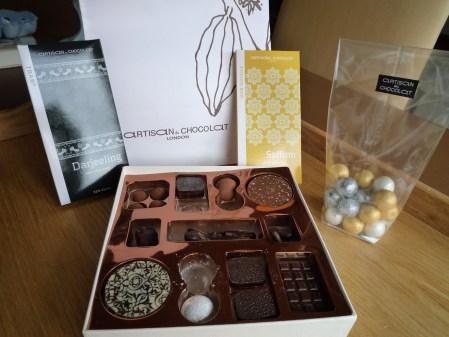
Sof far, my favourites are the signature liquid salted caramel balls also the wondrous thin discs filled with either passionfruit coulis or apricot and tonka bean coulis.
Selfridges food customers are rather fickle – the fresh fish and meat counters soon disappeared as did the cheese counter. Let’s hope Artisan du Chocolat can stay the course.
And they’ve brought out a range of election chocolate buttons too bearing tongue-in-cheek slogans so you can stay topical and enjoy your chocolate at the same time.
http://www.artisanduchocolat.com/ArtisanduChocolatSite/pages/home/default.asp
Contact details
http://www.artisanduchocolat.com
L’Artisan du Chocolat – flagship London store
89 Lower Sloane Street
London SW1 8DA
0845 270 6996
Manchester – Selfridges concession store
1 Exchange Square
M3 1BD
Where to shop in the Forest of Fontainebleau: Nemours, Larchant and La Chapelle
April 23, 2010 § Leave a comment
We’ve been coming to this area of France for the past 15 years now and I’ve managed to build up quite a little black book of food addresses. It’s time to write them down and share them which will be quite a magnum opus. If you happen to be staying in a gîte nearby, please don’t just rely on the supermarket but give these places a try.
I’m going to start not with Fontainebleau itself but with Nemours and its nearby villages of Larchant and La Chapelle. After all Larchant is the village we’ve been based in for the last few years thanks to our friends Alex and Elin who’ve bought a house in the village.
Nemours is a substantial market town on the Loing, a tributary of the Seine. Despite its castle and imposing church it’s a straightforward workaday sort of place not on the tourist trail and none the worse for that. The heart of the town is its marketplace. Perversely the twice-weekly market (Wednesdays and Saturday mornings – a good range of fresh food stalls) is no longer held here but in the Champ de Mars, an open area by the riverside.
The market may have moved on but the old marketplace is home to some great food shops. Let’s start with Chaffraix, the cheese and poultry shop:

This is the place to come if you want to try Brie which is the local cheese in this reqion. You will be spoilt for choice:

Next stop is Aujard Aufradet’s butcher’s shop also in the marketplace where you can have your meat prepared by a real craftsman. The guy is an absolute whizz with his boning knife and that fine string that French butchers like to use.

Keep walking just a little longer to complete your meal with a fruit tart from the best bakery in Nemours, La Fontaine Gourmande:
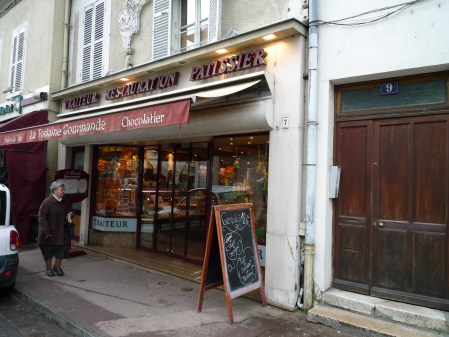
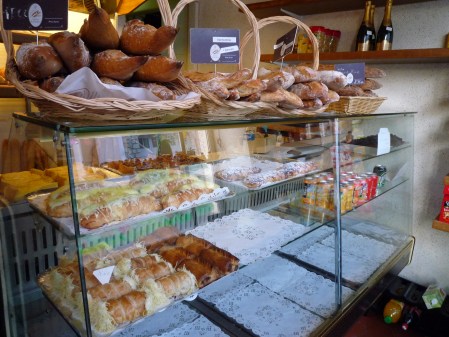
They have a handy little café at the back where, after your morning shopping, you can enjoy a cup of coffee and one of their incredible Bostock pastries. I haven’t found the intriguingly named Bostock anywhere else – I’m sure there’s a story behind this somewhere that I will have to look into sometime. It’s an absolutely deliciously buttery almondy affair:

And if you really do need a supermarket, your best bet is Carrefour Marché on the west side of town in the suburb of Nemours St Pierre.
Next stop is the picturesque village of Larchant a few miles outside Nemours. There’s a great local bakery here:

I like their brown Campagrain bread once I’ve had my fill of baguette à l’ancienne. The almond croissants they do are a breakfast treat but you need to get there early as they sell out fast.
And if you are into foraging for wild food the nearby forest is awash with wild violets at this time of year. They have a shy but distinct taste and make a pretty addition to a salad – just be sure to leave out garlic in your salad dressing which will otherwise overpower their delicate flavour. One year I will definitely try my hand at crystallising some for cakes and chocolate puddings.

Last port of call is the village of La Chapelle la Reine, a village in the midst of prairie-like fields on the plateau beyond Larchant. It’s home to an Atac supermarket, a convenience store and a couple of OK bakeries – useful when the Larchant bakery takes its weekly day off. There is a weekly market too but it’s sadly nothing to write home about.
Clearly signposted from the main road on a handwritten chalk board is a farm shop selling potatoes and all your onion family requirements (onions, shallots and garlic).
That’s it from the Forest of Fontainebleau for this year – I’ll continue with my shopping round-up after our next visit, Easter 2011.
If you know anything more about the mysterious Bostock pastry or if you have tips on crystallising your own violets I’d love to hear from you…
 The Rhubarb Fool