
Brunei breakfast and best brioche recipe
September 28, 2012 § Leave a comment
The latest in our Breakfasts of the World Project series.
Brunei is a tiny country with a population of some 400,000 shoehorned into a territory of just 2,228 square miles on the island of Borneo. Part of Borneo belongs to Malaysia and the rest (apart from Brunei of course) belongs to Indonesia. The Sultanate of Brunei was powerful regional presence whose influence was at its height between the 15th and 17th centuries. As its influence subsequently declined its territory became gradually smaller. The economic decline was reversed following the discovery of oil in Brunei in 1929. As a result, tiny Brunei became a highly developed and wealthy country whose citizens have an appetite for Western luxury goods.
Today’s breakfast idea was taken from the cosmopolitan menu of the Fleur de Lys Bakeshop in Brunei’s capital city, Bandar Seri Bagawan. The Fleur de Lys Bakeshop is a French style pâtisserie whose macarons and croissants could rival anything you’d find in Paris. My selections was “French toast kaya – brioche French toast served with our very own ‘home-made’ coconut-egg kaya”. This looked rather more appealing than the various chicken sausage and beef bacon rasher combos on offer, pork being ruled out by local Islamic dietary rules.

OK so I know how to make brioche French toast but what on earth is coconut-egg kaya? Kaya, it turns out, is a sweet, creamy coconut preserve flavoured with pandan leaves, made in a similar way to our own lemon curd (but obviously without the lemons!). Ex pat South East Asians yearn for the stuff and either get it shipped out to them or make their own.
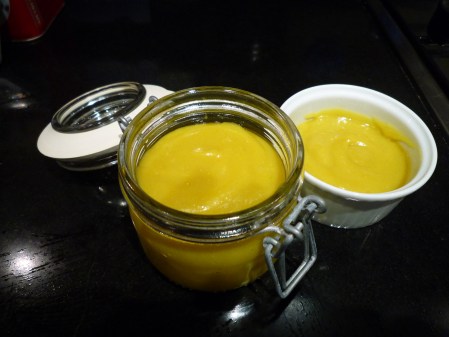
I searched around for an approachable, logical kaya recipe and fell for the lovely pictures in Malaysian-born cook and food writer Billy Law’s blog “A Table for Two”. It turns out that Billy was a finalist in the Australian extra-tough version of Masterchef winning the hearts of viewers if not ultimately the judges.
Billy’s instructions were sufficient and easy to follow. First stop is your local Asian grocer for pandan leaves and good quality 100% coconut milk. I’m lucky enough to have Kim’s Thai foodstore in Manchester’s Chinatown (see contact details below) almost on my doorstep. Walking down the steps into the tardis-like basement, you’re transported to the scents and sights of Bangkok’s Khao San Road. It was straightforward enough to pick up the specialist ingredients I needed here – a good quality 100% coconut milk and pandan leaves:

Having gone to the trouble of sourcing authentic ingredients for my kaya, I now needed a decent brioche loaf to turn into indulgent French toast. Having looked at the dry and sad little excuses for brioche offerings available at local supermarkets I decided I’d better bake my own.
I turned to Dorie Greenspan’s “Baking – from my home to yours” for inspiration, as, based on my experience with her Kugelhopf recipe, Ms Greenspan knows how to handle enriched yeasted doughs. The only quibble I have about this bible-type baking compendium is that having meticulously sourced and researched her recipes from professional European bakers in many cases, she doesn’t give accurate gram weights but turns everything into American cup sizes. I have to reverse engineer her recipes and convert everything back to grams!
Following the recipe and with the aid of my Kenwood mixer, after a day and a half (!) I produced a stretchy, silken ball of golden dough:

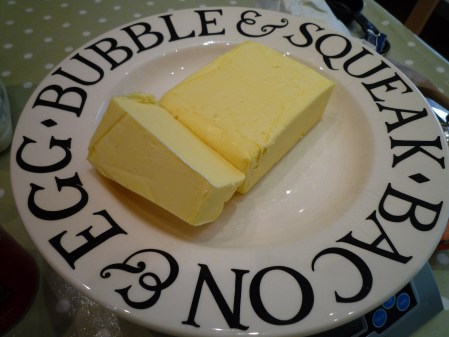
The golden colour is attributable not only to the eggs in the dough but also to the full 340g butter required to make the recipe. Let me repeat that – 340g butter, a pack and a half, which looks like this:
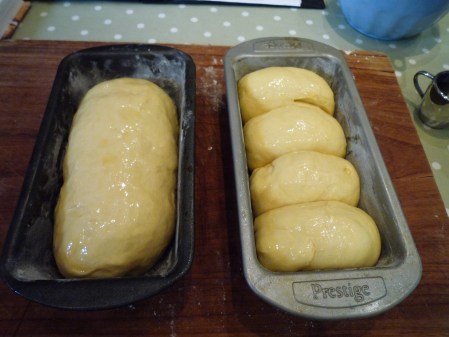
I shaped the loaves two different ways, the first like a triple bun loaf as the recipe specifies, and the second as a standard loaf shape (after the time-consuming effort of making the dough you are rewarded by one brioche loaf for now and one to stash in the freezer as a treat for later). These are loaves before proving:

They are quite slow to achieve a rise in the tin as the dough has spent the night chilling in the refrigerator before being shaped the next morning. This is what mine looked like after nearly 2 hours – not really doubled in size but I couldn’t wait for my breakfast any longer:
I always use steam in my oven when baking any kind of yeasted dough as I think it prevents a dry skin forming on the dough too soon which would impede its rise. Thus I added steam to my oven when baking the brioche and was very happy with the rise and end result. I have read elsewhere (specifically Tom Herbert’s comment in a baking article in October 2012’s Delicious magazine) that baking a brioche with steam will produce a thick hard crust but I have not found this to be the case so suggest steaming ahead!
Here are the loaves straight out of the oven:

That first slice, still warm, was definitely worth waiting for:
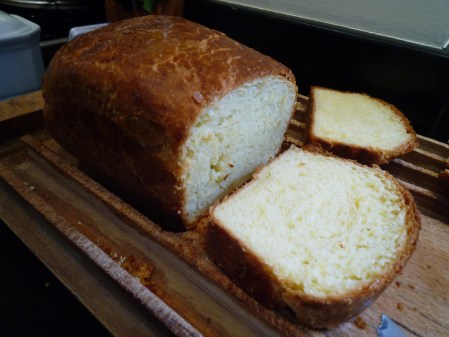
Interestingly, the loaf shaped as three buns had a more satisfactory structure and better rise than the standard loaf shape so I’d recommend this shaping method in future.
It goes without saying that the brioche made wonderful French toast, sprinkled with a little grated nutmeg and golden caster sugar before being topped with a generous dollop of the home-made kaya. Brunei is now up there in our “top ten” of world breakfasts.
Recipe for coconut egg kaya
Adapted from Australian chef and food writer Billy Law’s blog “A Table for Two”.
Makes enough to fill one small preserving jar with a bit left over.
Ingredients
3 eggs
2 egg yolks
150g golden caster sugar
250ml canned or packet coconut milk – check the small print to make sure it’s 100% coconut
3–4 pandan leaves, knotted (optional)
Set up a double boiler by placing a suitably sized mixing bowl over a large pan containing simmering water.
Having made sure the bowl will sit comfortably over the pan, take it off the heat and add the whole eggs, yolks and sugar to it and, using a balloon whisk, mix until the sugar has dissolved. Slowly pour the coconut milk into mixture while whisking until well combined. If using, drop the knotted pandan leaves into the mixture.
Swap the balloon whisk for a rubber spatula. Place the mixing bowl on top of the pan containing simmering hot water and start stirring the mixture constantly, scraping down the sides and base of the bowl. Baste the pandan leaves by using the spatula to pour the hot coconut custard over them.
The mixture will start to get thicker. This is likely to take between 20 minutes and half an hour. At this stage, remove the knotted pandan leaves, scraping and squeezing the kaya off them before discarding. Test for doneness by drawing a line right through the mixture in the bowl one swift move using the spatula. If a channel remains for a second or two before the mixture flows back, then it is ready. Remember that it will thicken further as it cools.
Spoon the mixture into a a sterilised jar, allow to cool then refrigerate. It will keep for up to a month in the fridge.
Recipe for Brioche
Adapted from Dorie Greenspan’s “Baking – from my home to yours”
Makes 2 loaves
Ingredients
7g fast action dried yeast
300g strong plain flour
225g ordinary plain flour
10g salt
80g water mixed with 80g whole milk, either at room temperature or slightly warmed
3 large eggs, lightly beaten with a fork
45g golden caster sugar
340g unsalted butter, at room temperature
To glaze
1 small egg, beaten
1 tablespoon water
In the bowl of a Kenwood or similar mixer fitted with a dough hook, stir together the flours, fast action dried yeast and salt. Pour in the milk and water mixture then turn the mixer on to a low speed and mix for one to two minutes until the flour is moistened and you have a fairly dry shaggy mixture.
Scrape down the sides of the bowl using a plastic dough scraper or rubber spatula. Turn the mixer back on to a low speed and add the egg mixture little by little, then the sugar. Increase the speed to medium and beat for about 3 minutes by which time the dough should have formed into a ball.
Reduce the mixer speed to low and add the butter in big chunks, beating until almost incorporated before adding the next. You will end up with a very soft cake-batter-like dough. Increase the mixer speed to medium and beat until the mixture comes away from the sides of the bowl, about 10 minutes.
Scrape down the sides of the bowl with a plastic dough scraper then cover the bowl with cling film and leave to prove at room temperature until the dough has nearly doubled in size, around 40 to 60 minutes depending on the ambient temperature.
Deflate the dough by picking it up and slapping it back into the bowl. Cover the bowl again with cling film and put it in the fridge. Check the dough every 30 minutes and slap it back until it stops rising. You may need to do this 4 or 5 times. Once it’s stopped rising, make sure the bowl is sealed with cling film and leave it overnight in the refrigerator.
The next morning, grease and flour two loaf tins. Loaf tins are notoriously difficult to size so I’ll tell you the measurements of the ones I used here which were both 22cm (Length) by 11cm (Width) by 6cm (Depth). Divide the brioche dough in half, and divide each half into four equal pieces (best done using an accurate set of scales). Roll each of these small pieces into a log shape (the length of which is equal to the width of your tin)and press four of the logs side by side in the base of each loaf tin. Cover the tins with an upturned plastic storage box or big mixing bowl and leave the loaves to prove until nearly doubled in size and filling the tins. This may take up to three hours as the dough is fridge cold and takes a while to get going again.
When the dough is reaching the end of its proving time, make sure your oven shelf is in a central position and preheat the oven to 190 degrees C (fan).
Make the glaze by beating the egg with the water. Brush the surface of the loaves carefully with the glaze trying not to let it run down the sides of the tin where it will prevent the loaves from rising.
Bake the loaves until well risen and a deep golden brown. I like to add steam at the beginning of the baking time (by quickly throwing a mug of cold water into a shallow preheated roasting tin placed at the bottom of the hot oven) to stop a crust from forming and allow the loaves to rise to their maximum potential.
Remove the loaves from the oven when done and allow to cool in their tins for about 15 minutes before turning them out to complete cooling on a rack. The crumb structure is quite fragile at this stage so be careful when you do this. Don’t attempt to slice until the loaves have cooled thoroughly, for at least an hour.
Contact details
Kim’s Thai Food Store
46 George Street
Manchester M1 4HF
Area: Chinatown
0161 228 6263
Spinach pie and semolina cake from Greece
September 17, 2012 § Leave a comment
Spinach and semolina sound like school dinner hell rather than fond food memories don’t they? Trust me, they really can be good given the right treatment.
The summer holidays are over and the boys are back at school, though in George’s case this is the last time I’ll be able to say this as, all being well, he’ll be a college student next September. I’m still thinking longingly of our week spent in Greece in mid August. We went back to Paleros on the Ionian Coast, a straight repeat of last summer’s holiday but it worked just as well this year too.
The village streets are still lined with enticing little tavernas:

Who wouldn’t want to retreat in here for a leisurely lunch on a hot afternoon?
I love the geometric perfection of the Greek script on a taverna menu: 
Though an English menu is more practical for the majority of us:
I fact we confined our taverna visits mainly to the evenings and most lunches were picnics in little bays like this one, a short boat across the bay from Paleros:
And our picnic foods of choice were wedges of freshly baked spinach and cheese pie from Paleros’ bustling little bakery:
I’d carry these back from the bakery, crisp, savoury and still warm. I’ve sought out an authentic Greek recipe from George Moudiotis’ excellent and informative book “Traditional Greek Cooking – The Food and Wines of Greece” which I’ve adapted and given below. The widespread availability of ready made filo pastry and bags of washed and prepared spinach make this a cinch to put together.
To complete our picnic, we’d add tomatoes and ripe pears or watermelon wedges to the bag, plus a little sweet something from the bakery. The Greeks clearly have an extraordinarily sweet tooth and, sandwiched between east and west, their baking has a combined culinary heritage. The buffet table at our hotel would be crowned by over-the-top layered and decorated sponge cakes in the western tradition adorned with swirls of crème patissière and whipped cream, highly coloured icings and glacé fruit. My preference was for the more austere but deeply sticky and sweet middle eastern influenced pastries, kourabiedes, baklava, kadaifi and the like. Here’s the simple yet enticing display of these goodies at the local bakery, reverently screened as a protection from marauding insect life: 
I tried out the moist little lozenges topped with sesame seeds and a single decorative almond for the first time. I tried desperately hard with my phrase book modern Greek to find out their proper name but ended up with me and the bakery lady smiling and helplessly shrugging shoulders as I failed to understand what these cakes were called. Whatever they are called, they were dense, moist and syrup-laden, a great energy boost after a long swim: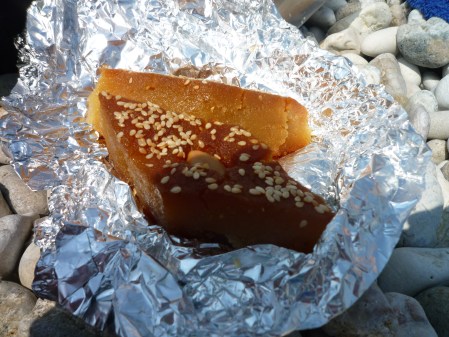
Looking for what they might be in my Greek food bible “Traditional Greek Cooking” once again, I found a recipe for a simple syruped semolina cake called Revani. This is a traditional cake from Northern Greece which I think sounds a little less dense than the cake I tried but similar in flavour and appearance. I give my adapted version of the recipe below and will be trying it out over coffee very soon to bring back those memories of summer.
Recipe for Spanakopita – Greek spinach and cheese pie
Adapted from George Moudiotis’ “Traditional Greek Cooking – The Food and Wines of Greece”
Serves 6-8
Ingredients
900g spinach, washed, stems removed and roughly chopped
1 bunch spring onions, trimmed and chopped
150ml extra virgin olive oil
225g crumbled feta cheese
4 eggs, beaten lightly with a fork
3 tablespoons chopped fresh herbs – a mixture of flat leaf parsley and dill is good
salt and freshly ground black pepper
250g filo pastry, about 12 sheets
pinch grated nutmeg
Preheat the oven to 180 degrees C (170 degrees C fan).
In a large frying pan big enough to hold all the spinach, fry the chopped spring onions in 3 tablespoons of the olive oil until soft but not browned. Tip into a large mixing bowl and set aside.
Add the spinach to the frying pan and cook for about 3 minutes until wilted. Tip into a colander and press out as much excess water as you can. Add the drained spinach to the mixing bowl which already contains the cooked spring onions and add the feta, beaten eggs, chopped fresh herbs, salt, pepper and nutmeg. When seasoning, don’t add too much salt as the feta is already quite salty. Mix well to combine.
Brush a 4cm rectangular deep baking dish with oil. Metal is best to conduct the heat and cook the pastry. Choose a tin that is a little smaller than the dimensions of the filo sheets. Lay the first sheet of filo over the base letting the edges overhang. Brush the sheet with oil. Repeat until you have used half the sheets of pastry. This constitutes the base of the pie. Spoon over the filling, spreading it evenly over the pastry. Cover with the remaining filo sheets in a similar manner, brushing each one with oil as you layer up, not forgetting to brush the top sheet with oil.
Using a really sharp knife, score the top surface of the pie marking out 6 or 8 portions. Prick the surface of the pie evenly all over to give an additional way for steam to escape. Trim the overhanging pastry edges but still leaving a small border. Fold this small border over the top and press lightly to seal. Spritz the pie with a little water to prevent the pastry from curling and bake in the preheated oven for about 45 minutes or until the pie is golden brown and crisp.
Serve warm or cold.
Recipe for Revani – syruped semolina cake from Northern Greece
Adapted from George Moudiotis’ “Traditional Greek Cooking – The Food and Wines of Greece”
Serves 10-12
Ingredients
For the cake
225g golden caster sugar
6 eggs
5 tablespoons warm milk mixed with 1 teaspoon vanilla extract
225g fine semolina
150g self raising flour
2 teaspoons baking powder
pinch of salt
For the syrup
450g golden caster or granulated sugar
400 ml water
75g unsalted butter
2 tablespoons lemon juice
finely grated zest of half a lemon
To decorate
Toasted whole blanched almonds
Line a 12 inch round cake tin with baking paper. Preheat the oven to 180 degrees C (170 degrees C fan). Mix together thoroughly the semolina, self-raising flour, baking powder and salt. Set aside.
Using an electric mixer, whisk the eggs and sugar together at high speed for about 10 minutes, adding the milk and vanilla extract mix gradually, until the mixture is pale and fluffy. Sift the flour mixture over the whisked egg mixture in three batches, gently incorporating each batch with a balloon whisk trying to retain all the whisked air bubbles in the mixture.
Pour the mixture into the prepared cake tin and bake in the preheated oven for 40 minutes or until the cake is golden brown and cooked through.
While the cake is baking, make the syrup. Put the sugar and water into a medium saucepan and bring to the boil without stirring. Once the sugar is dissolved, boil for 2 to 3 minutes. Remove from the heat and add the butter, lemon juice and zest and leave to cool.
Spoon the cooled syrup over the hot cake shortly after it comes out of the oven. Do this carefully as you do not want the cake to collapse. Leave the cake in its tin to cool completely. Cut it into lozenges and decorate with toasted whole blanched almonds.
Brazilian breakfast
August 30, 2012 § 1 Comment
The latest in our Breakfasts of the World Project series.
Breakfasts in Brazil are many and various depending on where you are in this vast country. I chose to prepare Açaí na Tigela, a breakfast dish popular on Brazil’s beaches, from Caraivo in the north to Florianópolis in the south as the Brazilian breakfast date coincided with our family beach holiday to Southwold in Suffolk.
OK so both Southwold and Florianópolis are both on the coast but that’s where the similarities end. Southwold is famous for its pastel-coloured beach huts and sedate way-of-life whereas Florianópolis is known as one of Brazil’s hippest cities with “dental floss” bikinis rather than Cath Kidston florals being the beachwear of choice.

Let’s compare and contrast some other features of these two towns/cities :
1) Population: Southwold – 1,458 (compared to a national population of 62,641,000); Florianópolis – 427,298 (compared to a national population of 196,655,014)
2) Administration: Southwold – within Waveney district council in Suffolk in the east of England; Florianópolis – capital and second largest city of Santa Catarina province in the south of Brazil
3) Distance from capital city: Southwold 154km from London (but looks a long way on the map of our crowded little island); Florianópolis – 1,673 km from Brasilia (but looks quite close on the map because of the vastness of the country)
4) Climate: Southwold – temperate (really?!); Florianópolis – sub-tropical
5) Number of beaches: Southwold – 1; Florianópolis – 42
6) Main educational establishment: Southwold – Sailors’ reading room; Florianópolis – Santa Catarina University
I needed more for this breakfast than just the Açaí na Tigela. Brazilians love their coffee so this was a must, made from Brazilian beans, naturally. Finally, rather than ordinary white rolls I made a batch of cheese rolls, Pão de queijo, which are made from tapioca starch so perfect for anyone on a gluten-free diet.
Here’s the whole spread:

Back to the Açaí na Tigela, literally “bowl of açai berries”. This turns out to be a smoothie the main ingredients of which are super-trendy (and, over here, superexpensive) açai berries and banana, topped with granola and, optionally, more banana slices. I read about it here and instantly wanted to try one.
The smoothie was quickly whizzed up with a stick blender and I added a spoonful each of ginseng, guarana and maca powders to the whole fruit and juices to give it an extra Brazilian lift. It certainly gave my 90 year old father-in-law Lawrie an extra gear in his wheelchair travels that day.

I poured the smoothie into individual serving bowls:
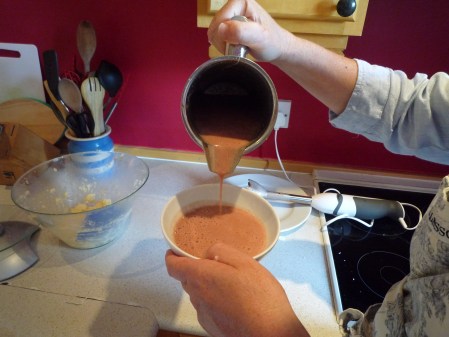
and topped it with a spoonful of homemade granola:

Yes of course you can buy granola readily these days but it’s quite satisfying to make your own now and again. I discovered this particular granola at a friend’s house a couple of years ago, asked for the recipe and was told I already had it as it’s in Nigella Lawson’s “Feast”. She in turn attributes the recipe to Andy Rolleri of The Pantry deli in Fairfield, Connecticut. It’s a cinch to make – the only remotely tricky bits are making sure you’ve bought all the items on the lengthy ingredients list and getting the correct bake – not underdone and not burnt. A long and slow toasting is what you’re aiming for, not a quick char. Be warned, it’s addictive stuff and you’ll find yourself eating it by the handful rather than rationing it just for breakfast.
I found my pão de queijo recipe on this website in 2008 but can’t remember now why I was trying to find a Brazilian cheese bread recipe back then. The list of ingredients sounds surprising – what, tapioca, the stuff that school dinner nightmares are made of? Yes , that’s right, but look for tapioca flour rather than the tapioca processed to make school dinner puddings. You can find it at specialist health food stores – mine came from Chorlton’s fantastic Unicorn deli. It’s a starch made from the cassava root and you might find it sold as manioc flour – all rather confusing. I have once made a batch using pudding tapioca which I tried to grind down to a flour in my liquidiser. It didn’t work as the stuff is rock hard. I made the recipe with it anyway and it was OK but there were occasional lumps, so do make every effort to find the right flour.
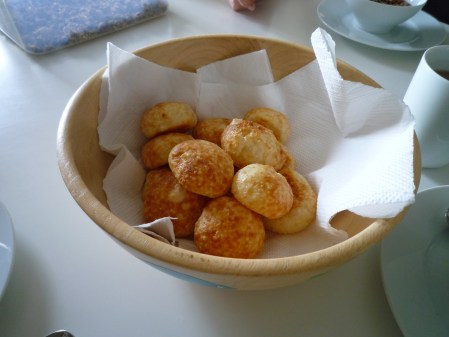
The recipe requires you to make a choux-type paste by throwing the tapioca starch into boiling water and then beating like crazy to make a smooth paste. Beaten eggs are then added before the soft dough is blobbed onto lined trays for baking.

Miraculously, these blobby balls transform when baked into light and fluffy rolls:
Recipe for granola
Adapted from a recipe in Nigella Lawson’s “Feast”.
Ingredients
450g rolled oats
120g sunflower seeds
120g white sesame seeds
175g apple compote (a little bought jar is fine)
2 teaspoons ground cinnamon
1 teaspoon ground ginger
120g brown rice syrup (from health food shops or the healthy eating aisle of your supermarket)
4 tablespoons runny honey
100g light brown sugar
250g whole unskinned almonds
1 teaspoon Maldon salt
2 tbsp sunflower oil
300g raisins
Mix everything except the raisins together very well in a large mixing bowl using 2 curved spatulas.
Spread the mixture out on 2 baking tins and bake at 170 degrees C for about 40 minutes. Keep an eye on the mixture and turn it over with a big spoon after about 20 minutes. It may need longer than 40 minutes in total. You need to achieve an even golden colour without overbaking or burning. Once cool, mix with the raisins and store in an airtight tin.
Recipe for Brazilian cheese bread (Pao de queijo)
From the website “sonia-portuguese.com”. Makes about 70 individual rolls.
Ingredients
1 cup water
1 cup milk
½ cup oil
1 teaspoon salt
450g tapioca starch
2 to 3 eggs
200g grated parmesan cheese
Bring to a boil in a big pan the water, milk, oil and salt. Remove the pan from the heat and add the tapioca starch. Mix well with a wooden spoon and allow to cool down. Put the mixture in a bowl, add the eggs and knead well. Add the grated cheese and keep kneading until the dough is smooth.
Roll into small balls (each ball requiring 1 tbsp mixture). Oil rather than flour your hands.
Place the balls on a baking tray lined with baking paper. Bake at 180 degrees C for about 20 minutes or until golden brown.
Nourishment for the traditionally built: breakfast from Botswana
August 7, 2012 § Leave a comment
The latest in our Breakfasts of the World Project series.
I chose to learn about Botswana via the gentle medium of Alexander McCall-Smith’s bestseller “The No.1 Ladies’ Detective Agency” featuring the “traditionally built” heroine Mma Ramotswe. I was also helped by Stuart Brown’s “Mma Ramotswe’s Cookbook”, almost a companion volume to the series and a browsable mix of cookbook, travel guide and introduction to Botswanan geography and culture.
Thanks to both books I finally got to grips with the various confusingly similar words Batswana, Motswana, Setswana and Tswana. Batswana is the name for the people of Botswana; Motswana the singular form of the same word; Setswana, also Tswana, the name both for the main language of Botswana and the population group speaking this language living in Botswana, South Africa and Namibia.
Botswana, formerly Bechuanaland, gained independence from Britain in 1966. Its capital city is Gaborone, newly established when the country gained independence. Botswana has since grown to become an African success story, relatively prosperous and with a strong tradition of democracy.
It’s a large but sparsely populated country as much of its land area is taken up by the Kalahari desert. Despite being landlocked, Botswana can lay claim to the spectacular Okovango delta, formed where the Okovango river spreads out across a tectonic trough. The water in this inland delta never reaches the sea, being lost through transpiration and evaporation.
On to the breakfast. Deciding what to drink was easy – the first thing Mma Ramotswe and her able assistant Mma Makutsi do on their first morning at work in the Detective Agency is to drink a cup of bush tea, Mma Ramotswe’s favourite, with just a little condensed milk. And they go on to drink bush tea throughout the rest of the book. We followed suit:

The bush in question is of course the Rooibus or Redbush (Latin name Aspalathus linearis), a shrub from the Western Cape of southern Africa whose needle-like leaves turn red once dried in the sun and fermented. The resulting fragrant brew has a slightly medicinal quality, a beautiful red colour and is eminently drinkable with or without milk.

On to the food. Whilst there are plenty of food references in the No 1 Ladies’ Detective Agency series books, I didn’t find a definitive Setswana breakfast. I read with some trepidation about mopane worms, chipolata-sized moth caterpillars preserved by drying in the sun. Fortunately these seem to be eaten as snacks or made into a main-meal stew rather than being eaten for breakfast.
One blogger writing about a trip earlier this year to a “Sons of the Soil” festival in Botswana describes one possible breakfast option:
“On the breakfast menu was chicken necks with fat cakes cooked the very traditional way.”
Fat cakes are Botswana’s answer to the doughnut, a deep-fried yeast-raised wheatflour dough. My fryer needed cleaning and an oil-change before it could be used and I wasn’t sure how to get hold of chicken necks so I decided to focus my efforts on getting hold of some sorghum meal to make the thin soft sorghum porridge, Motogo, another traditional breakfast staple.
Sorghum is relatively unknown here in the UK but is a staple grain crop in large parts of Africa and the Indian subcontinent thanks to its nutritious qualities and ability to withstand drought. It’s known as Mabele in the Setswana language and as Jowar in Gujarati (useful to know if you’re shopping in one of the many ethnic Indian foodstores over here in the UK). I bought myself a distinctly unauthentic pack of American sorghum flour from an Amazon marketplace supplier:
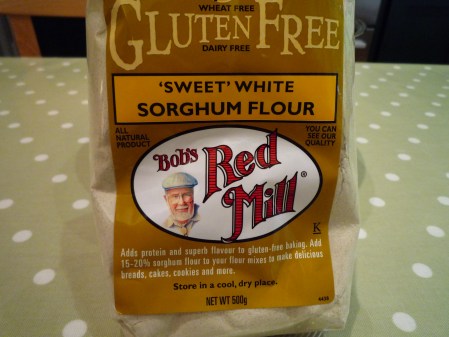
I had to buy in bulk so am busy giving away my remaining packs of sorghum flour to gluten-free friends. Marian, one of my remaining packs has your name on it!
I was a little concerned that my sorghum flour rather than a coarser sorghum meal would not make an acceptable porridge. I needn’t have worried as mixed with water and a little milk and cooked gently over a low heat for 10 minutes or so, the sorghum produced a perfectly acceptable porridge, albeit lacking a little in terms of texture:

Cakes for Hansel and Gretel
July 29, 2012 § Leave a comment
The challenge for this year’s Clonter Opera (Cheshire’s answer to Glyndebourne) picnic was to produce a themed dessert which could be eaten during a 30 minute interval. This year’s production was Engelbert Humperdinck’s “Hansel and Gretel”, so a selection of German mini-cakes, plus sweets and the obligatory gingerbread seemed to fit the bill.

I love proper cheesecake, so a traditional German-style baked cheesecake cooked in a rectangular tin and cut into dainty squares was first on my list. I chose my recipe from my newly acquired baking book, Dan Lepard’s “Short and Sweet” and found it to be excellent. This was the “Classic Cheesecake” from p.458 and was everything a cheesecake should be – deep cream cheese flavour with hints of orange zest and vanilla and great texture. The Hobnob biscuit base was an inspired variation on the usual digestives and was neither too hard nor too soggy, but just right. You can see the cheesecake squares presented in pink foil cases in the picture above.
Talking of which, the dinky self-assembly cardboard three tier cake stands I used attracted at least as much interest as the cakes! These were a Caroline Gardner design, stocked by online supermarket Ocado and maybe also Waitrose and John Lewis too.
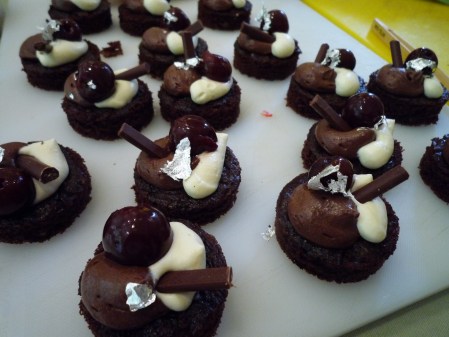
That much-bastardised 1970’s dinner party favourite, Black Forest Gâteau just had to be on the menu. Forget dry chocolate cake, too much buttercream and garish decoration, my version was constructed with featherlight chocolate génoise (I used Rose Levy Beranbaum’s recipe from “The Cake Bible”); kirsch-infused syrup; luscious smooth chocolate custard (another winner from Dan Lepard’s “Short and Sweet” book); white chocolate ganache which tastes and behaves like a super-stable whipped cream, great for a cake which has to sit in a warm room for a little time. The final decoration was a griottine-style morello cherry, a chocolate stick and for a final touch of bling, a shred of real edible silver leaf. The result was a delectable little mouthful:
So good in fact that I just had to put together another batch the next day for afternoon tea, this time with a double layer of sponge, fresh cherries and grated chocolate:

Both the chocolate génoise and custard are really good versions of these classic components and I’ve given both recipes at the end of this post.
Strawberry tartlets presented German style on a sponge cake rather than pastry base, completed my trio of mini-cakes. I used more of the white chocolate ganache and incorporated my mother’s trick of glazing the strawberries with redcurrant jelly for extra sweetness and shine. The cakes were finished off with a little edible gold leaf:

You can’t do Hansel and Gretel without a gingerbread house. I didn’t think a fully assembled gingerbread house would survive the minibus journey along bumpy country roads from home to Clonter so used the templates for mini gingerbread houses from the BBC Good Food site recipe here to make house-shaped biscuits. I didn’t use their gingerbread recipe though, opting for yet another Dan Lepard recipe from “Short and Sweet”, the gingerbread biscuit recipe from p. 243. Another winner, producing a dark, deeply spicy biscuit, its colour coming both from muscovado sugar and also a tablespoon of cocoa powder added to the dough, a neat trick producing a deep colour and rich flavour pointing up the spices but not overpowering them with obvious chocolate.
I decorated the biscuits very simply with white royal icing and a number 1.5 writing nozzle producing a stylish black and white effect:

A selection of old-fashioned sweets from Altrincham market’s pick and mix stall and Hale’s fabulous Gobstopper sweet shop (sugar mice, chevron lolly pops, candy canes, bon bons, comfits, sugared almonds..) plus squares of home-made fudge completed the spread. Shame the opera director had a slightly different vision of the story and went for a pyschedelic Affleck’s Palace style emporium complete with skateboard gear rather than a recognisable gingerbread house. Ah well, you can’t win them all…
Recipe for Chocolate Génoise
Adapted from Rose Levy Beranbaum’s “Cake Bible”. I’d recommend buying the book for all Rose’s invaluable tips and tricks though. This recipe is sufficient for a deepish 23cm diameter round cake. I wanted thinner sheets of cake so scaled up the recipe to a 7 egg version and baked two 25cm square trays of cake.
Ingredients
37g clarified beurre noisette
28g cocoa powder (I like Valrhona or Green and Blacks)
60g boiling water
4g vanilla extract
5 large eggs (250g shelled weight)
100g golden caster sugar
75g sifted plain flour
Preheat the oven to 170 degrees C (fan).
Warm the beurre noisette until almost hot and keep warm.
In a smallish bowl, whisk together the cocoa and boiling water until you have a smooth paste. Stir in the vanilla extract and set aside, covering the bowl with the whisk still in it with cling film if you don’t plan to use it immediately.
Mix the eggs and sugar together in the large mixing bowl from your Kenwood or similar mixer. Set the bowl over, not in, a pan of simmering water and stir constantly until the mixture is just lukewarm. Take care and do not allow the eggs to coagulate or you will end up with hard little lumps in the finished cake. The heating of the eggs helps stabilise the mixture when whisked which is helpful when the dense chocolate is mixed in. I wouldn’t bother with the heating for a plain génoise.
Remove the bowl from the hot water, dry it off and return it to the mixer. Whisk at high speed until the mixture has tripled in volume and leaves a trail when the whisk is lifted.
Take a couple of big spoonfuls of the egg mixture and whisk them into the cocoa mixture using a balloon whisk.
Sift the flour over the remaining egg mixture and incorporate thoroughly but carefully using a balloon whisk. Add the cocoa and egg mixture and stir with the balloon whisk until half-incorporated. Fold in the beurre noisette in two batches by which time everything will be thoroughly combined yet still aerated.
Pour immediately into the prepared cake tin (greased and base lined for a deep round tin; fully lined with baking parchment if you’re baking a sheet of cake in a shallow square or rectangular tin as I was) and bake for about 30 minutes. You can tell when the cake is done as the cake shrinks away from the sides just a little.
Turn out straightaway onto a lightly greased cooling rack and peel off the parchment after a couple of minutes.
Recipe for Chocolate Cream Custard
From Dan Lepard’s “Short and Sweet”. Makes enough to fill 30 mini cakes with plenty left over.
Ingredients
100g golden caster sugar
25g cornflour
25g cocoa powder (I like Valrhona or Green and Blacks)
2 teaspoons vanilla extract
225 ml milk (I used semi-skimmed)
2 egg yolks
50g unsalted butter cut into pieces
50g dark chocolate in small pieces (I like Valrhona Manjari buttons)
150ml double cream
In a heavy-based saucepan whisk the sugar, cornflour, cocoa powder and vanilla extract with the milk until smooth. Add the egg yolks and whisk again. Heat gently over a low to moderate heat beating with a wooden spoon all the time. As the mixture warms, gradually add the butter piece by piece, stirring all the time. As the mixture begins to thicken, beat hard to keep it smooth.
Remove from the heat, tip the mixture into a medium sized bowl (you’re going to add cream to the mixture later) and cover the surface of the custard directly with cling film to stop a sking forming. Leave to cool then chill in the fridge until completely cold.
When you’re ready to complete the custard, take it out of the fridge and remove the cling film. Using a hand-held electric whisk, whisk the custard at a slow speed. When the custard is smooth, increase the speed to medium and gradually whisk in the double cream until the mixture is very smooth, shiny and thick. The mixture will thicken up further to a consistency which can be piped and will hold its shape if returned to the fridge to chill for a while.
Student food
June 28, 2012 § Leave a comment
Centre stage goes to my son George today. He’s studying for a Food and Nutrition GCSE qualification at school and one of his recent assignments (or “controlled assessments” in exam board jargon) was to research and prepare two meals suitable for a student living away from home.

George came up with two dishes: a spicy sausage and bean casserole and a vegetable and goat’s cheese frittata, both of which can be served with oven-baked potato wedges and a mixed salad to turn them into a balanced meal.
It’s fair to say that over the last month or so we’ve eaten a lot of sausage casserole and frittata as George tweaked his recipes and perfected his cooking techniques. Both of George’s final dishes are really good: packed with flavour; simple and relatively quick to make; dirty dishes for washing up kept to a minimum; relatively inexpensive; incorporating vegetables to help achieve the 5 a day target. What more could you ask for in a weekday meal? As a result they’ve become part of our family cooking repertoire and George is now very proud to have a couple of “signature dishes” up his sleeve.
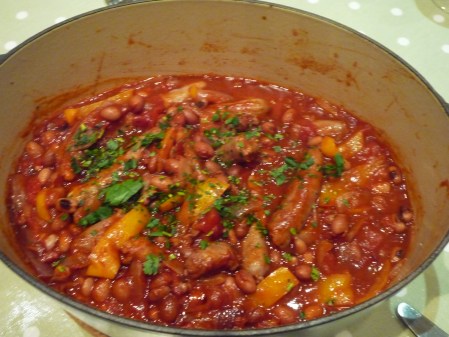
The sausage and bean casserole is enriched with smoked paprika, tomatoes, sweet peppers and, controversially in a school kitchen, red wine:
The frittata combines chunks of goat cheese with spring onions, peas and lightly cooked purple sprouting broccoli with the egg and grana padano cheese base. You can use different green vegetables depending on what’s in season and you can leave out the goat’s cheese if you like, but if so George suggests adding more grated grana padano to boost the flavour of the finished dish.

Recipe for sausage and bean casserole
The starting point for this recipe was “James’ Sausage Casserole” from Fiona Beckett’s book “The Ultimate Student Cookbook” which George reckons is the best student cookbook currently on the market.
All the tin/can sizes in the recipe are for a standard 400g can
Serves 4
Ingredients
1 red onion, halved and thinly sliced
1 pack of good quality high meat content sausages. (A pack will weigh 400-500g and if it contains 8 sausages it makes for easy serving portions of 2 sausages per person).
1 yellow pepper, halved, deseeded and cut into strips
1 tin butter beans, drained and rinsed in hot water from the kettle
1 tin borlotti beans, drained and rinsed in hot water from the kettle
1 tin chopped tomatoes (with herbs if you like)
100ml red wine
100ml hot chicken or vegetable stock (stock made from powder or a cube is fine for this recipe)
1 teaspoon smoked paprika
salt and pepper
olive oil
Select a large, heavy-based lidded saucepan or enamelled cast-iron casserole big enough to hold all the ingredients. Add a little olive oil to the chosen pan (maybe 2 tablespoons oil), place it over a low to medium heat, add the sliced onions, half cover with the lid and cook gently, lifting the lid and stirring with a wooden spoon from time to time, until the onion is soft and cooked through but not browned. This cooking technique is called sweating.
Remove the lid, increase the heat to medium and add the sausages and yellow pepper strips. Cook for a couple of minutes, turning the sausages frequently with tongs or your wooden spoon from time to time. Don’t worry too much about trying to brown the sausages as they might stick if they cook at too high a temperature for too long.
Next add the beans, tomatoes, wine, stock, smoked paprika and a little salt and pepper. Stir to mix, bring to the boil over a high heat then cover the pan, turn the heat down to low and simmer over a low heat for one hour. Lift the lid and give the contents of the pan a stir every 10 minutes or so. If after 45 minutes, there is too much liquid in the pan, remove the pan lid, turn the heat up and boil more fiercely to reduce and thicken the sauce. Watch the pan carefully though and stir more frequently so that the sausages and vegetables don’t burn.
Recipe for Vegetable and Goat’s Cheese Frittata
Again, a recipe from Fiona Beckett’s “The Ultimate Student Cookbook” (Spring Vegetable Frittata) provided a great starting point for this frittata. Technically, a true Italian frittata is cooked very gently so that it does not brown. This is a looser interpretation of what a frittata should be and does taste good cooked to brown the surfaces lightly – don’t overdo it though.
Serves 2
Ingredients
2 tablespoons olive oil
4-5 spring onions trimmed and finely sliced
60g defrosted frozen peas (you could of course use fresh peas from your garden if you’re lucky enough to get your hands on some)
60g trimmed, steamed broccoli (purple sprouting, tenderstem or ordinary all good but the purple sprouting kind needs a slightly longer cooking time to soften its stems which have a tendency to be a bit woody)
100g goat’s cheese (a slice of French chèvre log is fine – use all of it including the edible rind) cut or crumbled into rough 1cm cube chunks
25-50g finely grated grana padano cheese (similar to Parmesan but less expensive)
a tablespoon of chopped fresh herbs such as parsley, chives, chervil or a teaspoon of chopped fresh tarragon which is stronger in flavour (optional)
5 large eggs, choose free range or organic
salt and freshly ground black pepper
Choose a medium heavy-based non-stick frying pan with a metal handle suitable for going under the grill about 20cm in diameter for this recipe. It’s very disheartening to have your lovely frittata stick and burn in the wrong kind of frying pan. The frittata top is cooked under a hot grill so turn this on now and set to a medium heat.
In a large jug, whisk together the eggs, salt, pepper and grated grana padano cheese with a fork just to mix thoroughly. Set aside.
Heat the olive oil in your frying pan over a medium heat and fry the spring onions gently for a minute or two. Add the peas and broccoli to the pan and cook for a minute or two, stirring gently. Turn the heat up a little then pour in the egg and cheese mixture from the jug. Dot the pieces of goat’s cheese over the surface of the frittata. Lift the egg away from the surface of the pan at the edges as it begins to set and allow more liquid egg to take its place. Reduce the heat if the egg seems to be cooking too quickly. After 3 or 4 minutes once the frittata is mostly set, slip the pan under the grill and continue to cook until the top surface is puffed up and lightly browned. Cool for 10 minutes or so in the pan, then turn out, cut into wedges and serve warm. It’s also good cold the next day if you happen to have some leftover.
Bosnian breakfast
May 13, 2012 § Leave a comment
The latest in our Breakfasts of the World Project series.
Looking at the map of Bosnia and Herzegovina, I was taken aback by how familiar the names some of the larger towns were – Banja Luka once known for its tree-lined boulevards, Mostar similarly for its iconic bridge and the cultured and elegant capital city of Sarajevo. An unfortunate legacy of the Bosnian war of the 1990s is that all these cities are now best known for the war atrocities committed there.
April 2012 was the 20th anniversary of the start of the Siege of Sarajevo which lasted from 1992 until almost 4 years later, 29 February 1996, the longest siege of a capital city in modern warfare. This added a certain resonance to our breakfast.
On the menu was the ultimate Bosnian street food, burek, written about most engagingly here http://horinca.blogspot.co.uk/2009/06/burek-bosnias-gift-to-breakfast.html
Burek, a savoury filling encased in paper thin pastry is known across Eastern Europe and around the Mediterranean under various names – börek, bourek, böregi, bouréki, a legacy of the Ottoman empire. The Turks occupied Bosnia for more than 400 years (1463-1878) and their legacy remains many ways including their food.
Emigré Bosnians yearn for a dollop of kajmak a Balkan version of clotted cream cheese to serve alongside their burek. If you fancy having a go, the instructions here http://saltandfat.com/post/9168043369/kajmak look admirably detailed. We cheated and ate our burek with a spoonful of thick plain yoghurt instead.
I give the full burek recipe below though I chose not to make my own filo/strudel pastry on this occasion.
Preparing the meat filling is a simple job if you use a food processor. It comprises minced beef, onion, a liberal quantity of paprika and beaten egg to hold it all together.

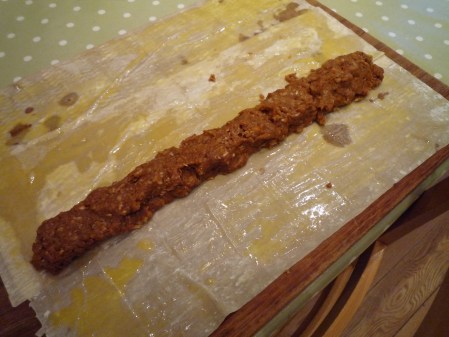
Making the burek is a little bit like creating an enormous sausage roll:
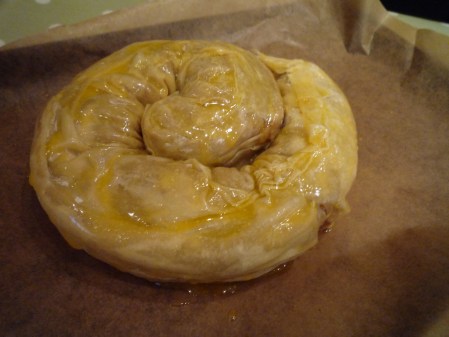
The next step is coiling up the roll ready to bake:
One baked the burek are best cooled on a rack to avoid a soggy bottom:

Finally the burek is sliced and ready to eat.
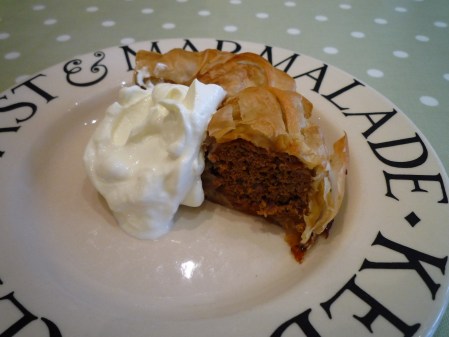
Recipe for Bosanski burek
Adapted from this recipe http://www.whats4eats.com/meats/bosanski-burek-recipe
I chose not to make my own filo/strudel pastry as the original recipe suggests. Instead I bought a pack of ready made filo. Jus-rol brand is readily available in UK shops and a pack of pastry contains 6 sheets and weighs 270g.
The recipe makes 3 medium sized burek rolls like the ones in my pictures above.
Ingredients
6 sheets filo pastry, 2 per burek, fully defrosted if using frozen pastry
approx. 50g melted butter
For the filling
600g lean minced beef
2 medium onions, chopped
1 large egg, beaten
1 and 1/2 tablespoons paprika (mild)
salt and pepper
Begin by making the simple filling. Put all the filling ingredients into the bowl of a food processor and pulse until combined and the mixture is very finely chopped but not reduced to a mulch with no texture. If you prefer not to use a food processor, make sure the onions are very finely chopped or even grated and mix all the ingredients together thoroughly in a large bowl using a wooden spoon or your hands. Set the prepared filling aside.
Next, get everything ready to shape and bake the bureks. Make sure your melted butter has cooled a little and that you have a pastry brush to hand. Lay out your pastry and workboard and have either a clean damp teatowel or some clingfilm to hand to cover the filo you’re not working with. Line three baking sheets with baking parchment, one for each burek. Finally, preheat your oven to 170 degrees C (fan). You need to be organised before you begin as the filos sheets are so thin that they dry out very quickly and crack and become difficult to roll up unless you keep them covered.
Spread one filo sheet onto your pastry board, long side facing you ie landscape rather than portrait orientation. Brush it liberally with melted butter. Lay a second sheet the same way partly overlapping first one by about one third. Brush this one with melted butter too.
Take one third of the filling and, leaving a 7cm border at the top and a 3cm border at each end, spread it out in a long rough sausage shape. Fold over the top border and continue rolling up into a long sausage roll shape. Pinch the ends to seal, brush the roll with melted butter and coil it into a rough spiral. Lift gently and place on the prepared baking sheet.
Complete the other two bureks in the same way.
Bake in the preheated oven for 35 to 45 minutes until golden brown and cooked through.
My top 5 Parisian pâtisserie trends
May 6, 2012 § Leave a comment
During April’s trip to Paris to brush up my pâtisserie skills at Lenôtre’s École des Amateurs, I took the opportunity to wander the streets, gaze into the shop windows, read the magazines and do a little tasting. I’ve distilled this into my take on the latest pâtisserie trends.
Trend 1: Choux puffs
Move over macarons, choux puffs are set to be the latest small cake trend, or so young entrepreneur Lauren Koumetz hopes. She set up her boutique bakery named Popelini in the Marais district last year. Cannily, the tiny patisserie selling just choux puffs is just across the road from world-famous bakery Poilâne’s newest outlet in the rue Debelleyme (see my previous post). Eagle-eyed viewers will have seen Rachel Khoo popping into the shop in Episode 2 of her recent BBC 2 series “Little Paris Kitchen”.
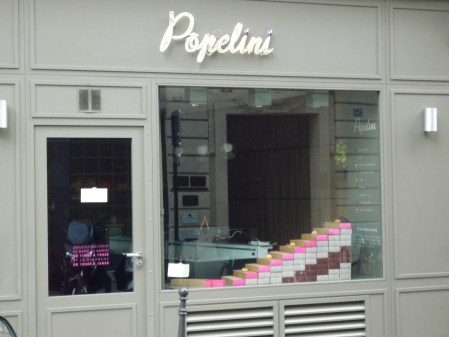
The concept is simple – take a choux pastry puff, fill it with flavoured crème pâtissière and top it with a disc of prettily coloured fondant icing. The appearance of these choux puffs and their flavour combinations clearly owes a lot to the macaron trend, and indeed the pastry chef at Popelini, Alice Barday, is ex- Ladurée.
There are 9 classic flavours in the current range – these include dark chocolate, lemon, salted caramel, pistachio/griottine (more on this one later) – plus an ever changing ‘flavour of the day’.
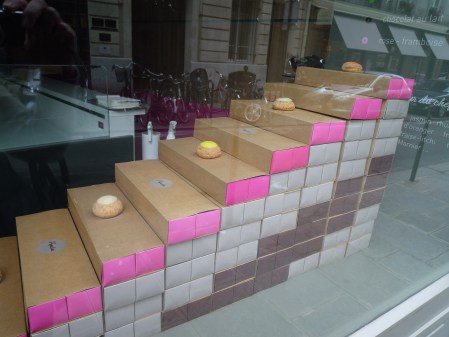
Trend 2: Pistachios
The love affair with the pistachio nut goes on and on. It must have something to do with their intriguing green colour as well as their delicate flavour. In the on-trend pâtisseries, every classic tart or entremet traditionally prepared with ground almonds has been reinvented with pistachios. The pairing of griottine cherries (morello cherries preserved in kirsch) with pistachios, whether in the filling for a choux puff (see above) or in a frangipane tart is increasingly popular.
There’s even a shop, La Pistacherie, which opened in mid 2011, devoted to the pistachio nut in all its forms on the Rue Rambuteau just around the corner from Beaubourg, the Pompidou Centre:

Trend 3: citrus
Forget familiar lemon and orange, now it’s got to be mandarin, grapefruit (ideally delicate pink grapefruit), or more exotically still bergamot or the Japanese favourite yuzu. The Japanese are avid buyers of French pâtisserie – just look at the big names that have opened up branches in Tokyo – and are in turn bringing their influence to bear – the green tea powder matcha is found flavouring all sorts of cakes and biscuits now. The tart, aromatic yuzu described in flavour terms as being similar to the grapefruit and mandarin is very popular in Japan but sadly well nigh impossible to get hold of in the UK. I have seen prepacked juice available for sale in specialist Japanese stores so maybe the fresh fruit is on its way.
Not strictly citrus, but the herb lemon-thyme is popping up all over the place whether perking up emigré pâtissier Eric Lanlard’s lemon cake or adorning a Pain de Sucre (see below) fig tart.
Trend 4: all things American
Parisians have fallen in love with brownies (charmingly pronounced as ‘brew-neez’), luscious cheesecake and simple-to-make pound cakes and muffins and have made them their own. You’ll find them everywhere now – peeking out of chi-chi pâtisserie windows and on sale to grab and go as you pass through the Gare du Nord or wherever. On-trend boulangerie-pâtisserie Huré on the rue Rambuteau has an enticing display of American-inpsired loaf cakes in the window with flavours such as white chocolate and cranberry and pecan to the fore.

Trend 5: Classics reinvented
A step further down the rue Rambuteau and you’ll find Pain de Sucre (‘sugarloaf’), one of Paris’ hottest establishments, regularly featuring on top 10 lists of Paris’ best pâtisseries. Renowned for its flavoured breads, oversized jars of pastel-coloured marshmallows, reinvented classics abound here. Its rum baba, renamed ‘Le Baobab’ is sold complete with miniature pharmacist’s dropper of rum to allow for dosing of alcohol just the way you want it.
It’s not just in Pain de Sucre that you’ll find classics reinvented. The space age showroom featured in several episodes of the BBC 2 programme “Little Paris Kitchen” is Philippe Conticini’s “Pâtisserie des Rêves” (Pâtisserie of Dreams). Rachel Khoo, the chef within the Little Paris Kitchen is shown admiring a reinvented chocolate éclair, a sculpted beauty almost unrecognisable as an éclair displayed like an artwork beneath its own glass dome. You can find pictures of it plus detailed tasting notes here.
Places like this lead the way, but everywhere you’ll find classic large cakes like the gâteaux Opéra or St Honoré reinvented either as small individual with sophisticated pared-down decoration. The mini Opéras will sport a lacquered chocolate glaze, as dark and shiny as a Steinway grand piano, ornamented only by a shred of pure gold leaf. Alternatively, classic cakes can be miniaturised and given a new flavour twist like Ladurée’s billowy pink raspberry and rose miniature St Honoré. You can see this here. My last two links are to US citizen Adam’s beautifully obsessive blog http://www.parispatisseries.com/ dedicated, as the name suggests to all things sweet in Paris – you couldn’t find a better starting point if you were planning a food-based trip to the French capital.
As the French are voting for a new president today, I’m going to sign off with a French joke. I suspect it may be the last we hear of Sarko for some time:
Q: What is Nicolas Sarkozy’s favourite cake?
A: Brownie (pronounced like ‘Bruni’ in French!)
Contact details
Popelini
http://www.popelini.com/
29, rue Debelleyme
Paris 75003
Tel +33 (0)1 44 61 31 44
Opening hours – check website but currently Tuesday to Saturday 11.00 to 19.30; Sunday 10.00 to 15.00
La Pistacherie (website still under construction at time of writing)
67, rue Rambuteau
Paris 75004
Tel +33 (0)1 42 78 84 55
Opening hours “every day of the week”
Huré
18, rue Rambuteau
Paris 75003
Tel +33 (0)1 42 72 32 18
Pain de Sucre
http://www.patisseriepaindesucre.com/
Rue Rambuteau
Paris 75003
Tel +33 (0)1 45 74 68 92
Opening hours: 10.00 – 20.00 closed Tuesday and Wednesday
La Pâtisserie des Rêves
http://www.lapatisseriedesreves.com/
93 rue du Bac
Paris 75007
Tel +33 (0)1 42 84 00 82
Opening hours: Tuesday to Saturday 9.00 – 20.00; Sunday 9.00 – 16.00
111 rue de Longchamp
Paris 750016
Tel +33 (0)1 47 04 00 24
Opening hours: Tuesday to Friday 10.00 – 20.00; Saturday and Sunday 9.00 – 20.00
Pain Poilâne: the best bargain in Paris?
April 22, 2012 § Leave a comment
The little box of Pierre Hermé macarons I wrote about in my last post set me back 25 Euros. For a third of the price, you can buy yourself beautiful, round, whole loaf of arguably the finest bread in the world weighing in at a shade under two kilos.
Here are the loaves on display at Poilâne’s newest store (opened in July 2011) on the rue Debelleyme in the Marais. The staff are charming and friendly and, unlike the Pierre Hermé shop, were happy for me to take photos. You’ll see that the word for what we might call a cob is not a mere “boule” but a “miche” literally a generously rounded buttock! I love that idea.

It was such a treat to carry out the whole loaf, still faintly warm from the legendary wood-fired oven, lovingly wrapped, and less lovingly stuffed into my rucksack for the journey back to Manchester. It survived the journey intact:

and was soon sliced up ready for sampling:

What makes the bread so special? It has the dark, crackly crust typical of a wood-fired oven bake. The crumb is not white but a deep cream colour attributable both to its wholegrain content and its long fermentation. The texture of the crumb is dense but not heavy. It’s chewy, just a touch sour, flavoursome and slices well. Fresh, it tastes excellent but thanks to its sourdough fermentation it keeps for a week and a few days old it toasts brilliantly.
What’s in it? The Poilâne website tells you that the bread is made from just four ingredients (stoneground flour, sourdough starter, water and Guérande sea salt) but doesn’t go into detail as to what type of flour is used. Lots of people have written lots of things about the flour in a Poilâne loaf. US baker Peter Reinhart in his book “The Breadbaker’s Apprentice” describes the flour as a stoneground 85% extraction wholewheat ie with some of the bran removed. This is not a type of flour readily accessible to homebakers but can be approximated by mixing three parts white flour to one part wholemeal/wholewheat. Other commentators refer to the inclusion of 30% spelt (épeautre in French) flour in the Poilâne mix but I haven’t yet found an unimpeachable source for this claim.
According to the Poilâne website, legend began in the 1932 when Pierre Poilâne from Normandy set up shop in the rue du Cherche Midi in St Germain on Paris’ Left Bank. He made a traditional loaf in the traditional way (best quality ingredients, long fermentation, natural yeasts, baking in a woodfired oven) rather than producing the more popular white flour baguettes. His sons Lionel (and also Max) continued the family baking business. Lionel was the marketing genius – very convenient if you’re going to supply countrywide if you can first convince the world that your bread tastes best not when absolutely fresh but 3 days’ old! – and it is his bread which has gone onto achieve iconic status worldwide. Lionel died in a freak helicopter accident in 2002 leaving his 19 year old daughter Apollonia in charge.
I’ve occasionally wondered how Poilâne bread can appear on English and French supermarket shelves when there are just three tiny traditional outlets in Paris. I’ve visited two of them, sadly not the original rue du Cherche Midi shop yet which I’ll have to save until next time.
Here’s the Boulevard de la Grenelle shop:

and here’s the newest rue Debelleyme shop in the Marais:
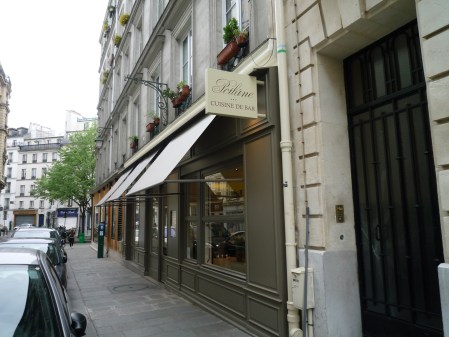
The answer to the supply conundrum is that in the 1980s, Lionel built a 24 wood-fired oven “facility” as the website delicately puts it, to supply growing demand. The discreet little cream-coloured tree-screened factory is located in Bièvres in the southwest outskirts of Paris not far from Versailles.
Harvard Business School graduate Apollonia Poilâne seems to have inherited her father’s business sense as well as his passion for good bread and has made a number of discreet innovations. I’m not convinced about the matcha flavoured green teaspoon shaped biscuits but the “Cuisine de Bar” outlets that have appeared adjacent to the bread shops in the rues du Cherche Midi and Debelleyme (also in London now) are an excellent idea. They are essentially cafés based on toast (tartines in French). So next time you’re in Paris looking for a fashionable, wholesome and inexpensive breakfast or light lunch, you know where to go.
After a bit of research
Contact details (Paris)
38 rue Debelleyme (Marais- “Cuisine de bar” adjacent to shop)
Paris 75003
Tel +33 (0) 1 44 61 83 39
Opening hours :
Tuesday to Sunday 7:15 am to 8:15 pm
49 bld de Grenelle (Eiffel Tower)
Paris 75015
Tel +33 (0) 1 45 79 11 49
Opening hours :
Tuesday to Sunday 7:15 am to 8:15 pm
8 rue du Cherche-Midi (St Germain – “Cuisine de bar” adjacent to shop)
Paris 75006
Tel +33 (0) 1 45 48 42 59
Opening hours :
Monday to Saturday 7:15 am to 8:15 pm
Parisian macaron update
April 17, 2012 § 2 Comments
Just back from our regular easter trip to Paris and Fontainebleau and this year, Bayeux in Normandy too. The focus of the Paris part of my trip was taking part in a couple of pâtisserie classes at the Lenôtre school on the avenue des Champs Elysées (making chocolate desserts and the legendary Gâteau St Honoré). Whilst there, I took the opportunity to use my carnet of metro tickets and my own two feet to explore the city, visit some iconic bakeries and pâtisseries, and try and work out by observation the newest Parisian pâtisserie trends.
In the first of three Paris posts, I thought I’d begin with an update on the macaron trend. In the UK I think I can say they’re officially mainstream now that our local Marks and Spencer Altrincham branch regularly stocks its Own Brand pack 6 pack. Paris is of course awash with them and whilst there I took the opportunity to try a cutting-edge selection from Pierre Hermé and classic favourites from Ladurée.
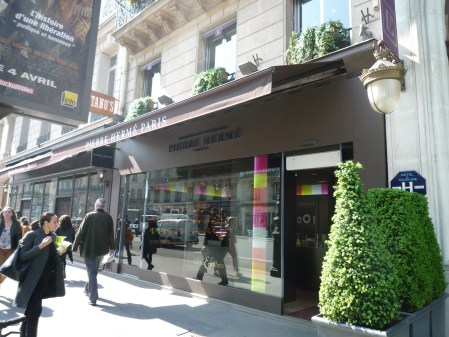
First stop was the Pierre Hermé Avenue de l’Opéra shop (which, cashing in on present trends just sells macarons and chocolates, not pâtisserie). One unwanted consequence of the proliferation of food bloggers is that polite requests such as mine to take a quick photo inside the shop are sadly refused. So here is a photo of said shop from a safe distance outside:
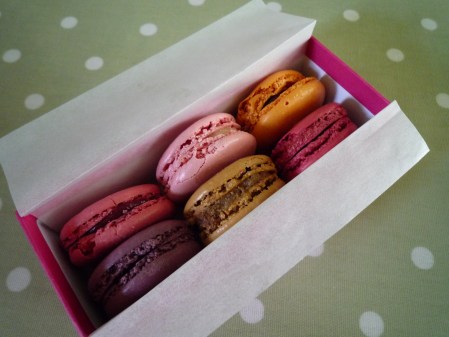
Here’s the selection of macarons I bought and subsequently tasted. The turquoise presentation box is just a little lurid perhaps?

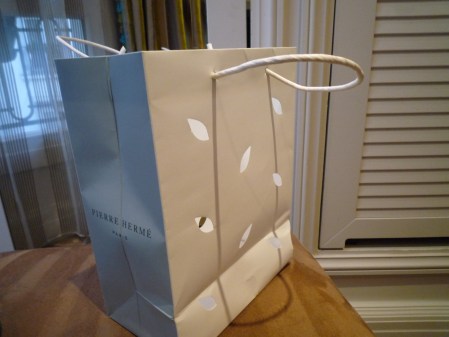
whereas the bag in which it was presented with its pale blue panels and cut-out broderie anglaise style leaves is much easier on the eye:
The Pierre Hermé macarons are characterised by their generous (some might say overgenerous?) fillings and bewildering palate of flavours. For the record, this is the latest menu with some of the names as fanciful as the flavour combinations. With the aid of Pierre Hermé’s Macaron book which gives instructions in meticulous detail for constructing his signature combinations, I’ve added a little extra information.
MOGADOR: milk chocolate and passion fruit – yellow shells speckled with cocoa powder; passion fruit milk chocolate ganache
INFINIMENT ROSE: rose & rose petals – pink shells; rose buttercream
INFINIMENT CHOCOLAT PORCELANA: pure chocolate origin Venezuala Porcelana – chocolate shells; Porcelana chocolate ganache
INFINIMENT CARAMEL: salted butter caramel – light brown shells coloured with yellow food colouring and coffee extract; salted butter caramel filling
CARAQUILLO: chocolate, coffee & aniseed – chocolate shells; chocolate ganache flavoured with aniseed
AMERICANO PAMPLEMOUSSE: orange, campari and candied grapefruit – orange shells; white chocolate ganache flavoured with Campari, grapefruit juice and orange juice; cubes of candied spiced grapefruit peel embedded in the ganache filling
CRÈME BRÛlÉE: vanilla and caramel shards
INFINIMENT CASSIS: blackcurrant – purple shells; white chocolate ganache made with blackcurrant and redcurrant juice rather than cream; one or two whole blackcurrants in the centre
ISPAHAN: rose, lychee & raspberry – deep pink shells sprinkled with red coloured sugar or ruby dusting powder; white chocolate ganache mixed with pureed preserved lychees and flavoured with rose extract; square of concentrated fresh raspberry jelly in the centre
INFINIMENT MENTHE FRAÎCHE: mint – blue-green shells; white chocolate ganache flavoured with an infusion of fresh mint leaves and Crème de Menthe
INFINIMENT JASMIN: jasmine flowers and jasmine tea – shells whitened with titanium dioxide with dried jasmine flowers sprinkled on top; jasmine tea white chocolate ganache flavour boosted with jasmine essential oil;
MÉTISSÉ: orange, carrot and Ceylon cinnamon – orange cinnamon shells; carrot, orange & white chocolate ganache
PLÉNITUDE: chocolate and caramel – one chocolate shell; one caramel brown shell (coffee extract and food colouring); milk and dark chocolate ganache mixed with salted butter caramel
PIETRA: caramelised hazelnut and crispy praline
HUILE D’OLIVE À LA MANDARINE: olive oil and mandarin – one olive green shell (green colouring and coffee extract); one orange shell; white chocolate ganache flavoured with vanilla mixed with extra virgin olive oil
MOSAÏC: pistachio, Ceylon cinnamon & griottine – natural shells sprinkled with red sugar or ruby dusting powder; white chocolate ganache flavoured and coloured with cinnamon and pistachio paste; stoned griottine (trade name for morello cherry preserved in kirsch) in the centre
ÉDEN: peach, apricot and saffron – peach coloured shells; white chocolate ganache infused with saffron mixed with purée of fresh white peach and small cubes of soft-dried apricot
INFINIMENT VANILLE: vanilla from Tahiti, Mexico & Madagascar – natural coloured shells flavoured with vanilla seeds; white chocolate ganache flavoured with 3 types of vanilla pod
MÉDÉLICE: lemon and crispy praline hazelnut wafer – yellow shells sprinkled with hazelnut wafer shards; natural colour lemon cream filling
INFINIMENT CITRON: lemon – yellow shells; natural colour lemon cream filling
They sound amazing don’t they? The truth is though that sample one with your eyes closed and you’d be hard pressed to say what the flavour is. There’s a healthy dose of psychological trickery going on here and the apparent flavour is boosted if you a) your macaron is strongly coloured and b) you can read the description of what you’re supposed to be tasting.
That said, the macarons tasted pretty good, even the mint one which was surprisingly subtle and fragrant rather than being filled with a toothpaste-like substance as I joked it might be before tasting it.
I didn’t make it to Hermé’s flagship store which is on the Rue Bonaparte on the left bank. He now has a myriad of shops throughout Paris, like the one I visited on the Avenue de l’Opéra selling just macarons and chocolate. Presumably these are shipped in daily by the dozen rather than being lovingly crafted on the premises. Well, I suppose you have to ride that trend while it lasts…
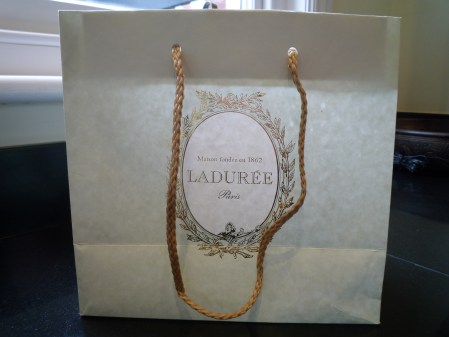
The original and classic macaroon maker Ladurée is playing the same game. You can load up on macarons in various locations throughout Paris, even at their newest outlet Terminal 2 Charles de Gaulle airport, which is exactly what I did. You can opt for the classic eau-de-nil and gold packaging:

Or the dinky duck-egg blue and shocking pink “Hello Kitty” presentation box aimed fair and square at the Japanese market:

The current Ladurée list of flavours runs as follows:
PERMANENT FLAVOURS
Café – coffee
Caramel – caramel
Cassis Violette – blackcurrant and violet
Chocolat – chocolate
Fleur d’Oranger – orange flower water
Framboise – raspberry
Pistache – pistachio
Réglisse – liquorice (black)
Rose – rose water
Vanille – vanilla
Incroyable Guimauve Amande – incredible almond marshmallow
SEASONAL FLAVOURS
Citron – lemon
Fruits rouges – red fruit
Fleurs de cerisier – cherry blossom
Chocolat pure origine Colombie – Colombian chocolate
Praliné – praline
Marron – chestnut
Pomme Verte – green apple
Chocolat au lait – milk chocolate
Read the small print underneath the box to discover the list of ingredients needed to make this range of flavours:
sugar; almonds; eggs; butter; cream; cocoa; blackcurrants; raspberries; pistachios; chestnuts; coconut; hazelnuts; mint; lemons; morello cherries; whole milk powder; glucose syrup; cornflour; pectin; coffee; rose syrup (sugar syrup, natural red colouring, rose flavour); redcurrant; dark rum; honey; candied fruit (sugar, glucose, citron, ginger, lemon, orange); flavourings: orange flower, citron, lemongrass, chestnut, mint, mimosa, violet (invert sugar, propylene glycol, alcohol); cinnamon; star anise; ginger, gelatine (not porcine); emulsifier: soya lecithin; natural vanilla extract; vanilla; lime; rose essence; salt; sunflower oil; vegetable fat; barley malt extract; emulsifier: glycerides of fatty acids; colours: luteine, carmine, carminique, carantho, chlorophyll, spinach, coal black, brilliant blue fcf, carotinoids, caramel.
Yum!
If you still feel like buying some here’s where to go:
Pierre Hermé Paris addresses
72 rue Bonaparte, 6th arrondissement (flagship store – the full range)
185 rue de Vaugirard, 15th – pâtisserie, macarons, chocolates
just macarons and chocolates:
58 avenue Paul Doumer, 16th
39 avenue de l’Opéra, 2nd
Galeries Lafayette concession, amongst shoes in the basement (!); home on ground floor; and designers on the 1st floor, 40 boulevard Haussmann, 9th
Publicis Drugstore concession, 133 avenue des Champs Elysées, 8th
Printemps Parly II concession, Avenue Charles de Gaulle, Le Chesnay nr Versailles
Ladurée Paris and surrounding area addresses
16-18 rue Royale, 8th arrondissement
21 rue Bonaparte, 6th
75 avenue des Champs Elysées, 8th – AT DATE OF WRITING CLOSED FOR REFURBISHMENT
Orly airport West Terminal
Charles de Gaulle airport Terminal 2
Printemps department store concession, 64 Boulevard Haussmann, 9th
Chateau de Versailles, Versailles
 The Rhubarb Fool