
A simple salad for spring
April 12, 2012 § Leave a comment

A ate a simple and delicious little salad for lunch last week in Paris, sitting outdoors in the spring sunshine, just off the the Champs Elysées. It was described on the menu as a “Salade Farandole” or merry-go-round salad, presumably because of the wheel shaped arrangement of the leaves.

The ingredients were chicory leaves, orange segments, strips of smoked duck breast, walnuts and a few spinach leaves together with just the right amount of a citrussy dressing.
It was such a good combination – crisp, bitter leaves, sweet orange, salty duck, crunchy walnuts – that I decided to recreate my own version at home. The Parisian version included some wafer thin slices of what might have been wet walnuts, unlikely at this time of year I know. I didn’t get the opportunity to ask the waiter to ask the chef what this mystery ingredient was. Back home, I remembered that I had a jar of inky-black pickled walnuts at the back of the fridge so I fished one out, sliced it as thinly as I could and added this to my salad for an extra flavour and texture.
Smoked duck isn’t that easy to get hold of, but locally the excellent Smokehouse in Wilmslow prepare their own smoked duck breasts and you can buy them ready sliced from Waitrose or Ocado in the “Reflets de France” range. Talking of Ocado, I’ve being going a bit crazy with their new range of Natoora specialist fruit, veg and deli products so I happened to have a bag of Sicilian blood oranges in my fridge which make a visually appealing addition and taste extra sweet:
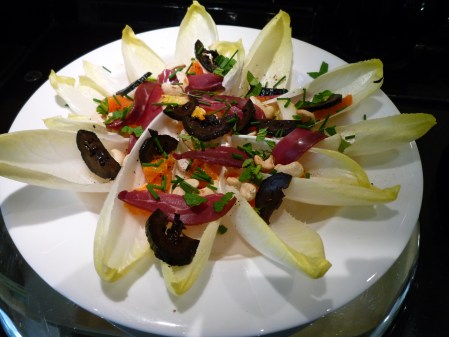
It made a lovely light lunch and the slightly bitter chicory combined with the orange were a perfect antidote to all that Easter chocolate. I was so pleased with my little salad that I made it again the next day, this time with some red Treviso radicchio I happened to have left over (I’m going through a bit of a bitter leaf phase at the moment) and with pistachios rather than walnuts as that’s all I had left in my cupboard. There’s no need to be too prescriptive about the ingredients as it’s a salad you can make your own. I hope you enjoy it.
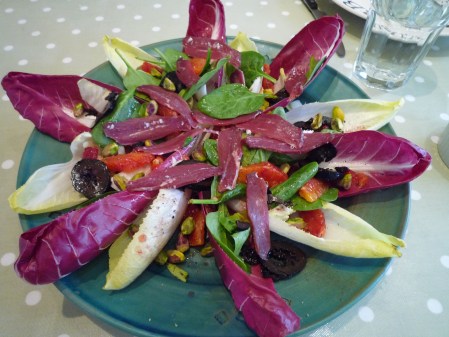
Recipe for chicory, orange and smoked duck salad
Serves 2
Ingredients
For the salad
2 medium heads chicory (white, red or a mixture of both)
2 and a half oranges, peeled and cut into pith-free segments
2 pickled walnuts, thinly sliced
handful walnut halves, lightly toasted and roughly chopped
1 smoked duck breast, cut into the thinnest slices you can manage, fat removed if you prefer
handful baby spinach leaves
For the dressing
juice of the remaining half orange
2 tablespoons walnut oil
salt and freshly ground black pepper
few snipped chives, torn mint leaves or other soft green herbs (optional)
Wash and dry the chicory heads. Cut of the base and pick off the larger outer leaves carefully. Arrange in an attractive wheel shape on your serving platter or in individual salad bowls as you prefer. Chop roughly the remaining centre part of the chicory, combine with the spinach leaves and pile in the centre.
Scatter over the salad the orange segments, pickled walnuts, chopped toasted walnuts and strips of smoked duck breast.
Whisk together the dressing ingredients and drizzle over the salad shortly before serving.
Honours even: world marmalade awards 2012
April 9, 2012 § 2 Comments

Once again, the World Marmalade Awards held at Dalemain in Cumbria brightened up those last days of February just before spring proper arrives. Tim and I had both submitted our marmalades for judging, each using our favourite recipe. Tim favours a straightforward Delia Smith recipe with a firmish set, whereas I’m wedded to an alternative recipe with very fine shreds of peel and a softish set. You can find both of our recipes via the Recipe Index page.
We were delighted to discover that both of us had been awarded 19 marks out of a possible 20 this year. This gained us a silver award each and, more importantly meant marital harmony over the breakfast table was maintained.
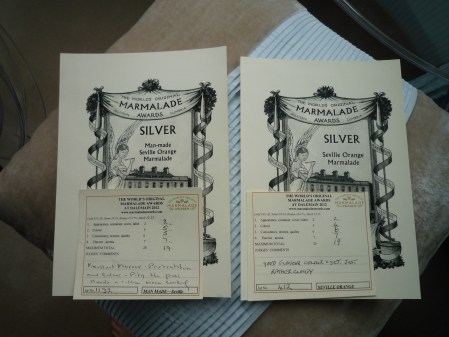
So where did we each drop that final elusive mark? In my case the judge remarked that my marmalade was “just rather cloudy” which was true as this picture of my 2012 batch shows:

I don’t know what made my marmalade cloudy this year but the most likely tip I’ve found is to skim off the scum rigorously while boiling and NOT to add a knob of butter to the boiling pan to reduce scumming as this will cause it to be dissolved back into the mixture, thus making it cloudy. So that’s the change I’ll be making next year.
In Tim’s case, the judge quibbled that his peel “needs a little more cooking” something which can be pretty easily put right. I think this may have happened as his oranges were hanging round in the fridge for about a month before he got round to making his marmalade right at the last minute.
Here’s one of the judges giving Tim a few tips to achieve that elusive gold next year:
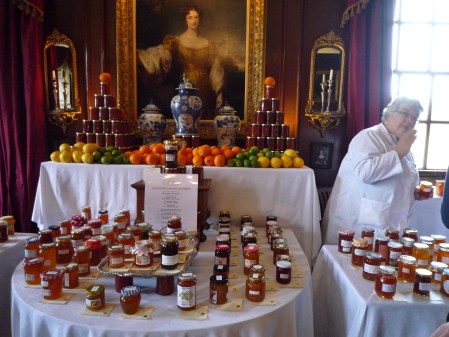
It’s human nature to dwell on the one point lost but perhaps it’s more constructive to focus on what we did right.
We both used beautiful organic oranges delivered via our Riverford veg box man. This was really top quality fruit which was bursting with zesty flavour. I bought my fruit early and used it straightaway and found the peel was quick to soften (ready in half an hour or so whereas older fruit can need an hour or more to soften) and a set was achieved relatively quickly once sugar was added. I think a shorter cooking time means a fresher, zingier citrus flavour.
I experimented with a sugar thermometer this year and stopped boiling once my marmalade reached 104.5 degrees C in order to achieve the wobbly softer set I was looking for. I think if I’d used the chilled saucer and fingertip wrinkle test alone, I’d have been tempted to boil the mixture for a good 5 minutes or so longer.
I potted while the mixture was still extremely hot, filling the jars to the brim, hoping that the peel would be correctly saturated with sugar and would therefore be suspended in the marmalade in perfect equilibrium. It didn’t work and infuriatingly rose to the top! This was soon put right by making sure the lids were on firmly and gently inverting and rotating the jars once the marmalade had cooled a little to help redistribute the peel.
Enought navel-gazing and what of the marmalade festival itself? As well as viewing the hundreds, nay thousands of jars of marmalade on display in the house itself, I attended three additional events this year.
The first was food historian Ivan Day’s talk on the history of marmalade and its links with Dalemain. He then proceeded to cook “Lady Westmoreland’s White Pot” a recipe for an enriched bread and butter pudding from a collection within the Dalemain archive. He’s a fascinating man with a laudable devotion to authenticity and an evident passion for his specialist subject. I’ll be checking out his website http://www.historicfood.com/portal.htm for details of food courses next time I feel like treating myself.
The second was celebrity baker Dan Lepard’s breadmaking workshop. One might have expected Dan to talk about baking the perfect loaf of bread to set off a pot of award-winning marmalade, but this session was more of an improvisation on the theme of bread prompted by audience questions. Lots of interesting tips for the serious home-baker with a good deal of previous experience, but I’d defy a novice to be able to bake a simple loaf after this 2 hour session!
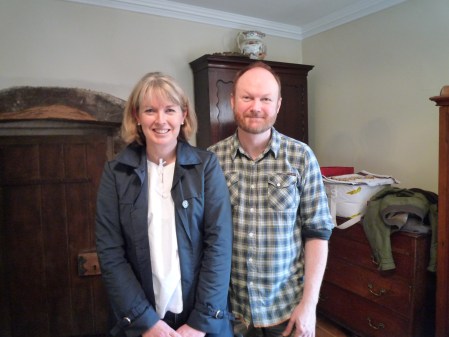
My final special event was a marmalade-making workshop run by The Jam Jar Shop team. Our little group of four actually made a batch of marmalade in less tanusing the boiled whole orange method under the watchful eye of our friendly Jam Jar Shop tutor who took this picture:
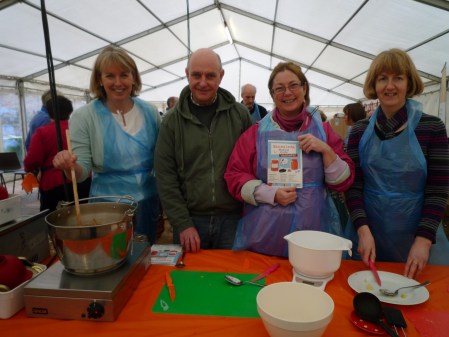
In case you’re wondering how we managed to prepare a batch of marmalade in less than 2 hours, the whole oranges had been precooked in order for us to be able to complete the marmalade making process in a reasonable timescale.
What did I learn that was new? Well, making marmalade with soft precooked oranges is something I don’t do often. It’s pretty easy to cut up the peel and scrape out the pith using this method but I still prefer to begin with raw fruit as I think ease of cutting is outweighed by a slight loss of flavour.
I learned how to refine my muslin bag-making technique. First, we enclosed all the pith and pips in a big square of muslin and tied the square securely with string to enclose all the contents and stop them escaping. So far so good. Next, we were told not to trim the string but to fold in all the loose raw edges forming the neck of the bag then roll it back down towards the knotted string. Next we wrapped the string around the resulting roll of fabric and tied securely thus enclosing all the raw edges and stopping any loose threads escaping into the pan of marmalade. Finally, the long ends of string were knotted together to form a loop secured to the pan handle for easy retrieval. Very professional looking and a tip I’ll be using again.
This method forms a robust bag that can stand up to the all important squeezing to extract as much pectin as possible so that the marmalade achieves a good set.

The peel was a little irregular as four different people had cut it up each according to their own preference and skill level but the end result of the workshop wasn’t at all bad:

If you fancy giving this marmalade-making method a go next year (or maybe you have some Sevilles stashed away in the freezer), you can download the recipe directly from the Jam Jar shop website by following this link http://www.jamjarshop.com/makingjam/marmalade/index.asp
Altrincham’s answer to Babette’s feast
March 21, 2012 § Leave a comment
The newly formed Altrincham Film Club chose the classic 1980’s Danish film “Babette’s Feast” for its March screening. The film is a loving adaptation, in almost BBC costume drama style, of the Karen Blixen novella which describes the effect of the arrival of refugee French chef Babette on the lives of the inhabitants of a remote and puritanical and village on the coast of Jutland. The story culminates in the preparation and serving of a stupendous French dinner which changes the lives of those lucky enough to share it.
The description of the meal and accompanying wines in the book is in fact a little sketchy with only these dishes and wines named specifically:
Turtle soup (Amontillado sherry)
Blinis Demidoff (Champagne Veuve Clicquot 1860)
Cailles en Sarcophage – Quails in coffins (Clos Vougeot 1846)
Grapes, peaches, fresh figs
The film necessarily fleshes out the meal with a salad course of chicory, frisée and walnuts, a plate of delicious cheeses, and its crowning glory, an immense glazed savarin liberally dosed with rum and finished in the Fanny Craddock manner with whole glacé fruits and whipped cream.
The Altrincham Film Club Committee decided they couldn’t let the opportunity of a food film go by without serving some film-themed snacks before and during the screening. Volunteers to bring cheese, pineapple, bruschette and blinis and so on soon came forward. Then my friend Gwyneth, baker extraordinaire (have a look at http://www.vintageafternoonteas.co.uk/ to see what I mean), approached me with the idea of collaborating on producing some sweet nothings to complement the savoury nibbles already on offer.
Thus the idea for the Babette’ Feast “bento box” was born, to contain an individual savarin modelled on the one in the film, a pot of Chantilly cream to accompany it and a final tiny pot containing a macedoine of black and white grapes, a passing reference to the immense platter of fruit served in the film. All this would be presented in a crisp white cardboard box with wooden cutlery, a nod to Scandinavian style and all fully disposable and biodegradable.
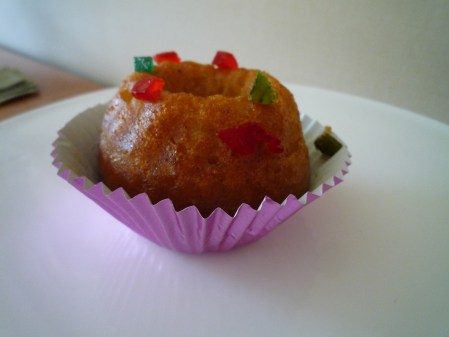
Here’s one of the completed mini-savarins sitting in its foil case which is happily durable enough to stand up to all that lovely rum-infused syrup:
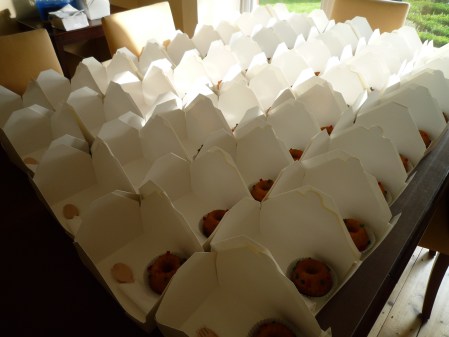
The box I photographed below doesn’t look quite as pristine as the ones we actually served as I forgot to take a picture until I brought my own box back home again after the film, so it’s had quite a journey dislodging one or two of the carefully placed fruits!

And of course, we didn’t just have a handful of boxes to prepare but in order to cater for the AFC audience we needed a whole fifty of them which just about filled my dining room table:
The whole bento box production exercise took the best part of three days.
On day 1, a savarin recipe was developed and all the necessary ingredients ordered online. Hardest to track down was proper glacé fruit (not just common or garden glacé cherries but plums, figs, apricots, peaches and so on in the French manner) but a lovely deli in Wellington, Somerset http://www.thecheeseandwineshop.co.uk/came up trumps and was able to despatch a shipment in time. The flour, butter and eggs were all organic, the sugar all unrefined and fairtrade, the rum not Bacardi but finest Angostura from Trinidad and the vanilla the best available from Madagascar. This was going to be a baking project truly in the spirit of “Babette’s Feast”.
The next step was developing the right recipe. I began with Julia Child’s baba/savarin recipe (the two doughs are interchangeable, just the shape being different) from “Mastering the Art of French Cooking”. This produced quite a stiff dough, easy to shape:

but the resulting buns were dense with a tight crumb that become a tad slimy when soaked in the syrup. We needed a wetter, stretchier dough that would bake to open-textured puffy perfection and would soak up and retain the syrup.
Over to baking guru Dan Lepard who gives a rum baba recipe in his recently published “Short and Sweet” book. I haven’t bought the book yet so had to rely on a republished version of the recipe given on the website of the Melbourne newspaper “The Age”. This was much better, a very wet dough that was hard to handle but produced a brilliantly light stretchy dough. I wasn’t happy with certain aspects of the recipe though – there was too much salt and too much yeast in it for my taste.
The third and final recipe is a conflation of the best bits of all the recipes I looked through and is the one we ultimately ran with. I give it in full below. Whilst I love the aroma of good rum, I don’t like too strong a taste of raw alcohol in a cake or dessert. In flavouring the savarins with vanilla, golden caster sugar and lemon zest and their syrup with unrefined sugar, citrus peel, more vanilla and cinnamon I’ve tried to incorporate the rum flavours without adding very much rum at all. Each savarin is anointed with just a teaspoon of rum to point up these flavours. Much less wasteful than pouring half a pint of rum into the syrup and then having to throw lots of it away.
Day 2 was devoted to baking the savarins in three double batches. Fermentation was long and slow so each batch took 5 hours start to finish so although the workload wasn’t huge, this was a lengthy task. The dough started with making a “sponge”. a wet dough used to get fermentation going and add flavour to the finished product:

Once the remaining flour, butter and eggs had been added, the completed dough looked like this as it began its first proving proper:
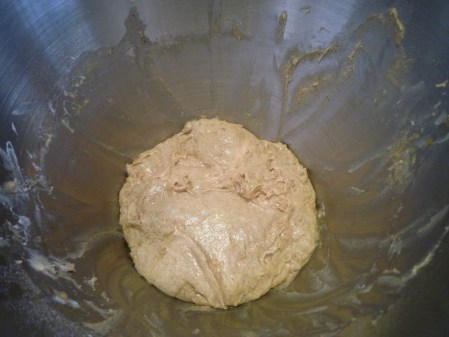
After proving and knocking-back, the very soft dough has to be poked and coaxed into the dinky mini savarin tins:

I picked up this mini savarin tin in Zurich earlier this year and am delighted to have been able to put it through its paces. Large individual kugelhopf/savarin/bundt moulds are beginning to appear in the UK but I haven’t been able to find a similar mini moulds over here yet.
This is what the risen buns looked like just before baking – they increase in size dramatically creating all those lovely air pockets:

And this is the end result after baking:

And of course, every batch requires quality control to make sure taste and texture are just right. Very pleased with the open texture of the dough here:

And finally, we’re on to day 3, the day of the screening itself and the major task of completing the savarins and assembling the bento boxes. The first job was the preparation of the black and white grape macedoine. Black and white grapes were halved and macerated in a light syrup of Sicilian blood orange juice, freshly grated lemon zest and just a little unrefined sugar. These were then left in the fridge for the flavours to mingle.
It was a great relief when Gywneth arrived mid-morning and immediately and calmly took charge of the rum application, glazing and decoration of the savarins while I syruped and dunked and drained. Six man hours later, we’d produced 50 bento boxes arranged in serried ranks across the dining room table and my generously proportioned fridge was filled with 50 mini cartons of grape macedoine and Chantilly cream.
Final thanks must go to my long-suffering husband Tim who barely raised an eyebrow at this 3 day baking marathon and who patiently transported the boxes to the cinema in the boot of our car, and wasn’t even able to stay and watch the film!
The boxes were handed out to the Altrincham Film Club audience right on cue with no spillages – job done – and we even managed to remember bin bags to clear up afterwards. Job done!
Anyone fancy La Grande Bouffe for April’s screening…?
Recipe for individual rum savarins
Makes 24 savarins. This is the smallest quantity of mixture which it is feasible to make in my Kenwood mixer, so if you just want 12 savarins, halve the quantities and mix by hand with a wooden spoon and dough scraper.
Ingredients
For the savarins
250 ml milk
12g fast action dried yeast
450g strong plain flour – use 150g for the initial sponge and add 300g to complete the dough
4g vanilla powder
25g golden caster sugar
5g salt
150g softened unsalted butter
4 medium eggs
grated zest of a lemon (scant – the flavour of the lemon is quite strong so don’t be too thorough with the grating)
For the syrup
500g demerara sugar
500g granulated white sugar
1.1 litre water
2 vanilla pods
6 strips lemon peel and 6 strips orange peel pared without pith using a vegetable peeler
juice of a lemon
To serve
1 teaspoon dark rum per savarin (I like Angostura)
Apricot glaze
Selection of glacé fruit (optional)
Chantilly cream (I like a mixture of cream and fromage frais for lightness).
Begin by weighing your mixing bowl so that you can accurately divide the completed dough by weight later on in the recipe. Note the weight down. My Kenwood bowl weighs 1,029g for future reference.
The recipe proper begins by making an initial wet dough, the sponge. Put 150g of the flour, the milk and yeast in the bowl of a stand mixer, whisk together by hand using a balloon whisk until thoroughly combined and scrape down the sides of the bowl using a dough scraper. Leave the mixture at room temperature until it starts to bubble up. This might take 45 minutes or so, maybe longer.
While the sponge begins to ferment, break the eggs into a small bowl; mash the butter using a fork to make sure its very soft and malleable; sift together the flour, salt, sugar and vanilla powder and stir into it the grated lemon zest.
Now complete the dough. Add the flour mixture alternately with the eggs to the bowl in three or four batches. Mix the dough after each addition using the dough hook on a low to medium speed. Scrape the sides of the bowl using a plastic scraper frequently while you do this. Once all the flour and eggs are incorporated, turn the speed up to medium and let the dough hook do its work for 2 minutes.
Next, incorporate the softened butter into the mixture. Make sure the butter is really soft before attempting this. Add a spoonful or so of butter to the bowl and mix at a low speed until incorporated. Keep going until all the butter is added, scraping the butter plate clean with your dough scraper to make sure every last bit ends up in the dough and not on your dishes. Turn the speed up to medium and work the dough for 2 minutes. The resultant dough will not resemble bread dough but will be very soft and stretchy like an elastic cake mix. This is absolutely fine, do not under any circumstances be tempted to add more flour.
If, like me, you have only one tray of mini savarin tins, you will need to retard the proving of one half of the dough. Weigh your mixing bowl, subtract the weight of the bowl which you noted down previously and remove half the dough to a separate bowl. Scrape it into a neatish mound, cover with a plate or cling film and refrigerate.
Do the same with your original bowl, but leave this one out at room temperature to prove. Leave it until the dough has begun to swell visibly and if you poke it you can see lots of spongy bubbles in the mix. It won’t necessarily have doubled in size.
While the dough proves, make the syrup. Put all the syrup ingredients into a large saucepan and bring to the boil. Boil the syrup vigorously for 3 minutes then switch off and leave all the flavours to infuse.
One the dough has proved, knock it back by beating it vigorously with a wooden spoon for 10 to 20 seconds. Now for the fiddly bit which is filling the savarin moulds. Make sure your moulds are well greased. I like to use Dr Oetker baking spray to do this quickly and conveniently.
Half fill each individual mould using about a tablespoon of mixture. Using a teaspoon and/or your fingers, gently tease the very soft dough into the mould and around the central metal spindle. Make sure the quantity of dough in each mould is approximately equal. This is very fiddly.
Cove the savarin tins with a big upturned roasting tin or similar and leave to prove a second time until the dough has risen to fill the moulds completely and puff up a bit more. This takes about an hour, maybe less. Make sure you catch the dough on the up rather than leaving it too long in which case it will collapse.
Put the tray of savarins into the centre of an oven preheated to 190 degrees C (fan). Chuck a small coffeecup of water onto the oven base to create steam and shut the door quickly. After exactly 10 minutes, turn the temperature down to 170 degrees C, rotate the tray of buns so they bake evenly, and bake for a further 10 minutes. They should have a good golden brown colour and be just shrinking away from the edges of the tin. Remove from the oven and turn out onto a wire rack to cool.
Once the savarins have cooled to a warm temperature, they are ready for dunking in the syrup. Drop them into the pan of warm syrup and gently push them under. Leave them in the syrup for about 7 minutes to absorb all that lovely sugar, basting frequently. Remove from the syrup bath, invert them and leave them to drain for about 15 minutes on a rack set over a roasting tin to drain. Try and do the dunking with the savarins facing down and the draining with them facing up to ensure even syrup distribution.
This is a long recipe, but we’re nearly there now. All that’s left to do is to drizzle a teaspoon of rum carefully over each savarin, brush with apricot glaze and if you like, decorate with diamonds of glacé fruit. Serve with a dollop of softly whipped Chantilly cream.
THE FULL MONTY: breakfast from Bolivia
March 16, 2012 § Leave a comment
The latest in our Breakfasts of the World Project series.
Unusually this time our breakfast comes from a country that one of us (my husband Tim) has actually visited. This was a climbing trip to the Andes hooking up with various members of the Oxford University Mountaineering Club. Three of the team are pictured below, from L to R Simon Beaufoy, Mike,and Doré. Simon has gone on to become well known for his screenplays so I thought it might be fun to try and shoehorn into this post the titles of all Simon’s screenplay titles. I’ll stick them in capitals so you’ll know why this post might sound a little stilted. I hope the guys don’t BURN-UP taking in all that high altitude sunshine and it looks as if Doré at least found time for a BLOW DRY.

Husband Tim, not pictured AMONG GIANTS above, is in this photo, looking rather younger than he is now, a bit of a SLUMDOG MILLIONAIRE with the designer sunglasses and “I’ve not shaved for 127 HOURS” designer stubble.

Here’s one of the team again (maybe Alex whom I’ve not yet mentioned?), not SALMON FISHING IN THE YEMEN but using his RUNNING TIME to stride purposefully towards a herd of a llamas in a high Andean glaciated valley. The objective was the ascent of Ancohuma, at 6,427m Bolivia’s third highest peak located in the Cordillera Real range of the Bolivian Andes.

Tim’s recollections of what they ate for breakfast during the expedition were hardly clear (more 10×10 than 20×20). He muttered vaguely about living dangerously by carrying fresh eggs in his backpack and the joys of homemade chapatis at base camp. So it was over to me to research a traditional Bolivian breakfast. Two dishes took my fancy, the first, Api Morada, something halfway between a drink and a porridge made with purple corn flour:

and the second, Bolivia’s answer to the Cornish pasty, the juicy beef-filled salteña, its YELLOW colour coming from an egg and paprika glaze. Truthfully, the one in the bottom right corner caught in the oven just a tad so its colour might best be described as THE DARKEST LIGHT.
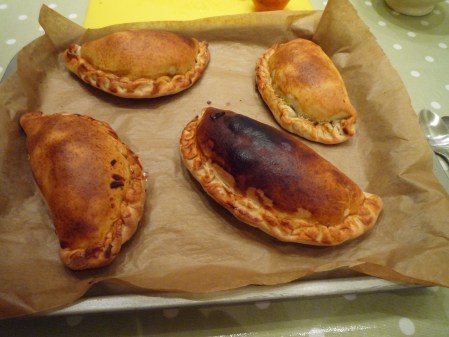
The Api Morada turned out like a Spanish hot chocolate, thick, spiced and velvety with a curious grapey flavour no doubt attributable to the naturally occurring anthocyanins which give the corn its vivid purple colour.

It’s pretty straightforward to make, the only hard part being the sourcing of the purple corn flour. Fortunately, small supplier “Detox Your World” trading on Amazon came up trumps:

The salteñas are more often eaten as a mid-morning snack with coffee rather then being a true breakfast dish but were too good to miss out. The filling in the recipe I’ve chosen is minced beef livened up with peas, spices, raisins, olives and chopped hardboiled egg. The masterstroke is the thickening of the meat juices with a judicious amount of gelatine. This means you can spoon a generous heap of cold set filling into the pastry and end up with plenty of lovely gravy when the pasties are baked – one of the features setting a salteña apart from any other South American empanada is the juices running down your arm as you bite into it.
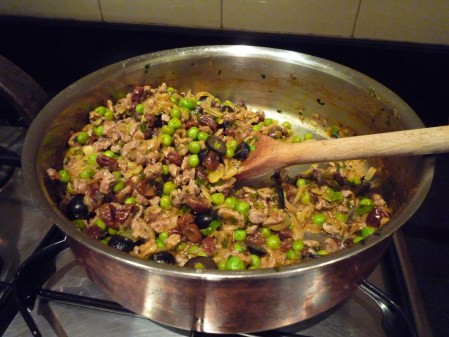
The other distinctive feature of the salteña is the braided seam (repulgue in Spanish) which looks very much like a Cornish pasty crimp. By rights, this should run across the top of the pasty, but as a beginner, I went for a slightly easier side seam. This was my first attempt at braiding the repulgue achieved following the instructions I found here. It’s trickier than it looks and I’ve a way to go before I can emulate the flying fingers of a Bolivian cook. The seams did the trick though and didn’t burst during baking.

The pastry for this recipe breaks all the rules (keep everything cool, don’t overwork etc) as after rubbing the butter into the flour, the pastry is mixed with practically boiling water straight from the kettle and is then given a thorough knead for 3 minutes or more. The end result is a structural pastry that contains the juicy filling but is nevertheless crisp and delicious. Much better than a true shortcrust would be and I’m going to be using it again for pasties.
A breakfast to ensure that EVERYONE’S HAPPY.
I managed to shoehorn in a whopping twelve of Simon Beaufoy’s screenplays but these three defeated me: “Miss Pettigrew Lives for a Day”, “Yasmin” and “This is Not a Love Song”. Frankly these would challenge anybody and his two listed projects in development “Sharp Teeth” and “Catching Fire” would have been a doddle to incorporate. Must try harder… anyway, here are the all-important recipes:
Recipe for Salteñas
Adapted from a recipe contributed by “happymommyx4” which I found on Allrecipes.com.
I’ve adjusted the quantity of filling as I found the original recipe gave too much filling for the pastry. I’ve converted all the US measurements into European ones, simplified a couple of steps and have tinkered with the seasoning to up the flavour as my first attempt was a little bland for my taste.
Makes 8 good-sized pasties
Ingredients
For the filling
2 sheets leaf gelatine (approx 3g)
1 tablespoon light olive oil
1 small onion, chopped
250g good quality beef mince
2 medium waxy potatoes, boiled in their skins,cooled,peeled and coarsely grated
150g frozen peas, defrosted
1 tablespoon chopped parsley
2 teaspoons sugar
2 teaspoons paprika
1/2 teaspoon ground cumin
salt and freshly ground black pepper to taste
tabasco to taste (optional)
150ml cold water
3 large hardboiled eggs, shelled and chopped
50g stoned black olives, sliced
50g raisins plumped-up in hot water and left to soak for half an hour, drained
For the pastry
400g plain flour
1 tablespoon caster sugar
1/2 teaspoon salt
110g butter, cubed
150ml hot water (a little more may be necessary to obtain a workable pastry)
beaten egg whisked with a teaspoon each of paprika and salt to seal and glaze
Begin by making the filling.
Set the sheets of gelatine in cold water.
Heat the olive oil in a large frying or sauté pan over medium heat. Add the onion and cook until translucent but not coloured, about 5 minutes. Turn up the heat and add the minced beef and cook for a further 10 minutes reducing the heat if necessary. Spoon off any excess fat.
Stir in the grated potatoes, peas, parsley, sugar, seasoning and water, stir together and simmer for a minute or so. Remove from the heat. Push the filling to one side of the pan leaving a pool of free liquid. Add the soaked gelatine sheets to this liquid and stir until dissolved. Stir everything together and set aside to cool completely. Once cool, mix in the olives, raisins and chopped hard-boiled egg.
Next make the pastry. Combine the flour, sugar and salt in a large bowl and stir well. Rub in the cubed butter with your fingertips until the mixture resembles breadcrumbs. So far, so normal. Now for the unconventional bit. Slowly add the hot water, mixing with a knife. You may need a little more water than the 150ml suggested. On a lightly floured surface knead the pastry for about 3 minutes until smooth. Divide the pastry into eight balls, either by eye or by weight if you want them all to be evenly sized. Cover the pastry balls with cling film and keep them warm while you work with the first pastry ball.
Preheat the oven to 220 degrees C.
On a lightly floured board, roll the pastry ball into a circle approximately 1/8 inch thick. Don’t make the pastry too thin as it will allow the filling to break through while it bakes. Brush egg wash carefully around the rim of the pastry circle. Place approximately 2 tablespoons of the meat filling on one half of the pastry circle and carefully fold over the free half of the pastry and press gently to seal. Crimp the pressed border either by pressing the tines of a fork around the edge or, more authentically, by braiding the edge scallop-fashion to form The Repulgue as it’s known in Spanish.
Place the salteña on a baking sheet lined with parchment.
Continue with the remaining pieces of pastry until you have 8 salteñas. Glaze with the egg wash and bake in an oven preheated to 220 degrees C for 15-20 minutes or until golden brown.
Enjoy warm or cold.
Recipe for Api Morado – purple corn drink
Adapted from a recipe from http://www.boliviabella.com
Serves 6
Ingredients
100g pack of purple corn flour
720 ml cold water for soaking
additional 1 litre water to complete the drink
6 tablespoons sugar or more to taste
1 stick cinnamon
2 whole cloves
2 strips peel from an orange removed using a vegetable peeler
a little chopped pineapple (fresh or canned) and additional orange zest to serve
Soak the purple corn flour in 720ml cold water for at least 2 hours, or oevrnight if you’re preparing it for breakfast.
While the corn flour soaks, bring the additional litre of water to the boil in a medium saucepan, throw in the cinnamon, cloves and orange peel, remove from the heat, cover and leave to infuse.
When you are ready to complete the drink, add the soaked corn flour and its soaking liquid to the litre of flavoured water along with the sugar and bring to the boil stirring constantly with a wooden spoon. Taste and add more sugar if you like.
To serve, ladle into drinking bowls and top with the chopped pineapple and a little orange zest.
Swiss alpine macaroni (Älpermagronen)
February 23, 2012 § Leave a comment
We spent a very chilly half term skiing in Engelberg in Central Switzerland once again this year. Views from the Titlis cable car were spectacular:

but the temperature was minus 21 degrees C up there. Brrr…
All the more reason to tuck into platefuls of that Central Swiss classic dish, Alpine macaroni (spelt locally as Älpermagronen on restaurant menus), a carb and calorie laden plateful of macaroni, potato, cheese, cream and a big dollop of apple sauce. Yes, that’s right, apple sauce. It sounds weird, but given that plain cheese and apple is a favourite lunchtime snack over here, maybe combining them in their cooked form is not so odd an idea after all. Oh, and it’s a great dish for vegetarians and children seem to like it too so no excuses not to give it a try.

Here’s the Alpine macaroni as served up at Engelberg’s Flühmatt mountain restaurant last week:
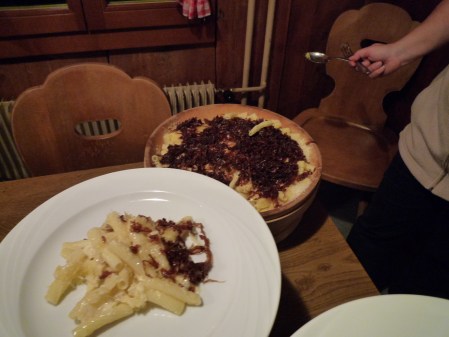
The recipe I give below is my take on the authentic Swiss recipe. For a double apple hit try the apple slices poached in cider as well as the apple sauce.
Serves 4
Ingredients
For the pasta
375g peeled, diced potatoes (use a yellow waxy variety such as Charlotte)
pinch of salt
375g dried maccaroni or similar small tubular pasta
250g gruyère cheese, coarsely grated (or other hard Swiss cheese such as Appenzell, Sbrinz or most authentic of all, mountain cheese from the canton of Obwald)
100ml milk
100ml double cream
salt
freshly ground black pepper
For the fried onions
1 tablespoon vegetable oil
20g butter
2 large onions, thinly sliced
1 clove of garlic, chopped
For the apple sauce
2 large cooking apples, peeled, cored and sliced
2-3 tablespoons golden caster sugar (or to taste)
1-2 tablespoons water
For the apple slices (optional)
4 medium eating apples ideally with a reddish skin, about 500g before preparation. Cox or Gala are good.
10g butter
1 cinnamon stick
100ml cider or apple juice
a little sugar to taste
Start by preparing the apple sauce. Put the apple slices, sugar and water in a heavy-based saucepan. Cover and place over a low heat. Stir and mash with a wooden spoon from time to time until the apples “fall” and become a thickish, smoothish sauce. Set aside.
Next, prepare the apple slices if you are going for the double apple hit (and I think you should). Quarter and core the apples, then cut into neat lengthwise slices, leaving the skin on as it looks attractive and helps the apple slices keep their shape.
Melt the butter in a medium heavy-based pan. Add the apple slices and cook for a minute or so over a medium heat, stirring carefully with a wooden spoon. Add the cinnamon stick, cider or apple juice and sugar to taste to the pan, turn down the heat and simmer until the apple is tender. Remove from the heat and set aside.
Now prepare the fried onion garnish. Melt the butter and oil together in a heavy based frying pan. Throw in the onions and garlic and cook over a low to medium heat stirring from time to time until the onion and garlic mixture is golden brown. This will take a little time – maybe 20 minutes; be careful not to let it burn. When ready, remove from the heat and set aside.
Finally, it’s time to prepare the pasta. This is a dish best served fresh and piping hot from the oven so I’m afraid it doesn’t lend itself to being prepped in advance and then baked as you might with any other pasta bake. That’s why you need to get the apple garnishes and onions ready in advance so you’re all set to go.
Preheat your oven to 200 degrees C (180 degrees C fan). Warm a large empty baking dish in the oven. Cook the potato cubes and the pasta in boiling salted water until done. If you are confident about the timings, you can cook the potatoes and pasta together in the same pan as they should both be done in about 10 minutes. If you’re trying this for the first time, it’s probably safer to use 2 separate pans so both pasta and potatoes are cooked to al dente perfection. Drain and immediately layer into the warmed baking dish with the grated cheese, seasoning with black pepper and a little salt as you go. Go easy on the salt as the cheese is already quite salty. Start with a layer of half the pasta and potato mix, then a layer of half the cheese, then a second layer of the pasta and potato and finish with a layer of cheese. Spread the golden brown onions you prepared earlier on top. Pop the dish into the preheated oven to melt the cheese. Finally, quickly heat together the milk and cream in a small saucepan until almost at boiling point. Pour the hot milk and cream over the cheesy pasta and potatoes and return to the oven for 5- 10 minutes until piping hot. While the pasta heats through, gently rewarm the apple sauces and (optional) apple slices.
Serve onto warm plates and eat with a generous dollop of the apple sauce and a spoonful of the apple slices.
Swiss new year
February 11, 2012 § Leave a comment
Yikes, we’re well into February, it’s almost the half-term holiday and I still haven’t written-up our New Year meal. It’s high time I put this right. We’ve been doing the new year thing since the big millennium celebration in 2000 and have taken turns hosting along with Neal & Shelley and Mike & Janet.
It fell to us to host this year and it occurred to me that despite my enthusiasm for all things Alpine I’d never yet chosen a Swiss theme. The challenge would be to avoid as many Swiss clichés as possible – cheese, chocolate, cowbells, cuckoo clocks and similar tat, and to keep the dishes relatively light so we’d all make it into 2012 feeling fit and raring to go.
Here’s the menu I came up with. You’ll see I didn’t entirely succeed with no cheese/light cuisine idea as the Malakoffs – deep-fried battered chunks of gruyère sound like the (Scottish?) first cousin of the deep fried Mars bar, but I couldn’t resist:
Canapés
(i) Bundnerfleisch (thin slices of air-dried cured beef)wrapped around celeriac remoulade; and (ii) Malakoffs – deep fried gruyère sticks
First course
Hay soup -light chicken/vegetable cream soup infused with meadow hay
Second course
Individual Luzerner Chugelipastete – puff pastry dome filled with braised veal pieces in cream and saffron sauce
Main course
Venison medallions with preiselbeer sauce, rösti and braised red cabbage
Salad
Lambs’ lettuce (the cutely named Nüsslisalat in German)
Pudding
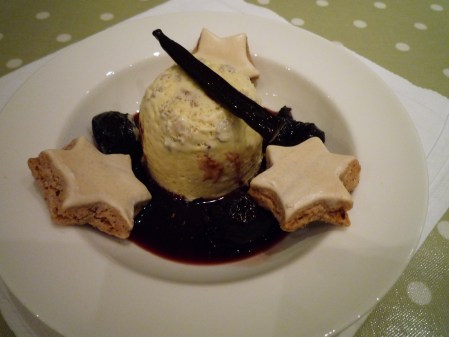
Walnut and cinnamon parfait with mulled prune sauce and Zimtsternen – cinnamon star biscuits
Cheese
Vacherin Mont d’Or
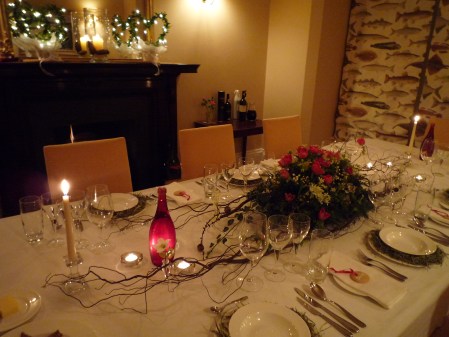
Menu decided, next step was to set the scene. There’s never time to sort out a table centrepiece when you’re preparing a meal so I called in professional help in the form of Vicky Clements’ magnificent Swiss flag inspired floral arrangement in red and whie, a veritable alp in miniature (see her contact details below if you’re in or around S Manchester/Cheshire):
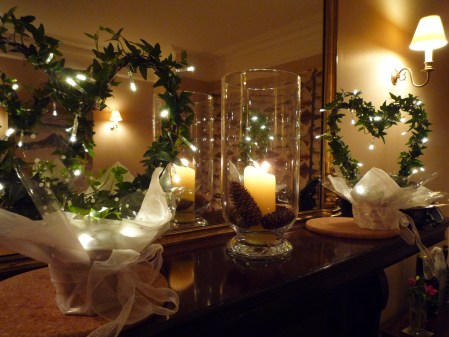
Vicky was responsible for the fairy-lit hearts too. Sehr gemütlich, Ja?
I dusted down my piping skills to write dinner guests’ names on an experimental batch of moulded biscuits using my newly acquired Swiss Springerle moulds. They were a little involved to make but I was quite pleased with these as my first attempt. My piping is rusty though and it took a few attempts to steady the hands and create something legible:

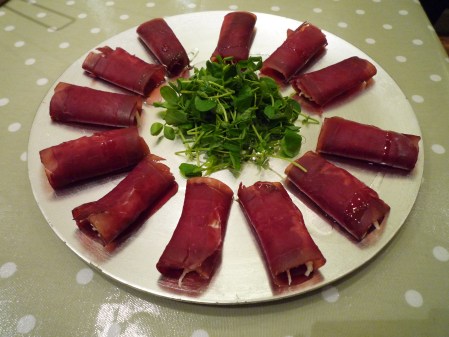
Air dried beef is usually served as part of a large platter of cured meats and cheeses in Switzerland. We chose to roll the beef around celeriac remoulade which created a light and fresh-tasting canapé packed with flavour. Janet made the celeriac – very simply made by mixing raw grated celeriac into a Greek yoghurt, lemon and parsley dressing – and assembled the canapés and very pretty they looked too. Celeriac makes a fantastic winter salad and we’ve eaten it several times already since then:
The doyennes of cookery and entertaining always tell you not to try out new recipes on your guests don’t they? Well, I think rules like this are meant to be broken, but sometimes minor disasters will ensue. I think it’s fair to say that the malakoffs didn’t work. Tim was banished to the garage to deep fry these battered cheese parcels. I can’t abide the smell of deep-frying fat in the house, so our deep-fat fryer lives very happily in the garage which means that, with the assistance of the barbecue it’s pretty easy to rustle up a mean steak and chips for al fresco consumption in the summer.
I thought we’d followed the malakoff instructions on the Swiss food blog http://www.fxcuisine.com to the letter. Maybe the batter was too light, maybe the oil was too hot, maybe we cooked them for too long, but when we came to consume the malakoffs, they turned out to be hollow as all the molten cheese had leaked out into the frying oil creating an unholy mess (which I have yet to properly clean up I’m ashamed to say). The fritters looked the part and retained enough of the ghost of a flavour of cheese to allow you to imagine how delicious a correctly cooked malakoff might be. Another time…

We began the meal proper with an unusual hay soup, expertly prepared by Shelley. This is a traditional Swiss soup, different versions of which come from the mountainous cantons of Valais and Graubünden. I’d tasted this in Klosters a couple of winters ago, and it looked so pretty presented on its bed of hay and garnished with dried meadow flowers that I had to put it on our menu.

I couldn’t find a definitive recipe but found several different versions by searching under “Heusuppe Rezept”. Our version used a hay-infused light stock, a flavour base of sweated vegetables and a little pearl barley to thicken. I think I’d like to try out the other versions before publishing a definitive recipe.
Sourcing the hay proved to be harder than I’d thought. I scoured farms in the Lake District and Yorkshire Dales for an elusive handful of local organic meadow hay but without success – all I was offered was silage which I don’t think would make a very pleasant tasting soup. In the end, The Hay Experts (see contact details below) came to my rescue. They really do know their hays (even if the end consumer is usually a pet rabbit) and despatched just what I needed very promptly.
Our next course was a miniature version of the Luzerner Chugelipastete – an exuberant puff pastry dome filled with braised veal and veal sausagemeat in a creamy saffron flavoured sauce. In order to cut down on the pastry, I made pastry lids to cover the braised veal which was served in individual ramekins.
I posted last year on the subject of this dish:
https://rhubarbfool.co.uk/2011/03/03/lunch-in-lucerne/
I used a couple of cheat steps when I made the miniature version of the dish. Short of time, I used Dorset all-butter puff pastry – reliably good if you don’t have time to make your own. Instead of veal forcemeat balls made from scratch I used a pack of veal meatballs from Waitrose. These are made from ethically sourced British rosé veal and are delicious and versatile. Actually, I didn’t follow the Marian Kaltenbach recipe for the sauce which I’ve quoted before at all. I flash fried strips of veal tenderloin, combined them with the cooked veal meatballs, added a little stock and cream, reduced the whole lot down to make a sauce and added grapes macerated in a Swiss grappa type schnapps to finish. I was reasonably happy with the end result:

We were now well set up for the main event, a fabulous-looking venison tenderloin supplied from The Blackface Meat Company who are based up near Dumfries in Scotland. I’ve used them a couple of times before for game and rare breed meat. They may be a little expensive but they supply top quality meat, expertly butchered and delivered promptly and efficiently to your door.
I did try and obtain some local venison from Dunham Massey. Each year, the deer are culled and just a few of the younger deer are butchered and sold to the public via a local farm shop. Unfortunately because of problems with poaching this year I didn’t know if my tenderloin was going to turn up on time. When finally I did get the call that the venison was available, I was a little disappointed with what the butcher had done as this tenderloin was nowhere near as expertly trimmed as the Blackhouse meat. So Dunham’s answer to Bambi is in the freezer ready for a future Sunday lunch.
The Blackhouse website lists useful recipes and I followed chef Mark Hix’s instructions for marinading the venison in red wine before flash-frying and serving with a red wine reduction. Not an authentic Swiss recipe but very Swiss in character as you’ll find lots of robust game dishes cooked with red wine in restaurants during the autumn and winter hunting season.
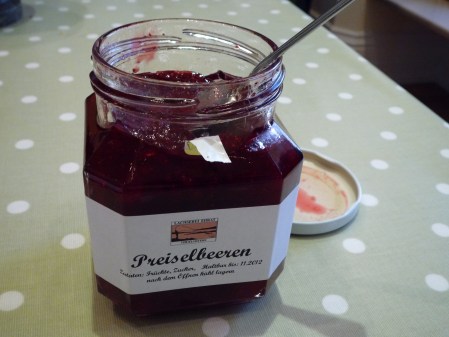
The venison was expertly cooked by Janet and was served with everyone’s favourite Swiss dish, potato rösti,braised red cabbage and a spoonful of Preiselbeer sauce. The Preiselbeer is a smaller, tastier European relative of the more familiar North American cranberry. It’s also known as the lingonberry in Swedish and here in England it’s known as the cowberry but is not a popular forager’s fruit as yet.
Sorry my pictures of the finished dish are too dark to be meaningful, but here are photos of the meat bathing in its marinade, the same meat cooked and carved, and a jar of the Preiselbeer sauce brought back from a little shop in Klosters:


Avoiding the temptations of triple Toblerone chocolate mousse and the like, I chose a simple walnut and honey parfait for pudding served with prunes cooked in red wine and spices to give a delicious festive mulled-wine flavour. Alongside the parfait and prunes I served a traditional Swiss/German advent biscuit, the Zimtstern – a cinnamon flavoured dough made like a macaroon from ground nuts, sugar and whisked egg whites, topped with a crisp meringue icing. These are nutty, chewy and delicious and a tad difficult to make. I’ve not given the recipe in this post as frankly it’s too long already, and they merit a post all of their own.
To conclude the meal as we approached midnight, a superb Vacherin Mont d’Or cheese from the Jura region of Switzerland, one of my favourite cheeses. It’s soft and creamy and can be spooned out of its wooden box when properly mature and ready to eat. It’s only available during the winter months. Ours came from the Duty Free shop at Zürich airport, but you can find it over here sometimes either in a specialist cheese shop or occasionally in Waitrose. If you find one, grab it, you won’t regret it.
I couldn’t possibly list all the evening’s recipes in a single post – in fact to help with the preparations, I photocopied and printed them all out and have enough material for a small cookery book!
I’m just going to give two recipes, both straightforward and both now in my regular repertoire.
Recipe for celeriac remoulade
My lighter, fresher version of this bistro classic, replacing the usual mayo with Greek yoghurt.
Serves 4 or more as part of a selection of salads
Ingredients
1 small or half a medium celeriac grated in a food processor
juice of half a lemon
sea salt and freshly ground black pepper
2 tablespoons thick Greek yoghurt
2 tablespoons half fat crème fraîche
2 teaspoons Dijon mustard
1 tablespoon chopped flatleaf parsley
Grate the celeriac quite finely (easiest to do this in a food processor) and in a medium bowl mix thoroughly with the lemon juice to stop the celeriac turning brown. You can prepare the celeriac to this stage then refrigerate it several hours ahead of time and it will still be fine. When you’re ready to serve, add the other ingredients to the bowl and stir to combine.
Recipe for walnut parfaits with mulled prunes
Translated from the German and adapted from a little Swiss cookbook called “Geliebte Schweizer Küche”.
Serves 6
Ingredients
For the mulled prunes
1 bottle fruity red wine
200g prunes
2 cinnamon sticks
1 vanilla pod
2 cloves
1 large piece of peel from an unwaxed orange
For the parfait
2 eggs
2 dessertspoons runny honey
1 pinch powdered cinnamon
1 dessertspoon Grand Marnier
180ml whipping cream
50g walnuts, coarsely chopped
Begin by making the mulled prunes the day before you plan to serve the dish. Put all the ingredients into a saucepan, bring to the boil then leave to cool and infuse overnight.
Next make the parfait. You can make this a couple of days ahead of time as it’s frozen. Mix the eggs, honey, powdered cinnamon and Grand Marnier together in a bowl. Using an electric whisk, beat together until the mixture is light and foamy. In a separate bowl, whisk the cream to the soft peak stage and combine with the egg mixture and chopped walnuts. Divide the mixture between 6 or more small moulds (china teacups or ramekins are fine) and freeze for at least four hours.
When you are ready to serve, dip the moulds briefly into hot water, loosen with a knife if necessary and invert onto individual serving plates. Spoon the prunes and red wine sauce around and serve.
Contact details
Vicky Clements – “Inside Out” flowers and gardening, Bowdon, Cheshire
Mobile 07762 387 372
The Hay Experts – suppliers of organic and other hays
http://www.thehayexperts.co.uk/
The Blackface Meat Company – suppliers of rare breed meat and game
http://www.blackface.co.uk/
Whistle-stop tour of Klosters’ most fêted restaurants
February 2, 2012 § Leave a comment
A busy January has just flashed by and it’s almost the end of an alcohol-free month. In anticipation of that glass of cellar-cool Châteauneuf du Pape that I have lined up for tonight, finally I’m in the mood to write again about good food and wine.
There’s lots to write about so I think I’d better catch up belatedly with the best bits of Christmas and New Year before moving on to the various food projects that have been keeping me busy this month.
We spent Christmas once again in Klosters in the mountainous and picturesque canton of Graubunden in Eastern Switzerland. During the course of 6 days, we ate our way through the Klosters pages of the Gault-Millau guide (4 restaurants collectively clocking up a whacking score of 59 Gault Millau points out of a theoretical maximum of 80), pausing only for a pizza on Christmas Day by way of respite. To be fair, our skiing lunches were pretty austere – Gerstensuppe (barley broth – a local speciality) or Gulaschsuppe for the most part – so we felt justified in going for it in the evenings.
Night 1 Rustico 13 GM points cumulative GM points 13
First up was the aptly named Hotel Rustico where we arrived curious to discover how the much fêted chef Vincent Wong would pull off the fusion of Asian and Swiss cuisine for which he is famous.
The Rustico certainly looked the part:

We were ushered out of the snow into the warmth of the cosy wood-panelled dining room and handed a menu of largely cheesy delicacies – essentially fondue or raclette. The boys were thrilled, but where was the Asian-Swiss fusion cuisine we’d come for?
There was just a hint of this on the menu – I ordered the scallop-filled Capuns (a local ravioli-like speciality of savoury stuffing wrapped in chard leaves traditionally made with meat and breadcrumbs).
It looked pretty enough:
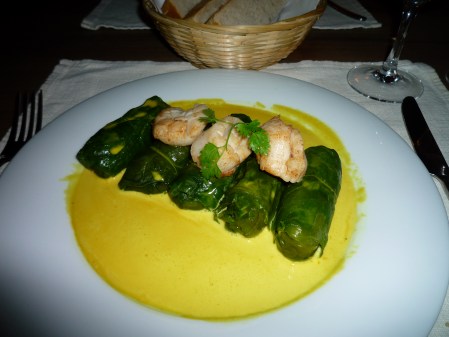
But disappointingly the scallops garnishing the Capuns were overcooked and possibly had arrived deep frozen rather than fresh on the shell and the filling itself was just plain stodgy. A dish that could of have been inspired but sadly the kitchen didn’t pull it off.
The fondue and raclette (not really a speciality of this region) were absolutely fine but we remained mystified as to the restaurant’s reputation for fine cooking.
A bit of research afterwards solved the mystery. We’d gone wrong on two counts. First, my Swiss-German being not so good, I’d booked us into the “Prättigauer Hüschi” rather than the restaurant proper (a bit like booking in for a bar meal rather than the full Monty in a country-house hotel). Second, the Rustico seems to have a bit of a chequered history and has changed hands twice in the last year or so, but the 2012 Gault-Millau guide has failed to reflect this still listing Al and Renée Thöny plus chef Vincent Wong as the management team. In fact Stefan Stocker and Martina Schele took over last year and shortly thereafter handed over to the current proprietors Anja and Jörg Walter. Herr and Frau Walter list AC DC, Swiss folk music and motorbiking amongst their shared interests. Does this perhaps give us a clue as to the direction in which they’ll be taking the hotel and restaurant?
Night 2 Alpina 15 GM points cumulative GM points 28
The Alpina is conveniently situated opposite Klosters’ busy little railway station – a model railway set writ large. It’s a slightly unprepossesing modern chalet-hotel type building that the owners have done their best to clothe with alpine charm. The boys were particularly taken (and I was too actually!) with the polar bear snow sculpture which sits as a pediment above the underground carpark entrance:

We were seated on a prime corner table and presented with the menus. This was a little scary at first as both starters and mains were labelled rather severely as single words.
I opted for “Tomato” and followed it up with “Lamb”.
The obligatory amuse-bouche arrived followed-up mercifully quickly (we were hungry after a day’s skiing) with the starters. The menu writing may have been laconic but the food itself was rather more sumptuous, not to mention playful.
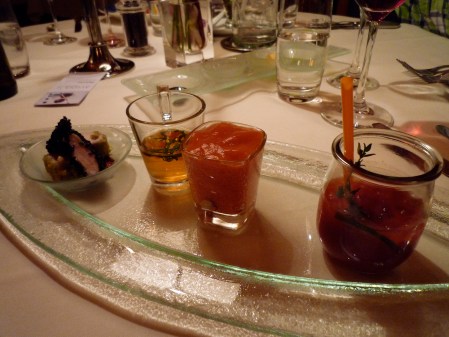
Here’s what “Tomato” turned out to be – a tomato Caipirinha (much more on-trend than a Bloody Mary), tomato mousse and the most intense clear essence of tomato and rabbit:
The restaurant clearly has high aspirations and cooking standards to match. Nevertheless the restaurant had a warm friendly atmosphere and we all felt comfortable. Yes, there’s a touch of pretentiousness about some of the menu wording – chef Christian Kaiser went under the moniker “Pleasure Composer” and the front-of-house team led by Jacques Revel and Patricia Reumschüssel were referred to as “Creators of Happiness” but the staff themselves were so efficient and charming you can forgive the odd purple patch in the prose. The hotel website gives idiosyncratic yet revealing profiles of all the key staff and Herr Revel certainly gets my vote with his love of mushroom-hunting and dislike of animals, “especially cats”!
Next to arrive was my “Lamb” – saddle; liquorice flavours; peas; tomato-sauce; olive oil”

This was a beautifully cooked and subtly flavoured dish but a bit lacking in starch. I had to help myself to some of the boys’ inviting looking potato rösti which set off the lamb a treat.
This is another attractive feature of the restaurant – as well as the high gastronomy on offer there are also simpler dishes to choose from (Wiener Schnitzel; veal sauté Zurich-style with rösti) which suited the boys well and made for a more relaxing meal for us. There’s a separate menu for younger children too which invites children to the upstairs play area once they’ve finished their meal. Someone has clearly thought about the practicalities of dining out with a family.
The pudding menu continued in the same single-word/quadruple dish style. I opted for the massive rumbling cheese trolley which competed with the trains running in and out of the snowy stations. The rest of the table pronounced the “Passion-fruit” as particularly good and big enough to share between two, maybe even three (panna cotta; soup; sorbet; crème brûlée):

And if you don’t fancy splashing out on pudding, just order coffee and finish your meal with the extremely generous plateful of petit fours and chocolates instead.
We’d definitely return for a special night out as the Alpina pulled off the trick of both providing top-class cooking and keeping two hungry not to mention fussy teenage boys happy.
Night 3 Walserhof 17 GM points cumulative GM points 45
In points terms at least, we’d reached the culinary high-point of the week. It felt slightly surreal crossing the threshold of the Walserhof for the first time rather than peering expectantly from the outside through handsomely draped windows into the opulent interior.
Other reviewers say the hotel is a simple chalet with a relaxed and welcoming feel but I’m not sure I agree. Yes, the exterior is low-key rather than glitzy and the welcome is attentive and charming but there’s the feeling that everything, absolutely everything, is carefully planned, checked, rechecked and “just so”. Having so many appraising staff eyes cast over one puts you imperceptibly on edge. With our thick down jackets and teenage boys in tow we felt a bit like the country mice visiting their smarter town cousins. The feeling of unease increased as we were seated too close for comfort adjacent to a couple clearly out for a special meal à deux. Something told me they weren’t going to enjoy fart jokes and football related banter…
The meal began with not one but two slender glass trays per person of amuse-bouches, each laden with triple or quadruple goodies. Here’s the more photogenic of the two:
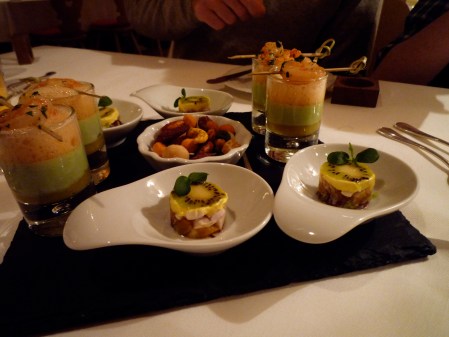
Quite substantial for an amuse-bouche isn’t it? And strangely retro with all that kiwi fruit garnish and something that tasted suspiciously like prawn cocktail in a glass.
The bread basket proffered next was a thing of beauty – laugenbrötchen (pretzel-type rolls with a shiny salty coating); tiny square rolls topped with pumpkin seeds and finally brown walnut rolls. My goodness, after two helpings of the amuse-bouches and all that bread I was extremely full already.
The menu is full-on cheffy throughout – no comfort dishes sneaked in at the back here. This makes it a tad awkward not to say pricey to feed a pair of tetchy teenagers. Blimey, even at Chez Panisse in Berkeley, one of the world’s top restaurants no less, a lovely waiter leant over and whispered quietly in my ear that the kitchen could rustle up a freshly made pizza for the kids if that would be helpful.
I mused that this was notionally a hotel restaurant and wondered how parents managed to feed their children there, not only that but how it would be possible to eat in the restaurant more than once during a week’s stay given the quantity and richness of the food, and the time it took to eat it.
We’d all chosen the plainest starter we could find, the “Klosterser Chruutchräpfli mit Novaier Alpkäse” a gastronomic take on a local stuffed pasta speciality finished with mountain cheese. This doesn’t look like something from a rustic farmhouse kitchen though does it?

A still life on a plate isn’t it? We were busy admiring our food when Frau Amrein-Juon herself (she leads the front-of-house team and is married to chef Armin Amrein) tut tutted at our waitress and very carefully rotated each plate 180 degrees. That may be the way the chef wants it but frankly we didn’t mind if our plates happened to be upside down and it was rather intrusive to have our meal fiddled with in this way.
I’d ordered a main course based around turbot (the wonderfully named Steinbutt in German) mainly because I wasn’t in the mood for my other possible option, a darkly sticky braised veal cheek. The menu described the turbot as accompanied by Sauerkraut, Quarantina Bianca Genovese 1880 and white truffle. The combination didn’t sound immediately appealing and I had no idea what Quarantina Bianca was – I (wrongly) assumed it was a type of fortified white wine. I didn’t have high expectations for this dish but it turned out to be inspired cooking of the highest order.
This is how the dish looked:

I get quite excited thinking again about the lavish quantities of white truffle that our waitress carefully shaved over the dish. The aroma of white truffle as it hit the hot fish and mingled with the sauerkraut will remain in my memory for some time to come.
It transpires that the Quarantina Bianca is a special old variety of potato grown only in Liguria, Northern Italy. It’s waxy with a firm white rather than yellow flesh. It made the most amazingly flavoured and textured foamy pure white purée so ambrosial that I didn’t associate it with humble mash at all.
I’m not really a pudding person, but nevertheless chose a simply-named Iced Coffee from the section of the menu called “Walserhof favourites”. I’m not usually given to hyperbole about coffee-flavoured desserts either but this was divine, spoon after spoon of the most delicious iced, moussy, creamy concoction that I just had to finish served simply and unashamedly in a sundae glass. And yes, that tuile is sitting on a doilly like the ones your granny used to keep in her drawers:

Overall conclusion? I’d go again just for the Iced Coffee, but probably without teenagers making fart jokes. Definitely a Temple of Gastronomy where you the diner are subservient to The Chef, but goodness, he knows what he’s doing.
Save it for when you’re in the mood (and in funds for that matter) and fast for a week before you go!
Night 4 Chesa Grischuna 14 GM points cumulative GM points 59
The final stage in our gastro tour of Klosters. The Chesa Grischuna is yet another of the small, discreet and charming hotels that Klosters does so well.
No pictures of the dining room or any of the food I’m afraid as the lighting was just too subtle. You’ll just have to imagine a cosy wood-panelled room, linen clad tables, candles and the hum that comes from a room full of contented diners.
We had a lovely meal – in my case veal carpaccio, then vegetarian Capuns (yes, non-traditional Capuns again – see comments on the Rustico above). If at the Walserhof you the diner fall in with the requirements of the chef, here at Chesa Grischuna it’s the other way round – the impeccably polite and efficient waiting staff cater to your every need.
The place is impossibly romantic – I leant over and mentioned to my younger teenage son Arthur that as and when he felt like proposing to a future girlfriend, he could do worse than bring her here. Predictably enough, he turned bright red and commented “shut up Mum!”.
As we departed, we were given a small jar of homemade spiced winter berry jam as a parting gift. Some might think it twee but I was totally bowled over. We left in a warm happy fug and elder son George was persuaded to take our photo by the ice sculpture outside:

Contact details
Rustico Hotel and Restaurant
Proprietors: Anja and Jörg Walter
Landstrasse 194
Klosters
00 44 81 410 22 (0)80
Alpina Hotel and Restaurant
Proprietors: Räto and Verena Conzett; Chef: Christian Kaiser
Bahnhofstrasse 1
Klosters
00 44 (0)81 410 24 24
Walserhof Hotel and Restaurant
Proprietors: Armin and Corina Amrein
Landstrasse 141
Klosters
00 44 (0)81 410 29 29
Chesa Grischuna Hotel and Restaurant
Proprietors: Guler Family; Chef: Michael Bless
Bahnhofstrasse 12
Klosters
00 44 (0)81 422 22 22
A zingy fruit salad for the New Year
January 3, 2012 § 1 Comment
I’m sitting down with a well-earned cup of coffee (the last of the Züri Kafi blend from H.Schwarzenbach Kolonialwaren in Zürich’s Aldstadt) having just about recovered after a Swiss food marathon over Christmas and New Year. We ate extremely well in Klosters over Christmas, then stocked up with yet more Swiss goodies for an alpine-themed New Year celebration at home. I’ll be writing more about these later in the month…
The crystal glasses and decanters are polished and put away in readiness for the now traditional alcohol-free January. The deep-fat fryer suffered rather when the deep-fried battered gruyère sticks exploded – it’s now drained, scrubbed and refilled with fresh oil ready for a cheeky steak, frites, salade or whatever. The matching pair of fondue sets are similarly decheesed and packed away. And I’m finally going to accept defeat and put our super-sized chocolate fountain on eBay. It’s five years old and we’ve used it…twice. It takes 2kg chocolate to fill most of which sets solid in the mechanism and takes and age to chip off and discard.
Right now, after all that cheese and chocolate, I find I’m craving clean sharp flavours and bright colours to beat the winter blues. The arrival of the first celebratory tender pink stems of forced rhubarb prompted me to try out an unusual pairing of ingredients – rhubarb and mango – in an oriental perfumed fruit salad that I’d read about in a Josceline Dimbleby cookbook. She in turn credits the inspiration for this dish to a sublime fruit soup tasted Vong, the French-Thai restaurant in London, now defunct.

With only two components to prepare, this is not a labour-intensive fruit salad to prepare. Just assembling the ingredients with the vibrant colours and perfumes lifts the spirit:

It doesn’t take long to slice up the rhubarb and ginger:

In fact the only faintly tricky part of the recipe is making sure the rhubarb is poached just so (rather than cooked to a pink pulp):
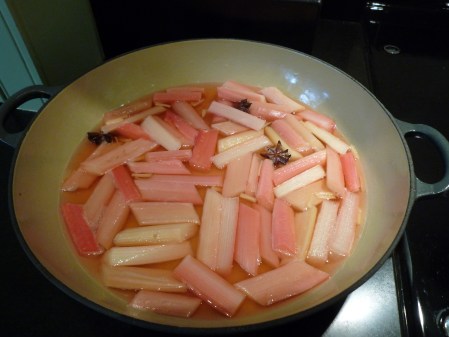
Once the rhubarb is poached, all that’s left to do is to slice the mango then assemble:

Recipe for rhubarb and mango fruit salad
Adapted from a Josceline Dimbleby’s recipe for Rhubarb and Mango à la Vong in her “Complete Cookbook”.
Serves 6
500g forced rhubarb (don’t substitute later field-grown rhubarb as the rhubarb needs to be tender and the colour needs to be the gorgeous bright pink to achieve the startling colour contrast with the golden-yellow mango).
1.5cm length chunk of fresh ginger root
3 star anise
150 ml water
75g golden caster sugar, maybe more to taste
two 4cm long pieces of peel from a lime, removed using a vegetable peeler
1 medium perfectly ripe mango
a little lime juice
a few fresh mint leaves
Preheat the oven to 150 degrees C.
Wash the rhubarb, trim off and discard the ends and slice the stalks into pieces 4 to 5 cm long, cutting prettily at an angle to form little rhombus shapes if you feel so inclined.
Peel the piece of root ginger, cut into slices then into the finest matchstick slivers you can manage. Put the rhubarb and ginger into a shallow lidded casserole dish, tip in the sugar and water and finally add the star anise and pieces of lime peel to the pan.
Put the pan on to the hob and bring to the boil. Cover, remove from the heat and place in the preheated oven to bake very slowly until the rhubarb is tender but still holding its shape. Mine took just 30 minutes in the Aga lowere oven which is only 140-150 degrees C so I suggest checking after just 20 minutes in an ordinary fan oven.
Once the rhubarb is cooked, remove from the oven, remove the lid and leave to cool, then chill in the fridge until you are ready to complete the salad.
Meanwhile, slice your mango into pretty strips using your preferred mango prep method – having tried various ways I still think the hedgehog method works best for me, modifying the criss-cross knife cuts to produce strips rather than cubes. Put the mango pieces into a bowl and squeeze over a little lime juice, enough to toss and coat the mango pieces. Cover the bowl with cling film and refrigerate until you are ready to assemble the fruit salad.
Once the fruit is chilled you can complete the salad. Spoon the rhubarb and its cooking syrup carefully into a pretty serving bowl – I think plain white or glass shows off the colours best. Dot in the mango pieces here and there, being careful not to break up the rhubarb. Make sure the star anise are artfully arranged on top, then finish by scattering over a few fresh mint leaves.
If I were pulling out all the stops, I might accompany the salad with a dainty plateful of green-tea flavoured langues de chat to keep the French-Thai vibe going.

Neapolitan pastries
November 30, 2011 § 2 Comments
Surprise, surprise, I didn’t find any UK style “Neapolitan ice cream” on our recent trip to Naples and the Sorrento peninsula – you know, that rigid tricolour block of strawberry, vanilla and chocolate flavours touted by Walls and similar industrial concerns.
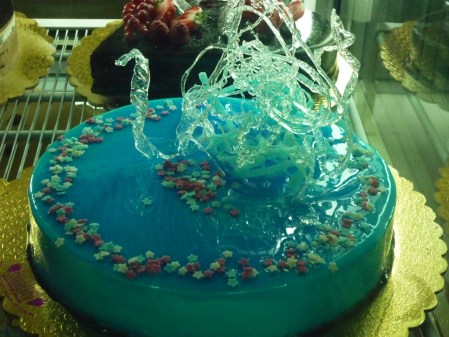
What I did find was cake in profusion – on every street corner there’s a little pasticceria catering to what is clearly a very sweet Italian tooth. What’s on offer ranges from trays of positively austere little biscotti sold by the etto (100g) to some of the most over-the-top and lurid confections I’ve come across, like this glazed blue swan marvel from Sorrento:
The city of Naples itself is home to some of the most long-established family run pasticcerie like this one, Angelo Carbone’s, complete with its obligatory skein of drying laundry. You’ll find Carbone’s in Largo Regina Coeli, a mini-square amidst the maze of streets that makes up Naples’ centro storico.

We stopped here after a visit to Naples’ wondrous Museum of Archaeology and refuelled on thimblefuls of espresso and a generously proportioned zuppa inglese pastry and wild strawberry tartlet:

Tempting they may look, but my goodness they were heavy! Those fragoline di bosco atop the tartlet may look delicate but beneath was a layer of hefty pastry and a crema pasticcera that you could use to repoint the walls of Pompeii.
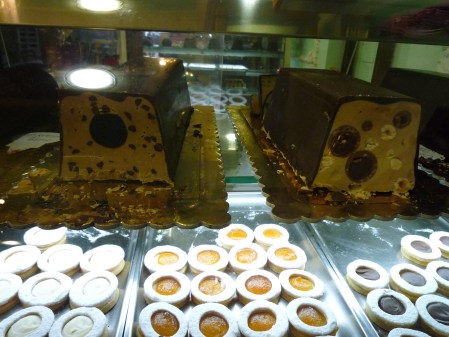
Perhaps a better option might have been a slice of home-made torrone, a Carbone speciality, or a jam-filled biscuit:
Of course we couldn’t leave without sampling some of Naples’ famous sfogliatelle. The name, meaning “many leaves” implies a light-as-air puff-pastry confection and indeed one type, the “riccia” exceeds expectations in this regard. I fell instantly in love with this organza-wrapped parcel of clamshell-shaped loveliness.
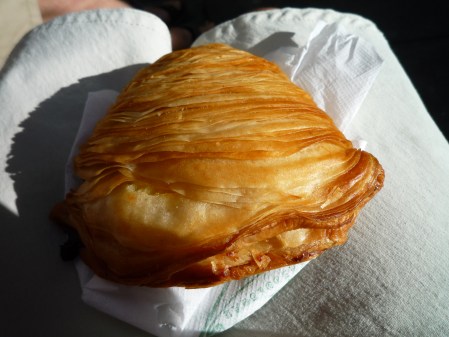
The intricate pastry encloses a dense sweet filling of cooked semolina, ricotta, candied fruit and spices. Oh, and they’re served warm, generally from a hot cabinet, much as we buy our cheese and onion pasties back here in the UK.
Just to confuse the novice pastry-eater, there’s a second type of sfogliatella known as a frolla, the plainer country cousin of the glamorous riccia, made with a sweet, crumbly shortcrust pastry encasing the same semolina/ricotta filling. In the interests of research, I had to try one of these too:

I’d happily eat either of these for breakfast along with a cappuccino. Having looked at recipes for each, I might consider having a go at baking a frolla, but shaping the riccia looks enough to have even a proficient croissant-maker quaking in his or her boots. There are videos of the process on youtube if your curiosity is piqued http://www.youtube.com/watch?v=5GGmqK6VVz4&feature=mfu_in_order&list=UL
I think the conclusion I’ve drawn is that Italian pastry-chefs come into their own when they’re not aping their French cousins. This display from Capri’s legendary Pasticceria Buonocore would seem to prove my point – don’t these look inviting?

And maybe the best Italian cakes are home-made – Marcella Hazan and Anna del Conte’s recipes for walnut cake, ricotta cake, apple cake and the like are enough to persuade me that this is the case. In fact, some of the best cakes we ate on our trip were not professionally made but were these slices of nutty chocolatey Torta Caprese and lemony lipsmacking baked ricotta cheesecake served up at a little café above Capri’s blue grotto and made by the proprietor’s wife. Home bakers rule!

Good things from Borrowdale
November 10, 2011 § Leave a comment
Perhaps the only good thing about having the kitchen redecorated is that we’re forced to get out of the house. When a glistening fresh coat of extra-slow drying oil-based eggshell arrived on the cupboard doors on Friday afternoon, we were forced to spend a weekend away. Fortunately, it all fell into place as there was a weekend of glorious high-pressure weather forecast for the North of England (remarkable for the first week in November) and my favourite youth hostel, the remote but cosy one up on the Honister Pass in the Lake District, had a family room available. So we packed the car, upped sticks and were rewarded with the most fantastic autumn weekend in and around the Borrowdale valley.

Saturday was spent on a circular lower level walk which, in addition to uplifting views and vibrant autumn colours, took in 4 different tearooms at Grange-in-Borrowdale, Watendlath, Rosthwaite, then back to Grange for a visit to its other tea establishment. Definitely my kind of walk.

I took the opportunity to stock-up on local products including this fantastic comb honey available from the Grange tearooms. According to the label, it comes from S. Edmondson of Troutdale, just down the road. It’s a dark, clear honey – from heather perhaps? and spread on my breakfast toast this morning I can confirm that the taste is divine – deeply fragrant, not too strong, and, odd as it may sound, I love the chewy crunch of the little bits of honeycomb wax.

I’ve now done a little reading round about the etiquette of whether or not to eat the wax in honeycomb. The consensus amongst the beekeeping community seems to be to go for it and eat the lot, honey, wax and all, so I now feel vindicated. There are some more delicate folk out there who prefer to chew then discreetly spit out – each to his own I suppose.
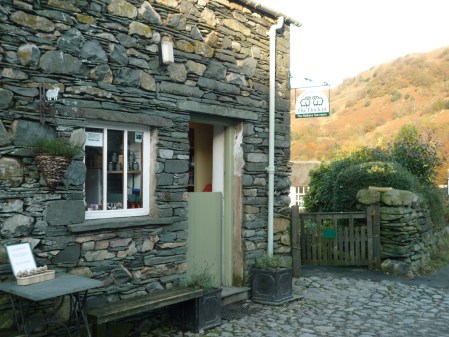
The village of Rosthwaite is home to Yew Tree Farm and its Flock-In tearoom which with its practical slate floors and generously sized cakes and mugs of tea, offers a warm welcome to walkers.
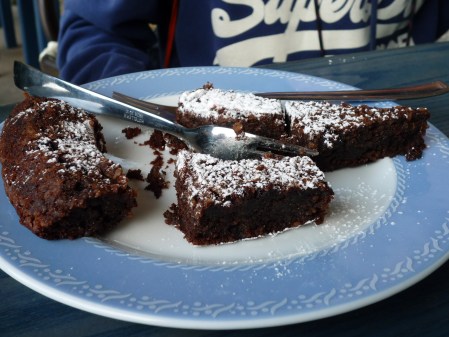
They make their own Borrowdale teabread here and sell whole loaves to take away as well as buttered slices to accompany your tea. I love teabreads of all kinds – quickly made, wholesome, and because there’s generally not much if indeed any fat in the cake mix itself, you can feel justified in enjoying a slice spread with lots of lovely butter.
Borrowdale teabread is a dark, moist slightly spicy loaf cake. Its colour comes both from the tea-soaked dried fruit it contains and the soft brown sugar used in the mix. I had a chat with Mrs Relph of Yew Tree Farm who was behind the counter that afternoon about the origins of Borrowdale teabread. Her view was that the dried fruits, spices and indeed tea in this teabread are a legacy of the overseas trade from the nearby port of Whitehaven. She mentioned that her recipe is made without the addition of fat so that it needs to be well-wrapped and stored in an airtight tin if it’s not to dry out if kept for any length of time. Not much chance of that in our family…

I’ve researched Borrowdale teabread recipes and have come up with my own version which I give below which combines the best bits of each recipe. I think the addition of a little melted butter which several recipe authors suggest will improve the keeping qualities of the cake.
I was then reminded of a treasured recipe for Borrowdale biscuits which I assume must originate in this same Lake District valley. Here’s the recipe given to me by my schoolfriend Helen Wright’s grandmother absolutely ages ago and kept in a file ever since:

These are the most moreish pale gold crunchy biscuits – like a superior Hob Nob for those familiar with the McVities product range. Going back to Helen’s house after school we’d be offered some of these with a cup of tea. I’m not proud to say I’d help myself to 6 or so more than the polite 2 offered when I thought nobody was looking…
I’ve tinkered with the original recipe just a little, substituting butter for margarine as I avoid margarine if I possibly can on grounds of flavour and odd as it may sound, health – all those lovely fat-soluble vitamins in butter from grazing cows can’t be all bad.
Most of the measurements in the original recipe are in “small teacups” so I’ve done my best to standardise the measures to give a consistent result.
I can’t wait to get back into my kitchen to start cooking once again rather than relying on baking memories, but in the meantime, it’s good to be outdoors burning off those cake and biscuit calories.

Recipe for Borrowdale teabread
Adapted from various sources including a Lakeland contributor to the Farmer’s Guardian, Carole Gregory’s little booklet “Favourite Lakeland Recipes”, Sizergh Barn’s online recipe (unusable as published as riddled with errors) and eating carefully the of Flock-In tearoom’s own teabread. I’ve maintained the key ratios and ingredients of the recipe but have incorporated what I think are the best elements of each recipe.
Good spread thickly with salted butter and maybe a wedge of crumbly Lancashire cheese.
Makes one large loaf cake.
Ingredients
½ pint (225 ml) strong hot black tea
14 oz (400g) dried mixed fruit (to include sultanas, raisins and glacé cherries)
6 oz (170g) dark soft brown sugar (use light soft brown sugar for a paler teabread with a less pronounced molasses flavour if you prefer)
1 large egg, beaten
grated rind of 1/2 orange and 1/2 lemon
1 oz (25g) melted butter
7 oz (200g) plain flour
2oz (50g) wholemeal flour
3/4 teaspoon bicarbonate of soda
¼ teaspoon freshly grated nutmeg
½ teaspoon mixed spice
Mix together the dried fruit and sugar in a large mixing bowl. Pour over the hot tea, cover and leave overnight to steep.
The next day, prepare a 2lb loaf tin by greasing and lining the base with baking paper. Preheat the oven to 160 C (fan).
Add the beaten egg, melted butter, grated citrus rind and grated nutmeg to the bowl containing the soaked fruit and mix well.
Sieve together the flours, bicarbonate of soda and spices. Tip any bran from the wholemeal flour or any larger pieces of grated nutmeg which don’t make it through the sieve back into the bowl too. Add to the bowl and fold into the mixture to blend thoroughly.
Pour the mixture into the prepared tin and bake for about 1 hour until firm when pressed lightly, well-risen and a deep golden brown.
Cool in the tin for 30 minutes then turn out and cool on a wire rack. Store in an airtight tin. Best left overnight before eating to allow the flavours to develop and the bread to soften and become sticky.
Recipe for Borrowdale biscuits
Adapted from a recipe given to me by my schoolfriend Helen Wright’s grandmother.
Makes 50-60 biscuits
Ingredients
8 oz butter
8 oz golden caster sugar
2 dessertspoons golden syrup
6 oz rolled porridge oats
8 oz self raising flour
1 teaspoon bicarbonate of soda
2 tablespoons boiling water
Cream together the butter, sugar and syrup. Dissolve the bicarbonate of soda in the boiling water. Add to the mixture then add the dry ingredients.
Pinch off and roll between your palms small balls of the dough about the size of a heaped teaspoon and set a little way apart on a prepared baking tray.
Bake at 160 degrees C/325 F/gas 3 for approximately 15 minutes.
Contact details
Flock-In tearoom
Yew Tree Farm
Rosthwaite
Borrowdale
Cumbria
CA12 5XB
Tel 01768 777 675
Website www.borrowdaleherdwick.co.uk
Borrowdale honey – jar and whole honeycomb in box available from tearoom in Grange-in-Borrowdale
Details on honey label are:
S. Edmondson
Troutdale
Keswick
Cumbria
 The Rhubarb Fool