
Reunion lunch at Mallory Court, Leamington Spa
August 11, 2011 § Leave a comment
Checking my AA road atlas before heading off to a long-planned reunion lunch, Mallory Court looked dangerously close to the industrial outskirts of Leamington Spa and Junction 13 on the M40.
I needn’t have worried as this is the view from the hotel terrace:

The M40 is there in the background but practically invisible. Mallory Court could be the setting for one of those beer ads “if Carlsberg did Motorway service stations” – long camera pan up the drive to the honey-coloured ivy-clad stone walls of the manor house; cut to guests sitting in cosy oak panelled dining room; lingering shots of guests sipping coffee on the terrace overlooking immaculate formal gardens…
So what was the occasion? Having exchanged nothing more than Christmas cards with Mike and Lynnette for years, it was Mike’s very good idea to meet up for lunch in the centre of England as we live at opposite ends of the country. We all met on a week long residential tennis course at Windmill Hill in Sussex in the early 1990s. Those who know me will confirm that my tennis didn’t really improve but we had the best of weeks – looking back I recall it as a week of sunshine, Glyndebourne, drinks and fun. Oddly (or perhaps not) I seem to have forgotten how to hit a double-handed backhand or how to apply topspin to my lob.
It was therefore very fitting for the three of us enjoy a hedonistic lunch after all these years. We had a lot of catching up to do so my attention was on conversation and company rather than the finer points of the food, which is after all how it should be.
Despite its name and initial impressions, Mallory Court is not an ancient manor but an Arts and Crafts trophy-house built in 1914 for a retired Manchester cotton baron. The house changed hands a number of times before being converted to a country house hotel in 1976. It’s now owned by Midlands entrepreneur (sounds posher than Brummy businessman doesn’t it?) Sir Peter Rigby who dabbles in hotels and airports as well as his main IT services business SCC Group.
The immediate impression on entering the hotel is one of welcoming efficiency. There are cosy armchairs to sit in and staff appear just when you feel like ordering a drink without the feeling of being hovered over. I always use the ladies’ loo as a bellwether of attention to detail in an establishment. Mallory Court did not disappoint:

After champagne and nibbles we were shown to our table in the dining room. White damask-clad tables are spaced discreetly apart to allow diners to talk business in privacy and there’s a comfortable, club-like atmosphere.
This is a Michelin-starred establishment so we began with the obligatory amuse-bouche. This comprised a tiny precise cylinder of smoked eel mousse together with vibrant magenta beetroot served three ways, the flavours pointed up with a scattering of micro-cress and flavour explosions from tiny shards of deep-fried caper.
I suppose the purpose of an amuse-bouche is for the chef to summarise his approach to food in one tiny little plateful. This is what chef Simon Haigh did here – what it told me is that this was a chef who likes classic combinations brought up to date, applies precision and attention to detail and has an eye for colour and texture. It came as no surprise to learn afterwards that Haigh learned his craft under Raymond Blanc at the Manoir au Quatre Saisons. In fact he seems intent on creating a Manoir-like atmosphere here in Warwickshire using produce (including that beetroot) fresh from his own kitchen garden.
I chose a rather weird sounding first course of egg purée, crispy ham hock and pineapple chutney, trusting the chef to turn it into something edible. This is what arrived:

The crispy ham-hock turned out to be a spring-roll type affair, and the egg purée a super smooth scrambled egg or perhaps a hot savoury custard. Very clever and no idea how you’d go about recreating it at home.
Main courses were a little more classic and little less off-the wall. Mike chose pork loin served with the most adorable Mirabelle plums looking like miniature apples:
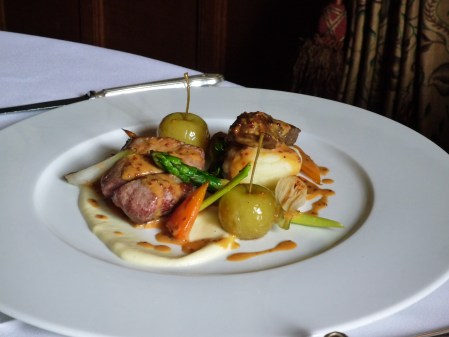
Lynnette and I both chose sea bream with black squid ink risotto, squid rings and Mediterranean vegetables. This should have been served with fillets of red mullet, one of my favourite fish, but (disappointingly but reassuringly I suppose) they’d sold out by the time we ordered hence the substitution of sea bream.

Another picture on a plate, but with every element contributing to the harmonious balance of flavours. A square plate this time, as weirdly shaped crockery seems to be de rigueur these days for any restaurant with Michelin aspirations.
I’m not normally a pudding person, but this wasn’t an everyday occasion so I chose crème brûlée with honeycomb mousse and strawberry sorbet.

This was a perfect size for a post-lunch pudding and each element was technically perfect.
I’m sorry to say we were a little greedy at this stage and, purely out of intellectual curiosity of course, ordered another pudding to share – peanut ice cream with caramelised bananas and bitter chocolate tart. Peanut or peanut butter ice cream is popping up in smart restaurants everywhere these days and this one did not disappoint, nor did the intensely flavoured bitter chocolate tart:

We concluded our lunch with coffee and petit fours on the terrace outside.
In fact the coffee here is both cheaper and a darn sight better than a slop-bucket of Starbucks from WelcomeBreak Warwick North. So next time you’re speeding along the M40 I recommend you take the slightest of detours from junction 13 to refresh the soul as well as the body.
Contact details
Mallory Court Hotel
Harbury Lane
Royal Leamington Spa
Warwickshire
CV33 9QB
01926 330214
reception@mallory.co.uk
http://www.mallory.co.uk/
Belizean breakfast
July 25, 2011 § Leave a comment
The latest in our Breakfasts of the World Project series.
Belize is a tiny little country just 180 miles long situated in Central America. Mexico lies to the North, Guatemala to the South and West and the Caribbean Sea to the East. The colony formerly known as British Honduras is now a hot tourist destination and a must-see place on the gap-year ecotourism trail according to my niece Lucy. It does sound rather idyllic – coral atolls, Mayan ruins, tropical rain forest… Maybe it’s not just for the low tax régime that Belize’s most famous resident Michael Ashcroft chooses to make his home here.
Because of the thriving tourism industry, descriptions of Belizean hospitality and specifically its breakfasts are not hard to come by on the web. I found this entry http://www.travellious.com/breakfast_in_belize pretty helpful in setting out what constitutes breakfast in Belize: refried beans, scrambled eggs, salsa, fry-jacks, and above all Marie Sharp’s hot sauce.
Here’s my version cooked up at home last Sunday morning. There’s one further addition to the Travellious list which is some greens quickly stir-fried with garlic. They’d use amaranth greens in Belize, sometimes referred to as callaloo, but I had to be content with some less exotic baby spinach:

The Marie Sharp’s hot sauce was impressively easy to obtain – a couple of mouse clicks and it arrived by post the next day. It’s a fiery red Tabasco type sauce but made authentically in Belize, and yes there really is a person called Marie Sharp who runs the company, it’s not just a marketing man’s fantasy à la Betty Crocker.

OK so menu and sauce sorted, this breakfast was beginning to take shape. Scrambled eggs, stir-fried greens and fresh salsa would be easy enough to whip-up, but what about the refried beans and those intriguingly named fry jacks?
My starting point for authentic refried beans was a recipe from the website of the rather lovely looking Chaa Creek ecolodge. Their recipe was a little sketchy so I’ve added my own tips for preparing refried beans. Despite the name, the beans are fried just once. I think I read somewhere that it’s more mellifluous in Spanish to refer to frijoles refritos rather than the uncomfortably alliterative frijoles fritos.
The soaked black beans look a dramatic inky deep purple colour as they go into the pot with the flavouring ingredients:

This softens when you come to fry and mash the beans to more of a sludgy grey. They may not look that pretty, but they do taste good:

Now for the fryjacks. I found an authentic recipe from fascinating blog Rice and Beans A Belizean in the USA which I’ve adapted and given below. My fry jacks tasted good – a bit like a savoury doughnut but didn’t puff up quite as much as expected.
First step was to make the dough and divide it into little balls:

Next, the dough balls are flattened and cut into quarters:

Finally, when you’re ready to eat, the quarters are dropped into hot deep fat to fry:
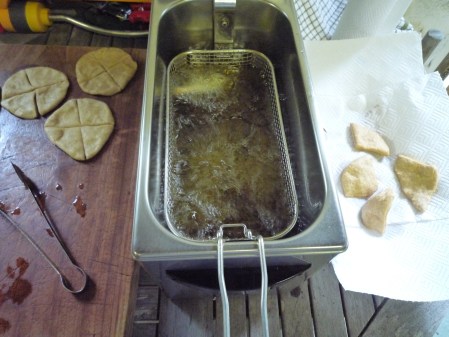
In keeping with the tropical vibe, I set up the deep fat fryer in the garage with the intention of eating our breakfast on the terrace outside. Great for containing cooking smells and conjuring up the beach shack atmosphere but unfortunately a Mancunian tropical downpour sent us scurrying back inside to eat.
Recipe for refried beans
Adapted from a recipe on the award winning Belizean eco-lodge Chaa Creek’s website.
Serves 6.
Ingredients
To cook the beans
1 lb dried black or red beans
1 small onion, peeled and quartered
2 cloves garlic, unpeeled but lightly crushed
2 bayleaves
1 sprig thyme
salt to taste
To fry the beans
3 tablespoons vegetable oil
1 small onion, finely chopped
2 cloves garlic, peeled and chopped
salt and freshly ground black pepper to taste
a little powdered cumin (optional)
handful chopped coriander (optional)
Soak the beans overnight in cold water. Next morning, drain the beans in a colander, rinse them and tip them into a deep lidded pot. Add enough fresh cold water to cover the beans adding an additional 1cm of water on top.
Add the flavouring ingredients except the salt and bring the beans to the boil leaving the lid off the pan as otherwise it will boil over. Skim off the scum, turn down to a very gentle simmer and cover the pan. Check the beans after 30 minutes – add salt as soon as the beans are nearly cooked through. Simmer until the beans are nice and soft but not too mushy. This might take anywhere between 30 minutes and an hour or longer depending on your batch of beans and how long they’ve soaked for. Don’t taste the beans until they gave boiled for at least 20 minutes as they are mildly toxic until cooked through. Remove the flavouring ingredients using a slotted spoon and leave the beans in their cooking liquid until you’re ready to fry. You can fry the beans straightaway or, once cooled, store them covered in their liquid in the fridge for a couple of days.
When you’re ready to fry, choose a heavy based deep wide sauté or frying pan and heat the vegetable oil until medium hot. Add the chopped onions and cook until soft and just turning golden. Throw in the garlic and cook for a minute or so more until just beginning to brown but not burn. Add a couple of ladlefuls of beans and their cooking liquid to the frying pan, turn down the heat to low and cook the beans and associated liquid mashing them into the base of a pan with your wooden spoon or a potato masher. Once each ladleful of beans is mashed and heated, add the next. Add more bean cooking liquid as required to form a thick paste. It won’t look too pretty – a thick, grey sludgy paste, but it will taste good. Taste and season with salt and pepper and, if using, ground cumin. Scatter over the optional chopped coriander and serve.
Recipe for Belizean fry jacks
Adapted from an authentic fry jacks recipe from the blog “Rice and Beans A Belizean in the USA”
Ingredients
1/2 cup wholewheat flour
1 and 1/2 cups white flour
1 and 1/2 tsp baking powder
1/2 tsp salt
1/4 cup vegetable oil
about 3/4 cup of water
Mix together the flour, salt and baking powder in a large mixing bowl. Add the vegetable oil and, using your hands, work the oil into the flour until you have little pebbles of oil saturated dough evenly distributed throughout the flour.
Make a well in the mixture and pour in the water a little at a time, using your other hand to stir the flour into the water in the centre of your pile. Keep adding the water and mixing it in a little at a time until you have formed the entire pile of flour into a rough ball of slightly sticky dough. You may need a little less water than specified in the list of ingredients.
Turn the dough out onto a floured work surface and knead for about 5 minutes until it is smooth and stretchy. Then roll it out into a snake shape and cut it into 8 equal sized pieces. Take each piece and roll it into a ball. Cover and leave the balls to rest on a lightly floured surface for at least 30 minutes.
Next, prepare to deep fry the fry jacks. I used an electric deep fat fryer and my chosen cooking oil was rapeseed (canola). Heat the oil until really hot. To test if the oil is hot enough, drop in a small scrap of dough. If it sizzles but doesn’t smoke, the oil is the right temperature.
Take one of the dough balls and roll or pat it out into a circle, about 6 inches across. Take a knife or pizza cutter and cut the circle into four pieces. Once your oil is hot, drop several fry jacks into the pan. I managed to cook four at once without overcrowding. The fry jacks first sink then quickly rise to the surface of the oil. After 20-30 seconds, check to see if the sides in the oil have browned. If so, flip the fry jacks over with a pair of tongs fork and let the other side cook. Lift out with a slotted spoon and drain on a plate lined with paper towels. Eat immediately.
Bring and share – two salads for summer
July 17, 2011 § Leave a comment
Help! Three words that bring on a panic attack. You know the kind of thing I mean – a communal summer event, maybe a club or choir social evening, a music teacher’s summer pupils’ concert, perhaps even a street party. Some people you’ll know well, others less so, and everyone is asked to bring a dish to create an inpromptu meal.
What to bring? It’s got to be transportable; capable of sitting around on a warm buffet table without melting/disintegrating/giving everyone food poisoning; taste good; look a teeny bit impressive but not as if you’v tried too hard, and finally not something that’s going to take all day to prepare.
My suggestion is to avoid little canapé nibble type things at all costs as these take forever to put together and to go for a generous bowl of colourful salad instead. I have two reliable standby recipes, the first an old favourite and the second a recent discovery.
My first recipe is for tabbouleh, the much-loved middle-Eastern parsley and mint salad mixed with chewy grains of burghul.

I learned how to make this from one of my all time favourite cookery books, Claudia Roden’s “A New Book of Middle Eastern Food”. My cookery book collection has grown over the years and has had to have a whole bookcase of its own set aside for it in our study. Neverthless, a selection of just ten books has crept back downstairs into the kitchen because I refer to them so often. ” A New Book of Middle Eastern Food” is one of those ten. It’s a book with no glossy photos (aside from the weird close-up of spring onions and vine leaves on the cover) yet manages to conjure up all sorts of evocative images of the Middle East in its imaginative and well-informed writing. A sort of Arabian Nights of the kitchen. And this small battered paperback is full of meticulously researched, concisely written recipes that actually work.
Tabbouleh, as Ms Roden explains, is essentially a herb salad, a mass of dense green freshness speckled with the pale grains of burghul. Quite often you’ll see something described as tabbouleh which is this idea reversed – lots of pale grains flecked with specks of grain. Salads like this may be good, but to me now they’re just not tabbouleh.
I grew up reading 1970s recipe books where herbs were mostly dried and strictly rationed – a teaspoon of chopped parsley in a white sauce to accompany boiled ham perhaps. I think that’s why I love the hugely generous quantities of fresh herbs you need for this recipe – think handfuls rather than teaspoons. Even with 2 big bunches of parsley, you need still more…

All the salad ingredients can be prepped beforehand which makes it very convenient to put together for a party. I’ve included some walnuts in this version:

You can very the garnishes according to your mood, what you have in the cupboard or fridge and what’s in season. I decorated this version with a few snipped chives and tasty chive flowers from the garden:

Is there any downside to this salad? Well, being honest, it will almost certainly leave green herby flecks on you and your guests’ teeth.
If having to check yourself in the mirror doesn’t appeal, then my second suggestion is a salad of blanched mangetout and French beans livened up with orange zest, toasted hazelnuts and freshly snipped chives. It comes from “Ottolenghi – The Cookbook”, one of those books where I turn the pages and want to eat everything in there.

This isn’t a salad you can throw together in a couple of minutes – each element has to be prepared quite carefully, be it the accurate and separate blanching and refreshing of the vegetables;

the roasting of the hazelnuts to just the right degree of toastiness without burning them;

or the careful preparation of the orange zest to give visually appealing long, thin strips without any pith.
Your efforts spent on preparation will be rewarded in a crunchy salad with a harmonious mix of intriguing flavours – the orange, hazelnut and mild onion flavour of the chives work really well together without overpowering the beans and sugar snaps.
Recipe for tabbouleh
Adapted from Claudia Roden’s “A New Book of Middle Eastern Food”. Serves 10 or more as part of a selection of dishes.
Ingredients
250g bunched flat leaf parsley – approx. 3 supermarket LARGE bunches
100g bunched mint
100g burghul
sea salt and freshly ground black pepper
Juice of 2 lemons
80 ml extra virgin olive oil
200g spring onions
Garnish – standard
2 little gem letttuces
3 medium tomatoes or 8 cherry tomatoes
2 inches cucumber
Garnish – optional additions
Handful of roughly chopped walnuts
Chive flowers, wild garlic flowers
Handful of pomegranate seeds
Wash the mint and parsley and dry carefully using a salad spinner. Pull out the thickest of the parsley stems and any discoloured leaves. The thinner parsley stalks can stay in as they are fine to eat once chopped. Remove the mint leaves from their coarse stems as these are generally too fibrous to make pleasant eating.
Chop the herbs either in a food processor or by hand as you prefer. I tend to use a food processor, pulsing carefully to chop the herbs to a medium degree without turning them into too fine a mix or worse of all, a mush. Set the chopped herbs aside in a tightly sealed plastic box and place in the fridge. If you’re preparing this dish ahead of time, the herbs will keep quite well in the fridge for 24 hours, even longer. Given that freshness is the essence of this salad, I don’t like to leave the herbs in the fridge too long though.
Finely slice the spring onions and set these aside in the fridge.
Meanwhile, prepare the burghul. Covering with cold water and leave to soak for half an hour or so. Tip into a sieve and leave to drain for 10 minutes or so, pressing out any excess water. Put in a mixing bowl and add half the lemon juice and olive oil and a little salt and pepper. Let it absorb the dressing for a further 30 minutes or so.
While the burghul is soaking, prepare your chosen garnishes. Carefully remove perfect whole leaves from the little gem lettuces and wash and dry them thoroughly. Dice the tomato and cucumber. If using, roughly chop the walnuts and/or remove seeds from a pomegranate.
Now assemble the salad. It’s best to assemble it no more than 30 minutes before you plan to serve it as otherwise the lemon juice in the dressing begins to blacken the mint leaves. Add the chopped herbs and spring onions to the dressed burghul in the mixing bowl. Add the remaining lemon juice and olive oil and more salt an pepper. Taste and check flavours. You need plenty of lemon juice and salt to make the salad really sing. Once you’re happy with the balance of flavours, line your chosen serving bowl with the prepared lettuce leaves, pile in the tabbouleh and scatter your garnish of tomato and cucumber, plus any optional additions, over the top.
Recipe for French bean and mangetout salad with orange and toasted hazelnuts
Adapted from Yotam Ottolenghi and Sami Tamimi’s “The Ottolenghi Cookbook”. Serves 8 or more as part of a selection of salads and other dishes.
Ingredients
400g French beans (trimmed weight)
400g Mangetout peas (trimmed weight)
60-80g skinned hazelnuts (use the higher quantity if you like hazelnuts)
1 unwaxed orange
1 clove garlic, crushed
5 tablespoons hazelnut oil
sea salt and freshly ground black pepper
10-20g chives, snipped into small pieces with a pair of scissors (plenty of chives perk up the flavour of this salad – use fewer if you prefer)
squeeze of lemon juice
Begin by blanching the vegetables. Bring a large pot of water to a fast rolling boil and add a little salt. Throw in the French beans and, using an accurate timer, cook them for 4 minutes, until just cooked. Using a slotted spoon, remove all the beans and throw them into a big bowl of iced water to refresh. Take the bowl to the sink and allow the cold tap to run over the beans until they are completely cold. Drain in a colander and tackle the mangetout in a similar fashion but the mangetout require just 60 seconds blanching time.
Pat the vegetables dry with kitchen paper and store in a sealed container in the fridge until needed. You can do this up to 24 hours ahead of time.
Scatter the hazelnuts on a shallow baking tray (I use a battered old Swiss roll tin) and bake in an oven preheated to 180 degrees C for 10 minutes until toasted to an even golden brown. Watch the nuts carefully as they bake and check them before 10 minutes is up to make sure they don’t burn. Chop roughly and set aside to cool.
Now prepare the dressing. I use a lidded jam jar to do this. Add to the jar the nut oil, the crushed clove of garlic and the zest of he orange. To prepare the orange zest, you need either to peel off a thin layer of orange skin without any pith using a swivel peeler. Having done this, using a sharp knife, cut the peel into long thin shreds. Much easier is to buy a special little zesting tool which you scrape over the surface of the orange which produces the desirable orange shreds in an instant. Add the juice of just half of the orange to the jar together with salt, pepper and a squeeze of lemon juice to taste. Don’t add the chives at this stage as the fruit juices will make them go soggy and dark coloured.
When you’re ready to serve, tip the beans and peas and snipped chives into a handsome serving dish. Pour over the dressing and toss lightly. Scatter over the toasted hazelnuts and serve.
Belgian breakfast
July 10, 2011 § Leave a comment
The latest in our series of international breakfasts making up the Breakfasts of the World Project.
Unlike most of the far-flung destinations whose breakfasts we’ve tried to recreate at home, hopping over to Belgium is relatively straighforward for us in the UK so we were able to do some serious research on a recent family trip based in Bruges. This combined a little education (First World War graves, Ypres, Flemish painting and architecture) with gastronomic sight-seeing.
I know that Venice has the edge when it comes to a romantic weekend away à deux, but if you’re travelling en famille, as we were, a city which combines gorgeous architecture with chips, chocolate and waffles takes the biscuit (or should that be the speculoos…?).

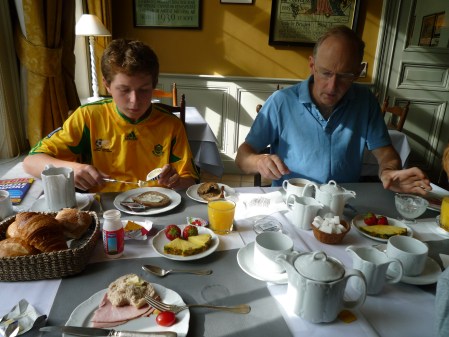
We stayed in the charming canalside Ter Duinen hotel which these days would probably be called a boutique hotel as this sounds more desirable than “small hotel”. They laid on an impressive breakfast spread and if you were prepared to leap out of bed early, you could grab one of the coveted window seats with gorgeous reflected light from the canal:
This is how we attempted to recreate the experience at home. Not quite as beautiful as the Ter Duinen breakfast I know. I don’t run to white damask in our kitchen but I made an effort with some Flemish inspired tulips.
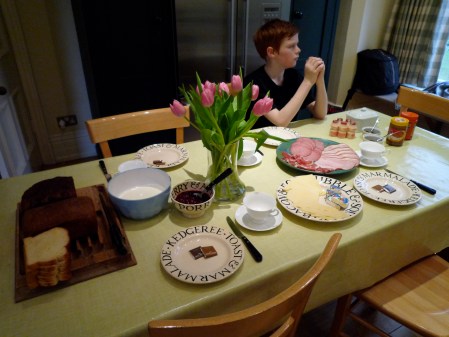
As you might expect from a country which has been fought over between the France and the Netherlands for aeons, its breakfast is a hybrid between the French influenced café au lait with croissants and the more Northern European influenced hearty brown bread with ham and sliced cheese. You get both at breakfast together with Belgium’s particular contribution to the breakfast universe, a host of tasty packaged treats, the legacy of its industrial and colonial past perhaps?
Belgium may not be known as a cheese producer, but here’s some prepacked slices of Bruges’ finest:
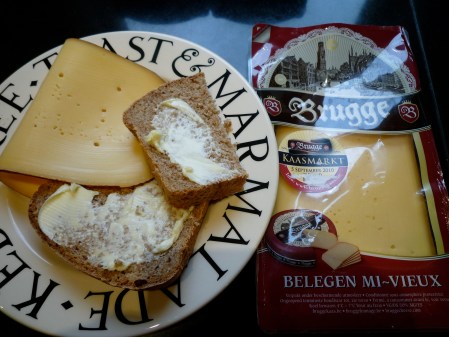
There were little squares of chocolate too – one of the reasons Belgium is world famous. Oddly, I can’t find a decent definition of what Belgian chocolate is – Côte d’Or with its familiar Elephant logo is the indigenous mass-market producer. Côte d’Or or Gold Coast is of course the old name for Ghana which is a former British rather than Belgian colony so how does that work? Maybe Belgian chocolates just refer to the delicious filled pralines sold by Neuhaus, Godiva and Leonidas and many more small artisan producers. A clear and comprehensive definition of Belgian chocolate remains elusive for the time being.
Popping into the Bruges branch of Delhaize (one of the big Belgian supermarket chains) to stock up on Belgian breakfast products I was thrilled to find family sized jars of two types of breakfast spread which we’d sampled only in indiviual portion packs at Ter Duinen.

On the right is an Ovomaltine spread based on the popular continental malted chocolate drink – imagine Nutella with the goodness of hazelnuts removed and replaced with nuggets of crunchy malty sugary stuff.
But wait for it, on the left is a jar of Speculoos spread based on the national biscuit of Belgium – a thin crisp ginger-spiced biscuit. Speculoos have a sort of mediaeval feel about them and were no doubt originally hand-made in elaborately decorated wooden moulds. They are most often found now individually wrapped in cellophane, branded Rombouts or most often Lotus, and served as a complimentary sweet nibble with a cup of coffee.
The idea of turning this small spicy biscuit into a spread is as preposterous an idea as a spread made from our own indigenous McVities’ ginger nuts.
Both jars were packed with unsuitable ingredients with a high E number count but nevertheless both have made it onto my not-so-secret list of guilty pleasures. All the family were secretly taking spoonfuls from the jar. I was amused to read recently the similar reaction to Speculoos spread of Paris-based food writer David Lebovitz (http://www.davidlebovitz.com/2010/05/speculoos-a-tartiner-gingersnap-paste/)
Grab a jar if you dare!
Contact details
Ter Duinen Hotel
Langerei 52
8000 Brugge
BELGIUM
info@terduinenhotel.be
http://www.terduinenhotel.be/
Tel: 00 32 50 33 04 37
Fax: 00 32 50 34 42 16
Lime tea and madeleines
July 5, 2011 § Leave a comment
The air outside is still fragrant with the scent of the blossom of the stately lime trees which line our pleasant suburban street. This is the year that I have finally harvested and dried some of these blossoms. They make the most delicately flavoured of tisanes to serve alongside a plateful of madeleines to recreate that oft-referenced literary reminiscence in Marcel Proust’s “Du Côté de Chez Swann”, the first instalment of the mighty novel cycle “À la Recherche du Temps Perdu”.

Towards the beginning of the novel, the narrator’s mother sends out for a small cake to serve with tea “un de ces gâteaux courts et dodus appelés Petites Madeleines qui semblaent avoir été moulés dans la valve rainurée d’une coquille de Saint-Jacques”.
Tasting the morsel of cake dipped in hot tea triggers in the narrator a childhood memory of eating madeleines dipped in his Aunt Léonie’s lime tea. The narrator is fascinated by the shape of the madeleine “the form, too of the little shell made of cake, so fatly sensual within its severe and pious pleating”.
The shape of the madeleine is undoubtedly part of its appeal. Its dainty size and unadorned simplicity make it the antithesis of an oversized, overfrosted, overdecorated cupcake.

The good news is that madeleines are very simple to make. The recipe I use comes from Frances Bissell’s book “Entertaining”. The key step before you start is getting hold of the essential madeleine moulds. Be sure to invest in at least two trays as it’s very frustrating being able to bake just 9 madeleines at a time. I picked up my pair of silicone moulds in a kitchen shop in France but there’s no need to travel – there’s a huge selection of similar moulds available on Amazon.
Some cooks insist that only metal moulds give good results but I’ve had excellent results with my silicone moulds which I grease lightly before use. I sit them on a baking tray to make the job of putting them in and taking them out of the oven risk-free.

I give the full madeleine recipe below, together with a slightly more complex recipe featured recently on BBC Radio 4’s “Woman’s Hour” which I haven’t tried out yet. Why bother when the basic recipe works so well?
You can ring the changes a little by flavouring the madeleines classically with a little orange zest and a teaspoon of orange flower water, or a little lemon peel. In the last batch I made, I finally found the opportunity to use my latest food purchase – a precious little tin of must-have Tonka beans – and grated just a little into the batter to impart a subtle spicy richness.
Another trick to add depth of flavour to your madeleines is to take your melted butter to the beurre noisette stage before stirring it into the mix – this is something I learned to do from Rose Levy Beranbaum’s Génoise Classique recipe from her aptly named “Cake Bible”. It’s also something that the second more complex madeleine recipe suggests.
Mixing the batter is very straightforward – no tricky creaming as the butter is melted and is incorporated very easily. It takes only a tablespoon of batter to fill each mould and the mixture really is quite runny – don’t be alarmed, this is how it should be.
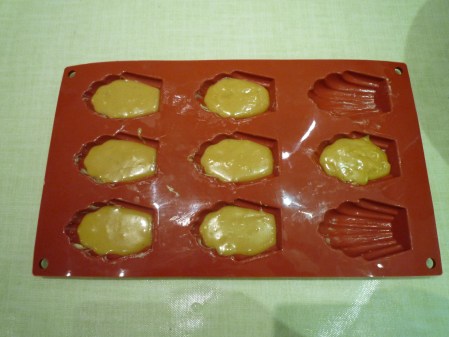
OK, so that’s the madeleines taken care of. Now for the tea to dip them in.
The lime trees outside my front door may smell divine but are too close to the road to contemplate gathering the flowers to make a tisane. Lime trees are in flower for a very short time – just a week or so – so when a warm dry day arrives to gather the blossoms, you have to drop everything and seize the moment.
When the right day arrived, I headed off to nearby Dunham Park where lime trees grow in a perfect rolling parkland setting well away from roads:

I spread out the blossoms I’d collected on a wicker tray to dry gently in the dining room out of direct sunlight:

And a week later, I was ready to prepare my tisane and enjoy my Proustian moment.
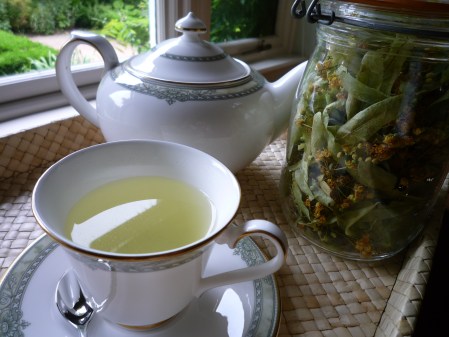
So much more refined than dunking a jaffa cake into a mug of PG tips. Come to think of it, there’s a great literary pastiche to be written here…
Recipe for madeleines (1)
From Frances Bissell’s “Entertaining”
Makes 24
Ingredients
100g (4 oz) caster sugar
100g (4 oz) self raising flour
pinch of salt
2 eggs, lightly beaten
130g (5 oz) unsalted butter, melted
Butter and flour madeleine moulds. Sift together the sugar, flour and salt. Beat in the eggs, and then mix in the melted butter. Pour the batter (which is quite liquid) into the prepared moulds, and bake in the top half of a preheated oven at 220 degrees C/450 degrees F/gas mark 8 for 5-7 minutes. Remove from the oven once the madeleines are golden, well risen and have the characteristic “bump” in the middle.
Recipe for madeleines (2)
Michael Vanheste of Betty’s cookery school’s recipe as featured on BBC Radio 4 Woman’s Hour earlier this year.
Ingredients
60g (2 oz) lightly salted butter
1 medium egg
50 g (1.5 oz) caster sugar
30g (1 oz) plain flour
20g (1/2 oz) ground almonds
1 lemon, zested
1. Preheat the oven to 190 degrees (fan assisted). Gas mark 5.
2. Warm a heavy-based pan over a moderate heat and add the butter. Cook the butter slowly until it has melted, turned a golden colour and gives off a nutty scent, hence the name “beurre noisette”. Remove from the heat and allow to cool slightly.
3. In a metal bowl, whisk the egg with the caster sugar until the mixture has become light and airy. You should be able to briefly leave a figure of eight with the balloon whisk on the surface of the mixture.
4. Sift the flour and ground almonds into the bowl and gently fold into the egg mixture together with the lemon zest. Finally, gently stir the beurre noisette through the mixture. Leave to rest for about an hour if you have the time, this will allow the gluten in the flour to relax, ensuring the cakes are light.
5. Spoon the batter into the madeleine moulds filling them 3/4 full. Bake in the preheated oven for 8-10 minutes or until golden brown and springy to the touch.
6. Leave to cool in the mould for a while until cool enough to handle and then turn out onto a wire rack.
7. Once cooled, store in an airtight container.
Instructions for preparing lime or linden tea
Choose a warm sunny day to gather lime blossoms. Pick your trees carefully, away from roadside dirt and pollution. Using a pair of scissors, snip off the blossoms including the leaflike bracts. Transport the blossoms home carefully ideally in a wicker basket. Lay them out to dry on trays and leave in a warm dry place out of direct sunlight for about a week. Store in an airtight container.
When ready to brew, place 2 tablespoons blossoms (7g) in a teapot, pour on boiling water (I used 835 ml) and leave to infuse for at least 5 minutes. Strain into your favourite china cup, and if liked, sweeten with a little runny honey – choose one which is light and floral in character to complement rather than overpower the flavour of the tisane.
Belarusian breakfast
June 28, 2011 § 2 Comments
The latest in the series making up our Breakfasts of the World project.
What an anonymous and grim-sounding place Belarus is. It’s a landlocked country nestling between Poland and Russia which declared independence from the former Soviet Union in 1991. The landscape is largely flat, marshy and forested and thanks to this and the Soviet legacy its economy is dominated by agriculture and manufacturing.
Whilst researching Belarus and its food I was amused to come across Alby’s travel blog documenting the all-action Italian’s trip there in 2005:
“It’s difficult to give impressions about Belarus. From a certain point of view travelling here it’s nice: no hassle with the policemen and it’s quite safe, but on the opposite the landscape is monotonous and there’re not highlights enough to justify the trip. In addition the food doesn’t help, since it really sucks, but what can push you there is the possibility of a off-of-the-beaten-track travel in a country almost under a dictator that today turns out the most isolated in Europe.”
The dictator he refers to is Alexander Lukashenko who has held the presidency since 1994. Although not at the forefront of news stories, various European countries have imposed economic sanctions as a response to Mr Lukashenko’s authoritarian rule. Things may be changing – there are very recent BBC news reports of protestors defying the ban on public demonstrations in Minsk and making silent, peaceful protests. Something to watch as well as the higher news profile Arab Spring/Summer stories.
Perhaps understandably given travel blogger Alby’s view of the food he ate on his trip, descriptions of Belarusian food are few and far between on the web or from other sources. I did come across this little snippet from an unknown author on http://www.mapsofworld.com/belarus/society-and-culture/
“Belarusian cuisine mostly comprises of meats, vegetables and breads. The staple food of Belarus includes pork, potatoes, cabbages and bread. The diet of a typical Belarusian includes a very light breakfast with two heavy meals and the dinner becomes the largest meal of the day. Both wheat and rye breads are consumed in Belarus society and culture. Drinks are also a very popular part of the culture and society of Belarus.”
So, not much to go on. I decided a light breakfast might mean a cup of tea and a piece of rye bread. So far so good as, thanks to last year’s baking course at Welbeck, homemade 100% rye sourdough is now a regular feature of the breakfast table. It doesn’t appeal to everyone but I enjoy its dense, dark sourness. Rye bread takes well to the addition of fruit and,on a whim, I threw a handful of dried apricots into this particular loaf:
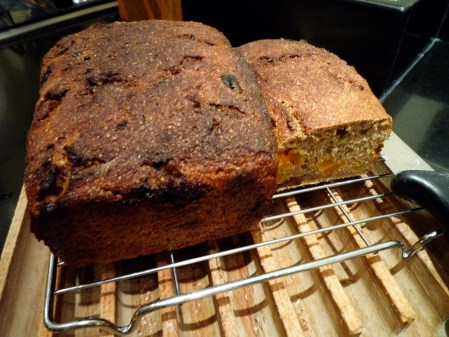
Surely that can’t be it though? I had another hunt around for Belarusian recipes and came up with Draniki, a fried potato pancake which is the de facto national dish of Belarus. I don’t know if draniki are eaten for breakfast in Belarus but that’s how we chose to eat them, with the addition of sour cream and smoked salmon as an atypical decadent touch:
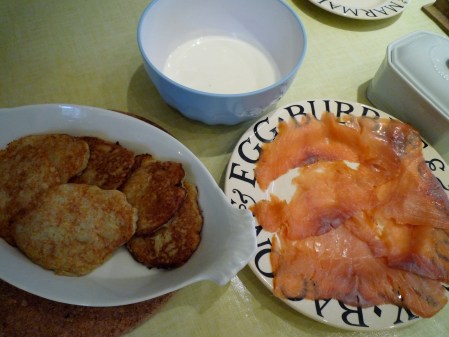
The Draniki turned out pretty well and reminded me of Jewish latkes:

In fact, looking through a few recipes for latkes now, I see that the list of ingredients and the method are practically identical. In common with many simple, traditional recipes, it seems that each person has there own way of making draniki. Some say no flour, some say a little; some grate the potato very finely almost to a purée, some have more distinct potato pieces. The draniki recipe I give below is the one that I used having looked at a number of different Belarusian recipes. What’s important is to get the grated potato as dry as you can by draining off the excess water.
If emerging Belarusian tennis star Victoria Azarenka breakfasts like this today she’ll certainly power through her match to make it the Wimbledon semi finals – I’ll be watching later…
Recipe for draniki
Makes 8-10 individual pancakes serving 4 people in a modest way
Ingredients
6 medium potatoes
1 onion
1 egg, beaten
2 tablespoons flour
flavourless vegetable oil for frying
Grate the potatoes finely into a bowl. Drain off excess water, pressing with kitchen roll to absorb more liquid if necessary. Finely chop the onion and add to the bowl. Add the beaten egg, flour and seasoning to the bowl and stir together vigorously with a wooden spoon to make a thick batter.
Heat 2 tablespoons vegetable oil in a non-stick frying pan until hot but not smoking. Drop in spoonfuls of batter which will form thick round pancakes. Fry until golden brown then flip over and fry on the other side. Drain on kitchen paper to absorb excess oil and serve.
Recipe for rye bread
You can find this in a previous post here
Salad from Sale
June 23, 2011 § Leave a comment
If you’ve ever been tempted by the mound of dainty salad leaves sold by weight in Chorlton’s legendary Unicorn grocers, you may have noticed not only that they beat supermarket sealed-bag salad leaves hands down for flavour and freshness but also that they are grown just down the road at Glebelands Road in Sale by an outfit called Glebelands City Growers.
Glebelands City Growers threw open their picket gates for last week’s Open Farm Sunday so I decided it was time for another visit to this idyllic little urban growing spot on the banks of the Mersey. Arriving via a very ordinary looking urban street, you turn down an alleyway between two semis and suddenly you arrive in the most unexpected haven of lush greenery.

Glebelands City Growers is not a faceless organisation but is Charlotte, Adam, Sally and Ed who collectively bear more than a passing resemblance to Velma, Shaggy, Daphne and Fred from Scooby Doo – no dogs in evidence last week though. The four of them have established a most happy blend of idealism combined with capitalism. They farm their small patch of Eden using organic methods and produce some of the products that we’re all clamouring for: unusual salad leaf mixtures complete with edible flowers if you’re lucky, coriander, basil, baby spinach, broad beans – the kind of stuff that finds its way into glossy food mag photo shoots at this time of year. So they’ve got the product range right on target and they succeed in making a profit but also follow sound ethical principles too – organic, sustainable, local, all with a healthy dash of pragmatism thrown in.

We were welcomed on our arrival by Adam with big mugs of tea or a glass of his home made elderflower cordial. The forecast rain arrived then, right on cue so we sheltered in one of the seed cultivation areas whilst people arrived ready for the first guided tour. We were in distinguished company – here’s Trafford Mayor Jane Baugh rubbing shoulders with the commoners in the high-tech potting shed:
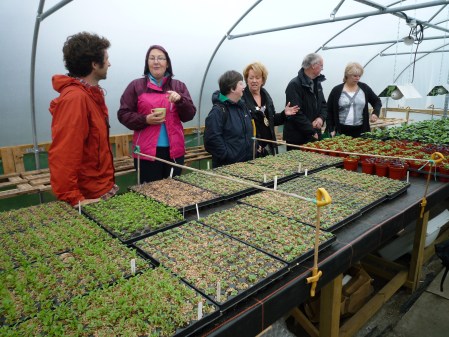
When 30 or so visitors had arrived, the tour began. The team grow all their own plants from seed, unlike some growers who buy in seedlings to grow on. Polytunnels are used extensively to provide protection from the worst of the weather and play a part in keeping weeds and pests under control. Here’s Ed demonstrating the use of the hoe, the primary technique for keeping weeds under control:

Growing under cover provides protection from the wind and cold, but how are the plants watered if there’s no rain falling on them? The answer came as we entered the next polytunnel which housed a crop of fragrant basil. The plants are nurtured using efficient drip-hoses fed from collected rainwater where possible:

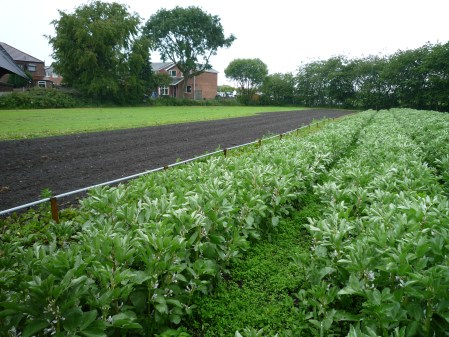
At the heart of an organic farming system is the idea of feeding the soil rather than the plant. This is achieved firstly by applying organic matter in the form of home made compost. The team has an arrangement with Unicorn whereby all the shop waste is composted down and applied to the soil. The second key feature is the use of a crop rotation plan whereby different plants are moved around the plot each year so pests and diseases never have chance to build up in the soil. After a period of trial and error, the team work to a five year rotation in which the land is left fallow in the fifth year. In the next picture you can see a fallow strip on the left and a crop of broad beans on the right, a legume performing its vital nitrogen fixing role as well as tasting good.
Finally, we learned about the harvesting of the leaves which takes place four times a week and is carried out by hand using a pair of scissors. The produce then travels some 3 miles to its primary retail outlet, Chorlton’s Unicorn Grocers (Chorlton is a suburb in South Manchester). It really is fresh and local.
Fortunately for us, there were a few bags of salad for sale on the day. I’m ashamed to say that once the tour was concluded, I raced to the trailer where the salad was for sale, shamelessly overtaking other visitors as I didn’t want to miss out. We were rewarded with a lunchtime salad to savour:

SO, if you can’t grow your own and live in the South Manchester area, get yourself down to Unicorn and try it for yourself. Just remember they’re not open on Mondays though.
Contact details
Unicorn Grocery
89 Albany Road
Chorlton
Manchester
M21 0BN
Tel: 0161 861 0010
Email: office@unicorn-grocery.co.uk
Web:http://www.unicorn-grocery.co.uk/
Glebelands City Growers
Email: contacts@glebelandscitygrowers.co.uk
Web: http://www.glebelandscitygrowers.co.uk/
Bajan breakfast
June 15, 2011 § 3 Comments
Bajan being the correct adjective to describe something from Barbados, this was the latest in our series of breakfasts of the world.
At 431 square kilometres, Barbados is a tiny country, approximately one third of the size of my own UK county, Greater Manchester which clocks in at 1,276 square kilometres. It was one of the earliest British colonies with settlers arriving in 1627. The British heritage is evident in the island’s organisation and placenames – it’s divided into parishes each named after a saint. The capital and main city, the very British sounding Bridgetown is in the parish of St Michaels.
Barbados may be a small country but it’s a familiar one. That Desmond Dekker song, sugar, rum, cricket and of course the larger-than-life Rihanna all come immediately to mind. That’s not all that’s larger than life as Barbados can put on a big breakfast. The Bajan breakfast option priced at $22 on the menu from Simply Gigi’s, a hotel restaurant which looks out over Barbados’ Dover Beach reads “Flying Fish, Bakes, Eggs, Onions, Peppers, Plantain”. Much more adventurous sounding than the Full English or bog-standard American options. After a little research and judicious cheating, this is the colourful plate of food I came up with:

First find your flying fish, the favourite fish and symbol of Barbados. This is not as easy as it sounds. I did track down a UK wholesale supplier of frozen flying fish fillets but couldn’t face ordering the industrial-sized minimum order quantity.
Next step was a trip to the cornucopic fish stall on Manchester’s Arndale Market which goes by the very mundane name of “Direct Fisheries”. They had all sorts of exotic species on offer as you can see:

but sadly, flying fish wasn’t one of them – it’s occasionally requested, said the fishmonger, but a bit pricey for most people so they’ve stopped selling it. I opted for a couple of seabass instead. No idea whether it’s like flying fish but it’s a very adaptable fish which works with all sorts of flavours.
The recipe involves a brief period in which the fish fillets are first marinaded/infused with aromatic flavourings (herbs, green pepper and lime juice), then, top side only, lightly coated in egg and breadcrumbs and quickly shallow fried.

Far from being just a regional curiosity, this is a handy little recipe which I’ll definitely be trying again. The marinading period gives the fish zingy flavours and the crispy golden crust gives a bit of fast food type appeal.
Next step was to find out what Bakes were. This is by no means a selection of bread rolls on the side but a little doughy Bajan treat which paradoxically is shallow-fried rather than baked. Bajan chef John Hazzard’s (pronounced Has-Ard rather than as in traffic obstruction, moral or Dukes of) little videoclip on was helpful in showing exactly how to whip up a batch of bakes.
I had planned to put in here the link to John’s handy little video which I found on a site called theholidaychannel.net but sadly the site appears to have been suspended. You’ll just have to take my word for it that he had a great relaxed manner and his lilting accent was rather lovely to listen to as well.
I followed Chef Hazzard’s instructions to the letter and he end result was rather good – a cross between a Scotch pancake and a doughnut. The brown sugar and spices provide flavour and the cornmeal a pleasing chewy crunch. I can see why the islanders get so passionate about bakes.

Sugar has been the mainstay of the Barbadian (or should that be Bajan?) economy for centuries so it seemed fitting to round off breakfast with something sweet. My choice was Bajan sweet bread, not a true bread but a coconut cake baked in a loaf tin. This beauty is made with refined sugar rather than what we know now as Barbados or Muscovado sugar, it’s studded with garish glacé cherries and raisins and has extra sugar and coconut strip concealed within the cake like so:
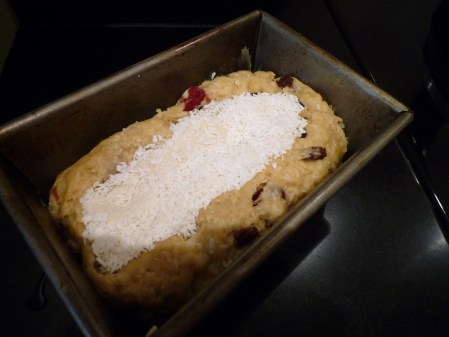
With all that refined sugar, coconut and artificially coloured dried fruit it could almost be a Scottish delicacy couldn’t it?

The end result looked impressive in a bulky golden brown homespun kind of way but sadly it was a bit disappointing. It was a bit dry and oversweet, it crumbled rather than slicing neatly, the coconut stuffing fell out rather than maintaining structural integrity and it went stale within 24 hours. For that reason I’m not going to painstakingly copy out the recipe here. If you’re interested, here’s where I found my recipe, a Paul Hollywood (not so) special – he’s the sleek silver haired judge on last year’s BBC programme “Great British Bake Off” you may recall.
http://uktv.co.uk/food/recipe/aid/515131
Recipe for fried flying fish fillets
I found this recipe in a Barbados travel blog http://barbadostravel.squarespace.com so thank you to blog author Linda Thompkins.
Works well for other medium to large fillets of firm white fish such as seabass.
Serves 4 (generous portions)
Ingredients
8 flying fish fillets
1 small onion
1 small green pepper, chopped
1 teaspoon chopped thyme leaves
t tablespoon chopped parsley
salt and pepper
juice of a lime
1 egg, beaten
dry natural breadcrumbs
oil for frying
to serve, lime wedges
Mix the seasoning ingredients together and spread over the meaty side of the fish. Leave for about 1 hour. Remove the fish from the seasoning mix, pat it dry it on kitchen paper. Dip the meaty side of the fish fish into the beaten egg and then into the breadcrumbs. Fry gently in a little oil for 3-4 minutes on each side until cooked through and crumbed surface is crisp and golden. Serve with lime wedges.
Recipe for Bajan bakes
Bajan chef John Hazzard’s recipe. John has twice been awarded the title “Caribbean Chef of the Year” so he should know what he’s talking about.
Ingredients
1 cup of plain flour
4 oz cornmeal (polenta)
3 oz brown sugar (I used demerara)
1/2 teaspoon salt
1/2 teaspoon baking powder
pinch allspice
pinch freshly grated nutmeg
6 oz water
to fry, 2 tablespoons flavourless vegetable oil
Combine the first 7 ingredients in a mixing bowl. Add most but not all of the water and mix well with a spoon to form a batter with a stiff dropping consistency. Add the reserved water if required to achieve the right consistency.
Heat the oil in a frying plan until it reaches 300 degrees Fahrenheit (what I would call a medium heat)
Drop generous spoonfuls of the mixture into the frying pan and cook for a few minutes on each side until golden brown.
Drain on kitchen paper and serve.
Weird fish
June 11, 2011 § Leave a comment
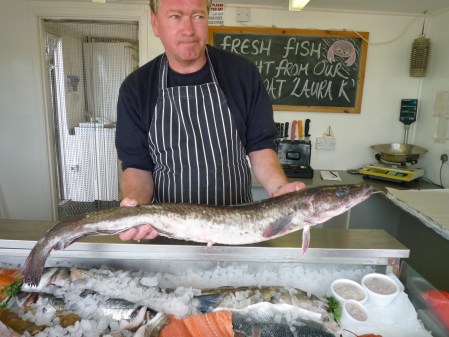
The weird fish in question is a ling, a member of the cod family. Rick Stein writes about ling in his “Taste of the Sea” like this:
“Ling is one of those underrated fish which, in addition to being reasonably flavoured, is also firm in texture – a cheap version of monkfish, if you like. It is an extraordinary looking fish which could easily be mistaken for an eel, so long and sinuous is its appearance.”
He’s certainly right about how it looks as the picture above, snapped at Samantha K’s fish shack on the harbour at Southwold, shows.
Over the years we’ve gently fallen in to the routine established by my husband’s family of joining a large family party at Southwold on the Suffolk coast. We eat out some of the time but for the most part take turns to cook an evening meal served on the big kitchen table.
Last Thursday, it was my turn to cook so, being by the seaside, I decided to cook fish. One of the pleasures of a holiday in Southwold is wandering along the Blackshore Harbour waterfront to buy the freshest possible fish without guilt – it’s caught sustainably on lines by small day boats which supply the harbourside shacks in the most direct way possible.
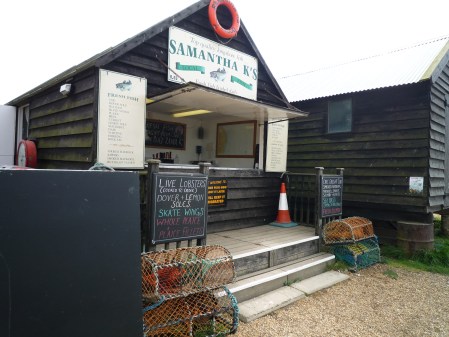
You have a choice of 3 fish shacks to buy from. My favourite is the smallest and simplest of the lot, Samantha K’s:
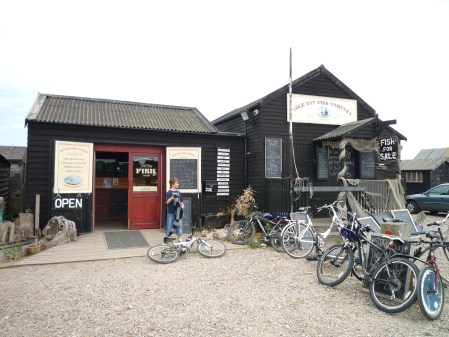
The Sole Bay Fish Company, a pebble’s throw away is good too and clearly has a superior PR machine. Blimey, you can even find Jasper Conran extolling its virtues in a Guardian Online article…
Having looked at what was on offer, I couldn’t resist choosing the impressive and rather scary whole ling. All mine for £24. The fish guy kindly filleted the monster for me while Tim and I slipped off to the Harbour Tearooms for an early morning coffee and toasted teacake.
I chose a simple Indian-inspired recipe to show off the fish at its best – the fish fillets are briefly marinaded in lemon juice plus added aromatics, then coated in lots of chopped fresh herbs before being baked for 20 minutes in a hot oven.
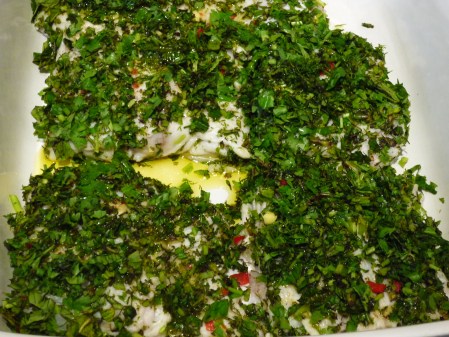
I included wild fennel which I found growing wild on the beach in my fresh herb mix for a truly local flavour:

It’s a very adaptable recipe which would work well with all sorts of white fish and the half hour marinading period gives the cook a perfect excuse to slip off to the local pub for a sundowner.
Cooking with fish this fresh was a real revelation. The raw fillets on the board didn’t smell fishy at all, there was just the faintest seaweedy smell of the sea. The cooked fish flaked easily, was an amazing pearly white and the taste was clean, fresh and very summery. So yes, Rick, I agree with you about the fish being underrated and reasonably flavoured but beg to differ on its texture being similar to monkfish – it’s much closer to the flaky texture of cod. A cheaper version of monkfish really would have been too good to be true.
I served the fish with spiced basmati rice, an Indian style grated carrot salad, cucumber raita and some simply steamed greens. A shameless attempt to persuade some of the curry fans in our family to give fresh fish a try – it seems to have worked:

Recipe for fish baked with herbs
I’ve adapted this recipe from one given in Thane Prince’s “Summer Cook”, a slim paperback volume perfect for slipping into your bag if you’re heading off on a self-catering holiday. Her recipe is called Pudina Macchi and she attributes it to Indian chef Satish Arora. Pudina is the Hindi word for mint, a key ingredient in this summery, fresh tasting and straightforward dish.
Serves 4
Ingredients
4 square chunky pieces of white fish fillet, one per person, each weighing about 6 oz so approx one and a half pounds in total. I left the skin on to help the fish keep its shape. I used ling but cod, haddock or any similar variety would work fine in this adaptable recipe
2 cloves garlic, peeled and roughly chopped
1 teaspoon ground coriander
1 fresh red medium hot chilli deseeded and roughly chopped (adjust quantity of chilli to suit your group’s capacity for heat)
juice of 1 lemon
small bunch each of mint, coriander and an aniseedy herb such as fennel or dill
2 tablespoons light olive oil
In a shallow glazed ceramic dish which which will hold the fish fillets snugly without overlapping to much mix together the garlic, coriander, chilli and lemon juice to form a marinade. Place the fish in the marinade flesh side down, skin side up, cover with cling film, refrigerate and leave in the marinade for betweeh 30 minutes and 1 hour. Don’t leave it longer than this as the lemon juice “cooks” the fish and you’ll end up with a ceviche on your hands rather than fish ready for cooking.
Meanwhile, prepare the herbs. Remove the leaves from the mint stalks and chop roughly. The coriander and fennel/dill can be chopped just as they are as their stems are tender. Mix together the chopped herbs.
Once the marinading period is over, remove the fish from the marinade and discard the liquid. Press the flesh side of the fish into the herb mixture aiming for a really thick generous herb coating. Place the fish skin side down, herb side up in a shallow baking dish.
Drizzle the light olive oil over the fish and bake in a preheated oven at 200 degrees C for approximately 20 minutes. Test the fish for doneness as it approaches the end of its cooking time by pressing with the point of sharp knife feeling for the difference in resistance between just cooked and slightly underdone fish.
The Southwold Dilemma
June 8, 2011 § Leave a comment
The Suffolk seaside town of Southwold where we spent our half term holiday is somewhere life moves at a gentle pace and the sun always shines. Think of it as Trumpton meets Cath Kidstonville. It’s a place where the town council has no more onerous concern than opening the annual Charter Fair on the village green;

a place where the biggest news event of the year is that local brewer and wine merchant Adnams has started distilling its own very superior gin (very delicious with Fevertree tonic water, ice and, if you want to look knowledgeable, a strip of cucumber rather than the usual lemon);

and a place where the only dilemma that need concern one is whether to eat at the town’s flagship hotel The Swan:

or its more approachable Adnams stablemate,The Crown:
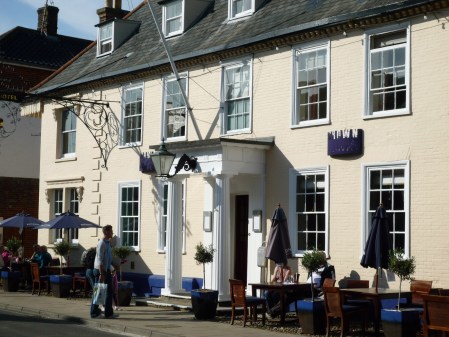
With our large mixed age party we plumped for the more relaxed atmosphere of the Crown. They don’t take bookings so to secure a good table (queues form outside the door in high season) we arrived promptly at the start of evening service at 6.00. The main eating area with oak beams and cosy snugs is by the bar but we asked to be seated in the adjacent airy dining room:

It has a certain understated elegance don’t you think? Having done a little research I see that it was recently redecorated/refurbished by international designer Keith Skeel who has worked with Donna Karan and Marco Pierre White amongst others. It’s a measure of how successful he’s been that you can’t tell that an interior designer has been at work here.
Enough of the décor and back to the food. The menu changes regularly, and offers (the now ubiquitous) Modern British cooking. There’s lots of intriguing things to choose from which is always a good sign, and head chef Robert Mace is clearly up to speed with current cooking trends – local, seasonal ingredients, carefully cooked cheaper cuts served alongside the more usual restaurant staples, witty touches like tonic flavoured jelly cubes served alongside gin-cured trout.Thank goodness there are no foams in sight – this is meant to be a pub after all.

I checked the Adnams website after our meal and worryingly, top of the list of situations vacant was that of head chef for the Crown. It looks like the talented Mr Mace (known as Macey to his kitchen colleagues) is moving on which must be a blow for the Crown – definitely a name to watch on the restaurant scene.
Back to our meal. We began with the savoury snack of the moment, two dishes of popcorn, one flavoured with pesto which was OK but a tad oily. The second dish, enlivened with chilli flakes and salt was much more like it and is a simple idea I’ll be trying out back home. Watch out book and recorder group!

I couldn’t resist choosing the rainbow trout cured with the aforementioned Adnams gin and served with cubes of tonic jelly and a cucumber-heavy salad – gin and tonic on a plate if you like:

The witty idea worked on the plate but if I were to rework this dish at home I would use the gin to cure salmon gravad lax style, I would intensify the tonic flavour of the jelly cubes, I would increase the cucumber and drop the rocket in the salas and finally add a citrus note to the plate which was missing.
Before deciding on the trout, I had been tempted by the rabbit three ways too. Fortunately, being a family occasion, sharing was encouraged so I could taste everything:

My main course was Dingley Dell pork cooked two ways – a chunky piece of fillet propping up a more flavourful strip of crunchy roast belly pork. The pork was served with excellent mash, steamed spinach and a creamy leek sauce. A good dish but perhaps a little autumnal for a summer evening? And I’d have preferred more of that crunchy belly pork.
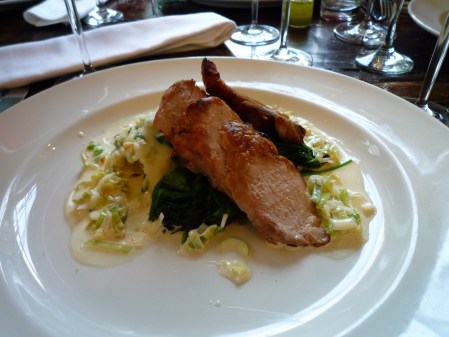
Incidentally, the slightly twee Dingley Dell name (from the fictional village in Pickwick Papers) is the name of an entirely non-fictional high-welfare pig business based in nearby Woodbridge, Suffolk.http://www.dingleydell.com/
Outdoor-reared pigs are a familiar sight (and smell!) in the Suffolk countryside – here are a few pigs I snapped on the journey from Southwold to Halesworth:

I’m not usually a pudding person usually but the highlight of my meal was the quirky sounding peanut butter sandwich, complete with toast and lashings of raspberry jam:

The peanut butter had been transfigured into a smooth parfait, and the toast was crispy melba toast, lightly caramelised. Just perfect.
The Crown is an Adnams establishment and makes good use of the expertise of the wine merchant side of the business – the wine list is interesting and varied and there’s plenty of interesting wines offered by the glass, especially dessert wine.
GoodcCoffee afterwards was served without frills and service was friendly and efficient. I just hope they have some strong applicants for that head chef vacancy.
 The Rhubarb Fool