
Pilgrimage to Chartres… and another twist on macaroons
April 22, 2010 § 2 Comments
We took a day out from our usual walking and climbing routine in the Forest of Fontainebleau to make the one hour drive west to Chartres. Chartres is dominated by its glorious gothic cathedral which soars out of the plains and can be seen from miles away. Here it is on a beautiful spring morning:

The grandeur of the building, the intricate carving throughout, the stained glass and the view from the belltower were all uplifting. Only the noise (I can’t bring myself to call it music) in the nave as we entered the cathedral marred our visit: a church service was in progress conducted by a guitar playing and singing group, loudly amplified and execrable. There was no-one attending the service but the performers themselves. More than a little self-indulgent.
After a visit to the cathedral, the modern-day pilgrim can take refreshment at the Bistrot de la Cathédrale. Despite its proximity to the cathedral (No 1, Cloisters Tel 00 33 (0)2 37 36 59 60) this is no mere tourist trap but an outpost of Chartres highly regarded “Le Georges” restaurant within the Grand Monarque hotel (22 Place des Epars Tel 00 33 (0)2 37 18 15 15).
Our visit was on Easter Monday so most shops were closed but we still had chance to wander through the streets. Chartres has a beautiful market hall:

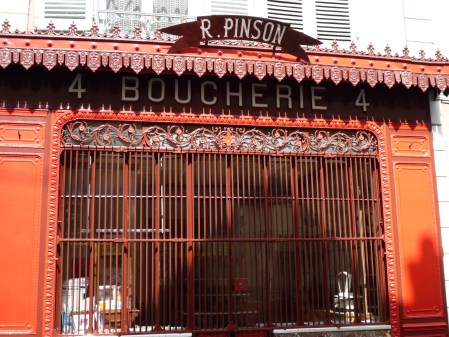
And I spotted this wonderful old-fashioned butcher’s in the old town:
In terms of regional specialites, local pâtisseries sell sweets called Mentchikoffs. These are praline in a crispy meringue coating and were invented in 1893 to celebrate the Franco-Russian pact of that year. The white meringue poetically represents Russian snow. There’s also Pâté de Chartres made from mixed game birds served either en croûte or from a terrine. Another speciality as is the French classic Poule au Pot (pot roast chicken). King Henri IV who famously wanted to put a Poule au Pot on every table in France was the only king to be crowned at Chartres hence the connection.
I was mistaken in thinking that the green and yellow Chartreuse liqueurs are from Chartres – the liqueur is made by Carthusian monks in Voiron near Grenoble. The drink local to Chartres is the beer “L’Eurélienne”. Sadly there was no opportunity to drink some that day.
So that’s almost it for my quick gastro-tour of Chartres. I think it would be a fantastic place to be whisked away for a weekend – wonderful architecture, places to eat and drink and not overrun with tourists.
But before I finish I have to mention these macaroons spotted in the window of a pâtisserie:
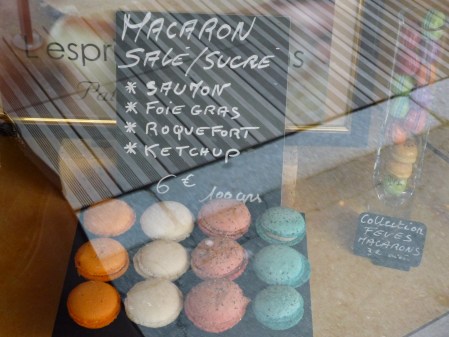
Your eyes are not deceiving you. These are sweet/savoury macaroons and the flavours on offer really are salmon, foie gras, blue roquefort cheese, and, to cap it all, tomato ketchup! This isn’t witty, it isn’t clever, it’s just yucky.
Treats from Dalloyau in Paris… and yet more macaroons
April 21, 2010 § 2 Comments
I made a flying visit to Paris during our Fontainebleau-based week over the Easter holidays. It’s an easy train journey of just under an hour on the commuter service from Fontainebleau-Avon station to the magnificent Gare de Lyon.
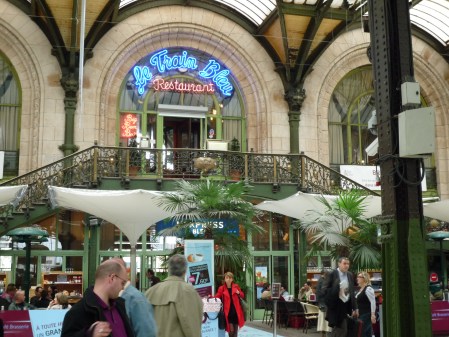
One day I will make a proper visit to the Train Bleu bistro and restaurant within the station but for now I’m just content to look:
After taking in lunch and a visit to the Chopin exhibition at the Cité de la Musique way up in Paris’ north-eastern corner, I decided to hop off the metro 2 stops early and walk back to the Gare de Lyon in the hope of taking in some gastronomic sensory experiences along the way. Bizarrely, most of the district I chose to walk through seemed to be a mecca in shopping terms for either motorbike or DIY enthusiasts. I finally struck gastro-gold in the form of august Parisian pâtisserie Dalloyau as I walked down the Boulevard Beaumarchais on the approach to the Place de la Bastille:

Here’s the elegantly simple window display which was stopping people, not just me, in their tracks:

The classic French Opéra cakes in the window looked absolutely stunning – sleek, glossy dark chocolate squares with a discreet flash of gold leaf. Given the shop’s proximity to the Bastille opera house, home to the Paris opera since 1989, I just had to have one.
Inside, the shop has the hushed spare opulent feel of a designer jewelry store, complete with security guard and cashier’s office. While I waited for my precious cake to be taken from the window display and packaged in the covetable burgundy Dalloyau bag, my eye was caught by a display of, you guessed it, yet more macaroons:

Browsing the rather lovely Dalloyau spring collection brochure (it really is like couture) I see that Dalloyau claim to have their own 300 hundred year old secret macaroon recipe. That would suggest a date of 1710 which would, if strictly true, make their macaroons a century older than the Ladurée ones. There is clearly scope for some historical research here. The brochure also says that the special recipe is lower in sugar and higher in their own almond paste to give a more flavoursome macaroon. They also make a big deal about using only natural plant derived colours and also the ultra freshness of their macaroons. Also for the record, their permanent collection of flavours is as follows: chocolate, coffee, caramel, vanilla, pistachio, raspberry, earl grey tea, Cognac and lemon. Clearly I had to put Dalloyau’s macaroon claims to the test.
Here is the little box of macaroons I brought home with me. I chose raspberry, pistachio, chocolate and salted butter caramel flavours:

And here is my gorgeous Opéra cake:
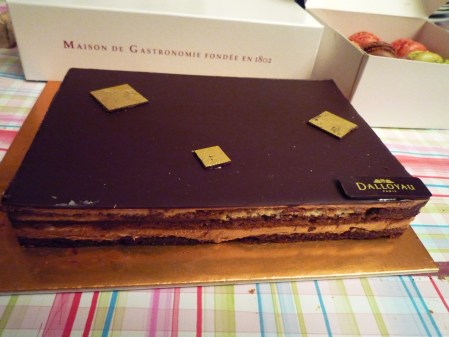
A little research revealed that Dalloyau is a fair-sized business: there are 7 more branches in Paris as well as the one I visited. The business has a long history having been founded back in 1802 by a canny former baker to the royal court. Post-revolution, he correctly thought that the bourgeois populace of Paris would want to have a taste of what had previously been reserved for the aristocracy. He clearly took Marie-Antoinette’s dictum “let them eat cake” seriously. Not only that but Dalloyau was the inventor of the classic French opéra cake which my Larousse tells me is a “cake composed of biscuit Joconde (almond sponge) soaked in strong coffee syrup and layered with coffee buttercream and chocolate ganache. An Opéra, whether an individual or larger cake is always rectangular and 3 cm thick. The top is covered with icing decorated with gold leaf on which the word “Opéra” is written.”
Back home I noticed an article on the firm not in a food publication in Real Deals, a private equity magazine. Paris-based Perceva Group has just acquired 50% of the company which has been struggling financially lately. The following Financial Times article of 19 March 2010 is informative:
http://www.ft.com/cms/s/0/b334c138-339b-11df-9223-00144feabdc0.html
Who would have thought that a chance visit to a cake shop could provoke a history lesson and an insight into the world of economics!
Back to the real question, what did the stuff taste like? I didn’t expect to be bowled over by the macaroons but they really were a cut above – the pistachio ones were a much more delicate shade of green than the Cassel ones (see my previous post of 21 April 2010) and tasted fresh and intensely nutty. The same was true of the raspberry ones – they delivered a real fruit hit. From now on these are the benchmark.
As for the Opéra, served in dainty pieces, this was a divine after dinner morsel, an ultra-sophisticated version of the more rustic Italian Tiramisu.
The only remaining question is can a bunch of private equity investors really run a cake shop?
Contact details
Dalloyau flagship store
101, rue du Faubourg St Honoré, 75008 Paris
00 33 (0)1 42 99 90 00
Dalloyau Bastille
5, boulevard Beaumarchais, 75004 Paris
00 33 (0)1 48 87 89 88
Fontainebleau’s best pâtisserie… and more macaroons
April 21, 2010 § Leave a comment
Fontainebleau, 35 miles south east of Paris, is dominated by the vast palace where the kings of France took their rest and relaxation. It is also home to Patricia Highsmith’s anti-hero, the charming but dangerous Tom Ripley. In the town’s centre, you will find a vast marketplace, the imposing Baroque St Louis church and a range of chic shops clustered in the cobbled streets of the old town.
But no visit to Fontainebleau would be complete without a visit to Frédéric Cassel’s exquisite boulangerie-pâtisserie on the Rue Grande. Cassel is no ordinary provincial cake-maker: he trained at Fauchon and Pierre Hermé in Paris before setting up shop in Fontainebleau. His marketing literature discreetly informs you that he was “pâtissier of the year” in both 1999 and 2007 – quite something in France.
The queues which form outside the shop at weekends are the first hint that this is something a little out of the ordinary:
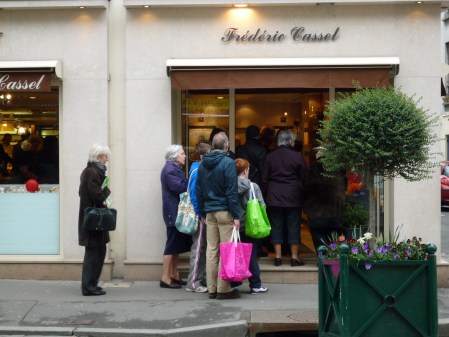
There are five distinct areas in the shop: the first displays petit fours, individual cakes and, of course, the obligatory macaroons.

Cassel does all the standard macaroon flavours plus some more unusual ones as well. Pictured below are the Punch Creole and Pina Colada macaroons alongside the more usual chocolate and raspberry:

I picked up a selection which included the aforementioned Punch Creole (rum an pineapple?) and Pina Colada (looks like coconut?) varieties alongside chestnut and chocolate to savour at leisure over a cup of coffee:

And to serve after dinner later that evening, a box of pâtisserie to share between 9 of us so it’s not as greedy as it looks:

You come next to the counter displaying savoury canapés, beautifully arranged, miniature works of art. Planning a picnic in the forest we weren’t in the market for dainty cocktail snacks but the most beautiful “oeufs surprise” served in their own eggshells, trimmed and cleaned so neatly, caught my eye. The pastel blue Cotswold Legbar eggs we find at home in the UK would look stunning given this treatment.
Cassel also makes a range of breads, croissants and other viennoiserie. There are clearly some lucky folk who call in regularly for their breakfast pastries and daily baguette.
The final area of the shop is devoted to whole large pâtisserie items – stunning fruit tarts and layered gateaux, and also to Cassel’s range of hand-made chocolates.
Here are the Easter items on display on the right hand side of the shop:

You walk out of the shop with pride clutching your precious purchases displayed in Cassel’s chic orange and brown packaging – the French couture experience all for a few Euros.
And the verdict on the cakes we brought home? Stunning, pure flavours, crisp pastry, light as air fillings. Truthfully I think the whole macaroon search for new flavours has got a little out of hand – eyes closed I would have recognised the chocolate flavour from our selectionbut the other three (chestnut, Pina colada and Punch Creole) were pretty much indistinguishable. Maybe the tried and tested flavours are the best and there’s no need for variety for its own sake.
Contact details
Frédéric Cassel
71-73, rue Grande
77300 Fontainebleau
Tel +33(0)1 64 22 29 59
Dinner at Les Prémices, Bourron-Marlotte near Fontainebleau
April 16, 2010 § Leave a comment
We took a deep breath and decided to book a table for all four of us at this French restaurant which takes itself very seriously. Time to teach the boys some proper table manners.
We visit Fontainebleau pretty much every Easter mainly for the rock-climbing (in fact bouldering which is climbing with no more equipment than a chalk bag and crash mat). This is younger son Arthur doing his thing with the help of 2 “spotters”.

Just once during the week it’s good to have a change of milieu so we dress up as smartly as our holiday wardrobe permits and head off to this Michelin and Gault-Millau recognised establishment situated in the grounds of Bourron Marlotte’s château.
Based on previous visits, the place is clearly kept going by its proximity to INSEAD, the Fontainebleau based business school. We’ve quietly sniggered to ourselves as job interviews are conducted in loud American English at neighbouring tables or as professors hold court surrounded by a clique of adoring students hanging on their every word. A great place to play bullshit bingo as phrases such as “framing the argument”, “low hanging fruit” or worst of all “paradigm shift” bounce off the walls.
Tonight though we were alone until pudding arrived, albeit we were early having booked a table for 7.30. A sign of recessionary times perhaps? Given the behaviour of elder son George who was on top boisterous teenage form that evening this was perhaps a blessing…
The dining room has been completely refurbished since our last visit. Previously it had a bit of shabby suburban conservatory feel with cane furniture and green carpet. The new look is much more chic and sharp, discreetly elegant in shades of steel grey and aubergine. Tables are still opulently dressed with generous white napery, designer stainless steel cutlery and plain crystal glasses. As a passing nod to Easter, each table was decorated with a solitary enormous ostrich egg. George thought it would make a good rugby ball and started to demonstrate. Aagh!
Here is our miraculously intact egg pictured with canapés served on trendy roofing slates. The toffee and sesame cherry tomatoes were weird but strangely good.

The ratio of front-of-house staff to customers was almost one to one. We were looked after by 2 charming young waitresses who exuded French chic and were snappily dressed in perfectly tailored trouser suits. I received the distinct impression that they hadn’t encountered children before though.
Our request for Orangina as an apéritif was enough to turn renowned sommelier Laurent Piro’s face white with shock. It clearly upset him so much he forgot to bring my glass of champagne.
Amusingly, the restaurant’s idea of a children’s menu was foie gras with toasted brioche, poached chicken breast with noodles and a chocolate fondant pudding. To be fair, Arthur did enjoy the last 2 courses but not the foie gras which we shared between the three of us spilling crumbs across the table much to the consternation of the staff.
The various multi-course tasting menus seemed too much for the children to take so, having sorted Arthur out with the children’s menu, the rest of us opted for the basic (relatively speaking) four-course market menu instead.
Our first course was a modern take on a prawn cocktail – avocado mousse, crayfish and some pink tomato foam all served in a massive martini glass. It looked extremely tacky but this was meant to be so in a post-modern ironic sort of way I think. It tasted good – zingy, fresh and light.

Next came dorade (translated as gilthead bream? must check this later) with Mediterranean vegetables and a bouillabaisse sauce – a really successful dish and portions not too large and overfacing. The bream was firm fleshed and subtly flavoured and all the tomato, saffron, shellfish, wine and garlic flavours of a good bouillabaisse were concentrated into the spoonful of sauce served with it.
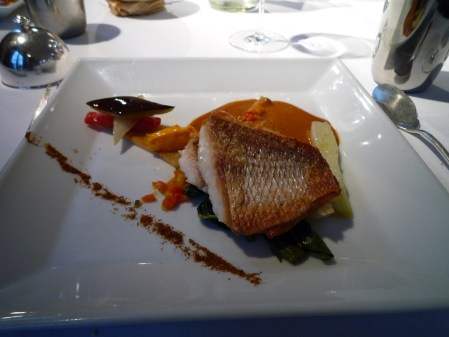
Next was the cheese course. The restaurant’s speciality is a baked camembert with caramelised apples and salad. This may seem like a novelty in France but back here in the UK we are used to all sorts of fruit and cheese combinations. What I would much have preferred is one of those old fashioned French cheese trolleys. Never mind.

Pudding was a rather lovely poached pear and gingerbread confection:

And afterwards with coffee came not one but two trays of dinky petit fours. Here’s arguably the prettier of the two served this time on a hunk of pink marble:

Frankly, I was then rather relieved to make our escape as the children were becoming restless and there was talk of initiating an armpit farting competition. We made our hasty excuses and left.
Les Prémices is a lovely restaurant and I think you would see the best of head chef Dominique Maës’ craft by sampling one of the multi course tasting or surprise menus.
It’s not the place to come for a quick or informal meal though – I wonder if current tastes have moved on and perhaps what people want is a little more informality without compromising on quality. The emptiness of the restaurant on what should have been a bustling Thursday night would suggest this might be so.
Contact details
12 bis Rue Blaise de Montesquiou, 77780 Bourron-Marlotte, France
00 33 (0)1 64 78 33 00
Macaroons made in Manchester
April 14, 2010 § Leave a comment
STOP PRESS: IF YOU ARE YOU LOOKING FOR SOMEWHERE IN THE MANCHESTER AREA TO BUY MACAROONS THEN CLICK ON THE FOLLOWING LINK: https://rhubarbfool.co.uk/2011/01/04/macaroons-made-in-manchester-revisited/
IF IN FACT YOU WANT TO SEE EARLY EXPERIMENTS IN MACAROON MAKING THEN READ ON!
The dinky French macaroon (or more correctly macaron) has finally reached Manchester.
My friend Vivienne brought along to a recent recorder group practice (I jest not) a little pack of Maison Blanc macaroons (chocolate, pistachio and raspberry flavours) which, surprise surprise, are now stocked by our local branch of Waitrose.
If “macaroon” conjures up an image for you of a cracked beige saucer-sized rusk complete with a skirt of carelessly torn rice paper, then think again. The Parisian macaroon is a dainty confection of egg whites, ground almonds and sugar formed into two tiny shells sandwiched together with a butttercream or ganache filling. They come in a range of flavours with colours to match. Those made by Parisian pâtisserie Ladurée are iconic.
Since Ladurée relaunched the macaroon back in the mid 1990s, they have become a worldwide craze. Not only Ladurée but a range of chic French pâtisseries proudly make and display their own collections of macaroons. They have become an obsession to many American women if the number of blog entries is anything to go by – they apparently flock to Paris in their hundreds to buy them, photograph them, drool over them and even take classes in how to make them.
Having resisted the whole macaroon thing for a number of years now, I decided to have a go at making a batch. The colours of macaroons displayed in French shop windows is, if tastefully done, gorgeous but clearly artificial colouring is used which is really just not me. What I wanted to achieve was an entirely natural colour and flavour. I thought I’d begin with my all time favourites, pistachio macaroons. Then, inspired by the dazzling scarlet colour of a pack of dried Goji berries in my kitchen cupboard, I decided that these could be added, finely ground, to a second batch of macaroons.
My next problem was that I didn’t have a reliable recipe. From my cookery book collection, I dug out Nigella Lawson’s recipe for pistachio macaroons from her Domestic Goddess book. I’ve tried this recipe before and found it wanting (buttercream quantities are wrong and the macaroon mix is too runny and difficult to handle) but I had to start somewhere. By coincidence, the March issue of UK food magazine featured a recipe for French macaroons so I decided to compare and contrast the two.
After a somewhat frustrating afternoon in the kitchen, I nevertheless produced two extremely edible batches of, respectively, pistachio and Goji berry & orange flower macaroons.
Did they look like the dainty confections of the Parisian shop window? A resounding no! they were uneven, knobbly, charmingly homespun but a far cry from the tiny smooth shells of the French pâtissier with their technically perfect “feet”.
The texture was spot-on though – crispy on the outside and softly chewy in the centre. And, with all due modesty, the taste was sensational and the whole lot were consumed by family and friends before the afternoon was out.
Here are the finished pistachio macaroons. The colour when baked is an extremely subtle shade of jade tinged with brown which I find infinitely preferable in an understated way to the bright artificial green of the commercial product.
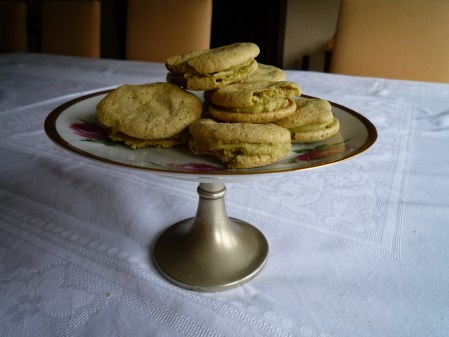
and here are the Goji berry macaroons sandwiched with a Goji buttercream filling scented with orange flower water – a further inspiration suggested by the orange colour of the baked macaroons. When this becomes Paris’ next “flavour of the season” you will know where the idea came from!

Now to compare and contrast the two recipes. I used Nigella’s recipe for the pistachio macaroons and the Delicious version for the Goji ones. Here are the different ratios of the 3 key ingredients:
Table of ratios:
1) Nigella “Domestic Goddess”
Egg white 1
37.5g ground nuts
70g sugars (a mixture of caster and icing sugar)
2) Delicious magazine
1 egg white
42g ground nuts
83g sugars (caster and icing)
The ratio of sugar to ground nuts is the same in both recipes but their is a whole 125 g of “dry matter” per egg white in the Delicious recipe compared to a meagre 107.5g in Nigella’s.
The Nigella mixture was extremely wet and practically unpipeable – I had to resort to spooning it onto the prepared baking sheet where it spread and didn’t hold its shape at all. Also, the yield figures she gives seem to be completely out – the mixture made about half as many paired macaroons as she suggested ie about 15 rather than 30 for a 2 egg white quantity.
And don’t get me started on her measurements as for the buttercream filling – though the mix of creamed butter, ground nuts and icing sugar is delicious, the quantity produced is far too much for the number of macaroon shells.
The proportions suggested in the Delicious magazine recipe produced a firmer texture which was pipeable and generally much easier to deal with. I think I would make this my starting point for any future macaroon experiments. I give my recipe for homespun macaroons below which uses the Delicious magazine ratios though not its exact method.
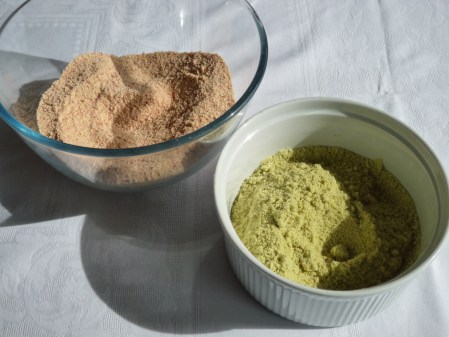
Here is the gorgeous pastel coloured “dust” of sugar, ground nuts and Goji berries which is folded into the stiffly beaten egg whites. Shame that the lovely colours don’t survive the baking process intact.
Here are the neatly piped Goji macaroons ready to go in the oven. The neat shape was somewhat altered by the heat of the oven!

Here are the pistachio macaroons ready to be sandwiched with the matching pistachio buttercream.

Recipe for Jennifer’s homespun macaroons
Don’t expect this to produce technically perfect Parisian results – it will however produce a very tasty macaroon. Assuming accurate piping of small 2cm diameter rounds, this should produce 40 shells, 20 complete macaroons:
Ingredients
For icing sugar/ground nut mix
300g icing sugar
215g whole blanched almonds or pistachios chilled in refrigerator
(makes 515g sugar nut mix in theory but some will stick to your liquidiser; recipe calls for a total of 450g sugar nut mix so there will be a little bit left over – sorry that’s the consequence of using convenient round numbers for the measurements)
For the macaroon shells
3 egg whites
300g sugar nut mix
75g caster sugar
For the buttercream filling
150g lightly salted butter, softened
150g sugar nut mix
First make up a batch of icing sugar and ground nut by whizzing the sugar and nuts together in a liquidiser or food processor until a fine powder is achieved. The idea of freezing the nuts first is to keep them cool so that they don’t turn into an oily mass. Don’t overprocess. Sift the mix into a bowl.
Whisk the egg whites with a pinch of salt to the soft peak stage then whisk in the caster sugar and keep whisking until the mixture is thick and glossy.
Fold the weighed out sugar nut mix carefully into the meringue in two batches.
Spoon into a piping bag fitted with a 1cm nozzle.
Pipe 2cm rounds of the mix onto baking-paper lined baking sheets.
Bake for 15 minutes at 140 degrees C (fan). Remove from oven and cool on sheet. Remove from sheet when cold. This is tricky as they stick easily even with the silicon baking paper.
Make the filling by creaming together the butter and sugar nut mix.
Sandwich the macaroon shells together when completely cool.
If you fancy having a go with the Goji berry flavouring, substitute 50g dried berries for the equivalent weight of nuts and whizz to a fine powder along with the nuts as in the master recipe. Also, add a teaspoon of orange flower water to the buttercream filling.
I realise I’m very late on this whole macaroon trend but I do have further macaroon posts planned after a recent trip to Fontainebleau in France.
If you have macaroon experiences to share, Mancunian or otherwise, I’d love to hear them…
Eggs for Easter
April 3, 2010 § 1 Comment

Two simple egg dishes for Easter. The first is a beautiful looking quail egg, pea and ham salad, the second a simple dish of baked eggs with cream and herbs.
They would work equally well as a starter before your Easter Sunday meal or as a lunch or supper dish.
Recipe for quail egg, pea and ham salad
This is hardly a recipe, more a culinary improvisation based on idea on the Ocado online grocery shopping website. I didn’t like the idea of hearty fried bacon in this delicate little salad so replaced it with slivers of ham. Airfreighted fresh peas and mangetout didn’t appeal either so I used lightly cooked British frozen peas which are sweet and good and bulked out the salad with some crisp Little Gem lettuce instead of the mangetout. I simplified the salad dressing too, making it light and lemony.

Ingredients
1 pack 10 quail eggs
2 generous handfuls frozen petit pois, cooked for 1 minute in boiling water and drained
4-6 slices Parma ham, torn into artful shreds
1 bag peashoots
2 little gem lettuces, washed and separated into individual leaves
For the dressing:
2-3 tablespoons of your favourite salad oil (olive, hazelnut or pistachio if you can get hold of it)
Generous squeeze of lemon juice
1 teaspoon Dijon mustard
Sea salt and freshly ground black pepper
snipped fresh soft herbs (optional)
Hardboil the quail eggs following the timings specified on the pack. Cool, peel and slice carefully in half lengthways.
Make the dressing in the usual way in a pretty serving bowl. Add the peas while still warm and leave to soak up the dressing for 5 minutes.
Then add the lettuce and peashoots and toss all together gently. Add a little more dressing if the salad needs it.
Strew the eggs and ham artfully over the top of the salad and your done.
Recipe for baked eggs in cream with fresh herbs
Otherwise known as Oeufs en Cocotte, a French classic. I use Julia Child’s instructions in “Mastering the Art of French Cooking”, a book I refer to very often (even before the film!).

For each serving
1 teaspoon butter
2 tablespoons double cream
1 egg
1-2 teaspoons mixed fresh parsley, chives, chervil and tarragon (use whatever combination you have to hand – I particularly like tarragon)
sea salt and freshly ground black pepper
You will also need a ramekin for each person and a deep tray containing 3/4 inches simmering water. I use a loaf tin if I’m just cooking for one or two people.
Butter the ramekin saving a dot for later. Add 1 tablespoon cream, half your herbs and a little seasoning and set the ramekin in the simmering water over moderate heat. When the cream is hot, break your egg into it. Pour over the remaining tablespoon of cream, season and scatter over the remaining herbs. Top with the reserved dot of butter.
Place in the middle of a moderate oven and bake for 7 to 10 minutes. The eggs are done when they are just set but will still tremble slightly.
Serve with fingers of your favourite lightly toasted bread to dip into the runny yolks and cream.
After such a light lunch, you will have plenty of room to tuck into your easter chocolate:
Happy Easter!


Hot Cross Buns
April 1, 2010 § 1 Comment

…is a recipe title that might confuse American readers but we in the UK know what we mean!
I spend most of the year going “Tsk, tsk” looking at unseasonal packets of hot cross buns on the shelf of my local Marks & Spencer food store.
Finally, Good Friday is almost upon us (yes, I know I have jumped the gun just a little) and we can eat them at their proper time.
If you fancing making a batch of your own, they are easy-peasy if you are familiar with the basics of yeast cookery (especially if you have a Kenwood or Kitchenaid electric mixer). Here’s my favourite recipe from Margaret Costa’s “Four Seasons Cookery Book”. As ever, I’ve tinkered with recipe just a little substituting half the white flour for wholemeal so you can kid yourself they’re good for you. Also I’ve added my favourite spice, cardamom, to her suggested nutmeg and cinnamon mix.
You unlikely to find cardamom in a shop-bought hot cross bun as it’s too pricy for the mass-market so you really will taste the difference (haven’t I heard that phrase somewhere before…).
Surprisingly, you can find the fresh yeast specified in the recipe at your local Sainsbury’s bakery counter. You may be able to find it at other supermarket in-store bakery counters too – Sainsbury’s just happens to be convenient for me.
I think there’s something magical about the way fresh yeast turns rapidly from an unyielding beige lump of putty into liquid when it is mashed and stirred for a few moments with a teaspoon of sugar. And it might be my imagination, but the rise, flavour and crust of bread and buns made with fresh rather dried yeast always seems superior to the result you achieve with dried yeast.
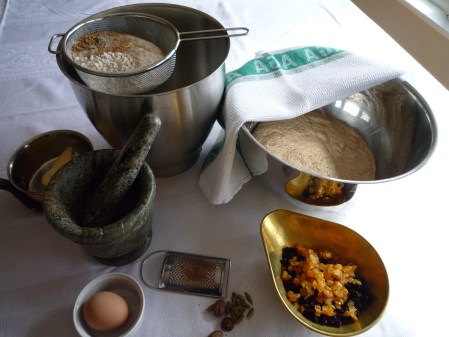
Here’s the mise en place for the hot cross buns – it’s a matter of just minutes to assemble what you need. The yeast and flour sponge after 45 minutes’ proving can be seen in the wider and shallower of the 2 stainless steel bowls.
Here are the buns after final proving ready to go into the oven. I happened to have a little ball of leftover pastry lurking at the back of my fridge so the buns are adorned with dinky crosses. I usually simply mark the crosses with sharp knife which is much quicker.

The finished product is shown at the top of the post. The aroma of warm spice and orange peel currently wafting round the kitchen is irresistible…
Recipe for Hot Cross Buns
From Margaret Costa’s Four Seasons Cookery Book with some additions of my own.
Ingredients
1 lb (450g) plain flour ( I like to use half strong wholemeal and half ordinary white or vice versa half strong plain white and half ordinary wholemeal
1 oz (25g) fresh yeast
1/2 pint (300ml) milk-and-water
1 teaspoon ground cinnamon
1 teaspoon grated nutmeg
seeds from 10 green cardamom pods pounded to as fine a dust as you can muster using a pestle and mortar
1 teaspoon salt
2 oz (55g) golden caster sugar
3 oz (85g) currants
1-2 oz (25-55g) chopped mixed candied peel
2 oz (55g) melted butter
1 egg, beaten
2 tablespoons sugar and 2 tablespoons water for glaze
Sift half the flour into a bowl. Blend the yeast into a liquid with a pinch of sugar and a little of the lukewarm (not more than blood heat otherwise you will kill the yeast) milk-and-water mixture. Pour the yeast mixture and remaining milk-and-water mixture into a well in half of the sifted flour and mix well. Cover the bowl with clingfilm and leave in a warmish place for about 45 minutes. The mixture will by then have become puffed-up and spongy.
Meanwhile sift the rest of the flour with the spices, salt and caster sugar. Stir in the currants and peel. When the first mixture has proved, add it to the flour then pour in the melted butter and egg. Mix thoroughly and knead until smooth. 5 minutes with the dough hook in your Kenwood mixer will make short shrift of this task. Cover the bowl with clingfilm and leave to prove this time for about 1 hour. The mixture should approximately double in bulk.
Now turn the dough onto a floured board, knead it lightly and cut it carefully into 16 equal pieces. Shape each piece into rounds and place not too close together on a lightly greased baking sheet. Mark each bun with a cross using a sharp knife or alternatively criss-cross the buns with narrow strips of shortcrust pastry or, even better, marzipan.
Cover the baking trays lightly with clingfilm or a clean tea towel and leave to prove for a further 15 minutes until well-risen.
Bake in a hot oven 220 degrees C (425 degrees F; gas mark 7) for about 15 minutes until golden brown and cooked through. As soon as you take them out of the oven, brush them generously with a glaze made by boiling together in a small saucepan for a minute or so the sugar and water.
Cool on a wire rack and eat them, split and spread liberally with butter, as soon as you dare!
More marmalade
March 31, 2010 § Leave a comment

I discovered a little goody bag of frozen Seville oranges in the bottom of my freezer this week and decided to make a second batch of marmalade.
This reminded me that I hadn’t posted the results of Tim’s Man-Made Marmalade entry into the World’s Original Marmalade Competition held at Dalemain in the Lake District back in February (see my February post
https://rhubarbfool.co.uk/2010/02/14/dalemain-marmalade-competition/
The Marmalade Competition and associated Festival did really well this year both in terms of the number of entries (over 800 jars) and in terms of media coverage. I read about the competition in every publication I picked up in February from the Independent to Delicious Magazine and even the Virgin Trains in-house magazine.
BBC Radio 4’s flagship Food Programme devoted a whole show to marmalade in which the competition featured prominently. At the time of writing, the programme was still available to listen again.
http://www.bbc.co.uk/programmes/b00qyvf8
I’m proud to report that Tim did pretty well in his first ever marmalade competition. Here’s the personalised results slip he was sent:

The judges are the redoubtable ladies of the Womens’ Institute who have developed their own national standardised scoring system. 15 marks out of 20 is not at all bad for a first attempt – and if he hadn’t scored an own goal by slightly burning the rubber seal on the lid in an over-zealous attempt to sterilise it in the oven he would certainly have increased his score to 16, just 2 marks away from a bronze medal score of 18. That’s the challenge for 2011…
I thought my own marmalade turned out pretty well but elder son George (aged 13 and already a marmalade enthusiast) pronounced it “not bad, but not as good as daddy’s”.
Harsh but fair!
Tartiflette, or, I need another cream, cheese and potato fix now!
March 30, 2010 § Leave a comment

Back home for 10 days now and still pining for the sunny crisp weather and the food of the French Alps.
I decided I could hold out no longer and visited the very wonderful Cheese Hamlet in Didsbury to buy a splendid Reblochon, half to savour au naturel (that is just a wedge of cheese and a glass of wine rather than me eating the cheese in my birthday suit) and the other half to turn into an unctuous Tartiflette, the potato, cheese and cream gratin which is a speciality of the Savoy Alps in France. You can find a link to the Cheese Hamlet’s site in my blogroll/links section in the sidebar. Here it is again just for good measure:
Having picked up a leaflet about Reblochon whilst in Moutiers 10 days ago I feel obliged to show off with a few cheesy facts:
• The name Reblochon is derived from the verb reblocher literally “to pinch a cow’s udder again” because the cheese is made from the more creamy milk of a cow’s second milking of the day.
• Reblochon achieved AOC (now the European AOP Appellation d’Origine Protégée) status in 1958 and is produced in a small region within the département (administrative region) of Haute-Savoie centred around the Aravis massif in the Alps.
• Reblochon is produced from unpasteurised cows’ milk from 3 permitted breeds: Abondance; Tarine; & Montbéliarde.
• The rind of an authentic AOP Reblochon cheese will bear a small edible seal made of the naturally occurring protein caseine; the very special Reblochon Fermier has a similar green seal.
That’s enough of the academic stuff. What you really need to know is that Reblochon is a creamy semi-soft cheese with an earthy nutty flavour and an apricot coloured edible rind which is dusted with a naturally occurring white mould. And if you are in the United States, sorry folks you can’t get hold of it because of your (misguided) countrywide ban on cheeses made from unpasteurised milk. Your loss I’m afraid….
Recipe for Tartiflette
This is my version of this classic Savoyarde potato gratin, pretty similar to the one found in my authentic Reblochon information leaflet. Some ersatz supermarket-derived recipes suggest cubing the cheese or, horror of horrors, cutting off and discarding the rind. No, no, no! When the cheese is halved horizontally and placed rind-side up atop the potatoes, it becomes deliciously crispy and brown when baked in a hot oven, absolutely the point of this dish.
The specified quantity is enough for 2 greedy people. Serve with a simple green salad and a glass of crisp white wine (ideally an Apremont from Savoie). The name of this dish is derived from the Franco-Provençal word for potato – tartifla.
Here’s the Tartiflette ready to go into the oven. The finished dish can be seen in at the top of this post.

Ingredients
1 medium onion finely chopped
70g lardons (I like pancetta lardons – inauthentic I know but still tasty)
750g waxy potatoes such as Charlotte, scrubbed, steamed until tender and thickly sliced
142 ml double cream
half a Reblochon cheese which should weigh approx 250g
salt, pepper, freshly grated nutmeg, a few fresh thyme leaves
Preheat the oven to 220 degrees C. Fry the onions and lardons together until golden brown. Grease a cast iron gratin dish generously with butter. Layer half the cooked sliced potatoes in the bottom. Season then spread over them half the onion and bacon mixture. Repeat with the remaining potatoes, onions and bacon. Pour over the cream and top with the Reblochon cheese, which you should cut in half first horizontally then vertically, rind and all. See picture above.
Bake for 12-15 minutes until bubbling and golden brown.
A dish for spring: potato pie with Beaufort cheese
March 27, 2010 § Leave a comment
The best thing about the Tarentaise town of Moutiers in the French alps is that it is home to a co-operative which produces the magnificent Beaufort cheese. I passed through Moutiers last weekend on the way home from my ski tour and brought home a generous wedge of the stuff.
You may know Moutiers as the road bottleneck en route to your ski holiday or indeed as a vast alpine waiting room: at weekends the coaches lumber through from the early hours of the morning and the place is thronged with dishevelled looking bleary-eyed travellers. However last weekend, Moutiers was looking uncharacteristically lovely in the spring sunshine:

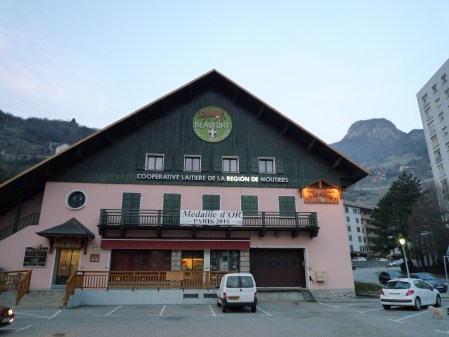
Just around the corner from the bridge over the Isère river is the redoubtable co-operative building. Solid and pink, you really can’t miss it:
And, joy of joys, there is a wonderful shop within which keeps sensible opening hours (open till 6.30 in the evening). Of course the Beaufort d’ été (cheese made from summer milk when the cows have grazed on the high alpine pastures) takes pride of place:
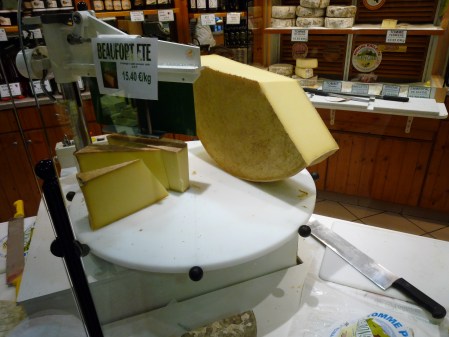
As well as the Beaufort, the shop sells a fantastic range of other local cheeses, sausages and preserves. I could have filled my shopping basket many times over but, mindful of my budget airline’s baggage weight limit and my own ability to lug the stuff home along with my ski kit, I confined myself to a single perfect generously proportioned wax paper wrapped parcel.
The co-operative offers guided tours at weekends. Sadly I didn’t have time for one of these but there are plenty of information leaflets on hand.
Time for a few Beaufort facts:
• Beaufort is produced under the EU’s “Appellation d’Origine Protégée” scheme
• Its production is limited to the Beaufortain, Tarentaise, Maurienne valleys plus part of the Val d’Arly all in the département (administrative region) of Savoie in France.
• The milk used to make the cheese must come from two special mountain cow breeds, the Tarine and the Abondance.
• There are currently 650 milk suppliers, and 45 cheesemakers collectively producing some 4,300 tonnes of cheese a year.
And one kilogramme of this lovely stuff was mine all mine to to take home and treasure! In the unlikely event that you should tire of eating your Beaufort au naturel, here is a recipe which both showcases the cheese and doesn’t require too much of it.
It comes from Simon Hopkinson’s new book “The Vegetarian Option” and combines the cheese with potatoes and cream, encasing the lot in buttery puff pastry. A scattering of fresh herbs – thyme and the first chives from the garden – give a taste of spring.
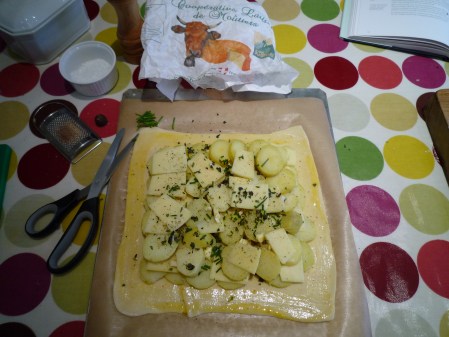
Here’s the cheese and potato filling spread onto the puff pastry base:
And here is the finished pie glazed and ready for the oven:

And here is the crispy golden brown finished article smelling deliciously of thyme, a touch of garlic and cheese.

Recipe for potato pie with Beaufort cheese
Taken from Simon Hopkinson’s “The Vegetarian Option” but with some alterations/improvements of my own. This is absolutely gorgeous eaten warm from the oven with a simply dressed peppery green salad. It’s also pretty good cold the next day perhaps as part of a superior packed lunch if by chance there’s a wedge left.
Ingredients
500g small/medium potatoes (SH suggests Desirée: I used new season Pentland Dells very successfully – they have just the right balance between flouriness and waxiness for this dish)
Salt, freshly ground black pepper, freshly grated nutmeg
100 ml double cream
2 garlic cloves, peeled and lightly bruised
10-15g butter for dotting
375g bought all-butter puff pastry in 2 equal pieces or sheets (if you have a 500g pack pastry, simply scale up the recipe)
75g Beaufort cheese, very thinly sliced
teaspoon each chopped thyme leaves and snipped chives
beaten egg to glaze the pastry
First steam or boil the potatoes in their skins until tender. Leave to cool, peel and slice thickly and put to one side.
Place the cream with the garlic in a small saucepan, bring to the boil then remove from the heat, cover and allow to infuse until the cream is cool.
Line a shallow heavy baking sheet with baking paper. Roll out the pastry into a rough square shape 2-3mm thick. Take as much care as you can as this will be the shape of your finished pie. Lay the pastry on the baking sheet.
Leaving a border of 2 cm or soCover the pastry shape with half of the potatoes, overlapping slightly. Lightly season with salt, pepper and nutmeg and cover with half the cheese, half the herbs and a few dots of butter.
Repeat these layers. Brush the border of the pastry with beaten egg. Roll out the second piece of pastry to an identical shape and place over the following. Press the edges very firmly together, rolling up to form a tight seal. Remember that you will be adding liquid cream to the filling shortly and it is imperative that it does not leak out. Press the tines of a fork into the rolled rim of your pie to further reinforce the join.
Carefully cut a hole 1 cm in diameter in the centre of the pie. This will allow you to pour cream into the pie in due course. Glaze the finished pie generously with beaten egg.
Before adding the cream and baking the pie it is a good idea to rest the whole thing in the fridge for half an hour to stop the pastry shrinking when it goes into a hot oven.
Preheat the oven to 220 degrees C/gas mark 6 while the pie rests.
Once the pie is rested and you are ready to bake it, the final step is to add the cream. Remove the garlic from the cream then carefully pour cream through the hole into the pie either using a funnel or a teaspoon. Allow the cream to settle and stop pouring as soon as the pie seems full. Reserve and set aside any leftover cream, you will have a chance to add some more once the pie has browned.
Place the pie in the oven and bake for 220 degrees C/gas mark 6 for 20 minutes until the pastry begins to crisp up and become golden. Remove from the oven and add a little more of any remaining cream.
Reduce the heat to 180 degrees/gas mark 4, return the pie to the oven and continue cooking for a further 20-25 minutes until puffed and golden brown all over. Check progress during this second phase of baking and cover with foil of necessary to stop the pastry turning too brown.
Let the pie stand for a few minutes after baking. If you are not eating it straightaway, remove carefully to a wire rack to allow to cool.
 The Rhubarb Fool