
Performance anxiety at the school Christmas fair
December 8, 2009 § 2 Comments
Attending the school Christmas fair has become one of the landmark events leading up to Christmas in our social calendar. It has become a badge of honour to bring in a batch of freshly baked home-made cakes to sell on the cake stall (rather than produce something plastic wrapped from Costco as I am afraid, Dear Reader, some parents do…) I can’t be alone in worrying about whether my cakes will sell. Fear not, follow my top tips below and cake stall success is virtually guaranteed.
This year, in consultation with son Arthur whose opinion was sought as to what would appeal to his classmates, I decided to bake a batch of chocolate muffins. These ticked all the right boxes – quick, easy and cheap to make, easy to transport and, with their sprinkling of chocolate chips on top, all-important visual appeal. The recipe, which I give below, comes from a little book “Alison Holst’s Marvellous Muffins” which my mother-in-law Monica brought back for me after a trip to New Zealand. Baked goods including both muffins and the curiously named friands are big in the Antipodes.
The muffin mixture is gloriously mud-like and improbably runny and lumpy but this means it is just right. Here it is, in double quantity, in my trusty stainless steel All-Clad mixing bowl:
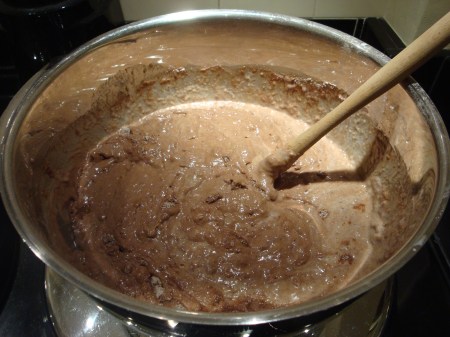
The muffin mixture is spooned into cases and each is topped with a sprinkling of chocolate chips. I chose a pleasingly contrasted mixture of both white and dark chips. The chocolate chips are I think essential to the success of these muffins as without them both the texture and flavour of the muffins are a bit dull.

Fresh out of the oven they look like this:
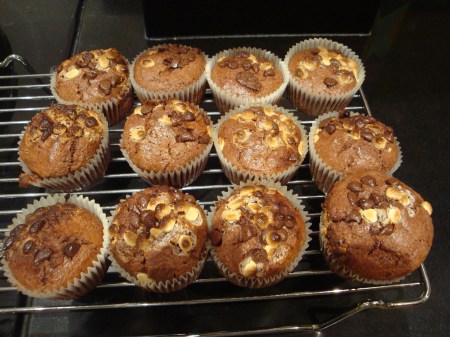
As soon as the muffins had cooled, off to school we went bearing our cake box proudly.
I had planned to position the muffins artfully in pole position at the front of the stall (it is mortifying if your cakes don’t sell) and then head for the dining room for a well-deserved cup of coffee. It was not to be. The cake stall was short-staffed so I ducked under the trestle table and got stuck-in. After initial panic, we soon had the stall under control. The art of origami was mastered and several dozen cardboard cake boxes were swiftly assembled; cakes were unpacked and displayed as prettily as we could manage, items were priced, the money was managed and we were soon operating like a well oiled machine. We managed to sell the lot without resorting to heavy discounting. After all, as the old Yorkshire saying goes “any fool can give away t’cake”.

After my morning’s experience my 5 top tips for bakers are:
1) Appearance is everything – people buy with their eyes
2) A single large cake is easy to make and is much in demand
3) Slabs of neatly sliced rocky road and attractively decorated cupcakes also sell well
4) Sending in cakes decorated with wet icing is just unkind to the poor souls manning the stall
5) If you choose to decorate your cakes with blue and black icing, they will appeal only to a niche market of small boys under the age of 4…
Does anyone out there have their own top tips for cake stalls, whether recipes or practical ideas?
Recipe for double chocolate muffins
This recipe comes from a little New Zealand book “Alison Holst’s Marvellous Muffins”. I give below both the cup measurements from the original recipe and metric weight equivalents. if you choose to use the cup measurements, please remember that Australian/New Zealand cup sizes are, annoyingly not the same as US ones. You have been warned!
The recipe makes 12 standard-sized muffins.
Ingredients
1 and 3/4 cups (245g) plain flour
4 teaspoons baking powder
1 cup (225g) caster sugar
1/4 cup (35g) cocoa powder
100g butter
1 large egg, lightly beaten
1 cup (250ml) natural yoghurt
1/2 cup (125ml) milk
1 teaspoon natural vanilla extract
1/4-1/2 cup (25-50g) chocolate chips, a mixture of dark and white if you like
Sift the dry ingredients (excluding the chocolate chips) into a large mixing bowl.
Melt the butter and add it to the other wet ingredients and mix until smooth.
Add the combined liquids to the dry ingredients and fold together but do not overmix so that the mixture is smooth. Lumps are desirable at this stage.
Divide the mixture evenly between 12 muffin tins lined with muffin cases. Sprinkle with chocolate chips.
Bake at 200 degrees C for 10-12 minutes. Cool on a wire rack. The muffins freeze well. Take them out of the freezer and warm them through in a low oven for 10-15 minutes when you’re ready to eat them.
A Very British Thanksgiving
December 1, 2009 § Leave a comment
We are a thoroughly English family living in Manchester but nevertheless have celebrated Thanksgiving for the last four years. This is down to my friend Lorilee who comes from West Coast of the US but now lives over here. Sitting in her kitchen as she was preparing for her annual family celebration there was a wonderful bronze turkey on the table ready for stuffing, and delicious smells of cranberries and pumpkin pie spice wafting through the house. I was seduced and we’ve been doing our own Thanksgiving ever since.
It’s a great way to celebrate the beginning of advent and to get together with family and friends that you won’t see on Christmas Day itself. For us, it’s free of the weight of expectation and tradition that comes with Christmas, a blank canvas which we’ve made our own.
This year, we invited in-laws Monica and Lawrie over, plus son Arthur’s schoolfriend Rahin. We made a bit of an effort to smarten up the house and even went so far as to hang corncobs from the door to welcome guests:

The main event was of course a wonderful bronze turkey from local supplier the Cheshire Smokehouse together with cranberry and cornbread stuffing. The stuffing is a pleasure to make, wonderful colours and smells from both the cranberries gently cooked with orange:

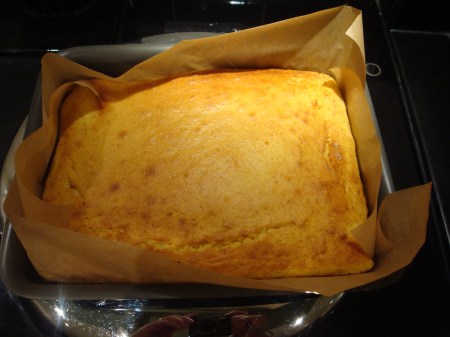
and from the golden cornbread:
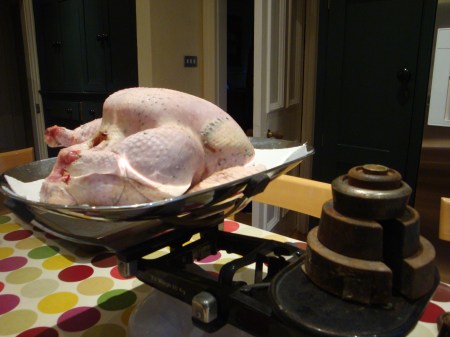
Here is the stuffed turkey being ritually weighed on my trusty Avery Berkel scales. This set of scales has a bit of history behind it having been sold to me some years ago by the Hon Rupert Soames, grandson of Winston Churchill. Rupert was running a division of the the Avery business in Smethwick and I was visiting from head office and bought some of his old stock.
The scales have since become part of the family – both my two boys as babies were regularly weighed in them and they are now used for weighing ceremonial roasts.
And here is the finished turkey:

I used to have terrible trouble with turkey but have since discovered the method recommended by Leith’s Cookery Bible which is to drape over the turkey before it goes into the oven an enormous square of folded muslin soaked in an unfeasible quantity of melted butter. This combined with a digital meat thermometer inserted into the thigh of the bird seems to do the trick. My thermometer tells me turkey is cooked when its internal temperature reaches 82 degrees C; I find that I need to remove the bird from the oven when it reaches just 73 degrees C as the heat carries on transferring through the meat for a good 20 to 30 minutes afterwards.
With the turkey I served, as well as the aforementioned stuffing, cranberry sauce, gravy, roast winter vegetables and a dish of sweet potatoes topped with toasted marshmallows – improbably sweet and weird but nevertheless good.
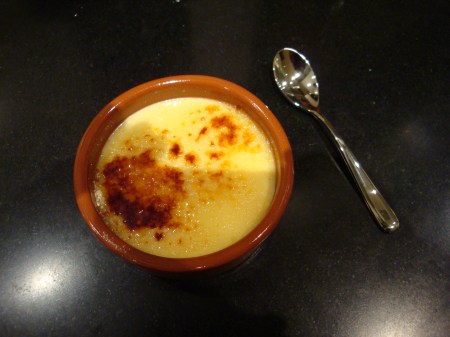
Afterwards, instead of the more usual pumpkin or pecan pies, I served crema catalana, the Spanish orange and cinnamon scented version of crème brûlée together with a dish of sliced oranges in orange juice flavoured with grated lemon peel. I know this Spanish element is from the wrong continent entirely but somehow the colours of the crema catalanas, burnished gold in their terracotta cazuelas and the cinnamon and citrus flavours seem just right for a winter celebration which is a precursor to Christmas.
Here is a single perfect crema catalana in the tiniest of authentic cazuelas:
And here are the sliced oranges displayed in my favourite midnight blue and yellow serving bowl. I had a pomegranate and a couple of passionfruit lurking in my fruitbowl so added these to the oranges for a pleasingly jewelled effect:

I’ll conclude now with recipes for both the stuffing and the crema catalana.
Recipe for cornbread, cranberry and orange stuffing
This recipe comes from Nigella Lawson’s book “Feast” with just a few small modifications of my own.
Ingredients for the cornbread
175g cornmeal (I use instant polenta)
125g plain flour
45g caster sugar
pinch salt
1 tablespoon baking powder
250 ml milk
1 egg
45g butter, melted and cooled slightly
Ingredients for the stuffing
1 large orange
340g cranberries, fresh or frozen
2 tablespoons runny honey
125g butter
500g cornbread crumbs
2 eggs, beaten
1 teaspoon ground cinnamon
salt and pepper
First make the cornbread. Preheat the oven to gas mark 6/200 degrees C then prepare a square 23 cm tin (5cm deep) either by greasing with butter or lining with baking paper. Mix the cornmeal, flour, sugar, salt and baking powder in a large bowl. In a measuring jug beat together the milk, egg and melted and cooled butter. Then pour the wet ingredients into the dry, stirring with a wooden spoon until just combined but no more – the odd lump is desirable at this stage. Pour into the prepared tin and bake for 15-20 minutes. When ready, the cornbread should just be shrinking from the sides. Most of the cornbread is needed for the stuffing but there should be just enough for one slice for the cook to eat, still warm from the oven and spread with butter.
Now complete the stuffing. Zest and juice the orange. Put the cranberries into a heavy based saucepan along with the zest and juice of the orange. Bring to simmering point on a moderately high heat on the stove top, then add the honey then cover the pan and turn down the heat and simmer for 5 minutes. Add the butter to the pan allowing it to melt then add the cornbread crumbs. I simply break up the warm cornbread with a fork to give desirably rough-textured uneven crumbs. Beat in the eggs along with the ground cinnamon plus a little salt and pepper.
Recipe for crema catalana
I found this recipe on the web after returning from an inspirational trip to Barcelona in October 2005. It came from a US site with the unpromising sounding name of Cook’n Grill’n but claimed to originate from Barcelona landmark restaurant Set Portes which I visited on my trip. The recipe works and tastes authentic. The recipe I found required no less than 7 egg yolks and stated that it served 4 people. My cut-down version requires 5 yolks and makes approximately 8 tiny pots. The four people envisaged in the original recipe must have been very greedy indeed…
Ingredients
12 fl oz milk (whole or semi skimmed)
6 fl oz double cream
2 one inch pieces cinnamon stick
2 strips lemon zest and 2 strips orange zest (each 2 inches by 1/2 inch removed with a vegetable peeler)
2 and 1/2 oz golden caster sugar
5 egg yolks from large eggs
1 and 3/4 tablespoons plain flour
more golden caster sugar for caramelising surface of the creams
Combine the milk, cream, orange and lemon zests and cinnamon sticks in a medium sized heavy based saucepan and bring almost up to a simmer on a low heat. Let the mixture cook for about 10 minutes so that the milk and cream become infused with the cinnamon and citrus but do not let it boil. Remove from the heat, cover to prevent a skin forming and allow to cool a little.
Whisk together the sugar and egg yolks in a medium sized bowl. Whisk in the flour. Strain the infused milk and cream mixture into the yolk mixture in a thin stream and whisk to mix. Return this mixture to the saucepan and bring gradually to simmering point over a low heat, whisking steadily. The mixture must be allowed to thicken and cook otherwise it will not set. Do not allow to boil rapidly or overcook or the custard will curdle.
Once the mixture has thickened, divide it between 8 small gratin dishes. Individual terracotta cazuelas are authentic if you have them – this is how the crema is served in Barcelona. I bought mine online back in the UK from http://www.delicioso.co.uk/spanish-food/Kitchenware/
Cover the creams with clingfilm and refrigerate for at least 2 hours.
When you are ready to serve, remove the creams from the fridge and sprinkle the surface of each one with 2 teaspoons golden caster sugar. Quickly caramelise using a kitchen blowtorch.
Preparing for Christmas: recipes for cake, pudding and mincemeat
November 23, 2009 § 6 Comments
We are home for Christmas this year for the first time in ages so I made our Christmas cake and mincemeat this weekend, Stir-up Sunday itself. This is a little later than planned but nevertheless in reasonable time. Even had I all the time in the world, I wouldn’t make them before mid-October as I think a Christmas cake in particular can dry out if made too soon. I already have a Christmas pudding maturing in the cellar from last year so that’s one less thing to do.
In this post, I’ve compiled all three recipes. None of them are difficult – it’s mainly an assembly job getting all the dried fruit together.
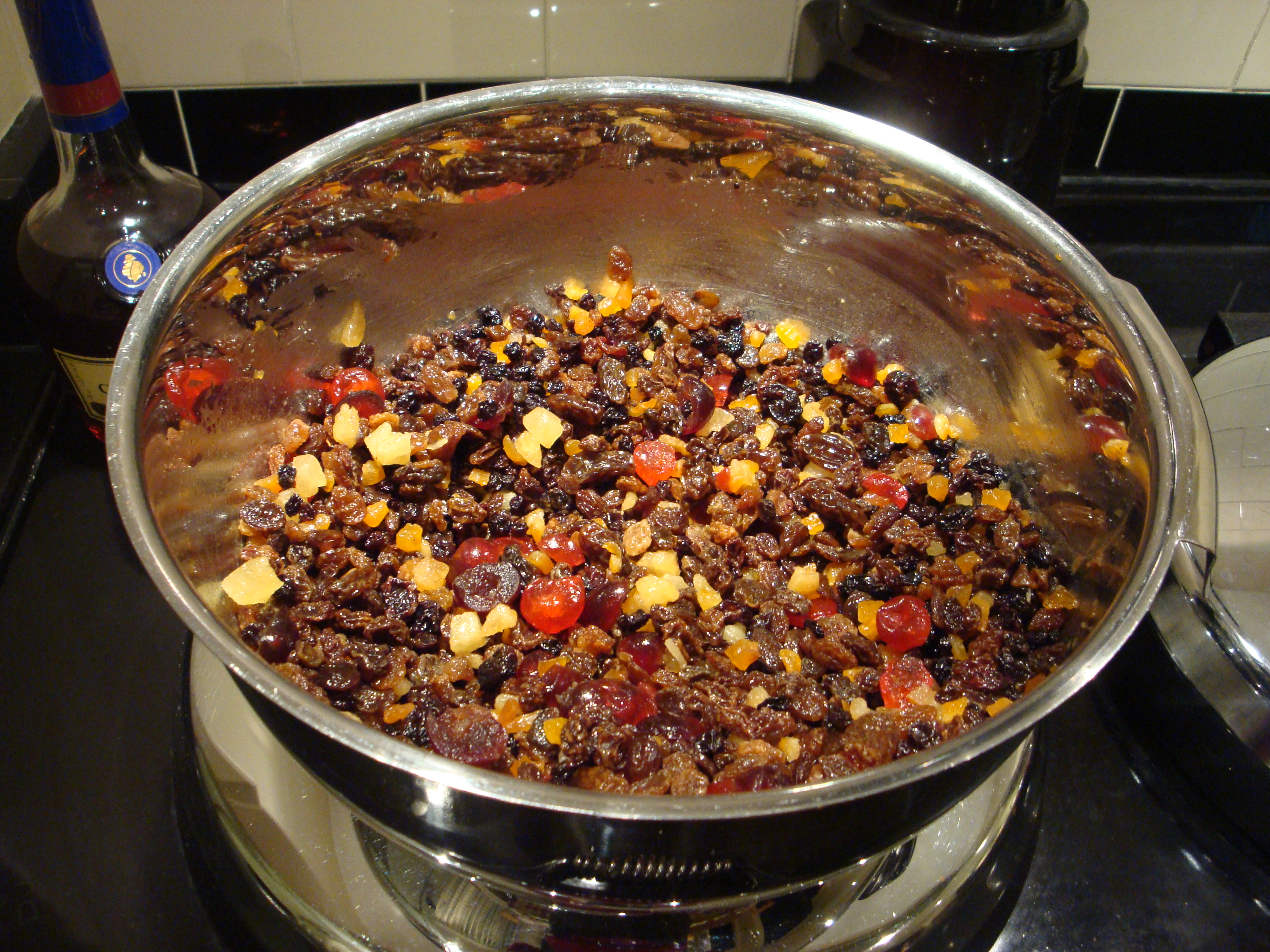
Making preparations for Christmas is a satisfying thing to do on a cold and wet November weekend. The weighing, mixing and chopping are soothing and even fun if you share them round the family and there is a great sense of linking to family tradition as the evocative Christmassy smells waft around the house. Here’s my Christmas cake dried fruit soaking in brandy complete with gaudy glacé cherries.
OK, enough of the domestic goddess stuff and onto the recipes themselves:
As various members of family and friends will testify, this is the reliable recipe I use for wedding and Christmas cakes. It comes from Delia Smith, the old-fashioned cookery course book, before she became a media person and the books and recipes became jazzed up with exotic ingredients and soft-focus photography. It’s dark and moist without being soggy and slices well into neat pieces – essential when you have 100 or so wedding guests to feed!
We like Christmas cake so much that I generally make two. One gets the full Christmas treatment and is white-iced and decorated with help from the children in whatever direction our imagination takes us. We excelled ourselves last year with a family of white plastic polar bears gathered round an improbably turquoise fishing hole (fashioned from hard-boiled sugar syrup) in a snowy white arctic scene twinkling with silver balls. The other gets a more workaday coat of icing on the top only. It lasts right through till spring and is a great snack for ski-touring trips and days out walking.
Here are the cakes before baking:
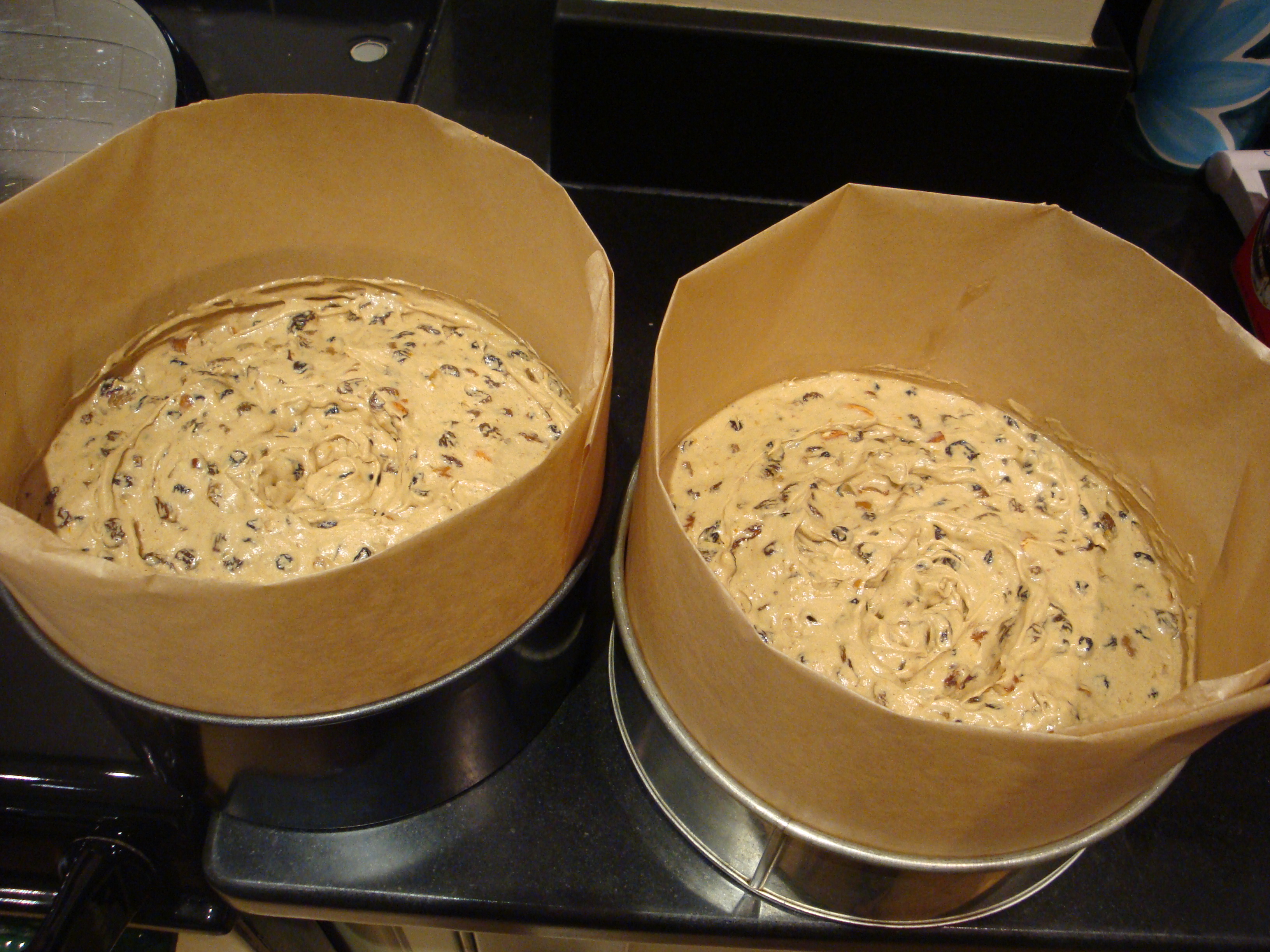
And here they are again some 6 hours later (that’s how long they take in the lower Aga oven). The stab mark in the centre is just that. I tested the centre with a sharp knife blade to make sure there was no uncooked mixture left. You can see the slight shrinkage away from the sides of the tin especially on the left hand one.
The smell as they come out of the oven is divine, especially when the small post-cooking glass of brandy is poured over.

My Christmas pudding recipe also comes from Delia Smith’s “Complete Cookery Course” 1982 Omnibus edition. It’s clear, reliable and produces a dark, moist traditional Christmas pudding. If you leave it for a full 12 months or so it becomes a wonderful black colour.
Making mincemeat was not one of the Christmas traditions I grew up with though my mother did make wonderful mince pies. They would have been even better had she done so. I find home-made mincemeat to be head and shoulders above the bought kind, better behaved as it’s drier and not to syrupy and you can tweak the spicing so it’s just the way you like it. I have a weakness for cardamom which I like to indulge.
I discovered this à la carte mincemeat recipe in Frances Bissell’s inspiring book “Entertaining”. What you do is make a base mixture without adding any ingredients which suffer if stored. So no chopped fresh apple which can make mincemeat ferment if stored for any length of time, and no nuts which become soggy and lose their crunch.. This means you can safely store your mincemeat for ages – certainly 15 months. When you come to use it, you add your chosen fruit and nuts and if required a further slug of alcohol to a small jar of the base mix and away you go.
Here is the completed mincemeat which needs to macerate for three days or so before potting. I fetched up the pudding from the cellar too so all three Christmas items appear in a picture.
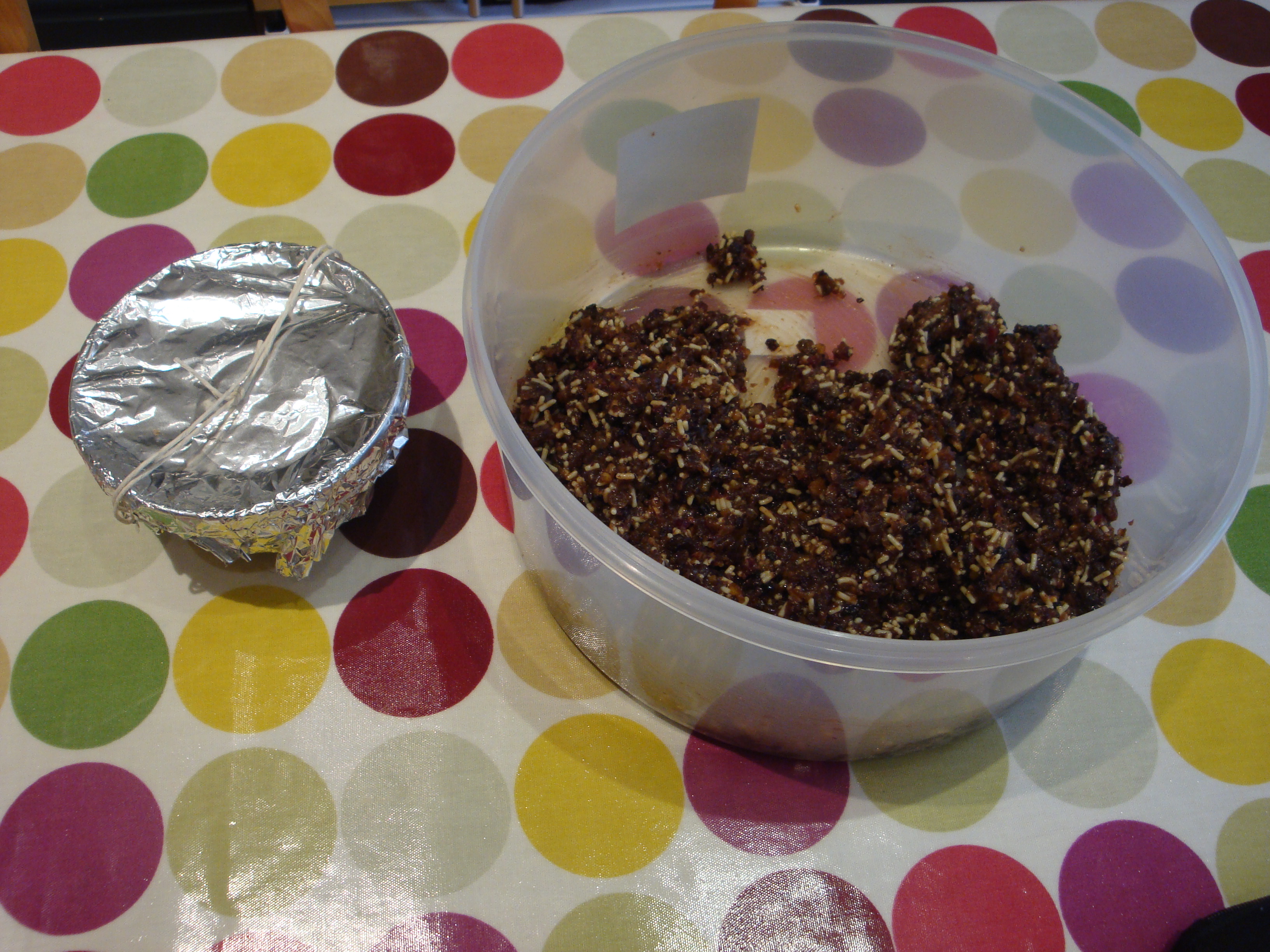
I can now sit back and enjoy the pleasant feeling of satisfaction that only a well-stocked neatly labelled storecupboard shelf can bring. I imagine squirrels feel this way when they bury their caches of nuts…
One final thought is that my wondrously sharp Microplane grater makes light work of grating all the lemon and orange peel that these recipes involve. I have a lot to thank the woodworking Grace brothers from Russellville Arkansas for.
Recipe for Christmas cake
1 lb (450g) currants
6 oz (175g) sultanas
6 oz (175g) raisins
2 oz (50g) glacé cherries rinsed and halved
2 oz (50g) mixed peel finely chopped
(Or instead of all the above, 2 lb (900g) luxury mixed fruit)
3tbsp brandy
8 oz (225g) plain flour¼ tsp nutmeg
½ tsp mixed spice (or ¼ tsp ground cloves and ¼ tsp allspice)
½ tsp ground cinnamon
2 oz (50g) chopped almonds – skin can be left on
8 oz (225g) soft brown sugar
1 dsp black treacle
8 oz (225g) butter
4 eggs
Grated rind of 1 lemon
Grated rind 1 orange
The night before you make the cake, place all the dried fruit in a bowl and mix in the brandy. Cover the bowl and leave to macerate for at least 12 hours.
Line an 8 inch (20 cm) round cake tin lined with a double thickness of baking paper in the usual way.
Leave the treacle in a warm place to make measuring a dessertspoon easier.
Sieve the flour, salt and spices into a mixing bowl. In a separate large mixing bowl big enough to hold the completed cake batter cream the butter, sugar and grated lemon and orange rinds together until the mixture is really light and fluffy. Next beat the eggs and – a tablespoon at a time – add them to the creamed mixture, beating thoroughly after each addition. Add a little flour after each addition of egg if it looks as though the mixture might curdle.
When all the egg has been added, fold in the flour and spices with your largest metal spoon. Now stir in the macerated dried fruit, chopped nuts and treacle.
Spoon the mixture into the prepared cake tin and spread it out evenly with the back of a spoon.
If baking in a conventional electric, fan or gas oven, tie a double band of brown paper around the cake tin and cover the top of the cake with a double square of greaseproof or baking paper in the centre of which you should cut a large-coin sized hole to allow steam to escape.
If you’re not ready to bake the cake straightaway, you can delay baking it for several hours or overnight if that’s more practical. Just leave it, covered, in a cool place until you are ready to bake.
Bake the cake in an oven preheated to 140 degrees Centigrade, 275 degrees Fahrenheit, gas mark 1 for 4-5 hours. If in doubt about your oven temperature, err on the side of caution and turn it down. Long slow cooking is best for a fruit cake. I think baking at too high a temperature is the mistake most commonly made when making Christmas cake (I have done it myself a few times). This results in the currants getting burnt making swollen little blackened lumps on the surface and the cake itself becomes dry and crumbly and very difficult to slice.
Wait until 4 hours have passed before checking the cake. When it is ready, the cake will have shrunk back just a little from the side of tin, it will be firm when pressed lightly in the centre with a finger tip and, final test, a skewer inserted into the centre will show no traces of uncooked cake batter.
I bake mine in the lower oven of our 2 oven Aga. The temperature is only 110-120 degrees C so the cooking time is rather longer. If I bake two cakes at the same time which I often do, it may take 8 hours in the bottom oven until both cakes are ready – long and slow really is best.
I like to pour a generous glass of brandy over the hot cake as soon as it comes out of the oven.
Leave until the cake is completely cold before folding over the wrappings, wrapping in foil and storing in an airtight tin or plastic box until you are ready to marzipan and ice the cake. You can feed the cake with a little brandy if you like – prick some holes in the top with a fine skewer or large darning needle and pour over a couple of tablespoons of brandy. Do not overdo this as it is possible to turn the centre of your cake into an alcohol sodden mush. If you’ve soaked the dried fruit properly and baked it at the right low temperature, the cake should be pretty moist already.
Recipe for Christmas pudding
Makes 2 puddings in 2 pint (1 litre) basins or 4 in 1 pint (570 ml) basin
8 oz (225g) shredded suet
1 heaped tsp mixed spice
½ tsp grated nutmeg
½ tsp ground cinnamon
4 oz (110g) self-raising flour
1 lb (450g) soft brown sugar
8 oz (225g) fresh white breadcrumbs
8 oz (225g) sultanas
8 oz (225g) raisins
1 ¼ lb (500g) currants
2 oz (50g) almonds, roughly chopped (skin can be left on if you like)
2 oz (50g) finely chopped mixed peel
The grated rind of 1 orange and 1 lemon
1 apple, peeled, cored and finely chopped (either cooking or eating apple)
4 medium eggs
10 fl oz dark beer (Guinness or your favourite Christmas ale)
4 tbsp brandy
Put the suet, flour, breadcrumbs, spices and sugar in a large bowl big enough to hold all the pudding mixture, mixing in each ingredient thoroughly before adding the next. Then gradually mix in all the fruit, peel and nuts and follow these with the apple and grated orange and lemon rind.
In a different bowl beat the eggs and mix the brandy and beer into them. Empty all this over the dry ingredients and stir vigorously until well combined. Make your wishes now. You may need to add a little more beer to give a soft dropping consistency. Cover the bowl and leave overnight to allow all the flavours to combine and to ensure there are no pockets of unmixed flour or breadcrumbs remaining.
The next day, pack the mixture into greased pudding basins filling them right to the top. Insert your preferred number of clean foil-wrapped £1 coins or (whatever coin or charm you like to use). Cover each basin with a square of greaseproof paper and tie a piece of foil over the top, securing tightly with string around the rim of the basin. Rig up a string handle over the basin, anchoring this to the string around the rim. This will make your life easier when you come to retrieve the puddings from the pan(s) of simmering water in which you will steam them.
Steam the puddings for 8 hours making sure the water in the pan does not all boil away. You can do this on the hob or inside a 140 degree Centigrade oven. I use the lower oven of a 2 oven Aga to do this which minimises steam in the kitchen and practically eliminates the risk of the water boiling dry. When cooked and cooled, replace foil and greaseproof paper with fresh. Store in a cool dry place for up to 15 months. They may keep longer but I’ve never gone longer than this. So you can make puddings now both for this Christmas and the year after. When ready to eat, steam for a further 2 hours. Before serving, warm (to a little more than blood temperature) three or four tablespoons of brandy in a small saucepan, carefully ignite shielding your hands, face and hair from the flames and pour the flaming brandy over the pudding in its serving bowl before taking it to the table where you will have dimmed the lights for the most theatrical effect.
Recipe for à la carte mincemeat
Makes about 4 lb (2 kg)
8 oz (250g) dried apricots or stoned prunes or combination of the two
8 oz (250g) raisins
8 oz (250g) dates
8 oz (250g) sultanas
8 oz (250g) currants
8 oz (250g) shredded beef suet or vegetarian suet or grated coconut cream or 8 tbsp flavourless vegetable oil
4 oz (125g) demerara sugar
4 oz (125g) chopped mixed peel
Grated zest and juice of 1 lemon and 1 orange
1 tsp ground mixed spice (or your own combination of cinnamon, cloves, ginger, nutmeg and mace)
½ tsp ground cardamom
¼ pint (150ml) rum or brandy
¼ pint (150 ml) oloroso or cream sherry or port
Chop or mince the dried fruit (I do this carefully in the food processor), then, in a large bowl, mix with all the other ingredients and leave, covered, for 2-3 days before potting and labeling.
When you wish to use the mincemeat, spoon out about 8 oz (250g) into a bowl. That, together with one of the following, will fill 12-18 mince pies: 1 Bramley or russet apple,peeled,cored and grated and mixed with 3 oz (75g) flaked almonds; 1-2 Cnference pears,peeled,cored and grated, and mixed with a little fresh, grated ginger or stem ginger and handful of pinenuts; 3 oz (75g) dried cranberries, cherries or blueberries; ½ medium pineapple, peeled, cored and chopped and mixed with a handful of pine nuts or flaked coconut; 3-4 oz (100g) dried mango, chopped and mixed with a handful of chopped cashew nuts; 3-4 oz (100g) fresh cranberries cooked in a little orange juice until they pop, and mixed with chopped mandarin segments and grated mandarin zest or chopped kumquats. To date, I have stuck with the apple and almond and pear, ginger and pine-nut combinations – both worked very well. Feel free to try your own.
Mountain breakfast from Andorra
November 15, 2009 § Leave a comment
Hmm this one proved a challenge. Tiny Andorra, only 180 square miles in land area is just a little smaller than the Isle of Man (in turn 1/3 of the size of Hertfordshire) and has a population of 70,000, about the same of my home town of Altrincham. It is located in the Pyrenées, squeezed in between France and Spain and is mainly rugged and mountainous in character – no part of the country lies below 3,000 ft or 900m – like living permanently on the summit of Helvellyn.
Andorra, known for cheap skiing holidays, duty free booze and a dodgy football team that even England can beat, is essentially Catalan in culture. Its food, from what I can glean, is rustic and hearty reflecting the life its mountain people lead (or used to lead before the influx of Irish skiers looking for a bargain).
I found no specific breakfast recipes, but rustled up two typical Andorran dishes are Trinxat – a Catalan version of bubble and squeak, and Truites de Carreroles, a type of mushroom omelette. These were just the thing for a hearty breakfast on a chilly November morning. What type of mushroom omelette we shall never know as the sources are silent on this – I decided to do my own thing on the mushroom omelette front.
The recipe for Trinxat follows, from a handy little website www.europeancuisines.com. I’ve tweaked the recipe a little to simplify the bacon fat rendering and cabbage cookery suggestions – boiling the cabbage whole for 45 minutes before chopping it sounded neither sensible nor pleasant.

Recipe for Trinxat Andorran cabbage and potato cake with bacon
Enough for one generous potato and cabbage cake in an 8-10 inch diameter frying pan. I used my trusty non-stick Meyer Anolon pan (8 inch diameter at the base flaring to 10 inches diameter) which is good for pancakes and omelettes of all kinds
Half a 2lb Savoy cabbage, quartered, core removed and shredded
1 lb floury potatoes, peeled
2 oz lardons (diced fat bacon pieces – I used inauthentic pancetta)
2 tbsp olive oil
1 clove garlic, peeled and crushed
pepper
Crisply fried or grilled rashers of bacon to serve
Boil the potatoes and mash using a food-mill for a lump-free mash. Season but add no butter or anything else to it at this stage.
Steam the shredded cabbage for 5 minutes until just cooked.
Mix together the cabbage and potatoes. Taste and season again.
Fry the lardons gently in the olive oil for 5 minutes or so until the fat is rendered and the lardons begin to turn golden-brown at the edges. Throw in the garlic and cook for a couple of minutes more. Add the cabbage and potato mixture, stir to distribute lardons and garlic then flatten into a 1/2 inch thick cake. Cook over a moderate heat on the hob until a crust has formed (5-10 minutes). Invert a large plate over the frying pan and carefully flip the cake over and slide it back into the pan. I wear oven gloves to do this. Cook for a further 5-10 minutes until the second side is crusty and browned.
Serve with crisply fried or grilled bacon rashers. A poached egg or two would be a good addition if not entirely authentically Andorran.
Too much salt in branded pasta sauces
November 14, 2009 § 2 Comments
I have yet to find and read a definitive academic study on salt in the diet and its effects on health but as I understand it salt/sodium in the diet has a proven effect on hypertension/high blood pressure which in turn significantly increases the risk of stroke and heart disease. I also have a suspicion that, without knowing what our recommended intake of salt is, most of us eat far more than our daily recommended allowance of salt.
I refuse to stop seasoning the food I cook at home with salt. What really annoys me is the hidden salt content in processed foods, salt we don’t even know we’re eating. One answer is to reduce the processed foods we eat. That’s all very well for soups, ready meals and sauces but much more difficult in the case of bread. Bread is a staple food and whilst it’s undeniably satisfying to bake your own bread most of us buy the majority of our bread probably from a supermarket. Having on occasion peered at the labels on bread, it seems that all the branded bread on sale is high in salt with remarkably little variation in salt content between the different brands. A little salt in bread is needed to make it taste good but it’s nothing short of scandalous that we are forced to eat salt in such quantity in a staple food.
Salt levels in processed food, especially in bread has been an issue I’ve been concerned about for some time now so the news story which broke yesterday about salt levels in branded pasta sauces caught my interest immediately.
http://www.guardian.co.uk/lifeandstyle/wordofmouth/2009/nov/12/jamie-oliver-salt-pasta-sauce
Predictably enough it was Jamie Oliver, and to a lesser extent Loyd Grossman branded products which hit the headlines as containing most salt. In Jamie’s case, the hypocrisy was pointed out as he has famously spearheaded a number of healthy eating initiatives, notably campaigning for better quality school meals.
The story behind the headlines is that on organisation called CASH (Consensus Action on Salt and Health) published the results of its survey into the salt content of 190 (yes 190) different branded pasta sauces. A quick glance at the CASH website shows that it seems to be a pukka (to borrow Jamie’s term) organisation backed by leading scientists. The sauces were then ranked by salt content per 100g and salt per serving size was then computed and compared to our recommended daily intake of 6 g salt per day.
You can find the CASH website at http://www.actiononsalt.org.uk/
Top of the list was actually Sainsbury’s Taste the Difference Pesto alla Genovese with 3.2g salt per 100g. This retails in a 190g jar but it was Jamie who hit the headlines as being the worst salt culprit with his Spicy Olive Garlic & Tomato Sauce containing 3g salt per 100g. The sauce is sold in a 350g jar and if you assume a portion size to be half a jar as the CASH researchers did, then each serving contains a whopping 5.25g salt using up nearly all your recommended daily salt allowance in one go.
This didn’t sound too good for Jamie. I support much of what he has done in raising issues about school food and conditions in which battery chickens are reared. I am also aware that certain areas of the media love to take a pop at him. I decided to call in at my local supermarket to pick up a bottle of the now infamous Spicy Olive Tomato & Garlic sauce to see if it might have any redeeming features. It might be for example a super-concentrated sauce where just a couple of spoonfuls might be required – for example nobody in their right mind would think of lobbing whole jar of pesto into the pan for pasta for 2 people.
Three attempts to find the sauce failed – the shelves of my local Co-op, Waitrose and even Jamie’s own Sainsbury’s were bare not only of this sauce but of all his branded products. I concluded that they couldn’t be much of a health risk if you couldn’t actually buy the stuff.
I was now in Sainsbury’s with an empty basket. Faced with shelf after shelf of lookalike bottled sauces I decided that I’d buy and taste test three of them. I picked up a 350g jar of Loyd Grossman Tomato and Chilli Sauce containing 1.5g salt per 100g, a 200g jar of Seeds of Change organic Roasted Red Pepper sauce also with 1.5g salt per 100g, and finally a 350g jar of Gordon Ramsay Seriously Good Olive and Tomato sauce with 1.0g salt per 100g.
Scanning the row after row of identikit sauces I was amazed, maybe even horrified at how many of these rather sad products were on offer. It was notable too that many were promoted by minor celebrities a little past their use-by date. As well as Loyd Grossman and Gordon Ramsay products there were of course Paul Newman’s sauces and even a range by Lawrence Dallaglio… yes the former England rugby captain. Are these products aimed at sad single guys cooking for themselves I mused?
Three of us (me plus sons George and Arthur) taste-tested the three selected sauces in the Raffle kitchen on Saturday lunchtime. We were unanimous in deciding that the Loyd Grossman sauce was the worst of the bunch. Watery, greasy, big lumps of carelessly chopped tomato and unpleasantly salty. The advertised chilli was unpleasantly harsh.
The boys quite liked the Seeds of Change red pepper sauce because of its sweetness which in turn masks its saltiness. They compared it to sweet and sour sauce. I found the smell on opening the jar rather repulsive – like a particularly nasty babyfood- and the texture rather slimy because of the inclusion of some kind of gum or starch within the ingredients. Also the red pepper was unskinned which is just lazy on the part of the manufacturers.
Best of the bunch was Gordon’s sauce. It had a pleasant thick texture and depth of flavour from the herbs used. There were visible chunks of olive and caper in the sauce. It was still quite salty and I think a little would go a long way. This sauce may have been best of the bunch but frankly that’s not saying much when the field is this weak.
My conclusion was that I wouldn’t choose to buy any of these products again and I rather wastefully chucked out the sauce we hadn’t eaten. Not only did they not taste great but all three were unnecessarily salty and the excess salt didn’t compensate for the underlying lack of flavour. If I wanted a tomato pasta sauce in a hurry, I would use a few spoonfuls of passata warmed through with a tablespoon of good olive oil.
For all you single guys cooking for yourself out there – don’t buy this stuff. Instead, whip up a quick Spaghetti ‘ajo e ojo’ (with garlic and oil). Just dress your spaghetti with olive oil in which a couple of chopped cloves of garlic have been sautéd until golden brown, season with a couple of twists of black pepper and as much or as little salt as is right for your personal taste and you’re done. This pasta dish is by all accounts the late-night snack of choice of Rome’s chic insomniacs. Much more stylish than a sad jar of Gordon Ramsay or, god forbid, Lawrence Dallaglio…
Dinner at Michael Caines Restaurant at ABode Manchester
November 5, 2009 § 2 Comments
Tim and I finally made it to Michael Caines Restaurant at ABode on a wet and windy Wednesday night in early November.
First, a little background on the Abode concept (sorry I can’t keep up the tricksy capitalisation any longer). Abode is a small chain of boutique city centre hotels each with a Michael Caines restaurant attached. Looking at the website, they aim to attract a hip and trendy crowd, but looking round at the lobby the real clientele is somewhat older, more portly but no doubt more monied. The man with the money behind the concept is one Andrew Brownsword, an entrepreneur with a taste for discreet self-publicity, hence the AB in ABode and the sponsoring of Brownsword Hall in Poundbury, Prince Charles’ model village. Yes, Brownsword is numbered amongst Prince Charles’ best mates.
Brownsword has featured regularly in the Sunday Times Rich List for a decade or so. He made his money in greetings cards and Forever Friends teddy bears, businesses which he sold to Hallmark Cards in the early 90s reputedly for some £190 million. He used the money to establish a hotel business and is also majority owner of Bath Rugby Club.
Brownsword and Caines met after a lunch at Exeter’s Royal Clarence Hotel in 2003 where Caines was executive chef. Brownsword enjoyed his meal so much that, in a Victor Kiam moment, he bought not just the restaurant but the hotel as well and the Abode concept was born. There are now Abode hotels in Glasgow, Canterbury, Chelsea and Chester as well as Manchester and Exeter.
Enough of background and onto the dinner experience. We descended from the hotel lobby into the basement where you will find the champagne bar and restaurant. Manchester is famous for being the centre of cotton industry in the nineteenth century and the building where Abode is now situated is very evidently a former cotton warehouse. It has been sympathetically converted, keeping the roomy expanse of space you associate with a warehouse and making a feature of the sturdy cast iron columns which support the roof. Clever use of translucent glass panels breaks up the room and gives its various spaces an intimate feel within the large basement area.
The comedy French maître d’ (is he for real?) whisked away my bags of early Christmas shopping and seated us in the champagne bar, a space adjoining the the main dining area with plenty of scope for people watching. The basement is softly lit, lots of dark wood, brown and orange and a Paul Smith striped carpet. There are black and white photos of rock stars on the walls and napery is limited to generously sized white napkins. The problem any basement encounters is that there is no natural light. On a cold and wet evening in late autumn this didn’t matter at all but I probably wouldn’t come here for lunch for that reason despite the remarkably good value £12 “grazing” menu lunch offer.

The cocktail list is impressive, naming the Head Mixologist as one Adrian Vipond. I liked the sound of the wittily named Lady Macbeth (blended Scotch plus various red fruit liqueurs shaken over ice) but Tim and I both plumped for a flute of the house champagne. This was acceptable but I wasn’t blown away by it. Being bone dry, it would have been good in one of the various Champagne cocktails on offer. I’d love to come back and try a cocktail sometime – the only downer was the rather damp smell lingering in this corner which resulted from a leaking skylight. Our fellow drinkers didn’t seem to notice that the sofa they were perched on was damp from dripping rainwater. I think they’d had a few…
After a little difficulty identifying the right member of staff – there were lots of staff in the dining room but working apparently to strict lines of demarcation- we succeeded in getting hold of menus. The first decision you have to make is whether to go with the grazing menu, multi-course tasting menu or standard à la carte selection. Prices didn’t look too unreasonable – for instance the tasting menu is a headline £65 per head (sorry I failed to make a note of whether this included VAT and service). Our hostess patiently explained how the grazing menu worked: these are small portions of stand-alone dishes which function either as starter or main. You order as many or as few as you like in whatever order takes your fancy. In effect it’s a design-your-own tasting menu.
Unsure of portion sizes and how the grazing concept would work in practice we decided to dip a toe in the water and choose 2 grazing dishes each as a starter followed by an à la carte main. My choices were (i) crab cannelloni with pink grapefruit jelly and lemon thyme foam, and (ii) tuna tartare with pickled beetroot and turnip, wasabi mayonnaise and sweet raisin vinaigrette. Both dishes were pretty as a picture as you can see below and modishly served on a square glass plate and slate tile respectively.

Head chef Ian Matfin clearly knows what he is doing. The flavour combinations were logical, classic even but presented in a new way and both dishes showcased high levels of skill in the kitchen. After tasting these two dishes, I wish I’d gone for the full grazing option rather than a single main.
My main course was roast mallard with jus (known in my kitchen as gravy) celeriac mash and winter berries (these were cranberries and blueberries I think). The mallard was cooked to an accurate medium rare as requested and was pink and juicy. It came unexpectedly with a tiny jug of bread sauce which, given the presence of celeriac mash, was not entirely necessary, nor is it a classic roast duck accompaniment. My only gripe (a perennial one) was that we had to order a selection of vegetables and potatoes to accompany the our main courses. These were dinkily served in a lidded white china sugar bowl but were nevertheless the same old boring boiled broccoli, cauliflower and carrot.
We chose a bottle of Gigondas to accompany our meal which appeared ostentatiously in the separate Fine Wine section of the menu. Why the wine list couldn’t simply be presented by region with wines listed in price order rather than by grape type I don’t know. This leads to weird anomalies such as Châteauneuf du Pape being grouped with Beaujolais under “Red wines – other”. Given the excellence and variety of the grazing dishes it would have been good to see more wines offered by the glass too – crab cannelloni and Gigondas is definitely not a match made in heaven.
We were offered the pudding menu with lots of interesting sounding choices. I chose the pumpkin crème brûlée with chocolate ice cream. It sounded weird and it was. Frankly it was a bit yucky. Like pumpkin pie filling but without the benefit of pumpkin spice. An obsession with inventiveness had clearly clouded the chef’s judgement here. Never mind, the espresso which came next was just right.
I’d love to come again and would try the full-blown grazing option skipping the pudding next time.
Julie and Julia review
October 20, 2009 § Leave a comment
I finally made it to our local cinema to see “Julie & Julia” along with my son George, aged 13. This was the first day of his half-term holidays and I am pleased that he chose to indulge me and see a film about cookery rather the latest Transformers movie or whatever.
This turned out to be a private screening just for us as we were the only people in the cinema at this Monday afternoon matinée. Well, it has been out for a while and I imagine most good cooks would be busy preparing the evening meal..
We both had a really enjoyable afternoon – George, who is interested in cooking and even more so in eating, pronounced it “good” – high praise from him! In my case, this was preaching to the converted – after all I am trying to become a blogger myself, and the book which is central to the film plotline “Mastering the Art of French Cooking” has long been a favourite on my kitchen shelf.
Until recently, the three authors of this book, listed in alphabetical order as Simone Beck, Louisette Bertholle and Julia Child, had no more significance to me than as practically anonymous writers of a technical manual, albeit a useful and readable one. I began to have an inkling that Julia Child must have a reputation as a celebrity cook in her native United States when chatting to my good friend Matthew who now lives in San Francisco. He dropped her name into conversation as being a well-known cook and given that his signature dish is baked beans with cheese, I concluded that she really must be a household name over there.
I imagine that many British people watching this film must have been rather bemused by the larger than life figure who is Julia Child. By all accounts, Meryl Streep’s portrayal of her is uncannily accurate but this aspect of the film is lost on us Brits. It doesn’t matter as the film stills works on many levels.
Following the life-story of Julia and her husband Paul through Paris in the 1950s and discovering the genesis of the book was like a marvellous fairy story. I was left with a deep admiration for her as a person, for her generosity of spirit and determination. The cookery book has now taken on an extra dimension for me and I can now sense the character of the women who wrote it beneath the specifics of the recipes.
I very much liked the way the stories of Julia Child and blogger Julie Powell were intertwined. I’ve always liked novels constructed in this way – The French Lieutenant’s Woman for instance (and by coincidence Meryl Streep took the leading role in the film adaptation of the novel). For me, the story of the very much lesser character Julie merely served to show Julia Child’s achievements over a lifetime in sharp relief.
I disliked the Julie Powell character right from the start. Whether this is a fair reflection on Julie or whether it results from actress Amy Adams’ portrayal of her I can’t say. I began to have misgivings about her when early on in the film it is revealed that at the age of 30 she had never eaten let alone cooked an egg before. Hmmm maybe this woman is a fraud or a faddy eater or maybe even both…and when the potentially agonising moment comes as Julie learns Julia’s reaction to her blog and tearfully tells her husband “She hates me!” I found myself cheering inwardly. I’m not entirely sure this is the reaction director Nora Ephron intended.
A word on the two supporting actors, the husbands of each of the two women. Stanley Tucci’s portrayal of patient, charming and debonair Paul Child was delightful whereas Eric Powell played by Chris Messina came across as a graceless slob.
I did feel the warm flush of familiarity as I watched Julie cook the recipes for boeuf bourgignon, boned duck and of course lobster Thermidor. Watching her struggle with a live lobster much as I had done myself a month before (see my August 2009 posts Lobster Saga I and II) I was left thinking -Blimey I wish I’d had Julie Powell’s idea before she did.
Finally, I was amused by the unconscious irony of screening a Flora advert before this film which has the goodness of butter as one of its central metaphors.
An enjoyable afternoon and a film I’d recommend for teenage boys in touch with their feminine side (hope that’s OK George!).
Here’s a link to the film website:
And here’s an extract fromJulie Powell’s blog. I have to say her prose, riddled with expletives, is not a patch on Julia’s lively and well considered writing:
Doncaster school bans birthday cake
October 19, 2009 § 2 Comments
Did I really hear this news story correctly? What I think I just heard on Radio 4’s Today Programme was that the head of a Doncaster primary school had sent back a birthday cake that pupil Olivia Morris had brought in to share with her classmates because it didn’t comply with healthy eating rules.
I later checked out the story which seems to have been broken by South Yorkshire’s own “The Star” and the headmistress is indeed quoted as saying that the birthday cake contradicted healthy eating rules and might cause allergic reactions. Oh dear. And to make matters worse it was a home-made cake baked by Olivia’s greatgrandmother. It defies belief and it’s rude to the point of churlishness into the bargain. And Yorkshire folk grumble about having a reputation for being miserable gits….
http://www.thestar.co.uk/rotherham/School-cake-ban-takes-the.5744755.jp
Algerian breakfast…not what you might think
October 18, 2009 § Leave a comment
“A line of cheap speed and a shot of Pernod, usually taken as a pick-me-up after a rough night” is how Urbandictionary.com defines an Algerian breakfast. Hmmm I’m not even quite sure what speed is let alone how to procure it cheaply in Altrincham. I had in mind something rather more civilised.
Algeria is a former French colony (think Zinadine Zidane, Albert Camus and the French Foreign Legion) becoming independent in 1962. The French left behind, amongst other things, the legacy of their bread so a crusty baguette was the first item to be chosen. I still baulk at tackling a loaf of French bread at home so this was purchased fresh from the boulangerie. With the baguette, unsalted butter and a jar of home-made jam – the one I chose was an amber coloured plum jam made by friend Nadia who is into preserving big-time at the moment. Nadia takes the trouble to crack open the plum stones and add the almondy kernels to the jam which is something you’ll never find in the shop-bought stuff.
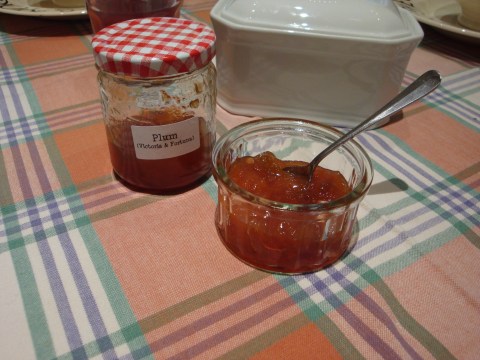
To drink, café au lait in bowls, plus glasses of deep purple pomegranate juice (I’m not sure whether the juice is authentic but I wanted to bring some eastern exoticism onto the breakfast table on this chilly October morning).

The pièce de resistance was a plateful of Makrout el Assel freshly deep fried, a kind of Algerian almond doughnut, the whole plateful doused in warm honey.

All of us spent the next couple of hours bouncing off the walls on a sugar, white bread and caffeine-induced high. Who needs cheap speed and Pernod with a breakfast like this!
I found the Makrout recipe on http://www.la-cuisine-marocaine.com French language website – yes I realise this means Moroccan but the given derivation was most definitely Algerian. Here’s the recipe translated as best I could.
Recipe for Makrout el Assel
Ingredients
Dough
500g medium semolina
125g melted smen (clarified butter)
pinch salt
orange-flower water
10cl warm water
Filling
250g ground almonds
150g caster sugar
orange-flower water
Oil for deep-frying
Place the semolina and salt in a bowl. Mix. Add the melted clarified butter and rub with the palms of your hands to mix well and incorporate the fat into the semolina. The mixture should be sandy in texture.
Add the warm water plus a little orange flower water gradually to the mixture and bring it together to form a dough without over-working. Once you have a supple dough, leave it to rest in the fridge.
Mix together the ground almonds and sugar and add a little orange flower water to form a paste. The mixture should not be too moist.
To form the Makrout, take a good-sized piece of dough, roll it out and hollow out a groove in the middle without going right through. Form with your hands a fat rope shaped piece of the almond filling and place it into the groove. Bring up the edges to seal in the filling and roll the whole thing, flattening it a little until it is 3-4cm thick. Cut the flattened roll into lozenges and place them on a plate until you are ready to fry them. Expect to repeat this exercise 3-4 times to use up the dough and filling.
Take a paintbrush, dip it into lightly beaten egg white and brush over the cut surfaces of the individual lozenges to seal in the almond filling before frying.
Fry in hot oil, preferably in a deep-fat frier with a basket, until golden brown. Drain on absorbent paper and serve with warm honey.
Note on semolina. I have semolina in my cupboard (for baking middle-eastern type cakes not for making the milk pudding of school-dinner induced nightmares) but have never been entirely sure what it is. Trusty Harold McGee in “On Food & Cooking” explains that semolina is “milled durum endosperm with a characteristically coarse particle size (0.15-0.5mm across) thanks to the hard nature of durum endosperm (finer grinding causes excessive damage to starch granules). So now you know.
Albanian Adventure
October 12, 2009 § 3 Comments
I’ve always wanted to visit Albania. Aged 14, I wrote to the Foreign Office requesting information on how to travel to Albania and received back a helpful advice pack detailing how to travel to all the then Communist Eastern bloc countries (with difficulty). They probably put me on a watch list back then and maybe that’s the reason why I never made it into the Civil Service despite passing those horrible exams whilst at University… I digress. I finally made a small excursion to Albania on Sunday morning in the form of the next breakfast of the world, (according to my son George’s flag poster) which, in alphabetical order, is that of Albania.
Detailed information sources on Albanian food and specific recipes are scarce. A good starting point was www.tourism-in-albania.com which helpfully explained “You have the option of starting your day with a continental breakfast that most Albanian hotels serve. However, if you are adventurous, you may try the traditional Albanian breakfast of pilaf, which is flavoured rice or paça – a soup made using animals’ innards.” Whilst trawling through internet search responses I found various Albanian travel blogs and was amused to read Gareth Morgan’s account of breakfast in the Albanian city of Shkodra – 2 espressos and 14 cigarettes.
Next stop was Lesley Chamberlain’s excellent book “The Food and Cooking of Eastern Europe” published by Penguin in 1989. The book is both comprehensive in scope covering cuisines from East Germany and Poland in the north to Albania in the south and the then USSR in the east. The recipes are clearly written and easy to follow and are interspersed with just the right amount of scholarly information and journalistic travel writing.
I quote the following extract both by way of background and to illustrate Ms Chamberlain’s poetic and informative style. “Today, with a population of 3 million, Albania declares itself self-sufficient in food. Realistically, this means some belt-tightening towards the end of winter and into mid-spring, for the cuisine is wholly dependent on the seasons rather than imports, but it remains primarily an agricultural country. I happened to visit Albania in September, which was, at the opposite end of the scale, the high season of locally harvested food. Peppers, tomatoes and aubergines abounded, with goat’s milk brine cheese, eggs, pasta, rice, dried beans and unadulterated bread. There was yoghurt, a wonderful green olive oil, some passable red meat and chicken, good fish – we ate grey mullet from the sea and carp from Lake Shkodra – and to highlight the Turkish legacy wonderful sweet Oriental pastries and lokum (Turkish delight) followed at the table and in the streets with fat bunches of green grapes and slices of refreshing watermelon.”
I decided to begin our breakfast with an Albanian soup recipe from Ms Chamberlain’s book. She writes in her soup chapter “Before the arrival of coffee in Central Europe, the first cup of soup was drunk at breakfast and the habit continued well into the nineteenth century…Magyar peasants first thought of coffee as ‘black soup’.”
Ms Chamberlain wrote back in 1989 that “it is difficult to find Albanian recipes, for there is no book on Albanian food in English.” Times have changed and I managed to track down “The Best of Albanian Cooking” by Klementina and R. John Hysa published in the US by Hippocrene in 1998. Mr and Mrs Hysa, whose scary black and white photos adorn the inside cover of the book (he a dead ringer for Frankenstein’s monster and she for Cruella de Ville) are an emigré couple now living in Canada. R.John Hysa writes in the introduction to book “All visitors we happened to host have really enjoyed the delicious Albanian dishes my wife served them. They couldn’t resist asking her to write down some of te
Albanian breakfast soup recipe
“A less elaborate garlic soup is made in Albania by frying half a dozen cloves of garlic in a tablespoon of olive oil, sprinkling on a teaspoon of paprika and a few cups of water. When the soup boils, add a few handfuls of vermicelli, season with salt to taste and garnish with parsley.”
In fact I substituted some home made beef stock for the water – after all, paça or paçe (see above) appears to mean a meat broth – and also substituted a handful of spaghetti snapped into bite-size lengths for the vermicelli. The end result was basic in flavour but good.
Here is the finished soup along with kabuni, a sweet rice pilaf:
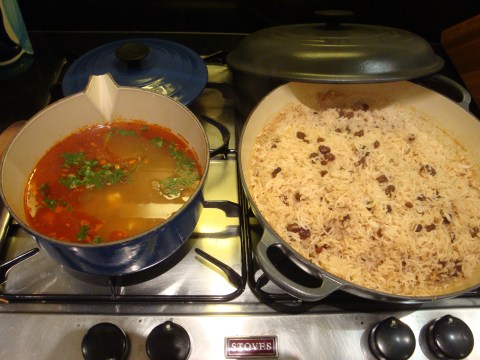
Ms Chamberlain writes “It is difficult to find Albanian recipes, for there is no book on Albanian food in English”. This has since been put right as I succeeded in tracking down a copy of “The Best of Albanian Cooking” by Klementina and R. John Hysa published in the US in 1998 by Hippocrene. The authors are an emigré couple now living in Canada and their rather scary black and white photographs adorn the inside back cover, he a dead-ringer for Frankenstein’s monster and she for Cruella de Ville. Mr Hysa writes in the introduction to the book “All visitors that we happened to host have really enjoyed the delicious Albanian dishes my wife served them. They couldn’t resist asking her to write down some of the recipes for them or urging her to open a restaurant that couldn’t but be a ‘smashing success’..”
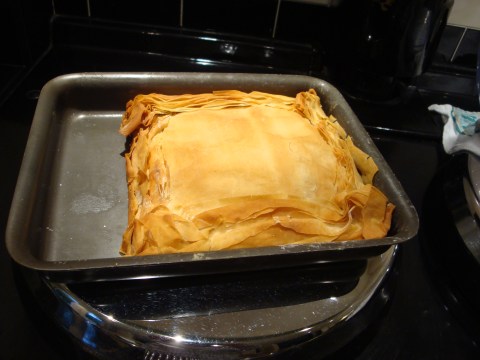
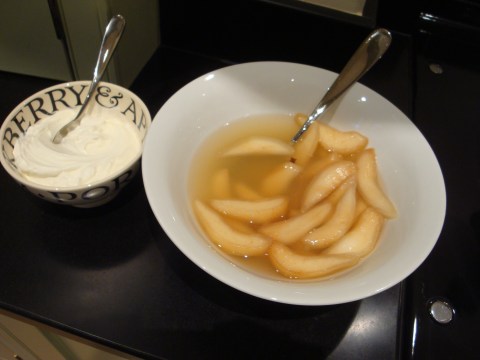
Flicking through the book I came across “Spitroasted Lamb Entrails”, “Stuffed Beef Spleen”, copious references to frying in margarine and a Trahana soup whose principal ingredients are water, breadcrumbs and toast. This is not a straightforward cuisine to sell to the uninitiated and I wanted to shout to R.John Hysa “Don’t do it! Don’t open that restaurant – your guests were just being polite!” Nevertheless, the book is clearly set out and gives a real flavour of authentic Albanian cooking, though the recipes are a little sketchy. After a little searching within, I found a sweet rice pilaf, kabuni (see above). The use of meat stock in a sweet rice dish is unusual and the clove and cinnamon flavouring typically Albanian. I decided to complete the breakfast with some fruit – a pear compote with an Italian influenced lemon zest flavouring,also a filo pastry pie (byrek or burek- a similar word to the Turkish pie börek) and some thick natural yoghurt for which Albania, like Bulgaria is well known. Of all the dishes, the filo pastry pie with a feta and parsley filling was the most accessible and is probably the one I would cook again. Here’s the pie, fresh out of the oven:
All in all, an unusual breakfast which provided a geographical and historical insight into this enigmatic Balkan country.

The 3 recipes from “The Best of Albanian Cooking” are reproduced below in all their sketchy glory.
Kabuni – Sweet Rice and Raisin Pilaf
Ingredients
1 cup rice
1/4 cup butter
1 cup sugar
1 and 1/2 cups mutton or lamb bouillon
1/4 cup raisins
Ground cinnamon and ground cloves
Sauteé rice slightly in butter mixed with a teaspoon sugar. Add boiling bouillon and raisins. Simmer 10 minutes, mix with sugar and bake in moderate oven (350 degrees F) for 20 minutes. Remove from oven, sprinkle with cinnamon and cloves. Serve hot. 4 servings.
Jennifer’s notes: I used basmati rice which I soaked in cold water for 20 minutes before draining in a sieve and frying according to the recipe. I increased the bouillon quantity to two cups which are the usual proportions for a pilau or pilaf. I used a mixture of home-made chicken and beef bouillon rather than lamb as that was I happened to have in the fridge. I added the spices to the buttery rice before adding the stock rather than at the end of cooking and I also reduced the sugar quantity by about 1/4. I covered my pan with a lid before baking in the oven.
Byrek me gjizë – cottage cheese pie
Ingredients
1 and 1/2 cups salted cottage cheese
3 eggs
4 tablespoons chopped parsley
Salt
6 tablespoons melted butter or margarine
1 and 1/2 packets pastry leaves (phyllo dough)
Mix well cottage cheese, eggs, parsley and a bit salt, and use this mixture as filling for the pie. Use melted butter/margarine to brush the baking pan and to sprinkle pastry leaves. Prepare and bake the pie as in the recipe spinach pie (Brush the baking pan with some of the melted butter/margarine, and start laying pastry leaves, allowing the edges to get out of the baking pan for about one inch: lay two leaves, sprinkle or brush with butter/margarine, then lay two other leaves, and so on, until half of the leaves are laid. Spread the filling mixture over the laid pastry leaves. Finish laying the other half of pastry leaves, turn the edges of the bottom leaves over the pie, sprinkle with melted butter/margarine and bake in a moderate oven at 350 degrees F for about 45 minutes or until a golden brown crust is obtained.) 4 servings.
Jennifer’s notes: I used a single pack of Cypressa filo pastry and a single pack of crumbled feta cheese combined with half the quantity of other ingredients for the filling. I baked the pie in a deepish rectangular metal tin which it didn’t fill: the halved pastry sheets formed a rustic square shape which looked quite attractive. This pie was also good cold and survived well for a picnic.
Komposto dardhe – pears compote
Ingredients
2 pounds pears
3 tablespoons lemon juice
1 cup sugar
1 tablespoon grated lemon rind
1/4 cup liqueur wine
Cloves (whole)
Put peeled sliced pears with the cores removed into 2 cups cold water and lemon juice for 20 minutes. Simmer pear peels for 10 minutes in 4 cups water in another utensil, filter the liquid, add sugar and return the syrup to the sliced pears. Chill and stir in wine. Season with cloves.
Jennifer’s notes: I added sugar to the water and boiled this to make a syrup rather than adding sugar afterwards. Best to cool the syrup a little before pouring over pears as it made their edges turn soggy. Does it mean a teaspoon rather than a tablespoon of lemon rind? The lemon flavouring really lifts the pears and Marcella Hazan uses it in her Italian fruit salad or macedoine recipe – that Balkan influence again!
 The Rhubarb Fool